Gastrointestinal Devices Market Analysis & Forecast: 2026-2033

Gastrointestinal Devices Market Size and Forecast – 2026 – 2033
The Global Gastrointestinal Devices Market size is estimated to be valued at USD 15.2 billion in 2026 and is expected to reach USD 26.7 billion by 2033, exhibiting a compound annual growth rate (CAGR) of 8.1% from 2026 to 2033.
Global Gastrointestinal Devices Market Overview
The gastrointestinal (GI) devices market includes a wide range of medical products used for the diagnosis, treatment, and management of digestive tract disorders. Key product categories include endoscopy devices (such as flexible endoscopes, capsule endoscopes, and imaging systems), therapeutic devices (stents, dilators, biopsy forceps, and hemostasis tools), and GI motility and monitoring devices. These products are widely used in hospitals, ambulatory surgical centers, and specialty clinics to manage conditions like colorectal cancer, inflammatory bowel disease, gastrointestinal bleeding, and acid reflux. Technological advancements, minimally invasive procedures, and rising digestive disease prevalence continue to drive product innovation and adoption.
Key Takeaways
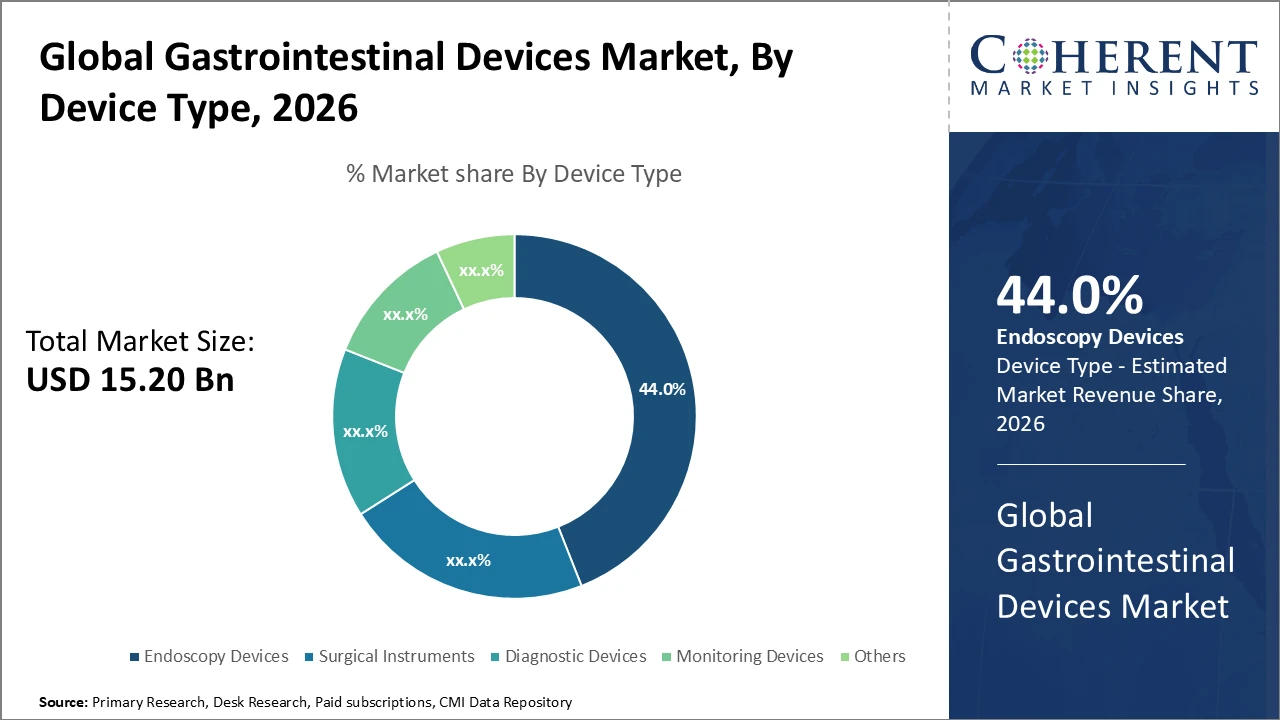
The endoscopy device segment leads the market revenue, capturing 44% of the gastrointestinal devices market share, driven by continuous innovation in high-definition imaging.
Digestive tract diagnostics dominate technology segments.
Hospitals remain the primary end users, accounting for over 60% of total market revenue, while ambulatory surgical centers are experiencing faster growth due to the shift toward outpatient procedures.
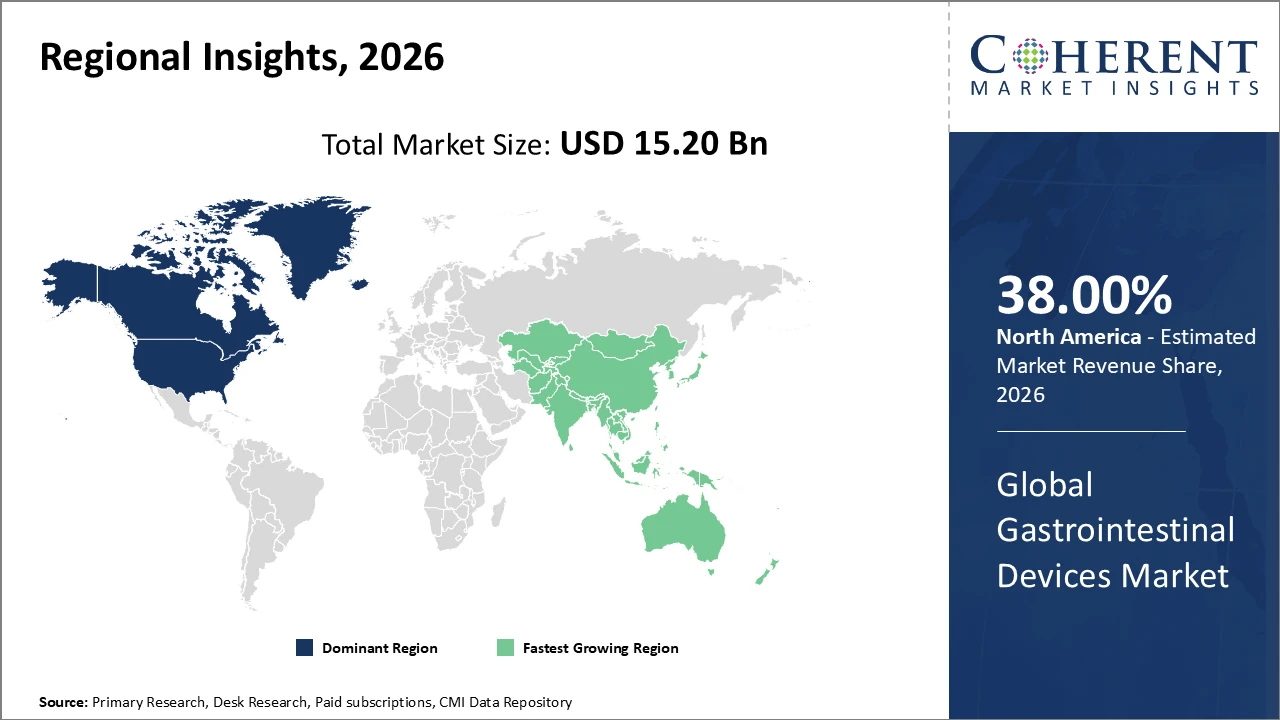
North America holds the largest market share at over 38%, whereas Asia Pacific is expected to register the highest CAGR, fueled by expanding healthcare infrastructure and supportive government initiatives.
Gastrointestinal Devices Market Segmentation Analysis
To learn more about this report, Request Free Sample
Gastrointestinal Devices Market Insights, By Device Type
Endoscopy devices continue to dominate the market due to their essential role in minimally invasive gastrointestinal diagnostics and therapeutics. Rising demand for high-definition and AI-assisted endoscopes is driving strong revenue growth, particularly for colonoscopes and gastroscopes. Notably, capsule endoscopy has gained significant traction, recording a 22% increase in usage for gastrointestinal bleeding diagnostics between 2024 and 2025. Surgical instruments represent a rapidly expanding subsegment, supported by advancements in ergonomic design and high-precision laparoscopic tools that enable shorter recovery times. Diagnostic devices support early disease detection through innovations in biosensors and molecular diagnostics, while monitoring devices are gaining momentum with the adoption of remote patient monitoring for chronic gastrointestinal disorders. Ancillary accessories further enhance procedural efficiency and clinical outcomes.
Gastrointestinal Devices Market Insights, By Technology
Digestive tract diagnostics continue to dominate the market, supported by widespread colorectal cancer screening programs and the growing need for early detection of chronic gastrointestinal diseases. Screening colonoscopy remains the most frequently performed gastrointestinal procedure worldwide. This segment has benefited significantly from AI-enabled diagnostic platforms, which have improved detection accuracy and operational efficiency; studies in 2025 reported a 15% reduction in missed lesions. Gastrointestinal surgery represents the fastest-growing subsegment, driven by rising demand for minimally invasive procedures supported by advanced surgical instruments that reduce complication rates. Disease management devices emphasize therapeutic solutions and continuous monitoring, particularly for inflammatory bowel disease, offering strong revenue potential. Preventive care focuses on minimizing disease risk through early-stage diagnostic innovations, while other segments include supportive therapies and emerging technologies.
Gastrointestinal Devices Market Insights, By End-User
Hospitals remain the leading end users due to the high concentration of complex gastrointestinal procedures and access to advanced medical equipment, accounting for over 60% of total market revenue. Their dominance is reinforced by integrated care pathways that support inpatient interventions. Ambulatory surgical centers are the fastest-growing end-user segment, driven by the shift toward outpatient care, improved patient convenience, and cost efficiency; this segment recorded a 12% revenue increase in 2025. Clinics primarily support routine diagnostics and follow-up procedures and are expanding device adoption due to advancements in portable technologies. Home healthcare is an emerging segment, fueled by the adoption of remote monitoring devices that enable long-term management of chronic gastrointestinal conditions. Other end users include research and academic institutions utilizing gastrointestinal devices for training and innovation purposes.
Gastrointestinal Devices Market Trends
The gastrointestinal devices market has increasingly integrated artificial intelligence in imaging and diagnostic applications since 2024, improving diagnostic accuracy and clinical workflow efficiency.
AI-powered colonoscopy systems demonstrated a 15% reduction in polyp miss rates, as reported in clinical trials conducted in 2025.
A growing shift toward disposable and single-use endoscopic devices has emerged to strengthen infection control, with single-use device revenues rising by 20% in 2026.
Telemedicine-enabled gastrointestinal monitoring solutions are gaining momentum, supported by digital healthcare adoption, with remote patient management increasing by 35% over the past two years.
Gastrointestinal Devices Market Insights, By Geography
To learn more about this report, Request Free Sample
North America Gastrointestinal Devices Market Analysis and Trends
North America leads the gastrointestinal devices market, accounting for over 38% of the total market share. This dominance is driven by a well-established healthcare infrastructure, high healthcare spending, and the early adoption of advanced medical technologies. Supportive reimbursement frameworks and the rising prevalence of gastrointestinal disorders further strengthen regional market growth. The United States, in particular, is home to major industry players such as Medtronic and Boston Scientific, whose continuous product innovations and strategic initiatives play a pivotal role in shaping regional revenue generation and overall market expansion.
Asia Pacific Gastrointestinal Devices Market Analysis and Trends
Asia Pacific is expected to register the fastest CAGR in the gastrointestinal devices market, driven by rapid expansion of healthcare infrastructure, government-led cancer screening initiatives, and rising patient awareness. China and India are at the forefront of this growth, supported by substantial investments in healthcare technology and capacity building. Policy frameworks such as China’s Healthy China 2030 initiative have accelerated the adoption of advanced gastrointestinal devices, while the growing presence of domestic manufacturers—alongside multinational companies—has strengthened market competitiveness and accessibility across the region.
Gastrointestinal Devices Market Outlook for Key Countries
USA Gastrointestinal Devices Market Analysis and Trends
The USA continues to be a key market in the gastrointestinal devices industry, contributing a significant portion of global revenue. US-based companies lead in innovation, particularly in AI-integrated endoscopic systems and minimally invasive surgical instruments. National public health initiatives, including colorectal cancer screening programs supported by the Centers for Disease Control and Prevention, have further driven demand for diagnostic devices. Favorable reimbursement policies for outpatient procedures have accelerated device adoption, with electronic medical record–integrated (EMR) gastrointestinal devices experiencing a 9% market growth in 2025 alone.
Germany Gastrointestinal Devices Market Analysis and Trends
Germany’s gastrointestinal devices market is supported by a robust hospital infrastructure and government initiatives promoting early disease detection. Key domestic players, such as Karl Storz, drive the adoption of advanced endoscopy systems. The country’s emphasis on digital health transformation has boosted demand for AI-enabled diagnostic tools and telemonitoring solutions. Market revenue continues to grow steadily, underpinned by comprehensive health insurance coverage and rising public awareness of digestive health and preventive care.
Analyst Opinion
The rising demand for advanced endoscopic devices is a key supply-side driver, with manufacturing capacities for high-definition endoscopes increasing by 14% in 2024, primarily due to hospital upgrades in North America and Europe, directly supporting market revenue growth.
On the demand side, improvements in diagnostic accuracy have expanded the adoption of capsule endoscopy, with usage for gastrointestinal bleeding diagnosis rising by 22% in 2025, particularly in outpatient centers, influencing strategies focused on non-invasive diagnostics.
Pricing dynamics for advanced therapeutic devices, including EMR (Endoscopic Mucosal Resection) tools, have become more competitive, with an average price reduction of 5.5% in 2026, enabling broader access in emerging markets and expanding market share in minimally invasive treatment segments.
The gastrointestinal monitoring devices segment is benefiting from the rising prevalence of chronic diseases, with continuous pH monitoring systems showing approximately 12% year-over-year global growth. Hospital adoption of remote monitoring solutions in 2025 saw a 30% increase in the US, highlighting the role of technology integration in market dynamics.
Market Scope
| Report Coverage | Details | ||
|---|---|---|---|
| Base Year: | 2025 | Market Size in 2026: | USD 15.2 billion |
| Historical Data for: | 2020 To 2024 | Forecast Period: | 2026 To 2033 |
| Forecast Period 2026 to 2033 CAGR: | 8.1% | 2033 Value Projection: | USD 26.7 billion |
| Geographies covered: |
|
||
| Segments covered: |
|
||
| Companies covered: | Medtronic, Olympus Corporation, Boston Scientific Corporation, Stryker Corporation, Cook Medical, Pentax Medical, Ambu A/S, Steris plc, QuickMedical, ConMed Corporation | ||
| Growth Drivers: |
|
||
Uncover macros and micros vetted on 75+ parameters: Get instant access to report
Gastrointestinal Devices Market Growth Factors
The increasing global prevalence of gastrointestinal disorders, including colorectal cancer and Crohn’s disease, remains the primary driver of the gastrointestinal devices market, with diagnostic device demand projected to grow by 10% annually in 2026. Technological advancements, particularly in capsule endoscopy and high-definition imaging, have significantly improved diagnostic accuracy and therapeutic outcomes, contributing to industry expansion.
Rising healthcare expenditure in emerging economies such as China and India has enhanced access to sophisticated gastrointestinal devices, fueling market revenue and business growth. Additionally, the growing trend toward minimally invasive surgeries, supported by advanced surgical instruments that reduce procedural risks, further strengthens market demand. Collectively, these factors underscore the strong growth prospects and evolving dynamics of the gastrointestinal devices market.
Gastrointestinal Devices Market Development
In 2025, AI-assisted capsule endoscopy systems advanced significantly, with companies introducing modules that enhance pathology detection and streamline clinician review. These innovations improved non-invasive small bowel diagnostics and supported faster, more accurate assessments of gastrointestinal conditions.
The same year also saw the launch of next-generation endoscopic devices incorporating extended depth of field technology, offering sharper imaging for gastroscopy and colonoscopy procedures. Capsule endoscopes with enhanced visualization features improved patient comfort and diagnostic precision. Together, these developments reflect the market’s focus on integrating advanced imaging, artificial intelligence, and patient-friendly design to drive adoption and expand gastrointestinal diagnostic capabilities.
Key Players
Leading Companies of the Market
Medtronic
Olympus Corporation
Boston Scientific Corporation
Stryker Corporation
Cook Medical
Pentax Medical
Ambu A/S
Steris plc
QuickMedical
ConMed Corporation
In the gastrointestinal devices market, commercial strategies have focused on mergers and strategic partnerships to accelerate product innovation. Medtronic, for example, collaborated with technology providers to enhance its endoscopic imaging systems, advancing the development of more sophisticated diagnostic solutions. Similarly, Olympus pursued targeted acquisitions to expand and diversify its product portfolio, resulting in a 7% increase in market share in the Asia Pacific region in 2025. These strategic initiatives demonstrate how leading companies leverage collaboration and consolidation to strengthen their market presence, improve technological capabilities, and meet the growing regional demand for advanced gastrointestinal devices.
Gastrointestinal Devices Market Future Outlook
The gastrointestinal devices market is poised for robust growth over the coming years, driven by rising prevalence of digestive disorders, technological innovations, and expanding healthcare infrastructure globally. Advancements in AI-assisted endoscopy, capsule endoscopy, and minimally invasive surgical instruments are expected to enhance diagnostic accuracy and therapeutic outcomes. Emerging markets, particularly in Asia Pacific, offer significant opportunities due to increasing healthcare expenditure and government initiatives promoting early disease detection. Additionally, trends such as telemedicine, remote patient monitoring, and single-use devices will continue shaping clinical practices. Overall, the market outlook reflects strong revenue potential, innovation-led expansion, and widening adoption across diverse healthcare settings.
Gastrointestinal Devices Market Historical Analysis
The gastrointestinal devices market has experienced steady growth over the past decade, driven by increasing gastrointestinal disorder prevalence, rising awareness, and technological advancements. Historically, endoscopy devices dominated the market, supported by innovations in high-definition imaging and minimally invasive procedures. Diagnostic and monitoring devices gained traction as non-invasive and patient-friendly technologies, such as capsule endoscopy and pH monitoring systems, became more accessible. Hospitals were the primary end users, while outpatient centers gradually increased adoption. North America and Europe led the market due to established healthcare infrastructure and high expenditure, whereas emerging economies began contributing significantly as healthcare investments and screening programs expanded, laying the foundation for future growth.
Sources
Primary Research Interviews:
Gastroenterologists
Endoscopists and Surgeons
Hospital Procurement Managers
Gastrointestinal Device Manufacturers
Clinical Researchers in GI disorders
Databases:
World Health Organization (WHO) Global Health Observatory
Global Burden of Disease (GBD) Database
OECD Health Data
Centers for Disease Control and Prevention (CDC) – GI Disease Statistics
Magazines:
Medical Design & Outsourcing
Gastroenterology & Endoscopy News
MedTech Outlook
HealthTech Magazine
Medical Device Network
Journals:
Gastroenterology
Journal of Gastrointestinal Surgery
Endoscopy
Digestive Diseases and Sciences
World Journal of Gastroenterology
Newspapers:
The New York Times (Health)
The Guardian (Health)
Financial Times (Healthcare)
The Hindu (Health)
Reuters Health
Associations:
World Health Organization (WHO)
American Gastroenterological Association (AGA)
European Society of Gastrointestinal Endoscopy (ESGE)
International Society for Gastrointestinal Oncology (ISGIO)
Share
Share
Komal Dighe is a Management Consultant with over 8 years of experience in market research and consulting. She excels in managing and delivering high-quality insights and solutions in Health-tech Consulting reports. Her expertise encompasses conducting both primary and secondary research, effectively addressing client requirements, and excelling in market estimation and forecast. Her comprehensive approach ensures that clients receive thorough and accurate analyses, enabling them to make informed decisions and capitalize on market opportunities.

Credibility and Certifications

860519526


9001:2015

27001:2022


Need a Custom Report?
We can customize every report - free of charge - including purchasing stand-alone sections or country-level reports
Customize NowJoining thousands of companies around the world committed to making the Excellent Business Solutions.
View All Our Clients