Grain Analysis Market Analysis & Forecast: 2026-2033

Grain Analysis Market Size and Forecast – 2026 – 2033
The Global Grain Analysis Market size is estimated to be valued at USD 1.15 billion in 2026 and is expected to reach USD 1.92 billion by 2033, exhibiting a compound annual growth rate (CAGR) of 7.8% from 2026 to 2033.
Global Grain Analysis Market Overview
The grain analysis market is driven by rising global demand for food safety and quality assurance, as consumers and regulators emphasize contamination detection and nutritional accuracy. Advancements in analytical technologies such as spectroscopy and chromatography enable faster, more precise testing, supporting adoption across the supply chain. Increasing international trade of grains requires standardized testing to meet export regulations, further boosting market growth.
Key Takeaways
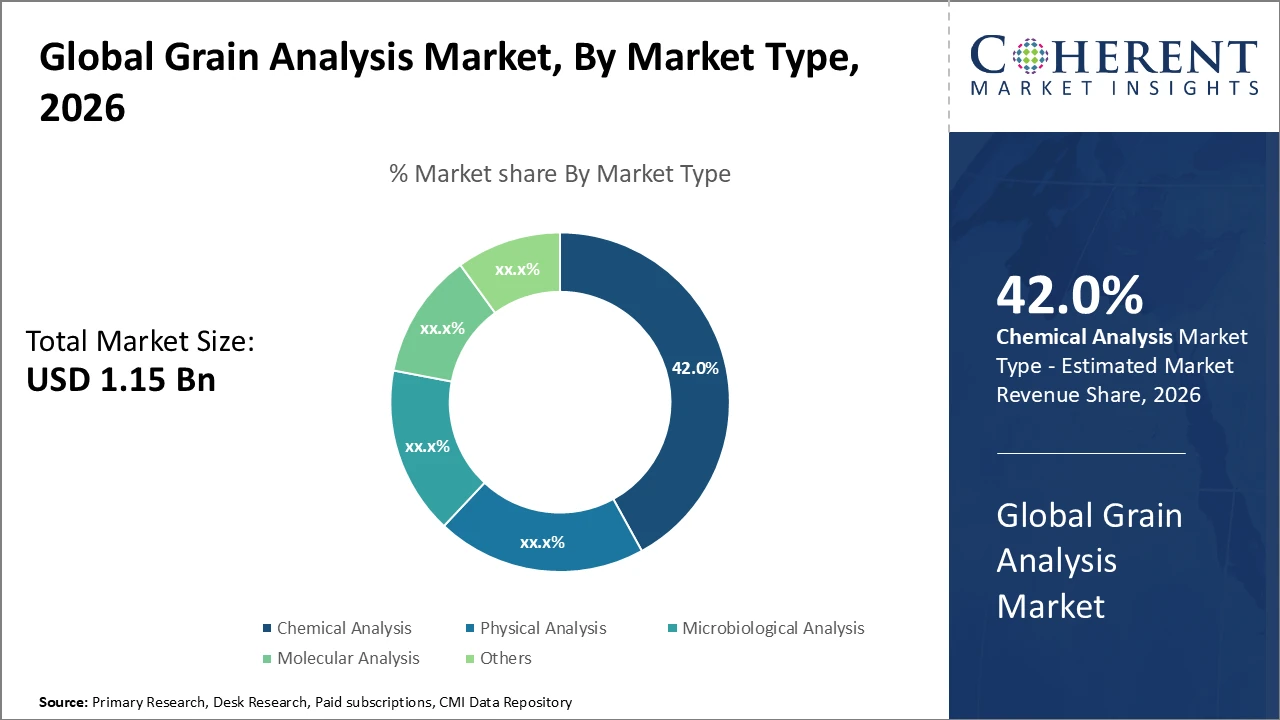
The Chemical Analysis segment dominates the market, accounting for over 42% of industry share, due to high precision requirements in grain quality and contamination testing.
Molecular Analysis is the fastest-growing subsegment, driven by advances in DNA-based pathogen detection technologies.
Cereals lead the Grain Type segment, contributing nearly half of market revenue, supported by staple crop monitoring and quality assessment.
Oilseeds represent the fastest-growing grain type, fueled by increasing demand for healthy oils.
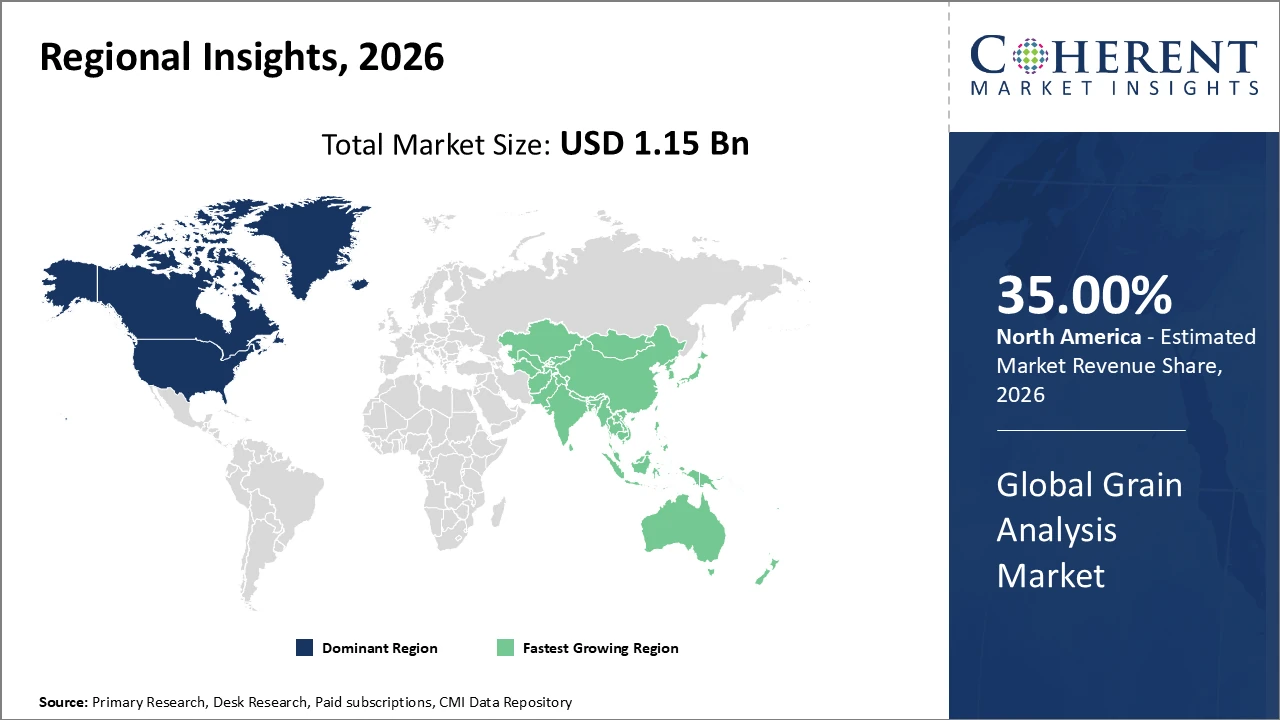
North America holds the largest regional share, exceeding 35%, supported by strong regulatory frameworks and advanced technology adoption.
Asia Pacific exhibits the highest CAGR, close to 9%, driven by government initiatives promoting food safety and modernization of agricultural practices, along with a growing agricultural export sector.
Grain Analysis Market Segmentation Analysis
To learn more about this report, Request Free Sample
Grain Analysis Market Insights, By Market Type
Chemical Analysis dominates the Grain Analysis Market, driven by its critical role in assessing nutrient composition, pesticide residues, and contaminants with high accuracy and regulatory compliance. Molecular Analysis is the fastest-growing subsegment, benefiting from advancements in DNA-based pathogen detection, which provide rapid and highly sensitive results essential for preventing outbreaks. Physical Analysis primarily covers moisture content and bulk density measurements, fundamental for storage and processing but less technologically advanced. Microbiological Analysis targets mycotoxins and microbial contaminants, ensuring food safety despite longer testing times.
Grain Analysis Market Insights, By Grain Type
Cereals command the largest share of the Grain Analysis Market, as staple crops like wheat, rice, and corn require extensive quality monitoring due to their high production volumes and essential role in global consumption. Oilseeds, including soybeans and sunflower seeds, are the fastest-growing subsegment, driven by increasing demand for edible oils and biodiesel feedstock. Pulses maintain steady growth, supported by rising protein consumption and the growing adoption of vegetarian and plant-based diets.
Grain Analysis Market Insights, By End User Industry
The Food & Beverage Industry dominates the Grain Analysis Market, driven by strict food safety regulations, increasing consumer demand for quality assurance, and expanding product lines requiring comprehensive testing. The Biofuel Industry is the fastest-growing subsegment, as the global transition toward renewable energy heightens the need for grain quality analysis to optimize fuel yield and efficiency.
Grain Analysis Market Trends
The Grain Analysis Market is increasingly integrating AI and machine learning to predict grain quality deterioration, with U.S. agribusinesses reporting 15% reductions in testing cycle times by mid-2025.
Blockchain-enabled traceability platforms are being adopted in Europe to provide end-to-end supply chain transparency, enabling faster recall responses and enhancing consumer trust.
Sustainable analysis methods are advancing through near-infrared spectroscopy (NIR) technologies, particularly in Asia Pacific, where stricter eco-conscious regulations are driving adoption.
Overall, technology integration, traceability, and sustainability are key trends shaping the future of grain analysis globally.
Grain Analysis Market Insights, By Geography
To learn more about this report, Request Free Sample
North America Grain Analysis Market Analysis and Trends
In North America, the Grain Analysis Market is dominated by stringent regulatory frameworks, including the FDA’s Food Safety Modernization Act (FSMA), high agricultural commodity production, and early adoption of advanced analytical technologies. The region accounts for over 35% of the industry share, supported by substantial investments from key market players based in the U.S. and Canada. Government-backed R&D initiatives, combined with a mature food safety and quality assurance ecosystem, further strengthen market growth. Additionally, widespread use of automated analyzers, AI-based quality monitoring, and robust supply chain traceability systems reinforces North America’s position as a leading hub for grain analysis solutions.
Asia Pacific Grain Analysis Market Analysis and Trends
The Asia Pacific region demonstrates the fastest growth in the Grain Analysis Market, with a CAGR approaching 9%, fueled by rising grain export volumes and modernization of agricultural practices. Government initiatives in countries such as China and India promoting food safety, quality monitoring, and advanced analytics support market expansion. Additionally, the growing biofuel industry increases demand for precise grain quality assessment to optimize fuel yield and efficiency. Adoption of digital agricultural tools, including IoT sensors and AI-enabled monitoring systems, further drives the need for sophisticated grain analysis methods. These factors collectively position Asia Pacific as a rapidly expanding market for grain analysis solutions.
Grain Analysis Market Outlook for Key Countries
USA Grain Analysis Market Analysis and Trends
The U.S. Grain Analysis Market is driven by advanced technological infrastructure and stringent regulatory mandates that require continuous grain quality and safety monitoring. In 2026, more than 40% of grain testing devices deployed in the U.S. featured AI capabilities, enhancing efficiency and accuracy while boosting growth for solution providers. Key market players focus on integrating real-time data analytics and predictive modeling to meet the needs of high-demand sectors, including organic grain production and ethanol manufacturing. These innovations, combined with a mature food safety ecosystem and strong R&D initiatives, establish the U.S. as a critical hub for grain analysis market development.
Germany Grain Analysis Market Analysis and Trends
Germany’s Grain Analysis Market is experiencing steady growth, driven by strict food safety regulations, technological innovation, and a strong focus on quality assurance in cereal and oilseed production. Automated analyzers, AI-enabled monitoring systems, and molecular testing methods are increasingly adopted across processing and storage facilities to ensure compliance with EU standards. The country’s prominence in grain exports and advanced agricultural practices further supports market expansion. Emerging trends include the integration of blockchain for supply chain traceability and sustainable testing methods such as near-infrared spectroscopy.
Analyst Opinion
The precision and accuracy of analytical instruments significantly influence market growth. Advances in near-infrared spectroscopy (NIR) and gas chromatography have increased throughput by 15% annually, enabling faster grain quality assessments. In 2025, several Canadian grain exporters reported a 20% reduction in post-harvest losses due to improved testing technologies.
Demand is growing from emerging applications in biofuel production and animal feed, as well as increased imports of specialty grains for quality verification. In 2024, the Asia Pacific region saw a 12% rise in grain imports requiring detailed compositional analysis, reflecting diversification in commercial usage.
Supply chain transparency and regulatory compliance drive market expansion. Stricter food safety regulations in the U.S. and EU in 2026 led to a 10% increase in demand for grain analysis services among agribusinesses to meet export standards.
Nano-level technological integration, such as IoT-enabled sensors for real-time moisture and contamination detection, is enhancing monitoring precision. By 2026, over 30% of large-scale U.S. grain storage facilities adopted these systems, optimizing inventory management and reducing spoilage risks by up to 25%.
Market Scope
| Report Coverage | Details | ||
|---|---|---|---|
| Base Year: | 2025 | Market Size in 2026: | USD 1.15 billion |
| Historical Data for: | 2020 To 2024 | Forecast Period: | 2026 To 2033 |
| Forecast Period 2026 to 2033 CAGR: | 7.8% | 2033 Value Projection: | USD 1.92 billion |
| Geographies covered: |
|
||
| Segments covered: |
|
||
| Companies covered: | PerkinElmer Inc., Bruker Corporation, Metrohm AG, Horiba, Ltd., ALS Limited, SGS SA, Romer Labs, Vicam, Waters Corporation, Shimadzu Corporation | ||
| Growth Drivers: |
|
||
Uncover macros and micros vetted on 75+ parameters: Get instant access to report
Grain Analysis Market Growth Factors
The Grain Analysis Market is driven by rising consumer health consciousness, with whole grain consumption increasing by 8% annually in developed regions, boosting demand for high-quality grain products. Technological advancements, including portable spectrometers and digital imaging, improve on-site testing, enabling faster decision-making across supply chains. Stringent international food safety regulations, particularly from the FDA and European Food Safety Authority (EFSA), further increase the need for accurate grain composition and contaminant analysis. Additionally, the expanding biofuel industry supports market growth, as grain quality directly impacts fuel efficiency and production costs, demonstrated by a 10% year-on-year rise in bioethanol production requiring grain assessment in 2025.
Grain Analysis Market Development
In February 2026, DTN, a global provider of agricultural data and technology, launched DTN Ag Hub, a data-driven platform that helps agribusinesses optimize buying and selling decisions and enhance farmer engagement.
Key Players
Leading Companies of the Market
PerkinElmer Inc.
Bruker Corporation
Metrohm AG
Horiba Ltd.
ALS Limited
SGS SA
Romerb Labs
Vicam
Waters Corporation
Shimadzu Corporation
Several key market players in the Grain Analysis Market have embraced digital transformation strategies by incorporating AI-driven data analytics for grain quality prediction, enhancing service customization and achieving a 15% increase in customer retention. In addition, collaborations with agricultural universities and substantial investments in R&D facilities have enabled these firms to develop multi-residue analysis technologies, which reduce testing time by nearly 30%. These innovations significantly improve operational efficiency, streamline laboratory workflows, and strengthen the competitive positioning of companies in the market, demonstrating how technology adoption and strategic partnerships are driving growth and modernization within the grain analysis industry.
Grain Analysis Market Future Outlook
The Grain Analysis Market is expected to experience robust growth over the coming years, driven by rising demand for high-quality grains, stringent food safety regulations, and technological advancements. Adoption of AI, IoT, and blockchain-enabled traceability systems will enhance predictive quality assessment, real-time monitoring, and supply chain transparency. Emerging applications in biofuel production, animal feed, and specialty grains will further expand market opportunities. Portable and automated testing solutions will increase efficiency across storage, processing, and export operations. Sustainability initiatives and regulatory compliance requirements, combined with growing consumer health awareness, are set to shape the future trajectory of the global grain analysis market.
Grain Analysis Market Historical Analysis
The Grain Analysis Market has experienced steady growth over the past decade, driven by increasing demand for high-quality and safe grain products. Initially, adoption centered on basic moisture and density testing for cereals and oilseeds. Between 2015 and 2020, technological advancements such as near-infrared (NIR) spectroscopy, chromatography, and molecular analysis enabled faster, more accurate detection of nutrients, contaminants, and pathogens. Rising regulatory standards from agencies like the FDA and EFSA, coupled with growing biofuel and animal feed industries, further propelled market expansion. Historical trends reflect a gradual shift from manual testing to automated, technology-driven solutions, enhancing efficiency, accuracy, and global supply chain reliability.
Sources
Primary Research Interviews:
Grain processing plant managers and quality assurance executives
Agricultural technology and grain analysis equipment providers
AI and IoT solution developers for agricultural applications
Industry consultants and market analysts specializing in grain quality and safety
Magazines:
Food Engineering – Grain Analysis and Processing Updates
Grain & Feed – Industry News and Technological Developments
World Grain – Grain Trading and Quality Monitoring Insights
Food Quality & Safety – Analytical Techniques and Innovations
Journals:
Journal of Cereal Science – Grain Composition and Quality Research
Food Control – Safety, Contaminant, and Analytical Studies
International Journal of Food Science & Technology – Grain Testing and Innovations
Trends in Food Science & Technology – Advances in Analytical Methods
Newspapers:
The Wall Street Journal – Agriculture and Food Processing Markets
Financial Times – Grain Trade, Technology, and Analytics Industry
Reuters – Grain Quality, Testing, and Agricultural News
Bloomberg – Agricultural Commodities and Market Trends
Associations:
International Association for Cereal Science and Technology (ICC)
American Society of Agronomy (ASA)
European Federation of Food, Agriculture and Tourism Trade Associations (EUROFEMA)
Grain and Feed Trade Association (GAFTA)
Share
Share
Shivam Bhutani has 6 years of experience in market research and strategy consulting. He is a Market Research Consultant with strong analytical background. He is currently an MBA candidate specializing in Business Analytics from BITS Pilani.
He is adept at navigating diverse roles from sales and marketing to research and strategy consulting. He excels in market estimation, competitive intelligence, pricing strategy, and primary research. He is skilled at analysing large datasets to provide precise insights, helping clients in achieving strategic transformation across various industries. He is skilled in leveraging data visualization techniques to drive innovation and enhance business processes.

Credibility and Certifications

860519526


9001:2015

27001:2022


Need a Custom Report?
We can customize every report - free of charge - including purchasing stand-alone sections or country-level reports
Customize NowJoining thousands of companies around the world committed to making the Excellent Business Solutions.
View All Our Clients