all report title image

Mechanical, Electrical And Plumbing Services Market Analysis & Forecast: 2026-2033

Mechanical, Electrical and Plumbing Services Market, By Service Type (Mechanical, Electrical, Plumbing), By End-User (Commercial, Residential), By Geography (North America, Latin America, Europe, Asia Pacific, Middle East and Africa)

  • Published In : 08 May, 2026
  • Code : CMI611
  • Page number :136
  • Formats :
      Excel and PDF :
  • Industry : Construction Engineering
  • Historical Range : 2020 - 2024
  • Forecast Period : 2026 - 2033

Mechanical, Electrical and Plumbing Services Market Size and Share Analysis: (2026 - 2033)

The Mechanical, Electrical and Plumbing Services Market is anticipated to grow at a CAGR of 11.6% with USD 66.4 Bn in 2026 and is expected to reach USD 143.0 Bn in 2033. In 2026, the Mechanical, Electrical, and Plumbing (mechanical, electrical and plumbing) Services Market remains shaped by rapid urbanization and infrastructure expansion, especially across Asia‑Pacific and India, where large construction pipelines increase demand for integrated building systems including HVAC, electrical distribution, and plumbing solutions. Urban growth drives residential, commercial, and industrial construction that requires advanced mechanical, electrical and plumbing design and implementation to ensure efficiency and compliance with safety and sustainability standards. India’s government reported nearly 1,948 ongoing infrastructure projects worth ₹41.98 lakh crore (~USD ~5oo billion) as of February 2026, demonstrating the scale of development fueling mechanical, electrical and plumbing service needs.

Source: PIB

Key Takeaways

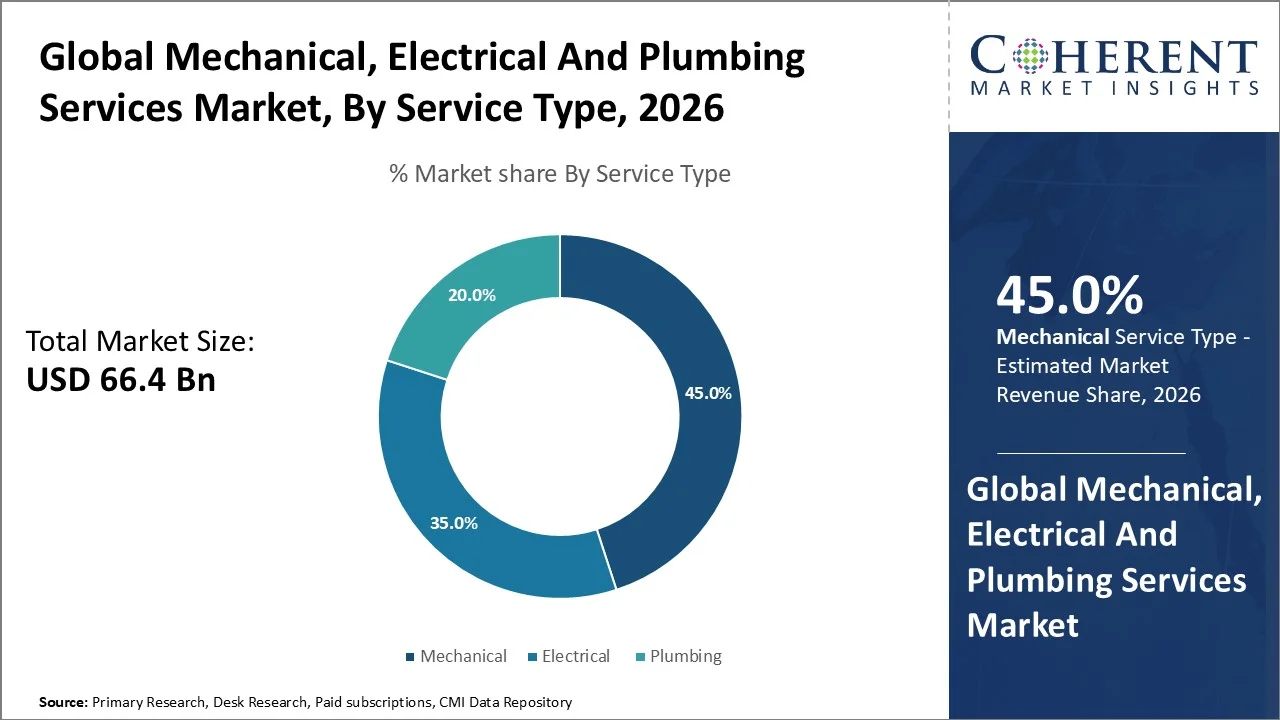
  • Mechanical is expected to account the largest share of 45.0% in 2026, driven by its critical role in energy efficiency, HVAC, and ventilation systems. With U.S. construction spending exceeding USD 2.19 trillion in 2026 (U.S. Census Bureau), mechanical services remain integral to building design and operational efficiency.
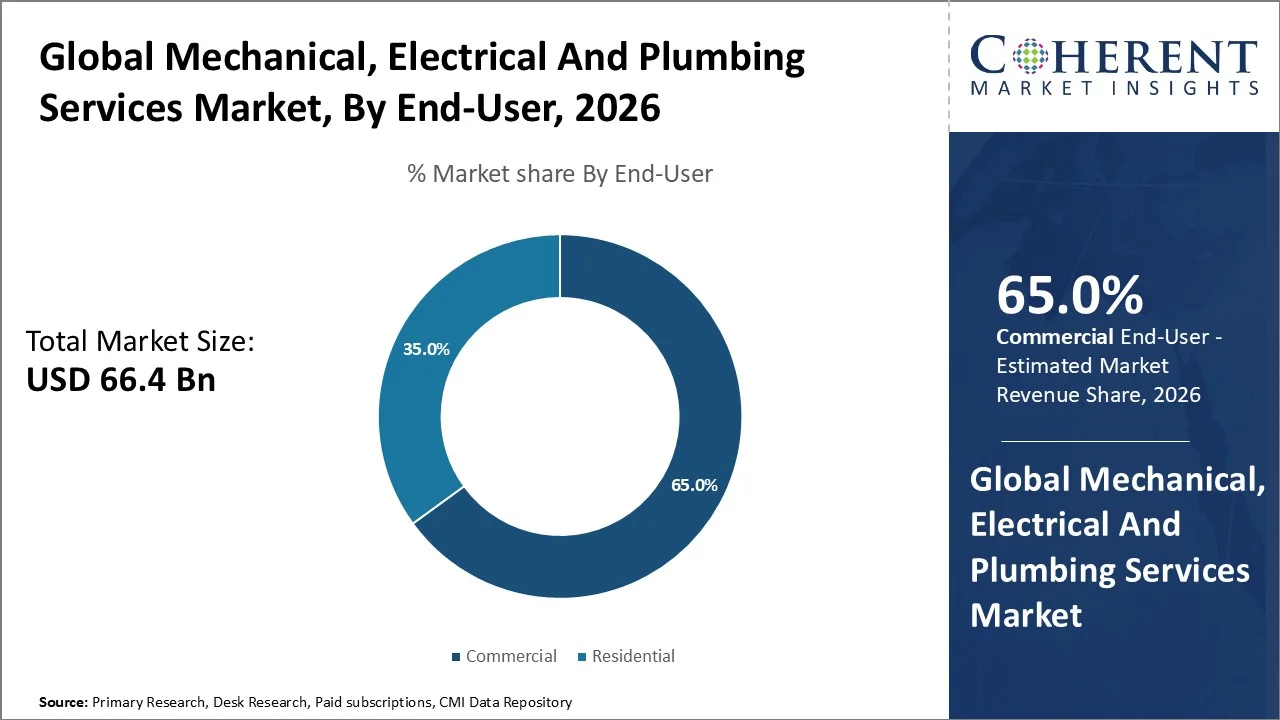
  • Based on end-user, commercial will dominate with 65.0% in 2026, supported offices, hospitals, retail, data centers and institutional buildings require recurring HVAC, electrical, plumbing, fire-safety and energy-efficiency upgrades. U.S. Census data published March 23, 2026 showed private nonresidential activity in January 2026, while EIA data posted May 5, 2026 found Virginia electricity sales rose nearly 30 million MWh since 2019, driven by data centers.
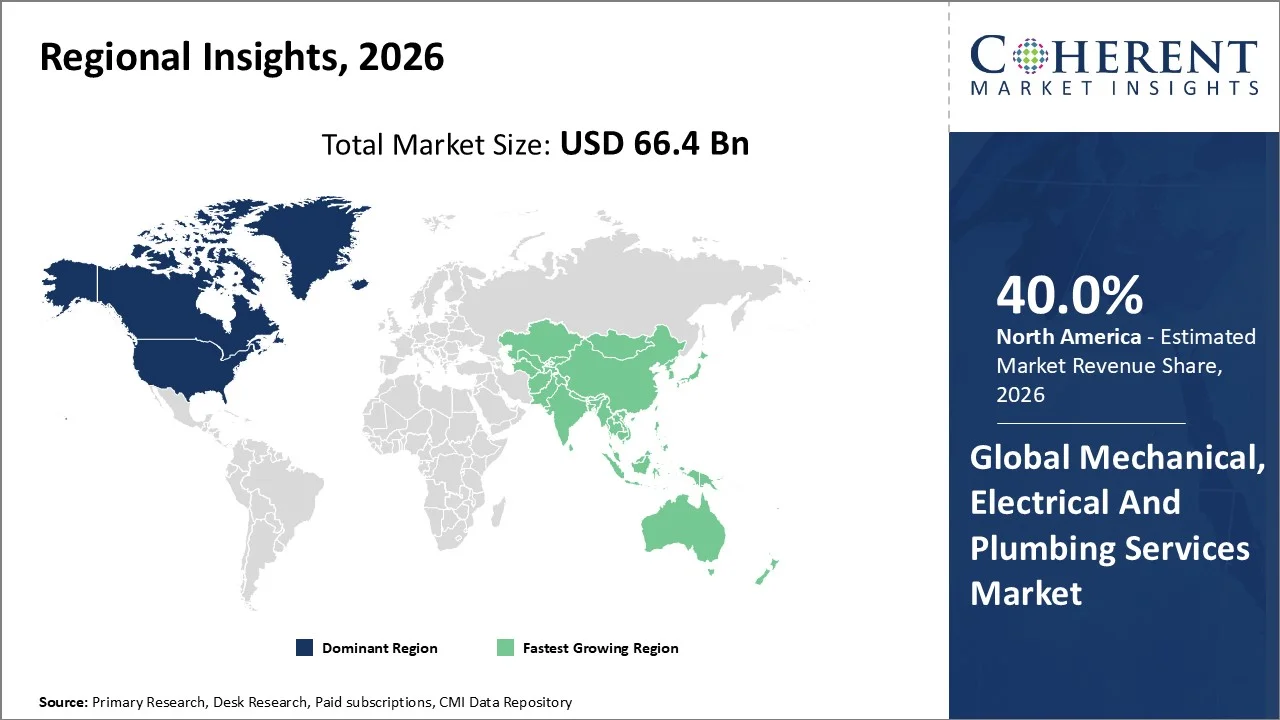
  • North America is expected to acquire the dominant share of 40.0% in 2026, attributed to technological advancement, urbanization, and high demand for smart and sustainable infrastructure. For instance, in April 2026, DOE highlights that efficient building and retrofitting, supported by energy codes, will reduce energy costs and consumption over the life of buildings, reinforcing advanced nechanical, electrical and plumbingdesign integration into commercial and institutional projects built through 2035 and beyond.

Segmental Insights

Mechanical, Electrical and Plumbing Services Market By Service Type

To learn more about this report, Download Free Sample

Why is Mechanical Acquiring the Largest Market Share?

Mechanical is projected to account for the largest share of cognitive systems spending in 2026, representing approximately 45.0% of the total volume. The mechanical segment which includes HVAC, ventilation and other building mechanical systems is often the dominant service type in the mechanical, electrical and plumbing services market because it represents a large and technically complex portion of building systems essential to occupant comfort and regulatory compliance. For instance, HVAC systems can account for 40–50% of a building’s total energy use, underscoring their scale and importance in building design and operation, according to a 2026 MDPI review on HVAC energy consumption and emissions.

Government construction data also reflects strong underlying activity in building projects that require extensive mechanical services. U.S. construction spending remained robust at an annual rate of over USD 2.19 trillion in January 2026, with substantial investment in both residential and nonresidential construction sectors where mechanical systems form a major part of the installed scope. Additionally, specialized areas such as data center construction reached an estimated USD 85.3 billion in 2026, where advanced mechanical cooling and ventilation systems are critical project components.

These data points highlight that mechanical work drives a significant portion of project effort, cost, and technical requirement in building and infrastructure development a key reason the mechanical service segment leads within the broader mechanical, electrical and plumbing services market.
Which End-User segment dominates the market?

Mechanical, Electrical and Plumbing Services Market By End-User

To learn more about this report, Download Free Sample

Commercial account for the largest share of 65.0% in 2026 because offices, healthcare facilities, retail spaces, educational buildings, data centers, and manufacturing facilities require high-capacity HVAC, electrical distribution, plumbing, ventilation, fire safety, and building automation systems. The U.S. Census Bureau’s Construction Spending release, published on March 23, 2026, reported USD 728.2 billion in private nonresidential construction in January 2026, including major mechanical, electrical and plumbing -intensive categories such as office, commercial, healthcare, and manufacturing buildings. EIA’s April 2026 commercial demand assumptions also identify space heating, cooling, ventilation, water heating, lighting, refrigeration, and data center servers as key commercial energy services. This makes commercial buildings a recurring source of mechanical, electrical and plumbing design, installation, retrofit, compliance, and maintenance demand.

Rapid urbanization and infrastructure development

Rapid urbanization and infrastructure development act as significant catalysts for the Mechanical, Electrical and Plumbing Services Market growth because expanding cities and infrastructure projects inherently increase demand for building systems that make structures safe, functional, and efficient. Urbanization drives construction of residential, commercial, and public facilities, all of which require comprehensive nechanical, electrical and plumbingdesign, installation and maintenance to support heating, ventilation and air‑conditioning (HVAC), power distribution, water supply, wastewater systems, fire safety, lighting, and more components that are fundamental to modern built environments.

Academic research also links urban infrastructure expansion with increased infrastructure complexity and investment requirements. For instance, a 2025 MDPI study on urbanization and infrastructure emphasizes that as urban infrastructure systems evolve to support denser populations and more complex urban environments, the integration and coordination of multiple services including those analogous to nechanical, electrical and plumbingframeworks become more essential for sustainable urban functioning and management.

Evidence from government sources highlights how national infrastructure growth coincides with enhanced urban development programmes. According to a Press Information Bureau (PIB) release from 1 February 2025, India’s infrastructure spending surged, with total budget allocations rising to ₹10 lakh crore in 2023‑24, supported by initiatives like PM Gati Shakti to integrate planning across sectors and improve connectivity. Such expansive infrastructure development including roads, logistics networks and urban systems drives construction that relies heavily on mechanical, electrical and plumbing services for integrated building systems.

Similarly, a PIB review from December 2024 of the Smart Cities Mission reports that by 15 November 2024, work orders totaling USD 19.76 billion had been issued for over 8,000 urban projects, including smart infrastructure development like water supply networks and traffic systems. These urban initiatives inherently require advanced mechanical, electrical and plumbing systems to handle utilities, automation, and city services, illustrating how urban investment expands the need for mechanical, electrical and plumbing expertise.

Source: MDPI; PIB

Market Drivers

Rise in commercial and residential construction

A rise in commercial and residential construction fuels the mechanical, electrical, and plumbing services market by increasing demand for complex systems integration in new buildings. For instance, U.S. Census Bureau’s New Residential Construction data released March 12, 2026 highlighted rising housing starts, reflecting heightened construction activity that requires mechanical, electrical, and plumbing installation and coordination. Simultaneously, the Building Permits Survey notes annual 2025 permits released May 14, 2026, indicating ongoing approvals for future residential projects. Higher construction activity typically leads to more mechanical, electrical and plumbing installations for HVAC, power distribution, water, and fire protection systems, amplifying service demand. As both homebuilding and commercial projects expand, mechanical, electrical and plumbing service workloads grow due to increased planning, design, and commissioning needs, linking industry growth directly to construction dynamics.

Innovation in Mechanical, Electrical and Plumbing Services: Powering the Shift Toward Intelligent, Energy-Efficient Buildings

Increasing innovation in mechanical, electrical and plumbing services has created significant opportunity for the mechanical, electrical and plumbing services market growth over the forecast period. For instance, in February 2025 a Singapore office deployed AI‑driven mechanical, electrical and plumbing systems that used real‑time occupancy data to automate HVAC adjustments and achieved a 22 % energy reduction. Such smart integrations increase demand for advanced design, automation, and system commissioning. U.S. building automation guidance published in 2026 notes that automated control systems now manage up to 70 % of a building’s energy loads, underscoring how energy management tech expands mechanical, electrical and plumbing services opportunities for optimization, controls, and predictive maintenance.

Furthermore, U.S. General Services Administration guidance on Building Energy Security and Efficiency, published March 16, 2026, emphasizes how advanced control systems optimize energy use and building operations, directly boosting demand for sophisticated mechanical, electrical and plumbing design and integration. Real‑world evaluations of smart automation across 45 projects show average energy savings of around 34 % through intelligent lighting, HVAC and sensor systems, highlighting tangible benefits that drive investment in energy‑efficient mechanical, electrical and plumbing technologies. This shift expands services in controls integration, analytics and predictive maintenance as building owners pursue operational efficiency and compliance.

Current Events and Their Impact on the Mechanical, Electrical and Plumbing Services Market

Current Event

Description and its Impact

Rising Government Funding & Initiatives

  • Description: Government of Canada launch of Canada’s build communities strong fund to speed infrastructure projects. The Government of Canada officially launched the Build Communities Strong Fund, a comprehensive USD 51 billion infrastructure investment program covering community building, transit, climate adaptation, and local priorities starting in 2026‑27.
  • Impact: Large‑scale public infrastructure projects translate into high demand for integrated mechanical, electrical and plumbing services in new public facilities (hospitals, transit hubs, community centres). This funding stream accelerates construction and upgrades of mechanical, electrical, and plumbing systems, boosting revenue opportunities for mechanical, electrical and plumbing service providers.

Canada’s Skilled Workforce & Clean Energy Incentives

  • Description: The 2026 Spring Economic Statement in Canada includes a C$2 billion plan to train and hire up to 100,000 skilled workers by 2030‑31, plus C$3.4 billion in grants to support completion of trade apprenticeships.
  • Impact: A larger skilled workforce helps address key talent shortages in the construction trades (including HVAC, electrical and plumbing). Enhanced labor pools support wider deployment of advanced mechanical, electrical and plumbing technologies and accelerate project execution across sectors vital for market expansion.

U.S. Local & State Energy Policy Divergence

  • Description: U.S. energy policy in 2026 reflects a mix of federal guidance and varied state initiatives, including performance‑based efficiency standards and local net‑zero goals that sometimes exceed federal baselines.
  • Impact: Divergent state codes and aggressive performance standards result in region‑specific requirements for mechanical and electrical system efficiency, pushing mechanical, electrical and plumbing firms to tailor solutions to local regulatory environments. This elevates demand for advanced design, system optimization, and compliance services.

U.S. Federal Building Energy Efficiency Standards & Codes

  • Description: The U.S. Department of Energy (DOE) continues to update and enforce federal building energy efficiency standards for new federal buildings and major renovations, requiring designs to achieve significant energy reductions and reduce on‑site fossil fuel use under rules like 10 CFR 433 and 10 CFR 435. These standards are part of DOE’s Federal Energy Management Program (FEMP) and broader energy policy mandates.
  • Impact: These stricter energy performance mandates drive demand for high‑efficiency HVAC, electrical distribution, efficient water heating and smart plumbing systems all core mechanical, electrical and plumbing services segments while encouraging mechanical, electrical and plumbing contractors to adopt advanced system designs and energy‑saving technologies to ensure compliance. This benefits firms specializing in sustainable mechanical, electrical and plumbing solutions.

Uncover macros and micros vetted on 75+ parameters: Get instant access to report

Mechanical, Electrical and Plumbing Services Market Trends

  • Rising shift toward energy-efficient building retrofits – Energy efficiency retrofits are becoming a major trend in the mechanical, electrical and plumbing services market as building owners focus on reducing energy consumption, improving operational efficiency, and meeting stricter building performance expectations. Mechanical, electrical and plumbing contractors are increasingly involved in HVAC upgrades, lighting controls, building automation, energy audits, commissioning, and replacement of inefficient equipment. The International Energy Agency states that buildings account for around 30% of global energy demand, while UNEP/GlobalABC reported that buildings and construction contribute 34% of global CO₂ emissions, making mechanical, electrical and plumbing services upgrades central to decarbonization strategies

Source: International Energy Agency; UNEP / GlobalABC

  • Growing adoption of heat pumps and electrified HVAC systems – Electrification of heating and cooling systems is becoming a strong trend as governments and building owners move away from fossil-fuel-based boilers and inefficient HVAC systems. Heat pumps are gaining importance in both new buildings and retrofit projects because they support lower energy use, better indoor comfort, and reduced building emissions. The IEA Energy Efficiency Policy Toolkit 2025 states that replacing fossil fuel boilers with high-efficiency heat pumps can reduce energy use by up to 75%, creating strong demand for mechanical contractors, HVAC engineers, commissioning specialists, and electrical upgrades required for higher electric loads.
  • Code-driven demand for compliant HVAC, electrical, and plumbing systems – Building codes and safety standards are increasingly shaping mechanical, electrical and plumbing service demand. Mechanical, electrical and plumbing contractors are required to design, install, test, and maintain systems according to updated energy, mechanical, plumbing, and electrical codes. ASHRAE Standard 90.1-2025 provides minimum energy-efficiency requirements for buildings except low-rise residential buildings, while the ICC I-Codes are widely adopted model codes for safe, sustainable, and affordable structures. The 2026 National Electrical Code also supports updated electrical installation practices, making compliance expertise a key service differentiator for mechanical, electrical and plumbing services firms.
  • Increasing focus on smart controls, automation, and building system integration – mechanical, electrical and plumbing services are shifting from only installation work to integrated building performance management. Building owners are adopting automated HVAC controls, smart metering, sensor-based ventilation, lighting controls, leak detection, and centralized building management systems. This trend increases demand for contractors that can integrate mechanical, electrical, and plumbing systems with digital controls. ASHRAE’s read-only standards list includes BACnet for building automation, commissioning standards, HVAC testing and balancing, and energy standards for data centers, showing how automation and system-level commissioning are becoming core parts of mechanical, electrical and plumbing delivery.

Source: ASHARE

  • Water efficiency and leak management becoming important in plumbing services – Plumbing services are increasingly moving toward water-efficient systems, advanced metering, leak detection, low-flow fixtures, and water-use benchmarking, especially in commercial and institutional buildings. EPA WaterSense notes that offices, schools, hotels, hospitals, restaurants, and other facilities use significant amounts of water and energy in daily operations, and facility managers are becoming more aware of water efficiency to reduce shortage risks and rising costs. This is creating demand for plumbing audits, fixture replacement, water metering, and preventive maintenance services.

Regional Insights

Mechanical, Electrical and Plumbing Services Market By Regional Insights

To learn more about this report, Download Free Sample

North America dominates owing to Strong Technological Infrastructure

North America account 40.0% market share in 2026, supported by high demand for smart and sustainable infrastructure and regulatory and energy efficiency standards. North America, especially the U.S. and Canada, has a growing demand for energy-efficient buildings, which drives the adoption of advanced mechanical, electrical and plumbing services, such as smart HVAC systems, energy-efficient plumbing, and electrical installations. North America leads in adopting new technologies such as Building Information Modeling (BIM), automation, and IoT integration in mechanical, electrical and plumbing systems. This technological edge boosts the demand for advanced mechanical, electrical and plumbing services in construction and renovation projects. For instance, in December 2025, Canada’s 2025 National Energy Code introduces technical requirements focused on reducing greenhouse gas emissions and improving energy performance in new buildings and retrofits, providing a harmonized framework for provinces to enforce energy‑efficient mechanical and electrical design. Furthermore, in April 2026, the Department of Energy, highlights that efficient building and retrofitting, supported by energy codes, will reduce energy costs and consumption over the life of buildings, reinforcing advanced mechanical, electrical and plumbing design integration into commercial and institutional projects built through 2035 and beyond.

The U.S. has historically been at the forefront of research and development (R&D) in the construction and mechanical, electrical and plumbing sectors. For instance, innovations in energy-efficient HVAC systems, smart plumbing technologies, and advanced electrical distribution systems are widely adopted in U.S. commercial construction. Government-backed incentives and grants, including those for energy-efficient buildings and renewable energy adoption, have fueled technological advancements. In 2026, the growing focus on smart grid integration, energy-efficient HVAC systems, and automated building management systems has further entrenched the U.S. as the leader in the commercial mechanical, electrical and plumbing services market.

Source: Government of Canada; DOE; ASHRAE

Asia Pacific Mechanical, Electrical and Plumbing Services Market Trends

The Asia-Pacific region is poised to be as the fastest-growing region through 2026-2033, owing to rapid urbanization, significant infrastructure development, and large-scale commercial and industrial construction projects. Government investments, such as China’s Belt and Road Initiative and India’s National Infrastructure Pipeline, drive demand for advanced mechanical, electrical and plumbing services. Additionally, increasing adoption of energy-efficient systems, green building standards, and smart technologies, along with rising disposable incomes and urban population growth, further fuel market expansion. These factors collectively ensure robust growth in the region's mechanical, electrical and plumbing sector. For instance, In May 2026, the Asian Development Bank (ADB) announced a US $70 billion regional energy and digital infrastructure program to be implemented by 2035. This investment aims to strengthen power grid interconnections, expand electricity transmission, and improve energy access across Asia‑Pacific, underpinning long‑term infrastructure growth and energy reliability in the region.

Growing Automation and Rapid Industrialization is Accelerating the Mechanical, Electrical and Plumbing Services Market Demand in United States

The U.S. is the dominant player in the North American Mechanical, Electrical, and Plumbing (mechanical, electrical and plumbing) market for several compelling reasons, primarily driven by the nation’s ongoing construction boom, regulatory environment, technological advancements, and economic resilience. The U.S. Census Bureau’s January 2026 construction spending report highlighted USD 728.2 billion in private nonresidential construction spending, covering areas such as commercial, healthcare, office, and manufacturing buildings. These sectors require high-capacity mechanical, electrical and plumbing services, including HVAC, electrical distribution, plumbing, and energy management systems. The growth in large-scale commercial projects, such as office buildings, retail spaces, and manufacturing plants, directly drives the demand for mechanical, electrical and plumbing contractors to meet both technical and regulatory requirements. The U.S. also consistently leads in construction spending, making it a major consumer of mechanical, electrical and plumbing services in the region. The diversity of projects spanning new builds and retrofits ensures a continuous need for mechanical, electrical and plumbing installations and maintenance.

Furthermore, U.S. regulations, including those from ASHRAE and the National Fire Protection Association (NFPA), create a compliance-driven environment that requires efficient mechanical, electrical and plumbing systems. For instance, ASHRAE Standard 90.1 for energy efficiency in commercial buildings mandates energy-saving measures for mechanical systems, which directly impacts mechanical, electrical and plumbing services providers. Additionally, updates to the 2026 National Electrical Code (NEC), issued by NFPA, set safety and performance standards that must be met for all electrical installations. These regulations promote the use of advanced technologies in mechanical, electrical and plumbing design and installation, such as smart HVAC systems, energy-efficient electrical distribution systems, and water-saving plumbing solutions. These standards ensure mechanical, electrical and plumbing companies are well-versed in code-compliant systems and innovations that support sustainable building practices.

Moreover, the U.S. is a leader in the adoption of smart building technologies, especially in the commercial sector. As reported in the 2026 U.S. Energy Information Administration (EIA) data, demand for HVAC, lighting, and refrigeration systems in commercial buildings is growing rapidly, driven by the increasing trend of intelligent building solutions that improve operational efficiency and sustainability.

China Mechanical, Electrical and Plumbing Services Market Trends

China has become the biggest player in the Asia Pacific mechanical, electrical and plumbing services market in 2026. China’s dominance in the Asia‑Pacific mechanical, electrical and plumbing services market services market stems from its massive government‑led infrastructure investment and construction activity, exemplified by the central government’s approval of major projects and a 2026 investment plan worth about 295 billion yuan (~US $42.2 billion) to support economic growth and infrastructure development. This sustained public spending fuels extensive mechanical, electrical, and plumbing requirements in commercial, industrial, and transit projects, making China the largest mechanical, electrical and plumbing services market in the region.

Source: Reuters

Who are the Major Companies in Mechanical, Electrical and Plumbing Services Market

Some of the major key players in Mechanical, Electrical and Plumbing Services Market are Jacobs Engineering Group Inc.; AECOM; WSP Global Inc.; Arup Group Ltd.; KBR Inc.; SNC-Lavalin Group Inc.; Schneider Electric SE; Siemens AG; Johnson Controls International plc; Carrier Global Corporation; Meinhardt Group; EMCOR Group, Inc.; Comfort Systems USA, Inc.; Sterling & Wilson Pvt Ltd; Assemblin Caverion Group

Key News

  • In February 2026, Carrier, a company focused on providing intelligent climate and energy solutions has introduced next‑generation HVAC solutions at major industry showcases like the International Builders’ Show 2026, emphasizing advanced connectivity, improved energy performance, and easier integration into smart building ecosystems. These systems reflect a shift toward HVAC units that can operate more efficiently with building automation platforms and support advanced data streams for predictive diagnostics. In related developments, Carrier is actively expanding its product lineup with inverter modular water‑cooled chillers and heat recovery chillers, reinforcing the trend toward electrification and advanced thermal management in mechanical, electrical and plumbing services design. Additionally, Carrier’s field trials of battery‑enabled HVAC systems are exploring how residential and commercial mechanical systems can act as distributed energy resources (DERs) to support grid flexibility, a key trend in utility‑interactive building services.

Source: Carrier

  • In February 2026, WSP Global Inc., a company based in Canada focused on providing engineering, advisory, and design services completed the acquisition of TRC Companies, a U.S. firm specializing in power and energy engineering. This strategic move significantly strengthens WSP’s capabilities in large‑scale grid infrastructure, energy transition planning, and electrification projects services increasingly intertwined with mechanical, electrical and plumbing services delivery as buildings and urban networks demand integrated electrical engineering expertise across power generation, distribution, and smart grid interconnection projects. By broadening its portfolio with TRC’s technology, WSP is better positioned to deliver resilient energy systems and support the structural electrical demands of next‑generation facilities.

Market Report Scope

Mechanical, Electrical and Plumbing Services Market Report Coverage

Report Coverage Details
Base Year: 2025 Market Size in 2026: USD 66.4 Bn
Historical Data for: 2026 To 2033 Forecast Period: 2026 To 2033
Forecast Period 2026 to 2033 CAGR: 11.6% 2033 Value Projection: USD 143.0 Bn
Geographies covered:
  • North America: U.S., Canada
  • Latin America: Brazil, Argentina, Mexico, Rest of Latin America
  • Europe: Germany, U.K., Spain, France, Italy, Russia, Rest of Europe
  • Asia Pacific: China, India, Japan, Australia, South Korea, ASEAN, Rest of Asia Pacific
  • Middle East: GCC Countries, Israel, Rest of Middle East
  • Africa: South Africa, North Africa, Central Africa
Segments covered:
  • By Service Type: Mechanical, Electrical, Plumbing.
  • By End-User: Commercial, Residential. 
Companies covered:

Jacobs Engineering Group Inc.; AECOM; WSP Global Inc.; Arup Group Ltd.; KBR Inc.; SNC-Lavalin Group Inc.; Schneider Electric SE; Siemens AG; Johnson Controls International plc; Carrier Global Corporation; Meinhardt Group; EMCOR Group, Inc.; Comfort Systems USA, Inc.; Sterling & Wilson Pvt Ltd; Assemblin Caverion Group

Uncover macros and micros vetted on 75+ parameters: Get instant access to report

Analyst Opinion

  • The Mechanical, Electrical, and Plumbing (mechanical, electrical and plumbing services) services market is evolving rapidly, driven by the growing need for energy-efficient, smart, and sustainable infrastructure. As global cities and buildings adapt to stricter environmental regulations and demand for sustainability, mechanical, electrical and plumbing services solutions incorporating AI, digital automation, and IoT-based systems are becoming essential. In 2026, advancements in AI-enabled building management systems, predictive maintenance, and automated HVAC solutions are expected to enhance operational efficiency and minimize costs, further accelerating the demand for integrated mechanical, electrical and plumbing services. Government initiatives, such as the U.S. Energy Efficiency and Conservation Block Grant Program, aim to support building retrofits and energy-saving upgrades, which will fuel the adoption of innovative mechanical, electrical and plumbing services technologies. The U.S. Department of Energy estimates that by 2026, the smart building market will grow by over 35%, with mechanical, electrical and plumbing services systems playing a central role in reducing energy consumption across buildings and infrastructure.
  • The trend toward sustainability and decarbonization is a key driver in the mechanical, electrical and plumbing services market, as energy-efficient mechanical, electrical and plumbing services systems reduce building energy use and carbon footprints. Governments and organizations are actively seeking solutions to meet net-zero targets, and mechanical, electrical and plumbing services service providers are increasingly deploying green HVAC systems, LED lighting, and low-flow plumbing solutions. Schneider Electric’s push toward AI-based energy management platforms and their collaboration with major cities and industrial hubs has shown the growing trend of sustainable infrastructure. These platforms leverage real-time analytics to optimize energy usage across building systems, reducing waste and cutting costs. For instance, in May 2025, according to Schneider Electric, their energy efficiency services have helped their clients save more than 30% in energy consumption, highlighting the growing reliance on AI and IoT for building operations.
  • North America remains the dominant region in the mechanical, electrical and plumbing services market, driven by high demand for energy-efficient infrastructure, advanced building systems, and stringent regulatory frameworks. The U.S., in particular, is spearheading investments in smart building technologies and sustainability-driven mechanical, electrical and plumbing services services, bolstered by government initiatives like the Energy Efficiency and Conservation Block Grant Program. For instance, the U.S. Department of Energy projects that by 2026, the smart building market in North America will experience a 35% increase, with significant investments in AI-powered HVAC and energy management systems, further solidifying the region’s leadership.

Source: U.S. Department of Energy

  • Asia-Pacific is the fastest-growing region, propelled by rapid urbanization, industrialization, and governmental support for smart city initiatives. Countries such as China, India, and Japan are witnessing massive investments in energy-efficient mechanical, electrical and plumbing services solutions as part of their sustainability goals. For instance, India’s Smart Cities Mission is driving infrastructure improvements and energy-saving projects across urban areas, with the country’s smart city investments expected to exceed USD 50 billion by 2026. This demand is creating a huge opportunity for mechanical, electrical and plumbing services service providers focused on sustainable and AI-enabled solutions.
  • Europe is the second-largest region in the mechanical, electrical and plumbing services market, owing to its commitment to sustainability, green building certifications, and energy-efficient systems. The European Union’s Green Deal and carbon neutrality targets are pushing for major investments in mechanical, electrical, and plumbing systems across the continent. Countries like Germany, France, and the UK are leading the way with large-scale retrofit programs and the adoption of digital twins, smart grids, and energy-efficient HVAC solutions in both commercial and residential buildings.

Market Segmentation

  • By Service Type (Revenue, USD Bn, 2026-2033)
    • Mechanical
    • Electrical
    • Plumbing
  • By End-User (Revenue, USD Bn, 2026-2033)
    • Commercial
    • Residential
  • By Region (Revenue, USD Bn, 2026-2033)
    • North America
      • U.S.
      • Canada
    • Latin America
      • Brazil
      • Mexico
      • Argentina
      • Rest of Latin America
    • Europe
      • Germany
      • U.K.
      • France
      • Italy
      • Spain
      • Russia
      • Rest of Europe
    • Asia Pacific
      • China
      • India
      • Japan
      • Australia
      • South Korea
      • ASEAN
      • Rest of Asia Pacific
    • Middle East
      • GCC
      • Israel
      • Rest of Middle East
    • Africa
      • South Africa
      • Central Africa
      • North Africa
  • Company Profiles
    • Jacobs Engineering Group Inc.
    • AECOM
    • WSP Global Inc.
    • Arup Group Ltd.
    • KBR Inc.
    • SNC-Lavalin Group Inc.
    • Schneider Electric SE
    • Siemens AG
    • Johnson Controls International plc
    • Carrier Global Corporation
    • Meinhardt Group
    • EMCOR Group, Inc.
    • Comfort Systems USA, Inc.
    • Sterling & Wilson Pvt Ltd
    • Assemblin Caverion Group

Sources

Primary Research Interviews

  • Interviews with facility managers and maintenance experts to understand HVAC, plumbing, and electrical system challenges, including efficiency and optimization.
  • Insights from mechanical, electrical and plumbing services contractors and engineers on trends in system design, installation, and the use of smart technologies like IoT.
  • Discussions with project managers and procurement professionals to assess market demand, project timelines, and cost structures for mechanical, electrical and plumbing services services.
  • Conversations with regulatory authorities to evaluate the impact of building codes, safety regulations, and sustainability on mechanical, electrical and plumbing services service providers.

Databases

  • U.S. Bureau of Labor Statistics (BLS)
  • OECD – Energy Efficiency Database
  • U.S. Department of Energy (DOE)
  • European Commission Construction and Infrastructure Database
  • International Energy Agency (IEA) Buildings Database

Magazines

  • HVACR Business Magazine
  • The Building Services Journal (BSJ)
  • Plumbing & Mechanical Magazine
  • Energy Manager Today
  • Facility Executive Magazine

Journals

  • Journal of Building Performance (Elsevier)
  • Energy and Buildings Journal (Elsevier)
  • Applied Energy (Elsevier)
  • Mechanical Systems and Signal Processing (Elsevier)
  • Journal of HVAC and Building Technology (Springer)

Newspapers

  • The Wall Street Journal (Technology Section)
  • The Guardian (Technology and Sustainability Section)
  • The New York Times (Technology Section)
  • Financial Times (Technology Section)
  • Government Technology News

Associations

  • ASHRAE (American Society of Heating, Refrigerating, and Air-Conditioning Engineers)
  • National Association of Plumbing-Heating-Cooling Contractors (NAPHCC)
  • International Code Council (ICC)
  • International Association of Plumbing and Mechanical Officials (IAPMO)
  • Institute of Electrical and Electronics Engineers (IEEE)

Public Domain Sources

  • U.S. Government – Energy Efficiency and Renewable Energy Reports (DOE.gov)
  • European Commission – Energy Efficiency and Buildings Policy
  • U.S. Federal Government Whitepapers on Building Technologies (NIST)
  • International Energy Agency (IEA) – Energy Efficiency Technology Papers
  • Company Annual Reports and Investor Presentations

Proprietary Elements

  • CMI Data Analytics Tool
  • Proprietary CMI Existing Repository of information for last 10 years

Share

Share

About Author

Ramprasad Bhute is a Senior Research Consultant with over 6 years of experience in market research and business consulting. He manages consulting and market research projects centered on go-to-market strategy, opportunity analysis, competitive landscape, and market size estimation and forecasting. He also advises clients on identifying and targeting absolute opportunities to penetrate untapped markets.

Missing comfort of reading report in your local language? Find your preferred language :

Frequently Asked Questions

The Mechanical, Electrical and Plumbing Services Market is anticipated to grow at a CAGR of 11.6% with USD 66.4 Bn in 2026 and is expected to reach USD 143.0 Bn in 2033.

Major players operating in the global Mechanical, Electrical and Plumbing Services Market include Jacobs Engineering Group Inc.; AECOM; WSP Global Inc.; Arup Group Ltd.; KBR Inc.; SNC-Lavalin Group Inc.; Schneider Electric SE; Siemens AG; Johnson Controls International plc; Carrier Global Corporation; Meinhardt Group; EMCOR Group, Inc.; Comfort Systems USA, Inc.; Sterling & Wilson Pvt Ltd; Assemblin Caverion Group

Labor shortage and skills gap and high initial investment are the major factors hampering the growth of the cognitive systems spending market.

Rapid urbanization and infrastructure development and rise in commercial and residential construction are the key factors driving the growth of the mechanical, electrical and plumbing services market.

The Mechanical, Electrical and Plumbing Services Market is anticipated to grow at a CAGR of 11.6% between 2026 and 2033.

Among regions, North America is expected to account for a largest market share in the global Mechanical, Electrical and Plumbing Services Market over the forecast period.

Select a License Type

EXISTING CLIENTELE

Joining thousands of companies around the world committed to making the Excellent Business Solutions.

View All Our Clients
trusted clients logo

© 2026 Coherent Market Insights Pvt Ltd. All Rights Reserved.