Mining Lubricant Market Analysis & Forecast: 2026-2033
Mining Lubricant Market Size and Forecast – 2026 – 2033
The Global Mining Lubricant Market size is estimated to be valued at USD 3.2 billion in 2026 and is expected to reach USD 5.1 billion by 2033, exhibiting a compound annual growth rate (CAGR) of 7.1% from 2026 to 2033.
Global Mining Lubricant Market Overview
Mining lubricants are specialized products designed to enhance the performance, efficiency, and lifespan of heavy mining equipment operating under extreme conditions. These lubricants include engine oils, hydraulic oils, gear oils, compressor oils, and greases used in excavators, haul trucks, drilling machines, and crushers. They help reduce friction, minimize wear and tear, prevent corrosion, and maintain equipment reliability in harsh environments such as high temperatures, heavy loads, and dusty conditions. Advanced mining lubricants often contain additives that improve oxidation stability, load-carrying capacity, and resistance to contamination. Their use is essential for reducing maintenance costs, improving operational efficiency, and ensuring continuous productivity in mining operations.
Key Takeaways
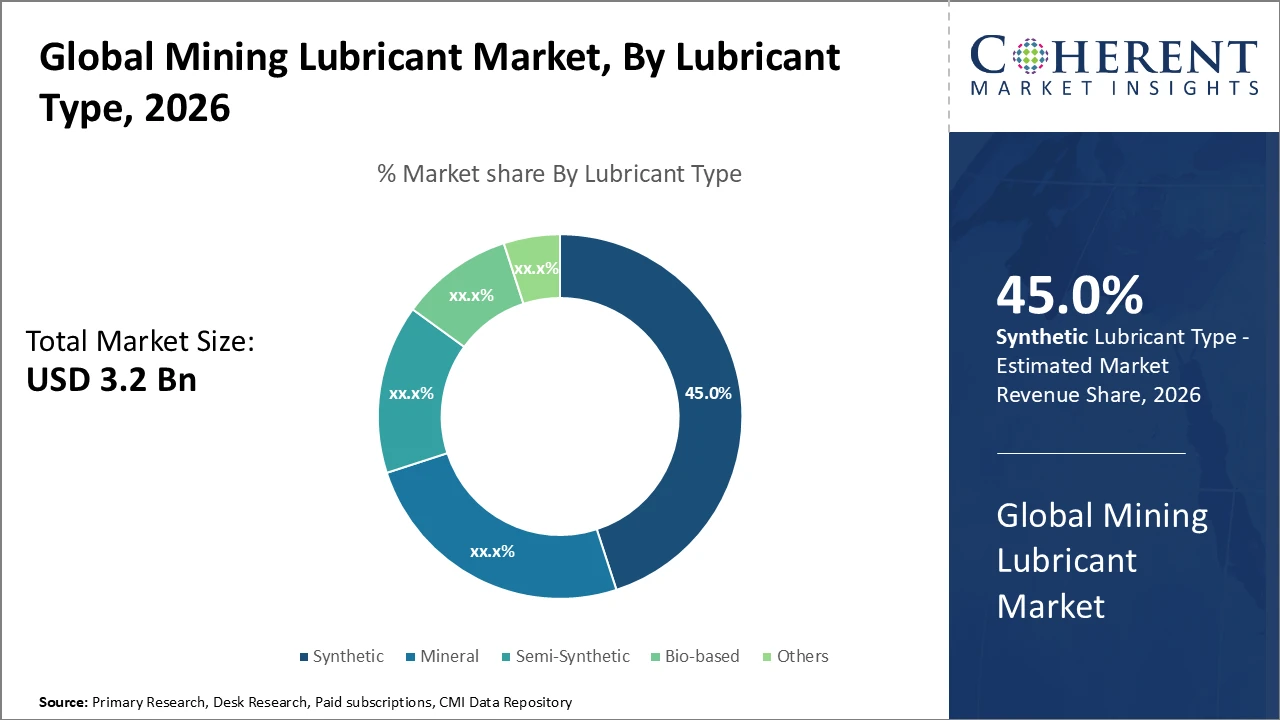
Synthetic lubricants dominate the lubricant type segment with a 45% market share, driven by their superior performance and increasing environmental compliance requirements.
Underground mining applications hold the largest share at 42%, reflecting intensified mining activities that rely on complex machinery requiring specialized lubrication solutions.
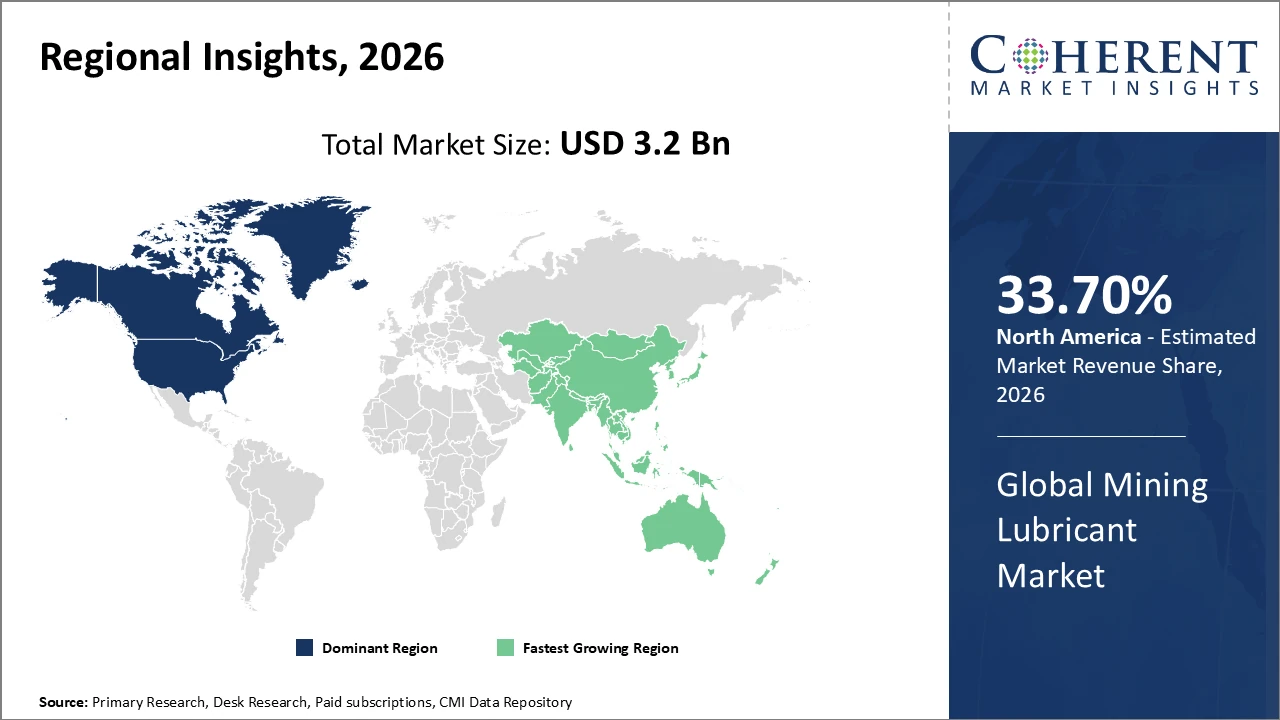
North America controls the market with the highest industry share due to advanced mining infrastructure and strict environmental policies supporting the adoption of premium lubricants.
Asia Pacific exhibits the fastest CAGR, fueled by rising mining investments, rapid urbanization, and increasing production of bio-based lubricants aligned with sustainability initiatives.
Mining Lubricant Market Segmentation Analysis
To learn more about this report, Request Free Sample
Mining Lubricant Market Insights, By Lubricant Type
Synthetic lubricants dominate the mining lubricant market with a 45% share due to their superior thermal stability, oxidation resistance, and ability to perform under extreme mining conditions. These lubricants help reduce friction, minimize equipment wear, and extend machinery life, making them ideal for high-stress mining operations. Their strong performance and compliance with strict environmental regulations have increased their adoption across major mining regions. Semi-synthetic lubricants are experiencing faster growth as they offer a balance between performance and cost efficiency. Mineral lubricants continue to be widely used due to their affordability, particularly in less demanding applications, while bio-based lubricants are gradually gaining attention as sustainable alternatives.
Mining Lubricant Market Insights, By Equipment Type
The heavy machinery segment holds a significant share in the mining lubricant market due to the extensive use of large equipment in mining extraction, material handling, and transportation. Equipment such as excavators, haul trucks, and loaders require high-performance lubricants to reduce friction, prevent wear, and ensure reliable operation under heavy loads and harsh environments. Continuous innovations in lubricant formulations are improving equipment efficiency and extending service intervals. Conveyor systems represent the fastest-growing subsegment, driven by increasing automation and the demand for uninterrupted material transport in large mining operations. Crushers and drills also require specialized lubricants capable of handling high pressure, heavy loads, and extreme temperatures.
Mining Lubricant Market Insights, By Application
Underground mining holds a dominant 42% share of the mining lubricant market, supported by the increasing complexity of underground extraction equipment that requires specialized lubricants capable of operating under high pressure, heavy loads, and low oxygen environments. These lubricants help maintain machinery efficiency, reduce wear, and ensure operational reliability in confined mining conditions. Continuous research and development in advanced lubricant additives has further improved their performance in underground applications. Open-pit mining is the fastest-growing application segment due to expanding surface mining projects worldwide. Additionally, drilling and crushing equipment require specialized lubricants to enhance mechanical efficiency and durability in harsh mining environments.
Mining Lubricant Market Trends
The mining lubricant market is witnessing a strong shift toward sustainable and high-performance lubricants as companies aim to reduce environmental impact and improve operational efficiency.
Mining operators are increasingly adopting biodegradable and bio-based lubricants to comply with stricter environmental regulations, particularly in regions with high ecological sensitivity.
Latin America experienced notable growth in bio-lubricant consumption, driven by stricter government regulations on discharge and environmental protection in mining activities.
The integration of smart lubrication technologies is emerging as a major trend, with IoT sensors enabling real-time monitoring of lubricant conditions and equipment performance.
These advanced monitoring systems help reduce maintenance costs, prevent equipment failures, and improve operational reliability in mining operations.
Continuous research and development efforts are also improving lubricant formulations to suit modern mining machinery and demanding operational environments, supporting long-term market growth.
Mining Lubricant Market Insights, By Geography
To learn more about this report, Request Free Sample
North America Mining Lubricant Market Analysis and Trends
North America holds a dominant position in the mining lubricant market due to its advanced mining infrastructure, strong technological capabilities, and strict environmental regulations that encourage the use of high-performance and eco-friendly lubricants. The United States represents the largest share within the region, driven by significant mining investments and the growing use of automated and heavy mining machinery requiring specialized lubrication solutions. Mining companies in the region prioritize high-quality lubricants to improve equipment efficiency and reduce operational downtime. Additionally, strong collaboration between lubricant manufacturers and major mining firms, along with continuous innovation in lubricant formulations, supports steady market growth across North America.
Asia Pacific Mining Lubricant Market Analysis and Trends
Asia Pacific is experiencing the fastest growth in the mining lubricant market, with a CAGR exceeding 8%, supported by rapid industrialization and expanding mining activities across major economies such as China, India, and Australia. Increasing infrastructure development and urbanization in the region are driving demand for raw materials, which in turn boosts mining production and the need for efficient lubrication solutions. Governments are also encouraging the adoption of environmentally friendly and bio-based lubricants through supportive policies and sustainability initiatives. Additionally, lubricant manufacturers are expanding local production and strengthening distribution networks to meet rising demand and take advantage of the region’s strong market growth potential.
Mining Lubricant Market Outlook for Key Countries
USA Mining Lubricant Market Analysis and Trends
The U.S. mining lubricant market is supported by strong technological advancements and strict environmental regulations that encourage the adoption of high-performance synthetic and biodegradable lubricants. Growing automation in mining operations has increased the demand for specialized lubricants that enhance equipment efficiency and reduce maintenance requirements. Underground mining activities, particularly in coal and metal mining, continue to drive lubricant consumption as machinery operates under extreme conditions. Major lubricant manufacturers are investing heavily in research and development to produce low-emission and energy-efficient formulations compatible with modern mining equipment. Additionally, digital lubricant management systems are improving supply chain efficiency and inventory control, supporting steady market growth.
Germany Mining Lubricant Market Analysis and Trends
Germany’s mining lubricant market is shaped by advanced industrial infrastructure, stringent environmental regulations, and a focus on sustainable operations. The adoption of synthetic and bio-based lubricants is increasing to comply with strict EU ecological standards, while reducing equipment wear and operational costs. Underground and open-pit mining operations rely on high-performance lubricants capable of withstanding heavy loads, high temperatures, and abrasive conditions. Technological innovations, including smart lubrication monitoring systems, enhance predictive maintenance and operational efficiency. Leading global and regional lubricant manufacturers are investing in R&D and local production facilities to cater to Germany’s evolving mining sector, driving market growth and supporting sustainable mining practices.
Analyst Opinion
Supply-side dynamics show increased production capacities for synthetic and biodegradable lubricants, driven by regulatory pressures and sustainability mandates; in 2025, global synthetic lubricant output rose by 18%, with North America contributing over 45% of this growth, highlighting its impact on market expansion.
Demand-side indicators reveal strong import growth of specialty mining lubricants in emerging markets such as India and Brazil, with import volumes increasing 22% and 17% respectively in 2026, reflecting rising mining activities and shifting regional demand.
Pricing trends indicate steady growth in average selling prices for premium mining lubricants, rising approximately 5% in 2024 due to higher raw material costs and value-added formulations, as miners invest in enhanced equipment longevity.
Application-wise, rising underground and open-pit mining activities significantly boost lubricant consumption; for example, underground mining lubricant demand in Russia grew 25% in 2025 amid intensified extraction projects, strengthening market share in this segment.
Market Scope
| Report Coverage | Details | ||
|---|---|---|---|
| Base Year: | 2025 | Market Size in 2026: | USD 3.2 billion |
| Historical Data for: | 2020 To 2024 | Forecast Period: | 2026 To 2033 |
| Forecast Period 2026 to 2033 CAGR: | 7.1% | 2033 Value Projection: | USD 5.1 billion |
| Geographies covered: |
|
||
| Segments covered: |
|
||
| Companies covered: | Shell, Chevron, TotalEnergies, Sinopec, FUCHS, BP, Castrol, Valvoline, Lubrizol, Philips 66 | ||
| Growth Drivers: |
|
||
Uncover macros and micros vetted on 75+ parameters: Get instant access to report
Mining Lubricant Market Growth Factors
The growing adoption of synthetic and bio-based lubricants, driven by stringent environmental regulations, is a key factor accelerating mining lubricant market growth. Global mandates limiting hydrocarbon emissions are encouraging companies to switch to eco-friendly alternatives. Increasing mechanization and automation in mining operations demand high-performance lubricants capable of withstanding extreme pressures, temperatures, and heavy loads, boosting consumption. Rapid industrialization and infrastructure projects across Asia Pacific are driving higher mining activity, further supporting market revenue growth. Additionally, frequent replacement cycles and ongoing maintenance of mining equipment require reliable lubrication solutions, reinforcing steady demand and sustaining long-term expansion in the global mining lubricant market.
Mining Lubricant Market Development
In October 2025, Syensqo announced the global availability of high-performance elastomers and lubricant fluids with certified circular content produced at its Spinetta Marengo Plant.
Key Players
Leading Companies of the Market
Shell
Chevron
TotalEnergies
Sinopec
FUCHS
BP
Castrol
Valvoline
Lubrizol
Philips 66
Several leading companies in the mining lubricant market have embraced digitalization and sustainability-focused strategies to enhance efficiency and competitiveness. For instance, in 2025, Shell launched a blockchain-enabled lubricant traceability system, which led to a 15% reduction in supply chain inefficiencies by improving tracking and transparency across distribution channels. Similarly, in 2026, ExxonMobil collaborated with mining OEMs to develop low-emission lubricants, resulting in a 12% increase in mining equipment lifespan under real-world field conditions. These initiatives demonstrate how innovation in technology and environmentally friendly formulations is driving operational performance and strengthening market positioning for key players.
Mining Lubricant Market Future Outlook
The future of the mining lubricant market is expected to be shaped by increasing automation, digitalization, and sustainability initiatives. Demand for high-performance synthetic and bio-based lubricants will continue to grow as mining operations seek to reduce equipment wear, extend machinery life, and comply with stricter environmental regulations. Integration of smart lubrication technologies, such as IoT-enabled monitoring systems, will enhance predictive maintenance and operational efficiency. Rapid industrialization in emerging regions and ongoing infrastructure development will further boost lubricant consumption. Additionally, continuous research and development by key players will drive innovation in specialized formulations, ensuring the market remains resilient and growth-oriented over the coming decade.
Mining Lubricant Market Historical Analysis
The mining lubricant market has experienced steady growth over the past decade, driven by expanding mining activities, mechanization, and increasing demand for heavy machinery maintenance. Historically, mineral-based lubricants dominated due to their cost-effectiveness, while synthetic and semi-synthetic lubricants gradually gained traction for high-performance applications. Regions such as North America and Europe led the market, supported by advanced mining infrastructure and stringent environmental regulations promoting eco-friendly lubricants. Asia Pacific emerged as a significant growth region due to rapid industrialization and large-scale surface mining projects. Technological advancements, including the introduction of additive-enhanced and high-temperature-resistant lubricants, have historically improved equipment efficiency and reduced operational downtime, shaping market evolution.
Sources
Primary Research Interviews:
Mining OEMs and lubricant product managers
Mining operators and fleet maintenance supervisors
Industrial lubricant suppliers and distributors
Mining equipment aftermarket service providers
Industry consultants and mechanical engineers specializing in mining operations
Magazines:
Lubrication Engineering – Industry Updates & Technology
Plant Engineering – Industrial Maintenance & Lubrication
Mining Global – Equipment & Operational Insights
World Oil – Drilling, Extraction, and Lubricant Trends
Journals:
Tribology International – Wear & Lubrication Research
Journal of Mining Science – Equipment Performance Studies
Wear – Materials & Lubricant Interaction Research
Industrial Lubrication and Tribology – Formulations & Applications
Newspapers:
The Wall Street Journal – Mining Equipment & Industrial Markets
Financial Times – Global Commodity & Mining Sector Analysis
Reuters – Mining Industry News & Supply Chain Developments
Bloomberg – Industrial Commodity & Machinery Trends
Associations:
Society of Tribologists and Lubrication Engineers (STLE)
International Council on Mining and Metals (ICMM)
The Lubricants Industry Association (LIA)
American Petroleum Institute (API)
Share
Share
Vidyesh Swar is a seasoned Consultant with a diverse background in market research and business consulting. With over 6 years of experience, Vidyesh has established a strong reputation for his proficiency in market estimations, supplier landscape analysis, and market share assessments for tailored research solution. Using his deep industry knowledge and analytical skills, he provides valuable insights and strategic recommendations, enabling clients to make informed decisions and navigate complex business landscapes.

Credibility and Certifications

860519526

9001:2015
27001:2022


Need a Custom Report?
We can customize every report - free of charge - including purchasing stand-alone sections or country-level reports
Customize NowJoining thousands of companies around the world committed to making the Excellent Business Solutions.
View All Our Clients