Petrochemicals Market Analysis & Forecast: 2026-2033

Petrochemicals Market Size and Forecast – 2026 – 2033
The Global Petrochemicals Market size is estimated to be valued at USD 720 billion in 2026 and is expected to reach USD 1110 billion by 2033, exhibiting a compound annual growth rate (CAGR) of 6.7% from 2026 to 2033.
Global Petrochemicals Market Overview
The petrochemicals market comprises a wide range of chemical products derived from petroleum and natural gas. Key product segments include olefins (ethylene, propylene, butadiene), aromatics (benzene, toluene, xylene), polyolefins (polyethylene, polypropylene), and specialty chemicals used in adhesives, coatings, and resins. These products serve as critical raw materials for industries such as plastics, automotive, construction, textiles, packaging, and consumer goods. Growing demand for lightweight materials, high-performance plastics, and sustainable chemical solutions is driving innovation across the product portfolio. With versatile applications and constant technological advancements, petrochemicals remain foundational to the global manufacturing and industrial ecosystem.
Key Takeaways
The Olefins segment holds the largest industry share due to strong demand for ethylene and propylene derivatives used extensively in packaging and automotive sectors.
Polymers, as an application segment, is experiencing the fastest growth because of innovations in lightweight and recyclable materials.
Naphtha remains the dominant feedstock owing to established infrastructure and supply chains.
Renewable feedstocks show promising growth potential, reflecting evolving market trends.
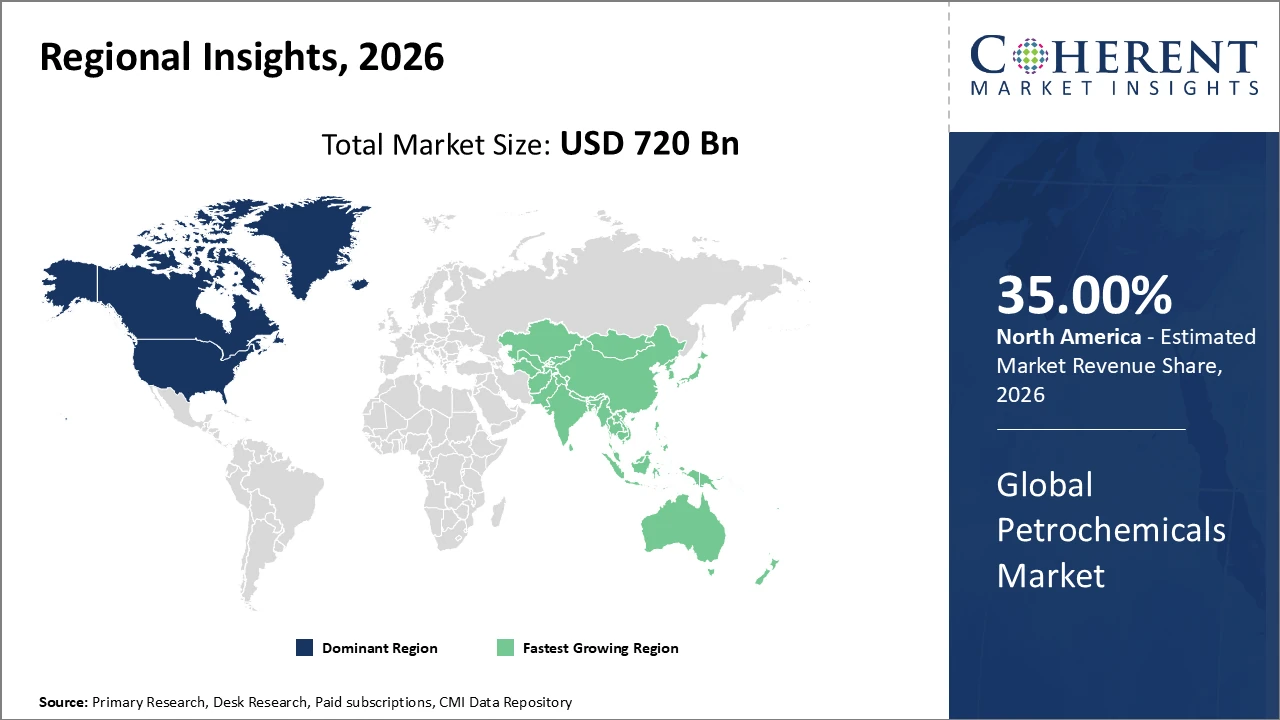
North America commands significant market share, supported by a strong industry presence and technological advancements led by the U.S.
Asia Pacific is the fastest-growing region, driven by rapid urbanization and investments in chemical industries, particularly in China and India.
China and India exemplify dynamic market ecosystems and increasing revenue streams.
Petrochemicals Market Segmentation Analysis
To learn more about this report, Request Free Sample
Petrochemicals Market Insights, By Product Type
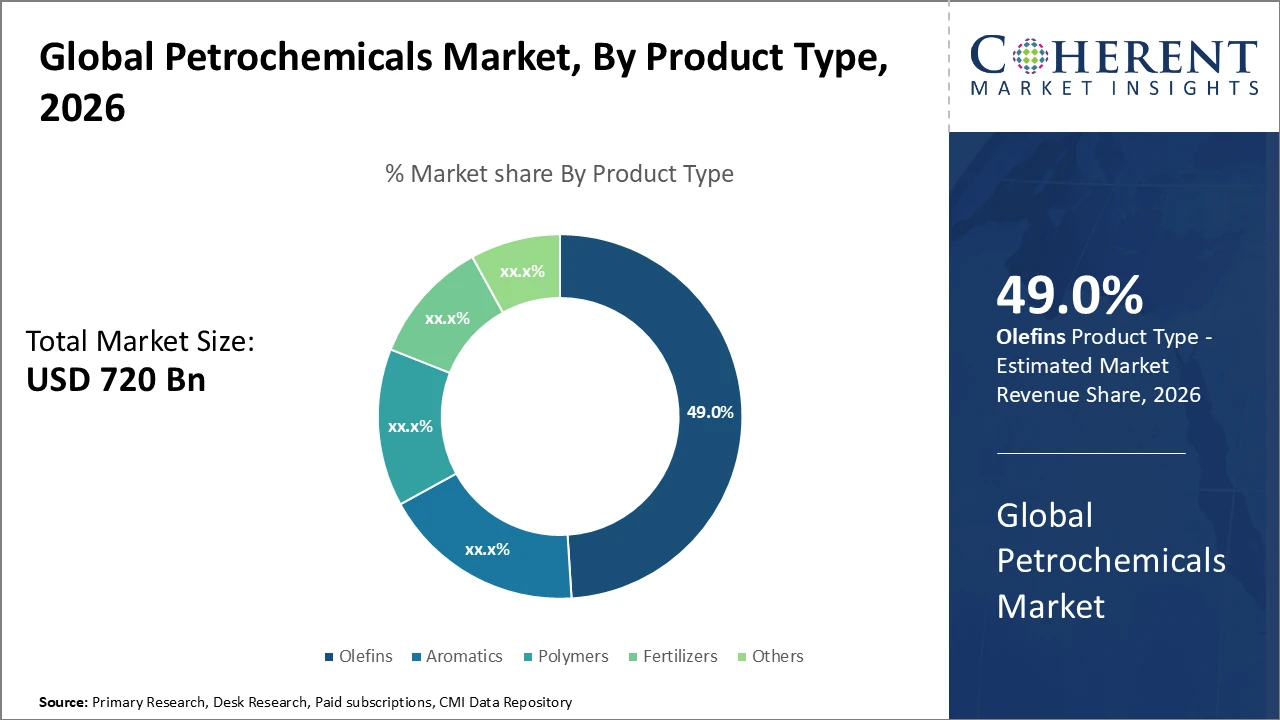
Olefins dominate the petrochemicals market, accounting for approximately 45% of the product share. They serve as essential feedstocks for polyethylene and polypropylene, widely used in packaging and automotive applications. Growing demand for lighter and stronger polymer materials drives continuous innovation in olefin derivatives, sustaining their market leadership. The fastest-growing subsegment is Polymers, fueled by expanding end-use applications and improvements in material performance. Aromatics contribute to steady growth as precursors for synthetic fibers and resins, while Fertilizers and other niche products cater to specialized industrial needs, experiencing moderate expansion. Overall, product diversification and innovation underpin market growth.
Petrochemicals Market Insights, By Application
Packaging dominates the petrochemicals market, driven by rising demand for flexible and sustainable polymer solutions in the food and e-commerce sectors, supported by technological advancements improving recyclability and barrier properties. The fastest-growing application is Automotive, propelled by lightweight composite materials and regulatory requirements to reduce vehicle emissions. Construction applications, including insulation materials and coatings, exhibit steady and robust growth. Textiles and Consumer Goods utilize petrochemical-based fibers and plastics to meet the needs of the fashion, electronics, and household goods industries. Overall, increasing application diversification and innovation continue to strengthen market expansion across sectors.
Petrochemicals Market Insights, By Feedstock Type
Naphtha dominates the petrochemicals market as the preferred feedstock, supported by well-established processing infrastructure and reliable supply chains, ensuring seamless integration across major markets. The fastest-growing subsegment is Renewable Feedstocks, driven by a strategic shift toward sustainable, bio-based raw materials to address environmental concerns and comply with stricter regulations, attracting accelerated investments. Natural Gas Liquids offer cost advantages in regions rich in shale gas, while coal and other feedstocks maintain smaller shares, catering to regional availability and specific product requirements. Overall, feedstock selection reflects a balance between established practices and emerging sustainable trends.
Petrochemicals Market Trends
The petrochemicals market is increasingly adopting circular economy models, emphasizing recycling and reuse of polymers.
Collaborations between petrochemical producers and recyclers have enhanced post-consumer resin incorporation, exceeding 20% in some products by 2025.
The shift toward bio-based and circular feedstocks is influencing investment patterns, with commercial-scale production of bio-ethylene and bio-propylene expected by 2026.
Digital transformation, including AI and IoT-driven process optimization, is improving operational efficiency and supply chain responsiveness.
These developments reflect a trend toward sustainability and resilience, addressing challenges such as feedstock volatility and regulatory pressures.
Petrochemicals Market Insights, By Geography
To learn more about this report, Request Free Sample
North America Petrochemicals Market Analysis and Trends
The North America petrochemicals market is characterized by a strong industry presence, advanced technological infrastructure, and access to abundant feedstocks, particularly shale gas. The region benefits from ongoing investments in petrochemical production, capacity expansions, and adoption of digital technologies like AI and IoT to optimize operations and supply chains. Key trends include a growing focus on sustainable and circular economy initiatives, increased use of recycled and bio-based feedstocks, and innovations in high-performance polymers for automotive, packaging, and construction applications. Regulatory support, combined with robust R&D activities, positions North America as a mature yet evolving market with steady growth prospects.
Asia Pacific Petrochemicals Market Analysis and Trends
In Asia Pacific, the petrochemicals market is dominated by large industrial hubs in China, India, and Southeast Asia, accounting for around 40% of the global market share in 2026. Growth is driven by supportive government policies promoting chemical industry modernization, abundant availability of feedstocks, and export-friendly trade dynamics. Major players, including SABIC and Reliance Industries, have expanded production capacities, reinforcing the region’s leadership in the sector. Rapid urbanization, industrial investments, and technological advancements further strengthen market growth. Overall, Asia Pacific’s strategic infrastructure and favorable business environment underpin its dominant and expanding role in the global petrochemicals market.
Petrochemicals Market Outlook for Key Countries
USA Petrochemicals Market Analysis and Trends
The U.S. petrochemicals market is driven by technological leadership and abundant shale gas production, which reduced feedstock costs by nearly 20% compared to global benchmarks in 2025. Major players, including Dow Inc., ExxonMobil, and LyondellBasell, dominate the market with production capacities exceeding 40 million tons per annum. Industry growth is further supported by innovations in sustainable petrochemical production, such as advanced plastic recycling initiatives and the adoption of bio-based feedstocks. Favorable regulatory frameworks and supportive policies enhance competitiveness, investment opportunities, and overall business growth, positioning the U.S. as a leading and resilient market in the global petrochemicals landscape.
Germany Petrochemicals Market Analysis and Trends
Germany’s petrochemicals market is driven by its strong industrial base, advanced manufacturing capabilities, and strategic position within the European Union. The country benefits from well-established infrastructure, skilled workforce, and access to diversified feedstocks, supporting large-scale production of polymers, specialty chemicals, and aromatics. Key trends include a focus on sustainability, with investments in bio-based feedstocks, chemical recycling, and energy-efficient processes. The automotive, construction, and packaging sectors continue to fuel demand for high-performance materials. Government initiatives promoting innovation, environmental compliance, and circular economy practices further strengthen the market, making Germany a critical hub for petrochemical production and technological advancement in Europe.
Analyst Opinion
Advanced catalytic reforming technologies have significantly increased production capacity. In 2024, capacity expansions in Asia Pacific accounted for over 22% of the total global increase, enhancing feedstock efficiency and lowering unit costs, supporting overall market growth and influencing regional market share distribution.
Demand-side shifts show substantial import changes, particularly from Middle Eastern feedstock producers to Asian manufacturers. In 2025, Asia Pacific's imports of naphtha and ethylene derivatives rose by 14%, driving revenue expansion and affecting pricing and local supply-demand balance.
Feedstock price volatility, influenced by crude oil fluctuations, impacts pricing strategies. Price corrections in 2026 following crude stabilization led to a 5% reduction in average petrochemical prices, stimulating downstream demand in emerging markets.
Adoption of bio-based polymers increased by 18% in 2024, reflecting a shift toward sustainability and creating new revenue streams, reshaping competitive advantages for market players.
Market Scope
| Report Coverage | Details | ||
|---|---|---|---|
| Base Year: | 2025 | Market Size in 2026: | USD 720 billion |
| Historical Data for: | 2020 To 2024 | Forecast Period: | 2026 To 2033 |
| Forecast Period 2026 to 2033 CAGR: | 6.7% | 2033 Value Projection: | USD 1,110 billion |
| Geographies covered: |
|
||
| Segments covered: |
|
||
| Companies covered: | SABIC, Dow Inc., INEOS Group, BASF SE, Shell Chemicals, Eastman Chemical Company, Braskem, NOVA Chemicals, TotalEnergies, LG Chem | ||
| Growth Drivers: |
|
||
Uncover macros and micros vetted on 75+ parameters: Get instant access to report
Petrochemicals Market Growth Factors
Sustained industrialization and urbanization in Asia Pacific and Latin America continue to drive petrochemical demand, particularly for construction and automotive applications, with India’s infrastructure spending reaching USD 1.4 trillion in 2024, boosting polymers consumption. Technological advancements in catalyst design and process intensification have enhanced production efficiency, with leading companies reporting a 12% increase in yields in 2025. Tightening environmental regulations globally are encouraging firms to adopt sustainable production methods and bio-based feedstocks, exemplified by EU policy reforms in 2026. Additionally, the packaging sector, especially flexible packaging using petrochemical-based polymers, grew at a CAGR of 7.3% between 2024 and 2026, reflecting evolving consumer preferences and e-commerce expansion.
Petrochemicals Market Development
In September 2025, China Petroleum & Chemical Corp. (Sinopec) and Saudi Aramco established a joint venture to develop and operate a RMB 71.1 billion ($9.8 billion) refining and petrochemical complex in Fujian province, marking a significant expansion of energy cooperation between China and Saudi Arabia.
Key Players
Leading Companies of the Market
SABIC
Dow Inc.
INEOS Group
BASF SE
Shell Chemicals
Eastman Chemical Company
Braskem
NOVA Chemicals
TotalEnergies
LG Chem
Several petrochemical companies implemented aggressive expansion and diversification strategies in 2025. SABIC invested heavily in renewable feedstock technologies, boosting its market footprint across Asia Pacific by 15% and strengthening its position in key emerging markets. Meanwhile, LyondellBasell pursued strategic partnerships focused on circular economy initiatives, resulting in a 10% increase in market share in Europe. These initiatives reflect a broader industry trend toward sustainability and innovation, combining capacity expansion with environmentally conscious practices. By leveraging both technological advancement and collaborative strategies, leading companies enhanced competitiveness while addressing evolving regulatory requirements and growing demand for sustainable petrochemical solutions.
Petrochemicals Market Future Outlook
The global petrochemicals market is expected to witness steady growth driven by rising demand across packaging, automotive, construction, and consumer goods sectors. Technological advancements in process optimization, catalyst design, and digitalization will enhance production efficiency and operational resilience. The industry is also shifting toward sustainable and circular practices, with increasing adoption of bio-based feedstocks, recycled polymers, and green chemistry solutions. Asia Pacific is likely to maintain its leading position, while North America and Europe will focus on innovation and regulatory compliance. Overall, market growth will be shaped by evolving consumer preferences, environmental regulations, and continued industrial expansion worldwide.
Petrochemicals Market Historical Analysis
The global petrochemicals market has experienced steady growth over the past decade, driven by industrialization, urbanization, and rising demand from end-use sectors such as packaging, automotive, construction, and consumer goods. Olefins and aromatics historically dominated product segments, while polymers emerged as the fastest-growing application. Asia Pacific, led by China and India, accounted for a significant share due to large-scale manufacturing hubs and abundant feedstocks. North America and Europe contributed through technological advancements and strong industrial infrastructure. Historical trends also reflect gradual adoption of sustainable practices, including early recycling initiatives and bio-based feedstock use, setting the stage for future market evolution.
Sources
Primary Research Interviews:
Petrochemical plant managers
Chemical engineers and process specialists
Supply chain and logistics managers
Industry consultants and market analysts
Databases:
International Energy Agency (IEA) Statistics
Organization of the Petroleum Exporting Countries (OPEC) Data
United Nations Comtrade Database
World Bank Energy Data
Magazines:
Chemical Week
Plastics Today
ICIS Chemical Business
Hydrocarbon Processing
Chemical & Engineering News
Journals:
Journal of Petroleum Science and Engineering
Industrial & Engineering Chemistry Research
Polymer Engineering and Science
Chemical Engineering Journal
Journal of Applied Polymer Science
Newspapers:
Financial Times (Energy & Commodities)
The Wall Street Journal (Markets & Energy)
Reuters (Commodities & Chemicals)
Bloomberg (Energy & Chemicals)
Associations:
American Chemistry Council (ACC)
European Chemical Industry Council (Cefic)
International Energy Agency (IEA)
World Petrochemical Association
Society of Chemical Industry (SCI)
Share
Share
Vidyesh Swar is a seasoned Consultant with a diverse background in market research and business consulting. With over 6 years of experience, Vidyesh has established a strong reputation for his proficiency in market estimations, supplier landscape analysis, and market share assessments for tailored research solution. Using his deep industry knowledge and analytical skills, he provides valuable insights and strategic recommendations, enabling clients to make informed decisions and navigate complex business landscapes.

Credibility and Certifications

860519526


9001:2015

27001:2022


Need a Custom Report?
We can customize every report - free of charge - including purchasing stand-alone sections or country-level reports
Customize NowJoining thousands of companies around the world committed to making the Excellent Business Solutions.
View All Our Clients