Polyamide 12 Market Analysis & Forecast: 2026-2033

The Polyamide 12 Market is estimated to be valued at USD 1.6 Bn in 2026 and is expected to reach USD 1.98 Bn by 2033, exhibiting a compound annual growth rate (CAGR) of 16.9% from 2026 to 2033.
The Polyamide 12 (PA12) market is rapidly expanding as industries leverage its versatile properties, such as high chemical resistance, durability, and dimensional stability. Manufacturers favor its lightweight yet strong nature for automotive, aerospace, electronics, and industrial applications. Growing demand for fuel-efficient vehicles, electric mobility, and advanced manufacturing technologies, including 3D printing, drives its adoption. Companies continue to innovate specialty grades and expand production, positioning PA12 as a high-performance alternative to metals and conventional polymers.
|
Current Events |
Description and its impact |
|
Geopolitical and Trade Dynamics |
|
|
Technological Advancements in Polymer Production |
|
|
Regional Infrastructure and Industrial Policies |
|
Uncover macros and micros vetted on 75+ parameters: Get instant access to report
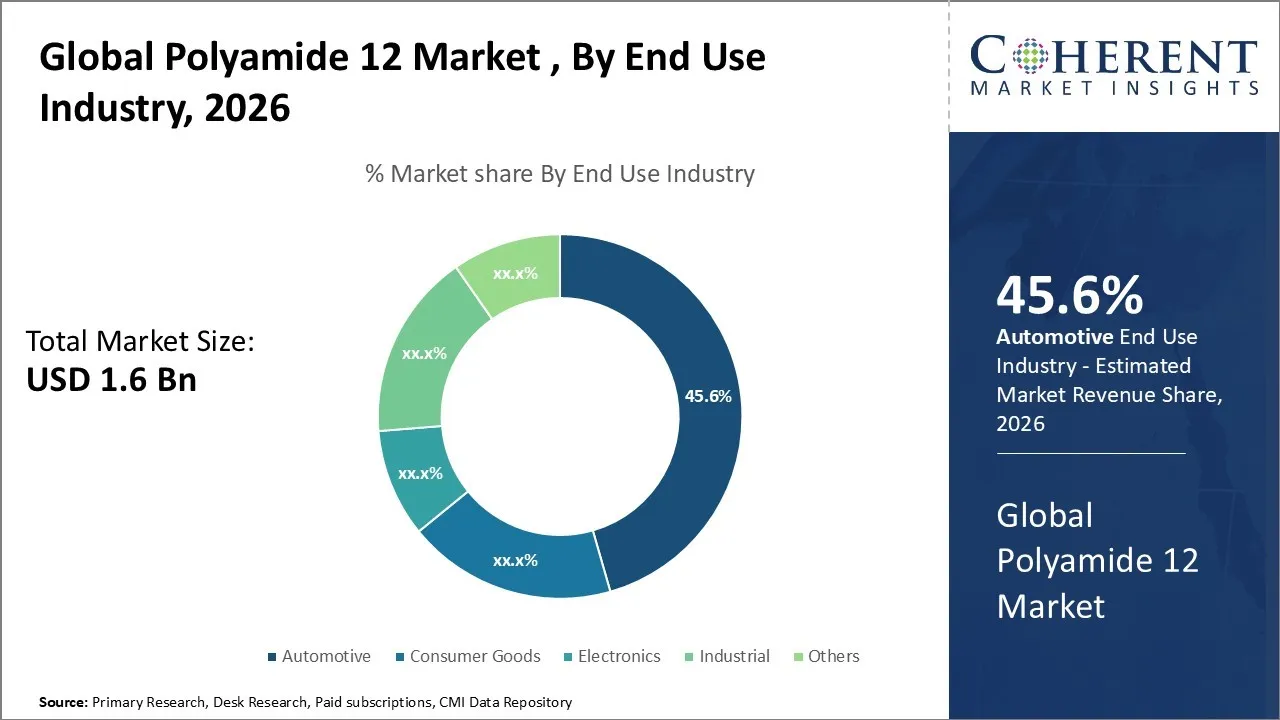
Automotive hold the largest market share of 45.6% in 2026. The automotive industry actively drives Polyamide 12 (PA12) demand by utilizing its combination of strength, flexibility, chemical resistance, and lightweight properties. Manufacturers apply PA12 in fuel lines, brake systems, connectors, and under-the-hood components to boost performance and durability. The move toward electric and hybrid vehicles, stricter emissions standards, and the focus on lightweighting to improve fuel efficiency accelerate its adoption. Companies also leverage PA12’s compatibility with advanced manufacturing methods, including 3D printing, to produce complex parts and enable rapid prototyping.
To learn more about this report, Download Free Sample
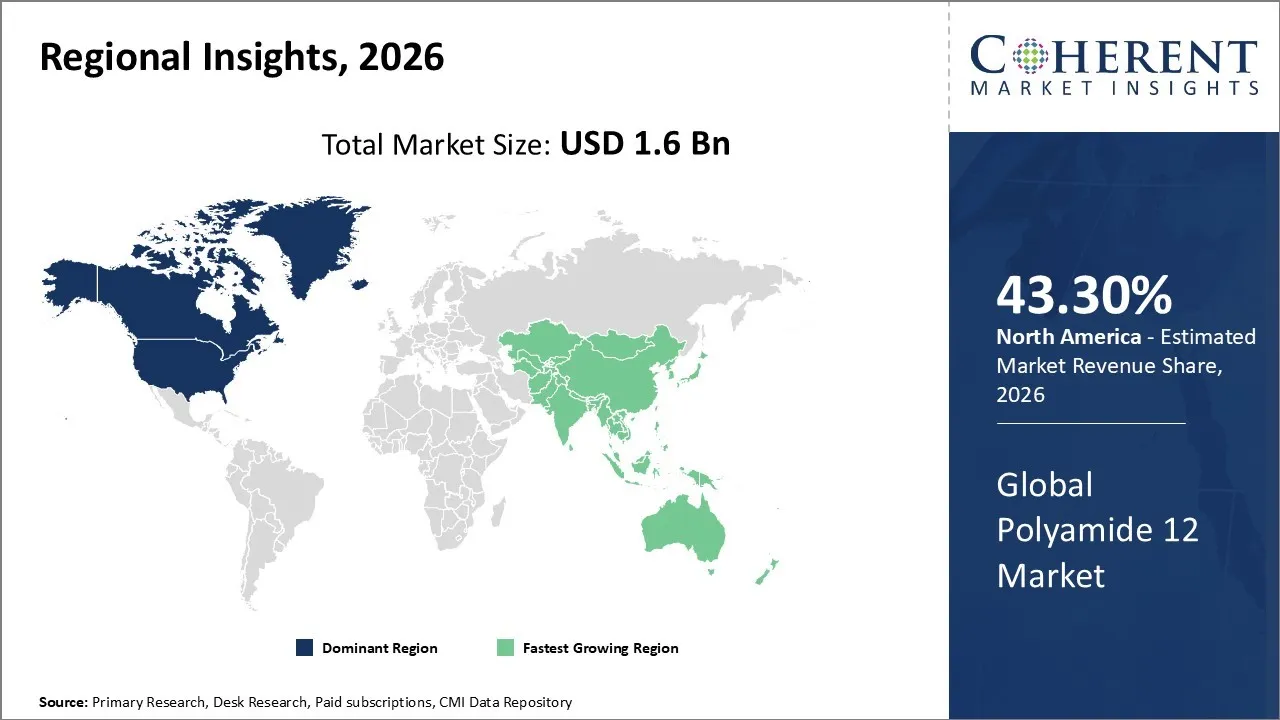
North America dominates the overall market with an estimated share of 43.30% in 2026. In North America, industries are driving the Polyamide 12 (PA12) market by increasingly using it in automotive, aerospace, and industrial applications that require durability, chemical resistance, and lightweight performance. Companies adopt PA12 more widely as electric vehicles gain popularity and advanced manufacturing methods, such as additive production, expand. Regional innovators develop tailored PA12 formulations, and local manufacturers ensure stable supply. Sustainability efforts and the shift toward high-performance polymers over traditional materials continue to shape market growth. For instance, in October 2025, AGY and Orion Compounding have jointly developed a next-generation Nylon PA 12 reinforced with AGY’s S2 Glass fiber, combining high strength, toughness, and processing versatility in a single advanced material.
In the Asia Pacific region, the Polyamide 12 (PA12) market is expanding rapidly as manufacturers tap into broad industrial and automotive growth. China, India, Japan, and South Korea lead demand, driven by increasing vehicle production, especially for electric and lightweight components, and by rising electronics and industrial applications that value PA12’s durability and chemical resistance. Regional firms and global players are boosting capacity, while adoption of advanced manufacturing like 3D printing and sustainability initiatives further shape market trends.
In the United States, manufacturers are driving the Polyamide 12 (PA12) market by using it across automotive, aerospace, electronics, and industrial sectors for its strength, chemical resistance, and lightweight performance. Companies increasingly incorporate PA12 into electric vehicle components and advanced additive manufacturing processes, especially 3D printing, to create complex, high‑precision parts. Innovators continue to develop new material formulations, and the growing focus on sustainability and performance shapes market trends, while local production and technological advancements ensure reliable supply and long-term adoption. For instance, Xenia, unveiled Xecarb PA12-CF-ST, a new carbon fiber-reinforced thermoplastic filament designed for fused filament fabrication (FFF) and fused deposition modeling (FDM) 3D printing.
In India, manufacturers are driving the Polyamide 12 (PA12) market by adopting it for automotive, electronics, and industrial applications, fueled by the demand for lightweight, high-performance materials and rising vehicle production. Companies are increasingly using advanced manufacturing and polymer technologies, supported by government initiatives that encourage domestic production and sustainable practices. Local producers are expanding capacity to serve both domestic and export markets, while overall industrial growth actively shapes material preferences and the adoption of PA12 across diverse applications.
The automotive sector drives PA12 adoption as manufacturers prioritize lightweight, durable materials to improve fuel efficiency and vehicle performance. PA12 is increasingly used in fuel lines, connectors, brake systems, and under-the-hood components due to its chemical resistance and strength. The rise of electric and hybrid vehicles further accelerates adoption, as PA12 supports high-voltage insulation, battery components, and thermal management systems, positioning it as a critical material for next-generation mobility solutions.
PA12 is emerging as a preferred material for additive manufacturing, especially 3D printing, due to its mechanical strength, flexibility, and precision capabilities. Industries use PA12 to create lightweight, complex geometries that are difficult to produce with traditional methods. Rising adoption of rapid prototyping, functional end-use parts, and industrial tooling is driving demand. Suppliers are developing specialized PA12 powders and filaments optimized for different printing technologies, enabling faster production cycles and cost-effective, high-performance applications.
The shift toward electric and hybrid vehicles opens a major opportunity for PA12 as manufacturers seek lightweight, chemically resistant materials for battery casings, cooling systems, connectors, and insulation components. PA12’s durability and thermal stability make it ideal for high-voltage applications. Increasing EV production worldwide allows suppliers to offer specialized grades tailored for energy efficiency and safety requirements, positioning PA12 as a critical material in the sustainable mobility transition.
| Report Coverage | Details | ||
|---|---|---|---|
| Base Year: | 2025 | Market Size in 2026: | USD 1.6 Bn |
| Historical Data for: | 2020 To 2024 | Forecast Period: | 2026 To 2033 |
| Forecast Period 2026 to 2033 CAGR: | 16.9% | 2033 Value Projection: | USD 1.98 Bn |
| Geographies covered: |
|
||
| Segments covered: |
|
||
| Companies covered: |
Arkema Group, DowDuPont Inc., Ensinger GmbH, Evonik Industries AG, UBE Industries Inc., Techmer PM LLC., Invista, EMS-Chemie Holding AG, RTP Company Inc., Toray Industries Inc., Formulated Polymers Limited, and Merck KGaA |
||
| Growth Drivers: |
|
||
| Restraints & Challenges: |
|
||
Uncover macros and micros vetted on 75+ parameters: Get instant access to report
Share
Share
Vidyesh Swar is a seasoned Consultant with a diverse background in market research and business consulting. With over 6 years of experience, Vidyesh has established a strong reputation for his proficiency in market estimations, supplier landscape analysis, and market share assessments for tailored research solution. Using his deep industry knowledge and analytical skills, he provides valuable insights and strategic recommendations, enabling clients to make informed decisions and navigate complex business landscapes.
Joining thousands of companies around the world committed to making the Excellent Business Solutions.
View All Our Clients