Resuscitation Masks Market Analysis & Forecast: 2026-2033

Resuscitation Masks Market Size and Forecast – 2026 – 2033
The Global Resuscitation Masks Market size is estimated to be valued at USD 1.45 billion in 2026 and is projected to reach USD 2.67 billion by 2033, registering a compound annual growth rate (CAGR) of 9.3% during the forecast period from 2026 to 2033.
Global Resuscitation Masks Market Overview
The resuscitation masks market is driven by the rising incidence of respiratory conditions such as Chronic Obstructive Pulmonary Disease and Cardiac Arrest, which increase the need for emergency airway management. Growing awareness of CPR and first-response training programs, supported by organizations like the American Heart Association, boosts adoption across public and healthcare settings. Expanding emergency medical services, along with stricter safety regulations for infection control, further accelerates demand. Additionally, increasing hospital admissions, rising geriatric populations, and the need for portable, single-use devices in ambulances and home care environments continue to support steady market growth.
Key Takeaways
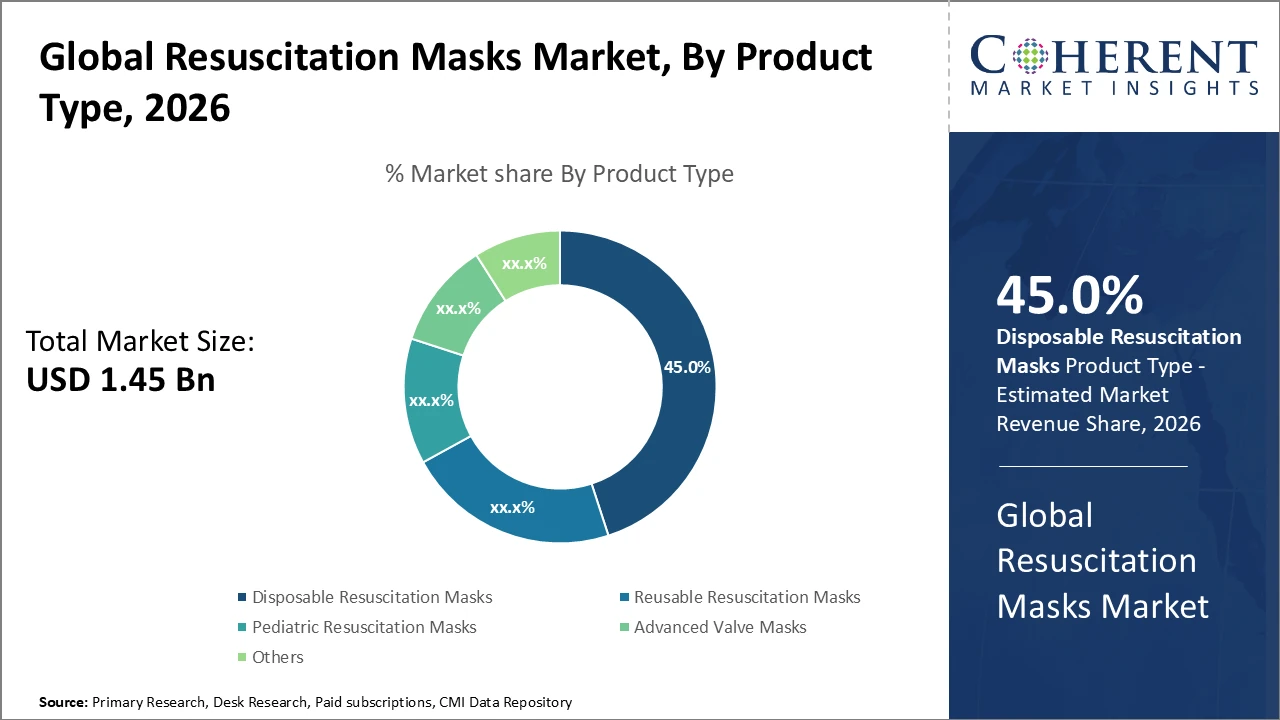
Disposable resuscitation masks represented the largest product segment in 2026, accounting for 45% of market share, driven by cost-effectiveness and infection control benefits.
Hospitals dominate end-user adoption with a 53% industry share, supported by concentrated procurement and mandated emergency preparedness standards.
Silicone-based masks lead the material segment with 57% of market revenue, due to superior biocompatibility and durability.
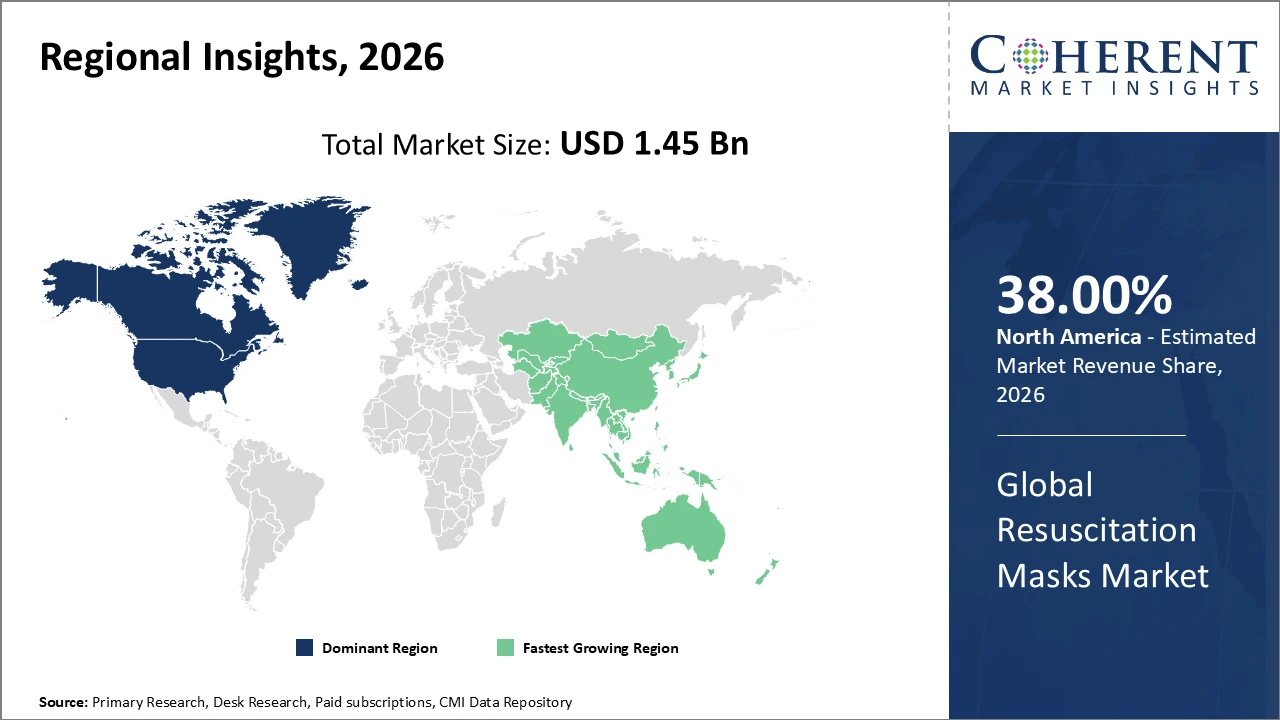
North America holds a major market share, supported by advanced healthcare infrastructure and regulatory frameworks, while Asia Pacific is the fastest-growing region, driven by government health initiatives and expanding emergency service networks.
Resuscitation Masks Market Segmentation Analysis
To learn more about this report, Request Free Sample
Resuscitation Masks Market Insights, By Product Type
Disposable resuscitation masks dominate the market with a 45% share, driven by infection-prevention benefits and convenience in high-turnover clinical settings. Regulatory preferences in emergency care protocols further accelerate their global adoption. Pediatric resuscitation masks are the fastest-growing subsegment, experiencing a 14% annual increase due to heightened focus on neonatal and infant emergency care, allowing safer, tailored interventions. Reusable masks maintain steady demand in ambulatory and hospital settings but face challenges from strict sterilization requirements. Advanced valve masks improve oxygen delivery and efficiency, though they occupy a smaller niche, while hybrid designs cater to specialized applications combining multiple functionalities.
Resuscitation Masks Market Insights, By Material
Silicone leads the resuscitation masks market with a 57% share, valued for its flexibility, comfort, and hypoallergenic properties, making it ideal for patient-sensitive clinical environments. Its durability also supports semi-reusable designs, balancing cost and performance. The fastest-growing subsegment is latex-free materials, which saw an 11% increase in 2025 due to rising allergy concerns and regulatory restrictions on latex in medical devices. PVC remains popular for its low-cost manufacturing, though its use is declining where biocompatibility is critical. Emerging hybrid materials, combining silicone and PVC benefits, are gaining attention for specialized applications, offering enhanced performance and safety in targeted clinical scenarios.
Resuscitation Masks Market Insights, By End User
Hospitals dominate the resuscitation masks market with a 53% share, driven by centralized purchasing and the critical need for emergency preparedness in inpatient care. Their emergency departments and trauma centers consistently integrate resuscitation masks, ensuring steady revenue streams. Ambulance services are the fastest-growing segment, experiencing around 13% annual growth due to government mandates for pre-hospital emergency care and expanded EMS vehicle outfitting. Clinics and home care settings show growing demand, supported by increasing chronic disease prevalence and a focus on home-based emergency readiness. Emergency response units continue specialized acquisitions for rapid deployment during disasters and community emergencies.
Resuscitation Masks Market Trends
Recent trends show a shift toward integrating digital technologies in resuscitation masks, enhancing user feedback and patient monitoring during emergency care.
Successful pilots in European healthcare settings in 2025 demonstrated improvements in procedural efficacy and patient outcomes.
Sustainability is gaining importance, with manufacturers adopting biodegradable materials to replace conventional plastics, led by North American initiatives.
The growth of decentralized healthcare and telemedicine in Asia Pacific is driving rapid adoption of portable resuscitation masks outside traditional clinical environments.
Overall, technological innovation, environmental considerations, and expanding healthcare delivery models are shaping market development globally.
Resuscitation Masks Market Insights, By Geography
To learn more about this report, Request Free Sample
North America Resuscitation Masks Market Analysis and Trends
North America holds a dominant position in the Resuscitation Masks market, accounting for approximately 38% of the global share. This leadership is supported by a robust emergency healthcare infrastructure, strict regulatory frameworks, and significant government investment in pre-hospital and emergency care systems. The United States and Canada contribute majorly to the region’s market revenue, driven by widespread adoption in hospitals, EMS services, and clinics. Leading companies utilize advanced R&D capabilities and extensive distribution networks to introduce innovative products, including digital and AI-integrated masks. Continuous training programs and compliance with regulatory standards further strengthen market penetration and sustained growth across the region.
Asia Pacific Resuscitation Masks Market Analysis and Trends
The Asia Pacific region is the fastest-growing market for resuscitation masks, with a CAGR exceeding 11%, driven by increasing healthcare investments and the expansion of emergency medical services. In 2025, India and China reported a combined 25% rise in demand, fueled by strengthened first responder programs and a growing prevalence of cardiovascular diseases. Market players in the region are focusing on low-cost manufacturing, localized product designs, and strategic partnerships to reach underserved areas. These efforts align with government initiatives aimed at improving rural healthcare access. The combination of rising demand, supportive policies, and cost-effective solutions is fueling robust regional market growth.
Resuscitation Masks Market Outlook for Key Countries
USA Resuscitation Masks Market Analysis and Trends
The U.S. Resuscitation Masks market is the largest globally, supported by significant public and private investments in emergency medical services and out-of-hospital care. In 2024, the National Emergency Medical Services Information System reported a 17% increase in cardiac arrest interventions requiring resuscitation devices, highlighting strong demand growth. Key players, including Philips Healthcare and Ambu A/S, leverage research collaborations with hospitals and emergency networks to enhance mask performance and ensure compliance with FDA regulations. These efforts, combined with widespread adoption in EMS, hospitals, and clinics, help maintain the U.S. market’s leading position while driving innovation and improving patient outcomes.
Germany Resuscitation Masks Market Analysis and Trends
Germany’s Resuscitation Masks market is characterized by strong adoption in hospitals, emergency medical services, and trauma care centers, supported by stringent regulatory standards and high healthcare quality benchmarks. Hospitals remain the primary end-users, with emphasis on disposable and silicone-based masks for infection control and patient safety. Technological advancements, including digital feedback systems and improved valve designs, are increasingly integrated to enhance ventilation efficiency. The market also reflects growing interest in portable and pediatric resuscitation masks to address pre-hospital and neonatal emergencies. Sustainability initiatives promoting biodegradable materials are emerging, while strong local manufacturing and established distribution networks support steady market growth and innovation.
Analyst Opinion
Growing procurement in emergency medical services increased market share for resuscitation masks, with production capacity across major manufacturing hubs rising 15% year-over-year in 2025. Innovations in mask filtration and sealing technology reduced device failure rates by 12%, enhancing healthcare professional confidence globally.
Government-funded health initiatives in Asia Pacific drove an 18% increase in resuscitation mask adoption in 2024, particularly through public first aid training programs, boosting institutional demand and overall market revenue.
Import surges in Latin America rose 22% in the first half of 2026, facilitated by enhanced regional trade agreements, notably in Brazil and Argentina, prompting supply chain-focused growth strategies.
Niche segments, including pediatric and neonatal resuscitation devices, saw above-average growth in 2025, contributing 8% of total market revenue, highlighting increasingly segmented and tailored product development.
Market Scope
| Report Coverage | Details | ||
|---|---|---|---|
| Base Year: | 2025 | Market Size in 2026: | USD 1.45 billion |
| Historical Data for: | 2020 To 2024 | Forecast Period: | 2026 To 2033 |
| Forecast Period 2026 to 2033 CAGR: | 9.3% | 2033 Value Projection: | USD 2.67 billion |
| Geographies covered: |
|
||
| Segments covered: |
|
||
| Companies covered: | Ambu A/S, Philips Healthcare, Medtronic plc, 3M Company, ResMed Inc., Halyard Health, Teleflex Incorporated, Laerdal Medical, Becton Dickinson and Company, Smith Medical | ||
| Growth Drivers: |
|
||
Uncover macros and micros vetted on 75+ parameters: Get instant access to report
Resuscitation Masks Market Growth Factors
The global rise in cardiac arrests and respiratory disorders continues to drive growth in the resuscitation masks market. In 2025, cardiac emergencies accounted for nearly 30% of urban emergency medical calls, increasing demand for reliable resuscitation equipment. Expanding healthcare infrastructure in emerging economies, such as India and Brazil, has boosted procurement volumes. Government-led training and awareness programs enhanced first responder readiness by 12% year-over-year, further supporting market revenue. Technological improvements in mask ergonomics and biocompatible materials have expanded usage beyond hospitals, enabling adoption in ambulatory care, home healthcare, and pre-hospital emergency settings, broadening overall market potential.
Resuscitation Masks Market Development
In February 2026, ResMed launched the AirTouch F30i Comfort mask in the United States, a CPAP full-face mask featuring a soft, breathable fabric design to improve patient comfort and adherence to therapy. The mask includes an ultra-compact structure, a fabric cushion, and a fully fabric-wrapped frame. It follows the earlier release of the AirTouch N30i, a nasal cushion mask with a similar fabric-wrapped design.
Key Players
Leading Companies of the Market
Ambu A/S
Philips Healthcare
Medtronic plc
3M Company
ResMed Inc.
Halyard Health
Teleflex Incorporated
Laerdal Medical
Becton Dickinson and Company
Smith Medical
Several companies in the resuscitation masks market have implemented effective competitive strategies, including product innovation and strategic partnerships. In 2025, Ambu A/S introduced advanced valve technology that improved usability, resulting in a 20% sales increase in North America within nine months. Similarly, Philips Healthcare strengthened its presence in the Asia Pacific region by collaborating with local medical suppliers, leading to a 25% growth in market share in India during 2024. These initiatives demonstrate how innovation, regional partnerships, and targeted distribution strategies are enabling market players to enhance their competitive positioning and expand adoption across key global markets.
Resuscitation Masks Market Future Outlook
The Resuscitation Masks market is expected to experience steady growth driven by rising awareness of emergency preparedness, increasing prevalence of cardiac and respiratory emergencies, and expanding pre-hospital and hospital care infrastructure. Technological advancements, including integrated oxygen delivery systems, improved sealing materials, and AI-assisted ventilation monitoring, will enhance device efficiency and user safety. Demand for portable and easy-to-use masks for bystander CPR and first responders is projected to grow, particularly in emerging economies. Additionally, stricter regulatory standards and increased training programs in resuscitation techniques will further support market expansion, making advanced, reliable, and patient-friendly resuscitation masks a critical component of emergency care worldwide.
Resuscitation Masks Market Historical Analysis
The Resuscitation Masks market has witnessed consistent growth over the past decade, primarily driven by increasing awareness of emergency response and rising incidences of cardiac and respiratory emergencies. Initially, the market was dominated by basic manual resuscitation masks with simple one-way valves. Over time, advancements in materials, ergonomics, and oxygen delivery systems led to the development of pediatric, adult, and infant-specific masks, as well as pocket and portable designs for bystander use. Adoption in hospitals, ambulances, and emergency response programs expanded significantly. Regulatory standards and training initiatives in CPR and advanced life support further reinforced market growth, establishing a foundation for ongoing technological innovation and wider adoption.
Sources
Primary Research Interviews:
Engineers, R&D managers, and product developers from companies manufacturing resuscitation masks and emergency ventilation devices.
Technical specialists from hospitals, ambulances, and pre-hospital care providers using resuscitation masks.
Industry experts from firms providing digital monitoring systems, AI-assisted ventilation devices, and portable emergency care solutions.
Magazines:
EMS World – Updates on emergency medical services, resuscitation devices, and field applications.
Clinical Laboratory News – Trends in patient monitoring, resuscitation technologies, and device adoption.
Medical Device and Diagnostic Industry (MD+DI) – Innovations, product launches, and market developments in resuscitation and emergency care devices.
Journals:
Resuscitation – Research on CPR, mask efficacy, ventilation techniques, and clinical outcomes.
Journal of Emergency Medicine – Studies on pre-hospital and in-hospital emergency care and device performance.
Critical Care Medicine – Insights on respiratory support, patient ventilation, and resuscitation interventions.
Newspapers:
The Wall Street Journal – Company strategies, mergers, and investments in resuscitation mask manufacturers.
Financial Times – Market trends, regulatory updates, and global demand for emergency care devices.
Reuters – News on technological advancements, product launches, and healthcare standards.
Bloomberg – Corporate performance and global market insights in emergency and critical care equipment.
Associations:
American Heart Association (AHA) – CPR guidelines, resuscitation standards, and device recommendations.
European Resuscitation Council (ERC) – Standards, training, and safety protocols for emergency ventilation.
World Health Organization (WHO) – Global guidelines and safety recommendations for emergency care and resuscitation equipment.
Share
Share
Komal Dighe is a Management Consultant with over 8 years of experience in market research and consulting. She excels in managing and delivering high-quality insights and solutions in Health-tech Consulting reports. Her expertise encompasses conducting both primary and secondary research, effectively addressing client requirements, and excelling in market estimation and forecast. Her comprehensive approach ensures that clients receive thorough and accurate analyses, enabling them to make informed decisions and capitalize on market opportunities.

Credibility and Certifications

860519526


9001:2015
27001:2022


Need a Custom Report?
We can customize every report - free of charge - including purchasing stand-alone sections or country-level reports
Customize NowJoining thousands of companies around the world committed to making the Excellent Business Solutions.
View All Our Clients