Wide Band Gap (Wbg) Semiconductor Market Analysis & Forecast: 2026-2033

Wide Band Gap (Wbg) Semiconductor Market Size and Forecast – 2026 – 2033
The Global Wide Band Gap Semiconductor Market size is estimated to be valued at USD 11.8 billion in 2026 and is expected to reach USD 28.6 billion by 2033, exhibiting a compound annual growth rate (CAGR) of 13.5% from 2026 to 2033.
Global Wide Band Gap (Wbg) Semiconductor Market Overview
Wide band gap semiconductors are advanced electronic materials characterized by higher band gap energy compared to traditional silicon. Common WBG materials include silicon carbide (SiC) and gallium nitride (GaN). These semiconductors operate efficiently at higher voltages, temperatures, and frequencies. WBG semiconductor products are used in power electronics, electric vehicles, renewable energy systems, aerospace, and high-frequency communication devices, offering improved efficiency, reduced energy loss, and compact system designs.
Key Takeaways
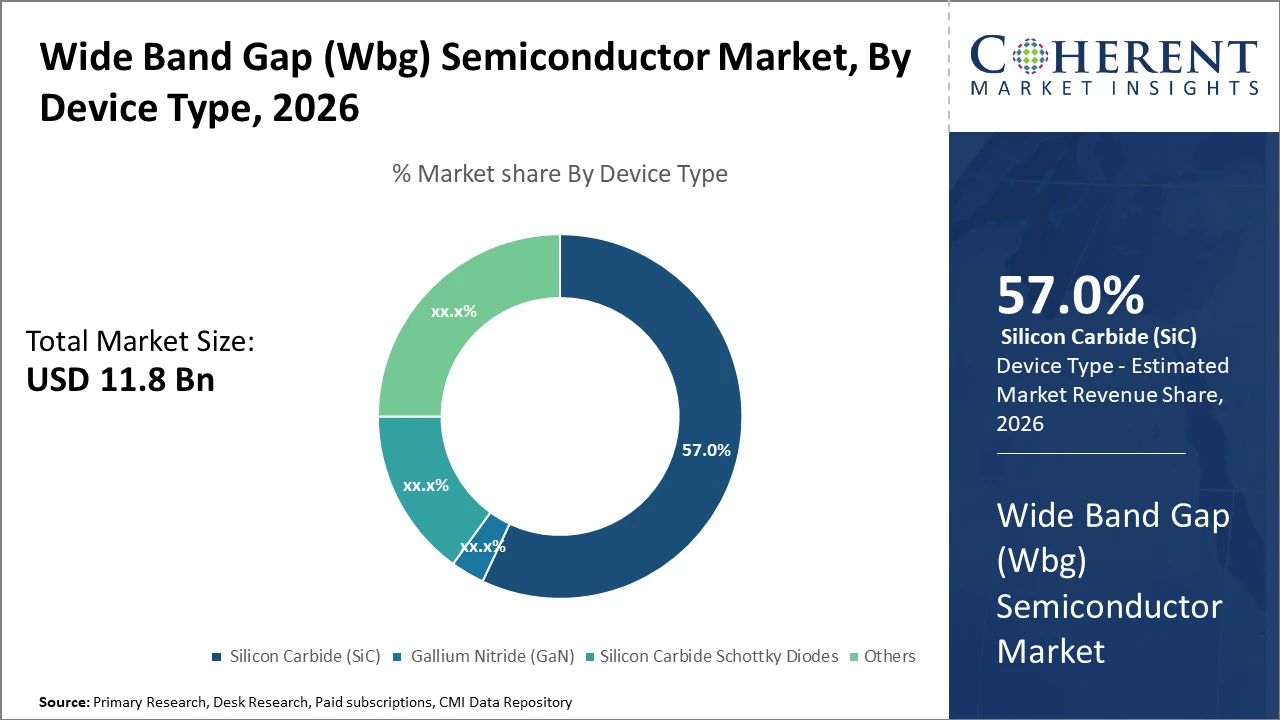
The Silicon Carbide device segment dominates the Wide Band Gap Semiconductor market share with over 57%, driven primarily by high demand in automotive and industrial power sectors.
The automotive application segment leads the market with a 39% industry share, capitalizing on the rapid EV adoption and related infrastructure development.
Discrete devices hold the largest share in package type, reflecting their simplicity and widespread deployment in power electronics.
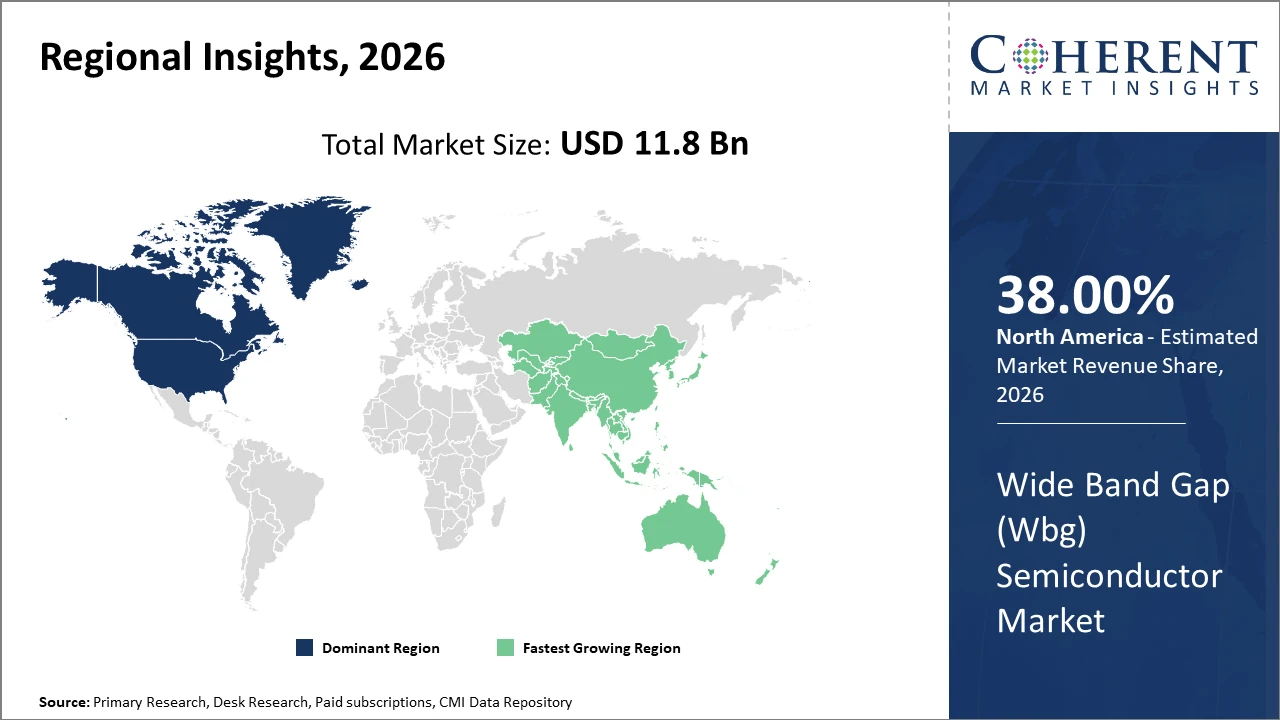
North America commands the dominant regional share, benefiting from robust industry presence and government incentives supporting green technologies.
Asia Pacific is the fastest-growing region, exhibiting a CAGR exceeding 15%, propelled by aggressive manufacturing expansion and consumer electronics demand.
Wide Band Gap (Wbg) Semiconductor Market Segmentation Analysis
To learn more about this report, Request Free Sample
Wide Band Gap (Wbg) Semiconductor Market Insights, By Device Type
Silicon Carbide dominates the market share. SiC devices lead due to their superior performance in high-voltage, high-temperature environments, making them indispensable in electric vehicles and industrial power electronics; their inherent thermal conductivity and breakdown voltage provide reliability and efficiency unmatched by silicon. The fastest-growing subsegment is Gallium Nitride, driven primarily by expansive 5G telecom infrastructure deployment that demands devices capable of high-frequency, high-efficiency operation. GaN's advantages in RF and power amplifiers support this rapid growth. Silicon Carbide Schottky Diodes serve niche markets with high-speed switching requirements, while the Others category includes emerging materials used in specialized applications.
Wide Band Gap (Wbg) Semiconductor Market Insights, By Application
Automotive dominates with close to 39% market share, propelled mainly by electric and hybrid vehicle power electronics employing WBG semiconductors for inverters and onboard chargers, aiding in improved fuel economy and emission reduction. The fastest-growing segment is Renewable Energy, leveraging SiC devices to improve power conversion efficiencies in solar inverters and wind turbines, responding to surging investments in green energy infrastructure. Industrial Power focuses on motor drives and power supplies, contributing steady demand underpinned by increased automation. Telecom applications are rising rapidly with 5G rollouts, while Consumer Electronics adoption reflects growing needs for compact and efficient power components.
Wide Band Gap (Wbg) Semiconductor Market Insights, By Package Type
Discrete devices remain dominant due to their modularity, ease of replacement, and cost-effectiveness in power applications. Modules, which integrate multiple devices, are the fastest-growing subsegment as they offer advantages in system compactness and improved thermal handling, crucial for automotive and industrial systems. Integrated Circuits provide specialized functions and are expanding slowly, primarily in consumer electronics and telecom sectors. The Others category includes packaging innovations aimed at enhancing mechanical robustness and electrical performance.
Wide Band Gap (Wbg) Semiconductor Market Trends
The market trend highlights a decisive movement towards GaN technology adoption in telecom due to the exponential rise of 5G infrastructure, which requires higher frequency components than silicon counterparts.
In 2024, 5G base stations utilizing GaN transistors surged by over 35%, driven by deployments in China and the U.S. Concurrently, SiC adoption in automotive power electronics has been bolstered by growing EV sales, facilitating reductions in weight and energy losses in power conversions.
Sustainability trends further influence WBG semiconductor development with increasing interest in packaging innovations that lower environmental footprints.
Wide Band Gap (Wbg) Semiconductor Market Insights, By Geography
To learn more about this report, Request Free Sample
North America Wide Band Gap (Wbg) Semiconductor Market Analysis and Trends
In North America, the dominance in the Wide Band Gap Semiconductor market is attributed to the presence of technology pioneers like Wolfspeed and Infineon’s U.S. operations, coupled with significant government incentives supporting EV infrastructure and clean energy projects. The region accounts for approximately 38% of the total market share, backed by high R&D spending and advanced automotive manufacturing ecosystems.
Asia Pacific Wide Band Gap (Wbg) Semiconductor Market Analysis and Trends
Meanwhile, the Asia Pacific exhibits the fastest growth with a CAGR exceeding 15%, driven by aggressive investments in semiconductor manufacturing capacities in China, Taiwan, and South Korea. The region benefits from expansive consumer electronics demand, burgeoning EV markets such as India and China, and proactive government policies incentivizing technological adoption.
Wide Band Gap (Wbg) Semiconductor Market Outlook for Key Countries
USA Wide Band Gap (Wbg) Semiconductor Market Analysis and Trends
The U.S. market has played a foundational role in advancing Wide Band Gap semiconductor technology, exemplified by Cree’s industry-leading SiC wafer production and support from Department of Energy initiatives promoting clean energy usage. U.S. electric vehicle sales grew by 45% in 2024, underscoring expanding opportunities for SiC power devices in automotive applications. Additionally, telecom infrastructure modernization with 5G rollouts is accelerating GaN transistor deployments, cementing the country’s position as a critical market player with a strong innovation output.
China Wide Band Gap (Wbg) Semiconductor Market Analysis and Trends
China's WBG semiconductor market is propelled by extensive consumer electronics production, rapid EV adoption surpassing 7 million units in 2024, and state-backed semiconductor manufacturing capabilities. Domestic companies are investing in GaN and SiC fab capacities to reduce import dependence. Policy frameworks emphasizing ‘Made in China 2025’ promote the localization of the semiconductor value chain, positioning China as a strategic growth hub with rising market revenue and share.
Analyst Opinion
The increasing adoption of electric vehicles is a critical demand-side driver in the market. In 2024, global EV sales surpassed 14 million units, a 40% increase over the previous year, propelling the incorporation of SiC power modules that enhance battery efficiency and thermal management. This has directly influenced the market revenue across automotive segments by contributing over 30% of total industry share in 2025.
On the supply side, manufacturing capacities and cost optimization of GaN devices have improved. For instance, the expansion of fabrication plants in Asia Pacific during 2024 enabled a 20% increment in SiC wafer production, reducing cost per unit by nearly 15%. This development offsets historic market restraints linked to high production costs and chip scarcity, facilitating broader industrial adoption.
The telecom sector's demand for WBG semiconductors in 5G infrastructure also marks a substantial growth vector. With 5G global base station installations expected to exceed 3.5 million units by the end of 2025, GaN high-electron-mobility transistors (HEMT) have become essential due to their higher frequency and power efficiency compared to silicon alternatives. This increasing use-case amplifies market growth strategies focused on telecommunications as one of the most lucrative segments.
Regulatory initiatives promoting green energy solutions have propelled investments into power conversion applications utilizing SiC devices. Countries like Germany and the U.S. have announced subsidies for power electronics modernization, contributing to a 25% surge in WBG semiconductor market share related to renewable energy technologies. The participation of utility-scale solar and wind projects underlines a growing demand for these materials.
Market Scope
| Report Coverage | Details | ||
|---|---|---|---|
| Base Year: | 2025 | Market Size in 2026: | USD 11.8 billion |
| Historical Data for: | 2020 To 2024 | Forecast Period: | 2026 To 2033 |
| Forecast Period 2026 to 2033 CAGR: | 13.5% | 2033 Value Projection: | USD 28.6 billion |
| Geographies covered: |
|
||
| Segments covered: |
|
||
| Companies covered: | Qorvo, Inc., Texas Instruments, II-VI Incorporated, Hitachi Chemical, ROHM Semiconductor, NXP Semiconductors, Samsung Electronics, Analog Devices, Inc., MACOM Technology Solutions, Navitas Semiconductor. | ||
| Growth Drivers: |
|
||
Uncover macros and micros vetted on 75+ parameters: Get instant access to report
Wide Band Gap (Wbg) Semiconductor Market Growth Factors
Key factors driving market growth include surging EV penetration that demands power-efficient WBG semiconductors for inverters and converters, with industry forecasts showing EVs will represent 35% of global vehicle sales by 2030. The rise in 5G deployment supports GaN adoption in telecom infrastructure due to superior high-frequency performance. Moreover, government mandates promoting energy efficiency and reduced emissions accelerate renewable energy infrastructure investments, driving industrial adoption of SiC devices. Lastly, advancements in wafer fabrication and packaging technologies are mitigating historical issues of high costs, resulting in broader application scope across sectors.
Wide Band Gap (Wbg) Semiconductor Market Development
In March 2025, Vishay Intertechnology launched its 1200 V MaxSiC™ series silicon carbide (SiC) MOSFETs at APEC 2025, targeting high-efficiency applications such as traction inverters, renewable energy systems, and solar energy storage. The new devices were engineered to deliver lower switching losses, higher power density, and improved thermal performance, supporting the growing demand for robust wide-bandgap semiconductors in electrification and energy-transition markets.
In September 2024, Infineon Technologies announced the development of the world’s first 300 mm (12-inch) power gallium nitride (GaN) wafer technology, marking a major breakthrough in wide-bandgap semiconductor manufacturing. The innovation is designed to enable cost-effective, high-volume production of GaN power devices, accelerating adoption across electric vehicles, data centers, and fast-charging infrastructure while significantly improving scalability and supply-chain efficiency.
Key Players
Leading Companies of the Market
Qorvo, Inc.
Texas Instruments
II-VI Incorporated
Hitachi Chemical
ROHM Semiconductor
NXP Semiconductors
Samsung Electronics
Analog Devices, Inc.
MACOM Technology Solutions
Navitas Semiconductor
Several leading companies have adopted aggressive growth strategies such as strategic capacity expansions and collaborative ventures. For example, Wolfspeed expanded its SiC wafer fabrication facility in the U.S. in 2024, increasing output by 50%, thereby consolidating its leading market position. Infineon’s partnership with automobile manufacturers to integrate SiC MOSFETs in EV drivetrains has yielded a 22% revenue increase in the automotive segment during 2025. STMicroelectronics has deployed advanced GaN process technology, achieving higher yields and reduced device failure rates, which strengthened its competitiveness in the telecom sector.
Wide Band Gap (Wbg) Semiconductor Market Future Outlook
The future outlook for the wide band gap semiconductor market is robust as global energy and communications systems demand higher efficiency, greater power density, and operation at elevated temperatures. WBG semiconductors are anticipated to play a pivotal role in electrification of transportation (particularly electric vehicles and charging infrastructure), renewable energy conversion systems, and next-generation RF communication technologies such as 5G and beyond. Advances in material science and fabrication techniques will continue reducing costs and enabling larger-scale adoption. Integration with Si-based platforms and hybrid system designs will broaden application domains. Additionally, sustainability imperatives and carbon-reduction targets will favor WBG technologies that improve energy efficiency and reduce system losses in power conversion.
Wide Band Gap (Wbg) Semiconductor Market Historical Analysis
The wide band gap semiconductor market emerged from foundational research in semiconductor physics that recognized the superior electrical properties of materials such as silicon carbide (SiC) and gallium nitride (GaN). Early semiconductor technology focused primarily on silicon, but limitations in operating frequency, voltage tolerance, and temperature stability constrained performance in high-power applications. The development of SiC and GaN in the late 20th century opened new possibilities for power electronics, RF amplifiers, and high-frequency systems. Initial adoption was driven by niche applications in defense, aerospace, and high-performance computing due to high material and fabrication costs. Over time, improvements in crystal growth, wafer fabrication, and device packaging expanded commercial viability. Breakthroughs in manufacturing techniques reduced defect densities and improved yield, supporting broader adoption in automotive, telecommunications, and power infrastructure applications.
Sources
Primary Research Interviews:
Semiconductor Engineers
Power Electronics Designers
Automotive OEM Engineers
R&D Scientists
Foundry Executives
Databases:
Statista Semiconductor Data
SEMI Industry Reports
GlobalData Electronics
IEEE Data Library
OECD Technology Data
Magazines:
Semiconductor Today
EE Times
Power Electronics News
Electronics Weekly
Chip Design Magazine
Journals:
IEEE Transactions on Power Electronics
Semiconductor Science and Technology
Applied Physics Letter
Microelectronics Journal
Solid-State Electronics
Newspapers:
Financial Times (Technology)
Reuters Tech
Nikkei Asia
Bloomberg Technology
The Wall Street Journal
Associations:
IEEE
Semiconductor Industry Association
JEDEC Solid State Technology Association
SEMI
Power Electronics Society
Share
Share
As an accomplished Senior Consultant with 7+ years of experience, Pooja Tayade has a proven track record in devising and implementing data and strategy consulting across various industries. She specializes in market research, competitive analysis, primary insights, and market estimation. She excels in strategic advisory, delivering data-driven insights to help clients navigate market complexities, optimize entry strategies, and achieve sustainable growth.

Credibility and Certifications

860519526


9001:2015

27001:2022


Need a Custom Report?
We can customize every report - free of charge - including purchasing stand-alone sections or country-level reports
Customize NowJoining thousands of companies around the world committed to making the Excellent Business Solutions.
View All Our Clients