

Global 3D Weaving Market Size and Forecast – 2026-2033
The Global 3D Weaving Market is estimated to be valued at USD 38.97 Bn in 2026 and is expected to reach USD 84.55 Bn by 2033, exhibiting a compound annual growth rate (CAGR) of 11.7% from 2026 to 2033.
Key Takeaways of the 3D Weaving Market
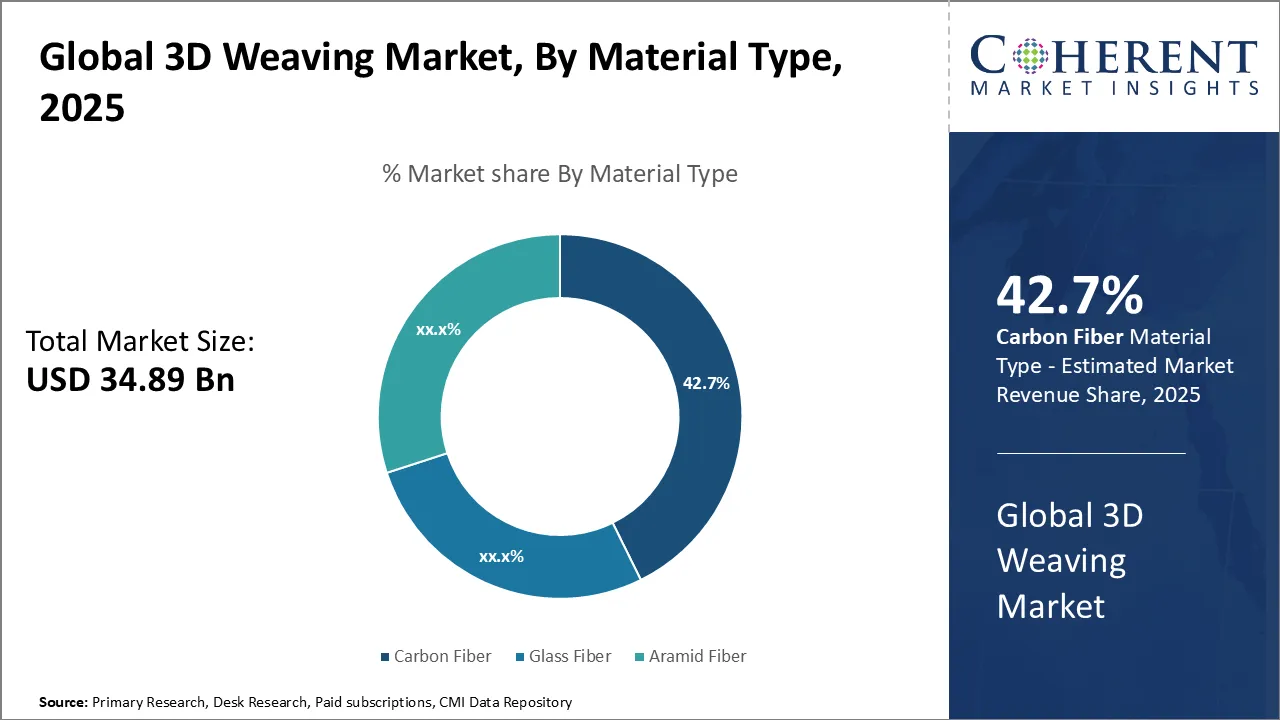
- The carbon fiber segment is expected to account for 43.7 % of the global 3D weaving market in 2026.
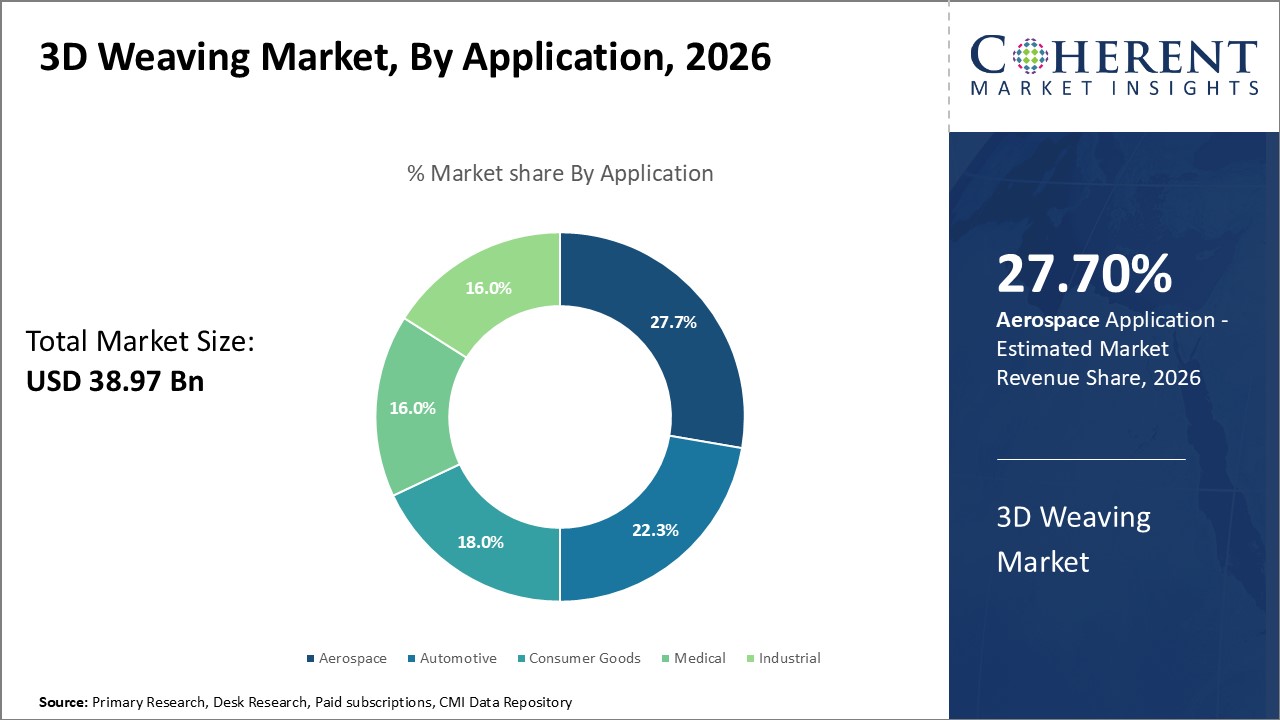
- The aerospace segment is projected to hold a 27.7 % share of the market in 2026.
- The 3D woven fabrics segment is expected to capture 39.7% of the market in 2026.
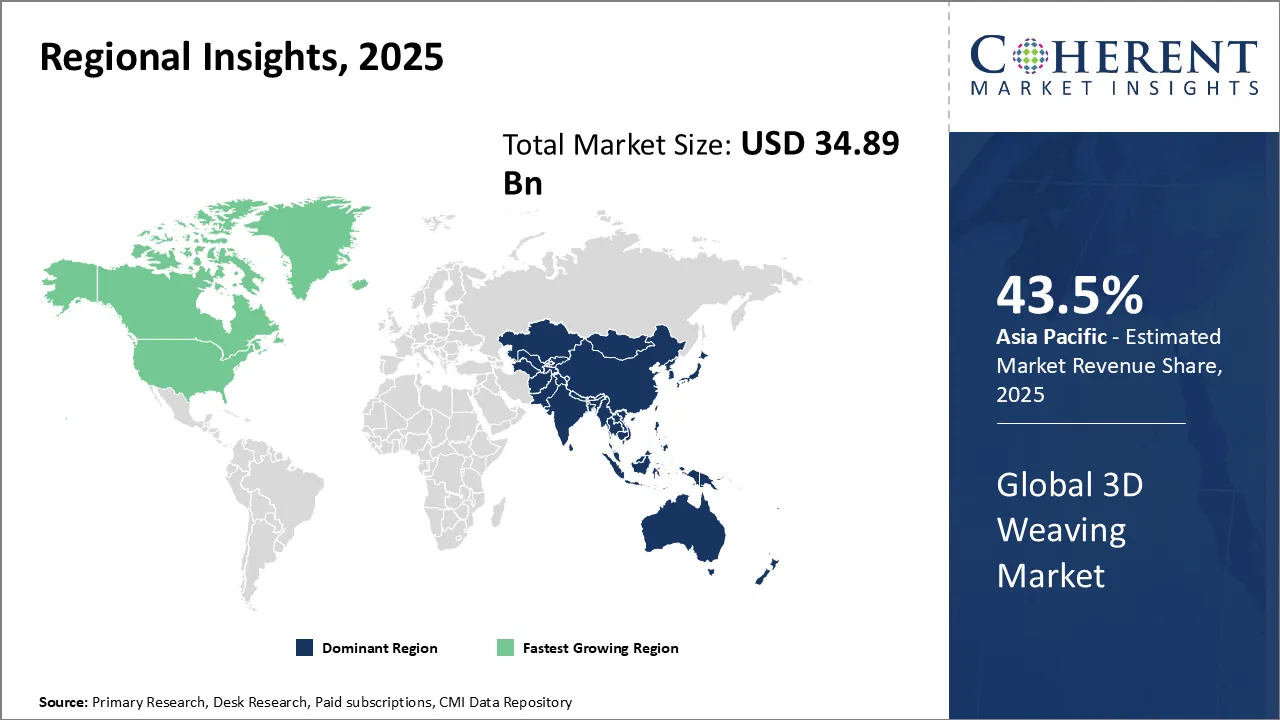
- Asia Pacific is projected to lead the global 3D weaving market in 2026 with a 43.5 % share. North America, with a 24.5% share, will be the fastest-growing region.
Market Overview
A prominent trend in the 3D weaving market is the integration of smart fabrics, smart textiles, technical textile, and composites in the aerospace, automotive, and healthcare sectors. Innovations focusing on enhancing material strength, flexibility, and multifunctionality are propelling the market expansion. Additionally, the growing preference for sustainable and eco-friendly materials within the weaving processes is influencing product development, further accelerating market demand and fostering technological advancements in 3D weaving applications worldwide.
Current Events and Its Impact
Current Events | Description and its impact |
Growth Driven by Renewable Energy and Infrastructure Projects |
|
Industry Collaborations & Supply Chain Innovation (2024–2025) |
|
Segmental Insights
- Current Industry Events of 2026
- Market Size Estimation
- Regional Breakdown
- Competitive Landscape
- Customer Intelligence
- Segmental Analysis
- Pricing Analysis
- Key Market Drivers, Challenges & Future Trends
- Customized Insights Section
3D Weaving Market Insights, By Material Type - Carbon Fiber Segment Dominates Due to Its Superior Performance Characteristics and Expanding Application Scope
Carbon fiber segment is expected to hold 43.7% of the global 3D weaving market in 2026, due to its exceptional strength-to-weight ratio, durability, and resistance to fatigue and corrosion. These intrinsic properties make carbon fiber highly desirable in industries demanding lightweight yet robust composite materials. One of the key factors driving the adoption of carbon fiber in 3D weaving is its ability to enhance structural integrity without adding significant weight, which is critical in sectors such as aerospace and automotive. Manufacturers increasingly rely on carbon fiber-based 3D woven components to improve fuel efficiency, reduce emissions, and meet stringent performance standards.
3D Weaving Market Insights, By Application – Aerospace Segment Dominates Driven by Performance Demands and Innovation in Lightweight Composite Structures
The aerospace segment is projected to hold 27.7% share of the market in 2026. The aerospace industry is the foremost consumer of 3D weaving technologies, reflecting its critical need for materials that optimize weight, durability, and safety. The use of 3D woven composites in aircraft manufacturing addresses essential challenges such as reducing overall aircraft weight to improve fuel efficiency and comply with stringent environmental regulations. Lightweight yet high-strength materials contribute directly to lowering operational costs and enhancing flight performance through better payload capacity and range.
3D Weaving Market Insights, By Technology - 3D Woven Fabrics Contribute the Highest Market Share Supported by Versatility and Growing Demand for Customizable Composite Solutions
3D woven fabrics segment is expected to hold 39.7% share of the market in 2026, due to their adaptability across a wide range of applications and ease of integration into composite manufacturing. The fundamental advantage of 3D woven fabrics lies in their ability to combine multiple layers of fibers into a single unified structure that delivers enhanced mechanical properties, such as improved interlaminar shear strength and damage tolerance. This makes them particularly appealing for industries requiring lightweight yet tough materials.
The technology behind 3D woven fabrics enables the production of customized textile architectures that can be tuned for specific load requirements and structural functions. This customization capability leads to optimized material usage, reducing waste and improving cost efficiency. Furthermore, the scalability of 3D woven fabrics in both industrial and high-volume production environments accelerates their adoption in sectors like automotive and consumer goods, where cost-effectiveness and performance are simultaneously prioritized.
Regional Insights
Asia Pacific 3D Weaving Market Analysis and Trends
The Asia Pacific region is projected to lead the market with a 43.5% share in 2026, rooted in the region’s well-established manufacturing ecosystem, abundant raw material availability, and robust industrial infrastructure. Countries like China, Japan, and South Korea have significant textile and advanced materials industries, supported by strong government initiatives promoting innovation and export competitiveness.
The presence of numerous key players such as Toray Industries (Japan), Shandong Henglun Industrial Group (China), and Hyosung Corporation (South Korea) further bolsters the region’s stronghold. Additionally, substantial investments in research and development for aerospace, automotive, and construction sectors, which heavily utilize 3D woven fabrics, amplify the region’s market leadership. Trade dynamics showcase Asia Pacific as both a major exporter of 3D woven textiles and an attractive destination for foreign direct investment, facilitating continuous growth and technological advancements.
North America 3D Weaving Market Analysis and Trends
The North America region is expected to exhibit the fastest growth in the market contributing 24.5% share in 2026, due to its focus on technological innovation and adoption of smart manufacturing processes. The region benefits from heavy investments in the aerospace, defense, and automotive sectors where 3D woven fabrics are critical for lightweight and high-strength components.
The presence of companies like 3TEX, Inc., Weavexx, and Hexcel Corporation drives innovation in composite materials and tailored 3D weaving technologies. Government policies encouraging advanced manufacturing and sustainability further support market expansion. Trade policies facilitating material imports and exports, along with collaborations between academia, technology providers, and end users, create a conducive environment for rapid advancements and market growth in North America.
3D Weaving Market Outlook for Key Countries
China 3D Weaving Market Trends
China’s 3D weaving market remains a powerhouse within the 3D weaving space, backed by its extensive industrial base and government-driven initiatives toward advanced manufacturing and high-tech textiles. Leading companies such as Shandong Henglun and Xiamen Warp Knitting contribute significantly by integrating 3D weaving with large-scale production capabilities and R&D innovation. The country’s strategic focus on export expansion and increasing domestic use in automotive, defense, and construction sectors positions it as a global hub, continuously pushing the boundaries of 3D woven fabric applications.
U.S. 3D Weaving Market Trends
The U.S. commands a pivotal role driven by strong research institutions and innovative companies like 3TEX, Inc. and Hexcel Corporation, which pioneer developments in aerospace-grade 3D woven composites. The alignment of government policies that promote advanced composites for defense and transportation applications accelerates market adoption. With increasing industry-academia collaborations, the U.S. 3D weaving market actively explores novel 3D weaving techniques aimed at enhancing material performance and sustainability, thereby solidifying its position in high-value segments.
Germany 3D Weaving Market Trends
Germany continues to lead in Europe with its well-established automotive and aerospace industries that depend heavily on advanced textile technologies. Companies such as Oerlikon Group and Schützenberger play key roles in developing high-quality 3D woven fabrics and machinery. The country’s emphasis on precision engineering, supported by government incentives for research and sustainable production methods, fosters innovation and elevates the regional competitive edge. Germany also benefits from strong intra-European trade networks, facilitating market penetration and technology exchange.
Japan 3D Weaving Market Trends
Japan's 3D weaving market benefits from its cutting-edge technological ecosystem and strong industrial sectors, including electronics and automotive, which demand sophisticated 3D woven components. Firms like Toray Industries are at the forefront, producing advanced composite materials that integrate 3D weaving technology. Supportive government policies aimed at enhancing manufacturing innovation and a focus on lightweight, high-strength structural materials continue to propel Japan’s significant role in the regional and global market.
Brazil 3D Weaving Market Trends
Brazil represents a growing market within Latin America, supported by increasing investments in automotive and construction industries adopting 3D woven materials for enhanced performance and sustainability. Companies such as Companhia Brasileira de Textiles contribute to local manufacturing capabilities. The Brazilian government's initiatives aimed at industrial modernization, coupled with favorable trade agreements within the Mercosur bloc, foster a conducive ecosystem for market growth. Although still emerging compared to established markets, Brazil’s strategic positioning within Latin America offers attractive opportunities for expansion.
Macroeconomic Factors
- Global Economic Growth and Infrastructure Investment: The 3D weaving market benefits significantly from growing investments in renewable energy and infrastructure projects worldwide. This fuels demand for lightweight, durable, and corrosion-resistant composite parts used in wind turbine blades and structural reinforcements in construction.
- Clean Energy Trends: Increasing global investment in clean and renewable energy sources drives demand for advanced 3D weaving technologies to produce high-performance composite materials, supporting sustainability goals.
- Government Policies and Regulatory Support: In regions like Europe and Asia Pacific, regulatory frameworks promoting green technologies, sustainable engineering, and lightweight composites boost demand. Governments also fund R&D and green material development that benefits the 3D weaving industry.
Microeconomic Factors
- Industry Demand from Key Sectors: The aerospace, automotive, construction, defense, and renewable energy sectors are primary end-users. Their increasing demand for high-strength, lightweight, multifunctional, and recyclable textile composites drive the market growth.
- Technological Advancements: Innovations in 3D weaving machinery, digital design, and fiber placement technologies improve production efficiency, customization, and scalability. These advancements lower production costs and enhance product performance.
- Sustainability and Eco-Friendly Materials: Rising awareness and consumer preference for sustainable textiles push industry adoption of recyclable and bio-based 3D woven composites. This micro trend supports the shift toward greener manufacturing practices.
Market Players, Key Development, and Competitive Intelligence
Key Developments
- In October 2024, UNSPUN entered into a partnership with Decathlon to implement its Vega 3D weaving technology across Europe. This collaboration allows for on-demand, low-waste, and locally produced sportswear. The multiyear agreement not only aligns with Decathlon's sustainability objectives but also enhances UNSPUN’s presence through localized micro-factories.
- In July 2024, UNSPUN secured USD 32 Mn in funding to advance its 3D weaving machines. The investment will support the company’s efforts to expand the use of its technology, enabling localized manufacturing capabilities across North America and Europe.
Top Strategies Followed by Global 3D Weaving Market Players
- Established players dominate the market by heavily investing in research and development to pioneer high-performance and technologically advanced 3D woven products. These industry leaders focus on continuous innovation to meet evolving customer demands, often developing lightweight, durable, and multifunctional materials that cater to sectors such as aerospace, automotive, and defense.
- For example, Toray Industries is a leader in the aerospace sector, providing advanced 3D woven composites that enhance the performance of aircraft parts. Its products, such as carbon fiber-based woven materials, are lightweight yet highly durable, offer advantages in fuel efficiency and structural integrity.
- Mid-level players in the 3D weaving market adopt a different strategic approach focused primarily on balancing product quality with cost-effectiveness. Recognizing the price sensitivity of a substantial portion of the customer base, these companies emphasize offering affordable yet reliable 3D woven solutions that appeal to industries requiring moderate performance but stringent budget constraints. To improve their market traction, mid-tier firms often enter into collaborations or joint ventures to leverage external expertise, technology sharing, and scale up production capacities.
- For example, Hexcel Corporation, a player in the composites market, produces cost-effective 3D woven fabrics used in automotive applications. While not as high-end as materials used in aerospace, Hexcel’s products offer a good balance of strength, weight reduction, and cost-effectiveness for automotive manufacturers.
- Small-scale players in the global 3D weaving market compete by carving out niche segments through specialization and innovation. These enterprises focus on developing cutting-edge or highly customized product lines tailored to specific industry needs, such as medical textiles, smart fabrics, or environmentally sustainable materials. By adopting the latest weaving technologies and experimental production techniques, smaller firms maintain competitive advantages despite limited resources. To bolster their market presence, they often forge local alliances with startups, small manufacturers, or regional distributors, which facilitates market entry and enhances visibility in targeted geographic areas.
- For example, Smart Textile Solutions, a small firm, specializes in producing 3D woven fabrics embedded with sensors for healthcare applications. Its products are used in smart bandages that monitor wound healing or in wearable health monitoring devices.
Market Report Scope
3D Weaving Market Report Coverage
| Report Coverage | Details | ||
|---|---|---|---|
| Base Year: | 2025 | Market Size in 2026: | USD 38.97 Bn |
| Historical Data for: | 2020 To 2024 | Forecast Period: | 2026 To 2033 |
| Forecast Period 2026 to 2033 CAGR: | 11.7% | 2033 Value Projection: | USD 84.55 Bn |
| Geographies covered: |
| ||
| Segments covered: |
| ||
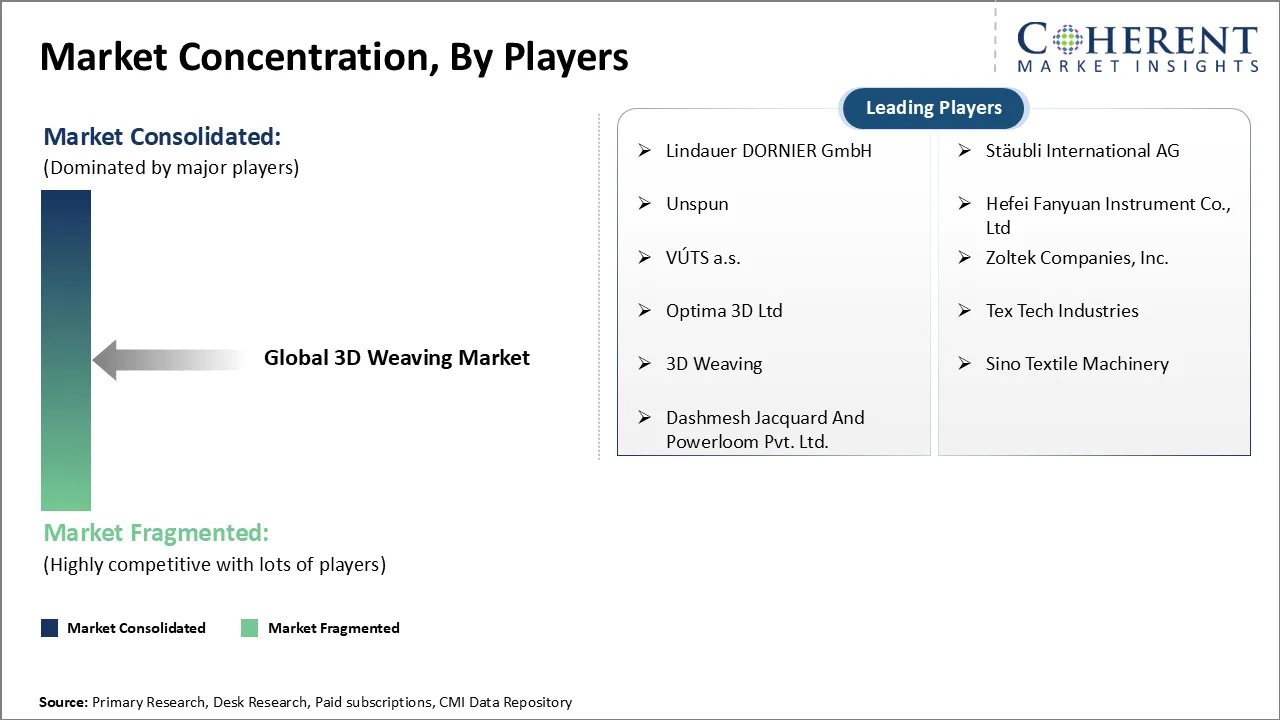
| Companies covered: | Lindauer DORNIER GmbH, Stäubli International AG, Unspun, Hefei Fanyuan Instrument Co., Ltd, VÚTS a.s., Zoltek Companies, Inc., Optima 3D Ltd, Tex Tech Industries, 3D Weaving, Sino Textile Machinery, and Dashmesh Jacquard And Powerloom Pvt. Ltd. | ||
| Growth Drivers: |
| ||
| Restraints & Challenges: |
| ||
3D Weaving Market Dynamics
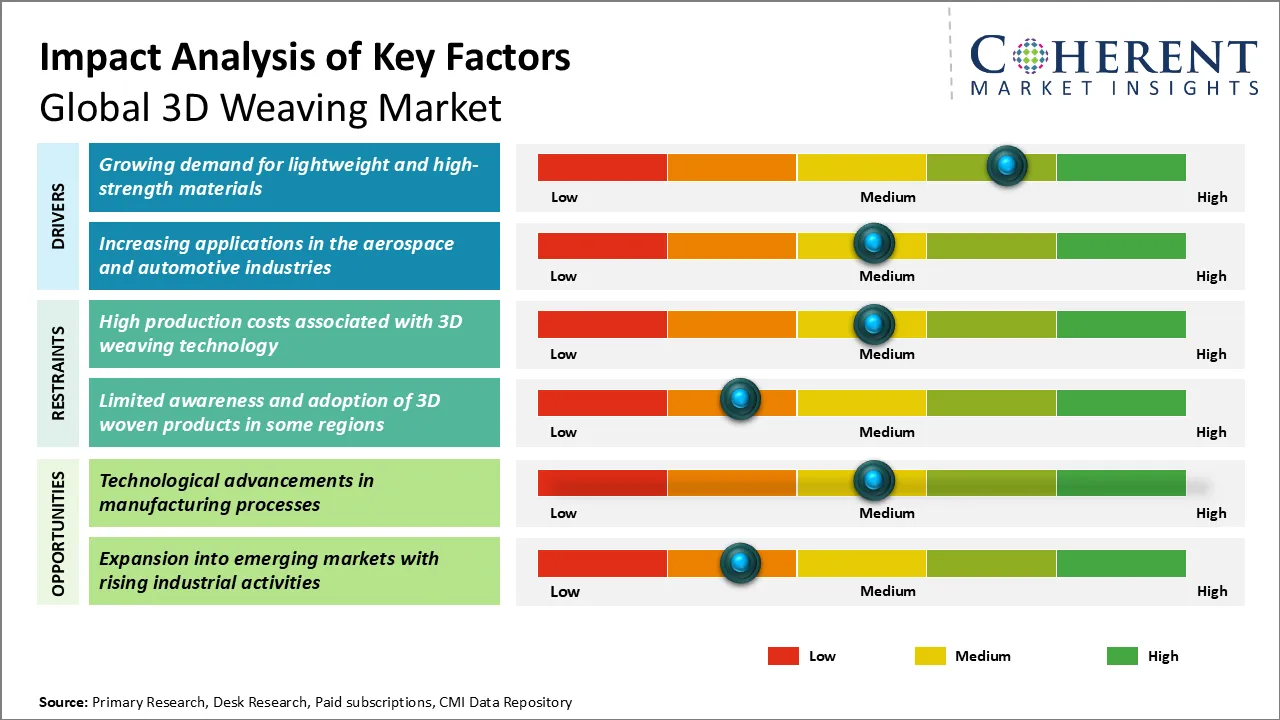
3D Weaving Market Driver - Growing Demand for Lightweight and High-Strength Materials
The increasing need for advanced lightweight and high-strength materials across various industries significantly fuels the adoption of 3D weaving technologies. Sectors such as aerospace, automotive, sports equipment, and construction are progressively shifting towards materials that offer enhanced mechanical properties combined with reduced weight to improve performance and fuel efficiency. The unique structural integrity and design flexibility of 3D woven composites make them ideal candidates for replacing traditional materials like metals, enabling manufacturers to achieve superior strength-to-weight ratios.
For instance, Boeing has adopted 3D woven composites in its aircraft, particularly for components like wing structures and fuselage elements. These materials offer a significant reduction in weight while maintaining strength and durability, contributing to fuel efficiency and overall performance enhancement.
3D Weaving Market Opportunity - Technological Advancements in Manufacturing Processes
The global 3D weaving market stands to benefit significantly from ongoing technological advancements in manufacturing processes, which present a substantial growth opportunity. Innovations such as automation, computer-aided design (CAD), and advanced robotics have enhanced precision, efficiency, and scalability in 3D weaving production. The integration of Industry 4.0 technologies, including the Internet of Things (IoT) and artificial intelligence (AI), enables real-time monitoring and optimization of weaving operations, reducing waste and improving throughput.
For example, Tencate has adopted automation and AI for real-time monitoring of production lines for 3D woven composites, ensuring precise adjustments during production. This integration allows them to scale up manufacturing while maintaining consistent product quality, meeting the increasing demand from industries like aerospace and automotive.
Analyst Opinion (Expert Opinion)
- The global 3D weaving market is on the brink of transformation, driven by the increasing demand for lightweight, high-strength materials in industries such as aerospace, automotive, and construction. Insights from the International Conference on Advanced Materials (2023) and the 3D Textile Forum (2022) highlighted significant advancements in weaving technology, with companies like Textile Innovators and 3D Weave Solutions showcasing innovative applications that enhance structural integrity and reduce weight.
- For instance, Textile Innovators' recent launch of a 3D woven composite for aerospace applications both performance enhancement and cost efficiency, appealing to manufacturers focusing on sustainability. Discussions at these conferences underscored the critical role of collaboration between manufacturers and material scientists to drive innovation and address challenges related to scalability and production costs.
- The barriers such as the need for specialized machinery and skilled labor were also noted, which could hinder market growth. Companies that invest in research and development, alongside partnerships to streamline production processes, will likely gain a competitive edge. Ultimately, the 3D weaving market's future will depend on its ability to innovate while meeting the evolving needs of diverse industries.
Speak to the analyst
Want personalized insights?
Take the findings above to one of our principal consultants, or have the report rebuilt around the segments, geographies and competitors you actually track.
Market Segmentation
- Material Type Insights (Revenue, USD Bn, 2021 - 2033)
- Carbon Fiber
- Glass Fiber
- Aramid Fiber
- Others
- Application Insights (Revenue, USD Bn, 2021 - 2033)
- Aerospace
- Automotive
- Consumer Goods
- Medical
- Industrial
- Technology Insights (Revenue, USD Bn, 2021 - 2033)
- 3D Woven Fabrics
- 3D Woven Composites
- 3D Woven Structures
- Regional Insights (Revenue, USD Bn, 2021 - 2033)
- North America
- U.S.
- Canada
- Latin America
- Brazil
- Argentina
- Mexico
- Rest of Latin America
- Europe
- Germany
- U.K.
- Spain
- France
- Italy
- Russia
- Rest of Europe
- Asia Pacific
- China
- India
- Japan
- Australia
- South Korea
- ASEAN
- Rest of Asia Pacific
- Middle East
- GCC Countries
- Israel
- Rest of Middle East
- Africa
- South Africa
- North Africa
- Central Africa
- North America
- Key Players Insights
- Lindauer DORNIER GmbH
- Stäubli International AG
- Unspun
- Hefei Fanyuan Instrument Co., Ltd
- VÚTS a.s.
- Zoltek Companies, Inc.
- Optima 3D Ltd
- Tex Tech Industries
- 3D Weaving
- Sino Textile Machinery
- Dashmesh Jacquard And Powerloom Pvt. Ltd.
Sources
Primary Research Interviews
- R&D Director – Leading 3D Textile Manufacturer
- Procurement Manager – Major Aerospace Composites Supplier
- Product Development Head – Well-Known Automotive Composites Brand
- Sustainability Manager – Certification Body for Technical Textiles
Stakeholders
- Manufacturers (3D woven fabric producers, machinery OEMs)
- End-use Sectors:
- Aerospace and Defense (structural components, interiors)
- Automotive (lightweight panels, crash structures)
- Construction (architectural composites, infrastructure)
- Sports Equipment (bicycle frames, helmets, protective gear)
- Marine (boat hulls, panels)
- Regulatory & Certification Bodies (ISO, ASTM for textiles)
- E-commerce Platforms and Distributors
- Technology Solution Providers: Automation, CAD/CAM Software Vendors
Databases
- UN Comtrade Database
- ITC Trade Map (International Trade Centre)
- Textile World Statistical Database
Magazines
- Technical Textiles International – Trends in 3D woven fabrics
- CompositesWorld – 3D weaving in advanced composites applications
- Textile World – Innovations in textile engineering
- JEC Composites Magazine – Updates on 3D weaving in composites
- Advanced Textiles Source – Market and technology trends
Journals
- Textile Research Journal – Mechanics and properties of 3D woven structures
- Composites Part A: Applied Science and Manufacturing
- The Journal of The Textile Institute – Innovations in 3D weaving
- Fibers and Polymers – Advanced weaving techniques
- Composite Structures – Performance analysis of 3D woven composites
Newspapers
- The Financial Times – Market growth and investment in technical textiles
- The Guardian – Sustainability trends in textiles and composites
- Asian Textile JournaI – Developments in the APAC region
- European Business Review – Textiles industry policy and innovations
Associations
- The Textile Institute
- Composite Fabricators Association
- Society for the Advancement of Material and Process Engineering (SAMPE)
- ASTM International – Technical committee on textiles
- European Composite Industry Association (EuCIA)
Public Domain Sources
- ISO – Standards for woven textiles and composites
- ASTM – Methods for testing and classification of 3D woven fabrics
- European Commission – Technical textile policy documents
- World Trade Organization – Textile product regulations
Proprietary Elements
- CMI Data Analytics Tool, Proprietary CMI Existing Repository of information for last 8 years.
Get access to 250+ pages report
Every segment, forecast, competitor profile and data table behind the analysis above — available for instant download.
- ESOMAR Member
- ISO 9001:2015 Certified
- D-U-N-S Registered
- GDPR & CCPA Compliant
Missing comfort of reading report in your local language? Find your preferred language:
Transform your Strategy with Exclusive Trending Reports
Frequently Asked Questions
The global 3D weaving market is estimated to be valued at USD 38.97 Bn in 2026 and is expected to reach USD 84.55 Bn by 2033.
The CAGR of global 3D weaving market is projected to be 11.7% from 2026 to 2033.
Growing demand for lightweight and high-strength materials and increasing applications in the aerospace and automotive industries are the major factors driving the growth of the global 3D weaving market.
High production costs associated with 3D weaving technology and limited awareness and adoption of 3D woven products in some regions are the major factors hampering the growth of the global 3D weaving market.
In terms of material type, carbon fiber is estimated to dominate the market revenue share in 2026.
Lindauer DORNIER GmbH, Stäubli International AG, Unspun, Hefei Fanyuan Instrument Co., Ltd, VÚTS a.s., Zoltek Companies, Inc., Optima 3D Ltd, Tex Tech Industries, 3D Weaving, Sino Textile Machinery, and Dashmesh Jacquard And Powerloom Pvt. Ltd. are the major players.
Asia Pacific is expected to lead the global 3D weaving market in 2026.