

Africa Caustic Soda Market Size and Forecast – 2026-2033
The Africa caustic soda market is estimated to be valued at USD 2,304.5 Mn in 2026 and is expected to reach USD 3,511.2 Mn by 2033, exhibiting a compound annual growth rate (CAGR) of 6.2% from 2026 to 2033.
Key Takeaways of the Africa Caustic Soda Market
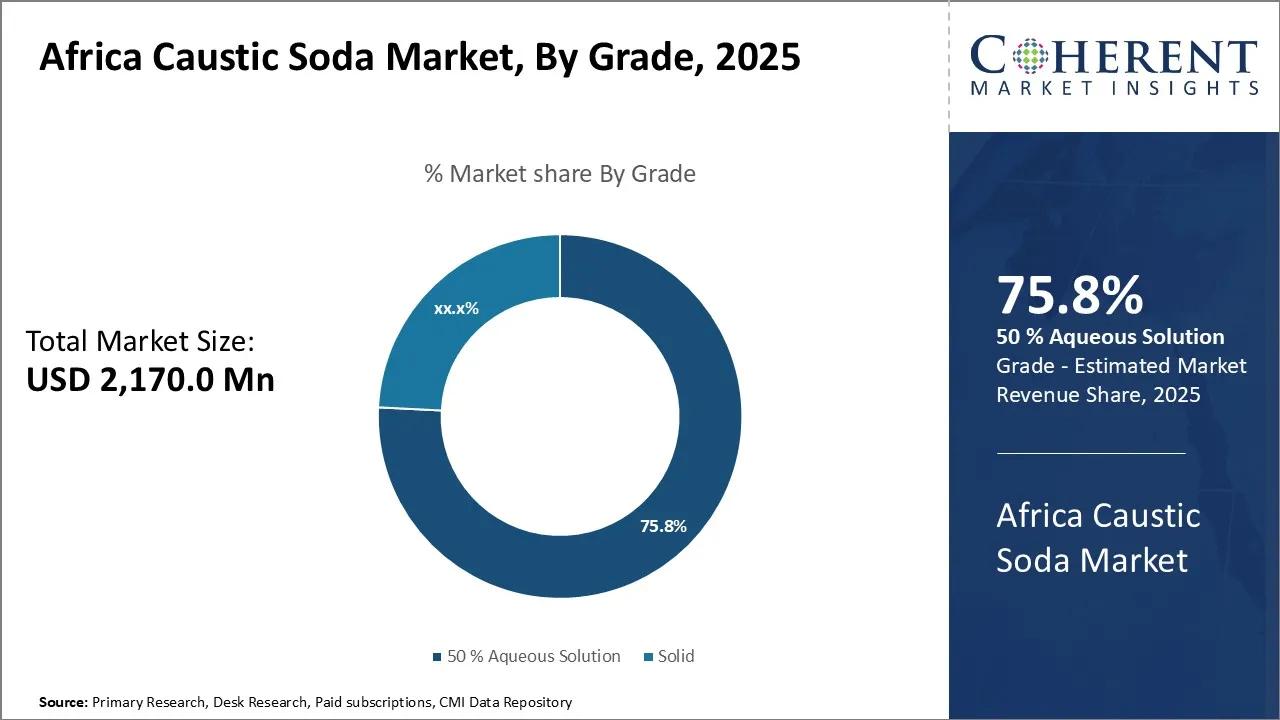
- The 50% aqueous solution segment is projected to account for 76.8 % of the Africa caustic soda market share in 2026.
- The chloralkali process segment is projected to hold 91.3 % of the market share in 2026.
- The soap and detergent manufacturing segment is expected to capture 35.3 % of the market share in 2026.
Market Overview
The market trend in Africa is characterized by an increasing focus on sustainable production processes and the adoption of eco-friendly technologies in caustic soda manufacturing. There is a rising demand for high-purity grades to cater to the pharmaceutical and food industries, supporting market diversification. Furthermore, the gradual industrialization in emerging economies within the continent is expected to enhance the application scope of caustic soda, despite the relatively low CAGR, signaling a stable yet cautious market environment driven by regulatory compliance and environmental concerns.
Currents Events and their Impact
Current Events | Description and its Impact |
Nigeria FX liberalization and naira volatility |
|
Egypt pound devaluation under IMF program |
|
Segmental Insights
- Current Industry Events of 2026
- Market Size Estimation
- Regional Breakdown
- Competitive Landscape
- Customer Intelligence
- Segmental Analysis
- Pricing Analysis
- Key Market Drivers, Challenges & Future Trends
- Customized Insights Section
Africa Caustic Soda Market Insights, by Grade - 51% Aqueous Solution Segment Dominates the Market due to its Versatile Applications and Ease of Handling
The 50% aqueous solution segment is expected to capture 76.8% of the market share in 2026, driven by its significant versatility and user-friendly nature. This type of caustic soda is also popular, as it provides a satisfactory balance of concentration and safety, thus, it can be used in an enormous range of industrial processes. The aqueous solution form is less cumbersome to transport, store, and apply on site compared to solid or powdered grades, which have to have further safety precautions and equipment to handle because they are corrosive and hygroscopic. This minimizes operations complexities and promotes workplace safety that is especially important in the developing African markets when infrastructure to deal with dangerous materials might still be evolving.
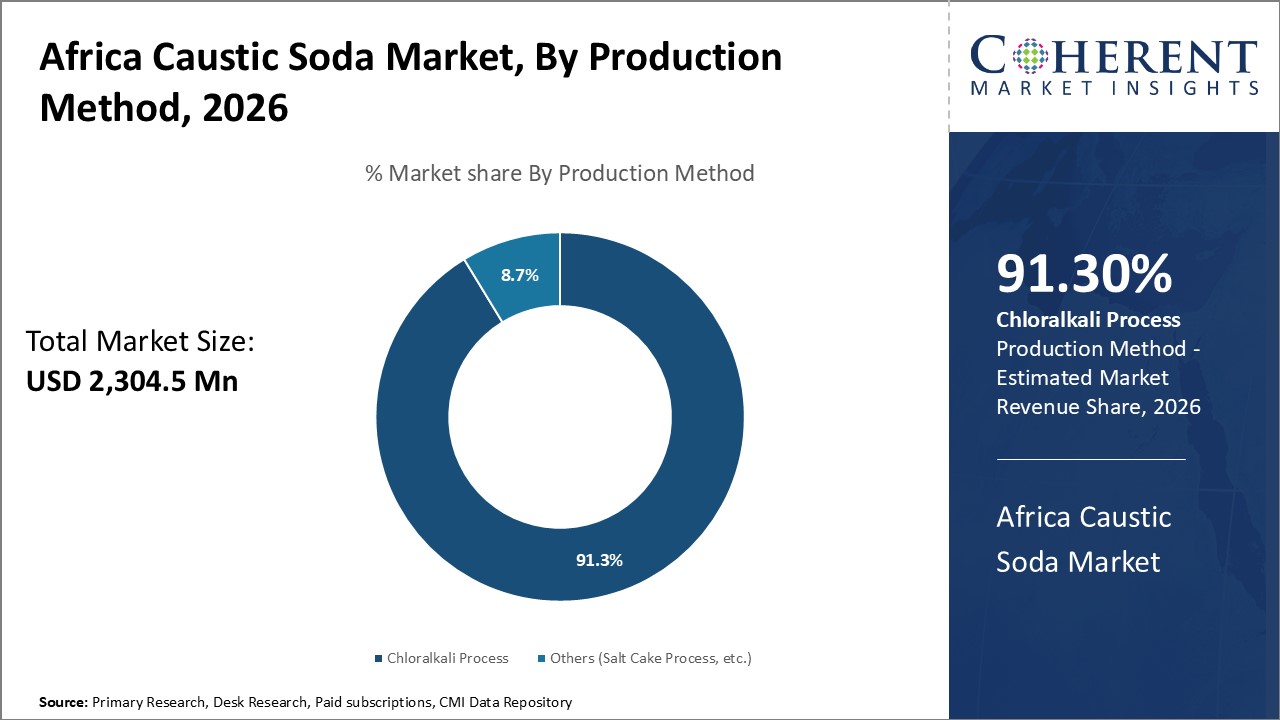
Africa Caustic Soda Market Insights, by Production Method - Chloralkali Process Segment Dominates the Market due to its High Purity Output and Energy Efficiency
The chloralkali process segment is projected to account for 91.3% share in 2026, because of several compelling technical and economic advantages. This is done by electrolyzing saltwater to produce caustic soda, chlorine and hydrogen at the same time and this enables the manufacturer to produce several industrial chemicals simultaneously. This synergy improves the efficiency and profitability of the entire plant and makes the chloralkali process the process of choice among the producers.
The high level of purity of the caustic soda produced is one of the reasons that have contributed to the popularity of this technique. The purity is extremely important, particularly when used in chemical production, food production, and biodiesel production, where impurities may be harmful to product quality and process efficiency. The chloralkali process guarantees a precise control over the level of contaminants and allows the manufacturers to comply with high quality specifications required by advanced end users.
Africa Caustic Soda Market Insights, by Application - Soap & Detergent Manufacturing Segment Dominates due to Rising Consumer Demand and Expanding Hygiene Awareness
The soap and detergent manufacturing segment is expected to capture 36.3% of the market share in 2026, driven by a surge in consumer awareness about personal and household hygiene, as well as increasing urbanization and rising income levels across the continent. Caustic soda is a basic raw material in soap saponification and detergent formulation processes, and the trends of the growth of these products directly depend on the demand of this chemical.
The major factor is the increased attention to hygiene and sanitation especially in the wake of international health programs and campaigns that encourage hand washing and cleanliness to avoid communicable diseases. This has increased consumption of soaps and detergents not only in the urban centers but also into the rural markets. The boom of low-priced and efficient cleansing goods is encouraging capacity building and introduction of new products, which happen to greatly depend on the availability of caustic soda.
Macro and Micro Economic Factors Impacting on Africa Caustic Soda Market Growth
Macro-Economic Factors
- Industrial Expansion: Infrastructure expansion, chemical production, and investment in water treatment and petrochemical industries in Africa (particularly in Nigeria, Egypt, Ghana and South Africa) are driving up the usage of caustic soda since the material is used in refining, pH control and industrial cleaning.
- Population Growth and Urbanization: Soaring populations in urban areas have been increasing the water and consumer product needs, which are being served by increasing use of caustic soda, which is used in water treatment and soap making.
- Import Reliance and Trade Dynamics: The dependence on imports by many African countries, as a result of the low production in the countries, exposes the market to the global prices and disruptions in the supply chain besides high costs caused by shipping and tariffs.
- Energy Costs: Local energy costs: Caustic soda manufacturing is energy-intensive High or unstable electricity costs in Africa This is a hindrance to local production growth, and can frequently reduce competitiveness compared to areas such as the Middle East or Asia.
- Regulatory Environment: Government programs concerning chemical safety, pollution prevention, and water treatment standards affect the mode of production and expansion of the sector particularly when strict environmental standards are enforced.
Micro Economic Factors
- Sectoral Demand: in Africa, the consumption of caustic soda is motivated by its utilization in pulp and paper, textile, soap and detergent, aluminum refining and chemical production. Ghana, an example, is experiencing a growth due to more industrialization and demand of these products.
- Supply Chain Challenges: The efficiency of distribution, fluctuations in price of raw material, and the availability of stable energy supply impacts operation costs and competitiveness in the market at the micro level, particularly to small and medium manufacturers.
- Technological Improvements: Sustainability demands the adoption of cleaner and more efficient production mechanisms (e.g. membrane cell technology) which however demand substantial investment which local players may not be able to afford.
- Competition and Innovation: The key African players, such as Egypt, are still leaders, although there is an increase in competition as other countries (e.g., Ghana, Nigeria, Ethiopia) are strengthening their capacity and inventing new uses, including specialty chemicals and sophisticated water treatment.
- Policy and Capacity Building: Local governments assist with training, and quality improvement and regulatory compliance measures to producers to increase the standard of competitiveness and safety.
Market Players, Company Insights/Key Development, and Competitive Intelligence
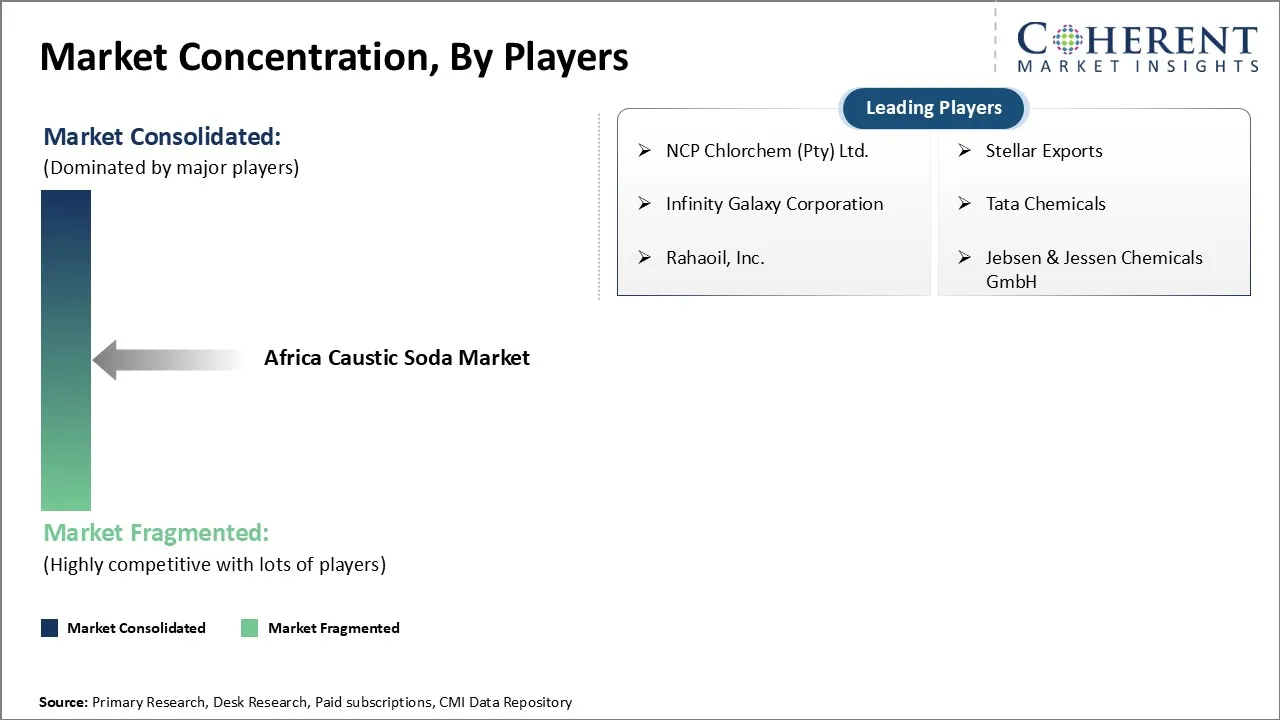
Company Insights/Key Development
- NCP Chlorchem (Pty) Ltd, a South African based chlor-alkali company which produces and distributes caustic soda (sodium hydroxide) and other related chemicals to the Africa caustic soda market. They are in the business of selling caustic soda lye produced to industries and delivered through bulk road tankers.
- In December 2023, Dow chemical producers introduced two groundbreaking caustic soda products, Caustic DEC and TRACELIGHT DEC, as a component of its Decarbia range. These products feature up to 90% reduced carbon dioxide emissions owing to an electrolysis production method that is fueled by renewable energy.
Top Strategies Followed by Africa Caustic Soda Market Players
- Established players: The market players are now monopolized by large investments in research and development (R&D) and innovate high-performance caustic soda products that are of high quality and efficiency required in large industries.
- For example, Tata Chemicals control the Africa caustic soda market on with massive investments in research and development. Tata Chemicals has invested in modern chlor-alkali facilities in Kenya and Tanzania and this has led to the constant provision of high-quality and quality caustic soda so as to satisfy the demands of the textile and detergent companies in East Africa.
- Mid-level players in the Africa caustic soda market typically adopt strategies focused which imply that they produce products that are of a quality that is not too expensive. The strategy aims at consumers who are price-sensitive such as the small and medium-sized enterprises (SME) and local industries that need to access and use reliable but cost-effective chemical inputs. In a bid to improve their market share, medium-scale companies are increasingly joining forces and pursuing joint ventures, occasionally with technology suppliers or local distributors, to scale up production and gain access to state-of-the-art production.
- An example of this is a company like NCP Chlorchem (Pty) Ltd. that offers quality water treatment products and services that fall within or above the expectations of our customers, technology suppliers to modernize chlor-alkali lines, and products are more competitive against imports.
- Small-scale players, although not as large as their larger counterparts, get their opportunities in specializing at innovative or highly-customized versions of caustic soda which apply to a particular application. These companies often make significant investments in the development of innovative technology and process advancements to stand out their production, including designing environmentally friendly or high-end caustic soda products that respond to the changing regulatory and consumer needs.
Market Report Scope
Africa Caustic Soda Market Report Coverage
| Report Coverage | Details | ||
|---|---|---|---|
| Base Year: | 2025 | Market Size in 2026: | USD 2,304.5 Mn |
| Historical Data for: | 2020 To 2024 | Forecast Period: | 2026 To 2033 |
| Forecast Period 2026 to 2033 CAGR: | 6.2% | 2033 Value Projection: | USD 3,511.2 Mn |
| Segments covered: |
| ||
| Companies covered: | NCP Chlorchem (Pty) Ltd., Stellar Exports, Infinity Galaxy Corporation, Tata Chemicals, Rahaoil, Inc., Jebsen & Jessen Chemicals GmbH | ||
| Growth Drivers: |
| ||
| Restraints & Challenges: |
| ||
Africa Caustic Soda Market Dynamics
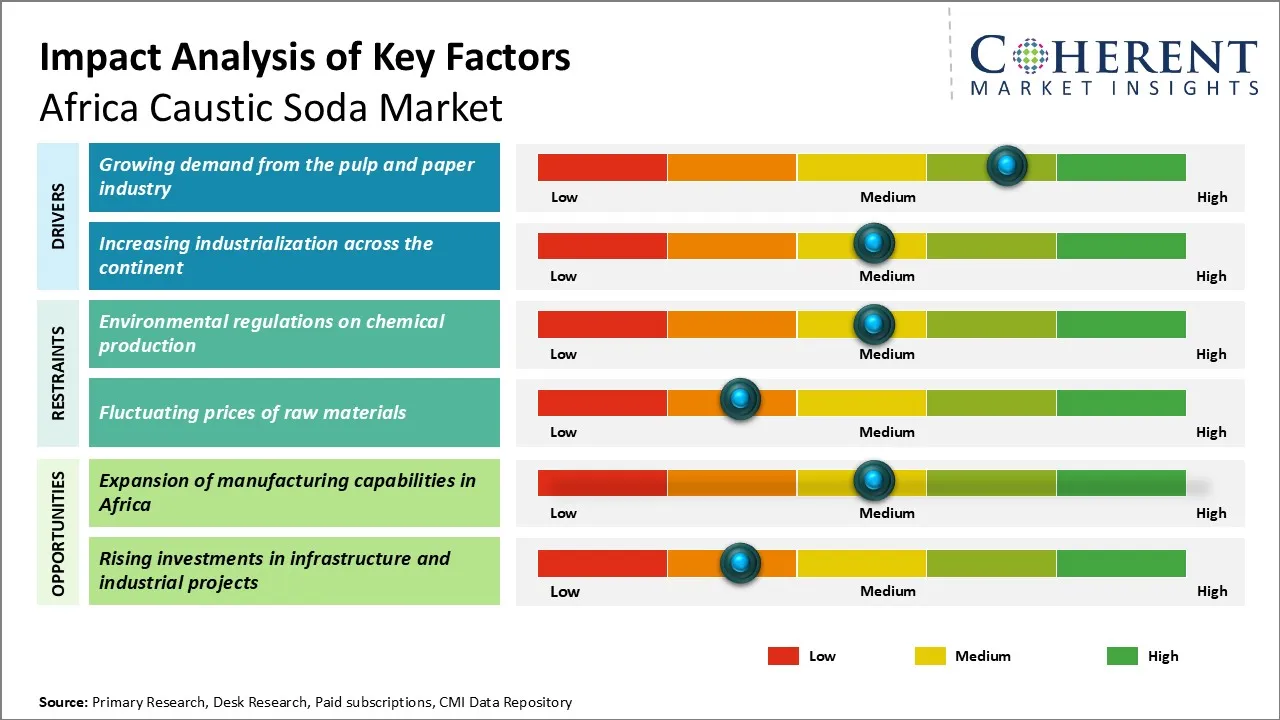
Africa Caustic Soda Market Driver - Growing Demand from the Pulp and Paper Industry
The growing pulp and paper sector in Africa is a major force behind the demand of caustic soda, which is an essential chemical in kraft process of pulping wood chips, wood products into paper fibers. With a number of countries in the continent looking at improving the capacity to produce paper to cater to the increasing domestic demand and minimize imports reliance, caustic soda is seen as a key raw material in the manufacturing process. The role of the chemicals in solvation of lignin and separation of cellulose fibers is the basis of its indispensability in the process of pulp production. Furthermore, the packaging boom led by e-commerce and retail industries has further increased the demand in paper based products, which in turn increased the use of caustic soda indirectly.
For example, in the Plateformes Industrielles du Congo (PIC) plans are specifically aimed at supplying caustic soda capacity to support the pulp and paper, textile and water treatment in Republic of Congo.
Africa Caustic Soda Market Opportunity - Expansion of Manufacturing Capabilities in Africa
The expansion of manufacturing capabilities in the continent will be a great boost to the Africa caustic soda market, which will offer a great growth opportunity to local and international players. During the increased rate of industrialization in Africa, the demand of caustic soda, one of the primary raw materials in industrial applications, especially in textiles, water treatment, pulp and paper, paper and packaging and chemicals, is anticipated to be skyrocketing. Today, most African nations are dependent on imports in a large scale to satisfy their caustic soda demands and are costly and vulnerable to supply chain risks.
The production of Africa caustic soda increased to 2.6 million tons in 2024 with an average annual growth of 3.4 in the long-term. This incremental capacity growth is an indicator of growth. In 2024, the imports dropped 11.5 to 936 kt, which indicates the onset of the process of substituting imports by local manufacturers.
Analyst Opinion (Expert Opinion)
- The caustic soda market in Africa is witnessing promising growth, propelled by rising demand across various industries, including textiles, paper, and chemicals. Insights from the African Chemicals Conference (2023) and the Sustainable Industrial Solutions Summit (2022) underscored significant trends, with companies like Sasol and Kuwait Chemical Company driving innovation in production methods.
- Sasol’s recent investment in advanced electrolytic cell technology aims to enhance efficiency and reduce environmental impact, reflecting a strategic pivot towards sustainability. Discussions at these conferences highlighted the challenges posed by fluctuating energy costs and the need for improved infrastructure to support production capabilities. Furthermore, the emphasis on local sourcing and reducing import dependence was a recurring theme, as regional players seek to fortify their supply chains. Companies that can navigate these challenges while embracing eco-friendly practices and technological advancements will likely secure a competitive edge. Expanding educational initiatives to raise awareness about caustic soda’s applications in emerging markets can also bolster the demand. Ultimately, the Africa caustic soda market growth will hinge on its ability to adapt to evolving industrial needs and regulatory frameworks while fostering sustainable practices.
Speak to the analyst
Want personalized insights?
Take the findings above to one of our principal consultants, or have the report rebuilt around the segments, geographies and competitors you actually track.
Market Segmentation
- Grade Insights (Revenue, USD Mn, 2021 - 2033)
- 50 % Aqueous Solution
- Solid
- Flakes
- Powder
- Production Method Insights (Revenue, USD Mn, 2021 - 2033)
- Chloralkali Process
- Others (Salt Cake Process, etc.)
- Application Insights (Revenue, USD Mn, 2021 - 2033)
- Soap & Detergent Manufacturing
- Biodiesel Production
- Alumina Production
- Chemical Manufacturing
- Food Processing
- Pulp & Paper Manufacturing
- Others (Textile Processing, etc.)
- Key Players Insights
- NCP Chlorchem (Pty) Ltd.
- Stellar Exports
- Infinity Galaxy Corporation
- Tata Chemicals
- Rahaoil, Inc.
- Jebsen & Jessen Chemicals GmbH
Sources
Primary Research Interviews
- Plant Operations Head – Leading African Caustic Soda Manufacturer
- Senior Procurement Manager – Major Detergent & Soap Producer in Africa
- Supply Chain Director – Multinational Chemical Distributor (Africa Region)
- Regulatory Compliance Specialist – African Standards Organization (chemicals sector)
Stakeholders
- Manufacturers (chlor-alkali producers, local and JV chemical firms)
- End Use Sectors:
- Pulp & Paper Industry
- Textiles & Leather Processing
- Soap & Detergents Production
- Mining & Mineral Processing (e.g., gold extraction)
- Water Treatment Facilities
- Regulatory & Certification Bodies (e.g., African Medicines Agency, National Environmental Management Authorities)
- Regional and International Distributors
- E-commerce Chemical Marketplaces
- Technology Providers (automation, environmental controls for caustic processing)
Databases
- UN Comtrade Database – Trade flows of caustic soda (import/export by HS code 2815)
- Africa Trade Statistics Database (AfTradeStats)
- India EXIM (for Africa-centric import/export to/from India)
- Global Trade Atlas (Africa-specific caustic soda trade)
Magazines
- African Chemicals Magazine – Market news and investment updates
- Chemical & Engineering News Africa (C&EN Africa) – Industry developments, plant expansions
- African Mining Brief – Caustic soda use in mineral/metals extraction
- African Pulp & Paper Review – Chemical demand in paper sector
Journals:
- Journal of African Industrial Chemistry – Local production and application studies
- Journal of Applied Chemical Research (Africa Edition) – Process innovations and environmental impact
- International Journal of Environmental Science – Effluent management in caustic soda plants
- African Journal of Mining & Metallurgy – Caustic soda usage in mining sector
Newspapers
- Business Daily Africa – Chemicals sector investment, price trends
- The East African – Regional trade and market access
- The Financial Times – Global impacts on Africa’s caustic soda market
- Engineering News Africa – Capacity additions, technology upgrades
Associations
- African Chemical Industry Association (ACIA)
- Pan African Chemistry Network (PACN)
- African Manufacturers Association
- South African Chemical & Allied Industries’ Association (CAIA)
- International Chlorine Council (Africa Liaison)
Public Domain Sources
- African Union – Chemicals regulation frameworks and standards
- African Development Bank (AfDB) – Infrastructure and industrial development reports
- National Environmental Management Authorities (e.g., NEMA Kenya, NEMC Tanzania)
- UN Environment Programme (Africa Reports) – Safety and emissions guidelines
Proprietary Elements
- CMI Data Analytics Tool, Proprietary CMI Existing Repository of information for last 8 years.
Get access to 250+ pages report
Every segment, forecast, competitor profile and data table behind the analysis above — available for instant download.
- ESOMAR Member
- ISO 9001:2015 Certified
- D-U-N-S Registered
- GDPR & CCPA Compliant
Missing comfort of reading report in your local language? Find your preferred language:
Transform your Strategy with Exclusive Trending Reports
Frequently Asked Questions
The Africa caustic soda market is estimated to be valued at USD 2,304.5 Mn in 2026 and is expected to reach USD 3,511.2 Mn by 2033.
The CAGR of the Africa caustic soda market is projected to be 6.2% from 2026 to 2033.
Growing demand from the pulp and paper industry and increasing industrialization across the continent are the major factors driving the growth of the Africa caustic soda market.
Environmental regulations on chemical production and fluctuating prices of raw materials are the major factors hampering the growth of the Africa caustic soda market.
In terms of grade, the 50 % aqueous solution segment is estimated to dominate the market revenue share in 2026.
NCP Chlorchem (Pty) Ltd., Stellar Exports, Infinity Galaxy Corporation, Tata Chemicals, Rahaoil, Inc., Jebsen & Jessen Chemicals GmbH are the major players.