

Global Aircraft Paint Market Size and Forecast – 2026 to 2033
According to Coherent Market Insights, the global aircraft paint market is estimated to be valued at USD 3.45 Bn in 2026 and is expected to reach USD 4.53 Bn by 2033, expanding at a compound annual growth rate (CAGR) of 3.98% from 2026 to 2033.
Key Takeaways of the Aircraft Paint Market
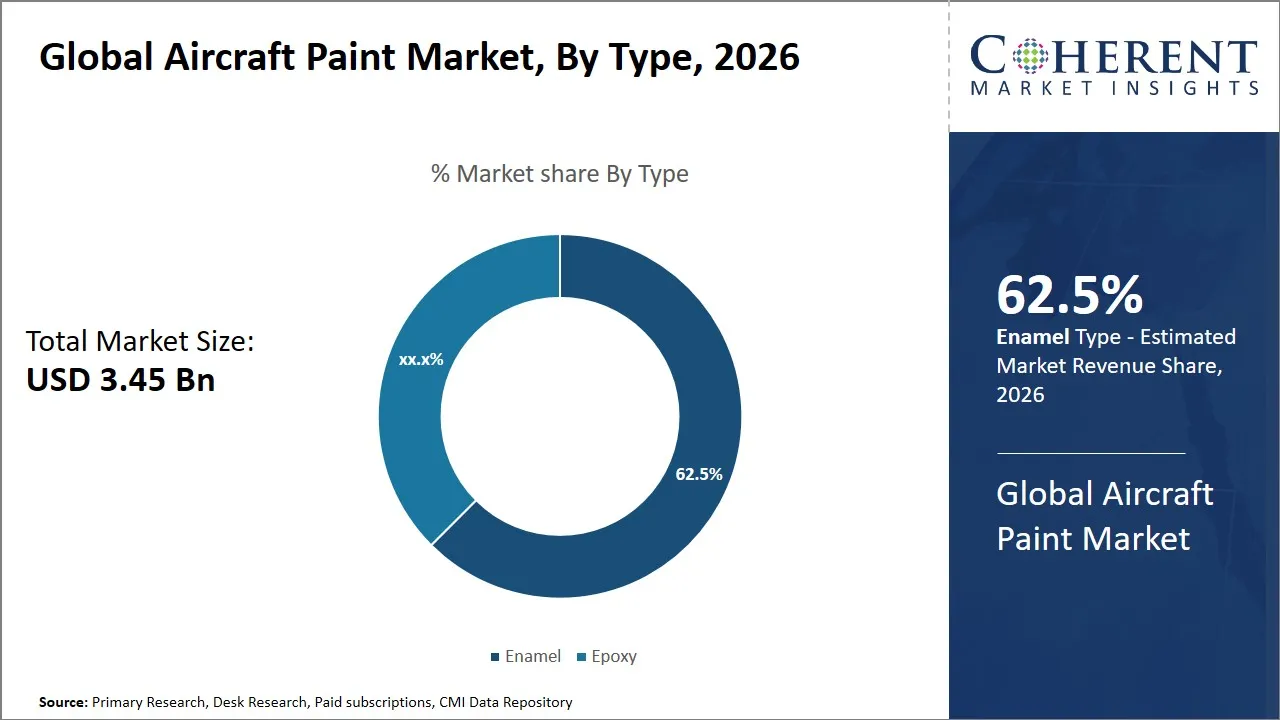
- The enamel segment is expected to capture 62.5% share of the market share in 2026.
- The interior segment is estimated to capture 67.2% of the aircraft paint market in 2026.
- The narrow body segment is expected to hold 48.5% of the global aircraft paint market share in 2026.
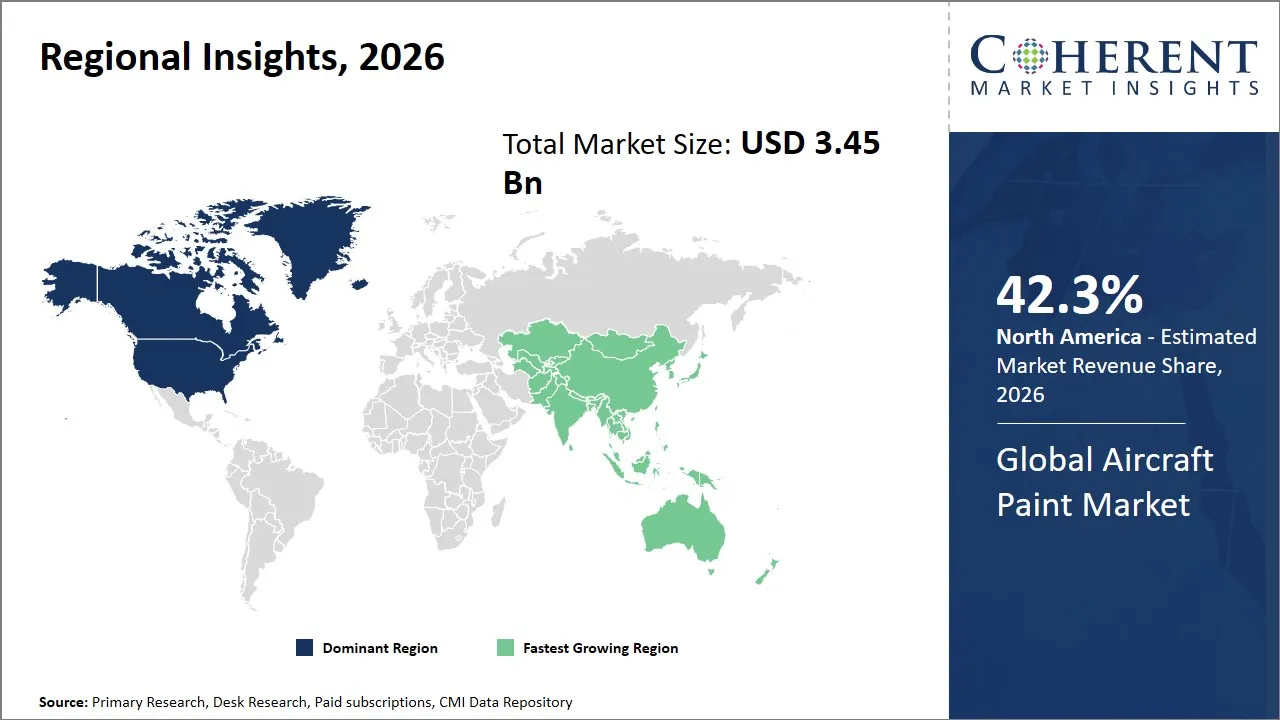
- North America is forecasted to lead the market in 2026 with a 42.3% share, supported by a strong aerospace industry, high defense spending, and robust manufacturing capabilities.
- The Asia Pacific region is projected to grow the fastest, capturing a 22.3% market share in 2026, driven by rapid aviation infrastructure expansion and rising air travel demand from economic growth.
Market Overview
- Current market trends indicate a strong shift toward sustainable and environmentally friendly aircraft paints, driven by stringent regulatory norms concerning volatile organic compounds (VOCs) and emissions.
- Innovations in lightweight coatings that reduce aircraft weight and improve fuel efficiency are gaining traction.
- Moreover, the adoption of advanced technologies such as nanocoatings and self-healing paints is increasing, providing better protection against corrosion and wear.
- These trends reflect the industry’s focus on improving aircraft performance while adhering to environmental sustainability standards.
Currents Events and Its Impacts
Current Events | Description and its Impact |
Stricter Environmental Regulations (CO₂/NOx & VOC Limits) |
|
Adoption of Advanced Coating Technologies (Ceramic/Graphene/Smart Coatings) |
|
Segmental Insights
- Current Industry Events of 2026
- Market Size Estimation
- Regional Breakdown
- Competitive Landscape
- Customer Intelligence
- Segmental Analysis
- Pricing Analysis
- Key Market Drivers, Challenges & Future Trends
- Customized Insights Section
Why Does the Enamel Segment Dominate the Global Aircraft Paint Market in 2026?
The enamel segment is expected to hold 62.5% share of the global aircraft paint market in 2026, due to its proven track record of offering robust protection combined with a visually appealing finish. Enamel paints have been characterized by their high glossiness and a smooth finish, as well as being highly resistant to factors in the environment like UV radiation, moisture, and changes in temperature. These features enable the enamel to be the choice between the commercial and military aircrafts, and the integrity of the paint does not only affect the outward appearance of the aircrafts but also their structural integrity and stability.
The chemical composition of the enamel paints is one of the most vital factors that caused their popularity. When cured, enamel paints are usually hard and shiny and this gives them a tough protective layer against degradation of the surface. This is important in reducing the rate of repainting and maintenance especially in the aviation industry where any kind of downtime because of maintenance is directly proportional to the cost of operation. In addition, the enamels are very resistant to hydraulic fluids, fuels and de-icing chemicals and this ensures that the surfaces of the aircrafts are preserved through long exposure to the harsh operational conditions.
Why Does the Interior Segment Dominate the Global Aircraft Paint Market?
The interior segment is projected to hold 67.2% of the aircraft paint market share in 2026, due to the increased focus on the comfort of passengers, safety, and cabin appeal. Aircraft paint is an important aspect of interior, which contributes towards the beauty of the interior and, at the same time, increases the longevity, cleanliness and general hygiene of the cabin. As air travel is becoming more commercialized and the consumer is favoring interiors that are modern, stylish, and safe, many airlines and manufacturers are spending big on innovative interior finishes.
There is a high level of interior airline paints that are crafted to ensure high levels of regulation towards fire resistance, low toxicity as well as low smoke production in the event of fire incidents. Such safety factors are of the first order, which makes much demand in achieving paints that meet the aviation safety standards. Also, there is a growing need of customized and modular cabin interiors in both narrow-body and wide-bodied planes, which require specific coating that can withstand cleaning agents and long-term wear without losing its appearance and its structural integrity.
Narrow Body Dominates the Aircraft Paint Market
Narrow body segment is expected to capture 48.5% of the global aircraft paint market share in 2026, being mostly representative of the overall industry trends in the airline market with short route flights and regional connectivity growing at a very high pace. The most common airbus used are narrow-body jets which are usually fitted to carry between 100 and 230 passengers and are a center of most airlines’ fleets around the world particularly in domestic and regional routes. Such a wide geographical area of operation caters to demand in maintenance activities such as painting to maintain these aircrafts in the best possible conditions.
The narrow-body segment favors and seeks after products due to several reasons. First, the frequency of flights involved in the short-haul sector leads to fast wear and tear because of the exposure to the environment, ground handling, and also rapid turnaround schedules. This requires permanent paint finishes that can endure frequent exposure to soot and grime and hydraulic fluids and washing procedures without losing aerodynamic smoothness or esthetic appearance of the aircraft.
Regional Insights
North America Aircraft Paint Market Analysis and Trends
The North America region is projected to lead the market with a 42.3% share in 2026, due to the developed aerospace industry ecosystem, high defense expenditure and manufacturing capacity of the regional powers. The U.S. is the country where such aerospace giants as Boeing and Lockheed Martin are located, which creates enormous demand in the sphere of modern aircraft coating that will provide greater durability, anti-corrosion protection, and appearance. The firm government policies aimed at encouraging the aerospace innovation and strict environment regulations also compel manufacturers to resort to the use of environmentally friendly and performance paints.
The dominance of major chemical firms like PPG Industries and Sherwin-Williams also consolidate the position of North America since they provide the state-of-the-art technology of coating that suits the requirements of commercial and military aircraft. Moreover, the well-developed relations in the trade and an impressive number of commercial airlines help to maintain the consistent demand and the constant development of the products in the region.
Asia Pacific Aircraft Paint Market Analysis and Trends
The Asia Pacific region is expected to exhibit the fastest growth in the market contributing 22.3% share in 2026, due to the rapid growth in aviation infrastructure and increasing demand in air travel due to economic growth. China and India are among those countries spending heavily in aircraft manufacturing and maintenance systems to cater to the growing domestic markets as well as regional airline companies. The activities of government to support aerospace industries, policies that encourage foreign investment, and even increasing defense modernization initiatives are some of the factors that have increased the aerospace coatings opportunities.
The ecosystem is changing very fast as it has not only established local manufacturing capacities but has also ventured into joint ventures between local companies and international companies like AkzoNobel and Axalta Coating Systems. The high growth rate in the region is worsened by the fact that more aircrafts are being added to the fleet and more innovative and sustainable coating solutions are being developed to enhance the performance of the aircrafts in various climatic conditions.
Global Aircraft Paint Market Outlook for Key Countries
Why is the U.S. Aircraft Paint Market a Global Leader?
The U.S. aircraft paint market stands as a powerhouse, driven by its extensive aerospace manufacturing and MRO (Maintenance, Repair, and Overhaul) facilities. The main participants such as PPG Industries which deal with Aerocron and Envirocron paint products have a role to play with the innovations in environmental compliant paint. The ongoing aircraft manufacturing and retrofitting programs at Boeing generate a high demand of specialized coatings that comply with the regulatory and performance standards. Demand in hi-tech camouflage and stealth paints is also stimulated by defense contracts and thus the U.S. is already a leader in aircraft paint technologies.
China Aircraft Paint Market Trends
The market in China is rapidly expanding, supported by large-scale investments in both civil and military aircraft production. The leading aircraft manufacturer in the country, which is the COMAC, is very aggressive in pushing the need to get the solution of aircraft painting which is advanced and is required to accommodate the expanding fleet of its commercial airliners.
The partnerships with such international companies as AkzoNobel and the local chemical producers have also spurred the transfer of technology and customization of products to fit regional requirements. Moreover, the system of regulations that promote environmentally friendly and low-VOC (volatile organic compounds) paints is in line with the global sustainability trends, which drives the growth of the market.
Germany Aircraft Paint Market Trends
Germany continues to lead Europe’s aircraft paint segment, leveraging its established aerospace industry and strong emphasis on precision engineering. Home to companies like Lufthansa Technik, which provides extensive aircraft MRO services, Germany, the home to companies such as Lufthansa Technik that offer comprehensive services of aircraft MROs to its clients, requires quality and durable coating products that meet the European standards. The suppliers of paint like BASF do not just offer products but also invest in R & D of lightweight and sustainable coating, which can be viewed as a reflection of the strict environmental policy in the country as well as the innovative manufacturing infrastructure.
Why is India’s Aircraft Paint Market Growing Rapidly?
The aircraft paint industry of India is on a high growth rate being catalyzed by the growth in the domestic aviation and government programs such as the Make in India program aimed at aerospace self-sufficiency. Such companies as the Hindustan Aeronautics Limited (HAL) and rising manufacturers of the aerospace industry of the private sector are raising the demand on the local paint formulations and maintenance coating. The focus of the governments on modernizing the air force and expansion of the commercial fleet size guarantees the potential growth. The joint ventures with international paint companies also contribute to the better access to technologies and product quality of the Indian market.
Brazil Aircraft Paint Market Trends
The aircraft paint market in Brazil has an advantage of being served by the well-established aerospace manufacturing industry, which is headed by Embraer, a renowned regional jet manufacturer in the world market. The domestic ecosystem is an ecosystem that requires specialized coating to cater to the demands of commercial and military aircrafts with emphasis made on durability and weight reducing. The partnership of Embraer with foreign coating companies increases technological penetration in painting aircrafts. The focus on aerospace production in the country is export-based, which makes the country always stay involved with advanced coating technology in order to satisfy the international standard of compliance and performance requirements.
Fuel Burn & Drag Reduction Benefits by Coating for Aircraft
Coating Type | Fuel Burn Reduction (%) | Drag Reduction Benefit | Examples of Coatings |
Aerodynamic Coatings | 2-3% | Lower drag, smoother surface | PPG’s Aerocron, AkzoNobel's Aerodur |
Anti-Icing Coatings | 1-2% | Reduced ice build-up | Boeing’s Ice Shield, BASF's De-icing Coatings |
Nano Coatings | 1-3% | Reduced surface roughness | AkzoNobel's Ultra-durable Nanocoat |
Market Players, Key Development, and Competitive Intelligence
Key Developments
- In November 2025, BASF Coatings introduced biodegradable paint formulations aimed at reducing the environmental footprint of aircraft coatings. The new product line is a step towards sustainability, helping airlines comply with increasingly strict environmental regulations. The biodegradable nature of the paint allows for easier disposable and less harmful waste, a growing concern in the aviation sector. The introduction of these coatings reflects BAFS' commitment to producing eco-friendly solutions while maintaining high-performance standards for the aviation industry.
- In October 2024, Airbourne Colors opened a USD 8.06 Mn aircraft painting facility equipped with advanced technologies to expedite the repairing process. The facility's capabilities aim to reduce aircraft downtimes and associated costs for airlines.
Top Strategies Followed by Global Aircraft Paint Market Players
Player Type | Strategic Focus | Example |
Established Market Leaders | Heavy investment in R&D and innovation | For example, AkzoNobel, a market leader, which invests heavily in R&D to develop high-performance coatings that are able to fulfill the high demands of the aerospace market. Their Interpon brand provides more durable and outstanding coatings that offer aircraft protection over time reducing the frequency at which planes have to be repainted. |
Mid-Level Players | Cost-effective solutions with balanced quality | Mankiewicz is a key example, offering coatings that provide good durability at a lower cost, making them attractive to smaller, regional carriers with tighter budgets. They offer a broad portfolio of coatings, from standard commercial finishes to custom solutions, to meet a variety of operational needs without the premium price tag of major brands. |
Small-Scale Players | Niche specialization & innovative variants | For instance, Mistral Paints, which focuses on the manufacturing of lightweight and environmental friendly coating to fulfill the individual needs in the aerospace industry like antimicrobial coating to counter the growth of undesirable bacteria on planes. |
Market Report Scope
Aircraft Paint Market Report Coverage
| Report Coverage | Details | ||
|---|---|---|---|
| Base Year: | 2025 | Market Size in 2026: | USD 3.45 Bn |
| Historical Data for: | 2020 To 2024 | Forecast Period: | 2026 To 2033 |
| Forecast Period 2026 to 2033 CAGR: | 3.98% | 2033 Value Projection: | USD 4.53 Bn |
| Geographies covered: |
| ||
| Segments covered: |
| ||
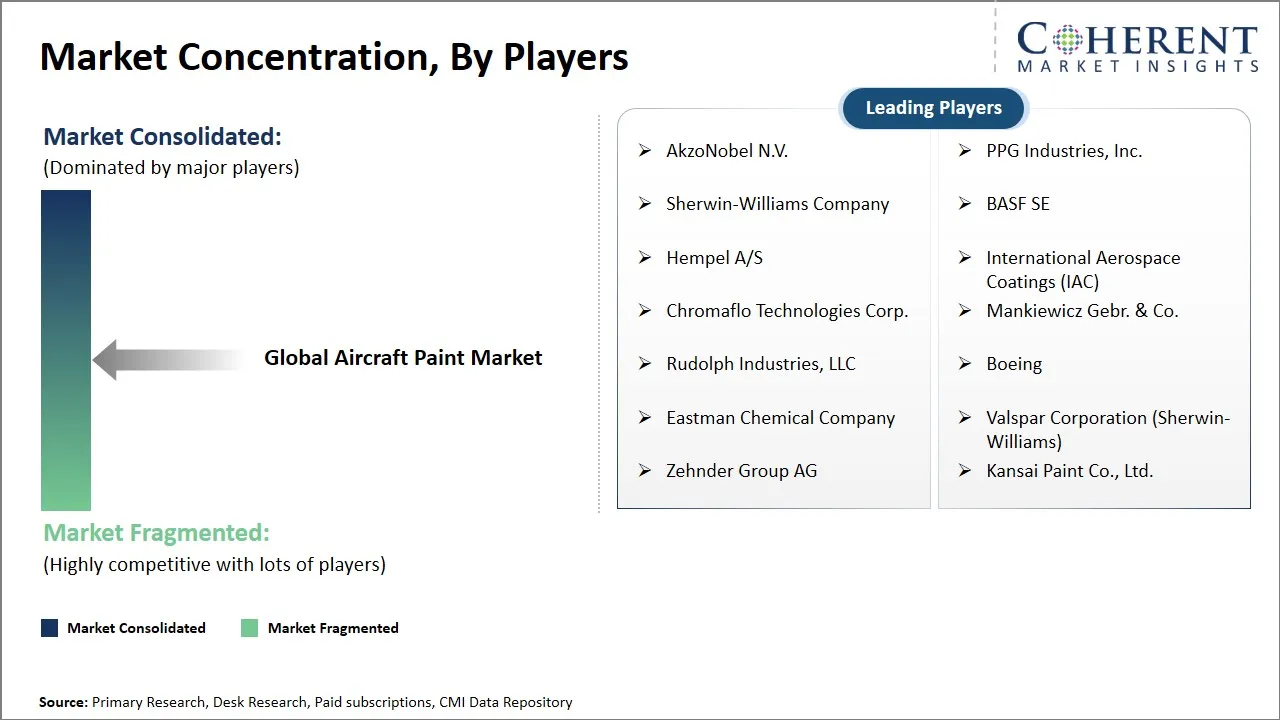
| Companies covered: | AkzoNobel N.V., PPG Industries, Inc., Sherwin-Williams Company, BASF SE, Hempel A/S, International Aerospace Coatings (IAC), Chromaflo Technologies Corp., Mankiewicz Gebr. & Co., Rudolph Industries, LLC, Boeing, Eastman Chemical Company, Valspar Corporation (Sherwin-Williams), Zehnder Group AG, and Kansai Paint Co., Ltd. | ||
| Growth Drivers: |
| ||
| Restraints & Challenges: |
| ||
Aircraft Paint Market Dynamics
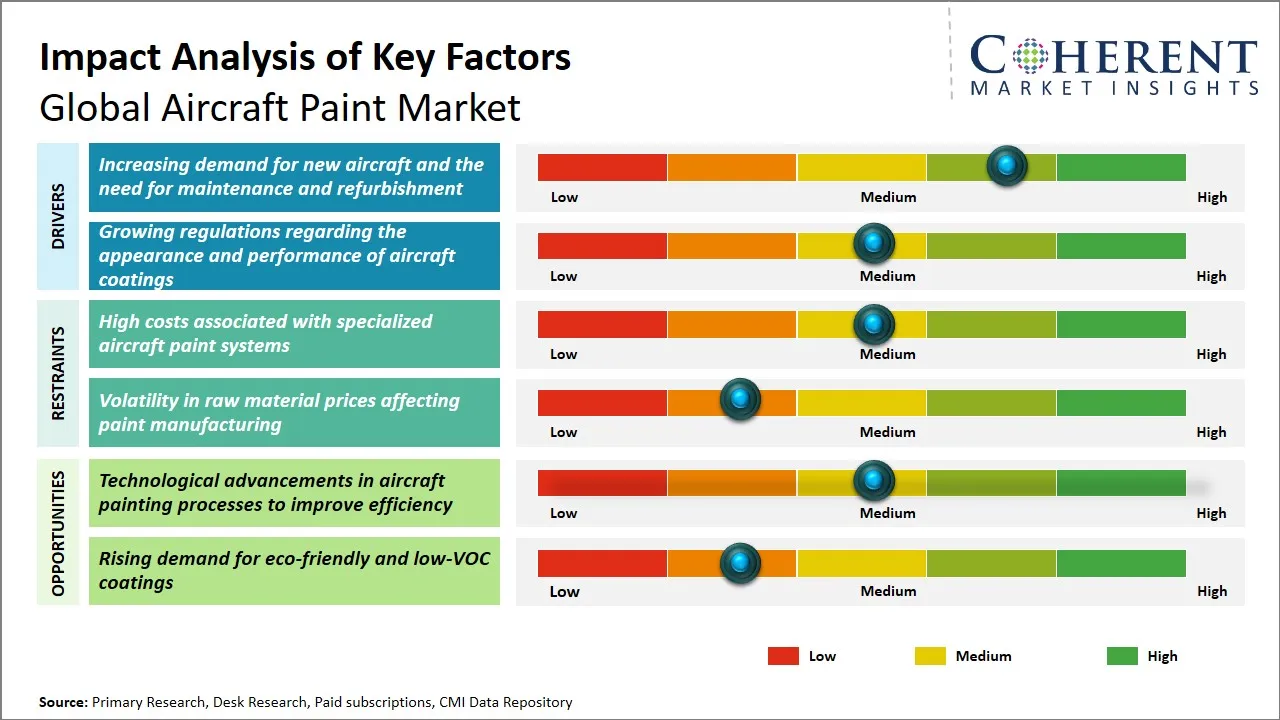
Aircraft Paint Market Driver - Increasing Demand for New Aircraft and the Need for Maintenance and Refurbishment
The growing aviation sector worldwide has resulted in the high demand of new aircraft which indirectly stimulates the aircraft paint market because of the requirement of quality and durable finishes that are used in the process of commercial aircraft production. The airlines, aircraft manufacturers are increasingly focusing on advanced paints which besides offering beauty, they offer protection against corrosion, UV radiations, and environmental wear and tear thus prolonging the life of the aircraft. At the same time, market expansion is also driven by the constant needs of upkeep and restoration of old fleets as older airplanes are being repainted to comply with safety standards, rebranded, and made more fuel-efficient with special paint applies.
Companies like The Emirates Group and Qatar Airways keep repainting their planes with new coats of paint to beautify the appearance outside and make sure that the safety standards are met. Also, repainting of older planes, particularly by low-cost airlines, is also important to ensure the fuel economy through the use of lighter and more aerodynamic paints.
Aircraft Paint Market Opportunity - Technological Advancements in Aircraft Painting Processes to Improve Efficiency
Technological development in the field of aircraft paints is set to positively impact the global aircraft paint market by making the painting activity efficient and better. Robotic painting systems, automated spray technology, and better coating materials are all ways of innovating the previous procedures and allowing quicker time of application and more accurate finishes. The advancement of these technologies lowers the amount of waste paint and solvents emitted, and it is in line with the growing demands and requirements of environmental regulation and sustainable development of the aerospace sector. Also, the use of digital tools such as computer-aided design (CAD) and artificial intelligence (AI) will allow to optimize the process of formulation and application of paints based on the efficient strategy concerning particular aircraft models and materials and reduce costs with maximum durability and resistance to corrosion.
As an example, Boeing’s robots paint 777 wings with dramatically higher speed and quality vs. humans — multiple industrial automation sources describe the system known as the Automated Spray Method (ASM) and its benefits (faster cycle times, uniform application, accuracy improvements).
Analyst Opinion (Expert Opinion)
- The market of aircraft paint is experiencing a high growth due to the growing concern of the aerospace industry on durability, safety, and beauty. Recent developments in the Global Aerospace Paint and Coatings Conference (2023) and the International Air Transport Association Expo (2022) have shown that key advances were made, with such companies as PPG Industries and AkzoNobel leading the way in developing new advanced coatings that will improve aircraft performance and environmental factors resistance.
- The introduction of a new line of high-durability and lightweight paints by PPGs recently shows how the industry is working towards ensuring that there is an increase in fuel efficiency and at the same time ensure high-quality aesthetics. The theme of greener coatings was discussed in these conferences due to the increasing popularity of eco-friendly coating, where regulatory forces are pushing manufacturers to find more sustainable alternatives that have reduced environmental effects.
- The barriers to widespread adoption were identified as the high price of high-tech coating and strict testing that is necessary in order to confirm the safety requirements. Those companies, which invest in the sphere of R&D to be innovative and develop unique solutions, as well as participate in active cooperation with aircraft manufacturers, have high chances to obtain a competitive advantage. The development of the aircraft paint market will depend ultimately on whether it can be consistent with the changing aerospace industry requirements in performance, sustainability, and appearance.
Speak to the analyst
Want personalized insights?
Take the findings above to one of our principal consultants, or have the report rebuilt around the segments, geographies and competitors you actually track.
Market Segmentation
- Type Insights (Revenue, USD Bn, 2021 - 2033)
- Enamel
- Epoxy
- Application Insights (Revenue, USD Bn, 2021 - 2033)
- Interior
- Exterior
- Aircraft Type Insights (Revenue, USD Bn, 2021 - 2033)
- Narrow Body
- Widebody
- Regional Jets
- End User Insights (Revenue, USD Bn, 2021 - 2033)
- Military Aircraft
- Commercial Aircraft
- Regional Insights (Revenue, USD Bn, 2021 - 2033)
- North America
- U.S.
- Canada
- Latin America
- Brazil
- Argentina
- Mexico
- Rest of Latin America
- Europe
- Germany
- U.K.
- Spain
- France
- Italy
- Russia
- Rest of Europe
- Asia Pacific
- China
- India
- Japan
- Australia
- South Korea
- ASEAN
- Rest of Asia Pacific
- Middle East
- GCC Countries
- Israel
- Rest of Middle East
- Africa
- South Africa
- North Africa
- Central Africa
- North America
- Key Players Insights
- AkzoNobel N.V.
- PPG Industries, Inc.
- Sherwin-Williams Company
- BASF SE
- Hempel A/S
- International Aerospace Coatings (IAC)
- Chromaflo Technologies Corp.
- Mankiewicz Gebr. & Co.
- Rudolph Industries, LLC
- Boeing
- Eastman Chemical Company
- Valspar Corporation (Sherwin-Williams)
- Zehnder Group AG
- Kansai Paint Co., Ltd.
Sources
Primary Research Interviews
- CEO/Business Head – Global aircraft coatings manufacturer (e.g., AkzoNobel Aerospace Coatings, PPG Aerospace, Sherwin-Williams Aerospace)
- VP/Director – Aircraft OEM procurement (e.g., Airbus, Boeing, Embraer, COMAC)
- MRO Operations Head – Aircraft repainting and maintenance provider (independent MRO and airline in-house MRO)
- Product & R&D Manager – Specialty aerospace coatings and sealants producer
- Sustainability/ESG Officer – Aviation coatings producer focusing on low-VOC and chrome-free systems
Stakeholders
- Manufacturers
- Aircraft paint and coating producers (polyurethane, epoxy, fluoropolymer systems)
- Raw material suppliers (resins, pigments, corrosion inhibitors, solvents, additives)
- End-use Sectors
- Commercial aircraft OEMs (narrow-body, wide-body, regional jets)
- Business jets and general aviation manufacturers
- Helicopter OEMs (civil and defense)
- Defense aircraft programs (fighters, transport, trainers)
- MRO service providers (airlines and independent repainting facilities)
- Regulatory & Certification Bodies
- Distribution & Channels
- Technology Integration Players
- Advanced coatings system integrators (chrome-free primers, fuel-efficient low-drag topcoats)
- Digital color-matching and robotic painting system providers
Databases
- UN Comtrade Database – Trade flows of HS codes related to aircraft paints, varnishes, and related coating materials
- IATA, ICAO and airport traffic statistics – Fleet and traffic trends impacting repainting cycles
- Airline financial and fleet databases (e.g., Cirium/Fleet data, CAPA profiles) for aircraft in-service and order book
- Eurostat Trade Statistics – EU trade in paints and varnishes for transport applications
- National trade statistics (USITC DataWeb, India EXIM, China customs) for aerospace paint-related HS codes
Magazines
- Aviation Week & Space Technology – Fleet trends, MRO and repainting demand
- MRO Management / Inside MRO – Articles on repainting intervals, shop capacity, coating innovations
- Coatings World – Features on aerospace coatings technologies and suppliers
- Paint & Coatings Industry Magazine – Raw materials (pigments, resins) and regulatory topics
- CompositesWorld – Surface treatment and coating issues on composite aircraft structures
Journals
- Progress in Organic Coatings – Research on high-performance and low-VOC aerospace coatings
- Journal of Coatings Technology and Research – Durability, corrosion, adhesion and weathering studies for aircraft paints
- Surface & Coatings Technology – Thin-film and advanced functional coatings for aerospace
- Journal of Protective Coatings & Linings – Anti-corrosive coating systems used on aircraft and structures
- Journal of Cleaner Production – Studies on sustainable and chrome-free aerospace coatings
Newspapers/Business Media
- The Wall Street Journal/Financial Times – Airline profitability, fleet expansion and capex trends driving repaint demand
- Reuters/Bloomberg – News on aircraft OEM production rates, order backlogs and supply chain disruptions in aerospace paints and chemicals
- Nikkei Asia/Business Standard – Asia-Pacific aircraft deliveries, MRO capacity and coatings demand
- Chemical Week/ICIS News – Raw material price movements (solvents, resins, pigments) affecting aircraft paint costs
Associations
- International Air Transport Association (IATA) – Traffic, fleet utilization and airline performance outlooks
- International Civil Aviation Organization (ICAO) – Environmental standards and emission frameworks influencing coating technologies
- Aircraft owners and operators’ associations (e.g., NBAA, EBAA) – Business aviation repainting and customization trends
- American Coatings Association (ACA)/European Council of the Paint, Printing Ink and Artists’ Colours Industry (CEPE) – Sector guidelines and regulatory updates for coatings
- MRO and airline associations (e.g., AFRAA, ALTA, A4A) – Maintenance and repainting policies, regional trends
Public Domain Sources
- FAA and EASA documentation – Airworthiness requirements, material and process approvals for coatings
- European Commission – REACH regulations on substances used in aircraft coatings (chromates, solvents, isocyanates)
- EPA – VOC, HAPs, and hazardous waste regulations relevant to paint booths and stripping operations
- OSHA/NIOSH – Worker exposure limits and safety practices for aircraft paint shops
Proprietary Elements
- CMI Data Analytics Tool
- Proprietary CMI Existing Repository of information for last 8 years.
Get access to 250+ pages report
Every segment, forecast, competitor profile and data table behind the analysis above — available for instant download.
- ESOMAR Member
- ISO 9001:2015 Certified
- D-U-N-S Registered
- GDPR & CCPA Compliant
Missing comfort of reading report in your local language? Find your preferred language:
Transform your Strategy with Exclusive Trending Reports
Frequently Asked Questions
The global aircraft paint market is estimated to be valued at USD 3.45 Bn in 2026 and is expected to reach USD 4.53 Bn by 2033.
The CAGR of global aircraft paint market is projected to be 3.98% from 2026 to 2033.
Increasing demand for new aircraft and the need for maintenance and refurbishment and growing regulations regarding the appearance and performance of aircraft coatings are the major factors driving the growth of the global aircraft paint market.
High costs associated with specialized aircraft paint systems and volatility in raw material prices affecting paint manufacturing are the major factors hampering the growth of the global aircraft paint market.
In terms of type, enamel is estimated to dominate the market revenue share in 2026.
AkzoNobel N.V., PPG Industries, Inc., Sherwin-Williams Company, BASF SE, Hempel A/S, International Aerospace Coatings (IAC), Chromaflo Technologies Corp., Mankiewicz Gebr. & Co., Rudolph Industries, LLC, Boeing, Eastman Chemical Company, Valspar Corporation (Sherwin-Williams), Zehnder Group AG, and Kansai Paint Co., Ltd. are the major players.
Advancements in robotic painting systems, improved coating materials, and innovations in spray technologies enhance the efficiency, precision, and environmental sustainability of aircraft paint applications.