

Global Artillery Shells Market Size and Forecast – 2026-2033
The Global Artillery Shells Market is estimated to be valued at USD 4.92 Bn in 2026 and is expected to reach USD 7.25 Bn by 2033, exhibiting a compound annual growth rate (CAGR) of 5.7% from 2026 to 2033.
Key Takeaways of the Global Artillery Shells Market
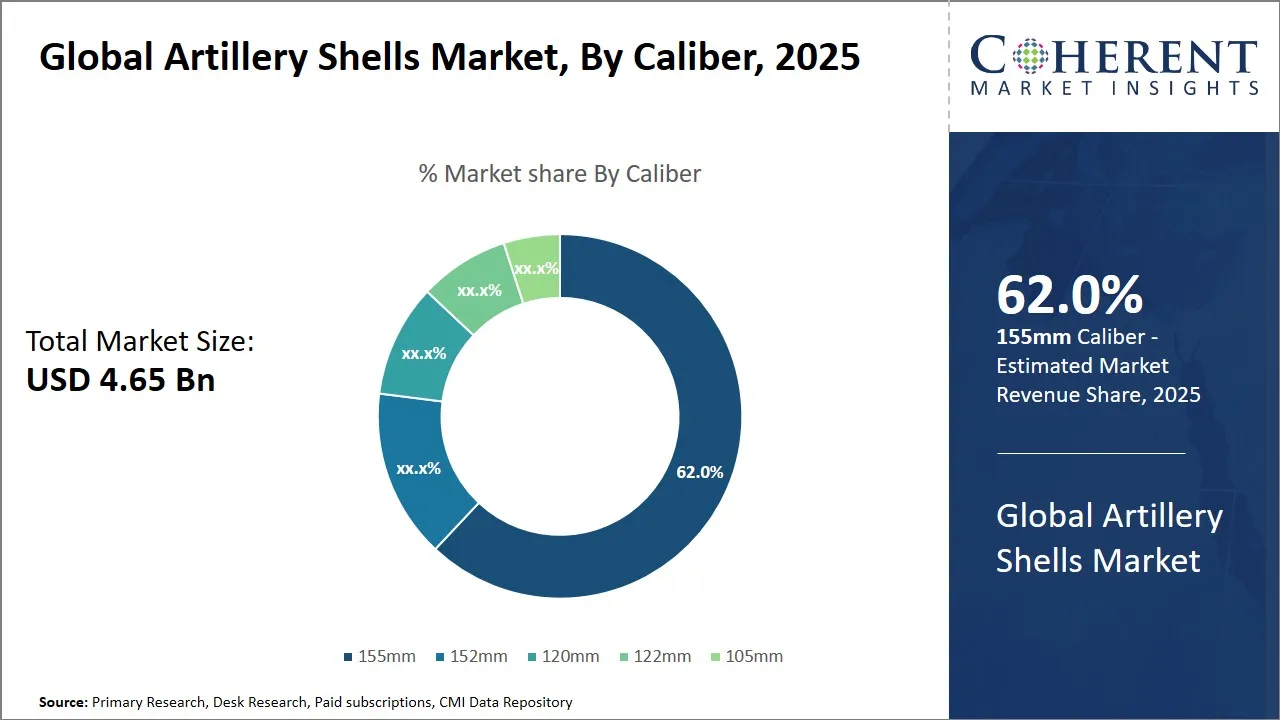
- The 155mm segment is projected to lead the market holding a share of 63% in 2026.
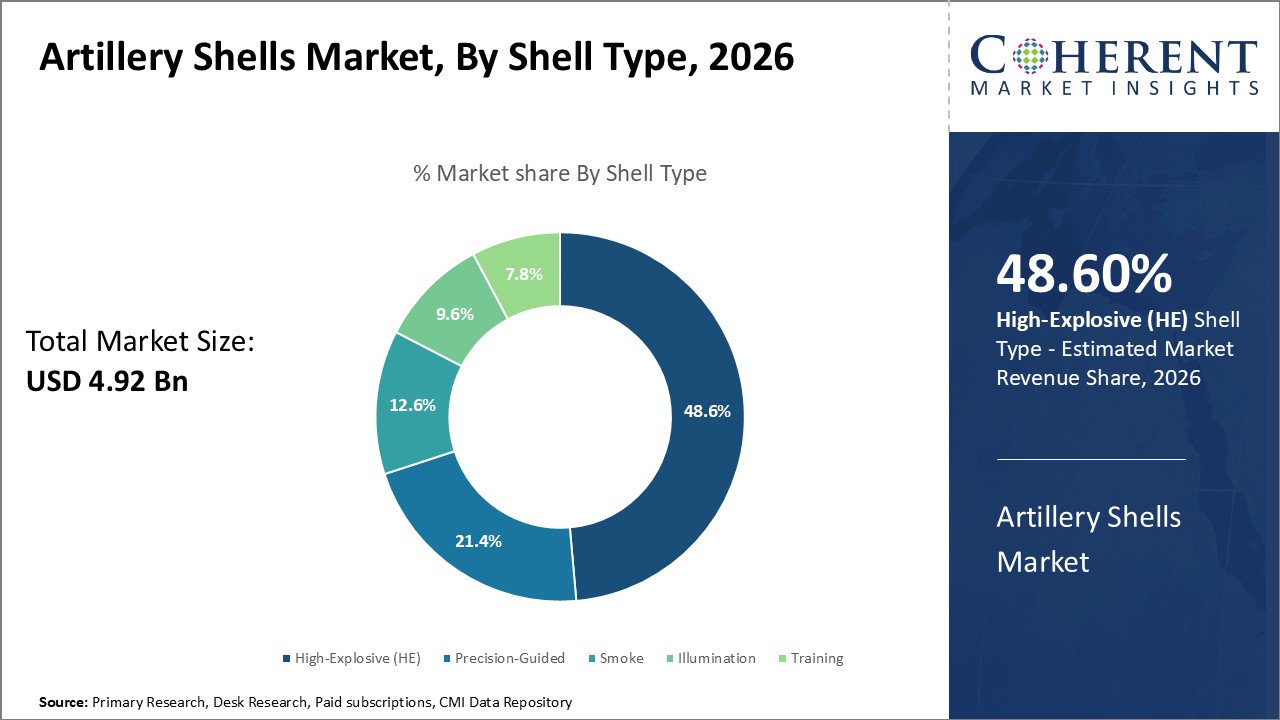
- The High-Explosive (HE) segment is expected to dominate the market with a share of 48.6% in 2026.
- The ground forces segment leads the market holding an estimated share of 71% in 2026.
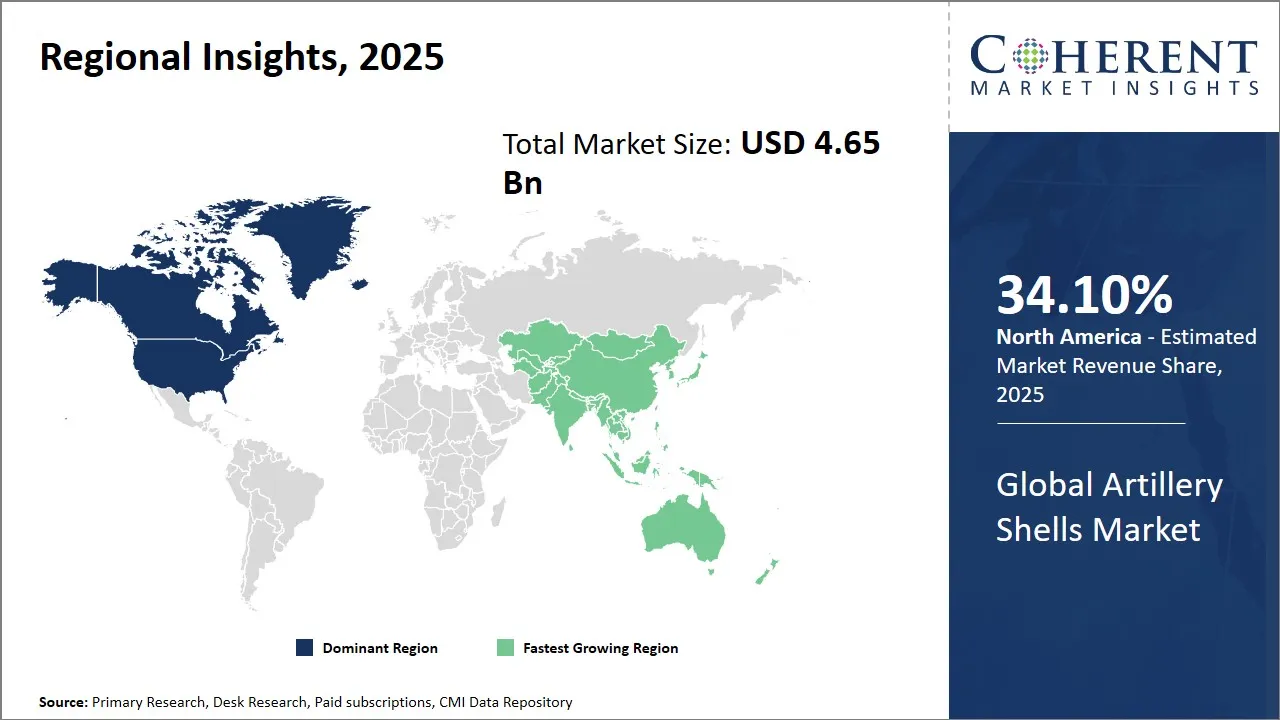
- North America, holding an estimated share of 34. 1% in 2026, is projected to dominate the market.
- Asia Pacific, holding an estimated share of 25% in 2026, shows the fastest growth in the market.
Market Overview
The market sees a move towards smart artillery shells with advanced guidance systems and improved explosive materials to maximize effectiveness and minimize collateral damage. Also, there is a lot of demand for environmentally friendly and reusable artillery components, driven by stricter regulations and sustainability goals. Defense organizations are investing a lot in research and development to innovate in munition technology, integrating AI and IoT capabilities to enhance battlefield awareness and operational efficiency.
Current Events and Its Impact
Current Events | Description and its Impact |
Geopolitical and Trade Developments |
|
Economic and Industrial Trends |
|
Segmental Insights
- Current Industry Events of 2026
- Market Size Estimation
- Regional Breakdown
- Competitive Landscape
- Customer Intelligence
- Segmental Analysis
- Pricing Analysis
- Key Market Drivers, Challenges & Future Trends
- Customized Insights Section
Global Artillery Shells Market Insights, By Caliber – 155mm Leads Because of its Superior Range and Firepower Capabilities
The 155mm segment is expected to dominate the market with a 63% share in 2026, because of its optimal combination of range, payload, and precision, making it the preferred choice among armed forces. Its high adoption by NATO and allied militaries has standardized production and logistics. Technological improvements, such as enhanced aerodynamics and propulsion, increase accuracy and lethality. The U.S. Army’s M777 howitzer uses 155mm shells, providing long-range precision support in operations like in Ukraine, showing their importance.
Global Artillery Shells Market Insights, By Shell Type – High-Explosive (HE) Segment Leads Because of its Versatility and Immediate Tactical Impact
The High-Explosive (HE) segment is projected to hold 48.6% of the market share in 2026, prized for their versatility and destructive capability. They neutralize personnel, fortifications, and light armor, and are cost-efficient for sustained operations. Advances in fuzing technologies, like proximity and delay fuzes, improve their battlefield effectiveness. Rheinmetall supplied HE 155mm shells to NATO forces for training and operational deployments in Eastern Europe, showing continued reliance on HE rounds.
Global Artillery Shells Market Insights, By Application – Ground Forces Dominate the Application Segment Because of Sustained Land Combat Needs and Versatile Fire Support
The ground forces segment is expected to hold 71% of the market share in 2026, because of the critical need for indirect firepower in land operations. Artillery shells support offensive, defensive, and area-control missions, and modern network-centric systems add to accuracy and responsiveness. Poland’s Ground Forces has increased procurement of 155mm shells for their Krab self-propelled howitzers because of regional security tensions, illustrating ground combat reliance on artillery.
Pricing Analysis of the Artillery Shells Market
Caliber/Shell Type | Unit Price (USD) |
155mm High-Explosive (HE) Shell | USD 500 – USD 1,500 |
155mm Guided (e.g., Excalibur) | USD 100,000 – USD 112,800 |
105mm High-Explosive (HE) Shell | USD 240 – USD 335 |
120mm High-Explosive (HE) Mortar | USD 400 – USD 510 |
120mm Guided Mortar (e.g., XM395) | ~USD 24,469 |
155mm Guided (e.g., Sceptre) | ~USD 3,300 |
Regional Insights
North America Artillery Shells Market Analysis and Trends
North America, holding a share of 34.1% in 2026, is expected to dominate the global artillery shells market, because of the region’s well-established defense infrastructure, advanced technological ecosystem, and significant government defense budgets. The U.S., as the largest defense spender globally, sees a strong ecosystem of artillery manufacturing and R&D. Supportive government policies focus on modernization of land forces and artillery systems, which makes demand for advanced artillery shells.
The presence of big defense contractors like General Dynamics Ordnance and Tactical Systems, BAE Systems Inc., and Lockheed Martin contributes a lot to the market’s strength. Additionally, extensive military engagements and strategic alliances reinforce trade dynamics that promote the bulk purchase and production of artillery munitions in the region. Canada also supports this through its collaborations on modernization projects with U.S. entities.
Asia Pacific Artillery Shells Market Analysis and Trends
The Asia Pacific region, holding an estimated share of 25% in 2026, shows the fastest growth in the artillery shells market because of rising geopolitical tensions, rapid military modernization programs, and increasing defense spending in countries like India, China, South Korea, and Australia. Governments in this region are investing a lot in upgrading their land warfare capabilities, including enhanced artillery munitions, propelled by strategic priorities of strengthening deterrence and defense readiness.
The market ecosystem sees growing local production capacities supported by policies for domestic defense industries, like India’s “Make in India” initiative and China’s indigenous defense modernization efforts. Big companies like Norinco, Bharat Dynamics Limited, and Hanwha Defense are adding to innovations and scaling production to meet both domestic and export demands. Trade factors, including regional arms deals and collaborations, further stimulate the market growth.
Global Artillery Shells Market Outlook for Key Countries
U.S. Artillery Shells Market Analysis and Trends
The U.S. artillery shells market leads in artillery shell innovations because of sustained investment in next-generation ammunition technologies such as precision-guided rounds and extended-range projectiles. Major defense players including General Dynamics, Raytheon Technologies, and BAE Systems have prioritized R&D to enhance range, lethality, and compatibility with upgraded artillery systems.
The U.S. Army’s modernization programs make a lot of market demand, while export activities to allied nations bolster production scales. Strategic policies focusing on maintaining technological superiority and fast supply chain responsiveness support the sustained market leadership of the U.S.
India Artillery Shells Market Analysis and Trends
India artillery shells market is growing because of a strong focus on self-reliance and indigenous production under government initiatives. With growing border tensions and modernization imperatives, India is rapidly making and procuring different artillery shells suited for various operational environments.
Big domestic companies, like Bharat Dynamics Limited and Ordnance Factory Board, are innovating a lot to meet army requirements, while foreign collaborations bring in advanced technologies. Government supports like licensing reforms and improved budget allocations for artillery modernization makes the country’s position stronger as a fast-emerging artillery shells market.
China Artillery Shells Market Analysis and Trends
China continues to lead in the Asia Pacific region, bolstered by its vast defense manufacturing base and aggressive modernization agenda targeting enhanced accuracy and explosive capability of artillery munitions. Companies like Norinco play a big role in domestic production and export to allied countries. China’s government policies highly focus on self-sufficiency and upgrading battlefield artillery capabilities under its military reform frameworks. This, along with strategic export partnerships, positions China as a formidable player shaping regional market dynamics.
Russia Artillery Shells Market Analysis and Trends
Russia artillery shells market is characterized by its extensive artillery munitions production capacity and continuous innovations in both conventional and precision artillery shells. Leading firms like Techmash and Uralvagonzavod remain important for fulfilling domestic demand and export commitments in Eurasia and beyond. Government focus on modernizing land forces and improving artillery effectiveness makes steady demand. Also, ongoing military conflicts and strategic partnerships maintain Russia's active role in global artillery shell supply chains.
South Korea Artillery Shells Market Analysis and Trends
South Korea artillery shells market sees modern military infrastructure and strategic investments aimed at making regional security stronger. Companies like Hanwha Defense are key contributors, making advanced artillery ammunition made for Korean peninsula defense needs. Government policies prioritize domestic defense production alongside technology transfer agreements, further accelerating the capability development of artillery munitions. South Korea's active export drive also plays a role in expanding the market reach within Asia Pacific.
Market Players, Key Development, and Competitive Intelligence
Key Developments
- On October 13, 2025, Leonardo DRS and KNDS entered a strategic teaming agreement to offer a high-performance, self-propelled howitzer system to the U.S. defense market. The team intends to present the U.S. Army with the CAESAR Self-Propelled Howitzer, a combat-proven and reliable system that addresses the U.S. Army’s needs for greater range and improved mobility.
- In September 2025, Rheinmetall took Europe's largest ammunition factory in Lower Saxony into operation in order to meet the urgent needs of the armed forces in Europe. The technology group invested almost USD 585.8 million (€500 million) in the construction of the production facility at the Rheinmetall site in Celle, Germany.
- In September 2025, Rheinmetall was commissioned to supply ammunition to an Eastern European customer. As a subcontractor to Global Military Products, a company commissioned by the U.S. government, Rheinmetall Expal Munitions will supply 155 mm M107 projectiles with M4A2 propellant charges and 105 mm M1 projectiles to the customer. The total value of the contract is around USD 520.3 million (€444 million).
- In August 2025, MSM North America, a subsidiary of the global Czechoslovak Group (CSG), won a U.S. Army contract to design, construct, and commission the most advanced large-caliber ammunition loading facility in North America. The contract for the so-called Future Artillery Complex (FAC), to be built at the Iowa Army Ammunition Plant, was signed between MSM North America and the U.S. Department of Defense.
Top Strategies Followed by Artillery Shells Market Players
- Established market leaders invest a lot in research and development (R&D) to innovate and deliver high-performance artillery shells.
- Raytheon Technologies is doing continuous R&D on the Excalibur GPS-guided 155mm shell to improve accuracy and extend operational range.
- Mid-level players in the artillery shells market adopt a distinctly pragmatic approach that centers on offering cost-effective solutions without compromising essential performance and reliability.
- Nammo AS makes standard 155mm and 120mm HE shells for NATO and export markets, focusing on reliability and cost-efficiency over high-tech precision munitions to appeal to mid-tier defense budgets.
- In contrast, small-scale entrants and niche manufacturers make their presence in the highly competitive artillery shells market by concentrating on specialized features or innovation-driven products often overlooked by larger firms.
- MSM North America (USA) focuses on specialized artillery munitions production, including training rounds and customized calibers for U.S. Army programs.
Market Report Scope
Artillery Shells Market Report Coverage
| Report Coverage | Details | ||
|---|---|---|---|
| Base Year: | 2025 | Market Size in 2026: | USD 4.92 Bn |
| Historical Data for: | 2020 To 2024 | Forecast Period: | 2026 To 2033 |
| Forecast Period 2026 to 2033 CAGR: | 5.7% | 2033 Value Projection: | USD 7.25 Bn |
| Geographies covered: |
| ||
| Segments covered: |
| ||
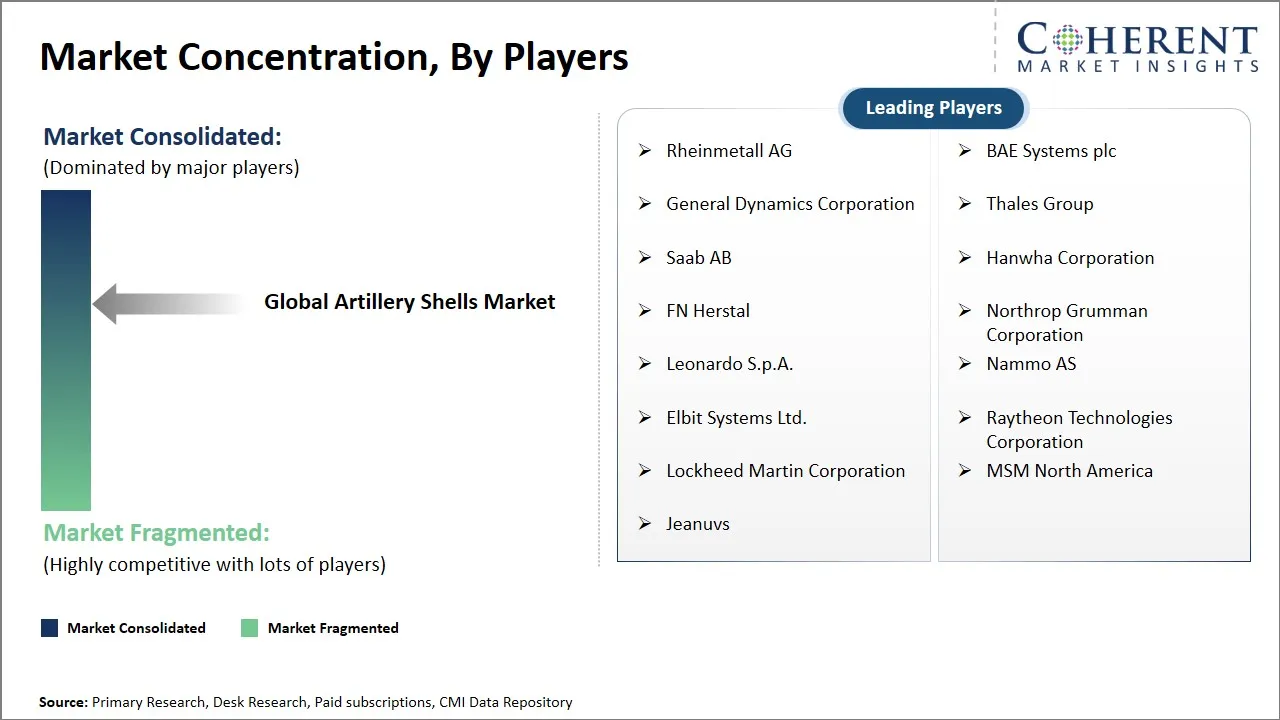
| Companies covered: | Rheinmetall AG, BAE Systems plc, General Dynamics Corporation, Thales Group, Saab AB, Hanwha Corporation, FN Herstal, Northrop Grumman Corporation, Leonardo S.p.A., Nammo AS, Elbit Systems Ltd., Raytheon Technologies Corporation, Lockheed Martin Corporation, MSM North America, and Jeanuvs | ||
| Growth Drivers: |
| ||
| Restraints & Challenges: |
| ||
Market Dynamics
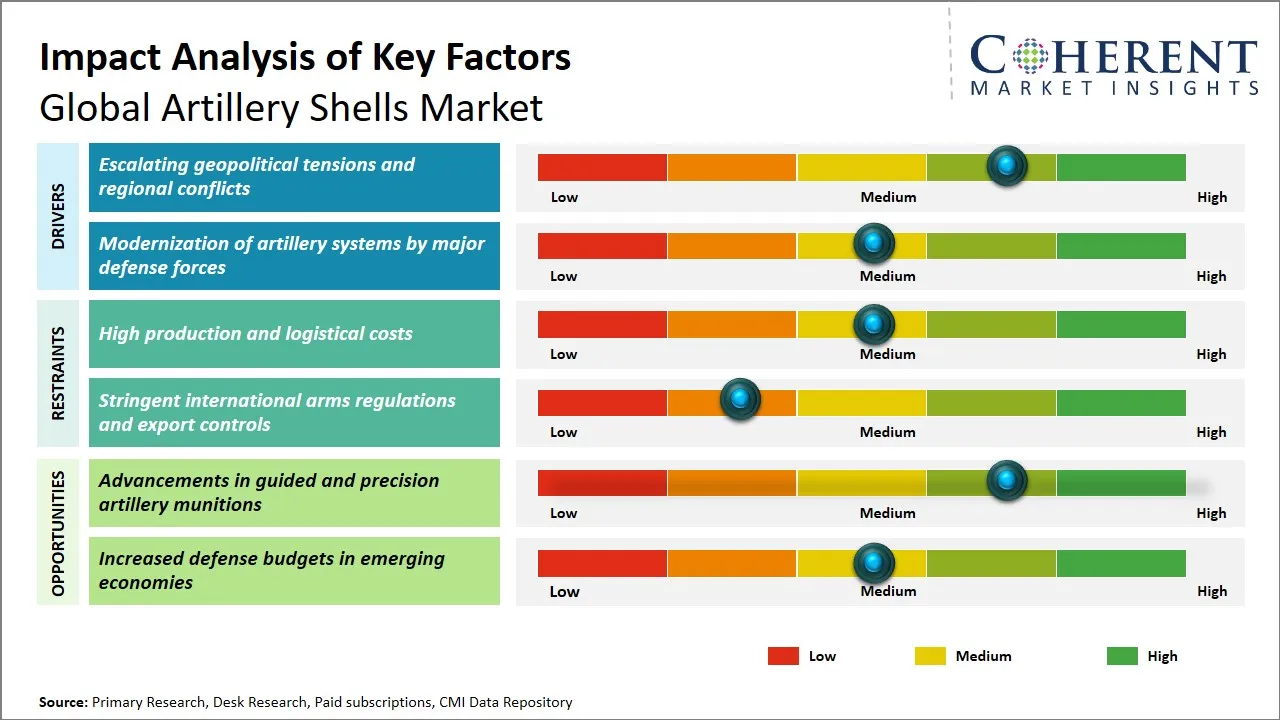
Global Artillery Shells Market Driver – Escalating Geopolitical Tensions and Regional Conflicts
The growing geopolitical tensions in different regions around the world have significantly fueled demand for artillery shells, as nations prioritize strengthening their defense capabilities amid growing uncertainties. Persistent conflicts and territorial disputes drive military modernization programs, pushing armed forces to improve their artillery arsenals to maintain operational readiness and deterrence. As countries look to assert dominance or protect their interests, investments in sophisticated artillery munitions become a crucial component of their defense strategies.
Also, the unpredictability of conflicts and the need for fast, effective response options further emphasize the importance of artillery shells, known for their versatility and battlefield impact. This ongoing environment of heightened military preparedness make sustained procurement cycles, influencing manufacturers and governments alike to focus on developing advanced artillery ammunition to meet evolving tactical requirements. Consequently, escalating geopolitical rivalries remain a pivotal factor shaping the artillery shells market landscape.
Global Artillery Shells Market Opportunity – Advancements in Guided and Precision Artillery Munitions
A big opportunity in the global artillery shells market lies in the fast advancements in guided and precision artillery munitions, which are transforming traditional artillery capabilities into highly accurate and efficient systems. Modern warfare needs precision strikes with minimal collateral damage, driving military forces worldwide to invest heavily in smart munitions equipped with GPS, laser guidance, and advanced sensor technologies. The ongoing development of these technologies allows artillery units to engage targets with precision, reducing ammunition expenditure and increasing mission success rates.
Also, many countries are modernizing their artillery arsenals by using these advanced munitions to replace legacy unguided shells, thereby boosting replacement demand in established and emerging markets. The addition of precision guidance systems with artillery shells also aligns with the broader defense trend toward network-centric warfare, enabling real-time data integration and target acquisition.
Analyst Opinion (Expert Opinion)
- Global conflicts, particularly in Eastern Europe and the Middle East, are forcing militaries to stockpile artillery shells at unprecedented rates. Analysts believe this has accelerated procurement cycles, creating a short-term surge in market revenues, especially for 155mm HE and precision-guided rounds.
- Ongoing conflicts are exposing vulnerabilities in global ammunition supply chains, from raw steel shortages to specialized fuzing components. The analyst view is that prices are likely to remain volatile, favoring established manufacturers with resilient production networks while straining smaller players.
- The intensity and unpredictability of modern warfare are pushing R&D toward guided, modular, and high-precision shells. Experts argue that global conflicts are not only boosting demand but also accelerating technological advancement, forcing the market to evolve faster than peacetime planning would allow.
Speak to the analyst
Want personalized insights?
Take the findings above to one of our principal consultants, or have the report rebuilt around the segments, geographies and competitors you actually track.
Market Segmentation
- Caliber Insights (Revenue, USD Bn, 2021 - 2033)
- 155mm
- 152mm
- 120mm
- 122mm
- 105mm
- Shell Type Insights (Revenue, USD Bn, 2021 - 2033)
- High-Explosive (HE)
- Precision-Guided
- Smoke
- Illumination
- Training
- Application Insights (Revenue, USD Bn, 2021 - 2033)
- Ground Forces
- Naval Forces
- Air Forces
- Regional Insights (Revenue, USD Bn, 2021 - 2033)
- North America
- U.S.
- Canada
- Latin America
- Brazil
- Argentina
- Mexico
- Rest of Latin America
- Europe
- Germany
- U.K.
- Spain
- France
- Italy
- Russia
- Rest of Europe
- Asia Pacific
- China
- India
- Japan
- Australia
- South Korea
- ASEAN
- Rest of Asia Pacific
- Middle East
- GCC Countries
- Israel
- Rest of Middle East
- Africa
- South Africa
- North Africa
- Central Africa
- North America
- Key Players Insights
- Rheinmetall AG
- BAE Systems plc
- General Dynamics Corporation
- Thales Group
- Saab AB
- Hanwha Corporation
- FN Herstal
- Northrop Grumman Corporation
- Leonardo S.p.A.
- Nammo AS
- Elbit Systems Ltd.
- Raytheon Technologies Corporation
- Lockheed Martin Corporation
- MSM North America
- Jeanuvs
Sources
Primary Research Interviews
Stakeholders
- Defense Ministries and Procurement Departments
- Artillery and Ammunition Manufacturers
- Military Logistics and Supply Chain Experts
- Defense Technology Consultants and Tactical Analysts
- Armed Forces Training Commanders and Artillery Specialists
- Strategic Policy Experts and Geopolitical Analysts
Databases
- Stockholm International Peace Research Institute (SIPRI) Arms Transfer Database
- Jane’s Defence Weekly Database
- NATO Defense Expenditure Reports
- Global Firepower Index
- IISS Military Balance Database
Magazines
- Defense Today
- Army Technology Magazine
- Military Procurement Review
- Defense Industry Journal
- Modern Artillery & Ammunition Magazine
Journals
- Journal of Defense Technology and Logistics
- Military Operations Research Journal
- Ammunition and Ordnance Engineering Journal
- International Journal of Defense Acquisition & Management
Newspapers
- Defense News
- Jane’s Defence Weekly Online
- The Washington Times – Defense Section
- The Times of India – Defense Edition
- The Guardian – Military & Security
Associations
- International Ammunition Technical Officers Association (IATOA)
- NATO Armaments Group (NAG)
- Association of the U.S. Army (AUSA)
- European Defence Agency (EDA)
- National Defense Industrial Association (NDIA)
Public Domain Sources
- U.S. Department of Defense Annual Reports
- United Nations Office for Disarmament Affairs (UNODA)
- World Bank – Defense and Security Expenditure Data
- Stockholm International Peace Research Institute (SIPRI) Reports
- ResearchGate – Defense Technology Publications
Proprietary Elements
- CMI Data Analytics Tool, Proprietary CMI Existing Repository of Information for last 8 years
Get access to 250+ pages report
Every segment, forecast, competitor profile and data table behind the analysis above — available for instant download.
- ESOMAR Member
- ISO 9001:2015 Certified
- D-U-N-S Registered
- GDPR & CCPA Compliant
Missing comfort of reading report in your local language? Find your preferred language:
Transform your Strategy with Exclusive Trending Reports
Frequently Asked Questions
The global artillery shells market is estimated to be valued at USD 4.92 billion in 2026 and is expected to reach USD 7.25 billion by 2033.
The CAGR of the global artillery shells market is projected to be 5.7% from 2026 to 2033.
Escalating geopolitical tensions and regional conflicts and modernization of artillery systems by major defense forces are the major factors driving the growth of the global artillery shells market.
High production and logistical costs and stringent international arms regulations and export controls are the major factors hampering the growth of the global artillery shells market.
They drive demand, create supply chain stress, increase prices, and accelerate innovation.
Yes, GPS- or guidance-enabled shells like Excalibur can cost over USD 100,000 per round.
In terms of caliber, the 155mm segment is estimated to dominate the market revenue share in 2026.