

Asia Pacific Vegetable Seed Market Size and Forecast: 2026-2033
The Asia Pacific Vegetable Seed Market is estimated to be valued at USD 2.96 Bn in 2026 and is expected to reach USD 4.22 Bn by 2033, exhibiting a compound annual growth rate (CAGR) of 5.2% from 2026 to 2033. The markets growth is strongly supported by the increasing adoption of hybrid vegetable seeds and the rapid expansion of protected cultivation across the region.
According to the International Society for Horticultural Science (ISHS), more than 4 million hectare protected vegetable (including melon and watermelon) production in China, which was over 95% of all protected production in China, and over 80% of all protected vegetable production in the world. (Source: International Society for Horticultural Science (ISHS))
Key Takeaways of the Asia Pacific Vegetable Seed Market
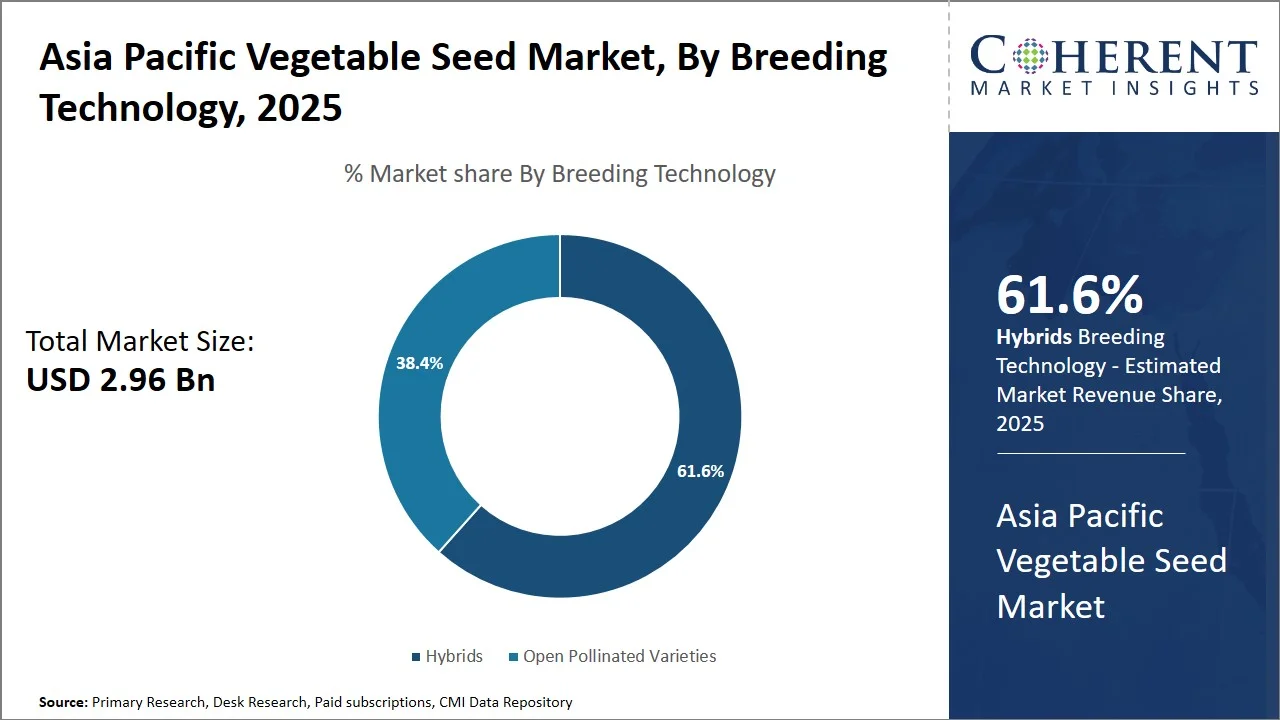
- The hybrids segment is projected to hold 61.6 % share of the Asia Pacific vegetable seed market in 2026, primarily due to their higher yield potential, improved disease resistance, and climate adaptability. Farmers in the region are increasingly shifting toward hybrids to meet rising food demand from a growing population and to ensure better productivity under shrinking arable land and climate variability. This is further supported by strong adoption in commercial farming systems and the rapid expansion of modern seed breeding technologies. In addition, the consortium launched specialized breeding projects such as the APSA–WorldVeg Okra Project in India to develop begomovirus-resistant okra hybrids, while WorldVeg also initiated advanced bitter gourd breeding programs in Thailand and South Asia focused on disease resistance and higher-yielding hybrid lines. (Source: World Vegetable Center)
- The Solanaceae segment is expected to hold 41.6 % share of the market in 2026. The Solanaceae family dominates across China, India, and other major vegetable-producing countries in Asia Pacific because it includes high-demand crops such as tomato, chili, eggplant, and capsicum, which are staple vegetables in both fresh consumption and food processing industries. According to the World Population Review, China remains the world’s largest producer of tomatoes and eggplants, accounting for nearly 38.3 Mn tons of global eggplant production, while India ranks as the second-largest producer globally for eggplants and one of the leading producers of chili and pepper crops. (Source: World Population Review)
- The protected segment is expected to hold 69.7 % share of the Asia Pacific vegetable seed market in 2026. Protected cultivation dominates particularly in Japan, South Korea, China, and peri-urban regions of India, where greenhouse, polyhouse, and net-house farming are expanding rapidly. This dominance is driven by the need for off-season production, higher yield per unit area, and protection from climate uncertainty and pests. In addition, protected systems support high-value vegetable production for urban markets, making seed demand more specialized and premium, especially for controlled-environment hybrids.
- Climate-Resilient Agriculture Alignment: Climate-resilient and drought-tolerant vegetable seed varieties are increasingly essential for maintaining stable yields amid rising temperature volatility, irregular rainfall, and soil stress across the Asia Pacific region.
- Market Expansion Catalysts: Advancements in hybrid breeding, gene editing, and stress-tolerant trait development—combined with government support for sustainable farming, food security programs, and modern irrigation adoption—are accelerating the expansion of the Asia Pacific vegetable seed market.
Segmental Insights
Why Does the Hybrids Segment Dominate the Asia Pacific Vegetable Seed Market?
Hybrids segment is expected to hold 61.6% share of the Asia Pacific vegetable seed market in 2026, due to their superior agronomic traits and consistent performance. Farmers also favor hybrid seeds over open-pollinated ones due to their higher yields, a crucial advantage for those with shorter growing seasons and limited land. Hybrid vegetable seeds usually have a 20–40% advantage in yields, depending on the crop, which helps farmers to get the most yield from their limited land area. In India, a hybrid tomato yields ~25–35 tons/acre compared to OP varieties which yield 10–15 tons/acre, the difference in yields is almost 2 times under similar conditions. (Source: Hyland Hybrid Seeds (India))
- Current Industry Events of 2026
- Market Size Estimation
- Regional Breakdown
- Competitive Landscape
- Customer Intelligence
- Segmental Analysis
- Pricing Analysis
- Key Market Drivers, Challenges & Future Trends
- Customized Insights Section
Why is Solanaceae the Most Preferred Crop Type?
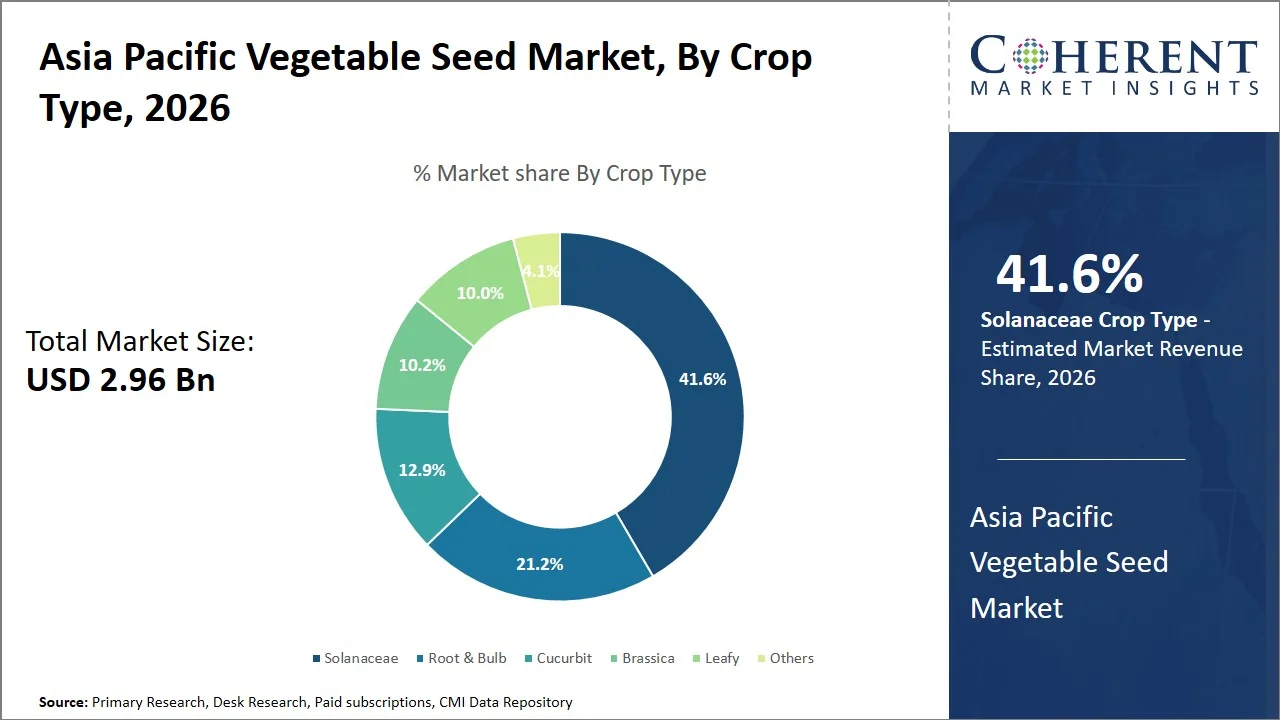
The Solanaceae segment is expected to hold 41.6% share of the market in 2026. This dominance is mostly driven by the great consumption of these crops and their high demand in the region, both in fresh and processed varieties. The versatility of culinary use of vegetables from Solanaceae family (crops used in traditional diet) is a significant contributing factor to their consistent market share. Tomato is one of the most consumed vegetables in Asia Pacific as well as in the world and is used for fresh consumption as well as in processed foods including purees, tomato sauces, ready to eat meals, and in the form of ketchup.
In the year 2024-25, according to Agriculture Institute, tomato production was estimated at 20.60 million tons (minus 0.62 million ton as compared to the previous year 21.32 million tons) while it is expected to grow to approximately 22.70 million tons in 2025-26. Tomatoes grow in important areas of Andhra Pradesh, Madhya Pradesh, Karnataka, and Gujarat in India. (Source: Agriculture Institute)
Protected Segment Dominates the Asia Pacific Vegetable Seed Market
Protected is expected to hold 69.7% share of the Asia Pacific vegetable seed market in 2026. The growing popularity of the protected cultivation method can be attributed to its ability to control the environment, maximize crop production, and produce vegetables throughout the year despite fluctuations in seasons. Depending on crops type and geography, production efficiency of protected cultivation systems (greenhouses, polyhouses, net houses) can be approximately 2-4 crops per year higher than the production efficiency in the open field cultivation, which is 1-2 crops per year.
For example, in China and India, greenhouse tomato production allows for the production of tomatoes even during monsoon and winter stress periods, thereby ensuring uninterrupted supply of tomatoes to urban markets such as Delhi and Mumbai, and Shanghai. (Source: ResearchGate)
Currents Events and their Impact
Current Events | Description and its Impact |
China accelerates gene-editing regulations for climate-resilient crop seeds (2025) |
|
Rapid adoption of CRISPR and AI-enabled breeding technologies in Asia Pacific seed development |
|
(Source: Reuters)
Asia Pacific Vegetable Seed Market Dynamics
Market Drivers
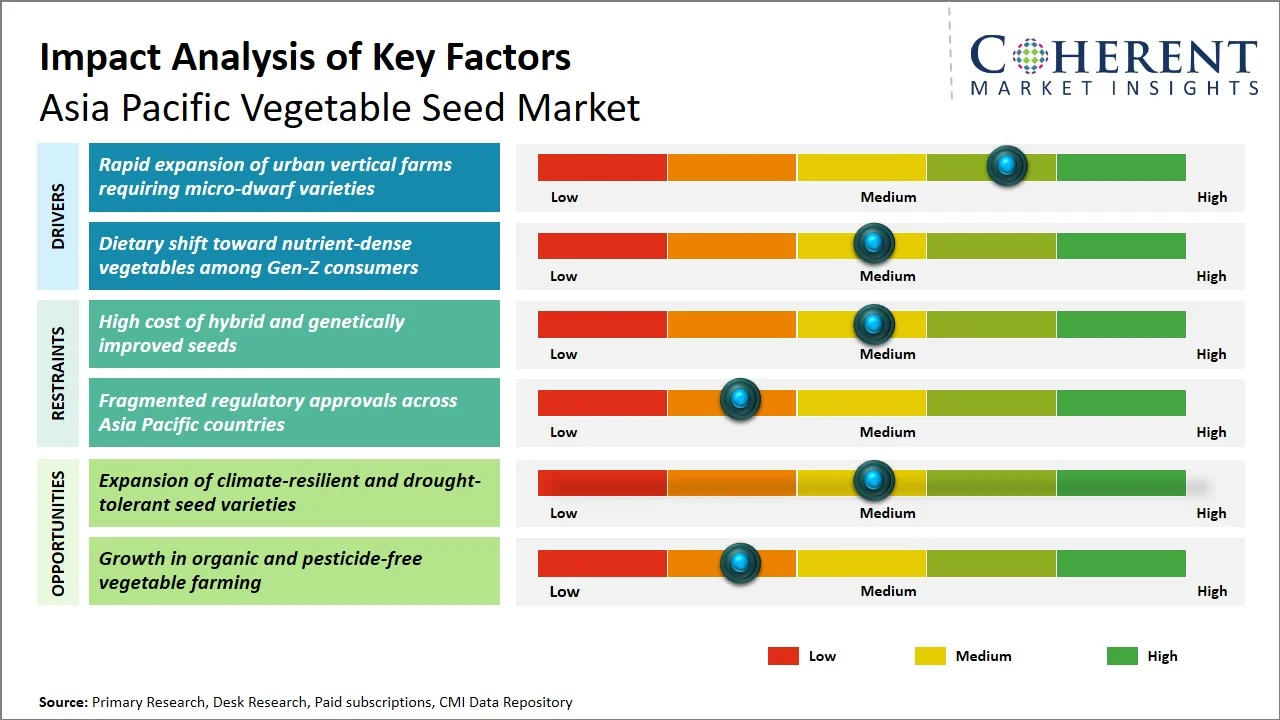
- Growing Demand for Micro-Dwarf Varieties Driven by Urban Vertical Farming Expansion: The increased use of vertical farming in urban regions, particularly in the Asia Pacific region, is contributing to the increasing demand for specialized vegetable seeds such as micro-dwarf vegetables. Vertical farming provides a revolutionary way of agricultural practices through the use of indoor spaces and polyculture buildings because cities are facing reduced arable land due to urbanization. It creates a need for vegetable seeds that grow quickly and occupy less space, hence the increase in the popularity of micro-dwarf seeds. These seeds are specifically created in a manner that makes them provide a high yield, but occupy less vertical and horizontal space; thus, they are ideal for use in stacked farming racks and hydroponics. Additionally, they are usually resistant to diseases and pests, hence creating sustainable agriculture practices in urban areas. As a result, seed companies are now investing more in and innovating on micro-dwarf vegetable seed production, and adaptation to the distinct requirements of the vertical urban farming industry.
- Dietary Shift Toward Nutrient-Dense Vegetables Among Gen-Z Consumers: The Asia Pacific vegetable seed market is being driven by a shift in dietary preferences among Gen Z consumers toward nutritious, clean-label, and functional foods. This trend is influencing not only retailers at the consumer level but also the agricultural sector upstream, increasing the demand for crops with enhanced nutrition, flavor, and appearance—posing a significant challenge for seed companies. The Gen-Z consumers (born 1997-2012) across Asia Pacific are more health conscious than their predecessors, as they have seen increased exposure to wellness content, fitness culture, and social media-based food trends. Consequently, vegetables are seen not just as the main ingredients, but as “functional foods” which promote immunity, skin health and well-being. In Asia Pacific, for example, regional agri-food consumption studies indicate that more than 60-65% of Gen-Z consumers actively seek “health-focused” or “functional” food products such as fresh vegetables and plant-based diets. India's digitally connected and health-conscious Gen Z consumers are driving the country's plant-based food market at a fast pace, according to the latest report by the plant-based foods association India (PBFIA) and Ipsos, which estimates the value of the Indian plant-based food market at USD 660 million (Rs 5,500 crore) by 2034.
Emerging Trends
- Shift Toward High-Yield, Climate-Resilient Seed Varieties: Climate change in the Asia Pacific region is becoming increasingly unpredictable, with pest outbreaks also becoming more common. As a result, demand is rising for vegetable seeds that are not only high-yielding but also more resilient to extreme temperatures, unpredictable weather, drought, and diseases. Consequently, hybrid seeds are gradually replacing conventional vegetable seeds.
- Popular Demand for Nutritious and Specialty Vegetables: With consumers demanding healthier food options, there has been an increasing desire for nutritious vegetables that have a longer shelf life and better taste. This is encouraging seed companies to develop specialty varieties such as vitamin-rich tomatoes, biofortified leafy greens, and improved Brassica crops tailored for urban and export-oriented markets.
Protected Cultivation & Greenhouse Seeds in the Asia Pacific Vegetable Seed Market
Indicator
| Data Point | Insight for the Asia Pacific Vegetable Seed Market |
China protected cultivation area | >4 million hectares | Largest greenhouse vegetable production base globally, driving hybrid seed demand |
Share of protected vegetable production in China | ~80% of global protected vegetable production | Indicates strong dependency on greenhouse-adapted seed varieties |
India protected cultivation area | ~50,000+ hectares (various structures) | Rapidly expanding segment, increasing demand for hybrid seeds |
How is the demand for climate-resilient and drought-tolerant seeds driving growth in the Asia Pacific vegetable seed market?
Climate resilient and drought tolerant vegetable seeds are a big growth opportunity in the Asia Pacific vegetable seed market. This is driven by changes in climate variability, unpredictable monsoons, extraction of groundwater, and more frequent and severe droughts and heat stress events in key agricultural nations like India, China and Southeast Asian countries. These conditions are directly affecting the productivity of vegetables, and are forcing farmers and governments to develop improved varieties of vegetables which could be productive under stress.
Groundwater extraction and the unpredictable nature of the monsoons have greatly driven the use of drought-tolerant vegetable varieties in India. In India, high groundwater extraction and irregular monsoons have resulted in the wide spread use of Drought-tolerant vegetable varieties. For instance, drought-tolerant tomato and chili hybrids are being widely grown in Maharashtra and Karnataka, which are experiencing droughts. The varieties allow for farmers to reach productivity without the use of as much irrigation water and while gaining resistance to viruses and bacteria stresses.
Market Players, Key Development, and Competitive Intelligence
Key Developments
- In March 2025, Advanta Seeds and KPAGRO opened a sweet corn seed drying facility in Lopburi, Thailand, strengthening their 19-year partnership. The facility features automated intake systems, centralized heating, and SCADA monitoring capabilities, enhancing Thailand's position in tropical sweet corn seed production.
- In November 2024, Crystal Crop Protection acquired IB Seeds to expand its presence in the vegetable and flower seed segments. This acquisition strengthens the company's research and development capabilities and product portfolio while advancing its expansion into India's horticulture markets.
- In March 2024, Syngenta Group opened a new Seed Health Lab in Hyderabad, India, to improve seed quality testing and support growers across Asia-Pacific and other regions. The facility, constructed at USD 2.4 Trillion (INR 20 crore), has the capacity to conduct 12,000 virus and bacterial tests annually and complies with global phytosanitary standards.
Competitive Landscape
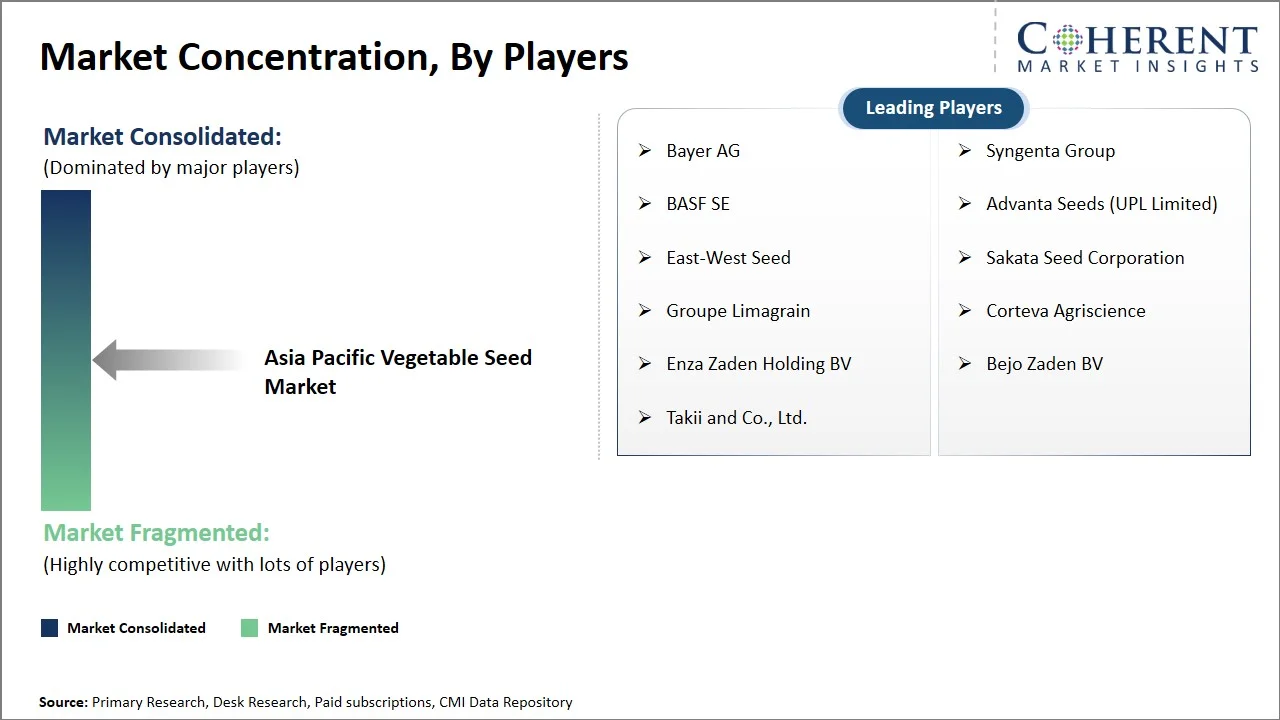
The vegetable seed market in Asia Pacific is highly competitive and moderately fragmented with the presence of global agrochemical giants and strong regional/niche vegetable seed specialists. The large multinational companies rely on their large research and development programs, biotechnology platforms, and broad distribution network, while the regional players rely on their ability to breed locally and engage their farmers, as well as their innovation in their crop. The main focus are:
- Easy-to-use, high yielding and climate resilient seed varieties
- Using breeding programs to diversify products and expand to new geographic areas.
- Utilization of breeding programs for product diversification and for geographical expansion.
- Strategic partnerships, acquisitions and R&D footprint expansion
Market Report Scope
Asia Pacific Vegetable Seed Market Report Coverage
| Report Coverage | Details | ||
|---|---|---|---|
| Base Year: | 2025 | Market Size in 2026: | USD 2.96 Bn |
| Historical Data for: | 2020 To 2024 | Forecast Period: | 2026 To 2033 |
| Forecast Period 2026 to 2033 CAGR: | 5.2% | 2033 Value Projection: | USD 4.22 Bn |
| Segments covered: |
| ||
| Companies covered: | Bayer AG, Syngenta Group, BASF SE, Advanta Seeds (UPL Limited), East-West Seed, Sakata Seed Corporation, Groupe Limagrain, Corteva Agriscience, Enza Zaden Holding BV, Bejo Zaden BV, and Takii and Co., Ltd. | ||
| Growth Drivers: |
| ||
| Restraints & Challenges: |
| ||
Analyst Opinion (Expert Opinion)
- Asia Pacific vegetable seed market is anticipated to be transformed from volume driven open pollinated varieties market to high value and technology intensive market dominated by F1 hybrids, trait improved varieties, and integrated agronomy solutions. The driving forces will be the fast urbanization, diversification of diets, and growing protected cultivation systems like polyhouse, greenhouse, and hydroponics.
- Resilience will become a standard requirement in the era of climate variability, not a premium. Resilience, such as heat tolerance, salinity tolerance and multi-disease resistance, will become a standard requirement, not a premium. Meanwhile, more rapid breeding methods like gene editing and speed breeding will shorten product development cycles, adding to the competition and quickening the length of time product differentiation will be a source of competitive edge.
- Structurally underpenetrated and fast-growing markets, like India, Indonesia, Vietnam and the Philippines, will be the regions with the greatest opportunity concentration. India is the most compelling opportunity because of its size, the low actual hybrid penetration in important vegetable crops, and the rapid growth of the demand-side agriculture-adjacent formal developer-led ecosystem of peri-urban agriculture and protected cultivation clusters.
- Among them, high value vegetable crops like tomato, chilli, cucumber, eggplant, okra, and leafy vegetables are more attractive in these markets due to the direct economic returns they offer in controlled-environment or semi-protected cultivation in terms of yield stability and resistance to diseases. High fragmentation and rapid adoption present a significant “first-mover” opportunity for companies that can localize effectively.
Speak to the analyst
Want personalized insights?
Take the findings above to one of our principal consultants, or have the report rebuilt around the segments, geographies and competitors you actually track.
Market Segmentation
- Breeding Technology Insights (Revenue, USD Bn, 2021 - 2033)
- Hybrids
- Open Pollinated Varieties
- Crop Type Insights (Revenue, USD Bn, 2021 - 2033)
- Solanaceae
- Root & Bulb
- Cucurbit
- Brassica
- Leafy
- Others
- Cultivation Method Insights (Revenue, USD Bn, 2021 - 2033)
- Protected
- Open Field
- Key Players Insights
- Bayer AG
- Syngenta Group
- BASF SE
- Advanta Seeds (UPL Limited)
- East-West Seed
- Sakata Seed Corporation
- Groupe Limagrain
- Corteva Agriscience
- Enza Zaden Holding BV
- Bejo Zaden BV
- Takii and Co., Ltd.
Sources
Primary Research Interviews:
- Seed company R&D / product manager
- Supply chain director or export manager at a major seed company (e.g., Bayer/Corteva regional office).
- Seed distributor / agri dealer operators in India, China, Vietnam (large wholesalers and regional co-ops).
- Government seed certification official (national seed labs in India/China/Australia).
- Sustainability officer or regulatory affairs lead at a major seed firm (trait stewardship / biosafety).
Stakeholders
- Seed manufacturers and breeders: Bayer, Corteva, Syngenta, Takii, Sakata, Limagrain, Advanta, Mahyco.
- End-use Sectors:
- Commercial vegetable producers and contract farming aggregators in China, India, Southeast Asia.
- Greenhouse and protected cultivation operators (horticulture clusters in Japan, Korea, China).
- Food processors and fresh cut suppliers sourcing specific hybrid varieties.
- Regulatory & Certification Bodies: National seed certification authorities (Central Seed Certification Board — India), national biosafety/regulatory agencies.
Databases
- UN Comtrade (use HS codes for seeds; consult HS codes and custom notes) — useful for trade flows and volumes.
- India Export Import (EXIM) database for India shipments and tariff lines.
- Eurostat and national statistics offices for import/export breakdown by country.
- USITC DataWeb for country trade comparisons.
Magazines
- Seed World, Seeds & Crops (industry magazines).
- HortiDaily (protected cultivation, vegetable seeds).
- Local trade press covering agri inputs in India/China (e.g., Business Standard agriculture section).
Journals
- Journal of Seed Science and Technology, Journal of Agricultural Science, Journal of Plant Breeding and Crop Science for varietal research and performance studies.
- Journal of Agricultural Economics for market structure analysis.
Newspapers
- Business Standard (India) — agribusiness coverage and seed company news.
- The Wall Street Journal or Financial Times for M&A and large multinational activity in seed industry.
- Local business publications in APAC markets (China Daily) for policy and trade developments.
Associations
- International Seed Federation (ISF)
- Asia Pacific Seed Association or regional seed associations (national seed associations of India, China, Japan)
- National agricultural research institutes (ICAR in India, CAAS in China) for varietal release data
Public Domain Sources
- FAO statistics for crop area and seed replacement rates.
- OECD and World Bank reports on agricultural trade and input markets.
- National statistical offices (India MOSPI, China NBS) for production and area data.
- UN Comtrade for trade flows using seed‑related HS codes.
Proprietary Elements:
- CMI Data Analytics Tool
- Proprietary CMI Existing Repository of information for last 10 years.
Get access to 250+ pages report
Every segment, forecast, competitor profile and data table behind the analysis above — available for instant download.
- ESOMAR Member
- ISO 9001:2015 Certified
- D-U-N-S Registered
- GDPR & CCPA Compliant
Missing comfort of reading report in your local language? Find your preferred language:
Transform your Strategy with Exclusive Trending Reports
Frequently Asked Questions
The Asia Pacific vegetable seed market is estimated to be valued at USD 2.96 Bn in 2026 and is expected to reach USD 4.22 Bn by 2033
The CAGR of Asia Pacific vegetable seed market is projected to be 5.2% from 2026 to 2033.
Rapid expansion of urban vertical farms requiring micro-dwarf varieties and dietary shift toward nutrient-dense vegetables among Gen-Z consumers are the major factors driving the growth of the Asia Pacific vegetable seed market.
High cost of hybrid and genetically improved seeds and fragmented regulatory approvals across Asia Pacific countries are the major factors hampering the growth of the Asia Pacific vegetable seed market.
In terms of breeding technology, the hybrids segment is estimated to dominate the market revenue share in 2026.
Bayer AG, Syngenta Group, BASF SE, Advanta Seeds (UPL Limited), East-West Seed, Sakata Seed Corporation, Groupe Limagrain, Corteva Agriscience, Enza Zaden Holding BV, Bejo Zaden BV, and Takii and Co., Ltd. are the major players.