

Global Auto Ventilated Seats Market Size and Forecast – 2026-2033
Coherent Market Insights estimates that the global auto ventilated seats market is expected to reach USD 10 Bn in 2026 and will expand to USD 15 Bn by 2033, registering a CAGR of 6% between 2026 and 2033.
Key Takeaways of the Auto Ventilated Seats Market
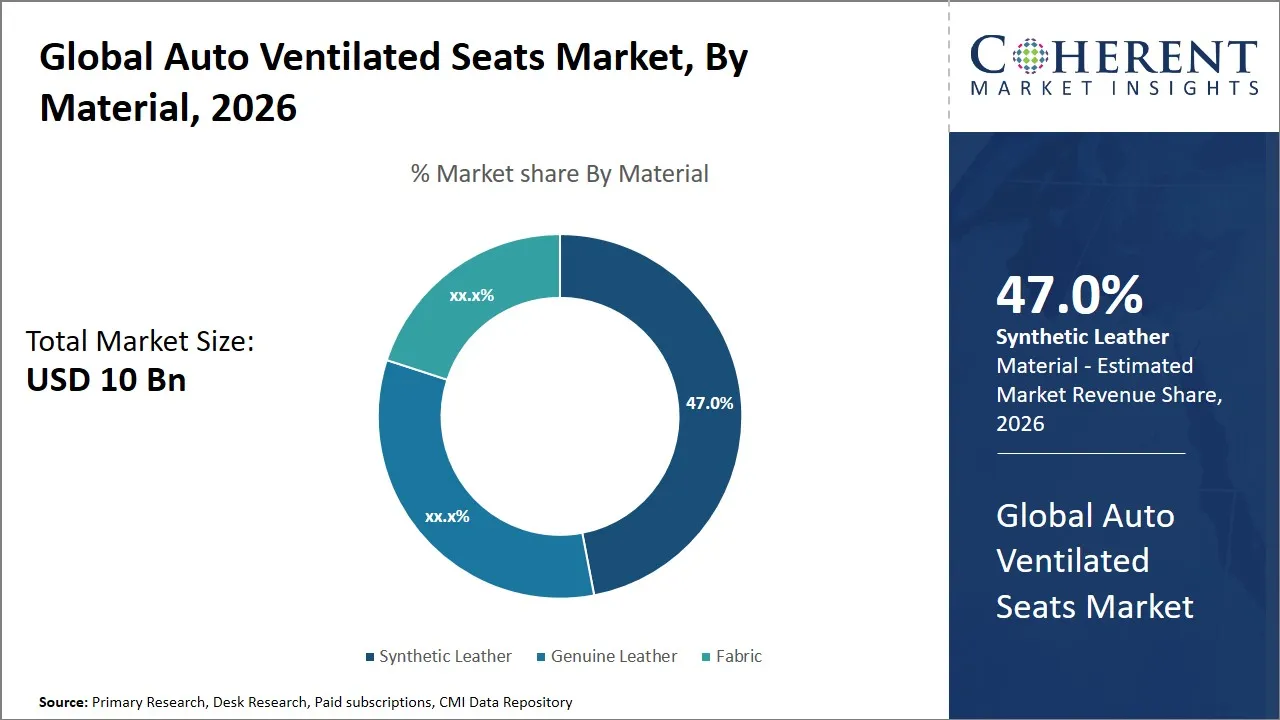
- The synthetic leather segment is expected to account for 47% of the auto ventilated seats market share in 2026.
- The internal combustion engine segment is estimated to hold 45% of the market share in 2026.
- The passenger vehicles segment is projected to capture 59% of the global auto ventilated seats market share in 2026.
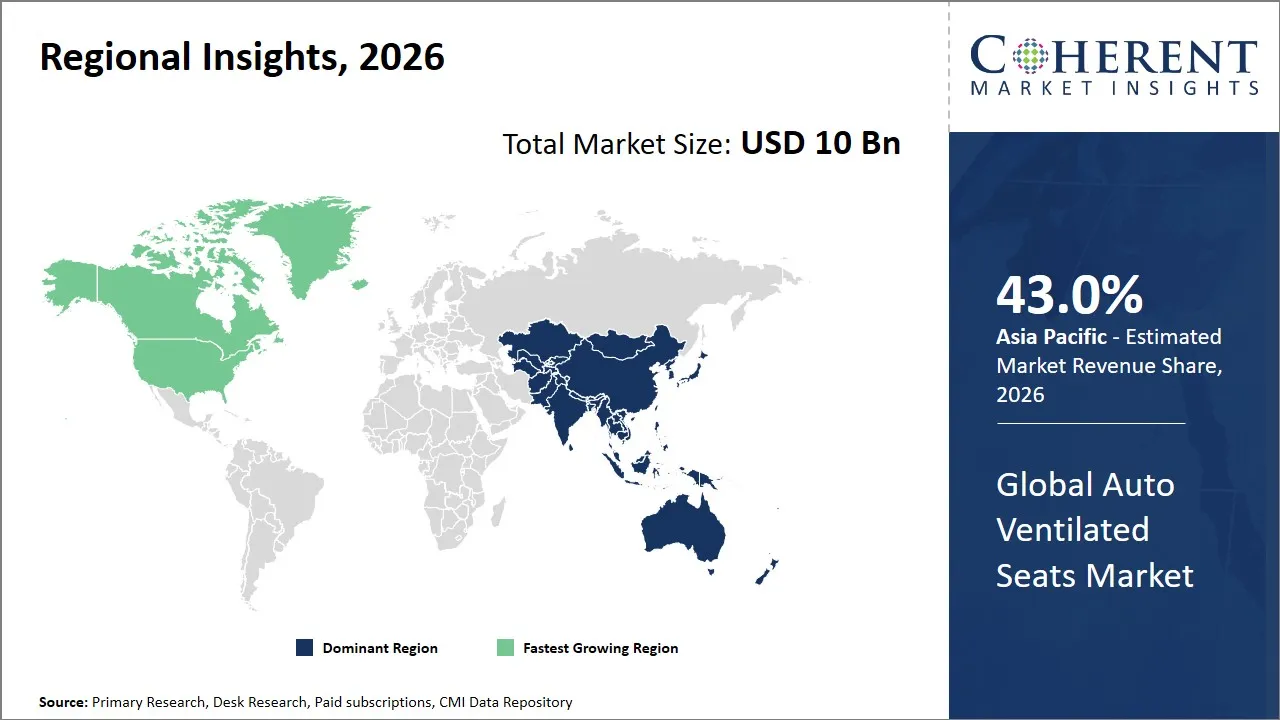
- Asia Pacific will dominate the auto ventilated seats market in 2026 with an estimated 43%
- North America will hold 24% share in 2026 and is expected to record the fastest growth over the forecast period.
Current Events and Its Impact
Current Events | Description and its Impact |
Tesla Launched Redesigned Model Y |
|
Segmental Insights
- Current Industry Events of 2026
- Market Size Estimation
- Regional Breakdown
- Competitive Landscape
- Customer Intelligence
- Segmental Analysis
- Pricing Analysis
- Key Market Drivers, Challenges & Future Trends
- Customized Insights Section
Why Does the Synthetic Leather Segment Dominate the Global Auto Ventilated Seats Market in 2026?
The synthetic leather segment is expected to account for 47.0% of the market share in 2026. Growth stems from long-lasting performance, lower costs, one reason being shifting buyer trends toward eco-friendly materials. A realistic look similar to real leather comes through here, yet avoids issues tied to animal treatment and ecological strain. In cars, artificial hide appears more often in breathable seating due to resistance against damage, stable form across weather extremes, simpler upkeep than cloth or natural hides. Another point: air flow systems fit better within this material, since design allows improved circulation and chill factors while keeping shape and visual appeal intact.
Internal Combustion Engine Segment Dominates the Global Auto Ventilated Seats Market
The internal combustion engine segment is expected to account for 45.0% of the global auto ventilated seats market share in 2026. Primarily, expansion stems from widespread international operations combined with long-standing production facilities. For many years, internal combustion engines dominated transport across nations, resulting in extensive adoption - this underpins steady requirements for replacement and original equipment cooling seats. Because conventional powertrains produce considerable warmth, vehicle interiors often require improved climate control; ventilation systems within seating address this naturally.
For instance, on January 17, 2025, Cummins Group announced the launch of its next generation HELM (Higher Efficiency, Lower emissions, Multiple fuels) engine platforms, with the high performance L10 engine, along with, an advanced Hydrogen Fuel Delivery System (FDS) with Type IV on-vehicle storage vessels and the innovative B6.7N natural gas engine, at Bharat Mobility Global Expo 2025.
(Source: cummins.com)
Why are Passenger Vehicles the Most Crucial Vehicle Type in the Auto Ventilated Seats Market?
The passenger vehicles segment is expected to account for 59.0% of the global auto ventilated seats market share in 2026. Comfort, convenience, and modern vehicle functions shape how people choose personal transport today. Though preferences differ, many now expect upgrades such as airflow-equipped seating during travel. Sedans, SUVs, and hatchbacks serve varied buyers who value these improvements. Because these models are made in high numbers, new comfort options appear faster here than in work-focused vehicles. What emerges is a market where everyday cars evolve ahead of utility-based ones.
Consumer Comfort & Fatigue Reduction Metrics
Metric | With Ventilated Seat |
Seat Back Temp. Reduction (°C) | ~4°C lower |
Seat Bottom Temp. Reduction (°C) | ~0.6°C lower |
Combined Seat Temp. Avg Reduction (°C) | ~2.3°C lower |
Equivalent A/C Heat Capacity Reduction (%) | ~4 % |
Predicted A/C Fuel Use Reduction – Highway (%) | ~2.8 % |
Predicted A/C Fuel Use Reduction – City (%) | ~4.5 % |
Reduction in Air‑Conditioning Compressor Power (%) | ~7 % |
Estimated National A/C Fuel Use Reduction (Hypothetical) (%) | ~7.5 % |
Regional Insights
Asia Pacific Auto Ventilated Seats Market Analysis and Trends
The Asia Pacific region is projected to lead the market with a 43% share in 2026. Emerging from deep-rooted production networks, expansion takes shape where populations are vast - examples include China, Japan, and India. Supported by steady funding, global carmakers and leading parts providers install airflow-enhanced seats into models ranging from upper-mid to luxury tiers. Policy support appears in forms that encourage smarter mobility tools, alongside cleaner, more economical transport options, adding momentum to industry movement. With urban populations expanding rapidly, alongside rising incomes, preferences begin favoring vehicle interiors designed for smoother journeys. Operations by companies like Toyota, Honda, and Hyundai span vast regions, progressing hand-in-hand with niche suppliers - Denso, Magna International - integrating ventilated seating into comprehensive climate-aware cabin systems.
For instance, on November 17, 2025, Nexteer Automotive broke ground on its APAC Smart Manufacturing Project in Suzhou Industrial Park, China, an initiative designed to advance the company's smart manufacturing capabilities and long-term operational agility.
(Source: nexteer.com)
North America Auto Ventilated Seats Market Analysis and Trends
The North America region is expected to exhibit the fastest growth in the market contributing 24% share in 2026. Early adoption of high-end vehicles drives expansion, since these models now commonly include airflow-equipped seating. With major brands including General Motors, Ford, and Tesla active in the region, alongside specialized suppliers such as Lear Corporation and Adient, market momentum builds steadily. Regulatory focus on occupant well-being and interior standards shapes development, while buyers seek individualized, tech-integrated cabin environments. In addition, the trend toward electric and connected vehicles in the U.S. and Canada encourages innovations in interior cabin technologies, including seat ventilation systems. Trade dynamics supported by well-established supplier networks and aftermarket demand also accelerate this region's market expansion.
Global Auto Ventilated Seats Market Outlook for Key Countries
Why is China Emerging as a Major Hub in the Auto Ventilated Seats Market?
Driven by its position as top global car maker and buyer, China sees strong demand for vehicles with airflow-equipped seating. Interest in upscale vehicles grows, influencing choices among manufacturers such as SAIC Motor, BYD, and Volkswagen, where comfort features shape appeal. Because policy support leans toward electric variants, enhancements inside the vehicle - like climate-controlled seating - progress at pace with improvements under the hood. With extensive manufacturing networks already in place, component availability remains steady across assembly lines and service centers alike.
Is U.S. the Next Growth Engine for the Auto Ventilated Seats Market?
The U.S. continues to lead with a mature automotive market that demands high-end comfort and safety features. American automakers like Ford and General Motors, alongside multinational suppliers such as Adient and Lear Corporation, are pioneering ventilated seat technologies as part of their vehicle upgrade packages. Consumer preferences for SUVs and luxury sedans that often include ventilated seats have a positive impact. Additionally, the growing penetration of electric vehicles, where thermal comfort is critical due to battery energy management constraints, drives targeted adoption of ventilated seating systems.
Germany Auto Ventilated Seats Market Analysis and Trends
In Germany, makers of premium cars such as BMW, Mercedes-Benz and Audi set direction for advanced seat ventilation across Europe. Alongside them, firms like Faurecia and Brose build stronger output by linking closely within shared supplier frameworks. As government standards demand lower emissions, vehicle construction adapts accordingly. Under this pressure, ease for riders shifts subtly, always balanced around energy use. New ideas in interior layouts appear - driven less by freedom, more by limits carefully defined at every turn.
India Auto Ventilated Seats Market Analysis and Trends
A shift toward passenger ease influences India’s expanding vehicle sector, seen clearly in cooled seats offered on upscale variants. Though affluent customers create pull, local builders such as Tata Motors collaborate with global suppliers to increase available features. Higher earnings in urban homes push companies to refine offerings. Support from state-led initiatives enhances technological growth within manufacturing chains. Post-sale access grows via an extending web of aftermarket sellers.
Japan Auto Ventilated Seats Market Analysis and Trends
Steadily, Japan's market for ventilated car seats advances through focused study that sharpens performance of air circulation mechanisms. Behind ongoing trials, comfort gains momentum while ecological footprints shrink gradually. Efficiency evolves quietly, driven by consistent testing rather than sudden leaps. Little by little, innovation aligns with sustainability goals without drawing attention. Japanese automakers frequently incorporate ventilated seats in high-end and electric vehicle models, responding to consumer demand for innovation and quality. The mature supplier base and integration of intelligent climate control systems complement the growth of the auto ventilated seats market here.
Market Players, Key Development, and Competitive Intelligence
Key Developments
- On February 5, 2025, Lear Corporation announced a key engineering integration with General Motors. A first of its kind, the ComfortMax Seat integrates thermal comfort technologies into trim covers, providing occupant comfort and well-being, superior thermal management and improved manufacturing efficiency.
- On November 27, 2024, JLR announced it had made a significant technical breakthrough in the closed-loop recycling of polyurethane seat foam from its used vehicles by successfully reintegrating it back into the production of new seats. In collaboration with Dow MobilityScience and Adient, this is the first time closed-loop seat foam content has been successfully used in automotive production.
Top Strategies Followed by Global Auto Ventilated Seats Market Players
Player Type | Strategic Focus | Example |
Established Market Leaders | Product Line Expansion | On July 2, 2025, ABB launched three new families of factory robots designed especially for China, as it aims to benefit from rising demand for automation. |
Mid-Level Players | Business Collaboration | On February 25, 2025, KUKA announced a collaboration with Dassault Systèmes to integrate Dassault’s 3DEXPERIENCE platform into KUKA’s digital ecosystem mosaixx), enabling virtual twin simulation, collaborative engineering, HVAC systems and advanced pre‑deployment planning for robotics and automated production systems. |
Small-Scale Players | Business Collaboration | On May 1, 2025, Red Hat and ABB announced an extended collaboration to develop automation systems for the future of industrial IT, enabling more secure and modular deployment of control applications for process industries. |
Market Report Scope
Auto Ventilated Seats Market Report Coverage
| Report Coverage | Details | ||
|---|---|---|---|
| Base Year: | 2025 | Market Size in 2026: | USD 10 Bn |
| Historical Data for: | 2020 To 2024 | Forecast Period: | 2026 To 2033 |
| Forecast Period 2026 to 2033 CAGR: | 6% | 2033 Value Projection: | USD 15 Bn |
| Geographies covered: |
| ||
| Segments covered: |
| ||
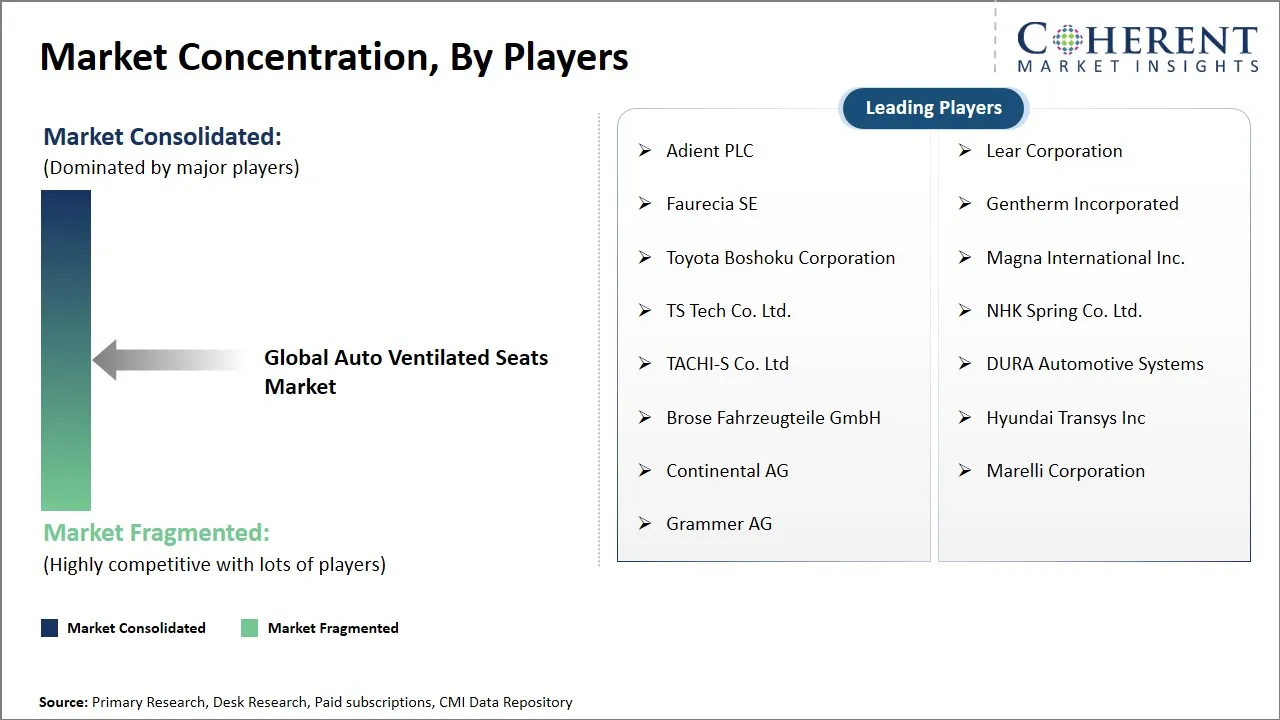
| Companies covered: | Adient PLC, Lear Corporation, Faurecia SE, Gentherm Incorporated, Toyota Boshoku Corporation, Magna International Inc., TS Tech Co. Ltd., NHK Spring Co. Ltd., TACHI-S Co. Ltd, DURA Automotive Systems, Brose Fahrzeugteile GmbH, Hyundai Transys Inc, Continental AG, Marelli Corporation, and Grammer AG | ||
| Growth Drivers: |
| ||
| Restraints & Challenges: |
| ||
Global Auto Ventilated Seats Market Dynamics
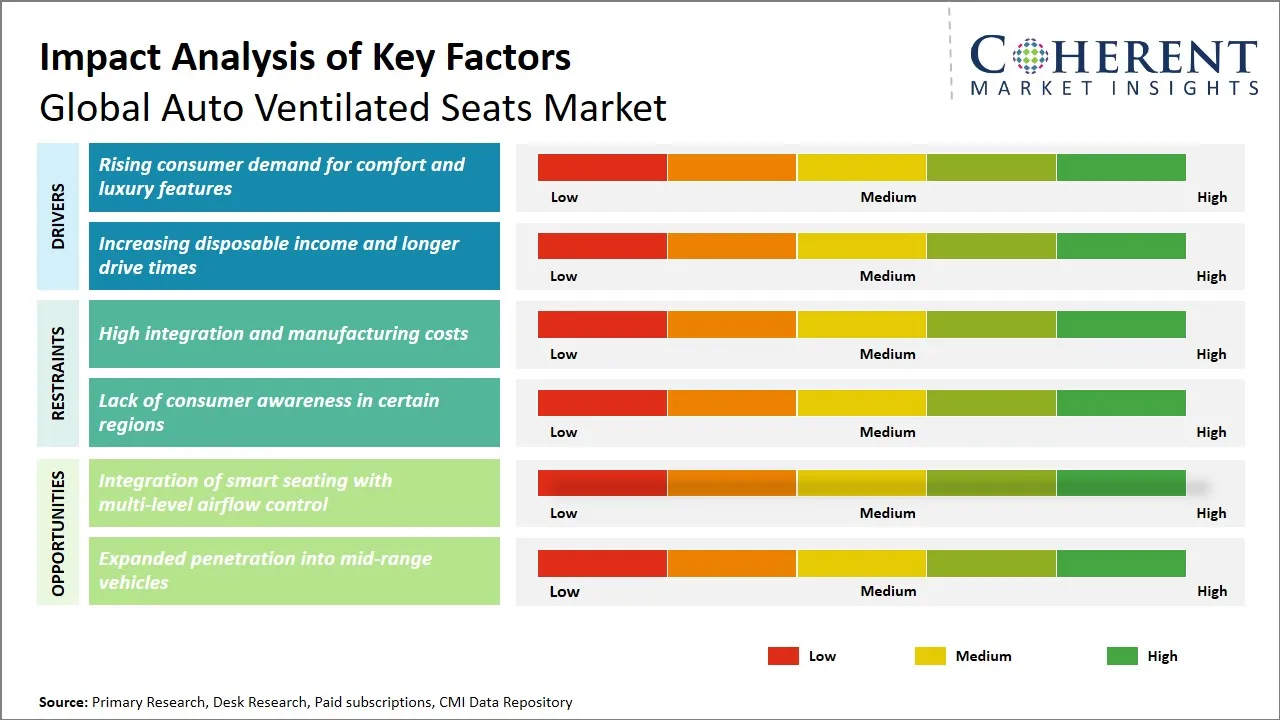
Global Auto Ventilated Seats Market Driver - Rising Consumer Demand for Comfort and Luxury Features
Comfort and luxury now matter more in car design, pushing ventilated seats into wider global use. As expectations shift, buyers look for individualized touches inside both passenger and commercial vehicles, details that make even brief drives feel better. Air moves through tiny holes in the seat fabric, cooling the body by reducing warmth and dampness. Such systems work because they manage conditions beyond what standard cooling can handle. In places where heat lingers and humidity stays high, these seats answer a real need.
For instance, on January 6, 2026, Hyundai Motor Company unveiled the STARIA Electric at the Brussels Motor Show, marking a bold step forward in multi-purpose vehicle (MPV) innovation. Combining zero-emission mobility with a people-centered design, STARIA Electric sets a new standard for modern lifestyles.
(Source: hyundainews.com)
Global Auto Ventilated Seats Market Opportunity - Integration of Smart Seating with Multi ‑ Level Airflow Control
Significant expansion appears likely within the global market for ventilated automotive seats, driven by adoption of intelligent seating with layered air management. With rising interest in greater cabin comfort and tailored settings, vehicle manufacturers now emphasize seat engineering that includes responsive ventilation able to shift intensity across zones. Customization of airflow and thermal output becomes possible in areas like lumbar support, base padding, or upper rest, adapting to personal needs and external weather shifts. Embedded temperature sensors combined with internet-connected modules improve responsiveness, modifying performance during use depending on passenger heat signatures, surrounding climate, and time spent driving.
For instance, on December 19, 2025, AutoPacific in their Future Attribute Demand Study, revealed that 38% of U.S. drivers ranked heated steering wheels and 37% ranked heated and ventilated front seats as their most‑wanted features among new‑vehicle technologies. That places both comfort amenities firmly in the top 15, showing that consumers increasingly expect their vehicles to deliver not just performance and safety, but everyday comfort.
(Source: gentherm.com)
Analyst Opinion (Expert Opinion)
- Comfort inside cars matters more now, so people want seats that adjust to how they feel. Owing to this shift, companies building vehicles focus on better air flow within seats, using technology that manages heat in smarter ways. Instead of simple designs, newer models offer several settings for cooling, helping brands stand out whether selling high-end or everyday cars. Growth in electric car numbers plus larger vehicle types pushes this trend forward, especially where roads favor bigger models. Regions like North America and parts of Asia show stronger interest, making these features common rather than rare.
- A fresh wave of interest creates openings for technology firms emphasizing agile, energy-efficient seating solutions. With built-in sensors managing heat without input, chairs do more than hold a person - they influence the feel of every journey. As vehicle makers adopt such elements, worth rises steadily, tied closely to improved margins and closer relationships with buyers. In today’s cabin design race, breathable and adaptive seats quietly set vehicles apart.
Speak to the analyst
Want personalized insights?
Take the findings above to one of our principal consultants, or have the report rebuilt around the segments, geographies and competitors you actually track.
Market Segmentation
- Material Insights (Revenue, USD Billion, 2021 - 2033)
- Synthetic Leather
- Genuine Leather
- Fabric
- Propulsion Type Insights (Revenue, USD Billion, 2021 - 2033)
- Internal Combustion Engine
- Hybrid
- Battery Electric Vehicle
- Vehicle Type Insights (Revenue, USD Billion, 2021 - 2033)
- Passenger Vehicles
- Commercial Vehicles
- Regional Insights (Revenue, USD Billion, 2021 - 2033)
- North America
- U.S.
- Canada
- Latin America
- Brazil
- Argentina
- Mexico
- Rest of Latin America
- Europe
- Germany
- U.K.
- Spain
- France
- Italy
- Russia
- Rest of Europe
- Asia Pacific
- China
- India
- Japan
- Australia
- South Korea
- ASEAN
- Rest of Asia Pacific
- Middle East
- GCC Countries
- Israel
- Rest of Middle East
- Africa
- South Africa
- North Africa
- Central Africa
- North America
- Key Players Insights
- Adient PLC
- Lear Corporation
- Faurecia SE
- Gentherm Incorporated
- Toyota Boshoku Corporation
- Magna International Inc.
- TS Tech Co. Ltd.
- NHK Spring Co. Ltd.
- TACHI-S Co. Ltd
- DURA Automotive Systems
- Brose Fahrzeugteile GmbH
- Hyundai Transys Inc
- Continental AG
- Marelli Corporation
- Grammer AG
Sources
Primary Research Interviews:
- Automotive seat manufacturers and suppliers
- OEM automotive companies executives
- Automotive interior technology providers
- Auto dealership managers and sales representatives
Databases
- Euromonitor International Automotive Components Database
Magazines
- Automotive News
- Ward's Auto World
- Automotive Design & Production Magazine
- Auto Interior World Magazine
Journals
- International Journal of Automotive Technology
- SAE International Journal of Passenger Cars
- Automotive Engineering International
Newspapers
- Financial Times (Automotive Section)
- The Wall Street Journal (Auto Industry Coverage)
- Reuters Business News (Automotive)
- Automotive News Europe
Associations
- Society of Automotive Engineers (SAE)
- Automotive Industry Association (AIA)
- International Organization of Motor Vehicle Manufacturers (OICA)
- Automotive Components Manufacturers Association (ACMA)
Public Domain Sources
- U.S. Department of Transportation reports
- European Automobile Manufacturers Association publications
- National Highway Traffic Safety Administration databases
- International Trade Administration automotive reports
Proprietary Elements
- CMI Data Analytics Tool, Proprietary CMI Existing Repository of information for last 8 years
Get access to 250+ pages report
Every segment, forecast, competitor profile and data table behind the analysis above — available for instant download.
- ESOMAR Member
- ISO 9001:2015 Certified
- D-U-N-S Registered
- GDPR & CCPA Compliant
Missing comfort of reading report in your local language? Find your preferred language:
Transform your Strategy with Exclusive Trending Reports
Frequently Asked Questions
The global auto ventilated seats market stood at USD 10 Bn in 2026 and is expected to reach USD 15 Bn by 2033.
The CAGR of global auto ventilated seats market is projected to be 6% from 2026 to 2033.
Rising consumer demand for comfort and luxury features and increasing disposable income and longer drive times are the major factors driving the growth of the global auto ventilated seats market.
High integration and manufacturing costs and lack of consumer awareness in certain regions are the major factors hampering the growth of the global auto ventilated seats market.
In terms of material, synthetic leather is estimated to dominate the market revenue share in 2026.
Yes, vehicles with ventilated and heated seats often have higher resale value due to added comfort features.
Yes, many vehicles allow users to adjust airflow intensity and sometimes seat cooling zones individually.