

Global Automotive Simulation Software Market Size and Forecast – 2026 To 2033
The global automotive simulation software market is expected to grow from USD 8 Bn in 2026 to USD 22 Bn by 2033, registering a compound annual growth rate (CAGR) of 13% from 2026 to 2033. The global automotive simulation software market is majorly driven by increasing adoption of digital twin engineering. On January 6, 2026, Siemens announced the launch of Digital Twin Composer, a new software solution that builds Industrial Metaverse environments at scale, empowering organizations to apply industrial AI, simulation and real-time physical data to make decisions virtually, at speed and at scale. (Source: Siemens)
Key Takeaways of the Global Automotive Simulation Software Market
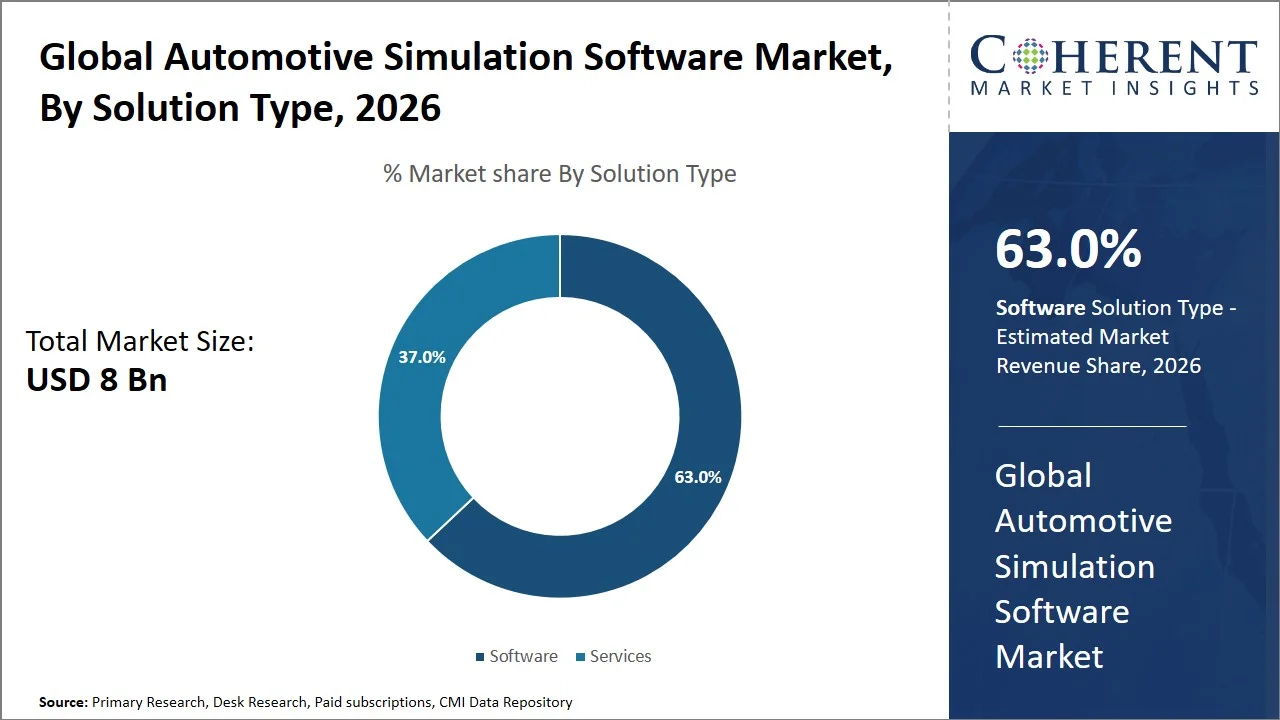
- The software segment is expected to account for 63.0 % of the global automotive simulation software market share in 2026. Rapid expansion of software-defined vehicles (SDVs) is driving the growth of the segment. On June 17, 2025, Volvo Group and Daimler Truck announced the launch of Coretura AB, its joint venture aimed at transforming the commercial vehicle industry through a new software-defined vehicle platform and establishing a new industry standard. (Source: Volvo)
- The cloud segment is estimated to capture 54.0 % of the market share in 2026. Growth in cloud-based high-performance computing (HPC) is a major factor driving the growth of the segment. On June 22, 2026, NVIDIA announced the launch of NVIDIA Vera Rubin platform which delivers world-class supercomputers for science, combining native double-precision (FP64) performance. (Source: NVIDIA)
- The passenger vehicles segment is estimated to capture 52.0 % of the market share in 2026. Rising demand for virtual crash and durability testing is driving the growth of the segment. On October 22, 2025, AVL unveiled its Euro NCAP virtual testing methodology, allowing automobile manufacturers to satisfy new active safety assessment requirements using high-fidelity simulation and scenario-based virtual validation.
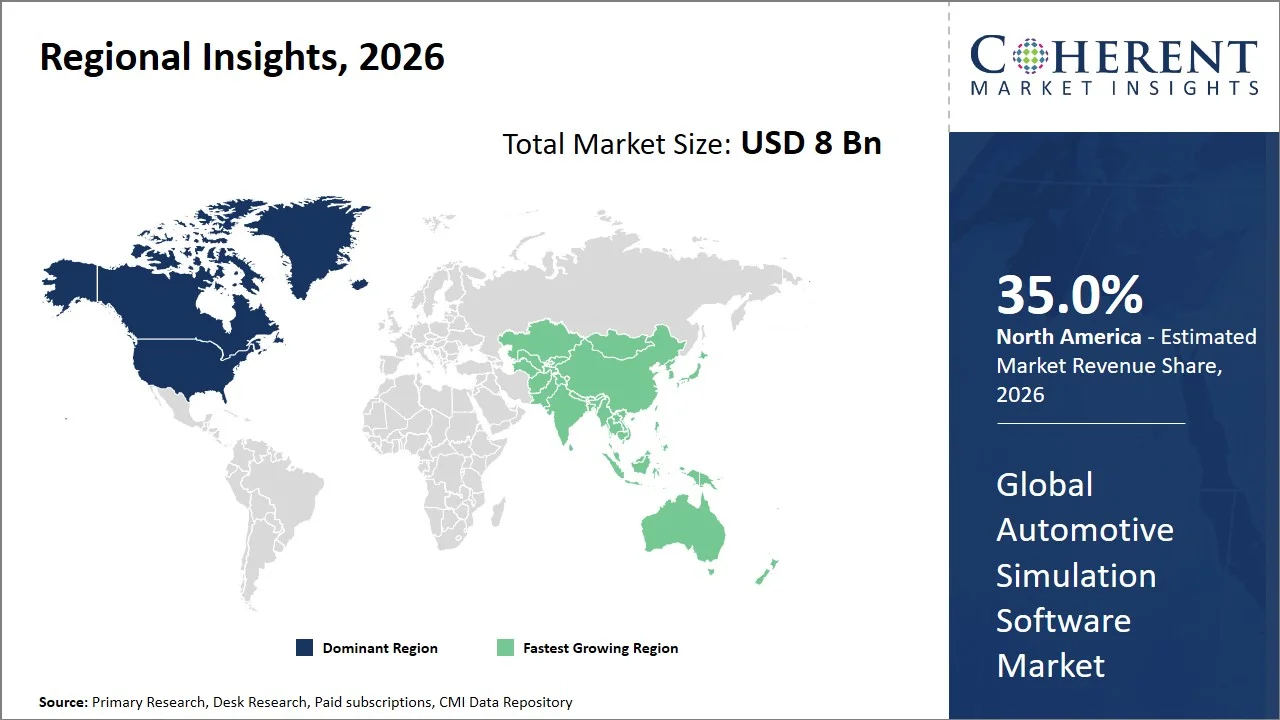
- North America is expected to dominate the automotive simulation software market in 2026 with a market share of 35.0 %. Expansion of autonomous vehicle testing platforms in North America is driving the growth of the regional market. On March 9, 2026, Amazon's robotaxi unit Zoox announced that it is expanding testing to Dallas and Phoenix and launching a command hub for fleet operations in Arizona, U.S., as it looks to widen its footprint in the U.S.'s increasingly competitive autonomous taxi market.
- Asia Pacific is expected to account for 29.0 % of the market share in 2026 and is projected to record the fastest growth over the forecast period. Increasing use of cloud-native simulation environments in Asia Pacific is driving the growth of the regional market. On August 5, 2025, Siemens expanded its Tecnomatix and Xcelerator cloud-based simulation ecosystem during the Realize LIVE Asia-Pacific 2025 event in Bengaluru, India, showcasing cloud-native manufacturing and automotive simulation workflows for OEMs and suppliers.
- AI-Driven Generative Engineering and Automated Simulation: Automotive simulation software is incorporating more and more artificial intelligence to automate design optimization, minimize simulation iterations and speed up engineering operations. AI-powered tools may recommend best component shapes, discover design faults early and do predictive assessments, drastically reducing vehicle development timescales while enhancing overall product performance.
- Digital Twin Adoption Across the Vehicle Lifecycle: Automotive firms are rapidly using digital twin technology to generate virtual representations of automobiles, assembly lines and key components. These digital twins provide continuous monitoring, predictive maintenance, real-time performance validation and virtual testing throughout design, manufacturing and after-sales operations, enabling more efficient, data-driven decision making.
Segmental Insights
Why Does Software Dominate the Global Automotive Simulation Software Market?
The software segment is expected to account for 63.0% of the global automotive simulation software market share in 2026. Software has the largest share of the automotive simulation software market as it allows the entire vehicle engineering process to be virtually developed in all phases, including concept design, structural analysis, crash testing, aerodynamics, battery performance and validation of autonomous driving. Contemporary simulation platforms merge multiphysics simulation, artificial intelligence, digital twins and cloud computing into a single environment, enabling engineers to conduct thousands of virtual tests in the digital world before physical prototypes are constructed. This dramatically decreases development costs, speeds up product launch times and increases design accuracy making advanced simulation software a vital part of future generation automobile development. In 2025, Dassault Systèmes added to its 3DEXPERIENCE platform improved simulation capabilities for the development of autonomous driving systems, with virtual validation of perception and decision-making algorithms.
- Current Industry Events of 2026
- Market Size Estimation
- Regional Breakdown
- Competitive Landscape
- Customer Intelligence
- Segmental Analysis
- Pricing Analysis
- Key Market Drivers, Challenges & Future Trends
- Customized Insights Section
Why is Cloud the Most Preferred Deployment Type?
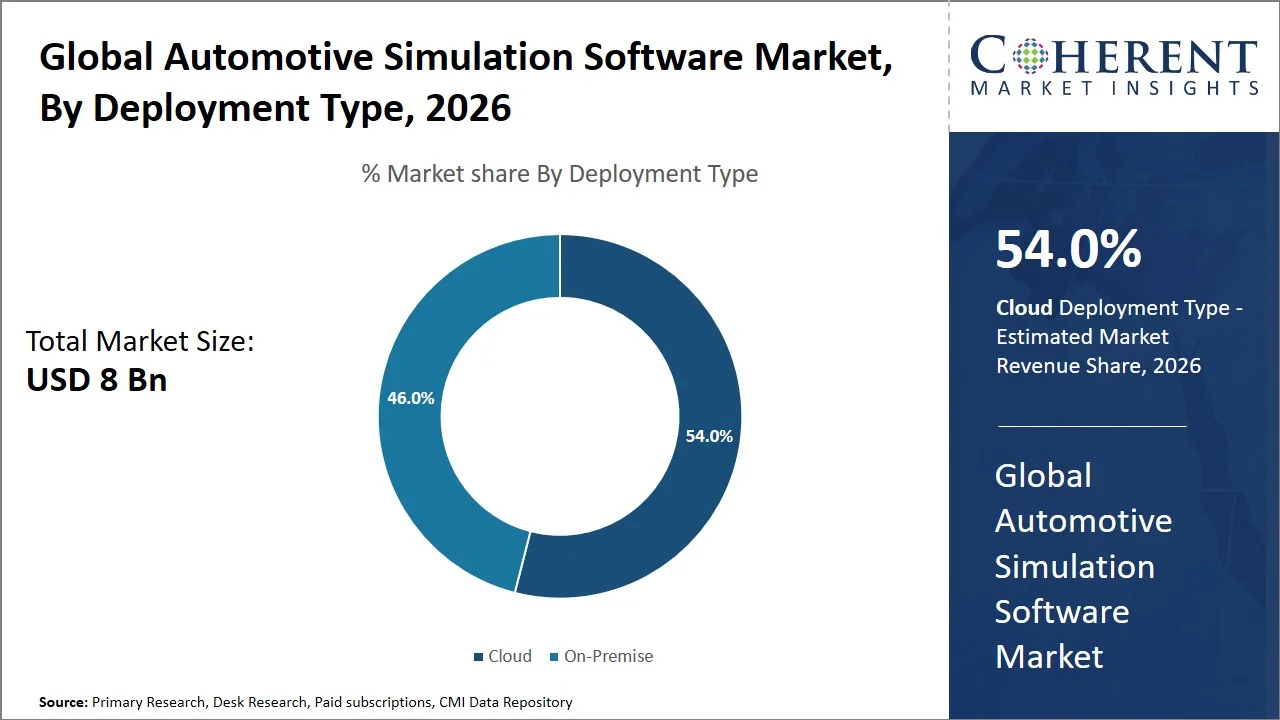
The cloud segment is expected to account for 54.0% of the global automotive simulation software market share in 2026. Cloud deployment is the most favored one since it provides scalable computing capacity for complicated automotive simulations without the requirement for expensive on-premise infrastructure. Cloud platforms concentrate resources, allowing engineers to access on-demand high-performance computing, run large-scale multiphysics simulations, and work smoothly across global development teams. This flexibility enables automotive manufacturers and suppliers to accelerate design validation, reduce infrastructure costs, enhance resource usage and enable continuous software updates, all of which make cloud deployment extremely well suited for modern car development programs. On February 5, 2025, Siemens stated that it has improved its HPCWorks platform with advanced cloud and hybrid HPC capabilities to help support large scale simulation workloads, including automotive crash investigation, multiphysics modeling and AI-driven engineering workflows.
Passenger Vehicles Segment Dominates the Global Automotive Simulation Software Market
The passenger vehicles segment is expected to account for 52.0% of the global automotive simulation software market share in 2026. The highest demand is from the passenger vehicles segment as the manufacturers are still investing in advanced virtual engineering to speed the creation of safe, efficient and technologically advanced automobiles. The fast pace of electric vehicle introduction, sophisticated driver assistance systems, connectivity, and software-defined architectures has created an enormous demand for simulation for vehicle design, crash testing, battery performance, aerodynamics and software validation. Passenger cars are produced in far greater volumes than commercial vehicles, and automotive manufacturers depend heavily on simulation software to cut development costs, shorten product development cycles and meet rising safety and pollution criteria. On December 11, 2025, Rivian held its first Autonomy & AI Day, announcing major achievements in vertically integrated automotive technology.
Currents Events and their Impact
Current Events | Description and its Impact |
European Union Artificial Intelligence Act (EU AI Act) - Phased implementation |
|
United Nations Regulation No. 171 (UN R171) - Driver Control Assistance Systems (DCAS) |
|
Automotive Simulation Software Market Dynamics
Market Drivers
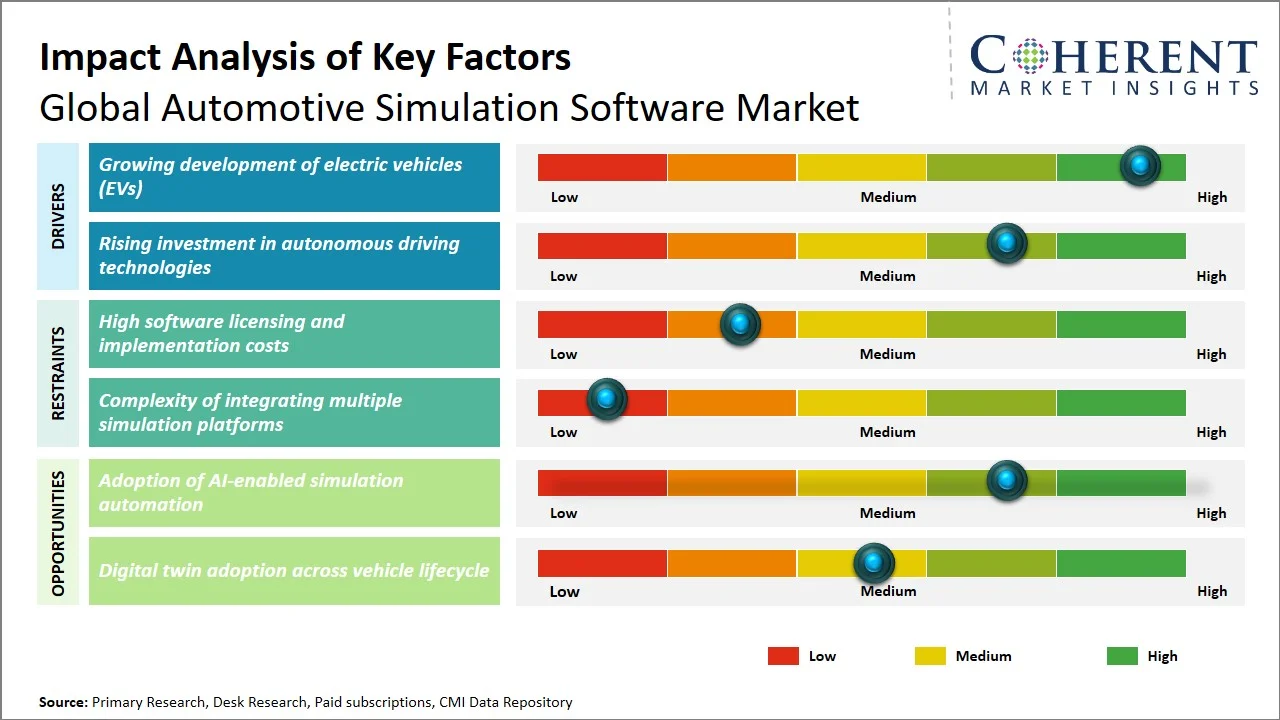
- Growing development of electric vehicles (EVs): The rapid growth of electric vehicles is a major factor driving the use of automotive simulation software, as electric vehicles require extensive virtual testing of battery systems, electric powertrains, thermal management, charging performance and energy efficiency. Car manufactures utilize sophisticated modeling tools to optimize battery design, boost vehicle range, enhance structural safety and evaluate performance across a wide range of operating circumstances before producing physical prototypes. This virtual engineering technique saves development costs and shortens product development cycles, allowing manufacturers to bring innovative electric car models to market faster and meet ever more severe safety and performance criteria. On June 30, 2026 BMW invested USD 1.7 billion to expand EV production at its South Carolina operations, establishing new manufacturing lines for next-generation electric vehicles for the North American market. These include modifications for full-scale EV assembly and battery integration for future passenger EVs.
- Rising investment in autonomous driving technologies: Growing investments in autonomous driving technologies are significantly driving the demand for automotive simulation software as autonomous systems need to be validated in millions of virtual driving scenarios prior to their deployment in the real world. Simulation platforms provide the possibility for developers to test perception algorithms, sensor fusion, decision-making, vehicle-to-everything communication and edge-case traffic scenarios in safe and repeatable environments. It accelerates software development, enhances the dependability of the system, minimizes the demand for expensive physical testing, and assists manufacturers in meeting the changing safety and regulatory standards for autonomous vehicles. On February 2, 2026, Waymo announced that it has raised a USD 16 billion investment round valuing the company at USD 126 billion. This capital underscores that the age of autonomous mobility at scale has arrived. (Source: Waymo)
Emerging Trends
- Expansion of Cloud-Based High-Performance Simulation Platforms: Cloud-native simulation platforms are gaining popularity with OEMs and suppliers looking for scalable computing resources without a large investment in on-premise infrastructure. Cloud-based systems allow worldwide teams to work together on engineering, run large-scale multiphysics simulations and access high-performance computing on demand for complicated vehicle development projects.
- Increased Simulation for Software-Defined Vehicles (SDVs) and Autonomous Systems: The shift towards software-defined vehicles and increased levels of vehicle autonomy is generating a demand for improved virtual validation platforms. Car manufacturers now use simulation software more to verify ADAS algorithms, sensor fusion, V2X communication, cybersecurity resilience, and over-the-air software upgrades in millions of virtual driving situations before deployment in the real world.
Regional Insights
Why is North America a Strong Market for Automotive Simulation Software?
North America is expected to account for a market share of 35.0% in 2026. North America is a significant hub for automotive simulation software due to the strong presence of vehicle manufacturers, autonomous driving innovators, and engineering software vendors. Leading automotive OEMs including General Motors, Ford, Tesla and Rivian are heavily using these digital engineering platforms for crashworthiness analysis, battery temperature management, software-defined vehicle development and autonomous driving validation. The region also benefits from significant simulation technology suppliers such Ansys, MathWorks, and Applied Intuition, whose platforms are extensively accepted for virtual testing of ADAS, sensor fusion, and over-the-air software updates before physical car testing. On March 18, 2025, General Motors and NVIDIA announced they are collaborating on next-generation vehicles, factories and robots using AI, simulation and accelerated computing.
Why Does the Asia Pacific Automotive Simulation Software Market Exhibit High Growth?
Asia Pacific is projected to account for 29.0% of the global automotive simulation software market and is expected to register the fastest growth. The Asia Pacific region is the fastest growing hub for automotive simulation software use as vehicle manufacturers are quickly scaling electric vehicle and intelligent mobility programs. Significant investment is being made in the region in battery research, autonomous driving and smart manufacturing, with companies increasingly using cloud-based simulation and digital twin technologies in automotive engineering. Automotive manufacturers in the region are increasingly relying on simulation for battery safety validation, vehicle dynamics optimization and virtual manufacturing to speed up development cycles and help the move to software-defined vehicles. On September 13, 2025, Tata Technologies announced that it has entered into a definitive agreement to acquire 100% equity shares of ES-Tech GmbH and its subsidiaries. The acquisition strengthens its delivery of vehicle simulation, validation, and software engineering services for global automotive clients including those in India and Southeast Asia. (Source: Tata Technologies)
Global Automotive Simulation Software Market Outlook for Key Countries
Why is the U.S. Emerging as a Major Hub in the Automotive Simulation Software Market?
The U.S. is at the forefront of automotive simulation innovation, with pioneering research in autonomous mobility and electrified automobiles. Tesla focuses significantly on simulation to optimize its batteries, vehicle dynamics and autonomous driving software development. General Motors uses virtual engineering for its Ultium EV platform and Super Cruise driver assistance technologies. Many OEMs rely on the simulation settings offered by California-based Applied Intuition to verify their autonomous driving software in millions of virtual driving scenarios before they hit the road.
Is China the Next Growth Engine for the Automotive Simulation Software Market?
China is leading the world in manufacturing electric cars (EVs) and intelligent connected vehicles (ICVs) and has seen a tremendous increase in the adoption of automotive simulation software. BYD leverages superior simulation technology to guarantee safety, thermal management and structural performance of blade batteries, while NIO uses digital engineering tools to verify battery swap systems and intelligent driving technologies. XPeng heavily depends on virtual simulation to create its XNGP autonomous driving platform, which allows it to validate vision and decision-making algorithms on a massive scale before testing on public roads.
Germany Automotive Simulation Software Market Analysis and Trends
Owing to the dense cluster of premium vehicle manufacturers and engineering software businesses, Germany is the global center of automotive engineering simulation. BMW employs digital twins and simulation at all stages of vehicle development to optimize aerodynamics, crash performance and manufacturing processes, while Mercedes-Benz uses virtual engineering to accelerate the development of its MB.OS software-defined vehicle platform. Large-scale simulation - Volkswagen Group uses large-scale simulation for electric vehicle platforms like MEB and SSP, which reduces the need for actual prototypes in vehicle development.
Japan Automotive Simulation Software Market Analysis and Trends
Japan’s ongoing development of hybrid, electric and hydrogen vehicles is pushing its automotive simulation capabilities. Toyota employs holistic simulation for fuel cell systems, battery technologies, vehicle safety and automated driving functions Honda applies digital engineering to the development of electric vehicles and advanced driver assistance systems. Nissan uses simulation extensively in the development of its ProPILOT technology, allowing the company to virtually validate driver assistance features in a wide range of traffic and environmental circumstances.
South Korea Automotive Simulation Software Market Analysis and Trends
South Korea is at the forefront of the use of automotive simulation software, owing to its leadership in electric vehicles, batteries, and smart mobility technology. Hyundai Motor Group employs digital twin technology and virtual simulation in the development of its E-GMP electric vehicle platform, enhancements to crash safety, and the validation of autonomous driving systems. Kia is applying simulation to increase battery thermal performance, vehicle aerodynamics and structural durability, while Hyundai Mobis is utilizing virtual engineering to speed up sensor, electronic control unit and next-generation ADAS solution development for global car manufacturers.
Global Automotive Simulation Software Market - Vehicle Programs Using Digital Twins
Region | OEMs | Vehicle Programs Using Digital Twins | Primary Application of Digital Twins |
North America | GM, Tesla, Ford, Rivian | EV platforms (Ultium, FSD-enabled EVs, F-150 Lightning), robotaxi & autonomous programs | Full vehicle digital twins used for battery thermal simulation, crash validation, ADAS scenario testing, and factory-level virtual commissioning |
Europe | BMW, Mercedes-Benz, Volkswagen, Stellantis | Neue Klasse EVs, MB.EA platform, SSP architecture, ID. series EVs | Digital twins used for end-to-end vehicle lifecycle simulation, crash testing, aerodynamics, and software-defined vehicle architecture validation |
Asia Pacific | BYD, Hyundai, Toyota, Tata Motors, SAIC | EV mass production platforms, hybrid systems, ADAS-enabled passenger vehicles | Digital twins applied for battery safety simulation, EV platform optimization, production line virtualization, and ADAS validation |
How is the Adoption of AI-Enabled Simulation Automation Creating New Growth Opportunities in the Automotive Simulation Software Market?
Adoption of AI-enabled simulation automation is providing big growth potential in the automotive simulation software industry. The AI-enabled simulation automation allows engineers to automate repetitive modeling jobs, optimize vehicle designs and accelerate validation processes with minimum manual intervention. AI can quickly assess thousands of design variations to find optimum engineering parameters, anticipate component performance, and offer design enhancements for battery systems, aerodynamics, crash safety and vehicle dynamics. This decreases simulation time, development costs and helps automakers bring innovative electrified, connected and autonomous vehicles to market faster, while boosting engineering accuracy and overall product quality. Sumitomo Riko to adopt Ansys AI technology to accelerate time-to-solution and enhance efficiency in automotive component design and manufacture. On October 8, 2025, Sumitomo Riko announced that it is implementing Ansys’s AI technology to accelerate time-to-solution and improve efficiency in the design and production of automotive components. SimAI swiftly learns from fresh and legacy simulation data to create high-fidelity AI models that can instantly forecast performance.
Market Players, Key Development, and Competitive Intelligence
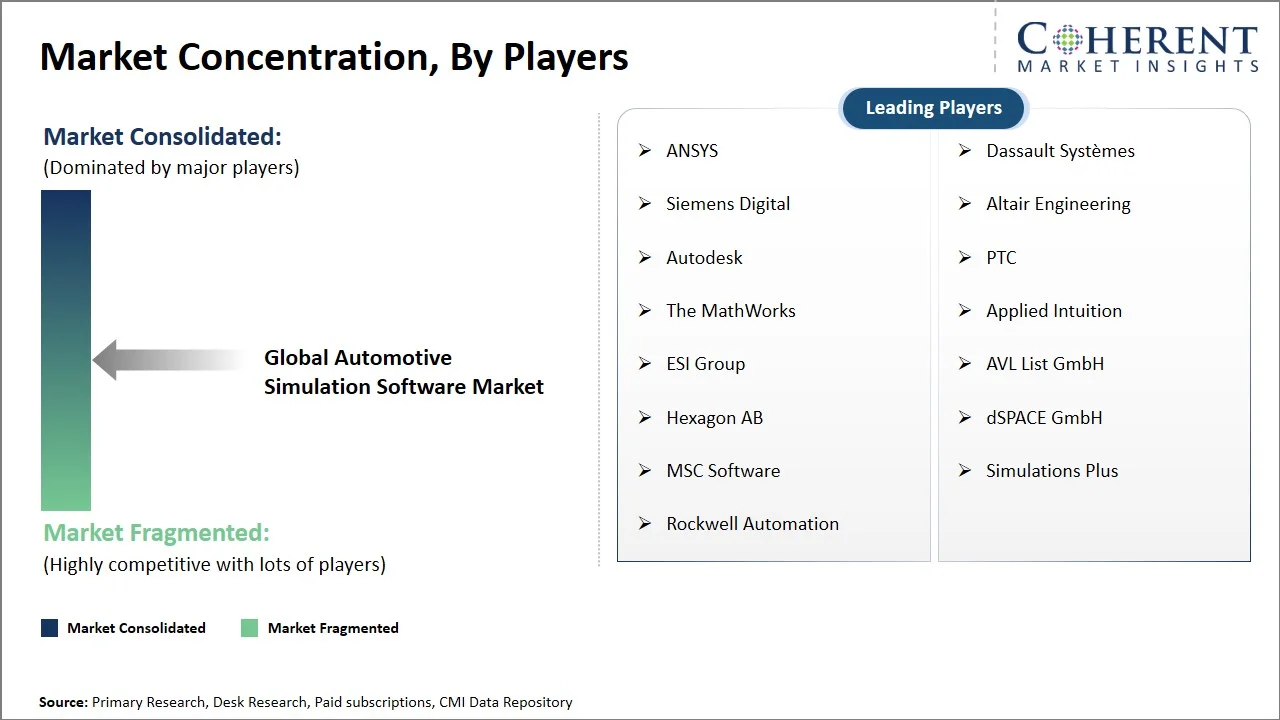
Key Developments
- On June 17, 2025, Applied Intuition, Inc., the leading vehicle intelligence company for automotive, trucking, construction, mining, agriculture and defense, announced that it has closed a USD 600 million Series F fundraise and tender offer at a USD 15 billion valuation.
- On March 26, 2025, Siemens announced that it has completed the acquisition of Altair Engineering Inc., a leading provider of software in the industrial simulation and analysis market, for an enterprise value of approximately USD 10 billion. With this acquisition, Siemens extends its leadership in simulation and industrial artificial intelligence (AI) by adding new capabilities in mechanical and electromagnetic simulation, high-performance computing (HPC), data science and AI.
Competitive Landscape
The automotive simulation software market is becoming quite competitive with the continual growth of integrated engineering ecosystems as opposed to standalone simulation solutions. Leading companies such as Ansys, Dassault Systèmes, Siemens Digital Industries Software, Altair Engineering and MathWorks are expanding their portfolios through the addition of multiphysics simulation, digital twins, artificial intelligence, cloud-native computing and model-based systems engineering within integrated platforms. Competition is also heating up from specialized firms such as Applied Intuition, dSPACE, AVL and Hexagon, who are working on autonomous vehicle validation, the creation of software-defined vehicles and hardware-in-the-loop testing. Software developers, automotive OEMs, semiconductor vendors and cloud service providers are building strategic collaborations, speeding innovation and creating end-to-end virtual vehicle development environments.
Market Report Scope
Automotive Simulation Software Market Report Coverage
| Report Coverage | Details | ||
|---|---|---|---|
| Base Year: | 2025 | Market Size in 2026: | USD 8 Bn |
| Historical Data for: | 2020 To 2024 | Forecast Period: | 2026 To 2033 |
| Forecast Period 2026 to 2033 CAGR: | 13% | 2033 Value Projection: | USD 22 Bn |
| Geographies covered: |
| ||
| Segments covered: |
| ||
| Companies covered: | ANSYS, Dassault Systèmes, Siemens Digital, Altair Engineering, Autodesk, PTC, The MathWorks, Applied Intuition, ESI Group, AVL List GmbH, Hexagon AB, dSPACE GmbH, MSC Software, Simulations Plus, and Rockwell Automation | ||
| Growth Drivers: |
| ||
| Restraints & Challenges: |
| ||
Analyst Opinion (Expert Opinion)
- Integration of simulation software with artificial intelligence, digital engineering, and software-defined vehicle architectures is projected to influence the automotive simulation software market. There is an increasing focus on decreasing engineering complexity through the use of integrated virtual development environments that can validate mechanical, electrical, electronic and software systems simultaneously. This is centered on cloud-based high-performance computing, real-time digital twins and automated validation platforms. Simulation is becoming a core engineering capability across the whole vehicle lifecycle, not just in individual product development stages.
- The future of the automotive simulation software market is likely to be driven by the move to entirely virtual vehicle development, as physical prototypes are increasingly replaced by high-fidelity digital validation. Advanced simulation will be a key enabler for the development of autonomous driving systems, next generation battery technologies, zonal electrical designs and software defined cars that need ongoing software verification and validation throughout the lifecycle of the vehicle. The use of generative artificial intelligence, quantum-inspired optimization, edge computing, and cloud-based engineering platforms is expected to expand simulation beyond traditional design tasks into predictive manufacturing, fleet performance optimization and continuous vehicle software validation post-commercialization.
Speak to the analyst
Want personalized insights?
Take the findings above to one of our principal consultants, or have the report rebuilt around the segments, geographies and competitors you actually track.
Market Segmentation
- Solution Type Insights (Revenue, USD Billion, 2021 - 2033)
- Software
- Services
- Deployment Type Insights (Revenue, USD Billion, 2021 - 2033)
- Cloud
- On-Premise
- Vehicle Type Insights (Revenue, USD Billion, 2021 - 2033)
- Passenger Vehicles
- Commercial Vehicles
- Application Insights (Revenue, USD Billion, 2021 - 2033)
- Product Design and Development
- Crash Simulation
- ADAS and Autonomous Driving Simulation
- Powertrain Simulation
- Vehicle Dynamics
- Thermal and Fluid Simulation
- Manufacturing Process Simulation
- Others
- Regional Insights (Revenue, USD Billion, 2021 - 2033)
- North America
- U.S.
- Canada
- Latin America
- Brazil
- Argentina
- Mexico
- Rest of Latin America
- Europe
- Germany
- U.K.
- Spain
- France
- Italy
- Russia
- Rest of Europe
- Asia Pacific
- China
- India
- Japan
- Australia
- South Korea
- ASEAN
- Rest of Asia Pacific
- Middle East
- GCC Countries
- Israel
- Rest of Middle East
- Africa
- South Africa
- North Africa
- Central Africa
- North America
- Key Players Insights
- ANSYS
- Dassault Systèmes
- Siemens Digital
- Altair Engineering
- Autodesk
- PTC
- The MathWorks
- Applied Intuition
- ESI Group
- AVL List GmbH
- Hexagon AB
- dSPACE GmbH
- MSC Software
- Simulations Plus
- Rockwell Automation
Sources
Primary Research Interviews
- Automotive Simulation Software Developers & Vendors
- OEM (Original Equipment Manufacturers) Representatives
- Automotive R&D Engineers & Technical Experts
- Fleet Management & Autonomous Vehicle Technology Specialists
Magazines
- Automotive Engineering International (SAE Media)
- Automotive World Magazine
- Motor Trend (Technology & Innovation Edition)
- Automotive Industries Magazine
Journals
- International Journal of Automotive Technology
- Journal of Simulation (Taylor & Francis)
- IEEE Transactions on Vehicular Technology
Associations
- Society of Automotive Engineers (SAE International)
- International Organization of Motor Vehicle Manufacturers (OICA)
- Automotive Industry Action Group (AIAG)
- European Automobile Manufacturers' Association (ACEA)
Public Domain Sources
- U.S. Department of Transportation (DOT) – National Highway Traffic Safety Administration (NHTSA)
- European Commission – Directorate-General for Internal Market, Industry, Entrepreneurship and SMEs
- World Economic Forum (WEF) – Automotive & Mobility Reports
- International Energy Agency (IEA) – Electric Vehicles & Automotive Data
Proprietary Elements
- CMI Data Analytics Tool
- Proprietary CMI Existing Repository of Information for the Last 10 Years
Get access to 250+ pages report
Every segment, forecast, competitor profile and data table behind the analysis above — available for instant download.
- ESOMAR Member
- ISO 9001:2015 Certified
- D-U-N-S Registered
- GDPR & CCPA Compliant
Missing comfort of reading report in your local language? Find your preferred language:
Transform your Strategy with Exclusive Trending Reports
Frequently Asked Questions
The global automotive simulation software market is expected to stand at USD 8 Bn in 2026 and is expected to reach USD 22 Bn by 2033.
The CAGR of the global automotive simulation software market is projected to be 13% from 2026 to 2033.
It allows developers to validate perception systems, sensor fusion, and driving algorithms across millions of virtual scenarios.
Artificial intelligence automates simulation workflows, optimizes designs, and accelerates engineering decision-making.
In terms of solution type, the software segment is estimated to dominate the market revenue share in 2026.
Growing development of electric vehicles (EVs) and rising investment in autonomous driving technologies are the major factors driving the growth of the global automotive simulation software market.
High software licensing and implementation costs and complexity of integrating multiple simulation platforms are the major factors hampering the growth of the global automotive simulation software market.