

Global Baby Care Packaging Market Size and Forecast – (2026-2033)
According to Coherent Market Insights, the global baby care packaging market is estimated to be valued at USD 16.45 Bn in 2026 and is expected to reach USD 25.06 Bn by 2033, expanding at a compound annual growth rate (CAGR) of 6.2% from 2026 to 2033.
Key Takeaways of the Baby Care Packaging Market
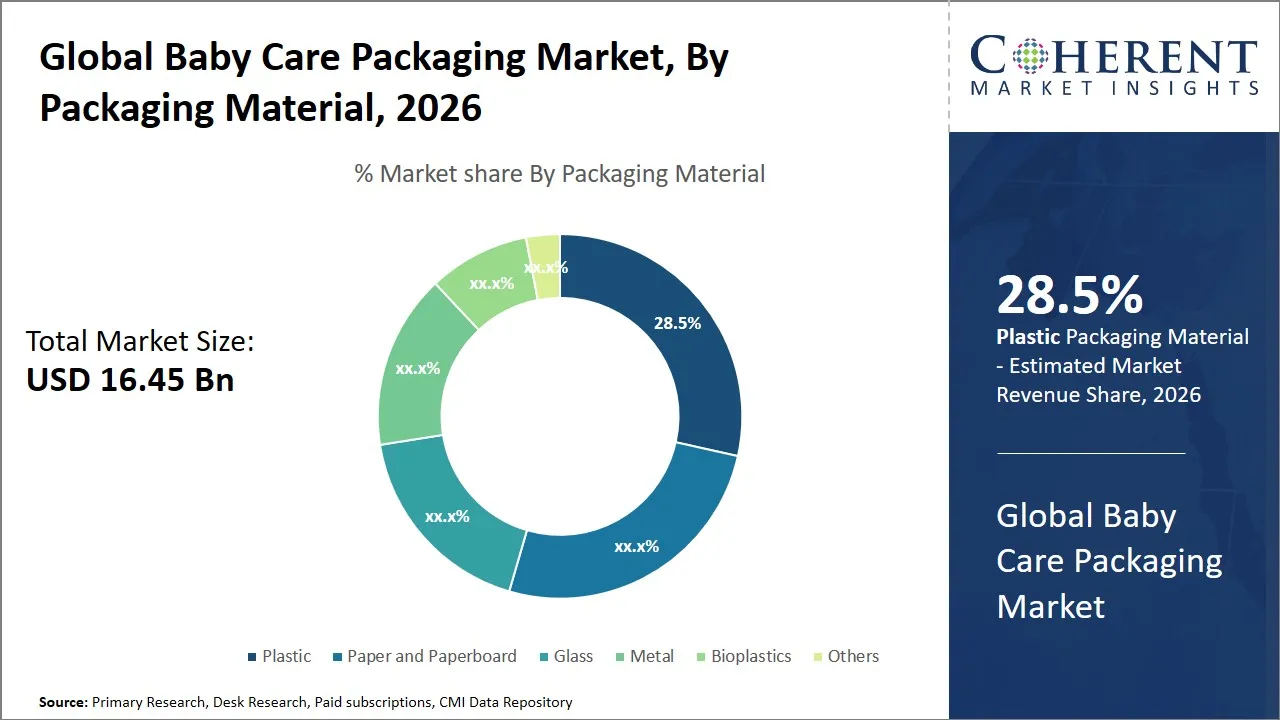
- The plastic segment is expected to account for 28.5 % of the global baby care packaging market share in 2026.
- The bottles and jars segment is projected to capture 31.7 % of the baby care packaging market share in 2026.
- The baby food segment is estimated to hold 45.7 % of the market share in 2026.
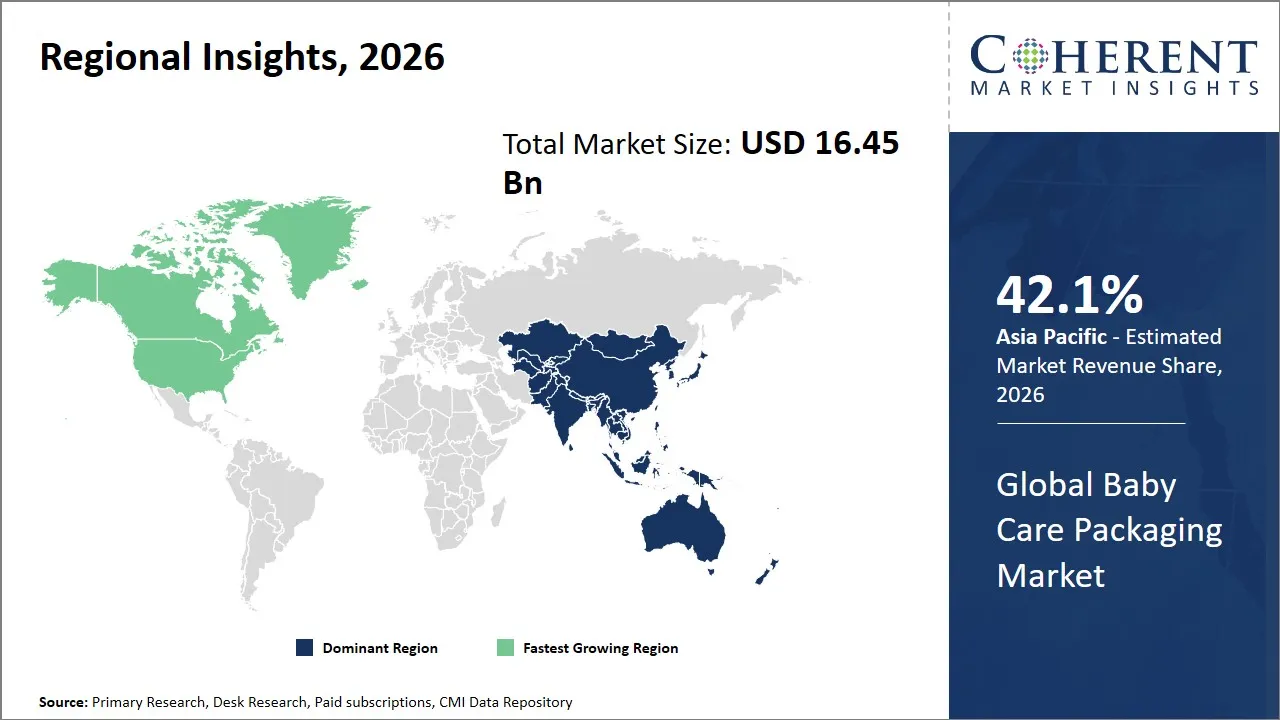
- The Asia Pacific region is expected to dominate the market with a 42.1 % share in 2026.
- North America is anticipated to experience the fastest market growth, contributing a 21.3 % share in 2026.
Market Overview
- Key market trends include a strong shift toward eco-friendly and biodegradable packaging materials to reduce environmental impact, alongside the integration of smart packaging technologies such as QR codes and anti-tampering features that enhance product safety and consumer trust.
- Additionally, personalized and aesthetically appealing packaging designs are gaining popularity, as manufacturers aim to differentiate their offerings and cater to the evolving preferences of millennial and Gen Z parents.
Currents Events and Its Impact
Current Events | Description and its Impact |
Rising Sustainability Regulations & Plastic Reduction Policies |
|
Surge in Eco‑Friendly Consumer Demand & Brand Innovation |
|
Segmental Insights
- Current Industry Events of 2026
- Market Size Estimation
- Regional Breakdown
- Competitive Landscape
- Customer Intelligence
- Segmental Analysis
- Pricing Analysis
- Key Market Drivers, Challenges & Future Trends
- Customized Insights Section
Why Does the Plastic Dominates the Global Baby Care Packaging Market in 2026?
Plastic segment is expected to hold 28.5% of the market share in 2026, due to its exceptional versatility and safety characteristics. Plastic materials give the manufacturers unrestricted freedom to come up with lightweight, durable, and break free packaging solutions which is very significant as far as baby care products are concerned. Packaging which keeps the product intact, uncontaminated and easy to handle are the needs of parents and caregivers, and plastic performs well in all aspects. As an example, plastic wrapping can be able to prevent external factors and spills, including the baby lotion and shampoos, as well as decrease the chances of being harmed in case of breaking, which is often related to glass.
For example, plastic packaging for baby lotions and shampoos can prevent spills and protect products from external factors, while also reducing the risk of breakage, which is a concern with glass containers. An instance of this would be the use of polyethylene (PE) and polypropylene (PP) in baby food jars, which offer ease of use and safety while maintaining product freshness.
What Drives the Popularity of Bottles and Jars in the Baby Care Packaging Market?
Bottles and jars segment is projected to account for 31.7% of the baby care packaging market share in 2026, driven by their functionality, convenience, and alignment with user expectations. Such packaging types are especially popular due to the possibility of storing a variety of baby care products such as liquid detergents and shampoos, creams and ointments, etc. safely. Bottles and jars are designed in a way that allows easy access, ability to control the portion size, and safeguard against contamination such that products that are used first are always used hygienically.
The bottling is distinguished by the ergonomic nature of their shapes which are meant to fit well in the hands of the parents as they go about their day-to-day activities, particularly when one hand might be occupied. This convenience is particularly desirable in child care environments where it is usual to multitask. They are also usually fitted with special dispensing characteristics like pumps, droppers or squeeze applications, enabling accuracy of application and avoiding wastage of the products. With feeding bottles, it is not just a packaging, but a product in itself which, in this context, should be safe and compatible with infants.
Baby Food Dominates the Global Baby Care Packaging Market
The baby food segment is expected to command 45.7% of the global baby care packaging market share in 2026, propelled by increasing demand for nutritious, convenient, and safe feeding options. The current generation of parents is very conscious about the ingredients and preservation of the baby food products hence motivating the manufacturers to design packaging that not only preserves the product but also increases its shelf life as well as on the go consumption.
Baby food packaging is a special problem because it is necessary to consider both a high level of hygiene and safety and ensure that the products are sensitive and perishable. The most important category of materials and formats is the one that prevents leakage, contamination, and spoilage. The success of this demand has resulted in the extensive use of packaging technologies including aseptic processing and vacuum sealing which preserve the quality of purees, cereals and milk-based formulations but do not depend on the use of preservatives to a great extent.
Regional Insights
Asia Pacific Baby Care Packaging Market Analysis and Trends
The Asia Pacific region is projected to lead the market with a 42.1% share in 2026, due to its rapidly expanding population, rising disposable incomes, and increasing awareness about infant care and hygiene. China, India and Southeast Asia are some of the emerging economies that are experiencing an increase in demand of the packaged baby products due to urbanization and increasing middle class.
The government policies about packaging standards are, in fact, less strict but slowly getting better, this is why manufacturers are more willing to embrace the use of higher-quality and environmentally friendly packaging. Large-scale production and cost efficiencies are supported by the strong manufacturing base of the Asia Pacific especially China, India and Japan. The overall industry leaders such as Huhtamaki Oyj, Huhtamaki Oyj and local innovators are investing in sustainable materials and smart packaging solutions. The policy of trade liberalization and the development of e-commerce infrastructure contribute to the growth of markets even more, increasing the channels of distribution.
North America Baby Care Packaging Market Analysis and Trends
The North America region is expected to exhibit the fastest growth in the market contributing 21.3% share in 2026, due to the existing market ecosystem in the region that is well developed in that it has advanced manufacturing infrastructure, strict regulatory requirements and high levels of consumer awareness on child safety and hygiene. The area has been well-endowed with detailed government policies that promote the health and safety of infants, hence compelling demand towards quality, sustainable and innovative packaging solutions in the baby care products.
Competitive environment is increased by the availability of major packaging industries in the world and major countries like Sealed Air Corporation, Berry Global Inc., and Amcor plc who engage in constant innovation of their products. In addition, the developed trade relations and distribution channels in the U.S. and Canada contribute to the effective market penetration and means that the manufacturers are able to promptly amend to the changing customer demands such as environmentally friendly and smart packaging technologies.
Global Baby Care Packaging Market Outlook for Key Countries
Is the U.S. Baby Care Packaging Market Set for Sustainable Growth?
The U.S. baby care packaging market continues to lead the baby care packaging sector within North America, driven by consumers’ strong preference for premium and eco-friendly packaging options. The country’s regulatory framework enforced by the FDA ensures high safety standards, influencing manufacturers to prioritize non-toxic and recyclable materials. Major companies such as Berry Global Inc. and Sealed Air Corporation have developed innovative biodegradable and flexible packaging specifically targeting baby food and skincare products. The U.S. also benefits from extensive R&D investments and collaborations between packaging firms and baby care brands, resulting in advanced solutions like antimicrobial and smart packaging.
Is China the New Frontier for Baby Care Packaging Innovation?
The packaging of baby care in China’s market is an indication of rapid transformation via urbanization and increasing income levels. There is a growing trend of domestic companies and multinational companies, such as Huhtamaki and Amcor, taking advantage of the vast manufacturing environment of the country and the governmental programs that encourage sustainable packaging. The Chinese buyers are also willing to receive safe, convenient, and appealing to the eye packaging, which makes them develop child-resistant closures and environmentally-friendly materials. The rise of e-commerce leaderships like Alibaba also makes protective and transport-efficient packaging more crucial, which encourages increased innovation among domestic and international market participants.
India Baby Care Packaging Market Trends
India is also becoming a major market where there is growing attention towards infant nutrition and hygiene helped by government health programs and more consumer awareness. The packaging environment in the baby care section of the country is defined by the varied needs ranging between low-end sachet products to high-end, sustainable packaging based on the multinational companies such as Amcor and local packaging providers.
Rapid expansion in organized retail and digital commerce enables efficient distribution, while recent regulatory improvements are fostering higher industry standards. Indian players are innovating with biodegradable films and child-safe packaging solutions, meeting both affordability and safety demands in the growing market.
Germany Baby Care Packaging Market Trends
Germany remains a pivotal market within Europe owing to its robust industrial base and stringent regulations on packaging safety and environmental sustainability. The country also focuses on recyclable and biodegradable solutions that are in line with the European Union requirements that affect the strategic orientation of major stakeholders like Klockner Pentaplast and Gerresheimer AG. German manufacturers have a lot of technological innovation with one of the aspects being smart packaging capabilities, which improve the life of their products on the shelf and the ease of use to the consumer. The retail network and the export-focused industry of Germanys help with a high stance on the high-quality segment of the baby care packaging.
Brazil Baby Care Packaging Market Trends
Brazil represents the forefront of growth in Latin America’s baby care packaging market, driven by increasing birth rates and gradually rising awareness of child healthcare. The local producers work together with international organizations such as the Bemis Company (and currently Amcor) in developing packaging that is both cost-effective and high-quality to meet the needs of the various socio-economic groups.
The efforts of the government to enhance infant nutrition have also triggered the improvement in product packaging with a focus on hygiene and durability. The development of the retail structure in Brazil and the changes in regulations in the packaging materials also influences the market promoting the sustainable and innovative packaging options which can meet the local preferences of the consumers.
Safety Labeling & Regulation
Category | Description |
Regulatory Compliance | Compliance with U.S. FDA regulations and European Union regulations on product packaging to ensure non-toxic, safe materials. |
Labeling Standards | Requirement to include ingredient lists, usage instructions, expiration dates, and safety warnings on packaging. |
Product Testing | Safety tests to ensure packaging materials meet standards for child safety and toxicity—critical for baby food, lotions, etc. |
Market Players, Key Development, and Competitive Intelligence
Key Developments
- In June 2025, Amcor completed its merger with Berry Global, forming a global flexible-packaging leader and forecasting USD 650 million in annual synergies.
- In May 2025, the U.S. FDA opened a docket seeking data on infant-formula nutrient specifications, an initiative that could reshape labeling rules and packaging real estate.
- In April 2025, Sonoco posted a 30.6% jump in quarterly net sales to USD 1.7 Bn, crediting its recently acquired metal-pack unit for stronger pricing power.
- In March 2025, China’s National Health Commission released GB 25596-2025 for FSMP Infant Formula, raising nutrient and labeling requirements that will alter pack artwork by 2027.
Top Strategies Followed by Global Baby Care Packaging Market Players
Player Type | Strategic Focus | Example |
Established Market Leaders | Heavy investment in R&D and innovation | For example, P&Gs Pampers brand, which created a new range of diapers, which have plant-based materials in their packaging, which lowers carbon emission and their environmental footprint, yet the product is also safe. |
Mid-Level Players | Cost-effective solutions with balanced quality | Munchkins Baby Bottle range is based on BPA-free packaging, but the main target of the range are the middle-income customers who want balance between safety and price. |
Small-Scale Players | Niche specialization & innovative variants | For instance, Sustainable Baby Company which has specialized in biodegradable diaper packaging which serves several environmentally-conscious consumers and thus enable them to establish a presence in a narrow niche market. |
Market Report Scope
Global Baby Care Packaging Market Report Coverage
| Report Coverage | Details | ||
|---|---|---|---|
| Base Year: | 2025 | Market Size in 2026: | USD 16.45 Bn |
| Historical Data for: | 2020 To 2024 | Forecast Period: | 2025 To 2032 |
| Forecast Period 2026 to 2033 CAGR: | 6.2% | 2033 Value Projection: | USD 25.06 Bn |
| Geographies covered: |
| ||
| Segments covered: |
| ||
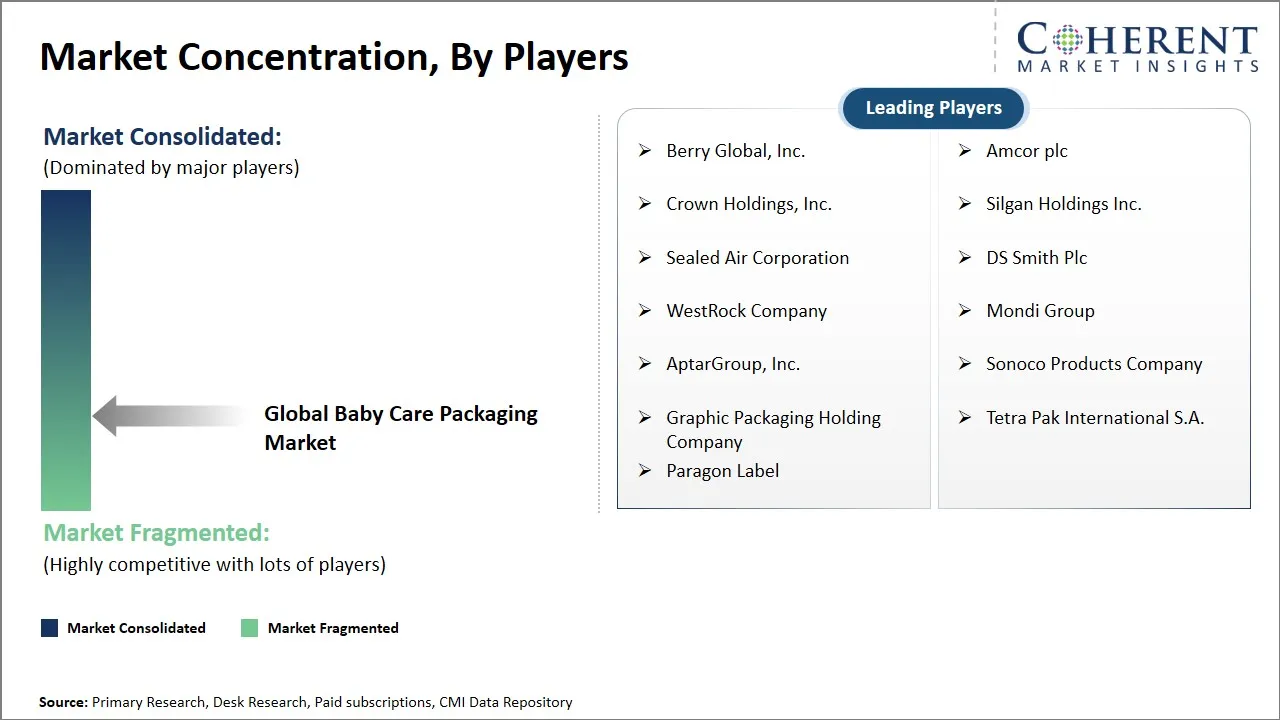
| Companies covered: | Berry Global, Inc., Amcor plc, Crown Holdings, Inc., Silgan Holdings Inc., Sealed Air Corporation, DS Smith Plc, WestRock Company, Mondi Group, AptarGroup, Inc., Sonoco Products Company, Graphic Packaging Holding Company, Tetra Pak International S.A., and Paragon Label | ||
| Growth Drivers: |
| ||
| Restraints & Challenges: |
| ||
Baby Care Packaging Market Dynamics
Baby Care Packaging Market Driver - Increasing Awareness of the Importance of Baby Care and Hygiene
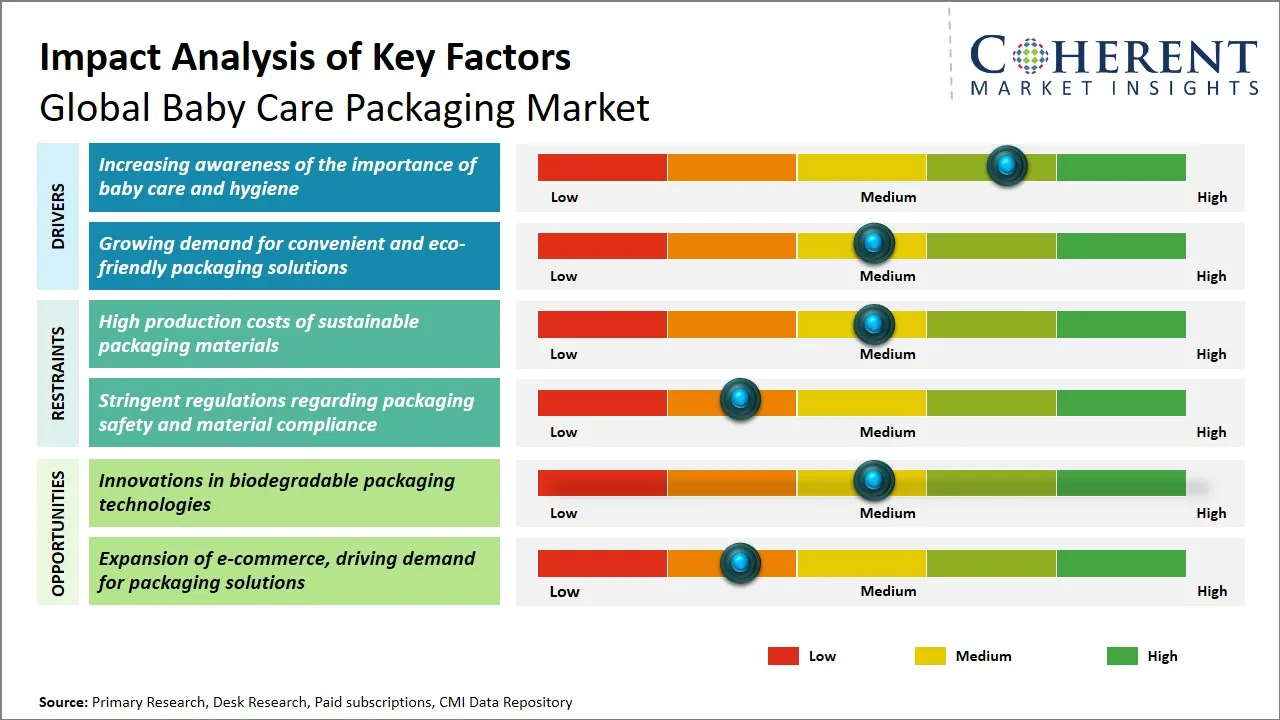
The increasing awareness amongst the parents and caregivers of the importance of hygiene and specialized care in the early years of life is a very serious push in the demand in the market of baby care packaging. Parents are now more educated than ever on the potentially harmful nature of poor hygiene behavior concerning infant health, and this has increased their demand to purchase products that are safe and convenient as well as protective. The increased awareness has given rise to the demand to have the solution to packaging that will not only safeguard the quality and sterility of the baby care products such as wipes, lotions, and diapers but also provide ease of use and portability.
For example, brands such as Pampers and Huggies to ensure that the packaging of their products is safer and sterile. An example of such a product would be the wipes provided by pampers which are packaged in a resealable bag that ensures the sterility and the moisture of the wipes are retained. Also, easy to transport and use on the go packaging has been in demand, which meets the needs of parents to be convenient.
(Source: https://www.pampers.com/en-us/baby/diapering/article/materials-and-safety)
Baby Care Packaging Market Opportunity - Innovations in Biodegradable Packaging Technologies
The global market in the packaging of baby care is enjoying a huge opportunity presented by the rising need of sustainable and environmental friendly packaging solutions. Biodegradable packaging technologies offer significant opportunities to the manufacturers in order to fulfill high regulatory standards and changing preferences of consumers. As the sensitivity on the importance of plastic waste increases, parents and caregivers are increasingly turning to the baby care products that have an eco-conscious package. The improvement of materials science has made it possible to create biodegradable polymers based on renewable materials, including cornstarch, sugarcane, and cellulose, that provide similar durability and safety levels as essential to baby care items.
For example, the Honest Company, which introduced a collection of baby care products with biodegradable and environmentally friendly packaging. This will cover their line of baby wipes, which packs are designed in pouches of biodegradable materials. Honest Company depends on renewable materials, in sugarcane and corn starch, to make their packaging solutions, which are made of plant-based materials.
(Source: https://www.honest.com/?srsltid=AfmBOoo4HNDFraLmXBP4R1nFntWt6gbXlRmCCeQeoY8BsTSuFAOA9RV9)
Analyst Opinion (Expert Opinion)
- The market for the baby care packaging is experiencing a significant growth thus the increased consumer awareness in terms of safety, sustainability, and convenience of baby products. The presentations of the Global Baby Care Packaging Conference (2023) and the International Packaging Innovations Summit (2022) revealed some of the most important trends, with such companies as P&G and Kimberly-Clark being the pioneers in creating new, environmentally-friendly, and sustainable packaging options that would appeal to health-conscious parents.
- The recent introduction of a biodegradable diaper packaging by P&G is not an exception in the industry to minimize the impact on the environment and increase the safety of the product at the same time. Topics of these conferences included a growing need to have tamper-free and convenient packaging as more parents were also concerned with ease and dependability. Nevertheless, some difficulties, including the need to balance the cost-saving but sustainable materials and the necessity to meet the high requirements of regulation, were also observed to be impediments to fast adoption.
- The key in this competitive environment can be the success and prosperity of companies that educate consumers on the advantages of innovative packaging and are actively involved in sustainability programs. Finally, the development of the baby care packaging market will rely on the capacity to innovate and keep up with the changing needs and preferences of the environmentally-conscious consumers of the modern environment.
Speak to the analyst
Want personalized insights?
Take the findings above to one of our principal consultants, or have the report rebuilt around the segments, geographies and competitors you actually track.
Market Segmentation
- Packaging Material Insights (Revenue, USD Bn, 2021 - 2033)
- Plastic
- Paper and Paperboard
- Glass
- Metal
- Bioplastics
- Others
- Packaging Format Insights (Revenue, USD Bn, 2021 - 2033)
- Bottles and Jars
- Pouches and Sachets
- Cans
- Tubes and Sticks
- Caps
- Closures and Labels
- Application Insights (Revenue, USD Bn, 2021 - 2033)
- Baby Food
- Baby Cosmetics
- Diapers and Wipes
- Baby Beverages
- Packaging Type Insights (Revenue, USD Bn, 2021 - 2033)
- Flexible
- Rigid
- Regional Insights (Revenue, USD Bn, 2021 - 2033)
- North America
- U.S.
- Canada
- Latin America
- Brazil
- Argentina
- Mexico
- Rest of Latin America
- Europe
- Germany
- U.K.
- Spain
- France
- Italy
- Russia
- Rest of Europe
- Asia Pacific
- China
- India
- Japan
- Australia
- South Korea
- ASEAN
- Rest of Asia Pacific
- Middle East
- GCC Countries
- Israel
- Rest of Middle East
- Africa
- South Africa
- North Africa
- Central Africa
- North America
- Key Players Insights
- Berry Global, Inc.
- Amcor plc
- Crown Holdings, Inc.
- Silgan Holdings Inc.
- Sealed Air Corporation
- DS Smith Plc
- WestRock Company
- Mondi Group
- AptarGroup, Inc.
- Sonoco Products Company
- Graphic Packaging Holding Company
- Tetra Pak International S.A.
- Paragon Label
Sources
Primary Research Interviews
- CEO – Leading Baby Care Packaging Manufacturer (e.g., Amcor PLC or Mondi Group equivalent)
- Supply Chain Director – Major Packaging Distributor for Baby Products
- Production Lead – Flexible Packaging Converter for Infant Formulas
- Sustainability Officer – Eco-Packaging Certification Authority for Baby Goods
Stakeholders
- Manufacturers
- Amcor PLC, Mondi Group, Berry Global, Sonoco Products Company, Tetra Laval
- End-use Sectors
- Baby Food Producers (Pouches, Jars)
- Diaper and Wipe Manufacturers
- Skincare and Shampoo Brands (Tubes, Bottles)
- Regulatory & Certification Bodies (e.g., FDA for infant food packaging, EU REACH compliance, FSSAI in India)
- E-commerce Platforms and Retailers (Amazon, Alibaba, Supermarkets, Pharmacies like CVS)
- Technology Integration Players: Sustainable packaging innovators (Bio-based plastics, child-resistant closures)
Databases
- UN Comtrade Database (Baby care packaging trade HS codes)
- India Import Export (EXIM) Database (Baby product packaging imports)
- Eurostat Trade Statistics for Packaging and Baby Products
- USITC or Similar for Packaging Imports (No direct USGS equivalent; FDA data instead)
Magazines
- Packaging Digest – Trends in sustainable baby packaging
- Baby Care Innovation – Packaging for infant products
- Cosmetics Packaging – Skincare and baby lotions trends
- Flexible Packaging – Pouches for baby food
Journals
- Journal of Packaging Technology – Sustainable materials for baby care
- Sustainable Development – Baby cosmetics packaging future
- BMJ Paediatrics Open – Labeling on infant food packaging
- Packaging Technology and Science – Child-resistant innovations
Newspapers
- The Wall Street Journal – Global demand for baby packaging
- Business Standard (India) – Baby care imports growth
- Reuters – Sustainability shifts in consumer packaging
Associations
- Flexible Packaging Association
- European Flexible Packaging Institute
- Consumer Packaging Association
- Baby Product Manufacturers Association (implied via standards)
- World Association of Manufacturers of Bottles and Teats (WBT)
Public Domain Sources
- FDA – Guidelines for infant formula packaging and food contact
- European Commission – REACH regulations on baby packaging materials
- FSSAI (India) – Standards for baby food products
- OECD – Sustainability reports for consumer goods packaging
Proprietary Elements
- CMI Data Analytics Tool
- Proprietary CMI Existing Repository of information for last 8 years.
Get access to 250+ pages report
Every segment, forecast, competitor profile and data table behind the analysis above — available for instant download.
- ESOMAR Member
- ISO 9001:2015 Certified
- D-U-N-S Registered
- GDPR & CCPA Compliant
Missing comfort of reading report in your local language? Find your preferred language:
Transform your Strategy with Exclusive Trending Reports
Frequently Asked Questions
The global baby care packaging market is estimated to be valued at USD 16.45 Bn in 2026 and is expected to reach USD 25.06 Bn by 2033.
The CAGR of global baby care packaging market is projected to be 6.2% from 2026 to 2033.
Increasing awareness of the importance of baby care and hygiene and growing demand for convenient and eco-friendly packaging solutions are the major factors driving the growth of the global baby care packaging market.
High production costs of sustainable packaging materials and stringent regulations regarding packaging safety and material compliance are the major factors hampering the growth of the global baby care packaging market.
In terms of packaging material, plastic is estimated to dominate the market revenue share in 2026.
Berry Global, Inc., Amcor plc, Crown Holdings, Inc., Silgan Holdings Inc., Sealed Air Corporation, DS Smith Plc, WestRock Company, Mondi Group, AptarGroup, Inc., Sonoco Products Company, Graphic Packaging Holding Company, Tetra Pak International S.A., and Paragon Label are the major players.
Asia Pacific is expected to lead the global baby care packaging market in 2026.