

Global Caviar Market Size and Forecast – 2026-2033
The Global Caviar Market is estimated to be valued at USD 450.0 Mn in 2026 and is expected to reach USD 771.3 Mn by 2033, reflecting a compound annual growth rate (CAGR) of 8.0% from 2026 to 2033.
Key Takeaways of the Caviar Market
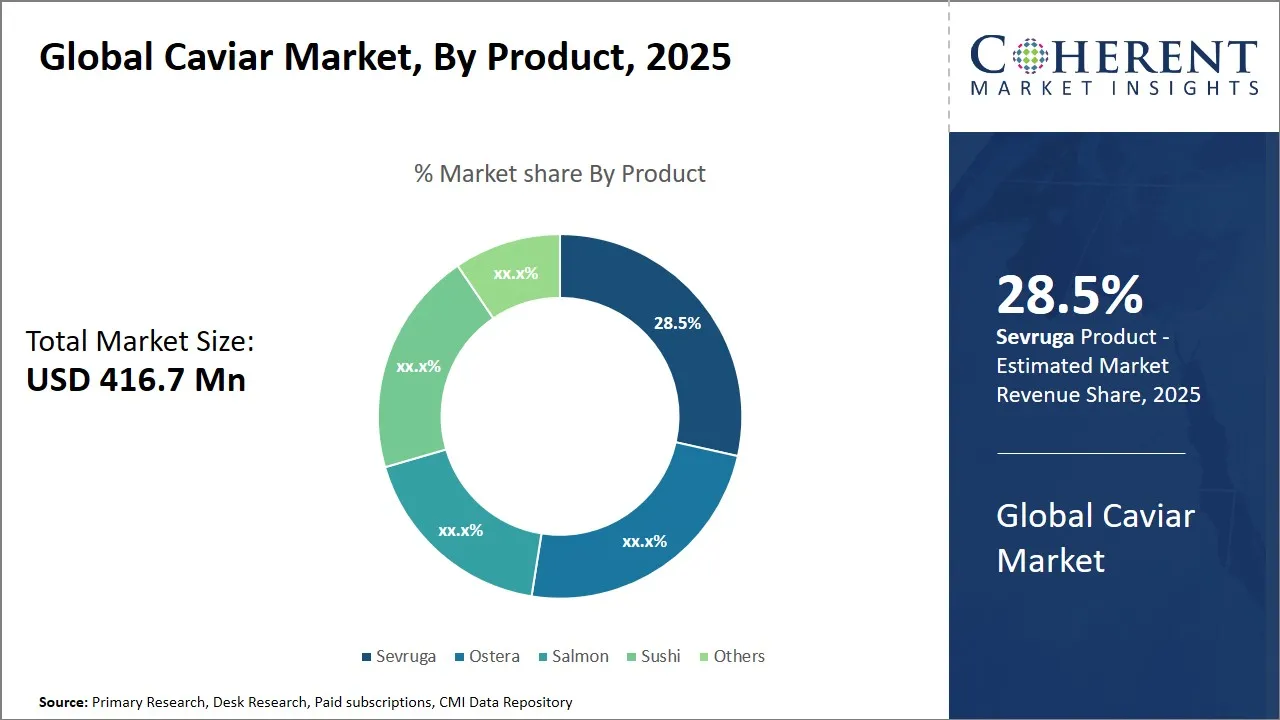
- Sevruga segment is expected to hold 29.5% of the market share in 2026.
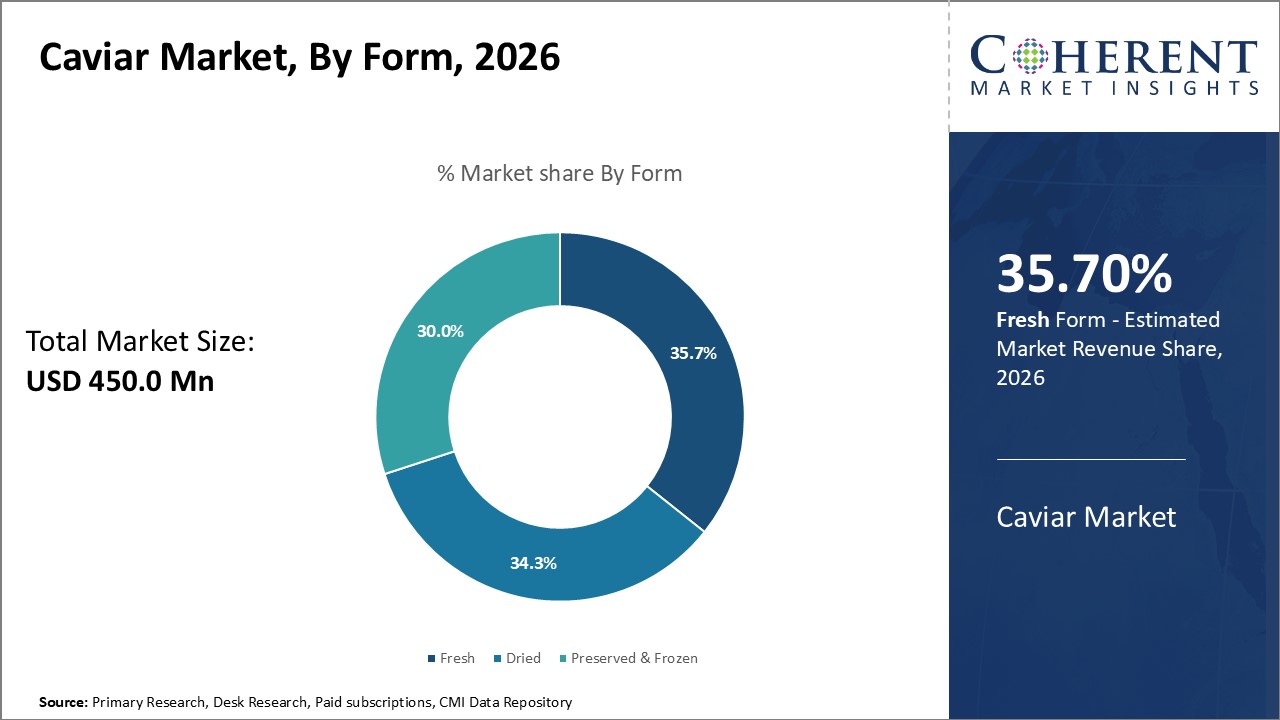
- The fresh segment is estimated to account for 35.7% of the global caviar market share in 2026.
- Restaurants segment is projected to hold 56.8% of the caviar market share in 2026.
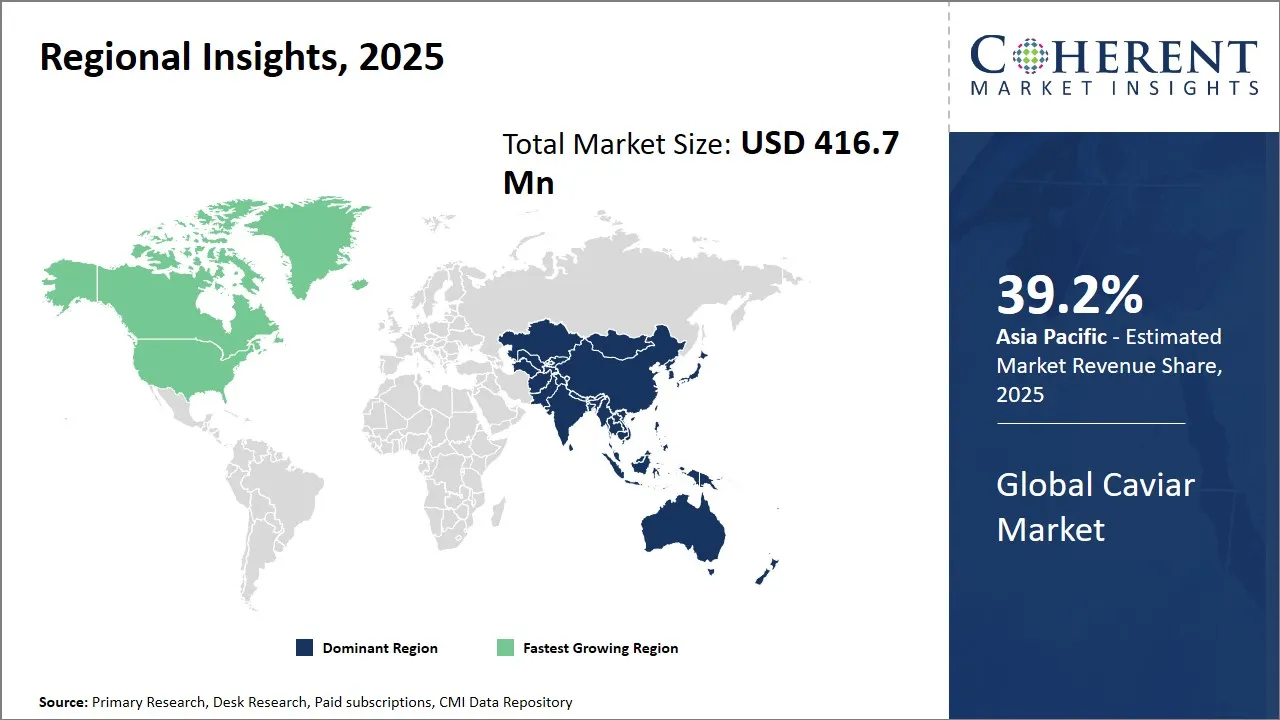
- Asia Pacific will dominate the caviar market in 2026 with an estimated 39.2% share.
- North America will hold 22.3% share in 2026 and record the fastest growth.
Market Overview
- Current market trends highlight a growing preference for sustainable and ethically sourced caviar, with producers focusing on aquaculture techniques to meet environmental concerns.
- Additionally, the rise in gourmet dining experiences and the influence of social media on luxury food consumption are propelling market growth. Innovations in packaging and product diversification, such as ready to eat food, caviar snacks, are also gaining traction, catering to a broader consumer base seeking convenience along with premium quality.
Current Events and Its Impact
Current Events | Description and its impact |
Expanded Russia-related sanctions and tighter customs scrutiny in Europe (2025) |
|
Russia’s production/export reorientation toward non-Western markets |
|
Segmental Insights
- Current Industry Events of 2026
- Market Size Estimation
- Regional Breakdown
- Competitive Landscape
- Customer Intelligence
- Segmental Analysis
- Pricing Analysis
- Key Market Drivers, Challenges & Future Trends
- Customized Insights Section
Why Does Sevruga Dominate the Global Caviar Market in 2026?
Sevruga caviar is expected to hold 29.5% of the caviar market share in 2026. This domination can be largely explained by its peculiarities and the choice of consumers who want to find the balance between the quality and exclusivity. Sevruga caviar is a stainless caviar produced out of the sterlet sturgeon; it has tiny eggs with a delicate texture that have a strong intense taste and a bit of nutty flavor. This renders it especially attractive to sophisticated connoisseurs and elite cooking places that focus on high-quality food.
The other major reason that is contributing to the development of the Sevruga caviar is its relative accessibility when compared to the other luxury caviar types such as Beluga. It is more affordable and accessible, which allows serving both experienced caviar lovers and novice clients who want to enjoy luxury seafood but do not want to abuse their budget.
For example, a fine-dining restaurant in Paris, renowned for its Michelin-starred dishes, recently introduced Sevruga caviar as part of its signature appetizer. While typically known for serving Beluga, the chef chose Sevruga for its balance of flavor and price, which allowed the restaurant to offer a luxury caviar experience at a more approachable cost.
Why is Fresh Segment the Dominant Form in the Global Caviar Market?
The fresh segment is projected to hold 35.7% of the market share in 2026, fueled by increasing consumer demand for authenticity and superior sensory experiences. The fresh caviar is known to preserve the original flavor, texture, and nutritional values that have been lost in the preserved or dried forms. The premium chefs and gourmet lovers will always like fresh caviar in giving preference to the fresh caviar since it is the one that has a bright briny smell and creamy flavor and texture which cannot be recreated by freezing or drying.
High quality of fresh caviar is also an influencing fact that promotes its consumption by high-end buyers. These minor differences in flavor and texture of fresh samples play a vital role in the fine dining setting where caviar is not only a component but also an experience. In addition, low shelf-life of fresh caviars provokes the restaurants and specialty stores to focus on immediate consumption and this strengthens a fresh supply chain and increases overall market focus on freshness and quality assurance.
Restaurants Dominate the Global Caviar Market
Restaurants are expected to represent 56.8% of the global caviar market share in 2026, which will be the beneficiaries of the close linkage of caviar with high-end culinary arts and fine dining. The popularity of high end restaurants that have caviar as part of their menus is evidence of the growing consumer preference towards high end gourmet experiences and the desire to spend to be exclusive. The use of caviars as a sign of luxury is perfectly aligned with the culinary branding of luxurious restaurants which strive to provide distinctive memorable foods which make them stand out of the crowd.
The contribution of innovative chefs to boosting the consumption of caviar can hardly be overestimated either. Culinary experts are also innovative when it comes to using caviar in new applications instead of serving it as garnish; they also use it as part of the flavor elements in dishes, therefore increasing the uses of caviar beyond the conventional way of serving. The development has made caviars more visible on menus particularly in western countries and in the emerging economies where fine dining culture is still thriving. Tasting menus and experience dining only promote the use of caviar and appeal to connoisseurs and curious customers.
Regional Insights
Asia Pacific Caviar Market Analysis and Trends
The Asia Pacific region is projected to lead the market with a 39.2% share in 2026, because of the growing disposable income as well as the growth of gourmet food culture and the growing consumer awareness in Fragrant delicacies in the countries of China, Japan, and South Korea. The market ecosystem is fast becoming mature with new local aquaculture projects targeting the sturgeon farming to satisfy the rising demand.
Government programs related to the development of aquaculture and luxury food production, as well as softened importation policies, have led to the easier entry to the market and foreign direct investments. The dynamics of trade have become more favorable as the Asian countries are becoming key caviar importers and exporters in the region. Stakeholder companies in the global market like Petrossian, Calvisius, and Caviar House and Prunier are vigorously extending their distributive channels in Asia Pacific, and local producers are slowly building up their product provisions to meet the local preferences.
North America Caviar Market Analysis and Trends
The North America region is expected to exhibit the fastest growth in the market contributing 23.3% share in 2026, potentially due to less tradition-oriented and more technology-oriented aquaculture, premium food culture, and sustainability-oriented production model. Advanced recirculating aquaculture systems (RAS), stringent food safety and increased demand by up-end and luxury hospitality, high-income households have made the U.S. and Canada key hubs. In contrast to the heritage-driven domination of the Europeans, the power of North Americas is in the controlled farming, steadfast quality, and traceable sourcing which are directly attractive to the modern luxury consumer.
The legal and regulatory systems in both the U.S. and Canada are very strict on harvesting wild sturgeon forcing the industry to fully converge on the production of farmed sturgeon caviar that is environmentally friendly. This has increased the rate at which sturgeon farms are invested in and imports minimized. Direct-to-consumer (D2C), gourmet retail chains, and Michelin-starred restaurants dominate distribution and are backed up by cold-chain logistics and high-quality branding. Caviar Russe, Markys, and Sterling Caviar are the major stakeholders that dominate the market with farm-raised, ethically sourced caviar that has been customized to suit North American consumption trends.
Global Caviar Market Outlook for Key Countries
Russia Caviar Market Trends
The market of Russians caviar is historically important as one of the original homelands of wild sturgeon, which sells both the traditional and farmed caviar products. A deep emphasis on the sustainable aquaculture is also maintained in the country to restore the sturgeon populations and meet such international regulations as CITES. Russian firms like Russian Caviar House and Beluga Gold keep providing the world with the supply chain of high quality and original Siberian sturgeon caviar. The governmental policies within Russia favor technological innovation in sturgeon farming, to improve the efficiency of production of sturgeon as well as its quality, but to retain the heritage of this luxury industry.
Why is France Leading the Caviar Market in Europe?
France is still dominating the luxury caviar market with the widely known manufacturers such as Petrossian who have combined tradition with a modern process. The French market is exhibiting a high level of demand, which is advanced in terms of the haute cuisine restaurants and the wealthy customers. Subsidies and quality certifications are the government measures to promote sustainable cultivation and export of high-quality caviar. The strategic location in Europe of Frances assists in easy access to premium markets, which is supported by an industry agenda on branding and artisanal skills.
Why is China Emerging as a High-Growth Market in the Global Caviar Industry?
The market of China caviar is growing at a rapid rate because the culture of consuming luxury food is changing. Middle- and upper-class populations are up surging and creating a demand in the imported and domestically produced caviar. The push to modernize agriculture and aquaculture by the governments has helped in the sturgeon farming projects that some of which are in collaboration with the European companies. The ability of imports and introduction of domestic aquaculture farms presented through trade policies give China an opportunity to become a major player in the Asia Pacific caviar market.
U.S. Caviar Market Trends
The U.S. features a growing caviar market influenced by its diverse consumer base and vibrant luxury food scene, particularly in metropolitan areas such as New York and Los Angeles. The regulatory environment oversees the sustainable farming of sturgeon, and American producers like Sterling Caviar are gaining recognition for quality and organic-certified products. Import restrictions and tariff policies shape trade dynamics, while rising consumer awareness of heritage and organic foods act as growth catalysts. The U.S. market acts as both a key import hub and a growing production base bolstered by investment in aquaculture technologies.
Japan Caviar Market Trends
The Japan caviar market has a high level of consumer sophistication and entrenched preference towards high quality seafood. Though sturgeon farming on a domestic level is small, it is through imports of Europe and Russia that the Japan demand is satisfied to a large extent. The government maintains high quality standards and food safety certifications, which increase consumer confidence. The world leaders have already formed alliances with the Japanese distributors in order to gain access to the market, whereas the smaller local enterprises encourage the Japanese to add caviar to their traditional and modern cuisine, which can further contribute to its status as a luxurious good.
Quality Benchmarking
- Aquaculture Quality: Aquaculture caviar is grown by controlled conditions which make the product consistent in quality, taste, texture and production volumes. This is due to the fact that the controlled environment enables easier monitoring of the health, feeding as well as general welfare of the sturgeon and this results in fewer contaminants and increased consistency in the quality of products.
- Wild Supply Quality: Wild caviar is more prone to variation because its natural harvest may be subject to environmental variations like water quality, age of the sturgeon and its genetics which may affect the nature of the final products. Although many might regard wild caviar as a luxury since it is a luxury item that is hard to come by, it has problems of uniformity and sustainability.
Regulatory & Trade Restriction Impact Mapping
Aspect | Aquaculture Caviar | Wild Caviar |
Regulatory Bodies
| Governed by national aquaculture regulations and animal welfare standards. | Governed by CITES (Convention on International Trade in Endangered Species) and national conservation laws. |
Sustainability Regulations | Regulations ensure sustainable farming practices (e.g., water quality, feed, habitat). | Strict sustainability regulations to protect endangered species and prevent overfishing. |
Environmental Compliance | Subject to farming environment regulations to minimize ecological impact. | Must comply with environmental protection laws that aim to protect natural sturgeon populations. |
Market Players, Key Development, and Competitive Intelligence
Key Developments
- On April 19, 2025, Pizza Hut launched a limited-time Pizza Caviar offering at its New York City location. This plant-based topping mimics the look and texture of traditional caviar but is infused with a smoky pepperoni flavor, aligning with the trend of merging luxury and casual dining. The launch is part of Pizza Hut's innovation drive aimed at younger, adventurous consumers seeking novelty foods.
- In February 2025, UMAMI Bioworks announced its development of cultivated caviar made from lab-grown sturgeon cells and plant-based scaffolds. The Singapore-based startup aims to offer a sustainable and ethical alternative to traditional caviar by avoiding harm to fish populations. This new product is designed to appeal to environmentally conscious consumers and luxury food retailers in Asia and Europe.
- In December 2024, Tsar Nicoulai Caviar announced the acquisition of Sterling Caviar, a major U.S. sturgeon farm. The merger positions the new entity as the largest producer of sustainable caviar in North America. This move strengthens their capacity to meet rising demand while focusing on eco-friendly farming methods and premium product lines.
Top Strategies Followed by Global Caviar Market Players
- The existing market leaders, usually the market leaders, invest so much in research and development to be able to be innovative to introduce high performance products that will address the shifting consumer preferences. They have been working on enhancing the quality, sustainability, and diversity of caviar products through their R&D, as a way of remaining market leaders both on quality and ethically sourced.
- For example, Calvisius Caviar has made massive investments in closed-loop sturgeon farming in Italy whereby it is traceable, of uniform quality and sustainable production. In a similar manner, Kaviari also focuses on exquisite maturation practices and long-term relationships with sustainable farms, which would give the company greater leverage on luxury hospitality and eating out mediums.
- The middle-range consumers of caviar are those that are price conscious and quality conscious. Their plan is centered on the provision of cheap caviar products to attract price-sensitive buyers without too much quality that should be compromised. It is through this balance that mid-level firms have adequately exploited a broader customer base, both in terms of newer consumers and in new market segments.
- As an example, The Caviar Co. has established itself as a premium but relatively low priced product in the U.S., through vertically integrated agriculture to regulate prices. Most of the mid-size players also work with distributors or hospitality companies to reach more consumers particularly in the new luxury food markets where first-time caviar consumers are increasing.
- Small players in the international caviar market place themselves in the niche and with the specific features of their products and new directions. These players tend to incorporate the advanced technologies in their operations to be able to product differentiation and remain competitive in the presence of bigger competitors. Considering organic or sustainably sourced caviar varieties or artisanal caviar, which are exclusive and appealing to a discriminating consumer, are some examples of small players.
- For example, Black River Caviar stands out with eco-certified sturgeon production and sourcing transparency, which attracts consumers who are concerned about sustainability. Others focus on limited-edition harvests, farm-to-table narratives, or direct-to-consumer frameworks, with the help of innovation and exclusivity to rival a much larger incumbent.
Market Report Scope
Caviar Market Report Coverage
| Report Coverage | Details | ||
|---|---|---|---|
| Base Year: | 2025 | Market Size in 2026: | USD 450.0 Mn |
| Historical Data for: | 2020 To 2024 | Forecast Period: | 2026 To 2033 |
| Forecast Period 2026 to 2033 CAGR: | 8.0% | 2033 Value Projection: | USD 771.3 Mn |
| Geographies covered: |
| ||
| Segments covered: |
| ||
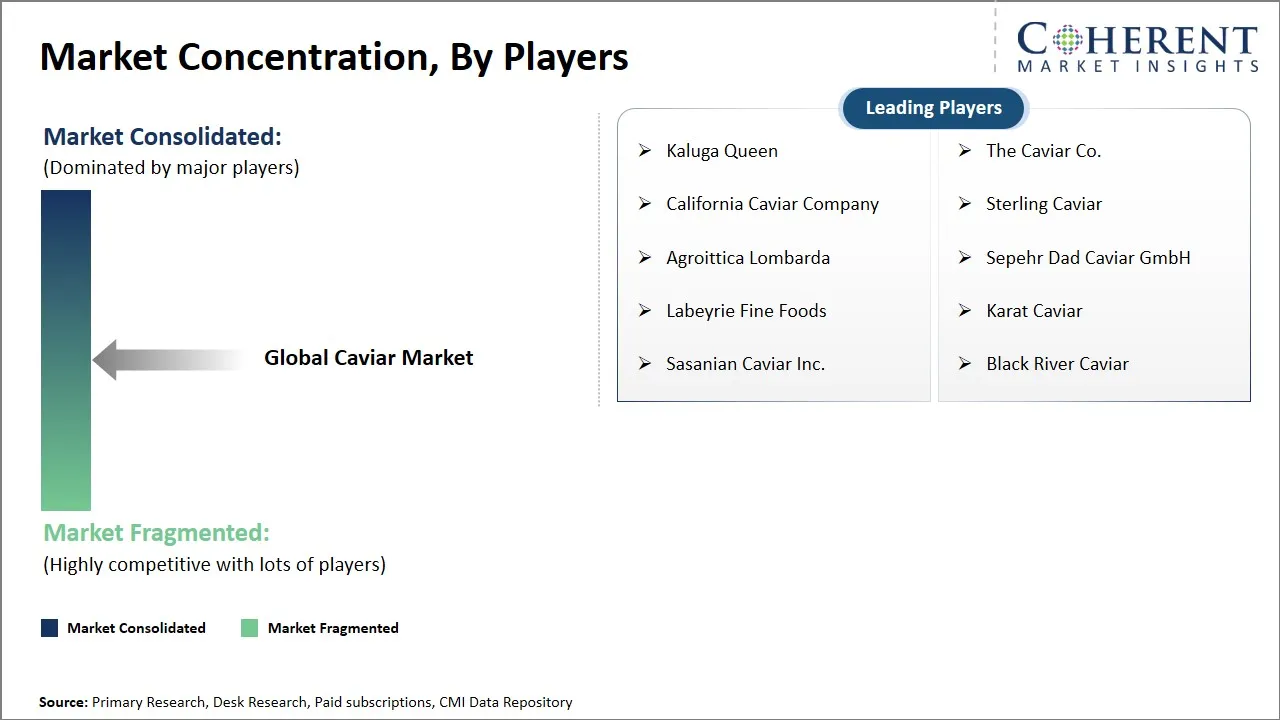
| Companies covered: | Kaluga Queen, The Caviar Co., California Caviar Company, Sterling Caviar, Agroittica Lombarda, Sepehr Dad Caviar GmbH, Labeyrie Fine Foods, Karat Caviar, Sasanian Caviar Inc., and Black River Caviar | ||
| Growth Drivers: |
| ||
| Restraints & Challenges: |
| ||
Caviar Market Dynamics
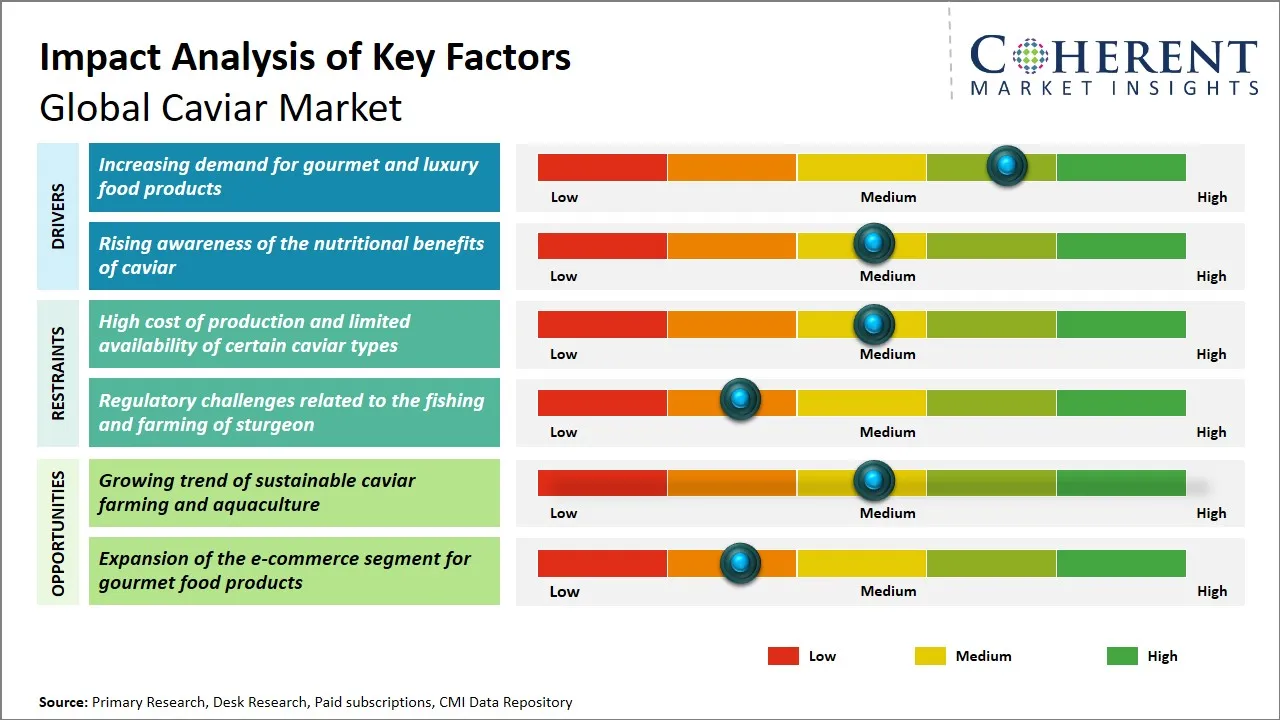
Caviar Market Driver - Increasing Demand for Gourmet and Luxury Food Products
The market of caviar is also greatly driven by the rising tendency of consumers to high-end and luxurious food items, as a result of rising disposable income and taste inclinations among high-end and aspiration consumers, which defines the global caviar market. With the growing sophistication of food culture, there is a greater appreciation to exclusive food items such as caviar that is usually linked to prestige, sophistication, and high-end lifestyle. The change is also contributed by the growth of high end food restaurants and luxury hotels, hospitality industries that currently heavily include caviar on their menus resulting in making it more visible and desirable.
For example, expensive hotels in such as Palazzo Versace Dubai places like Dubai, Paris, and New York habitually package caviar service with champagne accompaniment, exclusive lounges, and customized events directly transforming the increasing wealth and experience dining tendencies into greater caviar consumption quantity and value increase.
Caviar Market Opportunity - Growing Trend of Sustainable Caviar Farming and Aquaculture
The global caviar market due to the rising use of sustainable caviar production and culture. Conventional wild caviar fishing has been struggling with considerable issues of overfishing, ecology and declining sturgeon stocks, and has led the industry to a more regulated and ecologically friendly approach. In sustainable aquaculture, the producers can rear sturgeon in controlled conditions which enables the producer to have a steady supply, and the ecological footprint is minimal. This strategy not only suits the urgency issues of the conservation authorities but also targets the environmentally responsible consumers who are attracted by the ethically produced luxury goods.
The example is Calvisius Caviar and Sturgeon Aquafarms that are fully dependent on controlled aquaculture systems. These manufacturers experience land-based or closed-loop water systems to provide traceability, animal welfare, and strict adherence to environmental standards.
Analyst Opinion (Expert Opinion)
- There is a significant growth in the caviar business as the market is dominated by the growing popularity of luxury food products and growing attention towards sustainable sourcing. The lessons learned at the international caviar conference (2023) and the global seafood exposition (2022) demonstrate the new practices in the practice of aquaculture, and the companies such as Sturgeon Aquafarms and Caviar de France are on the forefront of implementing new technologies that help in the production of sustainable caviar.
- The introduction of sustainable farming methods by Sturgeon Aquafarms in recent times and its emphasis on the conservation of wild sturgeon species is one of the examples of how the industry is determined to undo the overfishing patterns and establish sustainability.
- The topic of focus was the rising popularity of low-price, high-quality substitutes, such as farmed caviar options, which serve a larger consumer base and which still have the luxury marketability. The obstacles, however, that were most often mentioned are variable prices as a result of climatic effects on the fish population and strict quality control.
- Those companies that invest in the open-minded supply chains and teach the consumers about the peculiarities of caviar types will have the chance to prosper. Finally, the development of the caviar market will be determined by its capacity to harmonize the high-quality products with sustainability to correspond with emerging consumer culture that focuses on responsible marketing and exclusivity.
Speak to the analyst
Want personalized insights?
Take the findings above to one of our principal consultants, or have the report rebuilt around the segments, geographies and competitors you actually track.
Market Segmentation
- Product Insights (Revenue, USD Mn, 2021 - 2033)
- Sevruga
- Ostera
- Salmon
- Sushi
- Others
- Form Insights (Revenue, USD Mn, 2021 - 2033)
- Fresh
- Dried
- Preserved and Frozen
- Application Insights (Revenue, USD Mn, 2021 - 2033)
- Restaurants
- Household
- Regional Insights (Revenue, USD Mn, 2021 - 2033)
- North America
- U.S.
- Canada
- Latin America
- Brazil
- Argentina
- Mexico
- Rest of Latin America
- Europe
- Germany
- U.K.
- Spain
- France
- Italy
- Russia
- Rest of Europe
- Asia Pacific
- China
- India
- Japan
- Australia
- South Korea
- ASEAN
- Rest of Asia Pacific
- Middle East
- GCC Countries
- Israel
- Rest of Middle East
- Africa
- South Africa
- North Africa
- Central Africa
- North America
- Key Players Insights
- Kaluga Queen
- The Caviar Co.
- California Caviar Company
- Sterling Caviar
- Agroittica Lombarda
- Sepehr Dad Caviar GmbH
- Labeyrie Fine Foods
- Karat Caviar
- Sasanian Caviar Inc.
- Black River Caviar
Sources
Primary Research Interviews
- CEO – Leading Caviar Producer (e.g., Kaluga Queen or Caviar de Neuvic equivalent)
- Supply Chain Director – Major Caviar Distributor (e.g., The Caviar Co. or Sterling Caviar)
- Production Lead – Sturgeon Aquaculture Farm
- Sustainability Officer – Caviar Certification Authority (e.g., Aquaculture Stewardship Council)
Stakeholders
- Manufacturers
- End-use Sectors
- Luxury Foodservice (Fine Dining Restaurants, Hotels)
- Gourmet Retailers
- High-End E-commerce Platforms
- Regulatory & Certification Bodies (e.g., CITES for sturgeon species, ASC for aquaculture, EU food safety regulations)
- E-commerce Platforms and Retailers (e.g., Great Atlantic Trading, Marky’s, Alibaba gourmet sections)
- Technology Integration Players: Advanced aquaculture and sustainable sturgeon farming operations
Databases
- UN Comtrade Database (caviar trade HS code 1604.31)
- EU MOFA Trade Statistics (caviar market reports)
- USITC DataWeb (caviar imports/exports)
- Eurostat Trade Statistics for Fish Preparations
- TRAFFIC Wildlife Trade Database (caviar trade monitoring)
Magazines
- Fine Dining Lovers – Caviar trends in gourmet cuisine
- SeafoodSource – Aquaculture and caviar production
- Aquaculture North America – Sturgeon farming innovations
- Luxury Travel Magazine – Caviar in high-end hospitality
Journals
- Aquaculture – Sturgeon farming and caviar yield studies
- Food Chemistry – Caviar quality and composition analysis
- Marine Policy – Caviar trade regulations and sustainability
- Journal of Food Science – Caviar sensory and nutritional profiles
- Fisheries Research – Global sturgeon population impacts
Newspapers
- The Wall Street Journal – Luxury food market dynamics including caviar
- Financial Times – Caviar supply chain and trade shifts
- Reuters – Caviar price volatility and production news
- South China Morning Post – China caviar export growth
- The Guardian – Sustainability challenges in caviar industry
Associations
- World Caviar Association
- Sturgeon Industry Alliance of America (SIAA)
- Aquaculture Stewardship Council (ASC)
- Canadian Aquaculture Industry Alliance (CAIA)
- Association of Caviar d'Aquitaine
- Global Aquaculture Alliance (GAA)
- International Sturgeon Trade Association equivalents
Public Domain Sources
- CITES – Sturgeon and caviar trade conventions
- FAO – Aquaculture statistics for sturgeon caviar
- WHO/FAO – Food safety standards for caviar
- US FDA – Imported caviar regulations
- OECD – Seafood trade and sustainability reports
Proprietary Elements
- CMI Data Analytics Tool, Proprietary CMI Existing Repository of information for last 8 years.
Get access to 250+ pages report
Every segment, forecast, competitor profile and data table behind the analysis above — available for instant download.
- ESOMAR Member
- ISO 9001:2015 Certified
- D-U-N-S Registered
- GDPR & CCPA Compliant
Missing comfort of reading report in your local language? Find your preferred language:
Transform your Strategy with Exclusive Trending Reports
Frequently Asked Questions
The global caviar market is estimated to be valued at USD 450.0 Mn in 2026 and is expected to reach USD 771.3 Mn by 2033.
The CAGR of global caviar market is projected to be 8.0% from 2026 to 2033.
Increasing demand for gourmet and luxury food products and rising awareness of the nutritional benefits of caviar are the major factors driving the growth of the global caviar market.
High cost of production and limited availability of certain caviar types and regulatory challenges related to the fishing and farming of sturgeon are the major factors hampering the growth of the global caviar market.
In terms of product, sevruga is estimated to dominate the market revenue share in 2026.
Aquaculture expansion, certified sustainable farming practices, genetic conservation, and traceability programs mitigate wild stock depletion.
Kaluga Queen, The Caviar Co., California Caviar Company, Sterling Caviar, Agroittica Lombarda, Sepehr Dad Caviar GmbH, Labeyrie Fine Foods, Karat Caviar, Sasanian Caviar Inc., and Black River Caviar are the major players.