

Global Charcoal Briquettes Market Size and Forecast – 2026-2033
The Global Charcoal Briquettes Market is estimated to be valued at USD 3.99 Bn in 2026 and is expected to reach USD 5.99 Bn by 2033, exhibiting a compound annual growth rate (CAGR) of 6.0% from 2026 to 2033.
Key Takeaways of the Charcoal Briquettes Market
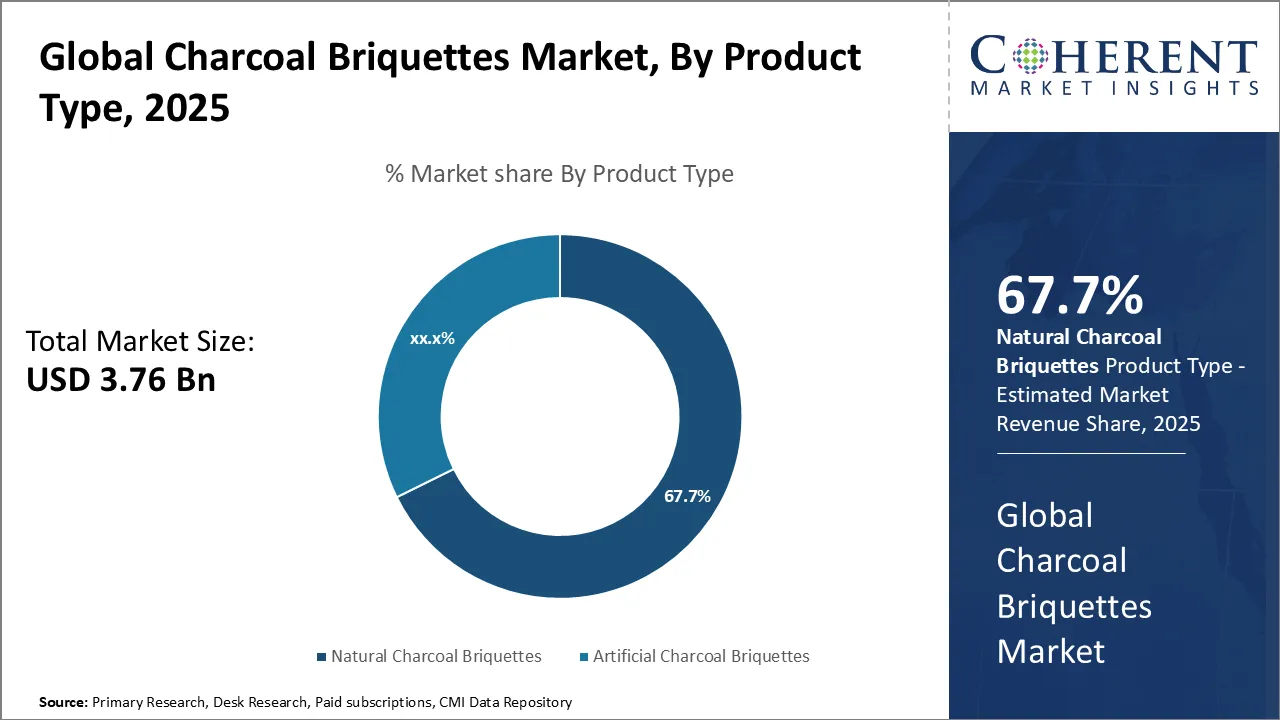
- The natural charcoal briquettes segment is expected to account for 68.7 % of the market share in 2026, driven by a strong preference for them over artificial briquettes.
- The wood charcoal segment is projected to capture 64.3% of the market share in 2026, owing to its widespread availability and established efficiency in energy production.
- The residential cooking segment is expected to hold a 39.5 % market share in 2026, driven by its accessibility, convenience, and cost-effectiveness in households worldwide.
- Asia Pacific is expected to lead the global charcoal briquettes market in 2026 with a 35.2 % share, driven by rising demand for alternative cooking fuels, environmental concerns, and increasing government initiatives to reduce deforestation. North America, with a 21.5% share, will be the fastest-growing region, fueled by the growing popularity of outdoor cooking, barbecuing trends, and the rise of eco-friendly fuel alternatives.
Market Overview
Current market trends indicate a significant shift towards the adoption of charcoal briquettes made from renewable biomass, organic waste, and biofuels, positioning them as a preferred choice over conventional fuels like white coal. Innovations in manufacturing processes are enhancing product quality and combustion efficiency, while growing consumer preference for cleaner cooking and heating fuels is boosting market penetration. Additionally, expanding use in outdoor recreational activities and food industries highlights the expanding application scope, reinforcing steady market growth.
Current Events and Its Impact
Current Events | Description and its impact |
Technological Advancements in Briquetting Machinery |
|
Expansion of E-Commerce Channels and Online Retail |
|
Segmental Insights
- Current Industry Events of 2026
- Market Size Estimation
- Regional Breakdown
- Competitive Landscape
- Customer Intelligence
- Segmental Analysis
- Pricing Analysis
- Key Market Drivers, Challenges & Future Trends
- Customized Insights Section
Charcoal Briquettes Market Insights, By Product Type - Natural Charcoal Briquettes Segment Dominates the Market due to their Eco-friendly Appeal and Superior Burning Qualities
Natural charcoal briquettes segment is expected to hold 68.7% share of the market in 2026, due to significant preference over artificial briquettes because they are produced using sustainable processes without the addition of chemical binders or fillers. Consumers and industries are progressively favoring natural alternatives due to increasing environmental awareness and stricter regulations on pollutant emissions. The inherent purity of natural charcoal briquettes results in less smoke and reduced toxic residues, making them ideal for users seeking a cleaner and more sustainable fuel source. This attribute significantly drives the demand in regions where environmental regulations and consumer consciousness align favorably.
Moreover, natural charcoal briquettes offer superior combustion efficiency and consistent heat release, attributes highly valued by both domestic and commercial users. Their ability to maintain steady temperatures makes them particularly suitable for applications involving prolonged cooking or heating. The natural origin also mitigates concerns about food contamination, which is critical for culinary uses in residential cooking and barbecuing.
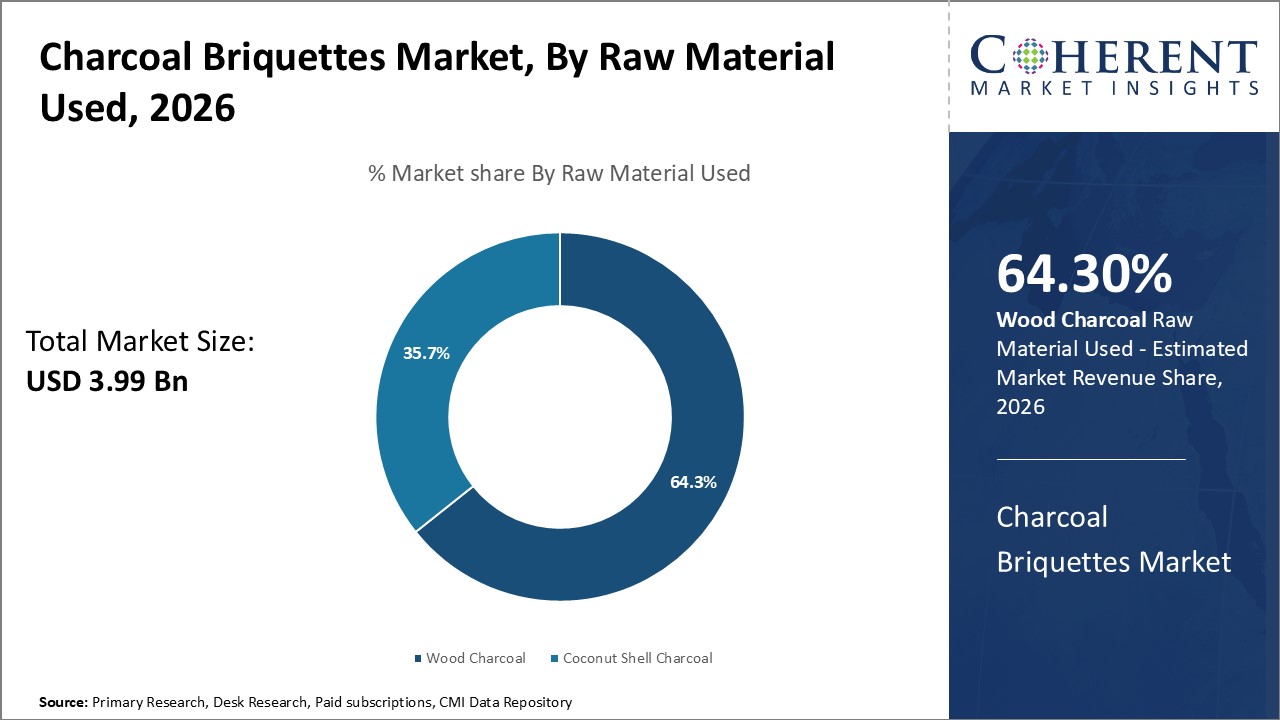
Charcoal Briquettes Market Insights, By Raw Material Used - Wood Charcoal Segment Dominates the Market Driven by its Abundant Availability and Superior Performance Characteristics
Wood charcoal segment is projected to hold 64.3% share of the market in 2026, due to its widespread accessibility and proven efficiency in energy delivery. The natural fibrous structure of wood allows it to char efficiently, producing briquettes with high calorific value and excellent ignition properties. This makes wood charcoal briquettes highly preferred for applications requiring consistent and prolonged heat, such as industrial processes and cooking.
The geographical distribution of wood resources plays a vital role in sustaining its dominance. Many regions have established forestry and wood processing industries that supply large volumes of wood waste suitable for charcoal production. This abundant feedstock availability helps maintain stable production costs and ensures steady market supply, making wood charcoal briquettes economically attractive compared to alternatives like coconut shell charcoal, which may be regionally concentrated.
Charcoal Briquettes Market Insights, By Application - Residential Cooking Segment Dominates the Market due to Widespread Cultural Adoption and Affordability of Charcoal Briquettes
Residential cooking segment is expected to hold 39.5% share of the market in 2026, due to their accessibility, convenience, and cost-effectiveness in households around the globe. In many parts of the world, especially in developing and semi-urban areas, charcoal briquettes are the preferred choice for traditional cooking methods. The ease of use, quick ignition, and steady heat output make them ideal for daily cooking needs, including grilling, boiling, and frying.
Cultural preferences and cooking styles in numerous countries also drive the usage of charcoal briquettes in residential settings. Food preparation methods that rely on direct heat or indirect grilling, such as barbecuing meats or slow-cooking stews, are enhanced by the consistent thermal output of charcoal briquettes. This has entrenched their role as a household staple fuel for communal and family meals, celebrations, and outdoor gatherings.
Regional Insights
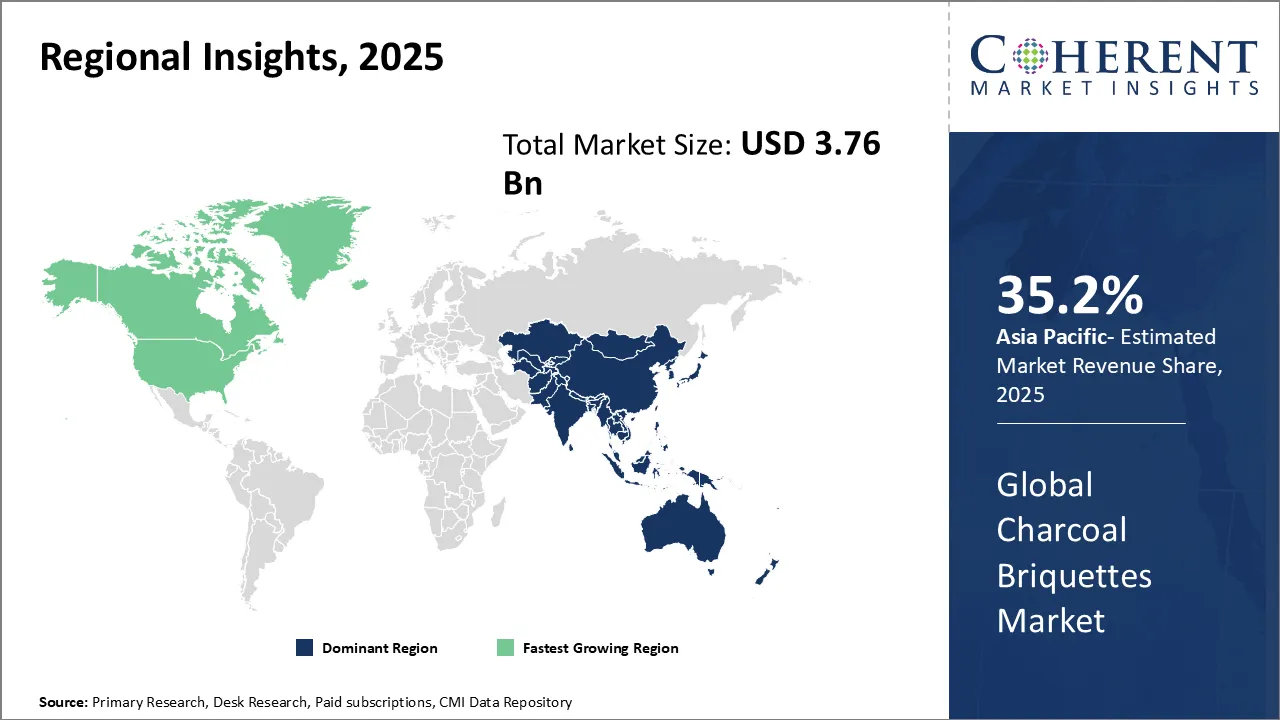
Asia Pacific Charcoal Briquettes Market Analysis and Trends
The Asia Pacific region is projected to lead the market with a 35.2% share in 2026, driven by a well-established manufacturing ecosystem, abundant raw material availability, and strong domestic demand. Countries like China, India, and Indonesia have significant forestry resources and agricultural by-products that facilitate large-scale production of briquettes. Government policies promoting sustainable energy alternatives and rural employment schemes further bolster production and consumption.
Additionally, the extensive presence of local and multinational players ensures effective distribution and innovation in product quality. Leading companies such as Nippon Carbon (Japan), PT Aboitiz Power (Indonesia), and Evergreen Fuel (India) contribute by leveraging efficient supply chains and investing in R&D to improve briquette combustibility and emissions standards. Moreover, the region benefits from robust export infrastructure, supporting trade both intra-regionally and globally.
North America Charcoal Briquettes Market Analysis and Trends
The North America region is expected to exhibit the fastest growth in the market contributing 21.5% share in 2026, driven by the increasing demand for outdoor grilling, barbecuing, and recreational cooking. This region also benefits from a growing preference for clean-burning fuels, sustainability concerns, and convenience in food preparation. The market is supported by a strong retail infrastructure and the popularity of barbecue culture, particularly in the U.S. There is also a notable trend towards premium charcoal briquettes, including those made from natural or sustainably sourced materials.
Government policies promoting sustainability and environment-friendly products have contributed to the adoption of eco-friendly charcoal alternatives. Additionally, rising awareness regarding the environmental impacts of traditional charcoal has led to a shift towards briquette-based products, which offer cleaner combustion and lower carbon footprints.
Global Charcoal Briquettes Market Outlook for Key Countries
China Charcoal Briquettes Market Trends
China’s charcoal briquettes market is underscored by its massive industrial base and government emphasis on reducing reliance on fossil fuels through renewable biomass energy policies. The country’s extensive forestry and agricultural sectors provide sufficient raw materials for charcoal briquette production. Companies such as Nippon Carbon and Shanxi Jiexing New Material enhance the market by employing advanced technological processes to boost briquette efficiency and environmental compliance. China's export capabilities also influence global trade flows, making it a central hub in the briquettes supply chain.
India Charcoal Briquettes Market Trends
India's charcoal briquettes market is driven by widespread rural demand for cleaner cooking fuels and increasing urban consumer interest in eco-friendly alternatives to conventional charcoal and firewood. Government schemes like the National Biomass Cookstoves Program intensify focus on briquettes as a cost-effective and sustainable fuel option. Major players like Evergreen Fuel and Eco Green Energy are instrumental in expanding production capacity and distribution networks while promoting awareness. The market is also influenced by abundant agricultural residues utilized as raw materials, supporting both domestic needs and export markets.
U.S. Charcoal Briquettes Market Trends
The U.S. charcoal briquettes market is shaped by rising outdoor recreational activities such as grilling and barbequing, where charcoal briquettes are preferred for convenience and performance. Additionally, growing environmental consciousness among consumers shifts demand towards sustainably sourced briquettes with low emissions. Domestic companies like Big Green Egg and Royal Oak contribute significantly by offering premium briquette products and investing in eco-friendly manufacturing processes. The US import market supplements raw material shortages with quality imports from Asia and Latin America, strengthening supply diversity.
Brazil Charcoal Briquettes Market Trends
Brazil continues to lead in the use of biomass resources, leveraging its vast forestry and agricultural residues to produce charcoal briquettes primarily for industrial and household consumption. The country benefits from government support aimed at promoting bioenergy within the energy mix to lower carbon emissions. Local companies such as Carvão Vale and Greenfire Bioenergy are associated with innovations in briquette formulations that improve energy density and reduce smoke emissions. The country's strong export orientation also facilitates trade relationships across Latin America and beyond, enhancing market penetration.
South Africa Charcoal Briquettes Market Trends
South Africa’s charcoal briquettes market is characterized by a growing shift toward sustainable and affordable household energy solutions amidst widespread energy challenges. Government policies supporting alternative energy adoption and community-level biomass projects help stimulate demand for briquettes. Key players like African Carbon & Energy Group and Greenheat Energy focus on localized production and distribution, addressing energy needs in underserviced areas. Trade within the Southern African Development Community (SADC) further opens regional market access while promoting responsible charcoal consumption.
Macroeconomic Factors
- Economic Growth & Disposable Income: Rising disposable incomes—especially in emerging economies—enable consumers to afford higher-quality, eco-friendly fuels, boosting the demand for charcoal briquettes by positioning them as a premium product compared to traditional charcoal.
- Urbanization & Industrialization: Rapid urbanization and expanding industrial activity increase the need for efficient and cleaner cooking and heating solutions are driving greater adoption of charcoal briquettes in both residential and commercial sectors.
- Government Policy & Environmental Regulations: Policies promoting renewable energy and restricting unsustainable charcoal production push producers toward sustainable practices and can incentivize the use of briquettes through subsidies, thus propelling market growth
Microeconomic Factors
- Consumer Awareness & Preferences: Increased awareness of environmental benefits, such as lower emissions and sustainable sourcing, pushes consumers and commercial buyers toward charcoal briquettes over traditional fuels.
- Pricing & Cost Competitiveness: The presence of low-cost, low-quality alternatives and competition from other fuels (e.g., LPG, natural gas) can suppress premium segment growth. Market education is key to differentiating higher-quality, eco-friendly briquettes.
- Production Efficiency & Technology: Innovations in briquette manufacturing technologies, use of sustainable raw materials, and supply chain efficiency directly impact production costs and product quality—driving competitive differentiation and consumer appeal.
Market Players, Key Development, and Competitive Intelligence
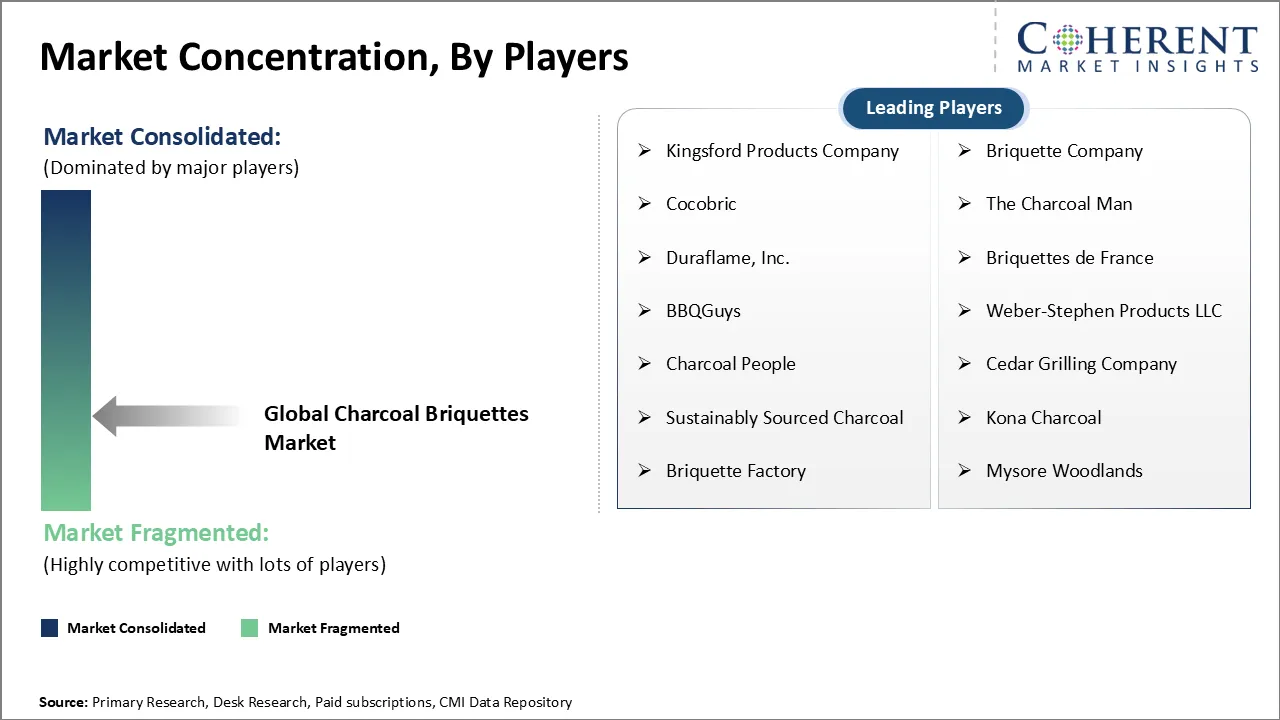
Key Developments
- In July 2025, Duraflame reported a devastating fire at the W.W. Wood Inc. production plant in Pleasanton, U.S., which is a key supplier of cooking wood fuel. The fire caused significant damage to the facility, disrupting production and potentially impacting Duraflame's supply chain. This incident underscores the vulnerability of manufacturing plants to unforeseen disasters, and its resolution will be critical for Duraflame's operations and its ability to meet market demands.
- In January 2025, Piramal Pharma Limited successfully converted the coal-fired steam boiler at its Digwal facility to run on biomass briquettes, advancing its decarbonization efforts. This conversion supports the company's goal to reduce Scope 1 and 2 GHG emissions by 42% by 2030, eliminating around 24,000 tonnes of CO2e annually, which represents 17% of its total emissions.
Top Strategies Followed by Global Charcoal Briquettes Market Players
- The global charcoal briquettes market is marked by a diverse competitive landscape where players of varying scales adopt distinct strategies to strengthen their foothold. Established market leaders typically invest heavily in research and development (R&D) to innovate high-performance products that meet evolving consumer demands and environmental standards.
- For instance, Kingsford Products Company has pioneered the development of charcoal briquettes that provide better heat retention, lower ash production, and are made using sustainably sourced wood. Its continuous innovation ensures it stay competitive by meeting evolving environmental and regulatory demands.
- Mid-level players in the charcoal briquettes market occupy a competitive niche by focusing on cost-effective solutions that strike a balance between quality and affordability. They primarily target price-sensitive consumers, including small retailers, local restaurants, and rural households, who seek reliable products without premium pricing. To maintain competitiveness, mid-level companies actively engage in collaborations and partnerships that allow them to enhance production capabilities and adopt improved technologies without incurring prohibitive costs. These alliances may include joint ventures with raw material suppliers, technology licensors, or regional distributors that help scale operations and expand market reach efficiently.
- For example, BioBriquettes, a startup, produces eco-friendly charcoal made from agricultural waste, offering an environmentally sustainable option to consumers. These specialized offerings allow small players to target niche segments, such as environmentally conscious consumers or those seeking alternative biomass products.
- Small-scale players, though limited in resources compared to industry giants, carve out their niche by emphasizing specialized product features or innovations that differentiate them from mainstream offerings. This might include developing eco-friendly briquettes made from unconventional biomass, experimenting with unique shapes or sizes to appeal to specific end-users, or creating products designed for particular applications such as BBQ grilling or heating.
- For example, Weber-Stephen Products LLC, a subsidiary of Weber Inc., is an established player in the global charcoal briquettes market with its premium Weber Briquettes product line. These briquettes are made from 100% natural hardwood charcoal and are completely free from added chemicals, making them a clean and safe fuel option for grilling. They are designed to provide consistent and long-lasting heat, often maintaining a steady burn for up to three hours, which makes them suitable for both quick grilling and extended cooking sessions.
Market Report Scope
Charcoal Briquettes Market Report Coverage
| Report Coverage | Details | ||
|---|---|---|---|
| Base Year: | 2025 | Market Size in 2026: | USD 3.99 Bn |
| Historical Data for: | 2020 To 2024 | Forecast Period: | 2026 To 2033 |
| Forecast Period 2026 to 2033 CAGR: | 6.0% | 2033 Value Projection: | USD 5.99 Bn |
| Geographies covered: |
| ||
| Segments covered: |
| ||
| Companies covered: | Kingsford Products Company, Briquette Company, Cocobric, The Charcoal Man, Duraflame, Inc., Briquettes de France, BBQGuys, Weber-Stephen Products LLC, Charcoal People, Cedar Grilling Company, Sustainably Sourced Charcoal, Kona Charcoal, Briquette Factory, and Mysore Woodlands | ||
| Growth Drivers: |
| ||
| Restraints & Challenges: |
| ||
Charcoal Briquettes Market Dynamics
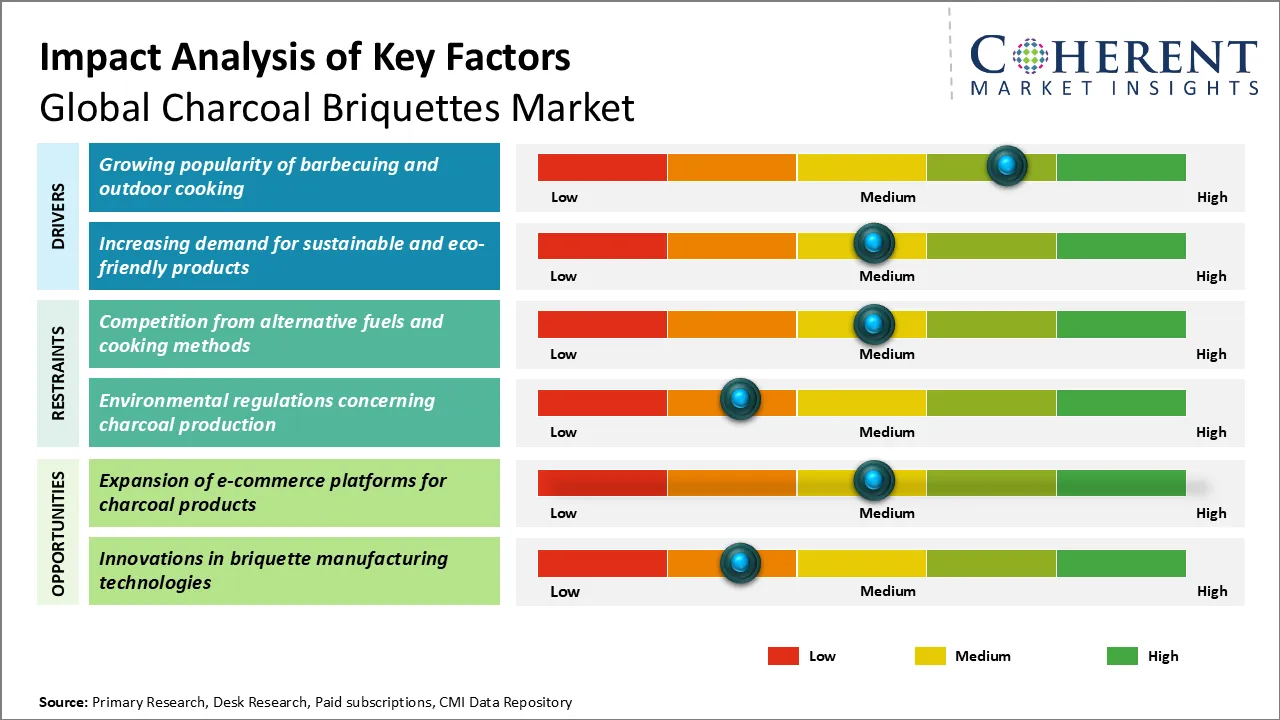
Charcoal Briquettes Market Driver - Growing Popularity of Barbecuing and Outdoor Cooking
The expanding enthusiasm for barbecuing and outdoor cooking has significantly contributed to the rising demand for charcoal briquettes globally. As more consumers seek social, recreational, and culinary experiences centered around outdoor gatherings, the use of charcoal briquettes as a preferred fuel source has surged. This trend is driven by a cultural shift toward enjoying food preparation in open-air settings, where charcoal briquettes provide an easy-to-use, consistent, and flavorful heat source that enhances the taste of grilled foods.
For instance, in the U.S., the National Barbecue Association (NBBQA) reports that over 75% of U.S. households own a grill, and approximately 60% of those households use it for barbecuing at least once a month during the summer months. This has led to a steady increase in demand for charcoal briquettes as consumers seek consistent, easy-to-use, and flavorful fuel options.
Charcoal Briquettes Market Opportunity - Expansion of E-commerce Platforms for Charcoal Products
The rapid expansion of e-commerce platforms presents a significant opportunity for the global charcoal briquettes market. With increasing internet penetration and the proliferation of smartphones across both developed and emerging markets, consumers now have easier access to online marketplaces where charcoal briquettes and related products can be conveniently purchased. E-commerce channels enable manufacturers and suppliers to reach a broader and more diverse customer base beyond traditional retail outlets, including direct-to-consumer sales models that reduce intermediaries and improve profit margins.
In India, platforms like Flipkart and BigBasket have begun offering charcoal briquettes, tapping into the growing urban demand for outdoor cooking products. With a large base of consumers interested in grilling and barbecuing, these platforms provide convenient home delivery options, making it easier for customers to access premium charcoal products at competitive prices.
Analyst Opinion (Expert Opinion)
- The global charcoal briquettes market is undergoing a notable transformation, fueled by rising consumer interest in sustainable and eco-friendly grilling options. Insights from the International Biomass Conference (2023) and the Global Charcoal Summit (2022) highlighted the increasing adoption of coconut shell and hardwood briquettes as alternatives to traditional charcoal, aligning with environmental sustainability goals.
- Companies like Royal Oak and Fogo Charcoal are leading this shift, with Royal Oak's recent product line featuring sustainably sourced materials that cater to eco-conscious consumers. Discussions at these conferences emphasized the importance of certifications and transparency in sourcing, which are vital for building consumer trust. Furthermore, the growing trend toward outdoor cooking and barbecuing has spurred demand, particularly in regions like North America and Europe.
- The challenges such as supply chain disruptions and competition from alternative fuels were noted, necessitating strategic innovation. Companies focusing on product differentiation, such as flavor-infused briquettes and eco-friendly packaging, will likely capture a larger market share. Ultimately, the charcoal briquettes market's growth will hinge on its ability to adapt to consumer preferences while promoting sustainable practices in production and sourcing.
Speak to the analyst
Want personalized insights?
Take the findings above to one of our principal consultants, or have the report rebuilt around the segments, geographies and competitors you actually track.
Sources
Primary Research Interviews
- Market Analyst – Leading Charcoal Briquette Manufacturer
- Procurement Officer – Major Retailer of Charcoal Products
- Sustainability Officer – Certification Body for Eco-friendly Charcoal
- Production Head – Top Charcoal Briquette Supplier
Stakeholders
- Manufacturers
- End-use Sectors:
- Household (BBQ, Cooking, Heating)
- Industrial Applications (Steel Production, Foundries)
- Catering & Hospitality Industry
- Eco-conscious Consumers for Sustainable Charcoal Options
- Regulatory & Certification Bodies
- E-commerce Platforms and Retailers
- Technology Providers – Innovations in Charcoal Production and Sustainability
Databases
- UN Comtrade Database
- India Import Export (EXIM) Database
Magazines
- Sustainable Energy & Environmental Business – Charcoal Production and Sustainability Trends
- Industrial Fuel Today – Innovations in Briquette Manufacturing
- The Charcoal & Biomass Industry Journal – Market Updates on Charcoal Briquettes
- Green Business Journal – Consumer and Environmental Impact of Charcoal Usage
- Global Renewable Fuels – Focus on Charcoal as a Renewable Fuel Source
Journals
- Journal of Clean Energy Technologies – Sustainability in Charcoal Briquette Production
- Renewable & Sustainable Energy Reviews – Environmental Impact of Charcoal Production
- Journal of Industrial Ecology – Charcoal as an Alternative Fuel for Industry
- Energy & Fuels – The Role of Charcoal in Energy Conversion Processes
- Waste and Biomass Valorization – Biomass Conversion to Charcoal Briquettes
Newspapers
- The Financial Times – Charcoal Market Growth & Environmental Impact Analysis
- The Guardian – Sustainable Charcoal Production & Eco-friendly Trends
- Asia Energy Journal – Charcoal Industry Development in the Asia-Pacific Region
- European Fuel Business News – Charcoal Briquette Regulations & Market Dynamics
Associations
- International Charcoal Producers Association (ICPA)
- World Charcoal Association (WCA)
- National Biomass and Bioenergy Association
- European Biomass Association (AEBIOM)
- Sustainable Biomass Program
- The Carbon Trust – Certification for Sustainable Charcoal Production
Public Domain Sources
- U.S. FDA – Guidelines on Charcoal as a Food Additive and Safety Standards
- European Commission – Charcoal Briquette Regulations and Sustainability Criteria
- World Health Organization (WHO) – Health & Safety Guidelines for Charcoal Usage
Proprietary Elements
- CMI Data Analytics Tool, Proprietary CMI Existing Repository of information for last 8 years.
Get access to 250+ pages report
Every segment, forecast, competitor profile and data table behind the analysis above — available for instant download.
- ESOMAR Member
- ISO 9001:2015 Certified
- D-U-N-S Registered
- GDPR & CCPA Compliant
Missing comfort of reading report in your local language? Find your preferred language:
Transform your Strategy with Exclusive Trending Reports
Frequently Asked Questions
The global charcoal briquettes market is estimated to be valued at USD 3.99 Bn in 2026 and is expected to reach USD 5.99 Bn by 2033.
The CAGR of global charcoal briquettes market is projected to be 6.0% from 2026 to 2033.
Growing popularity of barbecuing and outdoor cooking and increasing demand for sustainable and eco-friendly products are the major factors driving the growth of the global charcoal briquettes market.
Competition from alternative fuels and cooking methods and environmental regulations concerning charcoal production are the major factors hampering the growth of the global charcoal briquettes market.
In terms of product type, natural charcoal briquettes are estimated to dominate the market revenue share in 2026.
Kingsford Products Company, Briquette Company, Cocobric, The Charcoal Man, Duraflame, Inc., Briquettes de France, BBQGuys, Weber-Stephen Products LLC, Charcoal People, Cedar Grilling Company, Sustainably Sourced Charcoal, Kona Charcoal, Briquette Factory, and Mysore Woodlands are the major players.
Asia Pacific is expected to lead the global charcoal briquettes market in 2026.