

Global Charging as a Service Market and Forecast: 2026 to 2033
The Global Charging as a Service Market is estimated to be valued at USD 468.8 Mn in 2026 and is expected to reach USD 2,235.2 Mn by 2033, exhibiting a compound annual growth rate (CAGR) of 25.0% from 2026 to 2033.
Key Takeaways of the Global Charging as a Service Market
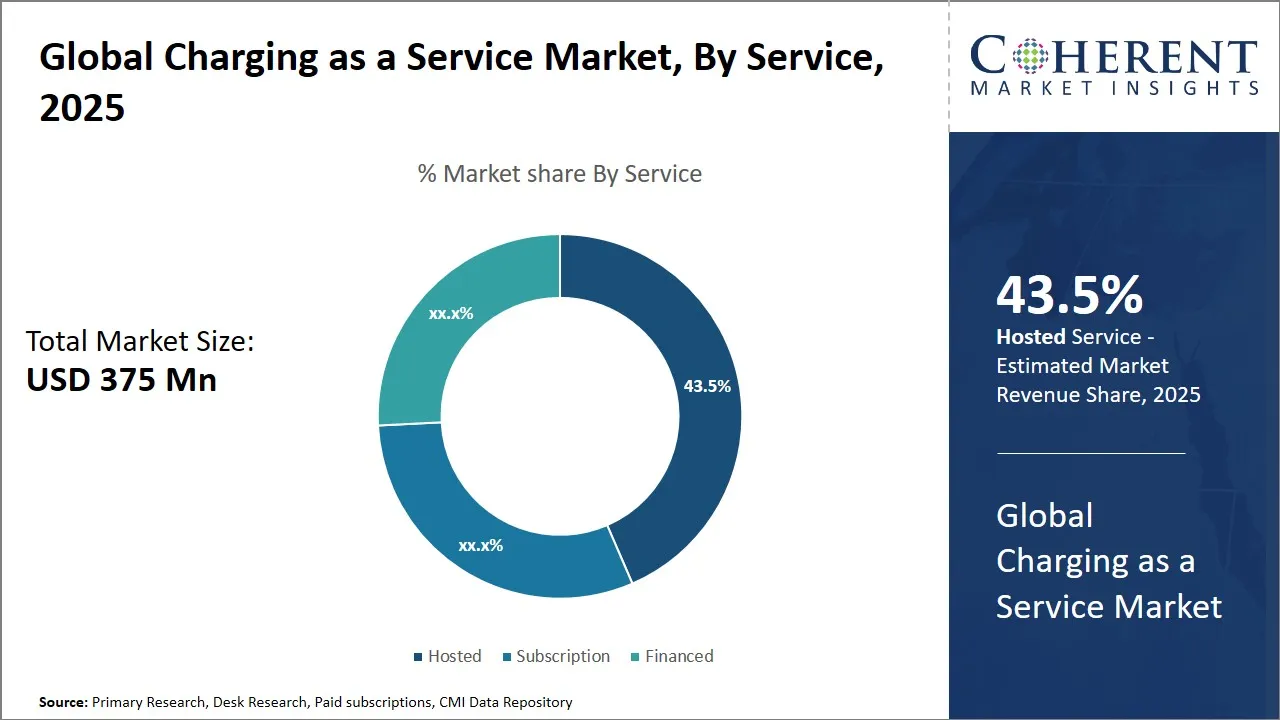
- The hosted segment is expected to lead the market holding a share of 44.5% in 2026.
- The AC charging segment is projected to hold a prominent market share of 52.9% in 2026.
- The commercial segment is projected to hold a prominent market share of 53.6% in 2026.
- Asia Pacific, expected to hold a share of 31.8% in 2026, dominates the market.
- Europe is expected to be the fastest growing regional market with a share of 28.9% in 2026.
Market Overview
The rapid rise of the global charging as a service market reflects growing electric vehicle use, alongside a pressing demand for reliable and widespread charging networks. Advancements in technology fuel this growth, while favorable regulations play a key role; at the same time, public interest in eco-friendly transport options continue to climb.
Nowadays, markets show growing use of smart chargers to better manage power usage while cutting expenses. Because of this, pay-per-use setups are spreading fast due to teamwork between car makers, energy firms, and builders. At the same time, progress in cordless and high-speed charging is getting more attention, meeting user needs for speed and ease. With cities expanding quickly, there’s stronger push toward flexible, compatible charging systems; these changes attract funding and new ideas into the charging-as-a-service space.
Current Events and Its Impact
Current Events | Description and their Impact |
NAAS Technology Network Expansion |
|
TATA Motors Expansion Plans |
|
Segmental Insights
- Current Industry Events of 2026
- Market Size Estimation
- Regional Breakdown
- Competitive Landscape
- Customer Intelligence
- Segmental Analysis
- Pricing Analysis
- Key Market Drivers, Challenges & Future Trends
- Customized Insights Section
Global Charging as a Service Market Insights, By Service – Hosted Segment Leads Driven by Operational Efficiency and Scalability
In terms of service, hosted is expected to contribute the highest share of 44.5% in the global charging as a service market mainly because it boosts performance while growing easily for companies and customers alike. Instead of handling hardware directly, charging solutions are managed by outside experts via online systems so providers can offer smooth experiences minus the hassle of upkeep. As a result, initial costs drop sharply, which matters greatly for cities and organizations wary of big bets on new EV tech.
A second factor behind the hosted segment's lead is its adaptability. While offering live tracking, off-site troubleshooting, and wireless upgrades, these systems let managers quickly fix problems while improving station output. With strong data tools included, they also predict usage trends and balance power use wisely which is important due to inconsistent EV charging demands. Such hands-on management boosts dependability along with user experience, so hosted options remain appealing.
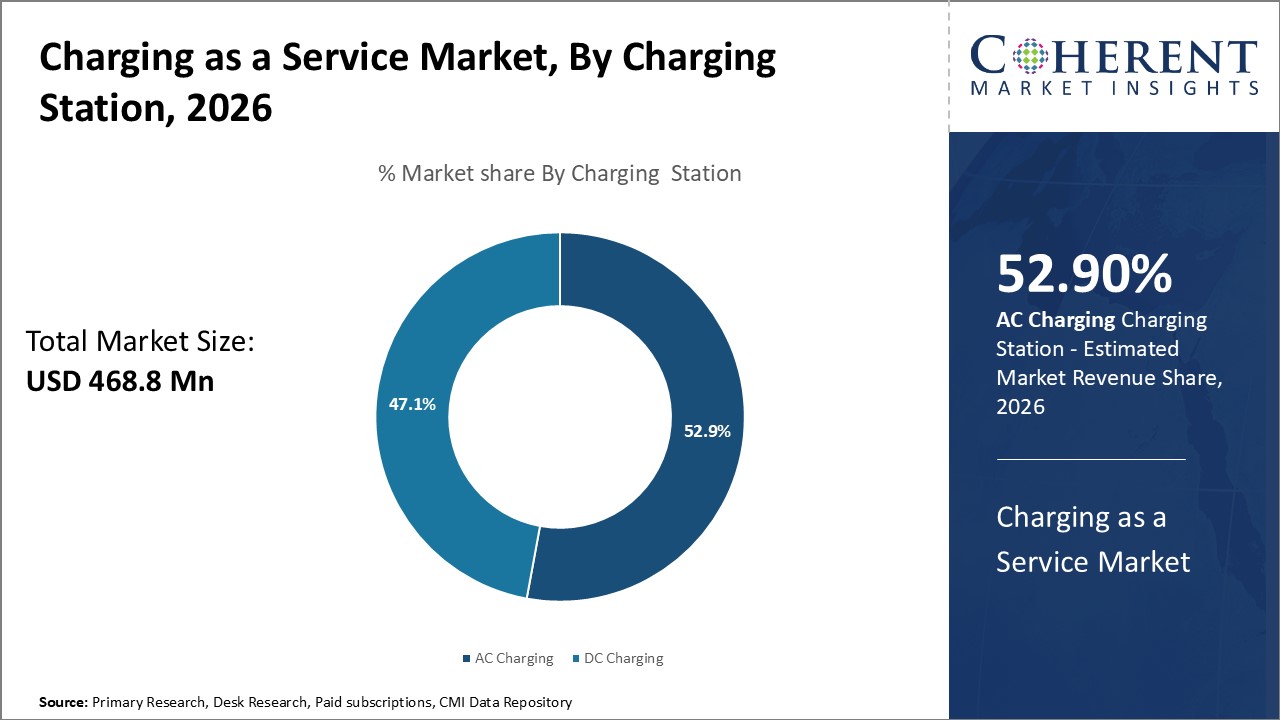
Global Charging as a Service Market Insights, By Charging Station – AC Charging Stations is Leading the Market Through Ubiquity and Cost-Effectiveness
Within the global charging as a service market segmentation by charging station, the AC charging segment is projected to command the highest market share of 52.9% in 2026, owing to broad usage stemming from affordability and ease of access. In alignment with current power systems, AC chargers provide moderate charging rates which is adequate for typical daily demands. Where cars stay plugged in for extended periods, like homes or offices, they perform well. As a result, many electric vehicle users and fleet operators find this option both sensible and user-friendly.
One key reason AC charging stations are growing is their lower setup and running expenses when compared to DC fast chargers. Because they use alternating current, these units link directly to existing power networks - avoiding costly grid modifications needed for f. Their cost efficiency makes it easier for companies, landlords, and local governments to adopt electric vehicle infrastructure without overspending.
For instance, on April 10, 2025, ChargePoint, known for its EV charging networks, introduced a major upgrade in AC Level 2 tech. This next-gen design includes breakthrough features like reverse power flow; performance may reach twice today’s standard units. New models support faster energy transfer while enabling vehicle-to-grid use through advanced circuitry. Each unit integrates smarter software - improving reliability across diverse settings.
Global Charging as a Service Market Insights, By Application – Commercial Applications Experience Superior Demand and Growth through Strategic Deployment
The commercial segment is expected to dominate the market with a share of 53.6% in 2026. Commercial charging application lead the global charge-as-a-service market because heavy-duty EV power needs cluster in areas like shops, hotels, delivery services, also transit networks. Business uptake grows as more company vehicles go electric and urban buses shift to batteries. With chargers often set up in busy zones, users can plug in quickly and keep moving.
A key reason behind growth in business sectors is linking charger investments to eco-friendly targets along with legal demands. Firms and city authorities now openly pledge cuts in carbon output, moving toward greener transit options. Setting up public chargers backs such aims and also draw clients and staff who value sustainability. As a result, more enterprises focus on fast rollout of charging points at workplaces and service areas.
Subscription & Pricing Model Benchmark
Pricing Model | Target Customers | Cost Structure |
Pay-per-Use (PPU) | Public EV users, small businesses, retail locations. | Per kWh, per session, or time-based rates. |
Fleet Subscription | Logistics fleets, last-mile delivery, ride-hailing, corporate fleets. | Predictable OPEX, dedicated charging access, managed operations. |
Energy-as-a-Service (EaaS) | Large enterprises, OEMs, commercial real estate, utilities. | Long-term contracts; subscription + energy optimization fees. |
Charging Bundles with Vehicles | Individual buyers, fleets, OEM customers. | Monthly add-on fee or bundled in vehicle price. |
Charger reliability & uptime benchmarking
Reliability Metric | Target Benchmark (%) | Real ‑ World Data (%) |
Uptime | 97–99% | 99% uptime |
True Uptime | 95–97% | 84% |
First-Time Charge Success | 90% | 71% |
Technical Success Rate | 95% | 94.3%-97.2% |
Regional Insights
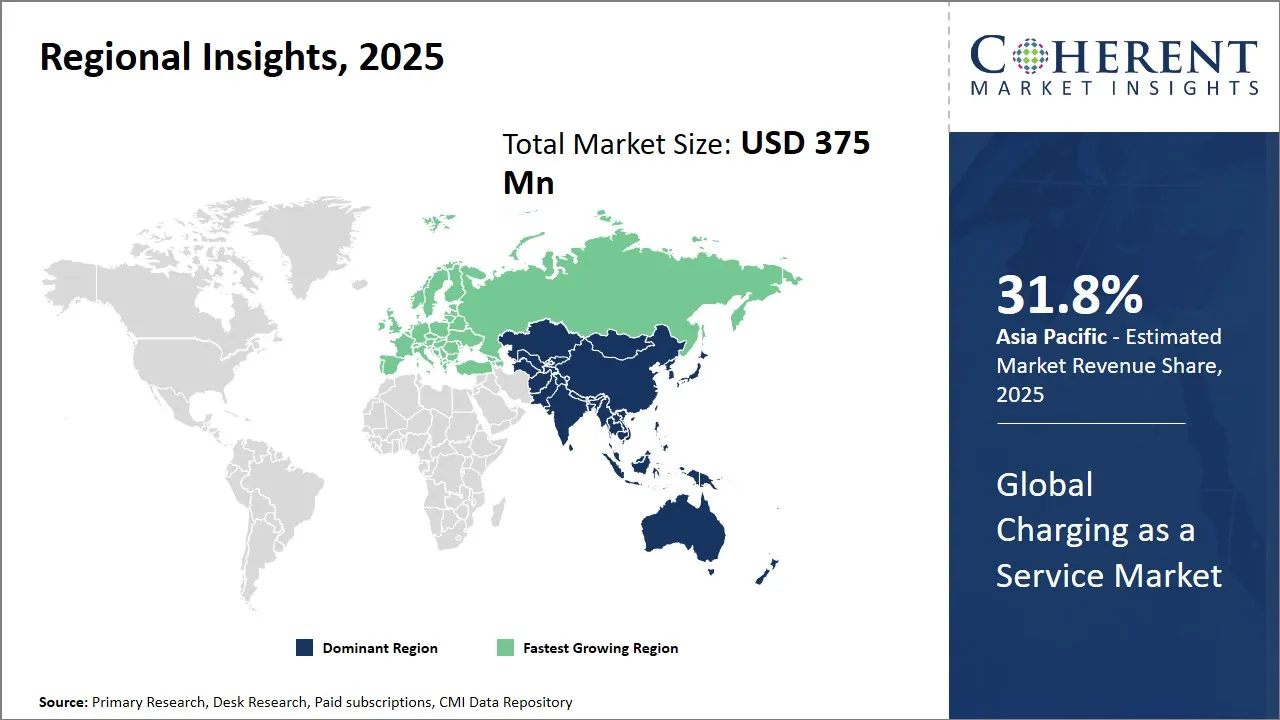
Asia Pacific Charging as a Service Market Analysis and Trends
Asia Pacific is the leader in the global charging as a service Market with an estimated share of 31.8% in 2026. The growth is boosted by fast city growth, rising electric vehicle use, and solid government support - especially in China, India, Japan, and South Korea - the market is expanding quickly. In China, bold moves toward electric transport, backed by buyer incentives and rules for carmakers, fuel major progress in charging as a service. High population density, along with growing public interest in eco-friendly mobility, boosts need for simple, reliable charging access.
Firms such as State Grid Corporation of China, ABB, and Tata Power play key roles in building smarter, wider networks. Meanwhile, new partnerships between tech newcomers and energy veterans lead to fresh solutions - like mobile booking tools and seamless payment systems. Trade rules boosting homegrown charger manufacturing cut expenses, which supports broader rollout. Vehicle electrification climbing, along with favorable laws or solid funding, positions Asia Pacific as a key region for fast CaaS growth.
Europe Charging as a Service Market Analysis and Trends
Europe charging as a service market is expected to exhibit the fastest growth and hold a market share of 28.9% in 2026. The Europe charging as a service market is growing quickly due to faster EV use, backed by firm climate rules, tight emissions goals, and major funding for public and shared charging setups. Growth comes from subscription or usage-based plans which lower initial setup expenses for companies, cities, and fleet managers - offering easier access plus clearer cost control.
Right now, Europe hosts one of the most packed charging environments globally, with rapid-charger routes extending through Western and Northern regions, pushed forward by nations like the Netherlands, Germany, France, Norway, and the UK; at the same time, rising needs from delivery vehicles, ride services, and business transport initiatives boost expansion in hub charging and monitored energy systems.
Global Charging as a Service Market Outlook for Key Countries
U.S. Charging as a Service Market Analysis and Trends
The U.S. market thrives due to a strong setup where many private and public groups push growth. ChargePoint and EV7o lead through wide coverage, whereas Tesla's Supercharger system boosts interest in its electric cars. Tax perks and national support for better facilities speed up development. Meanwhile, growing ties between power firms and tech suppliers strengthen how charging systems connect with the grid.
China Charging as a Service Market Analysis and Trends
China's market sees strong state involvement, alongside wide infrastructure pushes targeting bold electric vehicle goals. While the State Grid runs large-scale efforts to install rapid chargers nationwide, local players including BYD and NIO strengthen system cohesion through bundled car and charging solutions. At the same time, global actors such as ABB bring in new tech and modern service approaches within city hubs.
Germany Charging as a Service Market Analysis and Trends
Germany stays ahead in Europe’s CaaS sector due to its robust auto industry along with forward-looking measures that support EV charging setups. Firms including Siemens plus EnBW work hand-in-hand with automakers like VW or BMW to roll out wide-reaching charge point systems. Support from national and regional authorities helps boost uptake of private and shared chargers across cities. On top of this, Germany's focus on clean power sources strengthens how green the charging solutions really are.
India Charging as a Service Market Analysis and Trends
India's market expansion comes from growing use of electric vehicles, supported by state programs such as FAME along with projects to install city charging stations. Leading this shift are Tata Power and Fortum India, both rapidly deploying high-speed chargers across locations. Partnerships among authorities, power providers, and emerging firms aim at creating connected systems that simplify access for users. At the same time, more funding flows into clean energy sources, enabling eco-friendly vehicle charging options.
South Korea Charging as a Service Market Analysis and Trends
South Korea's charging sector benefits from high-tech capabilities along with active government backing. Firms such as Hyundai ChargeON or KEPCO lead development, combining smart grids into their networks. Public initiatives focus on cutting emissions by encouraging electric transport use, which boosts demand for flexible solutions - like shared plans across brands.
Market Players, Key Development, and Competitive Intelligence
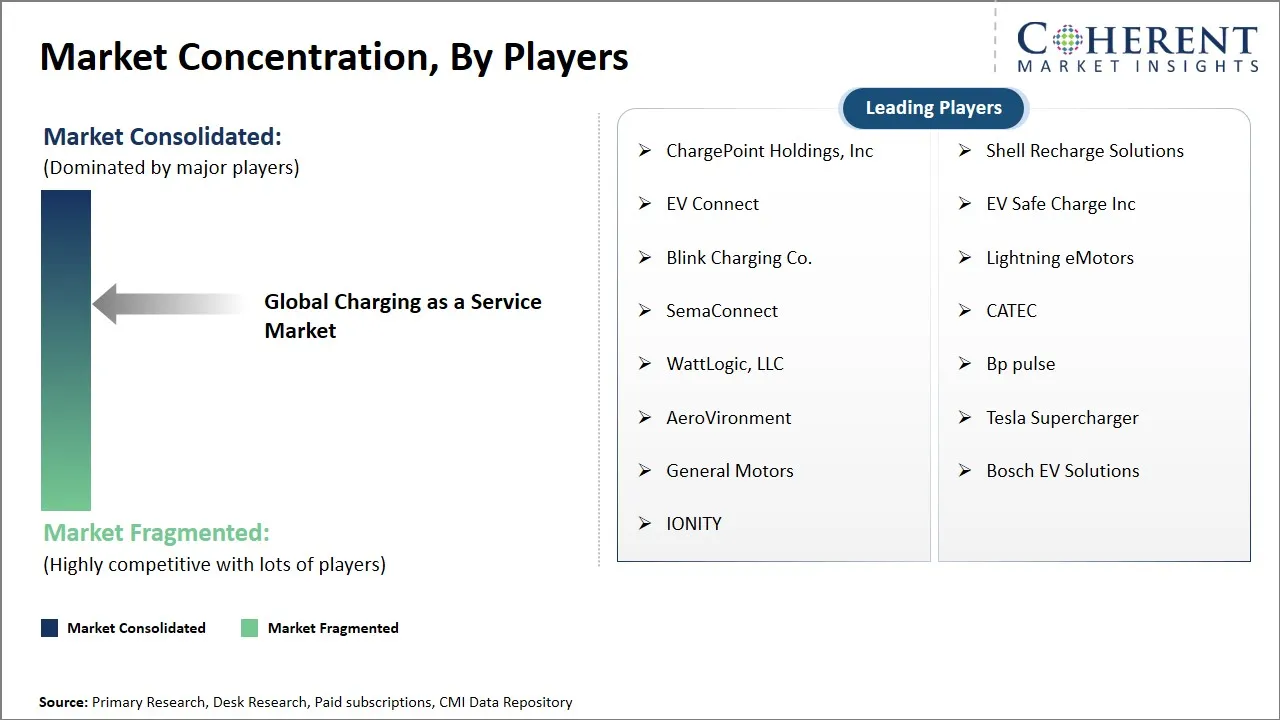
Key Developments
- On July 2, 2025, ChargePoint introduced its new Flex Plus Charger. Alongside this device, the company offers a management tool that tracks employee charging at home - then processes payments automatically. It also supports drivers who charge in public areas while giving fleet managers clear insights into overall usage patterns through integrated reporting features.
- On October 4, 2024, Siemens introduced the new SICHARGE FLEX range - its latest EV charging solution built for flexibility, durability, and cost-efficiency, suitable across multiple applications through scalable design.
Top Strategies Followed by Charging as a Service Market Players
- The global charging as a service market features many different firms using varied approaches to grow and gain advantage. While some focus on R&D to create advanced charging solutions, others aim to align with EV user demands more closely. Leading names set themselves apart by investing heavily in innovation to launch efficient products. Instead of going solo, they team up with OEMs or key sector actors - this strengthens their position. Such alliances also help stabilize sourcing and distribution networks over time.
- On September 30, 2025, Bp pulse announced a new collaboration with Moto, the UK’s largest motorway services operator. The collaboration aims to roll out electric truck charging on major UK routes.
- In contrast, mid-level firms in the CaaS sector usually aim for affordable options that still maintain solid performance. Because more budget-conscious customers and fleet managers are emerging, these businesses adjust their services to offer dependable charging at fair prices. Instead of high-end features, they work with tech developers or manufacturers to strengthen operations - improving output speed and adopting new tools faster. These joint efforts help them reach wider markets while gaining advanced know-how and intelligence that would be harder alone.
- Smaller companies find space in the worldwide CaaS sector by targeting unique functions or fresh, sometimes trial-based solutions - setting themselves apart from major brands. Instead of broad appeal, they use advanced tools like smart charge controls, green power links, or rapid charging tech to stay relevant even with fewer funds. In addition, partnerships with emerging ventures, area producers, or innovation hubs help boost recognition and access particular regions or user groups.
Market Report Scope
Global Charging as a Service Market Report Coverage
| Report Coverage | Details | ||
|---|---|---|---|
| Base Year: | 2025 | Market Size in 2026: | USD 468.8 Mn |
| Historical Data for: | 2020 To 2024 | Forecast Period: | 2026 To 2033 |
| Forecast Period 2026 to 2033 CAGR: | 25.0% | 2033 Value Projection: | USD 2,235.2 Mn |
| Geographies covered: |
| ||
| Segments covered: |
| ||
| Companies covered: | ChargePoint Holdings, Inc, Shell Recharge Solutions, EV Connect, EV Safe Charge Inc, Blink Charging Co., Lightning eMotors, SemaConnect, CATEC, WattLogic, LLC, Bp pulse, AeroVironment, Tesla Supercharger, General Motors, Bosch EV Solutions, and IONITY | ||
| Growth Drivers: |
| ||
| Restraints & Challenges: |
| ||
Market Dynamics
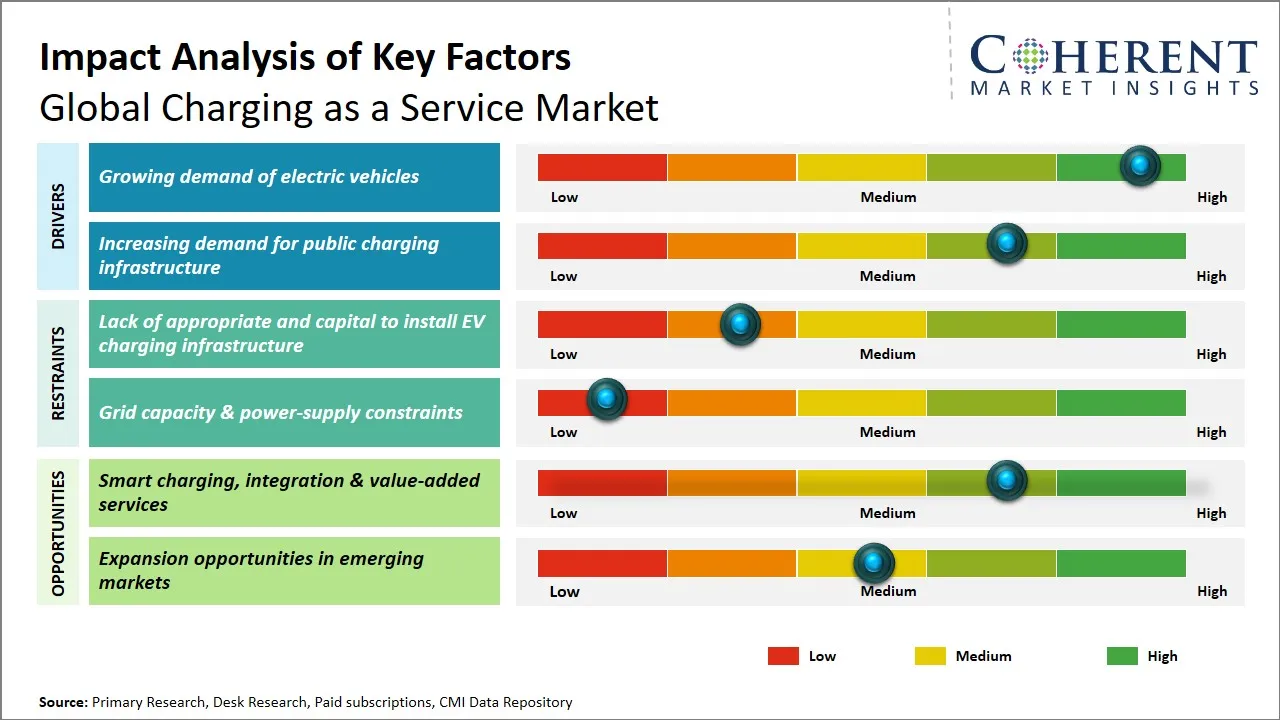
Global Charging as a Service Market Driver - Growing Demand of Electric Vehicles
The rapid rise in global electric vehicle use is strongly boosting demand for charging as a service. Because more people and policies now favor eco-friendly transport, EV numbers are climbing fast. So reliable, widespread charging options must follow. Owning and running charge points the old way usually means big initial expenses and ongoing technical hassles. CaaS stands out by offering flexible networks where users only pay when they plug in.
Instead of handling hardware themselves, customers gain smooth access via subscriptions or instant-use setups, removing major obstacles for drivers and companies alike. Moreover, the expanding variety and complexity of electric vehicle batteries require smarter, more connected charging systems, ones that CaaS companies are especially equipped to offer. Because of this shift, higher interest in EVs goes hand-in-hand with greater funding and advancements in the charging as a service market, supporting steady growth and ongoing development.
Global Charging as a Service Market Opportunity – Smart Charging, Integration & Value-added Services
The rise of smart charging technology presents strong potential to the global charging as a service market. Since EV use is growing fast, better, flexible, and people-focused charging methods are needed more than ever. Instead of fixed schedules, smart systems adjust timing and power based on supply limits, pricing, or driver choices - cutting expenses while easing pressure on electricity networks. When linked with renewables and battery storage, these setups become even cleaner, meeting both policy demands and public interest in eco-friendly mobility.
Moreover, extra features like live data analysis, forecast-based upkeep, or tailored dashboards are now commonly added to CaaS packages - boosting satisfaction while opening fresh income paths for vendors. Compatibility between intelligent chargers and V2G systems, along with networked gadgets, supports a tighter, more adaptable power network. Partnerships among car makers, energy suppliers, and tech firms push forward unified platforms enabling smooth electricity trades plus insights from collected information. Such progress improves performance - not just allowing players to benefit from evolving approaches like peer-to-peer energy exchange or dynamic load control - but placing smart charging solutions ahead of others in the CaaS space
Analyst Opinion (Expert Opinion)
- The global charging as a service market is moving into rapid expansion, driven by faster electric vehicle uptake in North America, Europe, while also spreading through parts of Asia Pacific, prompting officials and businesses to explore adaptable, expandable infrastructure options. Charging via subscription models represents a logical next step within the EV landscape since it turns stations from costly equipment buys into managed services paid over time, much like what occurred earlier with internet-based platforms or ride-sharing setups.
- Market dynamics are shifting due to advances in software, smarter energy systems, while collaborations among carmakers, power providers, charging networks also play a role. However, obstacles such as strain on electrical grids and expensive fast-charging setups could delay uptake in some areas.
Speak to the analyst
Want personalized insights?
Take the findings above to one of our principal consultants, or have the report rebuilt around the segments, geographies and competitors you actually track.
Market Segmentation
- Service Insights (Revenue, USD Mn, 2021 - 2033)
- Hosted
- Subscription
- Financed
- Charging Station Insights (Revenue, USD Mn, 2021 - 2033)
- AC Charging
- DC Charging
- Application Insights (Revenue, USD Mn, 2021 - 2033)
- Commercial
- Residential
- Regional Insights (Revenue, USD Mn, 2021 - 2033)
- North America
- U.S.
- Canada
- Latin America
- Brazil
- Argentina
- Mexico
- Rest of Latin America
- Europe
- Germany
- U.K.
- Spain
- France
- Italy
- Russia
- Rest of Europe
- Asia Pacific
- China
- India
- Japan
- Australia
- South Korea
- ASEAN
- Rest of Asia Pacific
- Middle East
- GCC Countries
- Israel
- Rest of Middle East
- Africa
- South Africa
- North Africa
- Central Africa
- North America
- Key Players Insights
- ChargePoint Holdings, Inc
- Shell Recharge Solutions
- EV Connect
- EV Safe Charge Inc
- Blink Charging Co.
- Lightning eMotors
- SemaConnect
- CATEC
- WattLogic, LLC
- Bp pulse
- AeroVironment
- Tesla Supercharger
- General Motors
- Bosch EV Solutions
- IONITY
Sources
Primary Research Interviews
- EV Charging Infrastructure Providers
- Fleet Management Companies
- Electric Vehicle Manufacturers
- Telecommunications Service Providers
Databases
- Bloomberg New Energy Finance (BNEF)
- IEA Global EV Data Explorer
- S&P Capital IQ
- Pitchbook Database
Magazines
- Electric Vehicle Magazine
- Charging Infrastructure Today
- Fleet Management Weekly
- Smart Grid International
Journals
- Journal of Power Sources
- Transportation Research Part D: Transport and Environment
- Energy Policy Journal
Newspapers
- Financial Times
- The Wall Street Journal
- Reuters
- Bloomberg News
Associations
- CharIN (Charging Interface Initiative)
- Electric Vehicle Association
- International Association of Public Transport (UITP)
- Society of Automotive Engineers (SAE)
Public Domain Sources
- International Energy Agency (IEA) Reports
- U.S. Department of Energy Publications
- European Commission Transport Reports
- National Renewable Energy Laboratory (NREL)
Proprietary Elements
- CMI Data Analytics Tool
- Proprietary CMI Existing Repository of information for last 8 years
Get access to 250+ pages report
Every segment, forecast, competitor profile and data table behind the analysis above — available for instant download.
- ESOMAR Member
- ISO 9001:2015 Certified
- D-U-N-S Registered
- GDPR & CCPA Compliant
Missing comfort of reading report in your local language? Find your preferred language:
Transform your Strategy with Exclusive Trending Reports
Frequently Asked Questions
The global charging as a service market is estimated to be valued at USD 468.8 Mn in 2026 and is expected to reach USD 2,235.2 Mn by 2033.
The CAGR of the global charging as a service market is projected to be 25.0 % from 2026 to 2033.
Growing demand of electric vehicles and increasing demand for public charging infrastructure are the major factors driving the growth of the global charging as a service market.
Lack of appropriate and capital to install EV charging infrastructure and grid capacity & power-supply constraints are the major factors hampering the growth of the global charging as a service market
Which is the leading service in the global charging as a service market?
ChargePoint Holdings, Inc, Shell Recharge Solutions, EV Connect, EV Safe Charge Inc, Blink Charging Co., Lightning eMotors, SemaConnect, CATEC, WattLogic, LLC, Bp pulse, AeroVironment, Tesla Supercharger, General Motors, Bosch EV Solutions, IONITY are the major players.
Asia Pacific is expected to lead the global charging as a service market in 2026.