

Global Combat Management System Market Size and Forecast – 2026 To 2033
The global combat management system market is expected to grow from USD 11.80 Bn in 2026 to USD 48.75 Bn by 2033, registering a compound annual growth rate (CAGR) of 22% from 2026 to 2033. The global combat management system market is driven by the increasing deployment of unmanned and autonomous platforms. On April 5, 2025, Anduril delivered its first Dive-LD autonomous underwater vehicle (AUV) to the U.S. Navy. The Dive-LD was handed over to Unmanned Undersea Vehicle Squadron 1 (UUVRON-1), which is tasked with developing and operating undersea drones for intelligence, surveillance, reconnaissance, and other naval missions. (Source: Connecticut Office of Military Affairs)
Key Takeaways of the Global Combat Management System Market
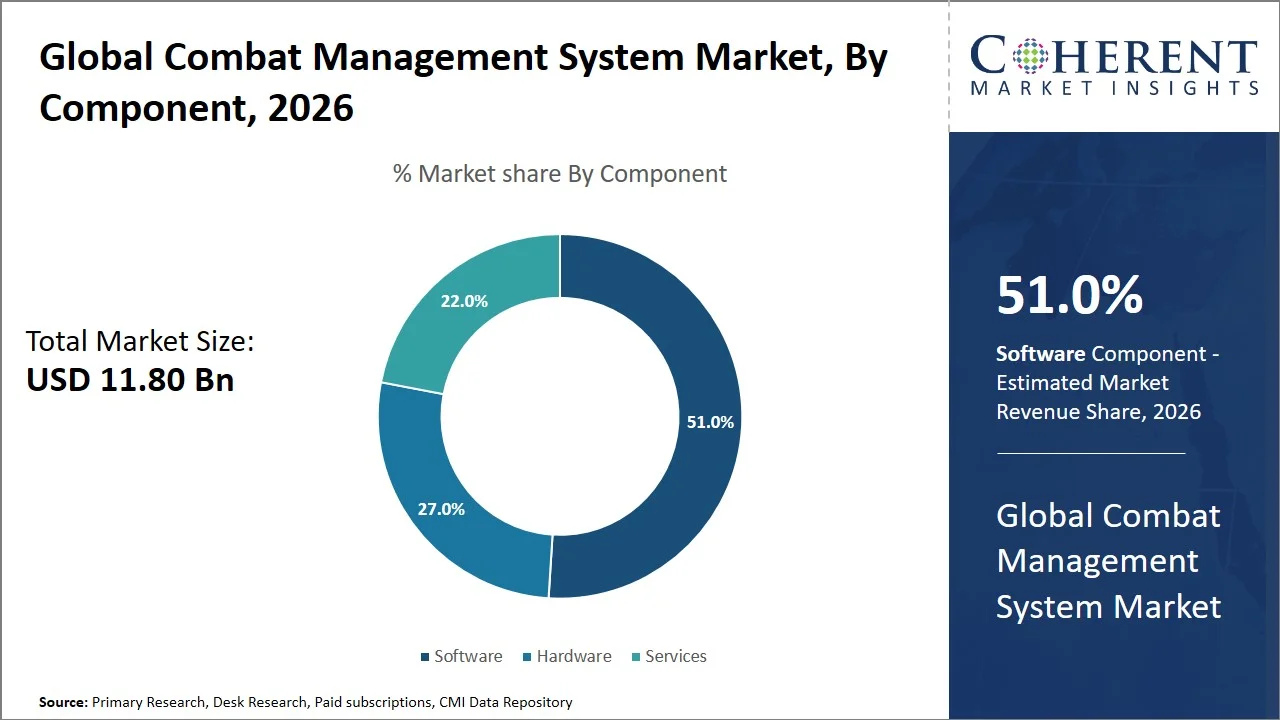
- The software segment is expected to account for 51.0 % of the global combat management system market share in 2026. Growing demand for real-time situational awareness and threat assessment is driving the growth of the software segment. On September 4, 2025, Thales successfully completed Factory Acceptance Tests (FATs) for both the Mission System and the Combat System on the Royal Navy’s new Type 31 Inspiration-class frigates, marking major milestones in one of the U.K.’s most significant naval programs. (Source: Thales)
- The Open Architecture CMS segment is estimated to capture 53.0 % of the market share in 2026. Expansion of multi-domain warfare operations is driving the growth of the segment. On December 18, 2025, Lockheed Martin Skunk Works and XTEND collaborated to integrate the XTEND Operating System (XOS) into Skunk Works' MDCX autonomy platform, allowing simultaneous Command and Control of multiple classes of UAS. (Source: Lockheed Martin)
- The weapon management system segment is estimated to capture 29.0 % of the market share in 2026. Fleet modernization initiatives among major naval forces is a major factor driving the growth of the segment. On April 28, 2026, HII announced that the U.S. Navy awarded its Ingalls Shipbuilding division a USD 283 million contract to perform FF(X) class frigate lead yard support activities. The contract allows Ingalls Shipbuilding to procure long lead time material, execute design work and begin pre-construction activities for the first ship. (Source: HII)
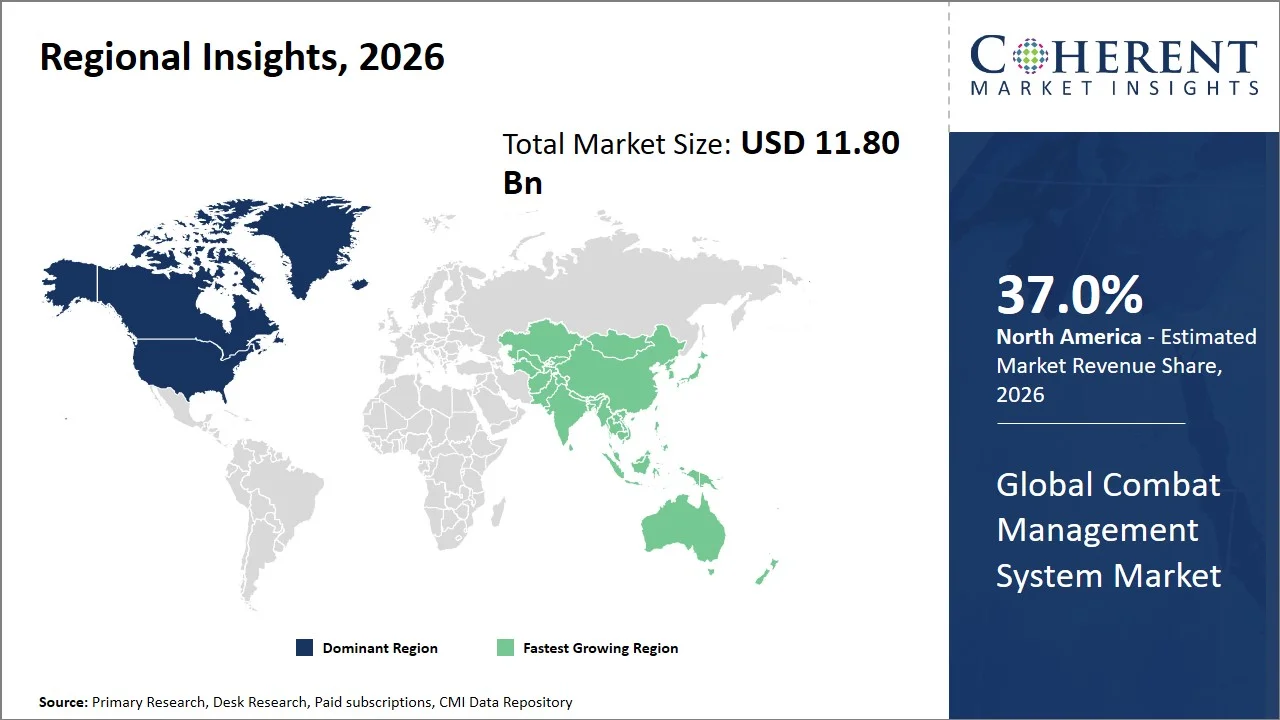
- North America is expected to dominate the combat management system market in 2026 with a market share of 37.0 %. Growing digital transformation of defense command networks in North America is driving the growth of the regional market. On February 25, 2026, CACI International Inc announced that the Spectral program has successfully completed rigorous review by the U.S. Navy’s Program Executive Office for Command, Control, Communications, Computers, and Intelligence (PEO C4I), achieving Milestone C. (Source: CACI)
- Asia Pacific is expected to account for 29.0 % of the market share in 2026 and is projected to record the fastest growth over the forecast period. Growing naval modernization in Asia Pacific countries is driving the growth of the regional market. On June 14, 2026, Hanwha Ocean announced that it has been selected as the preferred bidder for South Korea’s KDDX next-generation destroyer program, a decision notified by DAPA on June 11, 2026, that moves the long-delayed project toward detailed design and lead-ship construction. The six-ship program will give the Republic of Korea Navy a new 6,000- to 6,500-ton surface combatant to strengthen air defense, anti-submarine warfare, strike, and escort capacity. (Source: Army Recognition)
- Integration of Artificial Intelligence and Decision-Support Technologies: Combat management systems are rapidly integrating artificial intelligence (AI), machine learning, and predictive analytics to improve operational decision-making. The technologies allow for automated threat recognition, target prioritization, sensor data analysis and mission planning, letting military operators respond more swiftly and accurately in complicated combat scenarios. AI-driven features are becoming a significant differentiator for next generation combat management systems solutions.
- Adoption of Open-Architecture and Modular System Designs: Defense organizations are increasingly turning to open-architecture combat management systems that enable simpler integration of new sensors, weaponry, communication systems and software applications. Modular architecture reduces the costs of upgrades, increases interoperability, and allows for greater flexibility in adjusting to changing mission needs. This trend allows naval forces to upgrade current platforms without needing to rebuild the entire system.
Segmental Insights
Why Does Software Dominate the Global Combat Management System Market?
The software segment is expected to account for 51.0% of the global combat management system market share in 2026. Software is the backbone of the global combat management system market as it acts as the central intelligence layer that integrates sensor data, weapon systems, surveillance inputs, and command-and-control functions into a coherent operational picture, allowing for real-time threat assessment and rapid decision-making during naval and defense operations. On January 8, 2026, Lockheed Martin successfully completed a live demonstration of its suite of command and control (C2) and autonomy capabilities in the U.K. The demonstration featured the MDCX autonomy platform, multiple classes of smaller uncrewed air systems (UAS), and Vigilance Mission and Sensor management system, a UK-developed capability. (Source: Lockheed Martin)
- Current Industry Events of 2026
- Market Size Estimation
- Regional Breakdown
- Competitive Landscape
- Customer Intelligence
- Segmental Analysis
- Pricing Analysis
- Key Market Drivers, Challenges & Future Trends
- Customized Insights Section
Why is Open Architecture CMS the Most Preferred Architecture?
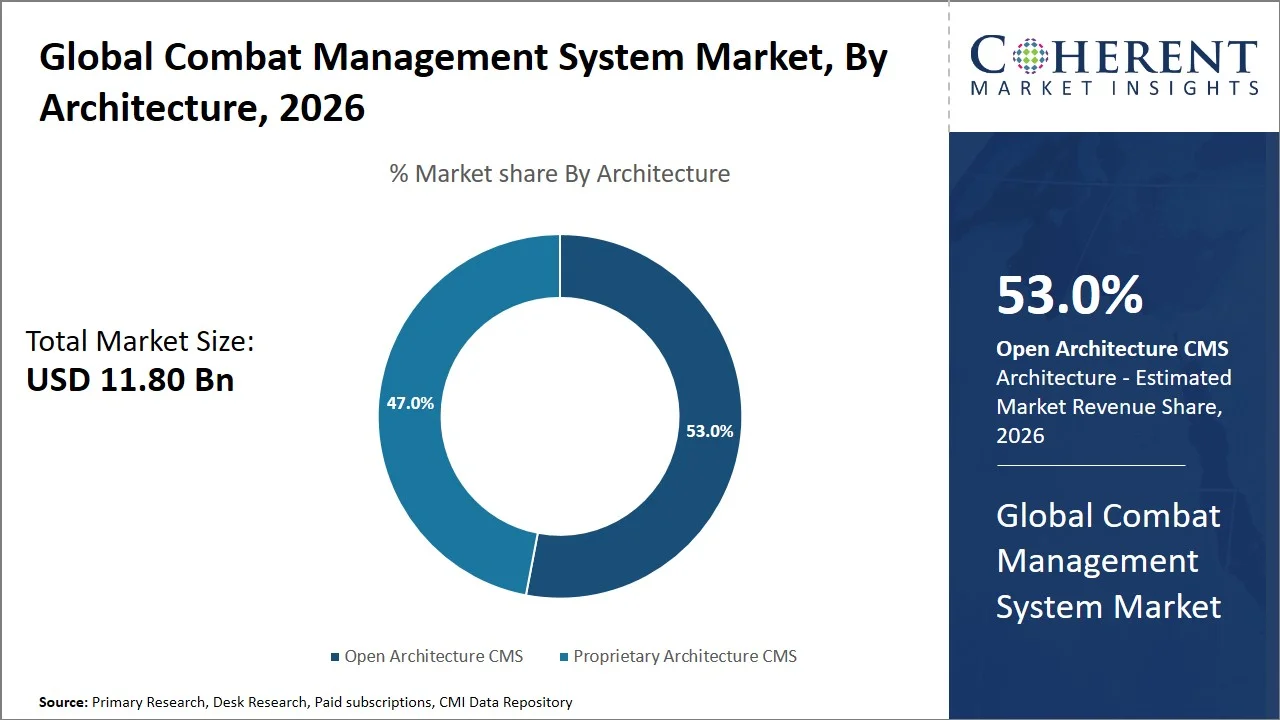
The Open Architecture CMS segment is expected to account for 53.0% of the global combat management system market share in 2026. Open architecture combat management systems are the most preferred architecture as they allow multi-vendor sensors, weapons, communication systems and future technology upgrades to be integrated seamlessly, thus enabling defense forces to modernize platforms in a more cost-effective manner and not be dependent on a single supplier. On May 28, 2026, Lockheed Martin successfully delivered the first Integrated Combat System (ICS)-enabled baseline to the U.S. Navy. ICS-enabled baselines combine heritage combat system capability with modern infrastructure, driving rapid proliferation of capability through a singular development effort at scale. (Source: Lockheed Martin)
Weapon Management System Dominates the Global Combat Management System Market
The weapon management system segment is expected to account for 29.0% of the global combat management system market share in 2026. The largest market segment of the global combat management systems is weapon management systems, because these systems are responsible for the direct engagement of targets, weapon allocation, missile launching and threat neutralizing functions. Weapon management systems are mission critical components for naval vessels to enhance combat effectiveness and to respond rapidly in modern warfare environments. On March 4, 2026, General Dynamics Mission Systems announced that it was awarded a cost-plus-incentive-fee and cost-plus-fixed-fee follow-on contract with an initial order value of USD 255 million as the prime integrator for the Trident II Fire Control System (FCS). (Source: General Dynamics)
Currents Events and their Impact
Current Events | Description and its Impact |
European Union Defence Readiness Omnibus Package |
|
EU Regulation on Defence-Related Investments |
|
(Source: European Commission, European Union)
Global Combat Management System Market - AI-Enabled Combat System Procurements
The acquisition of AI-enabled combat systems is accelerating at a rapid pace, with defense companies demanding speedier threat identification, automated target prioritization, predictive battlefield analytics, and real-time decision support. Major military modernization programs are increasingly allocating budgets for AI-powered command-and-control platforms, autonomous mission management software, combat cloud architectures, and AI-assisted combat management systems to enhance operational effectiveness across naval, air, land, and multi-domain environments. Acquisitions in recent times by businesses such as Leidos, Anduril, Palantir, XTEND, BEL, and HAVELSAN highlight the move of AI-enabled combat capabilities from pilot programmes to large-scale military deployments.
- Leidos won USD 869 million U.S. Army MACRO II contract (2026) for the development of AI-enabled battlefield decision tools to enable multidomain combat operations.
- S. Anduril Industries received a 10-year (2026) enterprise deal with the U.S. Army potentially worth up to USD 20 billion, making its AI-powered Lattice platform a core command-and-control backbone for defense missions.
- Palantir Technologies leveraged AI-enabled military procurement through a 10-year U.S. Agreement with US Army for up to USD 10 billion to assist Project Maven and AI-based targeting systems.
- Throughout 2026, the S. Department of Defense reported it had 1.5 million troops utilizing GenAI.mil daily, a demonstration of the rapid adoption of AI-enabled operational and decision-support capabilities throughout the defense enterprise.
- XTEND has secured a multi-million-dollar U.S. Department of Defense contract (2025) for AI-enabled autonomous combat drones for use in close-in military operations.
- Anduril Federal awarded a USD 642 million U.S. Marine Corps Contract Uses Lattice Command-and-Control Platform in AI-Powered Counter-Drone Systems (2025)
- Indian Army approved procurement of AI-driven “Saksham” Counter-UAS Grid System (2025) designed by Bharat Electronics Limited (BEL) to automate drone detection, tracking, threat evaluation and reaction recommendations.
- HAVELSAN has integrated ADVENT-AI (2026) into its naval combat management architecture, providing AI-enabled threat prioritization and combat decision support capabilities.
- The Pentagon has allocated USD 54 billion for AI-driven military programs in the projected 2027 budget, marking an unprecedented investment in autonomous combat systems and AI-enabled defense technologies.
- Ukraine’s AI Defence Centre reported that it was boosting acquisition and integration of AI technologies for combat decision-making, drone operations, missile analysis and command-network optimization in 2026.
Combat Management System Market Dynamics
Market Drivers
Rising global defense budgets and naval procurement programs
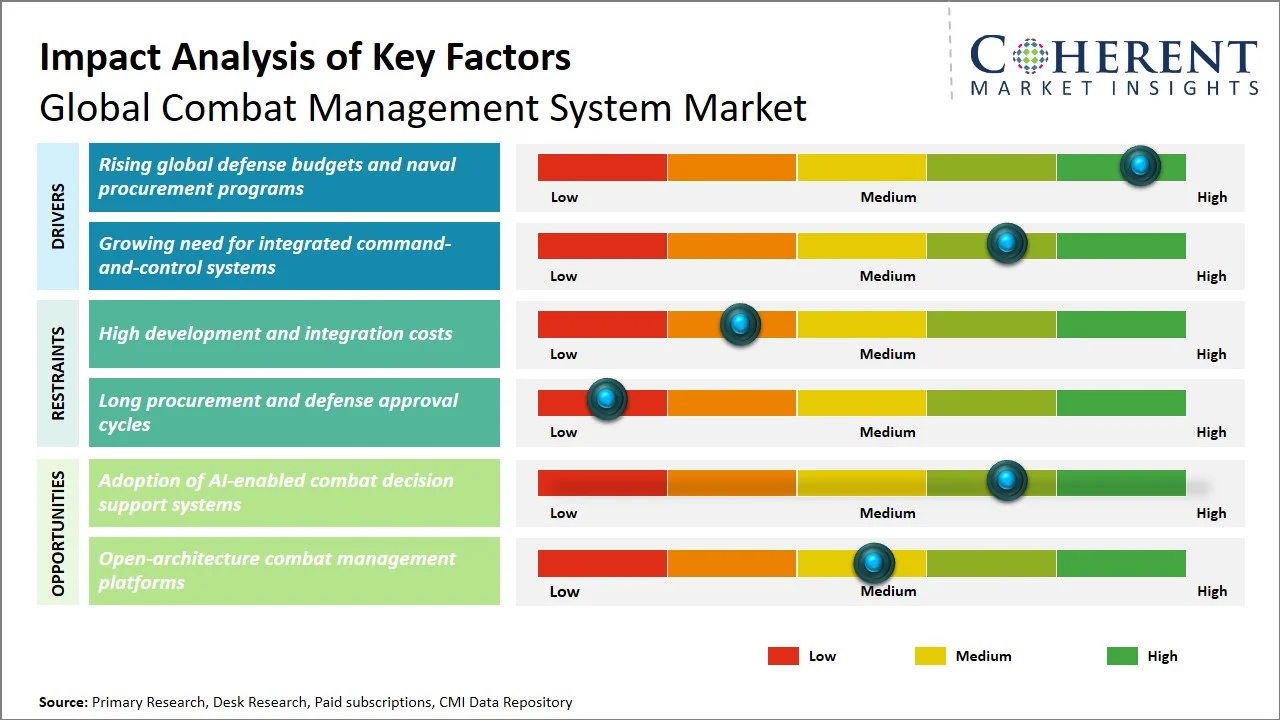
The market for combat management systems is expected to increase significantly due to rising global defense budgets and increasing naval acquisition programs. Governments in North America, Europe, Asia Pacific and the Middle East are boosting military spending to tighten maritime security, modernize aging fleets and increase operational readiness amid rising geopolitical tensions. Investment in modern destroyers, frigates, submarines, aircraft carriers and coastal defense vessels is driving high demand for complex combat management systems that integrate sensors, weaponry, communications networks and command-and-control capabilities. As naval forces seek better situational awareness, faster decision-making, and increased interoperability in multi-domain operations, the acquisition of next-generation CMS technologies is accelerating worldwide.
On April 21, 2026, France’s military programming plan awarded orders to Naval Group for the fourth and fifth Defense and Intervention Frigates (FDI). The extra ships are designed to boost the operational capabilities of the French Navy and signify a substantial increase in government investment in naval modernization and maritime defense initiatives. (Source: Naval Group)
Growing need for integrated command-and-control systems
The combat management system market is projected to be driven by the increasing demand for integrated command-and-control systems, as modern military operations require seamless coordination of sensors, weapons, communication networks, and operational data across multiple platforms. Consequently, defense forces are increasingly turning to integrated technologies that offer a common operational picture, allowing commanders to track threats, deploy resources and conduct missions more efficiently in real time. Modern military tactics rely heavily on combat management systems to facilitate better situational awareness, faster response times, and enhanced interoperability amongst naval, air, land, and cyber units when confronting complex and data-intensive conflict.
On November 20, 2025, Science Applications International Corp. announced that it was awarded the USD 1.4 billion COBRA (Collaborative Operations for Battlespace Resilient Architecture) task order in support of the Department of War (DoW). COBRA will leverage SAIC’s expertise in command and control (C2) and commercial solutions to rapidly develop and deliver multi-domain warfighting technologies that can be integrated with both new and existing platforms. The task order spans a five-year performance period and is set for a late 2025 start. (Source: SAIC)
Emerging Trends
- Expansion of Unmanned and Autonomous Platform Integration: The increasing deployment of unmanned surface vessels (USVs), unmanned underwater vehicles (UUVs), and autonomous marine systems is driving the demand for enhanced combat management solutions. Current CMS platforms are being developed to coordinate manned and unmanned assets in a common operational picture, boosting surveillance, reconnaissance and mission effectiveness and lowering the risk to personnel.
- Increased Focus on Multi-Domain Operations and Network-Centric Warfare: Military forces are increasingly embracing multi-domain operational approaches that demand integrated coordination across naval, air, ground, cyber and space domains. Combat management systems are being developed to enable real-time information exchange, joint-force interoperability and integrated battlefield awareness. This trend to network-centric warfare is pushing the investments in highly linked and data-driven CMS technology capable of handling complicated mission scenarios.
Global Combat Management System Market - Combat Management System Software Upgrade Revenue
The market for combat management system is growing, as many navies are choosing to modernize current fleets rather than rebuild a whole platform. Software upgrades enable battleships, submarines and patrol vessels to add new weaponry, sensors, artificial intelligence capabilities, cybersecurity defenses and multi-domain command-and-control tasks at a fraction of the cost of procuring new vessels. Recurring software modernization contracts are becoming a key revenue stream for CMS providers around the world, driven by the trend toward open-architecture combat systems, digital naval warfare, and software-defined combat capabilities.
- The U.S. Navy’s Aegis Integrated Combat System (ICS) modernization program achieved fleet deployment in 2026, with software-centric upgrades that allow rapid capability insertion across several ship classes.
- Lockheed Martin continues to get large recurring revenue from Aegis Baseline software upgrades that service more than 100 Aegis-equipped ships across the world.
- General Dynamics Mission Systems obtained a $55 million contract in 2026 to modernize the AN/BYG-1 Tactical Control System, the key battle software architecture utilized by the U.S. Navy Submarine force.
- Thales successfully completed Factory Acceptance Testing of improved TACTICOS Combat Management System software aboard the UK Royal Navy’s Type 31 frigates in 2025, creating further prospects for long-term software support and maintenance revenue.
- Saab’s 9LV Combat Management System software modernization efforts proceeded in Australia, Sweden, New Zealand and other navy operators with recurring update cycles focused on sensor integration and weapon control advancements.
- The Royal Australian Navy’s Hobart-class destroyer modernization program involves incremental combat-system software updates to boost air-defense, missile-defense and interoperability capabilities.
- BAE Systems continues software enhancement activities for the Aegis Combat System and related naval combat platforms under long-term U.S. Navy support contracts for 2025-2026.
- Leonardo DRS won a $41 million U.S. Navy contract in 2025 to support combat-management-system infrastructure upgrades, including software integration and open architecture modernization
- In 2025, new AI-enabled software advancements were developed for the HAVELSAN’s ADVENT Combat Management System, which created more upgrade options among existing navy customers.
- An increasing number of fleets are adopting open-architecture CMS platforms, which are driving up annual software update spending since navies may integrate new sensors, missiles, electronic warfare systems, and AI applications without replacing fundamental combat-management infrastructure.
- Software updates and lifecycle support are estimated by industry sources to account for around 25-35% of the overall CMS lifecycle cost for the operational service life of a warship, making software modernization one of the most profitable parts of the combat management system market.
- Cybersecurity needs, AI integration, cloud-enabled naval networks, and multi-domain warfare capabilities are likely to significantly accelerate CMS software upgrade revenue growth through 2033.
Regional Insights
Why is North America a Strong Market for Combat Management Systems?
North America is expected to account for a market share of 37.0% in 2026. North America is still the most technologically advanced area in the combat management system market mainly due to the modernization initiatives of the United States Navy and Royal Canadian Navy. The U.S. remains on a path to field and modernize the Aegis Combat System on its Arleigh Burke-class destroyers, Ticonderoga-class cruisers and newest Flight III ships as it incorporates sophisticated sensor fusion and Joint All-Domain Command and Control (JADC2) capabilities. “Canada’s Canadian Surface Combatant (CSC) program is incorporating next-generation combat management technologies through partnerships with Lockheed Martin Canada and other defense contractors that stress interoperability with NATO naval forces. On May 7, 2026, L3Harris Technologies announced that it has been selected to develop key features of the secure and resilient digital infrastructure that will serve as the backbone of the U.S. Air Force’s command and control network. L3Harris will strengthen the Air Force’s Advanced Battle Management System (ABMS) data integration and networking capabilities. This effort will be foundational to combining data from multiple sources and providing the warfighter with a real-time, comprehensive view of the battlefield. (Source: L3Harris)
Why Does the Asia Pacific Combat Management System Market Exhibit High Growth?
Asia Pacific is projected to account for 29.0% of the global combat management system market and is expected to register the fastest growth. Naval modernization efforts in China, India, Japan, South Korea and Australia are shaping the Asia Pacific combat management system market. Regional governments are investing extensively in indigenous combat systems, network-centric warfare capabilities and the integration of unmanned maritime assets. Programs such as Australia’s Hunter-class frigates, Japan’s Aegis-equipped destroyers, India’s Project 17A frigates and China’s Type 055 destroyers to name a few are seeking to manage ever more sophisticated sensor and weapon networks in contested maritime environments, driving the need for advanced CMS solutions. On February 6, 2026, Mitsubishi Electric Corporation announced that it was awarded a contract by the Japan Ministry of Defense to construct a next-generation defense satellite communications system. Under this contract, Mitsubishi Electric will develop and manufacture the next-generation defense communications satellite, which will succeed the current Kirameki-2 satellite, as well as design the ground system necessary for communicating with the satellite. (Source: Mitsubishi)
Global Combat Management System Market Outlook for Key Countries
Why is the U.S. Emerging as a Major Hub in the Combat Management System Market?
The U.S. is pushing CMS innovation through ongoing improvements of the Aegis Combat System and integration with the Pentagon’s Joint All-Domain Command and Control (JADC2) construct. Recent modernization projects include the installation of the AN/SPY-6(V) radar on board Flight III Arleigh Burke destroyers, which requires better combat management capabilities for missile defense and multi-threat tracking. The U.S. Navy is incorporating unmanned surface vehicles into the fleet with efforts like Ghost Fleet Overlord, establishing a need for combat systems that can connect manned and autonomous platforms into one operational network.
Is China the Next Growth Engine for the Combat Management System Market?
China’s market for combat management systems is directly linked to the rapid development of the People’s Liberation Army Navy (PLAN) and the deployment of sophisticated surface warships. The country's Renhai-class destroyers, designated Type 055, have a highly integrated combat management architecture capable of combining vast vertical launch missile stockpiles, sophisticated phased-array radars, and long-range air defense systems. China is also stressing domestic command-and-control systems and AI-assisted battlefield management capabilities to support its growing blue-water naval operations and carrier strike group deployments.
U.K. Combat Management System Market Analysis and Trends
The U.K. CMS industry is driven by the upgrading of Royal Navy’s Type 26 and Type 31 frigate programs. BAE Systems’ combat management systems are being fitted to these warships to boost anti-submarine warfare, air defense and multi-domain operating capabilities. The UK’s continued backing for the Global Combat Ship programme and its investment in digital naval warfare systems are helping to drive the adoption of open-architecture CMS platforms that can be quickly updated and are compatible with NATO maritime forces.
India Combat Management System Market Analysis and Trends
The combat management system market in India is growing due to indigenous naval modernization activities by the Indian Navy, Bharat Electronics Limited (BEL) and Defence Research and Development Organisation (DRDO). Indigenous CMS solutions have been implemented on Project 15B Visakhapatnam-class destroyers, Project 17A stealth frigates and the aircraft carrier INS Vikrant to enable integrated weapon control, sensor fusion and tactical decision making. The government’s Atmanirbhar Bharat push for defence self-reliance is further driving the development and use of indigenous combat management systems across present and future naval platforms.
Japan Combat Management System Market Analysis and Trends
Japan’s combat management system market has broad deployment of cutting-edge combat systems on its Maya-class and Atago-class Aegis destroyers, a vital element of the country’s ballistic missile defense network. The Japan Maritime Self-Defense Force (JMSDF) is also deploying next-generation Aegis System Equipped Vessels (ASEVs) aimed to boost regional missile defense capabilities. These programmes require highly complex battle management systems that can integrate long-range sensors, missile interceptors and combined operational data linkages with allied troops.
Global Combat Management System Market - Defense Network-Centric Warfare Investments (2025)
Region | Estimated Defense Network-Centric Warfare (NCW) Investments (USD Billion) |
North America | 24.0–28.0 |
Europe | 16.0–19.0 |
Asia Pacific | 12.0–15.0 |
Middle East | 4.0–5.5 |
Latin America | 1.0–1.5 |
Africa | 0.5–1.0 |
Global Combat Management System Market - Active Naval Vessel Upgrade Pipeline by Country
Country | Active Naval Vessel Upgrade / Modernization Program | Vessel Type | Vessels in Upgrade Pipeline (Units) |
U.S. | DDG Modernization 2.0, Aegis Baseline Upgrades, Zumwalt Modernization | Destroyers | 25-30 |
U.K. | Type 23 Life Extension & Combat System Upgrades | Frigates | 8-10 |
France | Horizon-Class Mid-Life Upgrade (MLU), FREMM Enhancements | Destroyers/Frigates | 10-12 |
Italy | Horizon-Class MLU, FREMM Modernization | Destroyers/Frigates | 10-12 |
Australia | Hobart-Class Destroyer Upgrade, ANZAC-Class Modernization | Destroyers/Frigates | 9-11 |
Japan | Kongo-, Atago-, Maya-Class Modernization | Destroyers | 12-14 |
South Korea | KDX Destroyer and Frigate Modernization Programs | Destroyers/Frigates | 12-15 |
India | Talwar-, Shivalik-, Delhi-, Rajput- and Carrier Modernization Programs | Destroyers/Frigates/Carriers | 20-25 |
China | Type 052D, Type 055, Type 054A Fleet Upgrades | Destroyers/Frigates | 35-45 |
Canada | Halifax-Class Frigate Life Extension Program | Frigates | 10-12 |
How is the Adoption of AI-enabled Combat Decision Support Systems Creating New Growth Opportunities in the Combat Management System Market?
The deployment of AI-enabled combat decision support systems is offering huge potential prospects for the combat management system market by raising the speed, precision and effectiveness of military decision making in increasingly complex operational contexts. Advanced artificial intelligence and machine learning algorithms can evaluate massive amounts of data from radars, sonar systems, electronic warfare sensors, satellites and communication networks to quickly identify threats, prioritize targets and offer effective response methods in real-time. These features reduce operator workload, enhance situational awareness and enable faster reactions to changing battlefield conditions. As naval forces progressively pivot to network-centric and multi-domain operations, AI-enabled combat management systems are becoming critical in orchestrating human and unmanned assets, anticipating potential threats and supporting autonomous mission execution. This has spurred defense corporations to invest in next generation CMS platforms with embedded AI capabilities, which offers significant prospects for technology providers, software developers and defense integrators worldwide.
On May 8, 2026, HAVELSAN, in collaboration with the Turkish Naval Forces Command’s ARMERKOM, unveiled ADVENT-AI, presenting the first phase of its artificial intelligence enabled approach developed to address the growing complexity, uncertainty, and asymmetric threats of the modern battlespace. (Source: HAVELSAN)
Global Combat Management System Market - Combat System Retrofit Spending by Fleet Class
Fleet Class | Average Combat System Retrofit Spending per Vessel (USD Million) |
Aircraft Carriers | 350-700 |
Destroyers | 180-450 |
Cruisers | 150-350 |
Frigates | 70-180 |
Corvettes | 30-90 |
Amphibious Assault Ships / LPDs | 80-200 |
Submarines | 50-150 |
Offshore Patrol Vessels (OPVs) | 10-40 |
Market Players, Key Development, and Competitive Intelligence
Key Developments
- On June 9, 2025, Leonardo DRS, Inc announced that it has been awarded a USD 41 million contract from the Naval Sea Systems Command to continue delivering critical combat management system hardware for U.S. Navy surface combatants, allied naval forces, and the U.S. Coast Guard.
- On February 26, 2025, Saab announced that it has signed a contract with Damen Naval for the Colombian Navy. The order includes the 9LV Combat Management System and 9LV Fire Control System, sensors and radars for the new Plataforma Estratégica de Superficie (PES) frigate programme.
Competitive Landscape
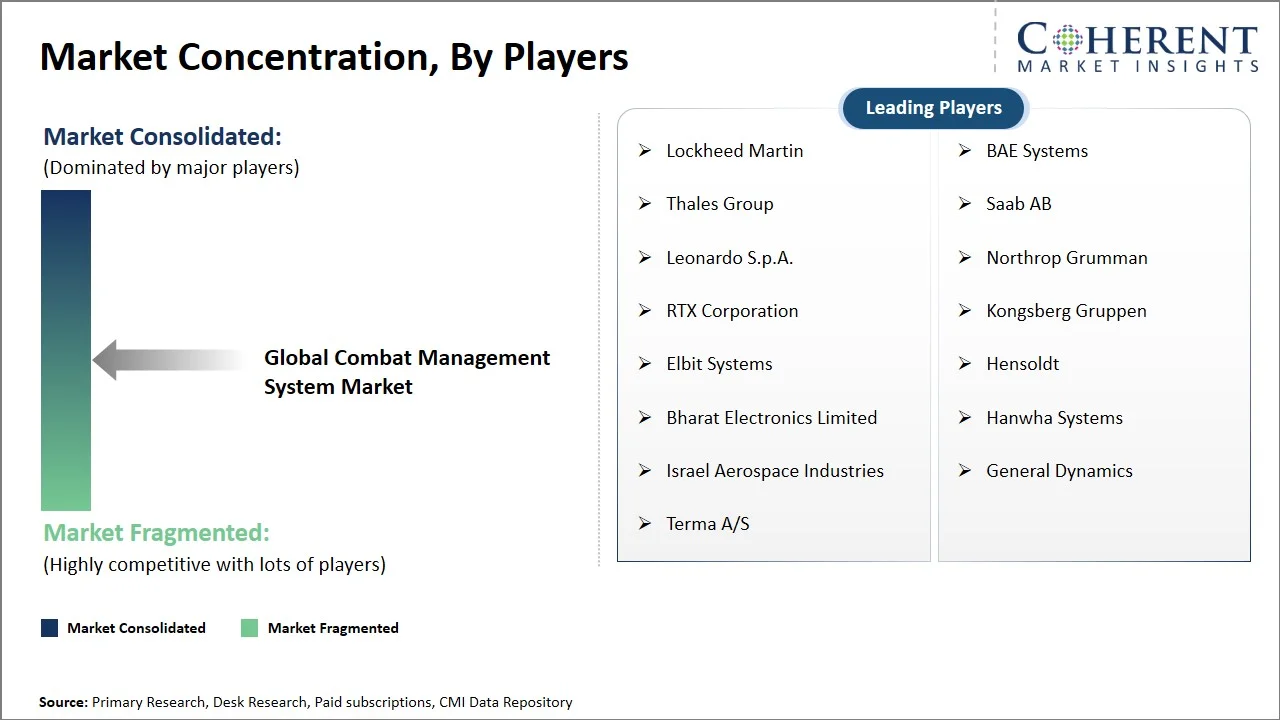
Defense contractors, naval systems integrators and specialized command-and-control technology providers vie for market share in the highly competitive combat management system industry. Advanced solutions are being developed and delivered by leading firms, including Lockheed Martin, BAE Systems, Thales Group, Saab AB, Leonardo S.p.A. and Northrop Grumman. These are strategic collaborations, contracts for the modernization of the navy, technology improvements and investments in artificial intelligence, cybersecurity and open-architecture platforms to boost competitive positioning. Countries are also turning more to indigenous solutions for conflict management in an effort to become more self-reliant in defense and less dependent on international providers.
Market Report Scope
Combat Management System Market Report Coverage
| Report Coverage | Details | ||
|---|---|---|---|
| Base Year: | 2025 | Market Size in 2026: | USD 11.80 Bn |
| Historical Data for: | 2020 To 2024 | Forecast Period: | 2026 To 2033 |
| Forecast Period 2026 to 2033 CAGR: | 22% | 2033 Value Projection: | USD 48.75 Bn |
| Geographies covered: |
| ||
| Segments covered: |
| ||
| Companies covered: | Lockheed Martin, BAE Systems, Thales Group, Saab AB, Leonardo S.p.A., Northrop Grumman, RTX Corporation, Kongsberg Gruppen, Elbit Systems, Hensoldt, Bharat Electronics Limited, Hanwha Systems, Israel Aerospace Industries, and General Dynamics, Terma A/S | ||
| Growth Drivers: |
| ||
| Restraints & Challenges: |
| ||
Analyst Opinion (Expert Opinion)
- The combination of artificial intelligence, sensor fusion, network-centric warfare and autonomous platform integration is changing the face of the combat management system industry. “Naval modernization programs, fleet digitization initiatives and growing demand for interoperable command-and-control capabilities are expected to provide significant opportunities. While issues around integration complexity, cybersecurity threats and procurement timelines are likely to persist, continued investment in cutting-edge defense technology is likely to support long-term market growth.
- The future of the combat management system market is projected to be driven by: wide adoption of AI-enabled decision-support tools, autonomous maritime operations and multi-domain command-and-control frameworks. There is expected to be more focus on open-system architectures that enable for quick integration of new sensors, weaponry and software applications. As naval forces modernize their fleets and develop their digital warfare capabilities, the demand for highly connected, cyber resilient, data-driven combat management platforms that can support complex operational environments in the sea, air, land, cyber and space domains is expected to increase.
Speak to the analyst
Want personalized insights?
Take the findings above to one of our principal consultants, or have the report rebuilt around the segments, geographies and competitors you actually track.
Market Segmentation
- Component Insights (Revenue, USD Billion, 2021 - 2033)
- Software
- Hardware
- Services
- Architecture Insights (Revenue, USD Billion, 2021 - 2033)
- Open Architecture CMS
- Proprietary Architecture CMS
- Sub-System Insights (Revenue, USD Billion, 2021 - 2033)
- Weapon Management System
- Self-Defense Management System
- Situational Awareness System
- Track Management System
- Identification System
- Display System
- Unmanned Vehicle Control System
- Platform Insights (Revenue, USD Billion, 2021 - 2033)
- Principal Surface Combatants
- Submarines
- Amphibious Ships
- Patrol Boats and Fast Attack Craft
- Aircraft Carriers
- Maritime Command Centers
- End User Insights (Revenue, USD Billion, 2021 - 2033)
- Navy
- Coast Guard
- Joint Defense Forces
- Homeland Security Agencies
- Regional Insights (Revenue, USD Billion, 2021 - 2033)
- North America
- U.S.
- Canada
- Latin America
- Brazil
- Argentina
- Mexico
- Rest of Latin America
- Europe
- Germany
- U.K.
- Spain
- France
- Italy
- Russia
- Rest of Europe
- Asia Pacific
- China
- India
- Japan
- Australia
- South Korea
- ASEAN
- Rest of Asia Pacific
- Middle East
- GCC Countries
- Israel
- Rest of Middle East
- Africa
- South Africa
- North Africa
- Central Africa
- North America
- Key Players Insights
- Lockheed Martin
- BAE Systems
- Thales Group
- Saab AB
- Leonardo S.p.A.
- Northrop Grumman
- RTX Corporation
- Kongsberg Gruppen
- Elbit Systems
- Hensoldt
- Bharat Electronics Limited
- Hanwha Systems
- Israel Aerospace Industries
- General Dynamics
- Terma A/S
Sources
Primary Research Interviews
- Combat Management System Program Managers
- Defense Systems Executives
- Naval Electronics and CMS Specialists
Magazines
- Naval Technology Magazine
- Military & Aerospace Electronics Magazine
- Jane's Defence Weekly
- The Naval Review
Journals
- Naval Engineers Journal
- International Journal of Intelligent Defence Support Systems
- Defense & Security Analysis
- Journal of Marine Science and Engineering
Associations
- Naval Sea Systems Command
- Association of Old Crows
- Armed Forces Communications and Electronics Association
- National Defense Industrial Association
Public Domain Sources
- U.S. Department of Defense
- U.S. Navy NAVSEA
- NATO Official Website
- European Defence Agency (EDA)
Proprietary Elements
- CMI Data Analytics Tool
- Proprietary CMI Existing Repository of information for last 10 years
Get access to 250+ pages report
Every segment, forecast, competitor profile and data table behind the analysis above — available for instant download.
- ESOMAR Member
- ISO 9001:2015 Certified
- D-U-N-S Registered
- GDPR & CCPA Compliant
Missing comfort of reading report in your local language? Find your preferred language:
Transform your Strategy with Exclusive Trending Reports
Frequently Asked Questions
The global combat management system market is expected to stand at USD 11.80 Bn in 2026 and is expected to reach USD 48.75 Bn by 2033.
The CAGR of the global combat management system market is projected to be 22% from 2026 to 2033.
Rising global defense budgets and naval procurement programs and growing need for integrated command-and-control systems are the major factors driving the growth of the global combat management system market.
High development and integration costs and long procurement and defense approval cycles are the major factors hampering the growth of the global combat management system market.
In terms of component, the software segment is estimated to dominate the market revenue share in 2026.
AI technologies are being integrated to improve threat detection, target prioritization, and operational decision-making speed.
Sensor fusion combines data from multiple sources to provide operators with a comprehensive and accurate operational picture.