

Global Radar Simulation Market Size and Forecast – 2026-2033
The global radar simulation market is estimated to be valued at USD 158.89 Bn in 2026 and is expected to reach USD 338.29 Bn by 2033, exhibiting a compound annual growth rate (CAGR) of 11.4% from 2026 to 2033.
Key Takeaways of the Global Radar Simulation Market
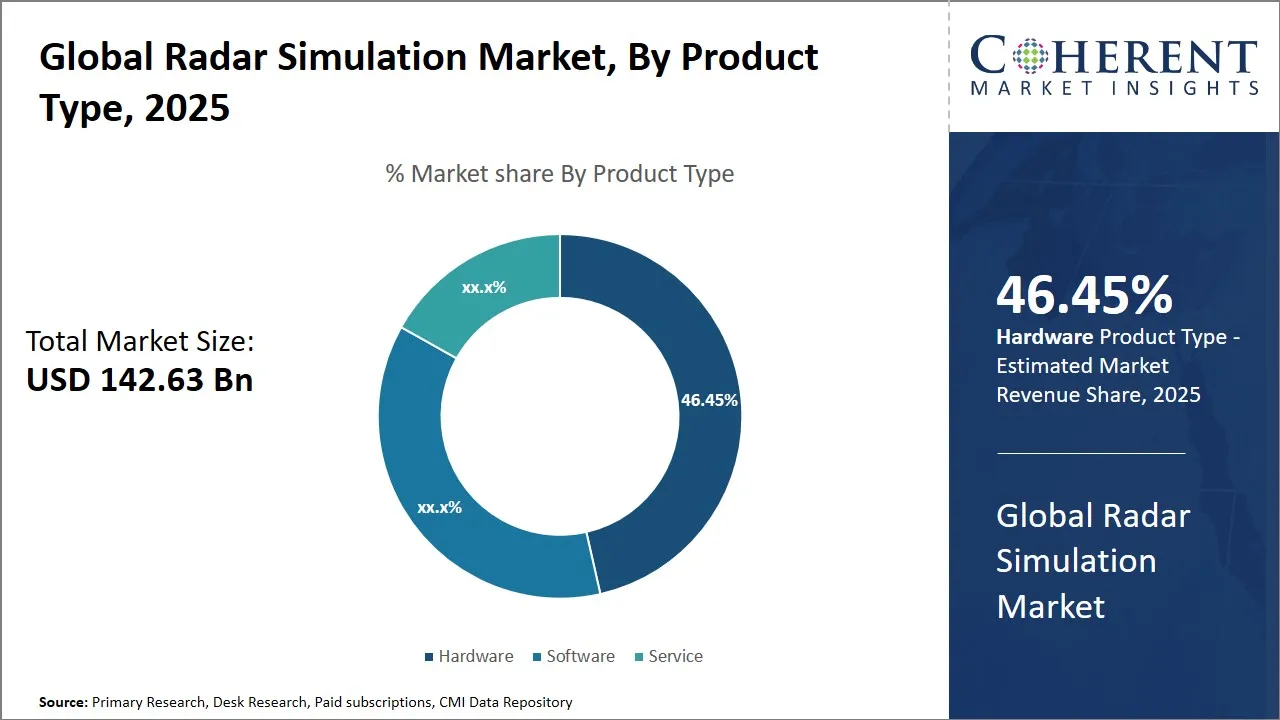
- The hardware segment is expected to lead the market holding a share of 47.5 % in 2026.
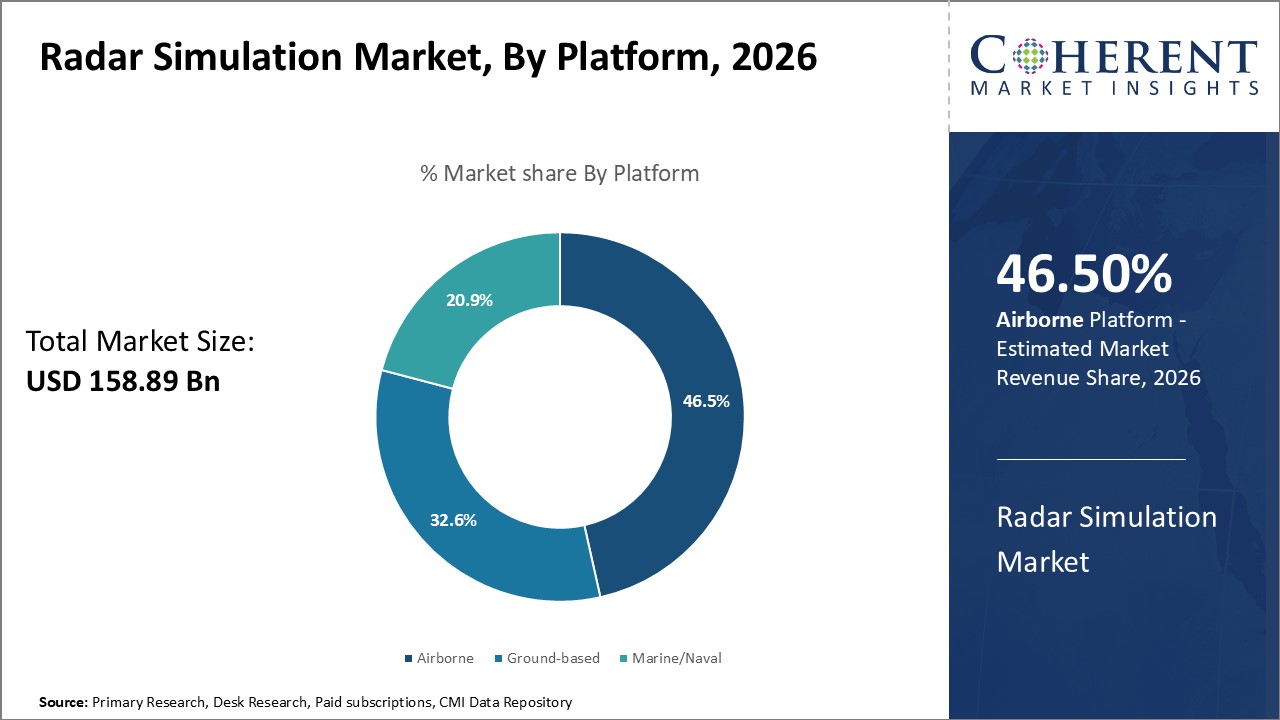
- The airborne segment is projected to dominate with a share of 46.5 % in 2026.
- The military and defense segment leads the market holding an estimated share of 49.63 % in 2026.
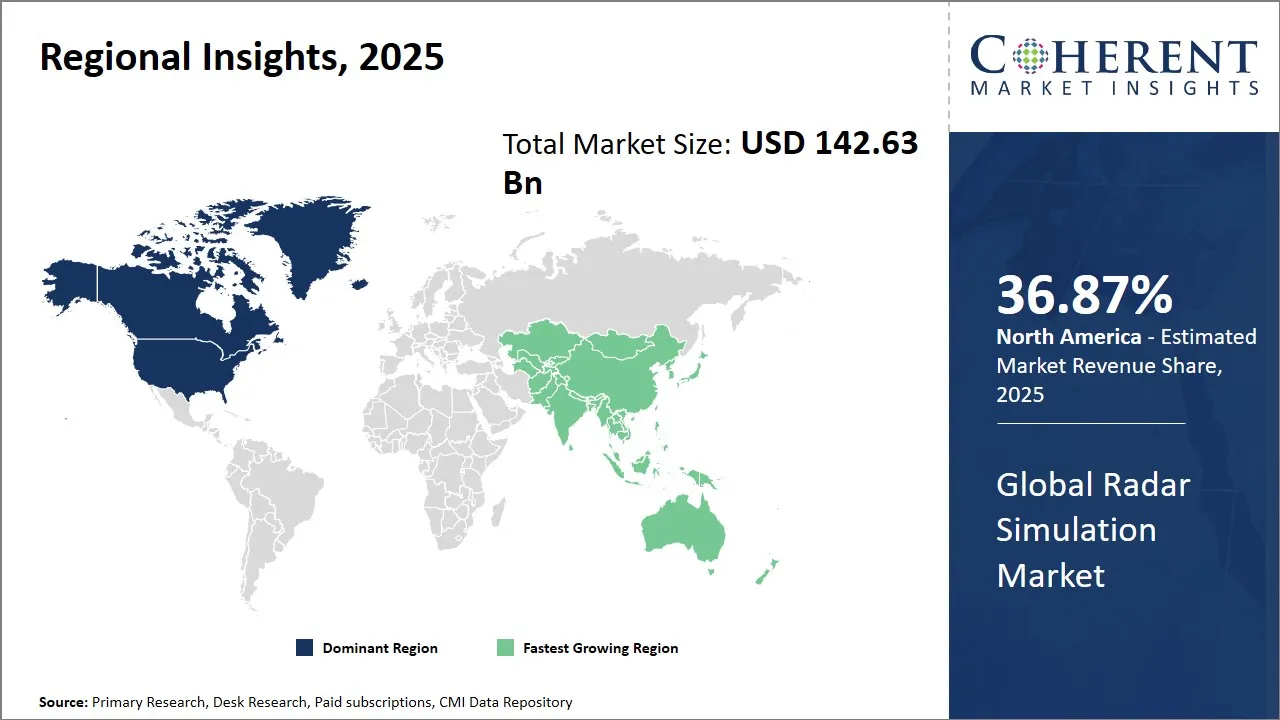
- North America, holding a share of 36.87 % in 2026, is projected to dominate the market.
- Asia Pacific, holding an estimated share of 19.17 % in 2026, shows the fastest growth in the market.
Market Overview
A notable trend in the radar simulation market is the integration of AI and machine learning algorithms to improve real-time data processing and predictive analytics. Moreover, the growing demand for unmanned aerial vehicles (UAVs) and autonomous systems is creating the need for sophisticated radar simulation platforms. Also, cloud-based simulation solutions are becoming popular, offering scalability and cost efficiency, which further adds to market growth and technological innovation within this sector.
Current Events and Its Impact
Current Events | Description and its Impact |
Geopolitical and Trade Developments |
|
Economic and Infrastructure Trends |
|
Segmental Insights
- Current Industry Events of 2026
- Market Size Estimation
- Regional Breakdown
- Competitive Landscape
- Customer Intelligence
- Segmental Analysis
- Pricing Analysis
- Key Market Drivers, Challenges & Future Trends
- Customized Insights Section
Global Radar Simulation Market Insights, By Product Type – Hardware Dominance in Radar Simulation Because of Increasing Demand for Realistic and High-Fidelity Testing Environments
Hardware is expected to hold the largest share of 47.5% in 2026, because of its ability to deliver high-fidelity and realistic radar testing environments. Components like signal generators, antennas, and sensors replicate complex real-world radar conditions including clutter, interference, and stealth scenarios. With growing adoption of phased-array and multifunction radars, hardware simulators offer essential low-latency, high-precision performance and support critical integration testing in defense and aerospace programs. In 2023, Lockheed Martin upgraded its radar test facilities with advanced hardware-based simulation modules for the AN/SPY-7 radar, making possible real-environment signal testing without expensive live trials.
Global Radar Simulation Market Insights, By Platform – Airborne Platform Leads Market Growth Because of Expanding Defense Aviation and Unmanned Aerial System Applications
The airborne segment, holding an estimated share of 46.5% in 2026, leads due to increased use of advanced radar systems in military aircraft, UAVs, and reconnaissance platforms. Airborne radar applications rely a lot on simulation to model high-altitude dynamics, SAR/MTI operations, and fast maneuvering in varied atmospheric conditions. Simulation reduces costly flight testing and supports modernization of fighter jets, surveillance aircraft, and next-generation UAV fleets. In 2024, Northrop Grumman used airborne radar simulation for its Global Hawk UAV upgrades to validate SAR performance and target-tracking algorithms before live testing.
Global Radar Simulation Market Insights, By End User – Military and Defense Segment Drives Growth with Focus on Enhanced Battlefield Capabilities and Electronic Warfare Preparedness
Military and defense, holding an estimated share of 49.63% in 2026 dominates because simulation is needed for testing early-warning systems, missile-guidance radars, fire-control radars, and electronic warfare capabilities. Simulation supports secure, controlled evaluation of radar performance in complex electromagnetic and stealth environments. It also improves operator training, interoperability testing, and data-fusion validation across multiple platforms in net-centric operations. In 2023, the U.S. Air Force used radar simulation modules during upgrades to the F-35’s AN/APG-81 radar to test jamming resistance and threat-detection modes without conducting live combat exercises.
Pricing Analysis of the Radar Simulation Market
Product category | Example | Price (USD) |
Entry-software only simulation (maritime/educational) | Starpath Radar Trainer and Simulator – PC download training software. | ~USD 159 |
Mid-level training hardware/software kit (commercial/training) | SkyRadar 8 GHz Pulse Radar Training System | ~ USD 21,000 (base) |
Module/target simulator component | Keysight E8718A Radar Target Simulator (76-81GHz) – module only, pricing “request”. | Estimated USD 200,000-500,000 (module scale) |
Full hardware-in-the-loop radar simulation system (defense grade) | Mercury Systems ARES Radar Environment Simulator – advertises “saves millions” for flight-test rigs. | Estimated USD 2 M-10 M+ depending on configuration |
Large defense radar system (for context) | Ground Master 400 (not purely simulation; radar system) cost ~ USD 30 M each. | ~ USD 30,000,000 |
Regional Defense Expenditure and Procurement Programs – Radar Simulation Market
Region | Estimated Defense Expenditure (USD) | Key Procurement/Modernization Programs |
Americas (North & Latin America) | ~ USD 1,000 billion+ (e.g., U.S. ~USD 997 billion in 2024) | • U.S. Pacific Deterrence Initiative: > USD 40 billion (2021-24) focussed on Indo-Pacific capabilities. |
Europe | ~USD 693 billion in 2024 (Europe region total per SIPRI) | • European Defense Industry Reinforcement through Common Procurement instrument (EDIRPA): EU funding ~€300 million for cross-border procurement; leveraging >€11 billion of defense product procurement. |
Asia Pacific | Estimates: Asia and Oceania region saw significant spend; for example China ~USD 314 billion in 2024. Also APAC defense market estimated USD ~USD 536.67 billion in 2025. | • Regional procurement push: Modernization of radar, naval, air defense systems in Japan, India, South Korea and China. |
Middle East & Africa | Middle East: ~ USD 243 billion estimate in 2024 for region. Africa: ~USD 52.1 billion in 2024. | • Radar simulator and radar system procurements in Gulf region: e.g., simulation market in Middle East valued at ~USD 330 million. |
Latin America | Included within Americas but separately smaller: e.g., Brazil ~USD 21 billion in 2024. | • Emerging procurements for radar, maritime surveillance and border control systems; specific high-value radar program |
Scenario-based Simulation Capabilities – Global Radar Simulation Market
Capability | Description | Typical Use Cases | Fidelity Level | Common Required Components |
Electronic Warfare (EW)/Jamming Scenarios | Simulates active electronic attack, deceptive jamming and reactive ECM techniques against radar systems. | EW T&E, operator training, countermeasure development. | High | EW signal generators, calibrated RF front-ends, EW libraries, real-time waveform engines. |
Clutter & Multi-Path Environments | Models land, sea and weather clutter, multipath returns and sea-state effects on radar returns. | Maritime surveillance, coastal radar tuning, airborne low-altitude ops. | Medium → High | Advanced propagation models, clutter maps, terrain/sea-state data, software signal processors. |
Multi-Platform/Multi-Sensor (Multi-Static) Scenarios | Simulates coordinated sensors (air/sea/ground) and bistatic/multistatic geometries for target detection and tracking. | Networked sensor fusion, cooperative surveillance, C2 system testing. | High | Time-synced scenario engine, GPS/INS motion models, networked signal distribution, LVC middleware. |
High-Velocity/Ballistic Target Profiles | Simulates hypersonic, ballistic and high-speed re-entry trajectories with Doppler effects. | Missile defense testing, tracker algorithm validation. | Very High | High-rate simulators, precise kinematic models, high-bandwidth RF channels, HIL fixtures. |
Low-RCS/Stealth Signatures | Models reduced radar cross section targets and signature management techniques. | Signature reduction assessment, detection algorithm tuning. | High | RCS libraries, frequency-dependent scattering models, advanced EM solvers. |
Urban & Complex Terrain Scenarios | Dense multipath, blocked/occluded returns, moving clutter (vehicles, pedestrians), building reflections. | Urban surveillance, border security, C-UAS testing. | Medium → High | 3D terrain/building databases, ray-tracing propagation, dynamic object libraries. |
Sensor Fusion & Data Association | Generates correlated tracks and fused sensor outputs (radar + EO/IR + AIS), with association ambiguities. | C2 systems, multi-sensor fusion algorithm training. | Medium → High | LVC framework, fusion middleware, sensor models for EO/IR/AIS, time sync. |
Digital Twin/Digital Environment | High-fidelity virtual replica of radar system + operational environment for lifecycle testing. | System design, predictive maintenance, software upgrades testing. | Very High | Digital twin platform, physics-based models, historical telemetry, AI analytics. |
Hardware-in-the-Loop (HIL) & Real-Time Emulation | Integrates real radar hardware with simulated environment for end-to-end validation. | Acceptance testing, production validation, field verification. | Very High | Real RF front-ends, target generators, signal switching matrices, real-time OS. |
Propagation & Atmospheric Effects | Models ducting, refraction, attenuation, rain/ionospheric effects across frequencies. | Long-range surveillance planning, HF/VHF system testing. | Medium → High | Advanced propagation solvers, meteorological data ingestion, frequency-dependent models. |
Adaptive/Cognitive Radar Scenarios | Simulates closed-loop radar systems that adapt waveforms and PRIs based on environment. | AI-enabled radar development, adaptive tracking and resource allocation testing. | High | Real-time waveform generators, reinforcement-learning agents, data labelling pipelines. |
Synthetic Aperture Radar (SAR) & GMTI Scenarios | Simulates SAR image formation, moving target indication, coherent processing chains. | Imagery generation, target recognition, SAR algorithm validation. | High | Coherent signal chains, motion compensation models, platform kinematics, image processors. |
Live-Virtual-Constructive (LVC) Integration | Blends live hardware, virtual simulated systems and constructive (simulated) entities in a single scenario. | Large-scale exercises, coalition training, interoperability testing. | High | LVC gateways, DIS/HLA simulators, timing/GPS emulation, federation management. |
Operator Training & Scenario Playback | Prebuilt scenarios, scripting, debrief playback with KPIs and performance metrics. | Training schools, syllabus development, after-action reviews. | Low → High (configurable) | Scenario editors, recording/playback servers, visualization dashboards, scoring engines. |
Regional Insights
North America Radar Simulation Market Analysis and Trends
North America, holding an estimated share of 36.87% in 2026, dominates the global radar simulation market, because of the well-established defense and aerospace industries, alongside a lot of investments in advanced simulation technologies. The U.S., as a big contributor, sees robust government initiatives focused on modernizing military radar systems, improving air traffic management, and advancing autonomous navigation technologies.
Strong collaboration between government agencies such as the Department of Defense (DoD) and private sector players makes a thriving ecosystem for innovation and product development. Also, presence of leading radar simulation technology companies like Lockheed Martin, Raytheon Technologies, and Northrop Grumman, who consistently invest in R&D, adds to North America’s leading position. Trade dynamics also favor the region because of extensive defense exports and partnerships with allied countries, reinforcing supply chains and technology dissemination.
Asia Pacific Radar Simulation Market Analysis and Trends
The Asia Pacific, holding an estimated share of 19.17% in 2026, exhibits the fastest growth in the radar simulation market, fueled by rapid modernization of defense infrastructure and increased commercial aerospace activity. Countries like China, India, Japan, and South Korea are progressively upgrading their radar and simulation capabilities, propelled by both government-funded defense programs and a surge in civil aviation operations. Supportive government policies, including increased defense budgets and initiatives to foster indigenous technological development, have accelerated market expansion.
The regional industry ecosystem is further made stronger by emerging domestic players alongside global companies establishing regional hubs. For example, Thales Group and Saab AB have grown operations in the region to cater to local demand. Trade dynamics in the Asia Pacific also reflect growing intra-regional collaboration and technology transfers, aiding rapid adoption of advanced radar simulation systems.
Radar Simulation Market Outlook for Key Countries
U.S. Radar Simulation Market Analysis and Trends
The U.S. radar simulation market sees mature defense systems integration and cutting-edge R&D activities. Big defense contractors such as Lockheed Martin and Raytheon Technologies lead advancements in simulation software and hardware, using them for military training and operational readiness. Also, big investments by government agencies into radar modernization and the use of simulation for civilian air traffic control ensures a diverse application landscape. The U.S. also benefits from a strong technological ecosystem supported by numerous startups that enhance simulation innovation.
China Radar Simulation Market Analysis and Trends
China radar simulation market is fast evolving, emphasizing self-reliance and modernization of defense capabilities. The government’s strategic focus on indigenous technology development has pushed local companies like China Electronics Technology Group Corporation (CETC) to the forefront of innovation in simulation technologies. China’s growing aerospace industry, expanding satellite programs, and increased naval assets also make demand for advanced radar training and simulation solutions. Collaborations with foreign firms and domestic investments have added to technology transfer and adaptation to meet sophisticated simulation requirements.
India Radar Simulation Market Analysis and Trends
India continues to lead its radar simulation market because of big defense procurement and modernization programs supported by government initiatives such as “Make in India.” Indigenous companies such as Bharat Electronics Limited (BEL) are vital contributors, developing radar simulation systems customized to local defense needs. Alongside defense, civil aviation growth adds to adoption of radar simulation for air traffic management. India’s strategic partnerships with international companies improve knowledge exchange, while government policies encourage private sector participation in simulation technology advancements.
U.K. Radar Simulation Market Analysis and Trends
The U.K. radar simulation market grows because of a well-established defense sector, supported by government programs to upgrade electronic warfare and radar systems. Companies like BAE Systems play a pivotal role in developing sophisticated simulation solutions used for training and system integration testing. The UK’s role as a big defense exporter also makes the need for realistic radar simulation environments to support multinational operations. Also, collaboration with European and North American partners fosters continual innovation.
Japan Radar Simulation Market Analysis and Trends
Japan radar simulation market grows because of its advanced technological infrastructure and strategic focus on self-defense forces' modernization. Japanese companies such as Mitsubishi Electric and NEC Corporation contribute a lot to radar and simulation technologies, focusing on both military and civilian sectors. Government policies pushing technology use for disaster management, aviation safety, and maritime security make dynamic demand for radar simulation. Trade relations with Western countries enable technology upgrades and the introduction of cutting-edge simulation platforms.
Market Players, Key Development, and Competitive Intelligence
Key Developments
- In April 2025, Keysight Technologies, Inc., awarded a contract with NATO’s Naval Forces Sensor and Weapons Accuracy Check Sites (FORACS) to modernize its testing capabilities for critical radar and electronic support measures (ESM) systems. Under this agreement, Keysight will deliver Radar Target Generator and Electronic Warfare testing (EW) solutions to be deployed at NATO Navy bases, enabling the calibration and maintenance of NATO radar systems and the assessment of ESM effectiveness.
- In March 2025, Cambridge Pixel, a leading developer of radar processing, tracking, and display solutions, has supplied its advanced radar tracking, recording, and display technology to Elcome (India) to enhance the security of offshore oil and gas platforms operated by Reliance Industries.
- In December 2024, Keysight Technologies Inc. announced that Indra had selected the Keysight EW Advanced Simulation Platform (EWASP) to enhance and accelerate EW test and evaluation capabilities.
- In January 2024, Cambridge Pixel announced the launch of SPx Radar Trainer, a software package designed to aid in the instruction and learning of the proper usage of maritime radars. SPx Radar Trainer makes it easier for students to familiarize themselves with radar controls by providing a modern simulation of a typical radar display, supported by chart and 3D environment views. It includes custom scenario creation for instructors and runs in a browser window for ease-of-use.
Top Strategies Followed by Radar Simulation Market Players
- Established players dominate through huge investments in research and development (R&D), driving the innovation of high-performance radar simulation products that meet the growing demands of diverse sectors such as aerospace, defense, and automotive.
- Thales Group’s "Research & Innovation" page states they have 33,500 researchers/engineers, 22,000 patents, and dedicate considerable R&D effort to disruptive technologies (quantum, AI, digital twins) across defense and simulation areas.
- Mid-level players in the radar simulation market adopt a different approach, focusing primarily on cost-effective solutions that strike a critical balance between quality and affordability.
- SkyRadar specialize in radar training and simulation solutions for education, aviation academies, research labs (rather than high-end military systems) — e.g., modular radar training systems and simulators for ATSEP/aviation training. This shows a mid-level vendor offering more affordable and modular simulation/training solutions rather than top-tier full defense systems.
- Small-scale players, meanwhile, focus on niche specialization to carve out a unique market presence.
- Weibel Scientific specializes in Doppler radars and tracking radars, catering to niche specialist markets like space tracking and missile defense tracking.
Market Report Scope
Radar Simulation Market Report Coverage
| Report Coverage | Details | ||
|---|---|---|---|
| Base Year: | 2025 | Market Size in 2026: | USD 158.89 Bn |
| Historical Data for: | 2020 To 2024 | Forecast Period: | 2026 To 2033 |
| Forecast Period 2026 to 2033 CAGR: | 11.4% | 2033 Value Projection: | USD 338.29 Bn |
| Geographies covered: |
| ||
| Segments covered: |
| ||
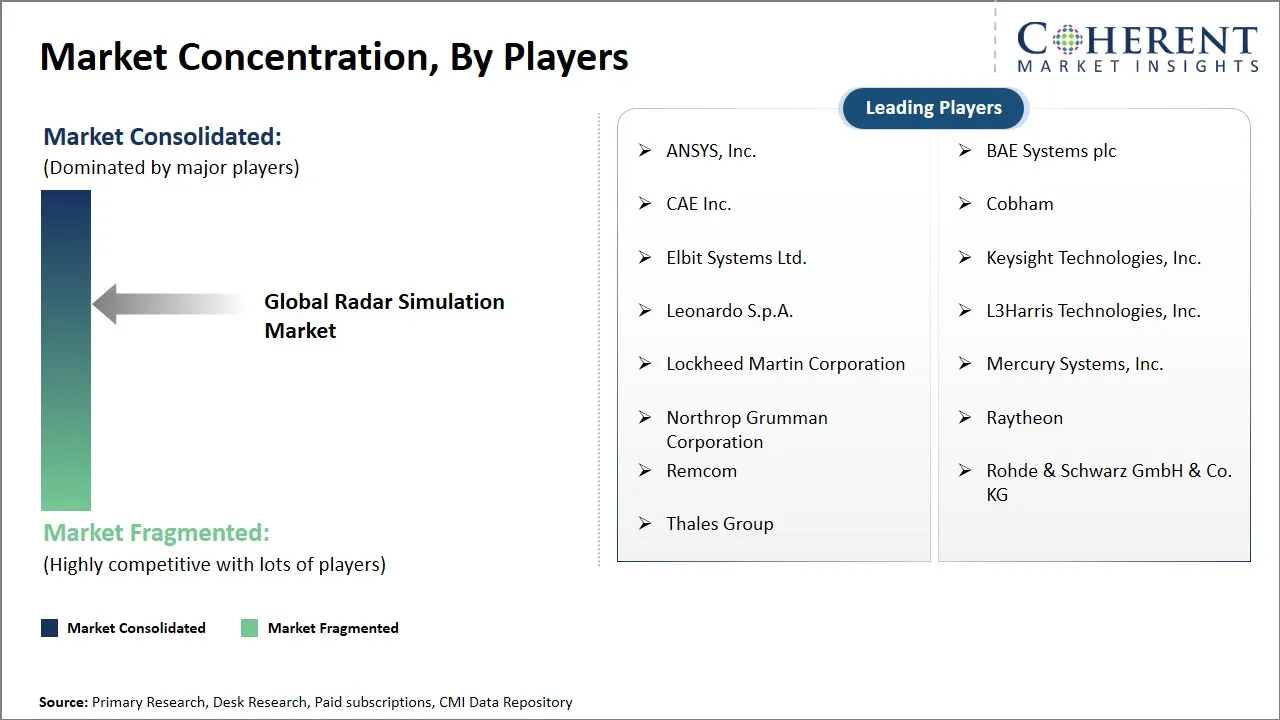
| Companies covered: | ANSYS, Inc., BAE Systems plc, CAE Inc., Cobham, Elbit Systems Ltd., Keysight Technologies, Inc., Leonardo S.p.A., L3Harris Technologies, Inc., Lockheed Martin Corporation, Mercury Systems, Inc., Northrop Grumman Corporation, Raytheon, Remcom, Rohde & Schwarz GmbH & Co. KG, and Thales Group | ||
| Growth Drivers: |
| ||
| Restraints & Challenges: |
| ||
Market Dynamics
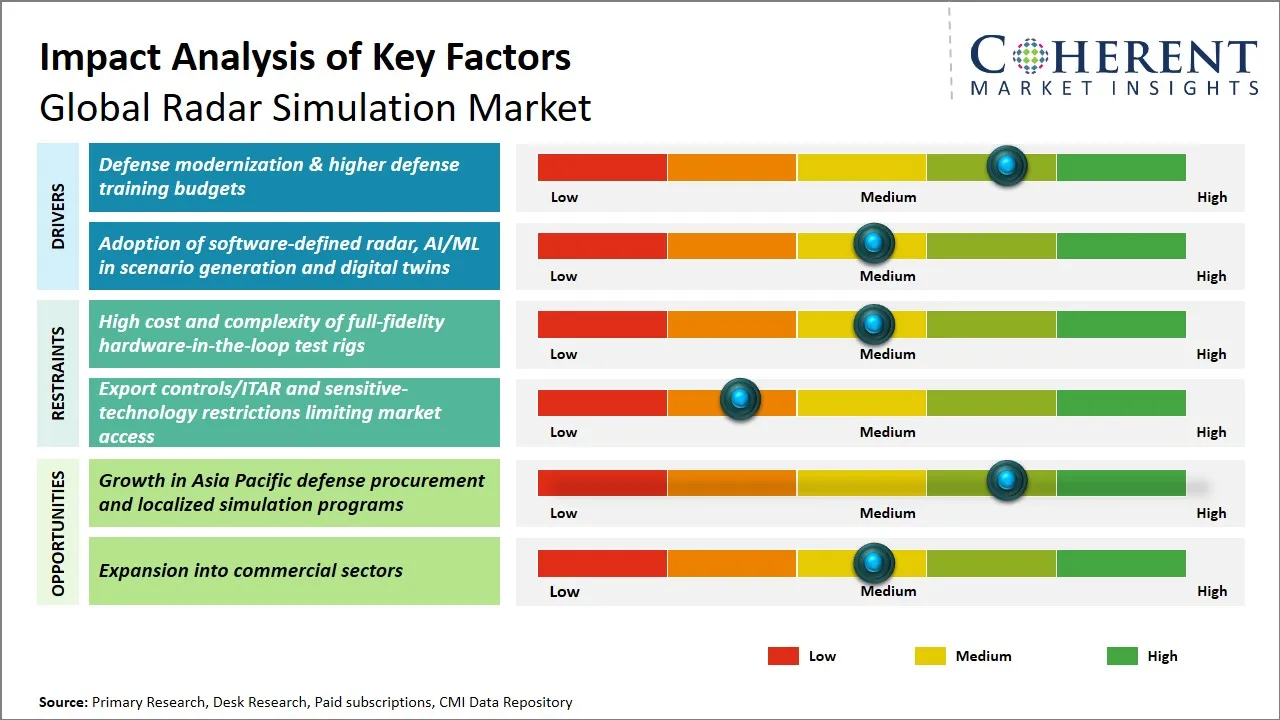
Global Radar Simulation Market Driver – Defense Modernization & Higher Defense Training Budgets
The ongoing global emphasis on defense modernization initiatives is significantly driving the demand within the radar simulation market. As countries strive to upgrade their military capabilities with advanced technology, there is a heightened focus on incorporating sophisticated radar systems that enhance surveillance, threat detection, and situational awareness. To maximize the effectiveness of these modernized radar systems, defense agencies are using larger portions of their budgets for extensive and realistic training programs.
NATO awarded Keysight Technologies a contract to deliver next-generation radar target generators and EW simulators to improve operational readiness. Radar simulation technology plays a big role in this regard, enabling military personnel to engage in complex training scenarios without the risks and costs associated with live exercises. This push towards enhanced preparedness necessitates state-of-the-art simulation tools that can replicate various operational environments and threat conditions accurately.
Global Radar Simulation Market Opportunity – Expansion in Asia Pacific Defense Procurement and Localized Simulation Programs
The Asia Pacific region presents a significant growth opportunity for the global radar simulation market, primarily fueled by increasing defense expenditure and strategic modernization initiatives among emerging economies such as India, China, Japan, South Korea, and Australia. As these countries prioritize enhancing their defense capabilities amid evolving geopolitical tensions, there is a rising demand for advanced radar systems, which necessitates sophisticated simulation tools for training, development, and operational testing. Moreover, regional governments are increasingly focusing on localized radar simulation programs to reduce dependence on foreign technology providers and to tailor solutions that address specific strategic requirements and environmental conditions unique to the Asia Pacific theater.
CAE Inc. signed a long-term agreement with General Atomics to develop mission trainers (including radar/EW simulation) for the MQ-9B SkyGuardian in the region. Additionally, partnerships between local firms and global radar simulation vendors are expanding, facilitating technology transfer and customization. The convergence of expanding defense budgets, collaborative projects, and the push for indigenous simulation solutions is poised to accelerate the adoption of radar simulation systems across military and civilian applications in the region.
Analyst Opinion (Expert Opinion)
- The market remains frustratingly constrained by outdated simulation architectures still entrenched across major defense establishments. Many operators cling to legacy platforms that are simply incapable of supporting modern radar waveforms, multi-domain threat libraries, or AI-driven training environments. This legacy inertia slows down procurement cycles and suffocates innovation—forcing vendors to spend time and resources on patchwork integration rather than next-generation development.
- Procurement pathways are overly bureaucratic and painfully inconsistent across regions. Each country’s certification standards, compliance rules, and evaluation methodologies differ so drastically that vendors often face years-long delays before approval. This fragmented regulatory landscape doesn’t just stall deployments—it actively discourages smaller, more agile players who might otherwise introduce disruptive technologies.
- Cyber-resilience has become the Achilles’ heel of modern radar simulation systems. As training environments integrate more networked components and real-time data feeds, the attack surface expands exponentially. Yet many providers are still playing catch-up, offering incremental security enhancements rather than systemic, hardened solutions. This reactive posture risks eroding trust among defense clients who require uncompromising security guarantees in mission-critical systems.
Speak to the analyst
Want personalized insights?
Take the findings above to one of our principal consultants, or have the report rebuilt around the segments, geographies and competitors you actually track.
Market Segmentation
- Product Type Insights (Revenue, USD Bn, 2021 - 2033)
- Hardware
- Software
- Service
- Platform Insights (Revenue, USD Bn, 2021 - 2033)
- Airborne
- Ground-based
- Marine/Naval
- End User Insights (Revenue, USD Bn, 2021 - 2033)
- Military and Defense
- Aerospace & Aviation
- Marine Industry
- Others
- Regional Insights (Revenue, USD Bn, 2021 - 2033)
- North America
- U.S.
- Canada
- Latin America
- Brazil
- Argentina
- Mexico
- Rest of Latin America
- Europe
- Germany
- U.K.
- Spain
- France
- Italy
- Russia
- Rest of Europe
- Asia Pacific
- China
- India
- Japan
- Australia
- South Korea
- ASEAN
- Rest of Asia Pacific
- Middle East
- GCC Countries
- Israel
- Rest of Middle East
- Africa
- South Africa
- North Africa
- Central Africa
- North America
- Key Players Insights
- ANSYS, Inc.
- BAE Systems plc
- CAE Inc.
- Cobham
- Elbit Systems Ltd.
- Keysight Technologies, Inc.
- Leonardo S.p.A.
- L3Harris Technologies, Inc.
- Lockheed Martin Corporation
- Mercury Systems, Inc.
- Northrop Grumman Corporation
- Raytheon
- Remcom
- Rohde & Schwarz GmbH & Co. KG
- Thales Group
Sources
Primary Research Interviews
Stakeholders
- Defense Radar System Engineers and Program Managers
- Radar Simulation Software Developers and Integration Specialists
- Military Training Command Officers responsible for radar operator training programs
- Aerospace and Defense OEMs
- Electronic Warfare (EW) System Analysts and Tactical Training Instructors
- Government Procurement Officials from Defense Ministries and Defense Acquisition Councils
- Cybersecurity Specialists involved in simulation system hardening and networked radar environments
Databases
- Defense Technical Information Center (DTIC)
- NATO Standardization Office (NSO) Publications Database
- UNROCA Defense Expenditure Registry
- Aviation Week Intelligence Network (AWIN) Public Defense Programme Database
- U.S. Department of Defense Open Data Portal (DoD Data Hub)
- OECD Defense Expenditure and R&D Indicators
Magazines
- Military Simulation & Training Magazine (MS&T)
- Defense Electronics Magazine
- Radar Systems & Signal Processing Monthly
- Aerospace & Defense Review
- Electronic Warfare Insights Quarterly
Journals
- IEEE Transactions on Aerospace and Electronic Systems
- Journal of Radar Systems Engineering
- Defense Simulation Journal
- International Journal of Microwave and Wireless Technologies
- Journal of Electronic Defense
Newspapers
- Defense News (U.S.)
- The National (U.A.E.)
- The Times of India – Defense Section (India)
- The Telegraph – Defence Technology Desk (U.K.)
- Global Security Daily
Associations
- Association for the Advancement of Radar Simulation Technology (AARST)
- International Radar Systems Council (IRSC)
- Institute of Electrical and Electronics Engineers (IEEE) – Radar Systems Community
- Defense Simulation Industry Association (DSIA)
- Association of Old Crows (AOC) – Electronic Warfare Community
Public Domain Sources
- U.S. Census Bureau
- EUROSTAT
- United Nations Institute for Disarmament Research (UNIDIR) Reports
- World Bank Defense Expenditure and Technology Indicators
- ResearchGate
Proprietary Elements
- CMI Data Analytics Tool, Proprietary CMI Existing Repository of information for last 8 years
Get access to 250+ pages report
Every segment, forecast, competitor profile and data table behind the analysis above — available for instant download.
- ESOMAR Member
- ISO 9001:2015 Certified
- D-U-N-S Registered
- GDPR & CCPA Compliant
Missing comfort of reading report in your local language? Find your preferred language:
Transform your Strategy with Exclusive Trending Reports
Frequently Asked Questions
The global radar simulation market is estimated to be valued at USD 158.89 billion in 2026 and is expected to reach USD 338.29 billion by 2033.
The CAGR of the global radar simulation market is projected to be 11.4% from 2026 to 2033.
Defense modernization & higher defense training budgets and adoption of software-defined radar, AI/ML in scenario generation and digital twins are the major factors driving the growth of the global radar simulation market.
High cost and complexity of full-fidelity hardware-in-the-loop test rigs and Export controls/ITAR and sensitive-technology restrictions limiting market access are the major factors hampering the growth of the global radar simulation market.
In terms of product type, the hardware segment is estimated to dominate the market revenue share in 2026.
It is the use of software and hardware systems to emulate radar behavior for training, testing, and system development.
It enables realistic training and threat assessment without the risks and costs of live exercises.