

Global Compact Cars Market Size and Forecast: 2026-2033
The global compact cars market is estimated to be valued at USD 201.58 Bn in 2026 and is expected to reach USD 267.06 Bn by 2033, exhibiting a compound annual growth rate (CAGR) of 4.1% from 2026 to 2033.
Key Takeaways of the Global Compact Cars Market
- The compact hatchback segment leads the market holding an estimated share of 40.1% in 2026.
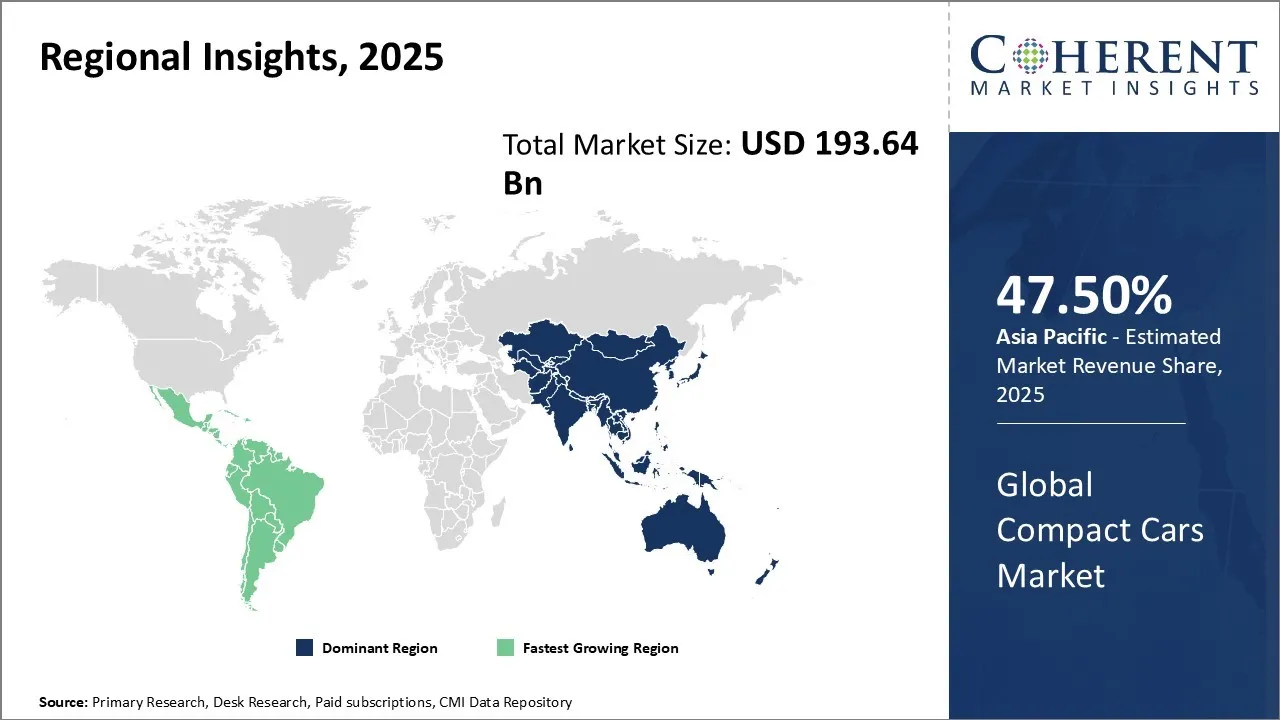
- Asia Pacific is estimated to lead the market with a share of 47.5% in 2026.
- Latin America, holding an estimated share of 8.8% in 2026, is projected to be the fastest growing region.
Market Overview
Current market trends indicate a shift towards electric and hybrid compact cars as environmental regulations tighten worldwide and consumers seek sustainable alternatives. Additionally, integration of smart features such as AI-driven infotainment systems and Advanced Driver-Assistance Systems (ADAS) is becoming standard, enhancing the appeal and usability of compact cars. Automakers are increasingly focusing on lightweight materials and aerodynamic designs to improve fuel efficiency, aligning with global efforts to reduce carbon footprints and promote eco-friendly transportation solutions.
Current Events and their Impact
Current Events | Description and its Impact |
Geopolitical and Trade Developments |
|
Economic and Infrastructure Trends |
|
Segmental Insights
- Current Industry Events of 2026
- Market Size Estimation
- Regional Breakdown
- Competitive Landscape
- Customer Intelligence
- Segmental Analysis
- Pricing Analysis
- Key Market Drivers, Challenges & Future Trends
- Customized Insights Section
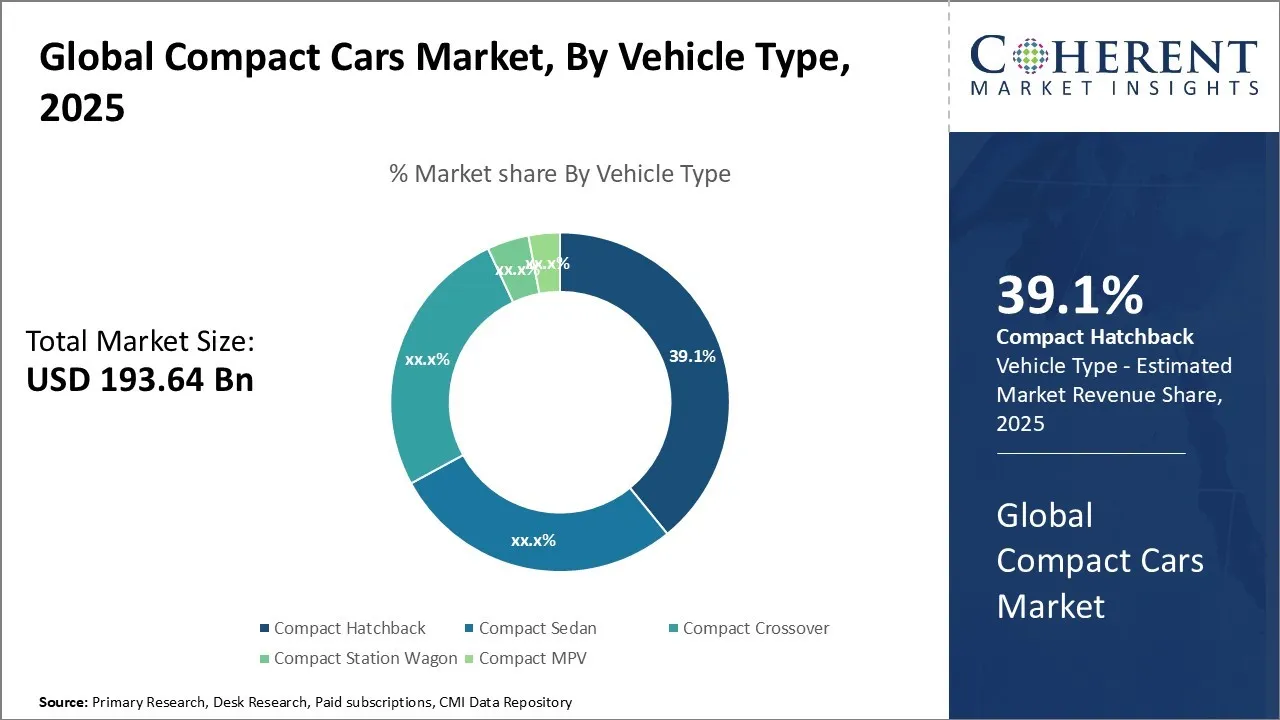
Global Compact Cars Market Insights, By Vehicle Type – Fuel Efficiency and Urban Adaptability are the Key Drivers for Compact Hatchback Dominance
Compact hatchback is expected to contribute the highest share of 40.1% in the market in 2026. Compact hatchbacks are engineered to maximize mileage, making them an attractive option for cost-conscious buyers who prioritize lower running costs amid fluctuating fuel prices. Moreover, the compact dimensions of hatchbacks suit densely populated urban environments, where parking space and maneuverability are often at a premium. Their smaller footprint allows drivers to navigate congested city streets with greater ease compared to larger vehicles, appealing especially to younger, first-time car owners and urban dwellers.
Another significant growth driver is the broad availability of compact hatchbacks across diverse price ranges and feature sets. Manufacturers have expanded offerings from basic, affordable models to more premium versions equipped with advanced technology such as infotainment systems, driver-assistance features, and enhanced safety packages. The popularity of compact hatchbacks also aligns with shifting consumer attitudes toward sustainable and efficient transportation.
Maruti Suzuki Swift (India) – The Swift, a compact hatchback, has consistently ranked among the top 5 best-selling cars in India, with over 2.5 million units sold cumulatively. It combines fuel efficiency (up to 22–24 km/l) with a compact design suited for urban driving. In 2023, Maruti introduced a mild-hybrid variant to further improve mileage and appeal to eco-conscious buyers. As urban centers become more focused on reducing congestion and pollution, smaller, fuel-efficient vehicles naturally gain favor. Additionally, government policies and incentives supporting environment-friendly vehicles in many regions further bolster the segment's appeal.
Pricing Analysis of the Compact Cars Market:
Category/Region | Estimated Average Price (USD) |
World Market Average (2025) | USD 28,500 (Estimate) |
U.S./North America | USD 30,000 (Estimate) |
Europe | USD 29,000 (Estimate) |
Asia Pacific (inc. China, India) | USD 15,500 (Estimate) |
Compact EVs (China exports/ASEAN) | USD 12,000 (Range) |
Bottom-end entry compacts (e.g., Mitsubishi Mirage USA) | USD 19,000 (Base Price) |
Regional Insights
Asia Pacific Compact Cars Market Analysis and Trends
Asia Pacific, holding an estimated share of 47.50% in 2026, dominates the global compact cars market, driven by a combination of large automotive manufacturing hubs, rapidly urbanizing populations, and increasing consumer preference for fuel-efficient, affordable vehicles. Countries such as China, Japan, and South Korea host a robust automotive ecosystem comprising both well-established manufacturers and emerging players, supported by strong supply chains and advanced technology adoption.
Government policies focused on promoting electric and hybrid vehicles further propel this region’s leadership, with incentives, stringent emission regulations, and investment in infrastructure fostering market growth. Notable companies such as Toyota, Honda, Hyundai, Nissan, and Suzuki have deep roots here, contributing significantly through innovation, localized production, and extensive distribution networks.
Latin America Compact Cars Market Analysis and Trends
Latin America, holding an estimated share of 8.8% in 2026, exhibits the fastest growth in the compact cars market due to rising income levels, urban sprawl, and increasing demand for affordable personal transportation. Markets such as Brazil, Mexico, and Argentina benefit from relatively young populations and growing middle classes, sparking demand for compact vehicles that combine economy with practicality in congested urban centers.
Local governments have also begun encouraging modernization of fleets with incentives for fuel-efficient and environmentally friendly vehicles, alongside easing import tariffs and facilitating trade agreements within the region. The automotive industry presence is growing, with companies like Volkswagen, General Motors, and Renault expanding production and tailoring models to local preferences. Additionally, rising investment in dealer networks and after-sales service systems enhances consumer confidence, accelerating the market penetration.
Global Compact Cars Market Outlook for Key Countries
China Compact Cars Market Analysis and Trends
China remains pivotal in the compact car segment thanks to its vast consumer base and aggressive government push towards new energy vehicles within the compact category. Major automakers such as BYD, Geely, and SAIC Motor have leveraged these policies to develop fuel-efficient compact models, including hybrids and electric compacts tailored to urban commuters. The country’s advanced manufacturing infrastructure, extensive supply chain, and a growing focus on smart vehicle integration reinforce its competitive edge, while trade policies promote both domestic sales and exports.
Japan Compact Cars Market Analysis and Trends
Japan continues to lead with a highly mature the compact cars market characterized by innovation, reliability, and a preference for compact designs suitable for dense city environments. Established companies like Toyota, Honda, and Suzuki dominate, with strengths in hybrid technology and fuel efficiency. Government regulations favor low emissions and efficiency, driving continuous product improvements. The industry ecosystem supports research and development, putting Japanese compact cars at the forefront of quality and technology, appealing globally.
U.S. Compact Cars Market Analysis and Trends
The U.S. compact cars market emphasis is shaped by consumer demand shifts toward fuel efficiency and practicality amid fluctuating fuel prices and environmental concerns. Major players such as Ford, Chevrolet, Honda, and Toyota maintain strong footholds with localized manufacturing and marketing strategies tailored to the North America preferences. U.S. government policies promoting clean vehicles and emission standards have accelerated the introduction of hybrid and electric compact models. Trade policies and production capabilities ensure a steady supply of compact cars both from domestic plants and imports.
Brazil Compact Cars Market Analysis and Trends
Brazil compact cars market is expanding due to economic improvements, urban population growth, and increasing demand for affordable, efficient vehicles adapted to local road conditions and fuel types. Domestic assembly plants by companies such as Volkswagen, Fiat, and General Motors support the market by producing compact cars suited for local consumers. Government policies, including tax incentives and trade agreements with neighboring countries, encourage production and the market expansion, while infrastructure development supports growing ownership rates.
Germany Compact Cars Market Analysis and Trends
Germany continues to be a central hub for premium and performance-oriented compact cars, with manufacturers like Volkswagen, BMW, and Mercedes-Benz pushing innovation in compact luxury and sport segments. The country’s strong automotive engineering tradition, investment in autonomous and electric vehicle technologies, and supportive regulatory framework foster a competitive compact car market. Export-driven strategies alongside high domestic demand position Germany as an influential player shaping global compact cars market trends.
Market Players, Key Development, and Competitive Landscape
Key Developments
- In March 2025, Chinese EV maker, Leapmotor, started selling two electric vehicle models at Stellantis dealerships in Britain. Leapmotor launched sales of the T03 compact electric car and the C10, a large electric SUV, with the B10 midsize SUV launching later this year, at 44 Stellantis dealerships.
- In December 2024, Stellantis and CATL reached an agreement to invest up to USD 4.78 billion (€4.1 billion) to form a joint venture that will build a large-scale European Lithium Iron Phosphate (LFP) battery plant in Zaragoza, Spain. Designed to be completely carbon neutral, the battery plant will be implemented in several phases and investment plans.
- In June 2024, Leapmotor International, a 51/49 Stellantis-led company between Stellantis and Leapmotor, shipped the first batch of Leapmotor electric vehicles - C10 SUVs and T03 cars - from Shanghai, China, to European ports this month, marking a significant milestone in the partnership and demonstrating the shared commitment to quickly providing sustainable mobility and innovation to the Europe EV market.
- In March 2024, Kia unveiled the all-new 2025 K4 compact four-door for its global debut at the 2024 New York International Auto Show. As Kia’s fourth-generation compact sedan, the K4 is a powerhouse of standard, segment-above technology, and it delivers Advanced Driver Assistance Systems (ADAS), refinement, and class-leading rear head room and leg room.
Top Strategies Followed by the Compact Cars Market Players
- Established players, typically major automotive manufacturers, invest heavily in research and development (R&D) to drive innovation and deliver high-performance, fuel-efficient, and technologically advanced vehicles.
- Toyota launched the next-generation hybrid powertrain in the 2025 Toyota Corolla and Prius, improving fuel efficiency and performance. This comes after Toyota invested billions in hybrid/EV R&D to maintain its dominance in compact and midsize segments.
- Mid-level players in the compact cars market often adopt a distinctly different approach, focusing primarily on cost-effective solutions that strike a careful balance between quality and affordability.
- Chery Automobile offers the Chery QQ Ice Cream mini EV at USD 4,700, targeting budget-conscious urban buyers in China and exporting to Latin America.
- Small-scale players in the global compact cars market face the challenge of operating amidst intense competition from well-established giants and mid-level companies.
- VinFast (Vietnam), entered the compact EV market with models like the VF 5 and VF e34, targeting urban electric mobility in Southeast Asia and Latin America with subscription-based battery services.
Market Report Scope
Compact Cars Market Report Coverage
| Report Coverage | Details | ||
|---|---|---|---|
| Base Year: | 2025 | Market Size in 2026: | USD 201.58 Bn |
| Historical Data for: | 2020 To 2024 | Forecast Period: | 2026 To 2033 |
| Forecast Period 2026 to 2033 CAGR: | 4.1% | 2033 Value Projection: | USD 267.06 Bn |
| Geographies covered: |
| ||
| Segments covered: |
| ||
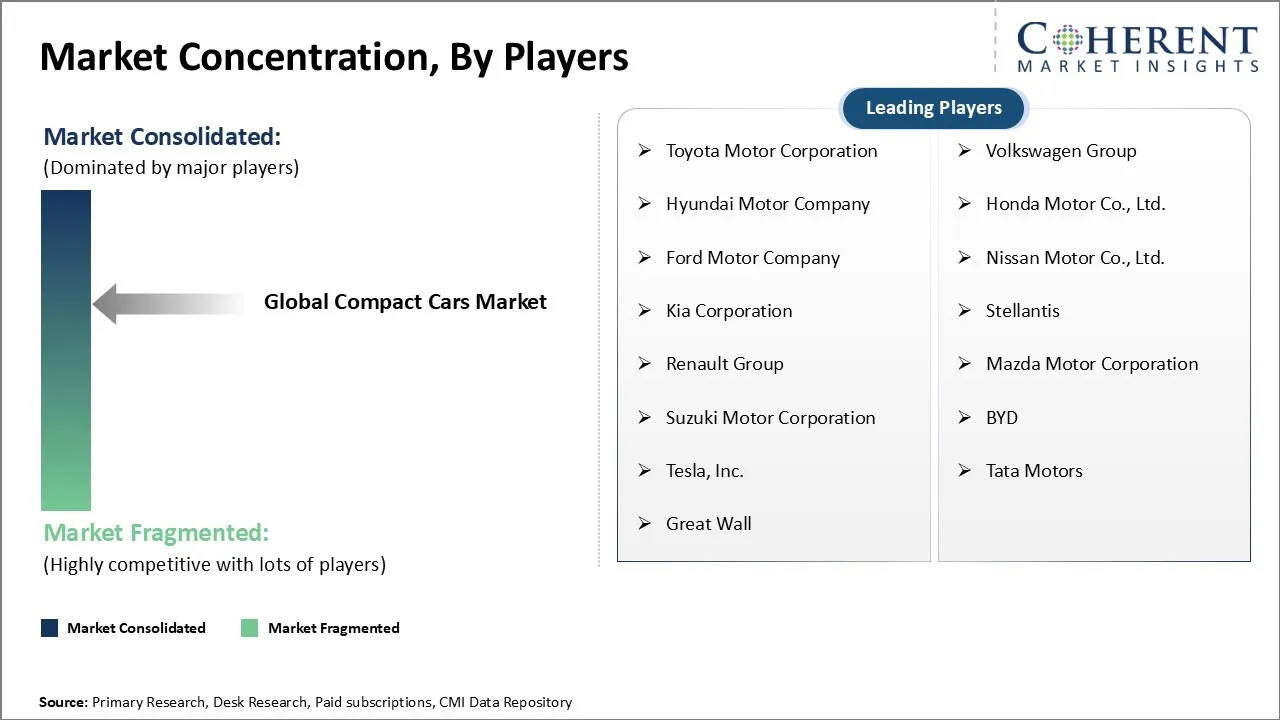
| Companies covered: | Toyota Motor Corporation, Volkswagen Group, Hyundai Motor Company, Honda Motor Co., Ltd., Ford Motor Company, Nissan Motor Co., Ltd., Kia Corporation, Stellantis, Renault Group, Mazda Motor Corporation, Suzuki Motor Corporation, BYD, Tesla, Inc., Tata Motors, and Great Wall | ||
| Growth Drivers: |
| ||
| Restraints & Challenges: |
| ||
Market Dynamics
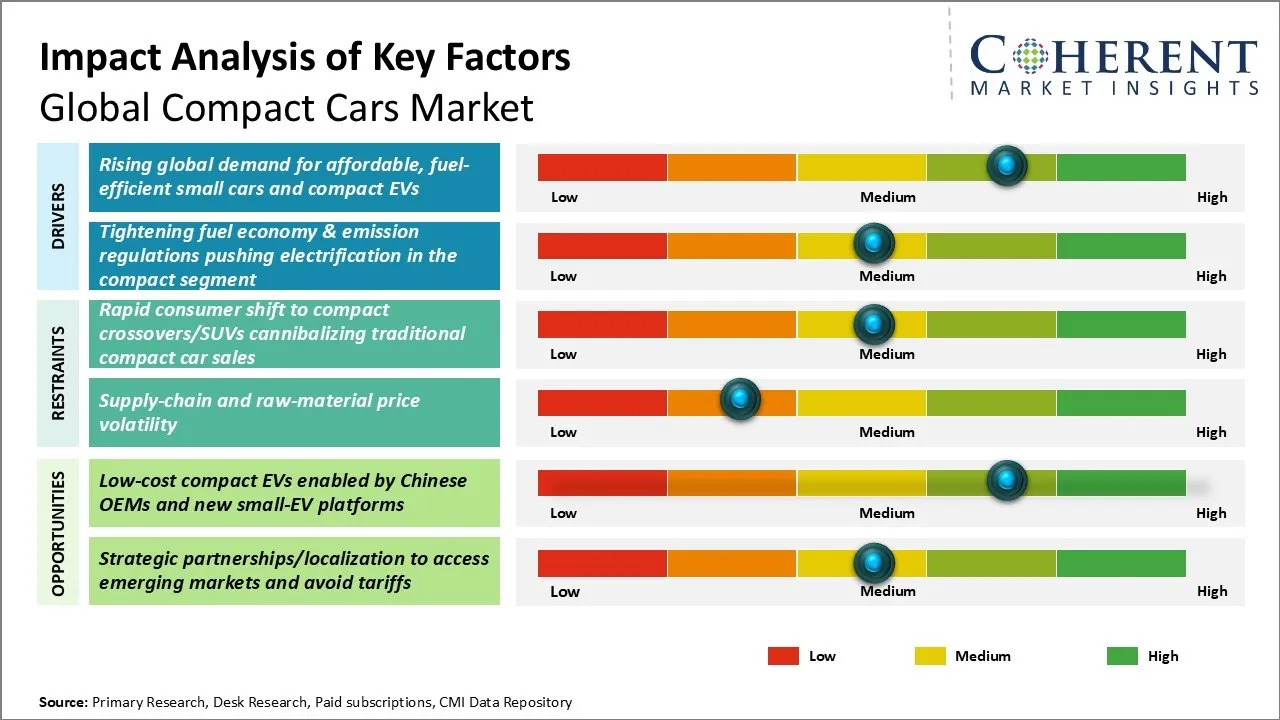
Global Compact Cars Market Driver – Rising Global Demand for Affordable, Fuel-Efficient Small Cars and Compact EVs
The growing emphasis on cost-effective mobility solutions is significantly propelling the demand for compact cars globally, as consumers prioritize affordability without compromising on efficiency. Rising fuel prices and the need for reduced greenhouse gas emissions have heightened interest in vehicles that offer superior fuel economy, making small cars an attractive choice for urban commuters and budget-conscious buyers.
Additionally, advancements in Electric Vehicle (EV) technology have expanded the availability of compact EVs, which combine the benefits of size efficiency with zero-emission driving, further fueling their popularity. Urbanization and increasing traffic congestion also play key roles, as compact vehicles are easier to maneuver and park in crowded city environments. For instance, Honda reintroduced the Civic Hybrid with 50 mpg+ efficiency, positioning it as a compact, fuel-efficient car to meet growing consumer demand for lower-cost and fuel-saving options. Coupled with evolving government incentives promoting eco-friendly transportation, the shift towards smaller, fuel-efficient vehicles reflects broader consumer trends seeking sustainable yet practical transport options for daily use.
Global Compact Cars Market Opportunity – Low-cost Compact EVs Enabled by Chinese OEMs and New Small-EV Platforms
The global compact cars market is witnessing a significant opportunity fueled by the rise of low-cost Electric Vehicles (EVs), primarily driven by Chinese Original Equipment Manufacturers (OEMs) and innovative small-EV platforms. Chinese automakers have aggressively invested in developing affordable compact EVs that cater to the increasing demand for sustainable urban mobility while addressing affordability concerns in emerging and mature markets alike. These manufacturers leverage advanced manufacturing techniques, scalable battery technologies, and localized supply chains to reduce production costs and pass savings onto consumers. Additionally, the proliferation of new small-EV platforms, designed specifically for compact electric vehicles, enables faster product development cycles and greater design flexibility.
For instance, BYD introduced the Seagull compact EV at a starting price of around USD 11,000, built on its e-Platform 3.0. The model quickly became a sales success in China and is planned for exports. Furthermore, governments worldwide continue to bolster support through subsidies, stringent emission regulations, and urban electrification initiatives, which amplifies the attractiveness of low-cost compact EVs. OEMs capitalizing on this opportunity by introducing competitively priced, compact EVs stand to capture growing market share, particularly in densely populated cities and developing economies where compact size and affordability are critical purchasing factors.
Analyst Opinion (Expert Opinion)
- The introduction of scalable EV architectures (e.g., BYD’s e-Platform 3.0, Stellantis–Leapmotor shared platforms) is reshaping affordability benchmarks. These technologies make compact EVs viable at price points under USD 15K, especially in Asia Pacific and Latin America, opening mass-market adoption opportunities.
- With hybrid systems becoming more efficient and cost-competitive, models like the Honda Civic Hybrid (2025) show how OEMs are using advanced hybrid drivetrains as a bridge between ICE dominance and full EV adoption, particularly in North America and regions with limited charging infrastructure.
- Emerging tech like Over-the-Air (OTA) updates, Advanced Driver-Assistance Systems (ADAS), and connected infotainment ecosystems is filtering down from premium to compact segments. This “software-defined car” trend allows compact vehicles to deliver high-value user experiences at lower cost, boosting consumer appeal and differentiating offerings.
Speak to the analyst
Want personalized insights?
Take the findings above to one of our principal consultants, or have the report rebuilt around the segments, geographies and competitors you actually track.
Market Segmentation
- Vehicle Type Insights (Revenue, USD Bn, 2021 - 2033)
- Compact Hatchback
- Compact Sedan
- Compact Crossover
- Compact Station Wagon
- Compact MPV
- Regional Insights (Revenue, USD Bn, 2021 - 2033)
- North America
- U.S.
- Canada
- Latin America
- Brazil
- Argentina
- Mexico
- Rest of Latin America
- Europe
- Germany
- U.K.
- Spain
- France
- Italy
- Russia
- Rest of Europe
- Asia Pacific
- China
- India
- Japan
- Australia
- South Korea
- ASEAN
- Rest of Asia Pacific
- Middle East
- GCC Countries
- Israel
- Rest of Middle East
- Africa
- South Africa
- North Africa
- Central Africa
- North America
- Key Players Insights
- Toyota Motor Corporation
- Volkswagen Group
- Hyundai Motor Company
- Honda Motor Co., Ltd.
- Ford Motor Company
- Nissan Motor Co., Ltd.
- Kia Corporation
- Stellantis
- Renault Group
- Mazda Motor Corporation
- Suzuki Motor Corporation
- BYD
- Tesla, Inc.
- Tata Motors
- Great Wall
Sources
Primary Research Interviews
Stakeholders
- Automotive OEM Executives
- Compact Car Component Suppliers
- Electric Vehicle (EV) Battery Manufacturers
- Regional Dealerships and Auto Distributors
- Automotive Finance & Leasing Firms specializing in compact vehicles
- Urban Mobility Experts and Smart City Planners (for EV adoption trends)
Databases
- Eurostat
- U.S. Census
- Automotive Global Database
- OECD
- International Energy Agency (IEA) EV Data
Magazines
- Automotive Today
- Car and Driver
- Auto Trends Magazine
- Green Mobility Review
Journals
- Journal of Automobile Engineering
- International Journal of Automotive Technology
- Journal of Cleaner Production (Automotive Special Issues)
- Transportation Research Part D Transport and Environment
- SAE International Journal of Passenger Cars
Newspapers
- The Detroit News (U.S.)
- Nikkei Asia (Japan)
- The Guardian (UK)
- The Economic Times (India)
- Automotive News Europe
Associations
- International Organization of Motor Vehicle Manufacturers (OICA)
- European Automobile Manufacturers’ Association (ACEA)
- Society of Indian Automobile Manufacturers (SIAM)
- Japan Automobile Manufacturers Association (JAMA)
- American Automotive Policy Council (AAPC)
Public Domain Sources
- U.S. Census Bureau
- EUROSTAT
- United Nations Economic Commission for Europe (UNECE)
- World Bank
- ResearchGate
Proprietary Elements
- CMI Data Analytics Tool
- Proprietary CMI Existing Repository of information for last 8 years
Get access to 250+ pages report
Every segment, forecast, competitor profile and data table behind the analysis above — available for instant download.
- ESOMAR Member
- ISO 9001:2015 Certified
- D-U-N-S Registered
- GDPR & CCPA Compliant
Missing comfort of reading report in your local language? Find your preferred language:
Transform your Strategy with Exclusive Trending Reports
Frequently Asked Questions
The global compact cars market is estimated to be valued at USD 201.58 Bn in 2026 and is expected to reach USD 267.06 Bn by 2033.
The CAGR of the global compact cars market is projected to be 4.1% from 2026 to 2033.
Rising global demand for affordable, fuel-efficient small cars and compact EVs and tightening fuel economy & emission regulations pushing electrification in the compact segment are the major factors driving the growth of the global compact cars market.
Rapid consumer shift to compact crossovers/SUVs cannibalizing traditional compact car sales and supply-chain and raw-material price volatility are the major factors hampering the growth of the global compact cars market.
In terms of vehicle type, the compact hatchback segment is estimated to dominate the market revenue share in 2026.
Toyota Motor Corporation, Volkswagen Group, Hyundai Motor Company, Honda Motor Co., Ltd., Ford Motor Company, Nissan Motor Co., Ltd., Kia Corporation, Stellantis, Renault Group, Mazda Motor Corporation, Suzuki Motor Corporation, BYD, Tesla, Inc., Tata Motors, and Great Wall are the major players.
Asia Pacific is expected to lead the global compact cars market in 2026.