

Global Crude Oil Desalter Market Size and Forecast – 2026-2033
The global crude oil desalter market is estimated to be valued at USD 270.6 Mn in 2026 and is expected to reach USD 395.4 Mn by 2033, exhibiting a compound annual growth rate (CAGR) of 5.6% from 2026 to 2033.
Key Takeaways of the Crude Oil Desalter Market
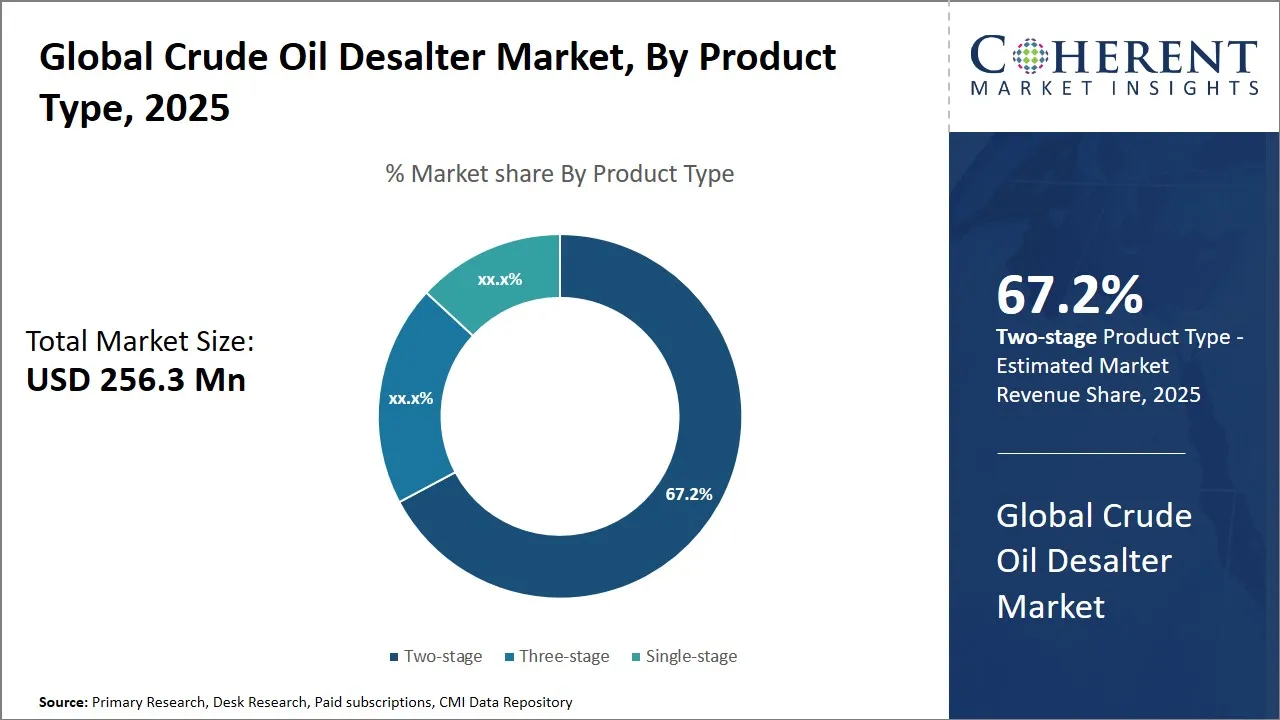
- The two-stage segment is expected to account for 68.2 % of the global crude oil desalter market share in 2026.
- The fully automated segment is projected to capture 54.10 % of the market share in 2026.
- The AC type segment is expected to hold 46.94 % of the crude oil desalter market share in 2026.
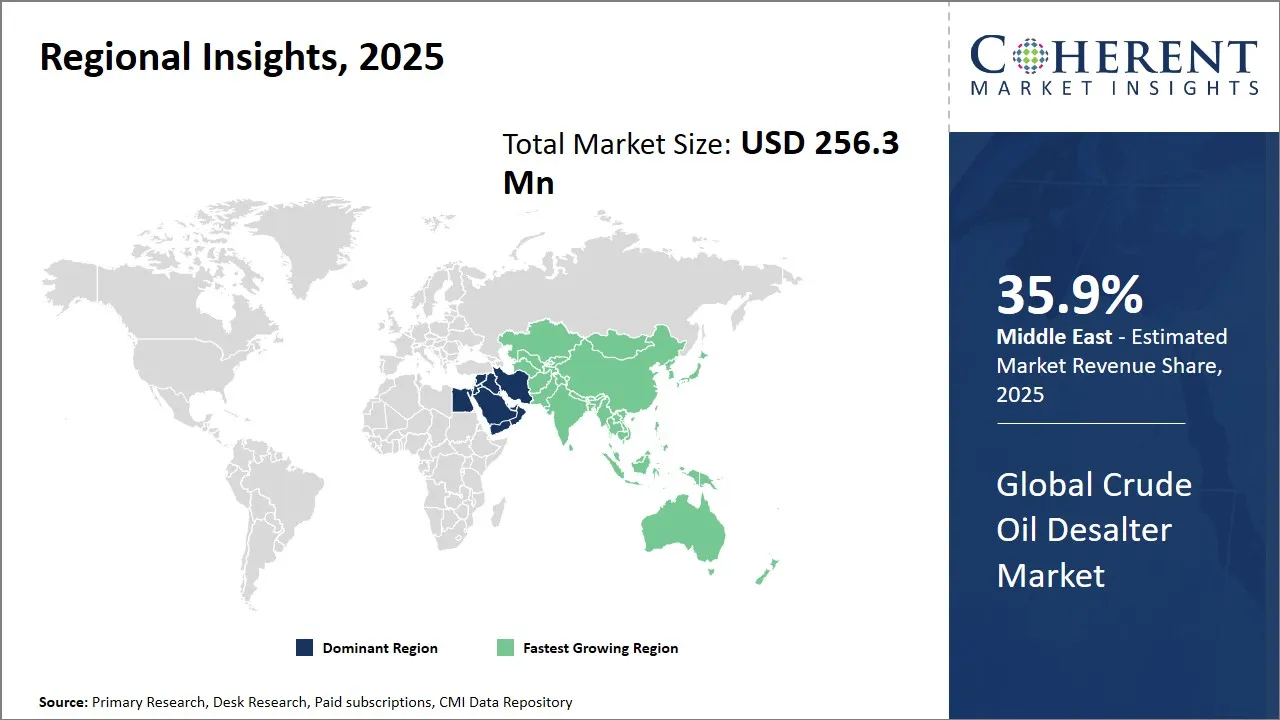
- The Middle East will dominate the global crude oil desalter market in 2026 with a 35.9 % share. Asia Pacific, holding 24.5% in 2026, is projected to be the fastest-growing region.
Market Overview
In terms of market trends, a major shift in the industry is towards adoption of improved and automated desalter systems that enhance crude oil quality and reduce costs and environmental risks. Regulatory pressure to lower the level of sulfur and other impurities in crude oil is also driving investment in better desalting technologies. The trend towards sustainability and reduction of greenhouse gas emissions in the oil and gas chemicals industry also promotes innovation and deployment of next-generation desalter technologies, globally and in emerging markets.
Current Events and Its Impact
Current Events | Description and its Impact |
Shift toward heavier, more contaminated crude feedstocks |
|
Refinery closures and capacity risk in mature regions |
|
Segmental Insights
- Current Industry Events of 2026
- Market Size Estimation
- Regional Breakdown
- Competitive Landscape
- Customer Intelligence
- Segmental Analysis
- Pricing Analysis
- Key Market Drivers, Challenges & Future Trends
- Customized Insights Section
Crude Oil Desalter Market Insights, By Product Type - Two-Stage Segment Dominates the Market due to Advanced Efficiency and Enhanced Performance
Two-stage segment is expected to command 68.2% of the market share in 2026, mainly because of its high efficiency and operational reliability for dealing with complex crude oil emulsions. Two-stage desalters are designed to handle higher quantities of salts, solids, and water content compared to single-stage units. That is why they are highly appreciated in refineries dealing with heavier or more contaminated crude oils. Carrying out desalting in two successive steps enhances the feedstock quality tremendously and directly boosts the efficiency of downstream refining units by reducing corrosion, fouling, and equipment wear.
One of the main driving forces for adopting two-stage desalters in refineries is their efficiency in salt removal, generally greater than 90%, which is necessary to meet the stringent refinery feed specifications. This efficiency leads to lower operating costs due to a reduction in maintenance needs and prolonged life span in catalytic units. In addition, two-stage systems offer flexibility when crude oils of disparate quality need to be handled; refiners can adjust operations dynamically without compromising desalting effectiveness.
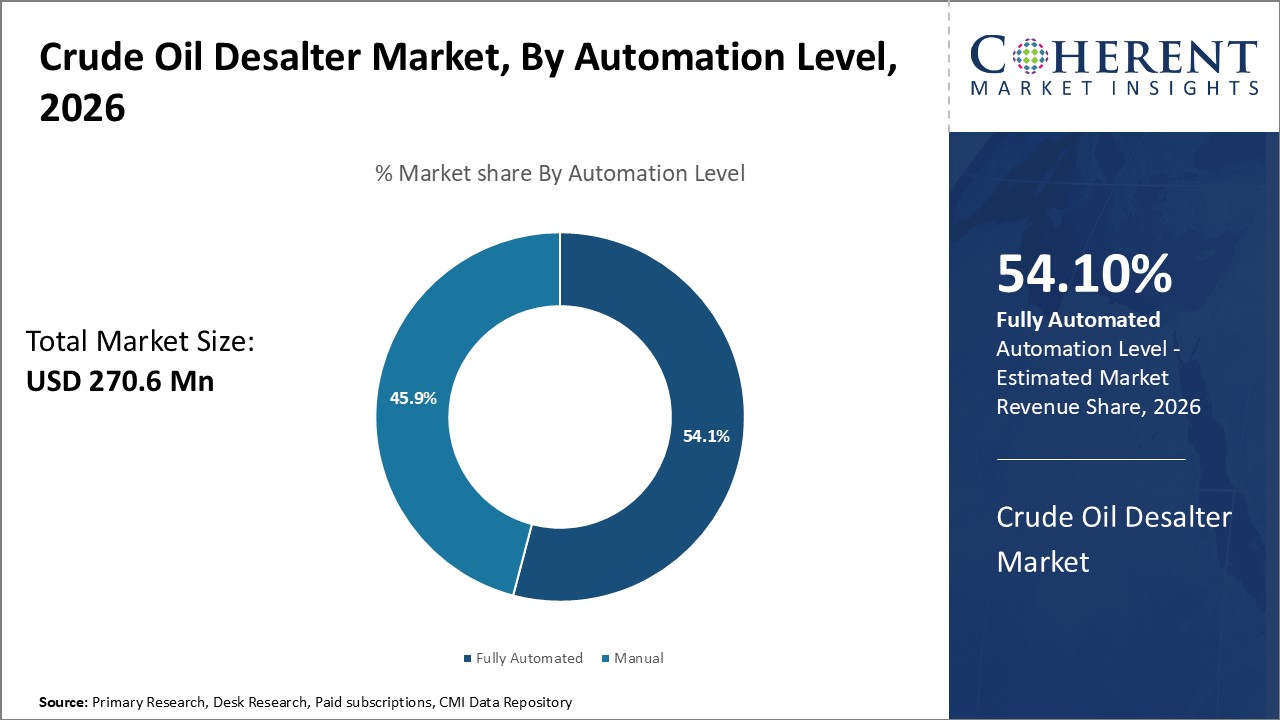
Crude Oil Desalter Market Insights, By Automation Level - Fully Automated Segment Dominates the Market due to Increasing Operational Efficiency and Safety
Fully automated segment is projected to hold 54.10% of the market share in 2026, driven primarily by the industry's intensified focus on operational efficiency, safety, and process consistency. Automation in crude oil desalting allows precise control over the critical parameters such as temperature, electrical field strength, chemical dosing, and wash water injection that enable refiners to achieve optimal desalting performance with minimum human intervention.
The main driving factors behind the demand for fully automated desalters are a reduction in manual operational errors and increased ability for real-time monitoring. Automation systems integrate advanced sensors and process control algorithms that maintain stable conditions of emulsification-water separation, even when crude feed characteristics change. This stability limits downtime and reduces risks associated with salt and water carryover into distillation units that might cause corrosion and fouling.
Crude Oil Desalter Market Insights, By Type - AC Type Segment Dominates the Market due to Superior Electrification and Versatility
AC type segment is expected to hold 46.94% share in 2026, primarily due to their versatility and established performance in many operating situations. The application of an AC-based electric field in these desalters facilitates the coalescence and separation of water droplets and salts from crude oil emulsions leading to high recovery rates and quality crude feedstocks for further refining.
The main driving forces for the preference of the AC type of desalters are their robust performance in a wide range of crude oil viscosities and compositions. AC electric fields promote superior charge movement and droplet coalescence, which is so vital when feedstocks may contain varying quantities of salts and suspended solids. Because of this feature, mixed crude slates could be processed without extensive adjustment by the refiner, increasing plant flexibility and reducing processing bottlenecks.
Regional Insights
Middle East Crude Oil Desalter Market Analysis and Trends
The Middle East region is projected to lead the market with a 35.9% share in 2026, due to its large reserves of oil and dominance in crude oil production on the global scale. The region, especially countries such as Saudi Arabia, the U.A.E., and Kuwait, has a very strong infrastructure for refining that is designed to process several of the world's heaviest and most sulfur-rich crude oils. This has increased the need for advanced desalter technologies capable of efficiently removing salts and other impurities, thereby ensuring smooth operation of subsequent processes.
The major players in the Middle East market - namely: Saudi Aramco, ADNOC, and KPC - have committed significant resources to the development of improved desalting technologies to meet operational and environmental Standards. Due to the serious implications associated with refinery equipment corrosion, fouling, and catalyst poisoning, these companies have significantly invested in increasing the efficiency of crude oil refining; specifically, heavy crudes. Furthermore, the region's focus on sustainability and alignment to international environmental legislation contributes to pushing refiners towards modernization of their desalting technologies, thus driving the market growth.
Asia Pacific Crude Oil Desalter Market Analysis and Trends
The Asia Pacific region is expected to exhibit the fastest growth in the market, contributing 24.5% share in 2026, due to the rapid expansion of refining capacity by countries like China, India, and Southeast Asia. This growth is underpinned by strong government initiatives aimed at boosting energy security and modernizing refinery infrastructure, including policies encouraging cleaner fuel production and reducing environmental impact.
The ecosystem here is evolving with increased investments from domestic and international industry leaders like Honeywell UOP, Larsen & Toubro, and China Petroleum Engineering & Construction Corporation. This surge in industry is supplemented by the rise in crude oil imports, which comprises several qualities needing sophisticated desalting technologies. Further acceleration to the market comes through trade liberalization and cross-border collaborations in this dynamic region.
Crude Oil Desalter Market Outlook for Key Countries
U.S. Crude Oil Desalter Market Analysis and Trends
The U.S. has a robust refining sector, which forms the basis for the crude oil desalter market in the country, with a focus on innovation and sustainability. Major players such as Schlumberger and Halliburton have deployed state-of-the-art desalting technologies that enhance crude processing efficiency while meeting stern environmental norms. The government's regulatory framework is helpful in encouraging the adoption of advanced desalting equipment, keeping the market competitive as well as technologically superior. Strong upstream and downstream integration in the oil and gas industry supports continuous demand for effective desalting solutions.
China Crude Oil Desalter Market Analysis and Trends
A rapid rise is seen in China' crude oil desalter market, with increasing efforts put into the upgrade of refining infrastructure as crude imports are rising. Companies like Honeywell UOP and China Petroleum Engineering & Construction Corporation offer advanced technologies, especially designed for processing diverse types of crude blends. Government regulations on energy efficiency and emissions control significantly impact the industry, coupled with huge investments in new refineries and petrochemical centers. Greater attention to meeting environmental requirements enhances the demand for more efficient desalter technologies.
India Crude Oil Desalter Market Analysis and Trends
India continues to drive the growth in Asia Pacific's crude oil refining expansion, particularly relying heavily on homegrown refiners including Indian Oil Corporation and Reliance Industries. Encouragement by the government toward cleaner fuels and modernization of infrastructure favors the adoption of advanced technologies for crude oil desalting to improve refinery yields and lower corrosion-related issues. Partnerships with technology providers, such as Honeywell UOP and Larsen & Toubro, allow the introduction of customized solutions considering the diverse quality of crude oil and refinery configurations in India. Furthermore, supportive regulatory reforms toward industrial sustainability enhance market development.
Saudi Arabia Crude Oil Desalter Market Analysis and Trends
Saudi Arabia crude oil desalter market benefits from its position as a leading oil producer with extensive refining operations managed by Saudi Aramco and SABIC. The country is focused on improving refinery output by integrating state-of-the-art desalting technologies that will prevent the salinity of feedstock from causing costly corrosion to valuable downstream processing equipment. Government investments in downstream diversification under Vision 2030 have encouraged modernization of existing desalting units and the deployment of new systems across mega refinery projects. Collaborations with international providers such as Baker Hughes facilitate technology transfer and improved operational efficiency.
Brazil Crude Oil Desalter Market Analysis and Trends
Brazil crude oil desalter market is affected by an increase in oil production in Brazil - primarily from offshore posts where crude oil contains high salt content that need better desalting and handling to improve refinery operation. Demand from Petrobras, Brazil's national oil company (NOC), for efficient desalter solutions remains an important driver for maintaining performance of refinery processes and safeguarding refinery and supporting infrastructure.
There is a responsiveness by the government through policies, legislation and incentives to increase refining capacity, while maintaining operating and environmental standards in Brazil, which is beneficial for the acceptance of novel desalting technology by the petroleum fiend in Brazil. Collaboration between Petrobras and industry players such as Schlumberger provides an avenue for desalting units to be customized for novel operating challenges unique to Brazil, and provides the opportunity for the desalter market to grow in Brazil.
Technology Adoption Curve (Automation, Real-Time Monitoring, AI Integration)
- The crude oil desalter industry is rapidly moving toward technologies such as automation, real-time monitoring, and AI technology. Modern control systems enhance the ability to closely monitor and control water-to-oil ratios, temperature, and pressure in desalting.
- With real-time monitoring, AI-enhanced analytics, IoT sensors, and predictive maintenance, clients will experience increased efficiency and productivity with less downtime, as well as more useful data to determine when maintenance needs to be scheduled.
- Digital technology in oil and gas is expected to increase by 15% as seen in other industries as market demands increase for efficiency, safety, and data-driven decision-making.
- Adoption of alternative crude oil desalter technologies such as electrostatic desalting and membrane desalting is also increasing. These technologies offer more reliability, less chemicals, and less impact and damage to the environment than traditional methods.
Impact of Crude Quality Shifts (Heavy vs Light Imports) on Desalter Design
- Heavy crude oil has a high level of impurities such as asphaltenes, solids, and salts, along with high viscosity, and places more demands on desalter equipment with deeper rag layers, closer grid velocities, and more aggressive solid removal methods.
- Heavy crude oil will usually require multi-stage desalting (up to 97 to 99% salt removal using two-stage desalters compared to 85 to 90% removal in a single stage) and the use of polymer additives, and even to keep up with the frequent cleaning of their electrode and mud-washing systems.
- Heavy crudes typically require blending with lighter crudes in order to get an optimal API gravity to desalting and avoid asphaltene precipitation.
- Light crude oils have lower viscosity and impurity content, which permits a simpler single-stage desalter setup and reduces the overall complexity of operations.
- Shifts in import patterns towards heavier crudes have required refiners to upgrade or redesign their desalters to have components with high-temperature ratings, better solids management equipment and improved emulsion breakers.
Market Players, Key Development, and Competitive Intelligence
Key Developments
- In October 2025, Kent was awarded the Front-End Engineering Design (FEED) contract for the Khafji Desalter and Water Treatment Plant & Related Facilities Upgrade (UDWT) Project by Al-Khafji Joint Operations (KJO), a partnership between Aramco Gulf Operations Co. (AGOC) and Kuwait Gulf Oil Co. (KGOC).
- In January 2025, the refinery announced that all its partners, including Ardova, Heyden and MRS Holdings, would supply petrol at a nationwide retail price of N970 per liter.
Top Strategies Followed by Global Crude Oil Desalter Market Players
- The primary focus for leading players in the market is to invest substantial resources in research and development (R&D) in order to develop high-efficiency desalter products that satisfy rigorous industry requirements and changing customer expectations of crude oil refining. Once established, players invest a notable part of their budget to develop innovative technologies to promote efficiency, lower operating costs, and improve meeting environmental regulations. The leading players are also aggressively pursuing global expansion by diversifying their distribution channels and project horizon into emerging markets in Asia Pacific, the Middle East, and Africa, where the demand is spurred by growing refining capability and industrial expansion.
- For example, Alfa Laval, a global leader in the separation and filtration systems industry, created advanced desalter technology which allows oils to be acceptable by not only improving salt removal but by also reducing energy requirements. This allows refiners to comply with growing environmental regulations related to water usage and discharge and to optimize their refineries.
- Mid-market players in the crude oil desalter market take a different approach to competition by offering price conscious solutions that provide price equivalency between quality and value. These players primarily target segments of the market which are price sensitive, including smaller refiners or independent oil companies looking for dependable desalter technology at value added cost
- As an example, SLB (Cameron), developed portable desalter units for smaller refineries that enable them to process high-salt crude with lower operational expense. Mid-tier companies oftentimes form partnerships and joint ventures to enhance their technology.
- Small firms operating in the crude oil desalter market distinguish themselves by emphasizing special features and novel product designs for their niche applications and geographic regions. These manufacturers use their nimbleness and rapid embrace of emerging technologies by incorporating new innovations such as IoT-enabled monitoring, automation, and energy-efficient designs into their offerings, ultimately offering differentiation and value to their customers to remain competitive against larger firms.
- For example, Trican Well Service developed a mobile desalter system for small refineries or remote operations where a large, more fixed desalter system is not practical. These smaller firms are taking advantage of their flexibility and speed to adopt new technologies as a point of differentiation from larger firms.
Market Report Scope
Crude Oil Desalter Market Report Coverage
| Report Coverage | Details | ||
|---|---|---|---|
| Base Year: | 2025 | Market Size in 2026: | USD 270.6 Mn |
| Historical Data for: | 2020 To 2024 | Forecast Period: | 2026 To 2033 |
| Forecast Period 2026 to 2033 CAGR: | 5.6% | 2033 Value Projection: | USD 395.4 Mn |
| Geographies covered: |
| ||
| Segments covered: |
| ||
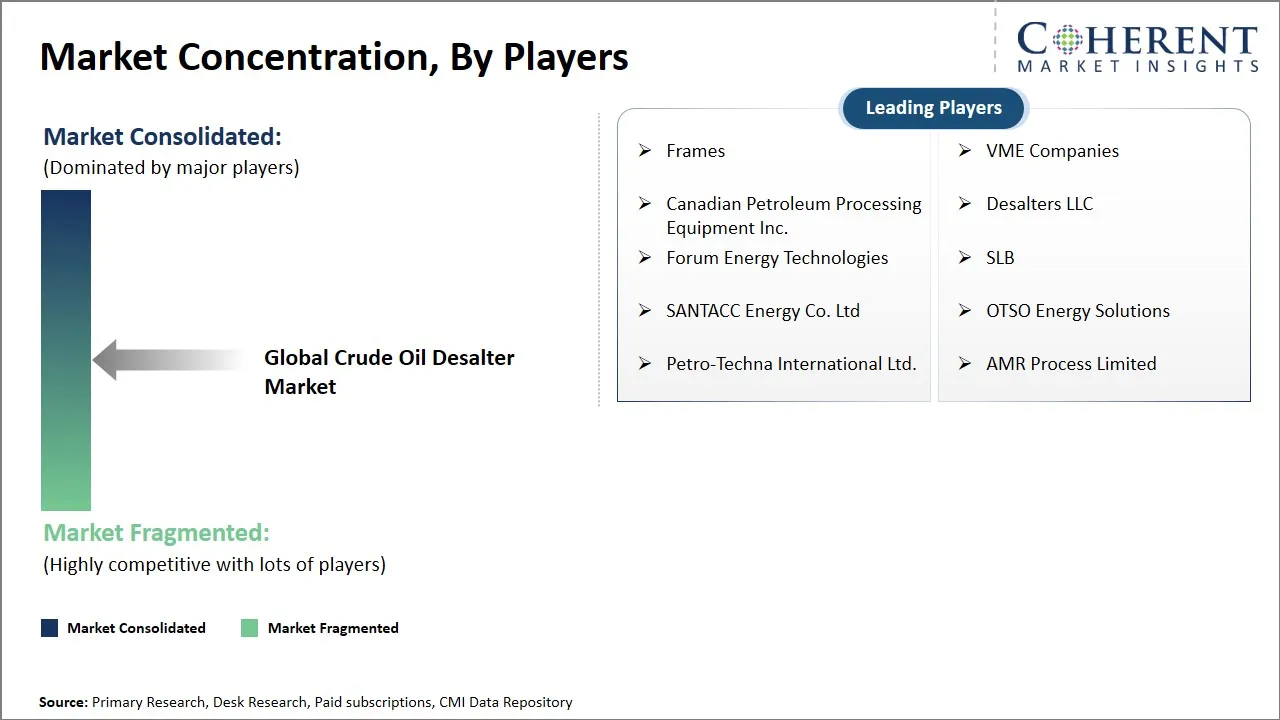
| Companies covered: | Frames, VME Companies, Canadian Petroleum Processing Equipment Inc., Desalters LLC, Forum Energy Technologies, SLB, SANTACC Energy Co. Ltd, OTSO Energy Solutions, Petro-Techna International Ltd., and AMR Process Limited | ||
| Growth Drivers: |
| ||
| Restraints & Challenges: |
| ||
Crude Oil Desalter Market Dynamics
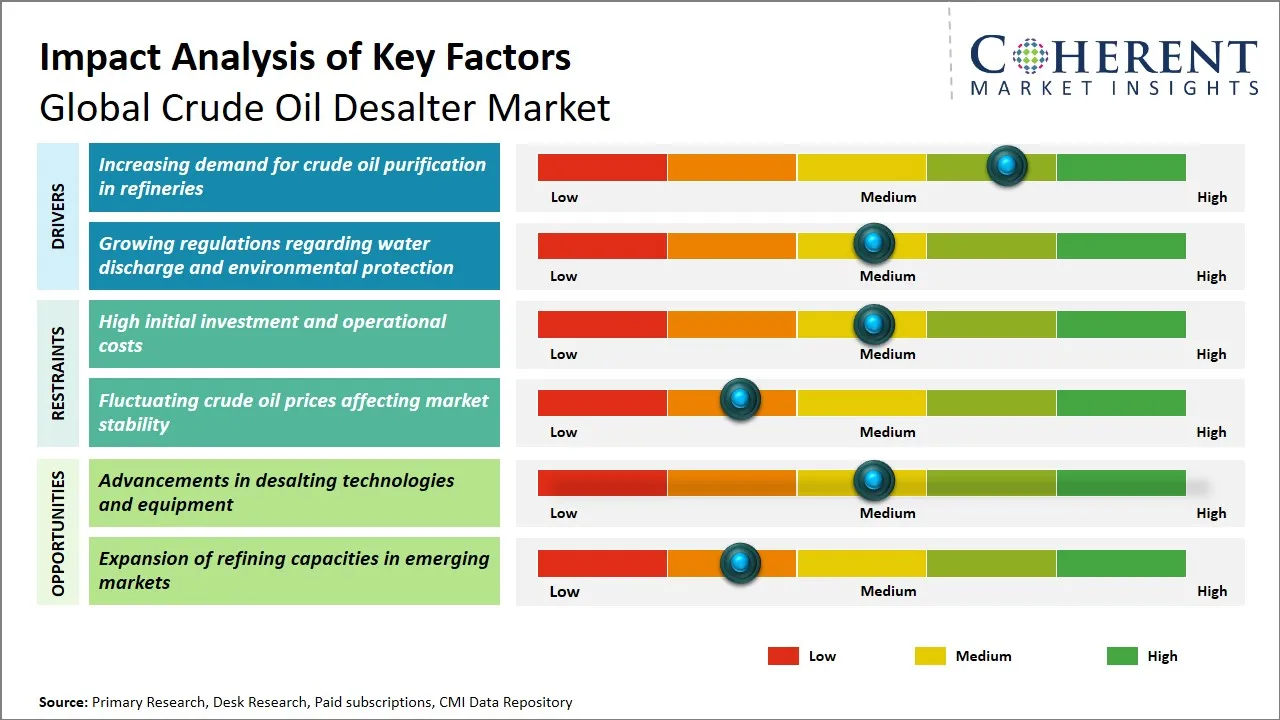
Crude Oil Desalter Market Driver - Increasing Demand for Crude Oil Purification in Refineries
The rising complexity of crude oil feedstocks and increasing focus on producing more quality end products has amplified the need to ensure effective crude oil purification functionality in refineries. As desalters handle heavier and more sulfur-rich crudes, more effective desalting becomes highly important to mitigate risks associated with downstream equipment, corrosion, fouling, and catalyst poisoning. Effective desalting of salts and impurities not only provides operational efficiencies in refining units, but, in the process, ensures regulatory requirements for hazardous emissions under operating conditions are met.
For example, Saudi Aramco, as an illustration of the world's biggest oil producers, has upgraded its desalting units with investment emphasis to handle sour crudes to keep refinery efficiency level. Improving desalter functionality helps to maintain efficient production by minimizing catalyst poisoning and corrosion of equipment, therefore creates cost savings and improves product quality.
Crude Oil Desalter Market Opportunity - Advancements in Desalting Technologies and Equipment
As a result of new desalting technologies and equipment, the global crude oil desalter market has the potential to be significantly lucrative as a growth opportunity. Advances such as new electrical desalting units, enhanced chemical dosing systems and automated controls, are enhancing the efficiency and efficacy of crude oil desalting processes. These advances will reduce the quantity of water and wastewater treatment chemicals required, reduce any operational costs, and reduce environmental concerns - a focus of industry sustainability initiatives on an upward trend in the oil and gas industry.
For example, Chevron has developed a new automated desalter systems that will enhance the efficiency in salt removal while reducing water and chemical consumption.
Analyst Opinion (Expert Opinion)
- The crude oil desalter market is set for a sizable expansion, driven by a growing necessity for cleaner fuels and stricter environmental regulations. Highlights from the World Petroleum Congress (2023) and the Oil & Gas Technology Conference (2022) indicated exciting advances, specifically companies like Schlumberger and Honeywell leading the innovation in desalter technologies.
- A recent showcase of Schlumberger's high efficiency electrostatic desalter that consumes less energy and performs more efficiently in separation demonstrates the market's demand for higher processing nuanced capabilities at the refinery. At the conferences, the speakers emphasized how crucial desalters are for reducing contaminants and improving crude oil quality, especially for low sulfur fuel.
- The challenges often mentioned about expanding the market were high capital costs and updating old infrastructure. Companies that focus on research and development of cost-effective and efficient desalter solutions, while also creating strong partnerships with refiners, are likely to gain a competitive advantage.
Speak to the analyst
Want personalized insights?
Take the findings above to one of our principal consultants, or have the report rebuilt around the segments, geographies and competitors you actually track.
Market Segmentation
- Product Type Insights (Revenue, USD Mn, 2021 - 2033)
- Two-stage
- Three-stage
- Single-stage
- Automation Level Insights (Revenue, USD Mn, 2021 - 2033)
- Fully Automated
- Manual
- Type Insights (Revenue, USD Mn, 2021 - 2033)
- AC Type
- DC Type
- AC-DC Type
- Capacity Outlook Insights (Revenue, USD Mn, 2021 - 2033)
- 25,000 bpd to 40,000 bpd
- Upto 25,000 bpd
- Above 40,000 bpd
- End-use Industry Insights (Revenue, USD Mn, 2021 - 2033)
- Refineries
- Oil and Gas
- Petrochemical
- Other End-use Industries
- Regional Insights (Revenue, USD Mn, 2021 - 2033)
- North America
- U.S.
- Canada
- Latin America
- Brazil
- Argentina
- Mexico
- Rest of Latin America
- Europe
- Germany
- U.K.
- Spain
- France
- Italy
- Russia
- Rest of Europe
- Asia Pacific
- China
- India
- Japan
- Australia
- South Korea
- ASEAN
- Rest of Asia Pacific
- Middle East
- GCC Countries
- Israel
- Rest of Middle East
- Africa
- South Africa
- North Africa
- Central Africa
- North America
- Key Players Insights
- Frames
- VME Companies
- Canadian Petroleum Processing Equipment Inc.
- Desalters LLC
- Forum Energy Technologies
- SLB
- SANTACC Energy Co. Ltd
- OTSO Energy Solutions
- Petro-Techna International Ltd.
- AMR Process Limited
Sources
Primary Research Interviews
- R&D Director – Leading Crude Oil Processing Equipment Manufacturer
- Procurement Manager – Major Oil Refinery Operator
- Product Development Head – Well-Known Oilfield Services Company
- Sustainability Manager – Oil & Gas Environmental Compliance Body
Stakeholders
- Equipment Manufacturers and Suppliers
- Oil Refining Companies
- Regulatory & Certification Bodies (EPA, equivalent regional bodies)
- Engineering, Procurement, and Construction (EPC) Firms
- Technology Providers: Advanced desalting process and automation integrators
- Consulting and Research Firms in Oil Processing Technologies
Databases
- UN Comtrade Database – Crude Oil Processing Equipment Trade Data
- India Import Export (EXIM) Database – Desalter Equipment Imports/Exports
Magazines
- Oil & Gas Journal – Market trends and technology in crude oil desalting
- Hydrocarbon Processing – Innovations in oil desalting and refining processes
- Refining & Petrochemicals Magazine – Equipment market and regulatory updates
- Petroleum Economist – Global crude oil refining market insights
Journals
- Journal of Petroleum Science and Engineering – Technical papers on crude oil desalting
- Energy & Fuels – Advances in refining and oil treatment processes
- Chemical Engineering Research and Design – Desalting process optimization studies
- Journal of Cleaner Production – Environmental impact and sustainability in oil desalting
Newspapers
- The Financial Times – Market growth and investment in crude oil processing
- The Wall Street Journal – Industry developments and company strategies
- The New York Times – Environmental regulations impacting oil refining
- Reuters Energy News – Global oil market dynamics and technology trends
Associations
- American Petroleum Institute (API)
- International Association of Oil & Gas Producers (IOGP)
- National Petrochemical & Refiners Association (NPRA)
- Society of Petroleum Engineers (SPE)
- Environmental Protection Agency (EPA)
Public Domain Sources
- U.S. Environmental Protection Agency (EPA) – Guidelines and regulations for crude oil desalting
- European Commission – Environmental standards for oil refining processes
- International Energy Agency (IEA) – Reports on crude oil processing and refinery technology
- Organisation of the Petroleum Exporting Countries (OPEC) – Market outlook and production standards
Proprietary Elements
- CMI Data Analytics Tool, Proprietary CMI Existing Repository of information for last 8 years.
Get access to 250+ pages report
Every segment, forecast, competitor profile and data table behind the analysis above — available for instant download.
- ESOMAR Member
- ISO 9001:2015 Certified
- D-U-N-S Registered
- GDPR & CCPA Compliant
Missing comfort of reading report in your local language? Find your preferred language:
Transform your Strategy with Exclusive Trending Reports
Frequently Asked Questions
The global crude oil desalter market is estimated to be valued at USD 270.6 Mn in 2026 and is expected to reach USD 395.4 Mn by 2033.
The CAGR of the global crude oil desalter market is projected to be 5.6% from 2026 to 2033.
Increasing demand for crude oil purification in refineries and growing regulations regarding water discharge and environmental protection are the major factors driving the growth of the global crude oil desalter market.
High initial investment and operational costs and fluctuating crude oil prices affecting market stability are the major factors hampering the growth of the global crude oil desalter market.
In terms of product type, the two-stage segment is estimated to dominate the market revenue share in 2026.
Frames, VME Companies, Canadian Petroleum Processing Equipment Inc., Desalters LLC, Forum Energy Technologies, SLB, SANTACC Energy Co. Ltd, OTSO Energy Solutions, Petro-Techna International Ltd., and AMR Process Limited are the major players.
Middle East is expected to lead the global crude oil desalter market in 2026.