

Global Data Relay Satellite Market and Forecast – 2026 to 2033
Coherent Market Insights estimates that the global data relay satellite market is expected to reach USD 9.5 Bn in 2026 and will expand to USD 18 Bn by 2033, registering a CAGR of 10% between 2026 and 2033.
Key Takeaways of the Data Relay Satellite Market
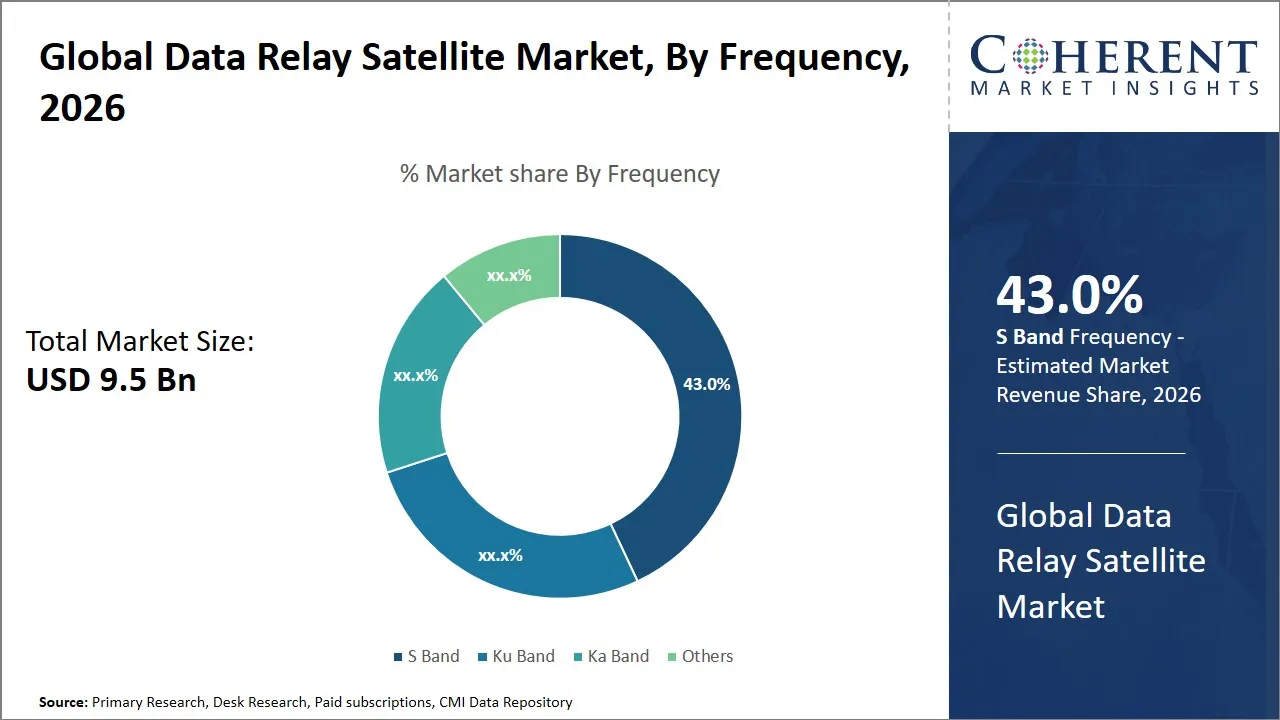
- The S Band segment is expected to account for 43% of the data relay satellite share in 2026.
- The communication segment is estimated to capture 47% of the global satellite manufacturing market share in 2026.
- The civil segment is projected to hold 44% of the market share in 2026.
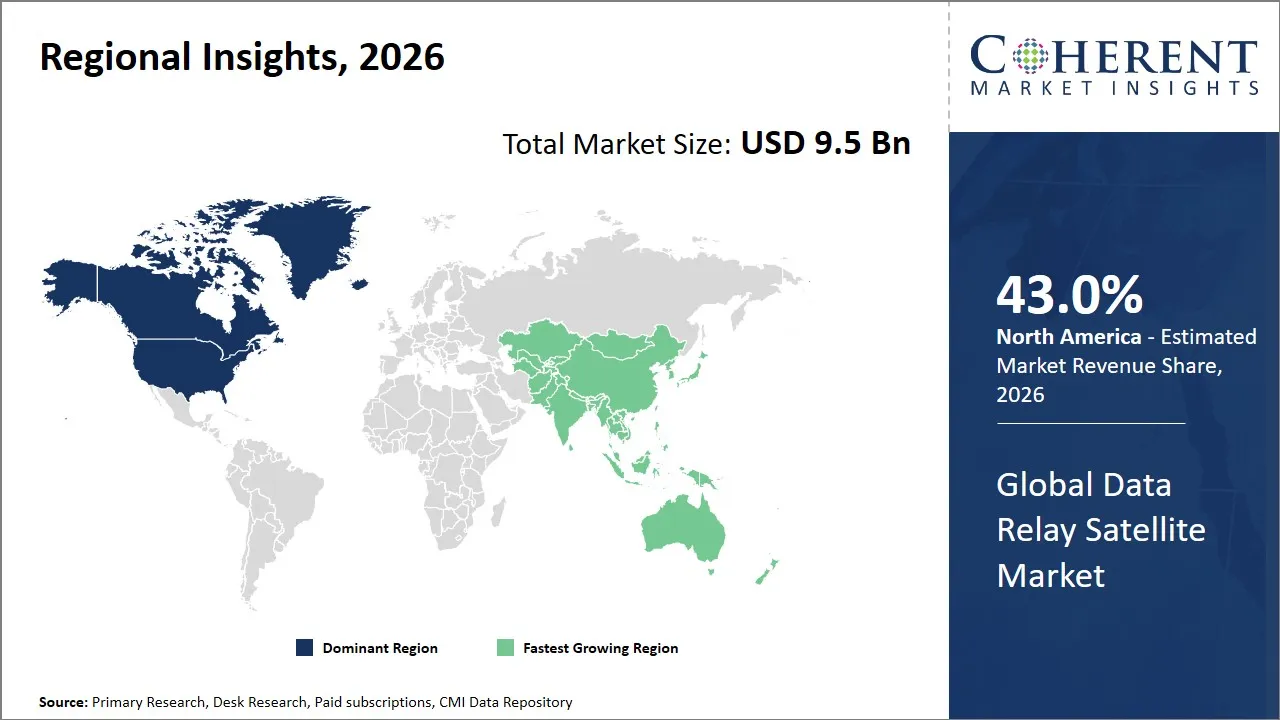
- North America will dominate the data relay satellite market in 2026 with an estimated 43%
- Asia Pacific will hold 26% share in 2026 and is expected to record the fastest growth over the forecast period.
Currents Events and Its Impacts
Current Events | Description and its Impact |
Amazon Project Kuiper |
|
Segmental Insights
- Current Industry Events of 2026
- Market Size Estimation
- Regional Breakdown
- Competitive Landscape
- Customer Intelligence
- Segmental Analysis
- Pricing Analysis
- Key Market Drivers, Challenges & Future Trends
- Customized Insights Section
Why Does the S Band Segment Dominates the Global Data Relay Satellite Market in 2026?
The S band segment is expected to account for 43% of the market share in 2026. A key factor behind its expansion is the effective handling of range and signal penetration. Positioned from 2 to 4 gigahertz, S Band differs from higher frequency bands since atmospheric elements weaken it less. Owing to consistent behavior amid environmental shifts, uninterrupted communication remains feasible. Stability under interference enables reliable operation where continuity matters.
Communication Segment Dominates the Global Data Relay Satellite Market
The communication segment is expected to account for 47% of the market share in 2026. Driven by rising needs, expansion unfolds through urgent demands for smooth worldwide connections at high speed. With broader availability of high-speed internet, consumption rises, especially in online video services, backed by extensive satellite networks. Where cities end, coverage continues, reaching isolated regions through extended transmission paths. Daily device connectivity expands quickly, depending on space-based repeaters whenever land systems are insufficient.
For instance, on October 20, 2025, SpaceX launched 20 spare OneWeb satellites to strengthen the resiliency of French operator Eutelsat’s rival low Earth orbit (LEO) broadband network. The launch was carried atop a Falcon 9 rocket.
Why is Civil the Most Crucial End User in the Data Relay Satellite Market?
The civil segment is expected to account for 44% of the market share in 2026. Expansion follows increased funding for systems handling Earth observation, emergency coordination, climate tracking, also secure communication during crises. Information relay via orbiting platforms enables civil uses where fast, consistent data transfer matters most.
Latency, Bandwidth & QoS Performance Economics
Metric | LEO Satellite | MEO Satellite | GEO Satellite | Airborne Relay (HAPS/UAV) |
Typical Altitude | ~500–1,500 km | ~8,000–12,000 km | ~35,786 km | ~20–50 km |
Typical RTT Latency | 20–50 ms | 100–150 ms | 250–600+ ms | < 10–25 ms |
Typical Downlink Throughput | 50 Mbps – multi-Gbps per beam/terminal | 100 Mbps – multiple Gbps | 10s Mbps – Gbps HTS | 10s – 100s Mbps local links |
Coverage per Platform | Small; requires constellation | Medium; regional/hemispheric | Very large (1/3 Earth) | Very local (~100–300 km radius) |
Regional Insights
North America Data Relay Satellite Market Analysis and Trends
The North America region is projected to lead the market with a 43% share in 2026. Driven by an advanced aerospace network, steady public spending on space facilities emerges as one factor. Progress emerges through large-scale initiatives guided by organizations like NASA and the Department of Defense, enabling advancements in protected information transfer for defense purposes, while space ventures proceed alongside growing commercial interest.
With steady backing from established firms like Lockheed Martin, Boeing, and Northrop Grumman, development in satellite-based networks moves forward consistently. Existing systems spread throughout the region allow seamless addition of fresh signal relays into active paths, even as oversight policies evolve before breakthroughs take hold.
For instance, on November 14, 2025, Viasat, Inc., a global leader in satellite communications, announced the successful launch and initial signal acquisition of the ViaSat-3 Flight 2 (F2) satellite. ViaSat-3 F2 will provide services over the Americas region and represents the latest addition to Viasat, Inc.’s global satellite network.
Asia Pacific Data Relay Satellite Market Analysis and Trends
The Asia Pacific region is expected to exhibit the fastest growth in the market contributing 26% share in 2026. Growth stems from fast-developing space initiatives, rising needs for instant communication systems, while funding flows in from public and commercial sources alike.
China, India, and Japan place strong emphasis on improving satellite functions, data relays included, to enable uses that span national security to internet access in isolated regions. Quick digital growth spreads through the region. Launch rates grow without pause. Fresh manufacturing hubs emerge without warning, pushing movement forward.
Global Data Relay Satellite Market Outlook for Key Countries
Why is the U.S. Emerging as a Major Hub in the Data Relay Satellite Market?
Despite global competition, the U.S. holds the leading position through deep-rooted strengths in aerospace capabilities and consistent public funding. Firms like Lockheed Martin, Boeing, and Northrop Grumman shape progress by building advanced data relay systems serving both military operations and business needs. Secure communications gain strength through federal support, tied closely to ambitions beyond Earth, creating steady progress in fresh technologies. From separate initiatives, private missions add motion, coordinating on orbiting relays built to extend connectivity across continents.
Is China the Next Growth Engine for the Data Relay Satellite Market?
Driven by growing focus on space, China pushes forward using government-supported goals in technology growth. At the forefront stands the China Aerospace Science and Technology Corporation, building stronger links between orbiting systems by upgrading signal transfer pathways. Instead of relying on foreign inputs, strategic choices emphasize steady investment into local innovation within satellite design. These shifts support assembly methods enabling quicker mission rollouts along with newer relay units becoming operational sooner.
India Data Relay Satellite Market Analysis and Trends
A transformation takes place in India’s data relay satellite field, supported steadily by ISRO. Integrated within wider orbital initiatives, these systems increasingly serve communication alongside environmental observation roles. As focus grows on connecting all regions, governmental direction reflects goals linked to digital inclusion in remote zones. Joint work between domestic enterprises and ISRO influences equipment and component design, advancing indigenous manufacturing strength. International partnerships bring essential expertise, supporting enhancements throughout current relay infrastructures.
Japan Data Relay Satellite Market Analysis and Trends
Japan sustains momentum through a developed satellite communications landscape shaped by firms including Mitsubishi Electric and NEC Corporation. Driven forward by entities like JAXA, national efforts focus on refining data relay technologies for resilient communication and emergency response uses. Because of deeply rooted manufacturing channels and consistent technological advancement, leadership remains firm. With strategic frameworks favoring cooperation between state bodies and commercial players, improvements in relay capabilities spread across both local and international orbital infrastructures.
France Data Relay Satellite Market Analysis and Trends
France hosts major aerospace firms like Thales Alenia Space and Airbus Defense and Space, central to advancing data relay satellites. Backed by state involvement via CNES, national efforts in space grow through structured support for progress in satellite transmission systems. Connected deeply to Europe’s broader framework, collaboration across borders - especially with ESA - amplifies influence and capability. Progress continues as funding shifts toward future-oriented relay platforms, emphasizing protected exchanges along with greater capacity for non-military and military needs alike.
Market Players, Key Development, and Competitive Intelligence
Key Developments
- On June 30, 2025, Vodafone Group and AST SpaceMobile Inc announced their new joint venture satellite company, SatCo, which will be headquartered in Luxembourg, creating a European sovereign integrated satellite service.
- On February 8, 2025, Kinéis completed its fourth satellite launch and signed strategic partnerships with Europorte‑Kerlink and CLS. The success of the 4th launch once again demonstrates the reliability of Kinéis’ technical capabilities.
Top Strategies Followed by Data Relay Satellite Market Players
Player Type | Strategic Focus | Example |
Established Market Leaders | Echostar Acquisition | On January 2, 2024, EchoStar Corporation announced the completion of its acquisition of DISH Network Corporation. To complete the acquisition, a wholly owned subsidiary of EchoStar merged with and into DISH Network, with DISH Network surviving the merger as a wholly owned subsidiary of EchoStar. |
Mid-Level Players | Bell and AST Space Mobile Test Completion | On October 3, 2025, Bell Canada and AST Space Mobile complete Canada's first successful satellite-based direct-to-cell 4G voice over LTE (VoLTE) call, broadband data and video streaming test. |
Small-Scale Players | Business Agreement | On August 4, 2025, Innovative Rocket Technologies Inc announced that they have entered into a five-year launch integration, mission planning, and propulsion systems agreement with SpaceBelt KSA for a total contract value of up to USD 640 million. This partnership places Innovative Rocket Technologies at the forefront of one of the most strategic and forward-looking space innovation initiatives in the Middle East. |
Market Report Scope
Data Relay Satellite Market Report Coverage
| Report Coverage | Details | ||
|---|---|---|---|
| Base Year: | 2025 | Market Size in 2026: | USD 9.5 Bn |
| Historical Data for: | 2020 To 2024 | Forecast Period: | 2026 To 2033 |
| Forecast Period 2026 to 2033 CAGR: | 10% | 2033 Value Projection: | USD 18 Bn |
| Geographies covered: |
| ||
| Segments covered: |
| ||
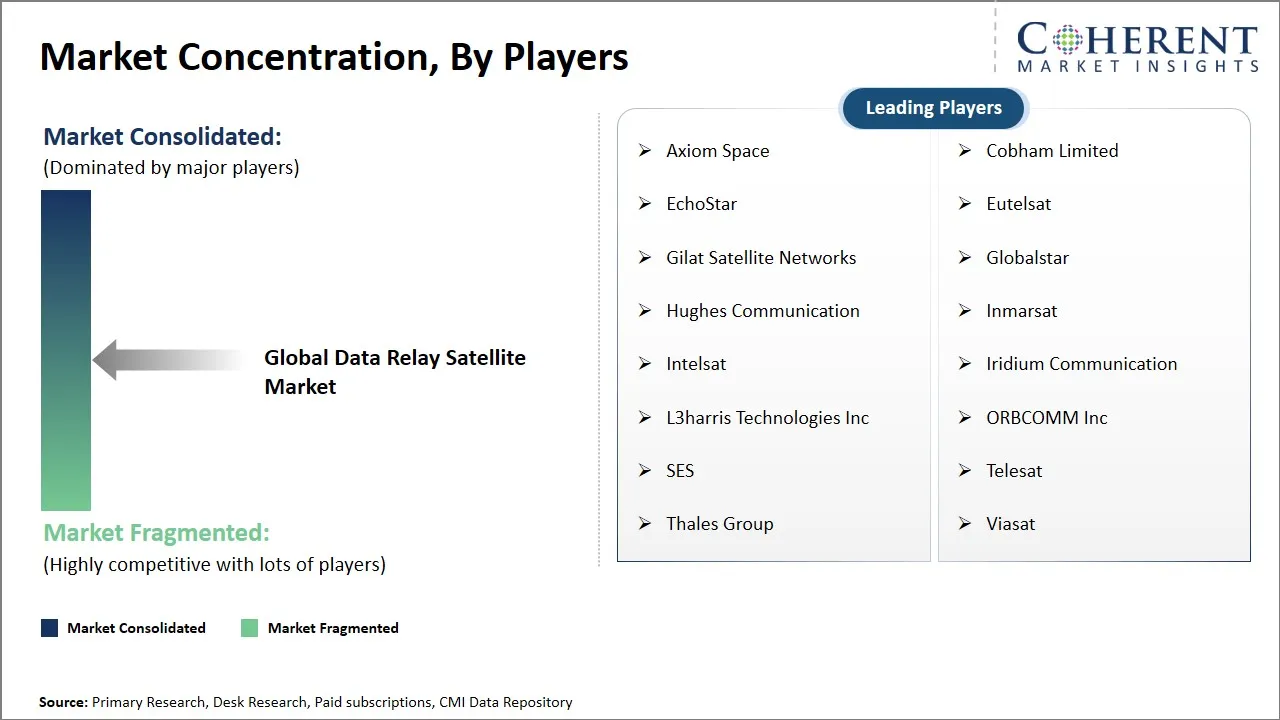
| Companies covered: | Axiom Space, Cobham Limited, EchoStar, Eutelsat, Gilat Satellite Networks, Globalstar, Hughes Communication, Inmarsat, Intelsat, Iridium Communication, L3harris Technologies Inc, ORBCOMM Inc, SES, Telesat, Thales Group, and Viasat | ||
| Growth Drivers: |
| ||
| Restraints & Challenges: |
| ||
Global Data Relay Satellite Market Dynamics
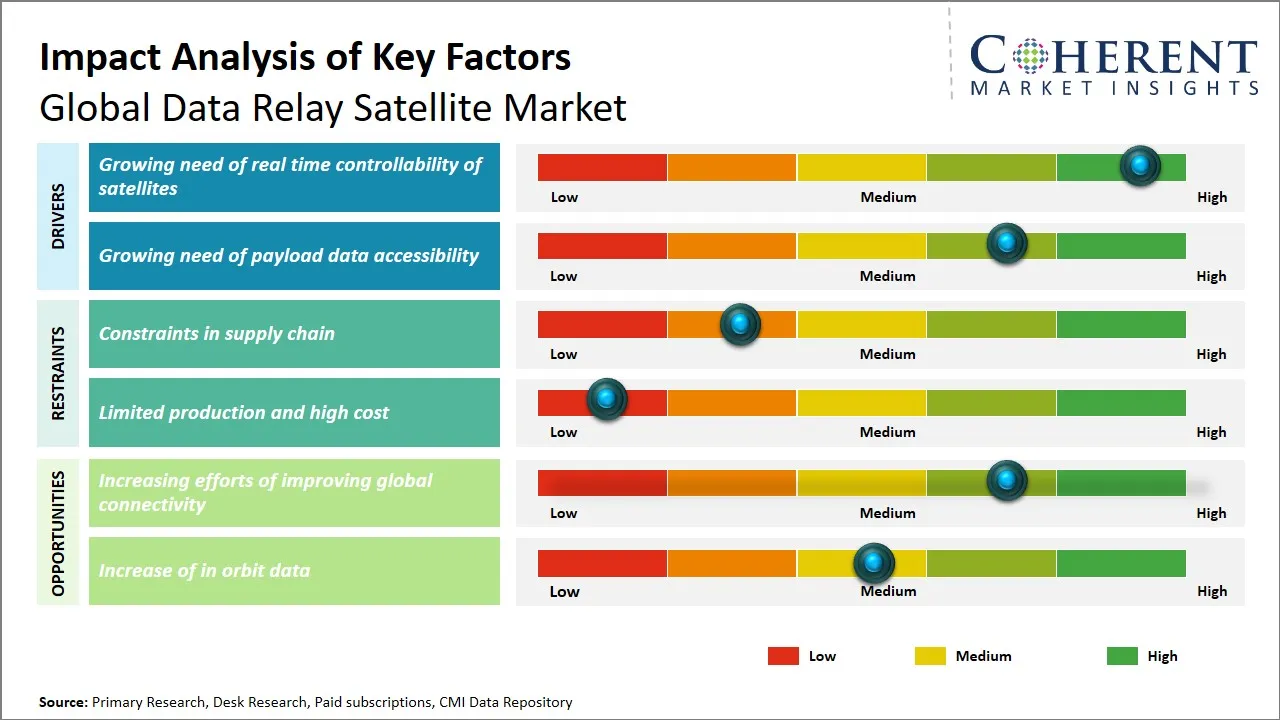
Global Data Relay Satellite Market Driver - Growing need of real time controllability of satellites
Growing numbers of satellite operations in public and private areas now require instant command access, pushing growth in data relay systems. As delays reduce effectiveness, constant connections for sending instructions and receiving feedback matter more than before. Immediate control allows quick shifts in location, better spotting of issues, faster responses, along with flexible task handling such as imaging, defense monitoring, or internet delivery.
With small satellites flying in low orbits and those stationed above one spot on Earth, steady links that transmit information rapidly are increasingly essential. These conditions create ongoing pressure to maintain seamless signal pathways across varying altitudes. Long gaps in contact compromise performance, making continuous coverage a structural need rather than an option. Such demands shape how networks must evolve to support modern space activities.
For instance, on March 10, 2025, SES and Lynk Global announced a strategic partnership to address the high-growth direct-to-device (D2D) segment. As part of the agreement, SES will provide Series B funding for Lynk Global’s D2D constellation and provide a suite of integrated services.
Global Data Relay Satellite Market Opportunity - Increasing efforts of improving global connectivity
Gradually, influence spreads when remote locations draw consistent focus. Through steady work, access extends into far corners of the map. Where physical infrastructure struggles, stronger links appear. In regions difficult to serve, reliability in transmission becomes increasingly central. Expansion across agencies gains momentum through broader outreach goals. As performance requirements increase, so does pressure to refine satellite-based communication systems. Improved remote connectivity emerges from updated technological support.
On September 4, 2025, JetBlue announced it will be the first airline in the world to sign on with Amazon’s Project Kuiper, an advanced low Earth orbit satellite broadband network, to bring even faster and more reliable connectivity to its popular onboard Wi-Fi known as Fly-Fi.
Analyst Opinion (Expert Opinion)
- A shift emerges as demand rises for immediate control, swift connections, faster response times, alongside seamless orbital functionality, driven largely by expanding networks in low and mid-orbit zones serving monitoring, wide-area internet, military tasks, deep-space ventures. Infrastructure relying solely on direct to satellite and terrestrial hubs falters under pressure from frequent revisits and urgent timelines, leading agencies to adopt specialized relays capable of sustaining constant flow in tracking, status updates, and instruction delivery.
- Despite shifts in ownership patterns, future expansion appears likely due to the widespread adoption of frameworks once limited to state-run entities like NASA’s TDRSS. Driven by funding from communications providers, military organizations, alongside new orbital platform developers, movement is underway toward blended network designs combining high-, mid-, and low-orbit components. With growing numbers of spacecraft deployed and missions gaining intricacy, relay platforms are increasingly central to maintaining function under stress, supporting immediate responses.
Speak to the analyst
Want personalized insights?
Take the findings above to one of our principal consultants, or have the report rebuilt around the segments, geographies and competitors you actually track.
Market Segmentation
- Frequency Insights (Revenue, USD Bn, 2021 - 2033)
- S Band
- Ku Band
- Ka Band
- Others
- Application Insights (Revenue, USD Bn, 2021 - 2033)
- Communication
- Navigation
- Others
- End User Insights (Revenue, USD Bn, 2021 - 2033)
- Civil
- Commercial
- Defense
- Regional Insights (Revenue, USD Bn, 2021 - 2033)
- North America
- U.S.
- Canada
- Latin America
- Brazil
- Argentina
- Mexico
- Rest of Latin America
- Europe
- Germany
- U.K.
- Spain
- France
- Italy
- Russia
- Rest of Europe
- Asia Pacific
- China
- India
- Japan
- Australia
- South Korea
- ASEAN
- Rest of Asia Pacific
- Middle East
- GCC Countries
- Israel
- Rest of Middle East
- Africa
- South Africa
- North Africa
- Central Africa
- North America
- Key Players Insights
- Axiom Space
- Cobham Limited
- EchoStar
- Eutelsat
- Gilat Satellite Networks
- Globalstar
- Hughes Communication
- Inmarsat
- Intelsat
- Iridium Communication
- L3harris Technologies Inc
- ORBCOMM Inc
- SES
- Telesat
- Thales Group
- Viasat
Sources
Primary Research Interviews
- Satellite manufacturers and system integrators
- Data relay service providers and operators
- Space agencies and government officials
- Ground station equipment suppliers
Databases
- Satellite Industry Association (SIA) Database
- Space Foundation Database
- Euroconsult Satellite Database
- Northern Sky Research (NSR) Database
Magazines
- Satellite Today Magazine
- Via Satellite Magazine
- Space News Magazine
- Satellite Evolution Global
Journals
- Journal of Spacecraft and Rockets
- IEEE Transactions on Aerospace and Electronic Systems
- Acta Astronautica
Newspapers
- SpaceNews
- Aviation Week & Space Technology
- Defense News
- Space Daily
Associations
- Satellite Industry Association (SIA)
- European Space Agency (ESA)
- Commercial Spaceflight Federation (CSF)
- International Astronautical Federation (IAF)
Public Domain Sources
- NASA Technical Reports Server
- ESA Publications Portal
- Government Accountability Office (GAO) Reports
- Federal Communications Commission (FCC) Filings
Proprietary Elements
- CMI Data Analytics Tool
- Proprietary CMI Existing Repository of information for last 8 years
Get access to 250+ pages report
Every segment, forecast, competitor profile and data table behind the analysis above — available for instant download.
- ESOMAR Member
- ISO 9001:2015 Certified
- D-U-N-S Registered
- GDPR & CCPA Compliant
Missing comfort of reading report in your local language? Find your preferred language:
Transform your Strategy with Exclusive Trending Reports
Frequently Asked Questions
The global data relay satellite market is expected to stand at USD 9.5 Bn in 2026 and is expected to reach USD 18 Bn by 2033.
The CAGR of the global data relay satellite market is projected to be 10% from 2026 to 2033.
Growing need of real time controllability of satellites and growing need of payload data accessibility are the major factors driving the growth of the global data relay satellite market.
Constraints in supply chain and limited production and high cost are the major factors hampering the growth of the global data relay satellite market.
In terms of frequency, S Band is estimated to dominate the market revenue share in 2026.
Geostationary Earth Orbit (GEO) is widely used due to its continuous coverage over large regions.
North America is expected to lead the global data relay satellite market in 2026.