

Global Dextrose Market Size and Forecast – 2026-2033
The global dextrose market is estimated to be valued at USD 6.86 Bn in 2026 and is expected to reach USD 11.46 Bn by 2033, exhibiting a compound annual growth rate (CAGR) of 7.6% from 2026 to 2033.
Key Takeaways of the Dextrose Market
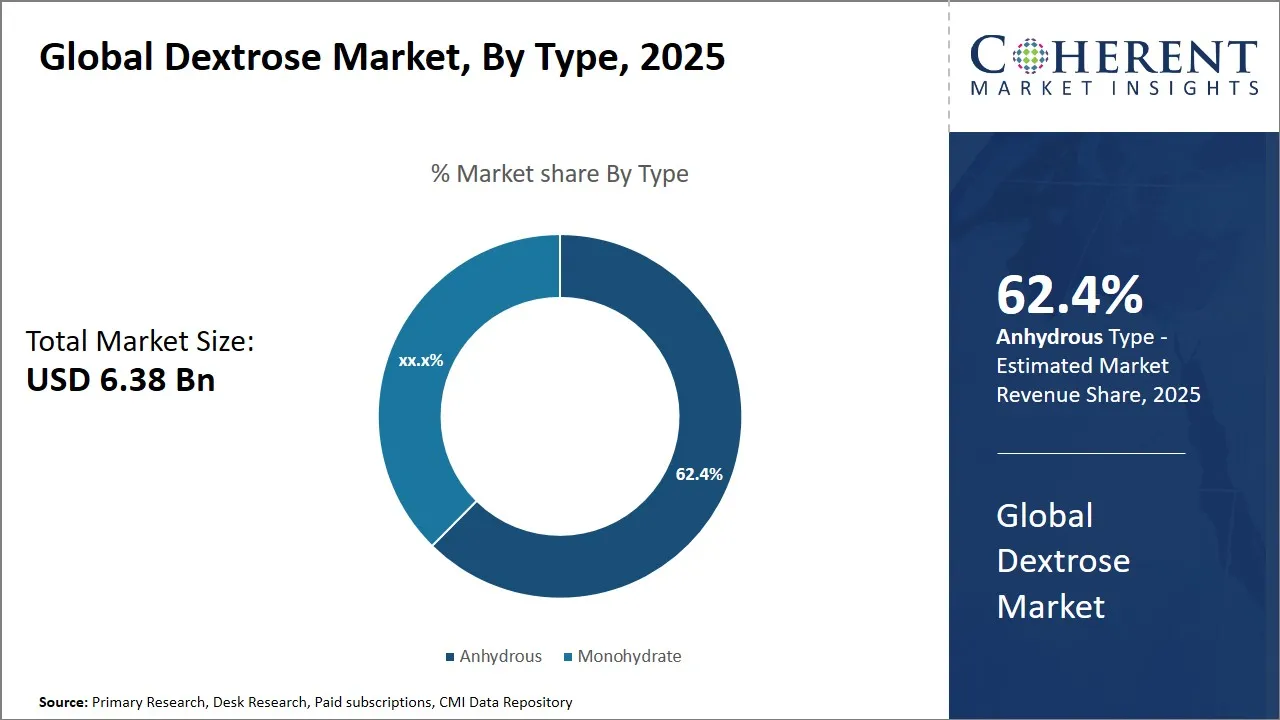
- The anhydrous segment is projected to account for 63.4 % of the global dextrose market share in 2026.
- The crystalline segment is expected to hold a 35.8 % share in 2026.
- The food & beverage segment is projected to capture a 23.5% of the market share in 2026.
- Asia Pacific is set to lead the global dextrose market in 2026 with a 42.4 % share. Europe, with an estimated share of 19.5% in 2026, will be the fastest-growing region.
Market Overview
A current market trends highlight a rising preference for clean-label and natural ingredients, boosting the adoption of dextrose as a healthier alternative to synthetic food sweeteners. Innovations in processing technologies and the growing functional food market are further propelling dextrose usage. Additionally, increasing health consciousness and the demand for energy-rich nutrition products are expected to sustain market growth in the coming years.
Currents Events and their Impact
Current Events | Description and its Impact |
Regulatory tightening on sugar content and labeling |
|
Surge in demand for healthy snacks and energy foods, particularly in developed regions |
|
Segmental Insights
- Current Industry Events of 2026
- Market Size Estimation
- Regional Breakdown
- Competitive Landscape
- Customer Intelligence
- Segmental Analysis
- Pricing Analysis
- Key Market Drivers, Challenges & Future Trends
- Customized Insights Section
Dextrose Market Insights, by Type – Anhydrous Segment Dominates the Market due to its Superior Functional Properties and Versatile Industrial Applications
The anhydrous segment is expected to hold 63.4% of the global dextrose market share in 2026, attributed to its chemical purity and efficiency in various manufacturing processes. In contrast to the monohydrate form, anhydrous dextrose is extremely stable and has very little moisture, which is why it can be successfully used in cases when the water level must be strictly regulated. This is especially important in such industries as pharmaceuticals and food production where moisture may impact product shelf life, texture and overall quality. Moreover, dextrose binds moisture thus, can be used as a humectant since it is anhydrous and therefore does not have to diminish the texture of food products in order to maintain their moisture levels hence improving product performance.
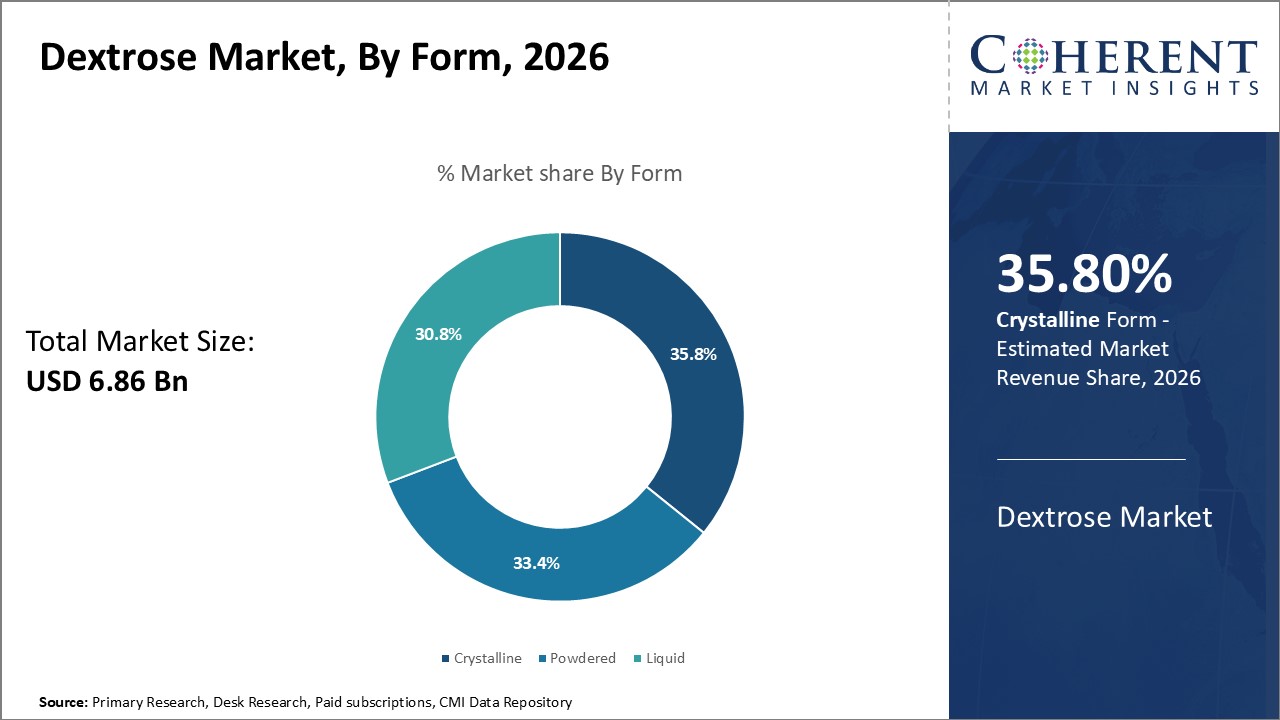
Dextrose Market Insights, by Form – Crystalline Segment Dominates the Market Driven by its Wide Usability, Ease of Handling, and Cost-Effectiveness in Various Industries
The crystalline segment is expected to capture 35.8% share in 2026, because of its physical form, which makes it highly suitable for a broad range of applications, particularly in the food and beverage sector. The crystalline form is easily measured and dosed and is suitable to industries where specific formulation is important. It has uniform particle size and shape that guarantee predictable behavior in processes like mixing, drying, and packaging that are critical in the preservation of product uniformity.
The large-scale application of the crystalline segment as a sweetener and fermentation substrate is one of the key driving factors of the crystalline segment. Its crystalline property enables the manufacturers to regulate the rate of dissolution which offers them the opportunity to regulate the level of sweetness and fermentation kinetics in their products such as baked goods, beverages and confectionery. This is in comparison to the liquid and powdered forms which are more specialized or liquid dominant.
Dextrose Market Insights, by Application - Food & Beverage Segment Dominates the Market Owing to the Rising Demand for Natural Sweeteners and Multifunctional Ingredients
The food & beverage segment is projected to hold 23.5% share in 2026, driven by the growing consumer preference for natural and clean-label ingredients. Dextrose is a naturally sourced sugar and can be found in corn or other starches and is generally accepted as a more natural sweetener than synthetic sweeteners. This taste is driving its inclusion in a wide range of products such as soft drinks and confectionaries to bakery and dairy products.
In addition to the sweetness, dextroses functionality advantages make it a food ingredient that cannot be eliminated in food preparations. It is a very important source of fermentable sugar used in yeast fermentation, which enhances rising and softness of baked goods. In addition, the fact that it has been used as a preservative through generation of osmotic pressure to extend shelf life as well as keeping products fresh is becoming more important as consumers nowadays want longer shelf life but to keep food products made naturally.
Regional Insights
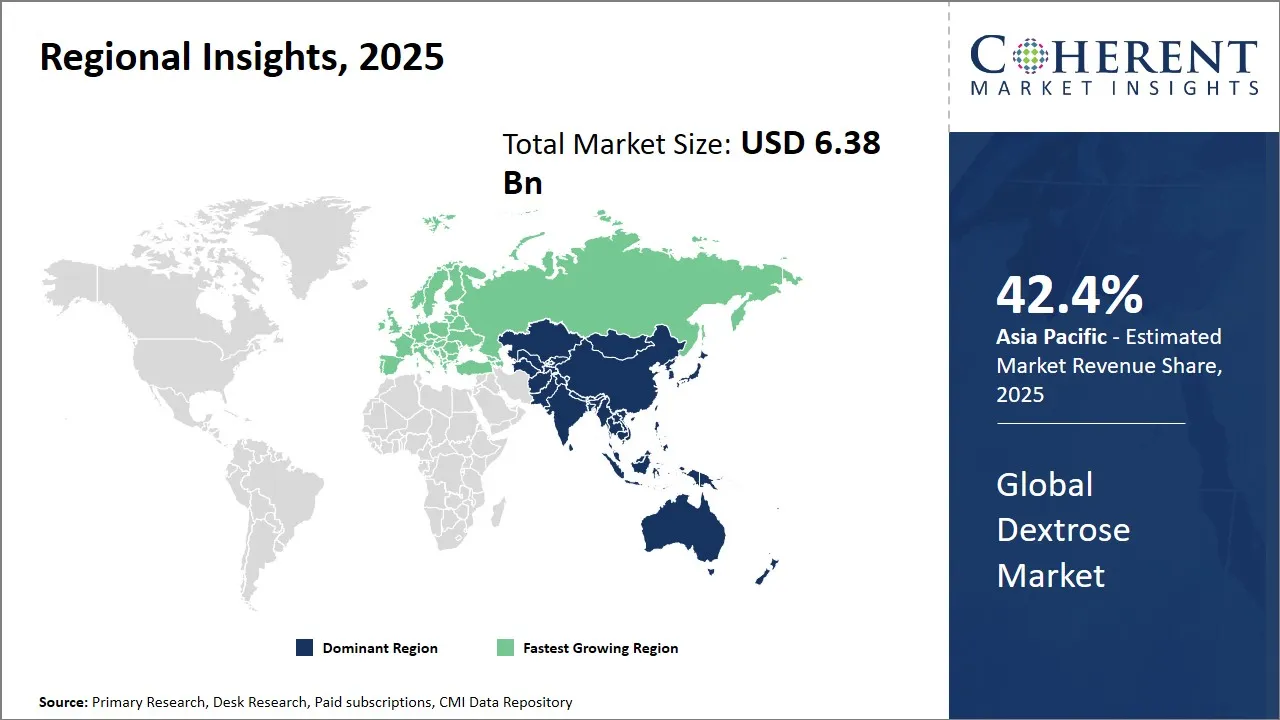
Asia Pacific Dextrose Market Analysis and Trends
The Asia Pacific region is projected to lead the market with a 42.4% share in 2026, fueled by increasing industrialization, expanding population, urbanization, and rising disposable incomes. The food processing, pharmaceutical and confectionery industries are experiencing high demand in this region and governments are taking steps to assist in availability of agricultural raw materials and food security. Ingredion Incorporated and Roquette Freres are the two leading players in the regions dynamic market landscape and are therefore actively investing in capacity building and local partnerships opportunities to cash in on new opportunities. Also, continuous enhancement of trade policies and infrastructure development in Asian Pacific countries make penetrating and distributing the market easier.
Europe Dextrose Market Analysis and Trends
The Europe region is anticipated to experience significant growth in the dextrose market, contributing a notable share of 19.5% in 2026. This is propelled by a mix of numerous factors, which include healthy industrial ecosystem, growing demand in various segments like food and beverage, pharmaceuticals and personal care, and also the emergence of health-consciousness in consumers. An excellent regulatory environment that places emphasis on food safety, clean-label, and high-purity dextrose is also advantageous to the region.
Dextrose Market Outlook for Key Countries
U.S. Dextrose Market Analysis and Trends
The U.S. continues to be a leading participant in the dextrose market that has a wide usage in different sectors such as food, pharmaceuticals and animal feed. The major players in the market including Archer Daniels Midland Company and Tate & Lyle are actively working on research and sustainable production processes that respond to the changing consumer trends in clean label and non GMO products. Market operations are also optimized by government regulations which concentrate on product safety and labeling. The developed manufacturing facilities and effective supply chains of the country provide it with a rapid response to market demand and keep the competitive advantage in the international arena.
China Dextrose Market Analysis and Trends
The dextrose market in China is rapidly growing because of the growing demand by processed food and beverage companies and pharmaceutical companies. Government support contributes to the country greatly with the policies that promote modernization of the food industry and agricultural efficiency that guarantees the availability of raw material chains necessary in dextrose production. Locals, including Shandong Futaste Agricultural Science and Technology Group and China National Chemical Corporation are tightening their grip by being innovative and capacity building. There is also the facilitation of the distribution, both within and to export as a result of the Chinas strategic trade policies as well as infrastructural improvements.
Germany Dextrose Market Analysis and Trends
Germany remains a market leader in dextrose in Europe, and has a solid industrial foundation that is acclaimed as food technology and pharmaceutical manufacturing. The market dynamics of the country are predetermined by the focus on the quality, sustainability, and compliance with the regulations. The major producers such as Sudzucker AG and Cargill GmbH play a crucial part by providing highly sophisticated technologies of processing and steady supply to the Europe dextrose market. Germanys global networking and involvement in EU regulation systems make it possible to take competitive positions and focus on products of high values.
India Dextrose Market Analysis and Trends
The market of India dextrose is steadily expanding due to the efforts of state agencies to promote the agricultural sector and encourage the growth of processed food. The rising demand in the confectionary, bakery and pharmaceutical industries is providing new opportunities. The Gujarat Ambuja Exports Limited and Patanjali Ayurved Ltd. are the leading Indian corporations that are growing with product diversification and local distribution channels. The countries that are changing their trade policy and infrastructure development help in enhancing access to markets and encourage local production and import-exports.
Brazil Dextrose Market Analysis and Trends
The market of dextrose in Brazil is dominated by a good agricultural foundation where raw materials to manufacture dextrose are obtained. Demand is increasing in the food and beverage industry in the country, especially in natural sweeteners and pharmaceutical usage. Businesses such as Bunge Limited and Odebrecht Agro-industrial play a central role in influencing production capacity and market growth. The government policies of Brazil that seek to favor agribusiness and export incentives increase trade opportunities. Also, transport infrastructures continue to be improved, which has facilitated effective supply chain management in Latin America.
Macro and Micro Economic Factors Impacting Dextrose Market Growth
Macroeconomic Factors
- Global supply chain disruptions, such as labor strikes at major ports, transport issues, and production facility shutdowns for infrastructure upgrades, have caused dextrose price spikes and availability challenges, particularly in regions like Europe and Asia. These disruptions impact production costs and timelines significantly.
- Rising energy costs and stringent environmental regulations in key producing regions have increased production costs, thereby affecting supply capacity and leading to higher prices.
- Economic conditions impacting corn prices, the primary raw material for dextrose, cause price volatility. Seasonal variations, weather effects, and changes in agricultural output influence raw material costs, which in turn affect dextrose production and pricing.
- Increasing consumer health consciousness globally drives demand for low-sugar and natural alternatives, boosting market growth. Demand for dextrose as a natural sweetener and preservative in food, beverages, and pharmaceuticals is rising with expanding markets in North America and Asia-Pacific.
- Advances in production technologies and processes help to improve supply chain efficiency and product quality, supporting market expansion.
- Growth in processed foods and beverages consumption, especially in emerging markets, fuels demand for dextrose as a sweetener and functional ingredient.
Microeconomic Factors
- Fluctuations in raw material (corn) costs directly affect producer margins and pricing strategies, influencing the supply-demand equilibrium.
- Competition from alternative sweeteners like stevia, agave, and natural gums (e.g., guar, xanthan gum) poses challenges to dextrose market growth, particularly in health-focused product segments.
- Increasing use of dextrose in pharmaceuticals, personal care, and sports nutrition adds diversified demand sources and stabilizes market growth.
Market Players, Key Development, and Competitive Intelligence
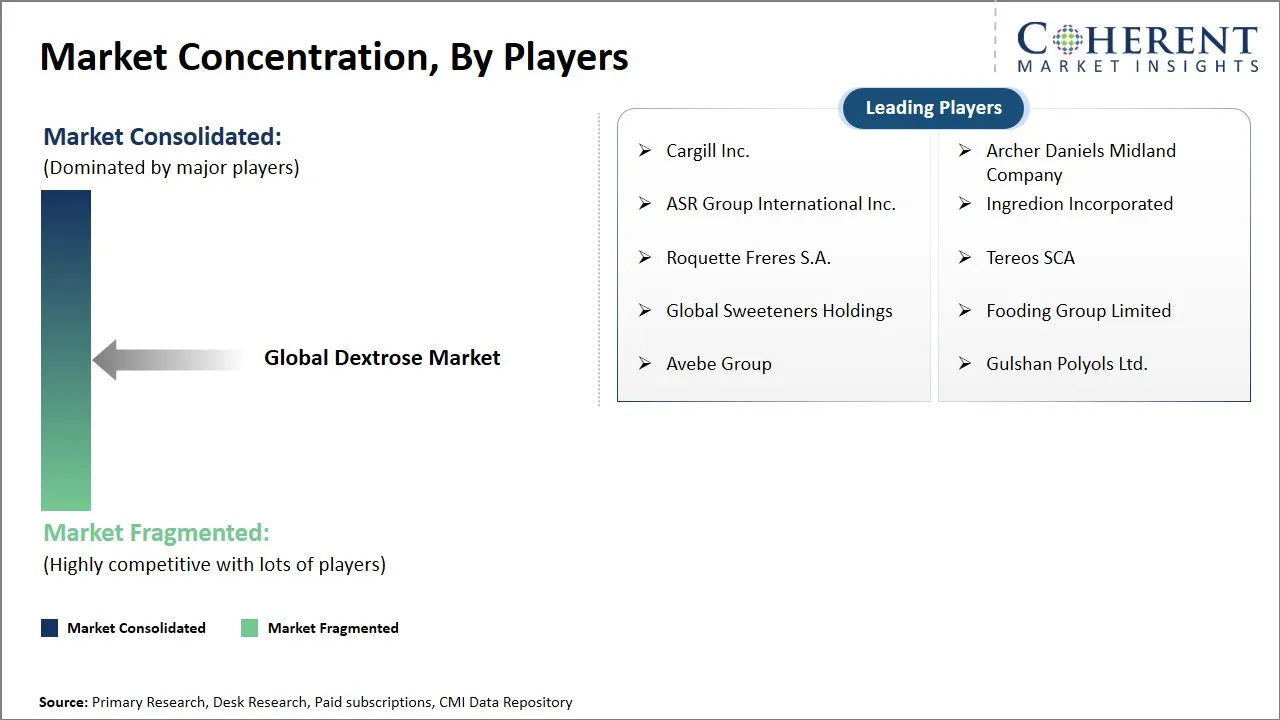
Key Developments
- In April 2022, Cargill (U.S.) built its “Global Animal Nutrition Innovation Center” for nutrient research and development in support of the agriculture and food industry customer base. This center can host more than 2,000 visitors yearly. Also, new viewing corridors would offer an opportunity for the visitors to easily view the animal R&D facilities. This move seems to bring Cargill closer to its customers.
- In May 2022, Tate & Lyle (U.K.) launched the Tate & Lyle Nutrition Center, a digital hub focused on ingredient science to tackle public health issues. This advanced the company's research program and helped food and beverage companies spread across the U.K., U.S., Brazil, and Singapore. Its establishment enhanced the growth of the dextrose market by fostering innovation and meeting nutritional needs in a wide array of applications.
Top Strategies Followed by Global Dextrose Market Players
- The industry is dominated by established players who use huge investments in research and development (R&D) to develop high performance dextrose products to support changing customer needs. To meet the demands of specialized use in food, pharmaceutical and industrial markets, these companies are constantly improving the quality, purity and functionality of their products. With these alliances they are able to fit their products more effectively in different supply chains and ensure their presence in the market.
- As an example, one of the largest manufacturers of the dextrose market, Archer Daniels Midland (ADM), employs advanced enzymatic hydrolysis technology to produce high purity dextrose to be used in pharmaceutical and food purposes.
- The dextrose market players in the middle level of the world market take a slightly different strategy according to their resources and competitive positioning. They are mainly interested in providing low cost solutions that balance quality and cost, which is aimed at price-sensitive consumers and sectors where cost is the main factor. These mid-tier companies attract a wide range of customer by providing stable products at low prices without the need to compromise important metrics of their performance.
- For example, Tate & Lyle is a mid-sized player that produces dextrose products of good quality but at a lower price than the top level competitors. They are mainly targeting food and beverage manufacturers who are in need of consistent, bulk ingredients but do not want to pay the higher prices of high end dextrose products.
- The small-scale players in the dextrose market are differentiated due to focusing on niche segments and specialized features of the products that could be ignored by bigger players. These players often follow new ways and incorporate new technologies which include enzymatic processing methods or bioengineering to come up with unique or customized forms of dextrose. They will be able to meet the needs of a niche consumer, allowing them to focus on organic certification or allergen-free, or a formulation that is adapted to some special industrial use.
- For example, GPC (Glucose Products Company), is an example and uses sophisticated enzyme processing to produce allergen-free, organic-certified dextrose products to meet the increasing demand in the food and beverage industry using clean-label, allergen-free ingredients.
Market Report Scope
Dextrose Market Report Coverage
| Report Coverage | Details | ||
|---|---|---|---|
| Base Year: | 2025 | Market Size in 2026: | USD 6.86 Bn |
| Historical Data for: | 2020 To 2024 | Forecast Period: | 2026 To 2033 |
| Forecast Period 2026 to 2033 CAGR: | 7.6% | 2033 Value Projection: | USD 11.46 Bn |
| Geographies covered: |
| ||
| Segments covered: |
| ||
| Companies covered: | Cargill Inc., Archer Daniels Midland Company, ASR Group International Inc., Ingredion Incorporated, Roquette Freres S.A., Tereos SCA, Global Sweeteners Holdings, Fooding Group Limited, Avebe Group, and Gulshan Polyols Ltd. | ||
| Growth Drivers: |
| ||
| Restraints & Challenges: |
| ||
Dextrose Market Dynamics
Dextrose Market Driver - Increasing Demand for Dextrose in the Food and Beverage Industry
The increasing production of dextrose is greatly driving the dextrose market globally. Dextrose is a common product of corn starch that enjoys popular use due to its versatile functional characteristics such as sweetness, fermentability and rapid energy release, making it a valuable ingredient in a wide variety of products, including baked goods, confectioneries, beverages and dairy products. Its capacity to add flavor, improve texture and serve as a natural preservative has compelled manufacturers to add dextrose to their formulations in ever-increasing amounts.
The surge of the demand of dextrose in the food and beverage industry is evident in the case of Coca-Cola, one of the biggest beverage companies in the world. Dextrose is also a sweetener that is employed in most of its products, including soft drinks, energy drinks, among others, to add flavor and give them instant energy, among other purposes.
Dextrose Market Opportunity - Expansion in Emerging Markets with Rising Disposable Incomes
The dextrose market globally is opportune to grow in the emerging markets, which are undergoing a swift increase in disposable incomes, coupled with a shift in consumer preference. The economies of countries in other parts of the world including Asia Pacific, Latin America, and some parts of Africa are experience faster economic growth which has increased consumer purchasing power, particularly in urban and semi-urban regions. It is this increase in disposable income that is driving up the demand of convenience foods, nutraceuticals, and fortified drinks which are often using dextrose as a major ingredient because of its energy giving and functional characteristics. Also, growing middle-income populations in these markets are growing more health-aware, and there are opportunities to launch dextrose-based products that would serve wellness and fitness markets.
Consequently, such businesses as Britannia Industries and Nestle India have been including dextrose in various products such as biscuits, beverages, and nutritional bars to meet the increasing demand of convenient boosting energy foods. This is also where these companies are capitalizing on the growing health-consciousness of the consumers by introducing fortified and low-sugar drinks, energy drinks, and wellness products that can use dextrose as the source of energy.
Analyst Opinion (Expert Opinion)
- The dextrose market is on a positive trend, influenced by growing usage in the food and beverage, pharmaceutical as well as nutraceutical markets. The insights of the International Food Science Conference (2023) and the Global Health Ingredients Summit (2022) outlined the major trends, and the companies, such as Cargill and Roquette, are on the forefront of product innovation.
- The recent introduction of non-GMO dextrose alternatives by Cargills is in line with increasing consumer health consciousness and preference of transparency and clean-label ingredients. The content of these conferences highlighted the increasing significance of dextrose as an energy supplement and sports nutrition as a result of the change to healthier lifestyle preferences.
- There are several obstacles that have been cited as a threat to expansion, including the fluctuating corn prices and governmental scrutiny of sugar substitutes. Firms having the ability to elaborate the health advantage of dextrose, especially in the renewal of energy, and metabolic well-being, will probably influence a bigger market share.
Speak to the analyst
Want personalized insights?
Take the findings above to one of our principal consultants, or have the report rebuilt around the segments, geographies and competitors you actually track.
Market Segmentation
- Type Insights (Revenue, USD Bn, 2021 - 2033)
- Anhydrous
- Monohydrate
- Form Insights (Revenue, USD Bn, 2021 - 2033)
- Crystalline
- Powdered
- Liquid
- Application Insights (Revenue, USD Bn, 2021 - 2033)
- Food & Beverage
- Paper & Pulp Products
- Pharmaceuticals
- Cosmetics & Personal Care Products
- Others
- Regional Insights (Revenue, USD Bn, 2021 - 2033)
- North America
- U.S.
- Canada
- Latin America
- Brazil
- Argentina
- Mexico
- Rest of Latin America
- Europe
- Germany
- U.K.
- Spain
- France
- Italy
- Russia
- Rest of Europe
- Asia Pacific
- China
- India
- Japan
- Australia
- South Korea
- ASEAN
- Rest of Asia Pacific
- Middle East
- GCC Countries
- Israel
- Rest of Middle East
- Africa
- South Africa
- North Africa
- Central Africa
- North America
- Key Players Insights
- Cargill Inc.
- Archer Daniels Midland Company
- ASR Group International Inc.
- Ingredion Incorporated
- Roquette Freres S.A.
- Tereos SCA
- Global Sweeteners Holdings
- Fooding Group Limited
- Avebe Group
- Gulshan Polyols Ltd.
Sources
Primary Research Interviews
- R&D Director – Leading Dextrose Manufacturer
- Procurement Manager – Major Food & Beverage Retailer
- Product Development Head – Global Health Supplement Brand
- Supply Chain Manager – Key Player in Pharmaceutical Industry
Stakeholders
- Manufacturers
- End Use Sectors
- Food & Beverage (Confectionery, Beverages, Processed Foods)
- Pharmaceuticals (Injectable Solutions, Oral Rehydration Salts)
- Animal Feed Industry (Livestock & Pet Nutrition)
- Industrial Applications (Textile & Paper Industries)
- Regulatory & Certification Bodies
- E-commerce Platforms and Retailers
- Technology Integration Players
- AI-based supply chain optimization tools
- Digital traceability solutions for dextrose
Databases
- UN Comtrade Database
- India Import Export (EXIM) Database
Magazines
- Food & Beverage Magazine – Trends in sugar alternatives and food ingredients
- Confectionery Production – Insights into sugar and alternative sweetener markets
- Global Health Business – Dextrose in health and energy products
- Food Engineering – Technologies in food ingredient processing, including dextrose
- Food Processing Technology – Industry updates on dextrose in food processing
Journals
- Journal of Food Science & Technology – Dextrose as a food ingredient in different formulations
- Food Research International – The role of dextrose in food preservation and texture
- International Journal of Food Science – Dextrose-based products in the food industry
- Journal of Nutritional Biochemistry – Nutritional role of dextrose and glucose
Newspapers
- The Financial Times – Market dynamics of dextrose in food and beverage industries
- The Wall Street Journal – Global trade and pricing analysis for dextrose
- The Guardian – The shift toward natural sweeteners and sugar alternatives
- Asia Food Journal – Growth of dextrose consumption in the Asia-Pacific region
Associations
- European Food Safety Authority (EFSA)
- American Sugar Alliance (ASA)
- International Sweeteners Association (ISA)
- Institute of Food Technologists (IFT)
- National Confectioners Association (NCA)
Public Domain Sources
- FDA – Guidelines for Sweeteners and Sugars in Food Products
- European Commission – Regulation on Food Ingredients and Additives
- World Health Organization (WHO) – Sugar and Sweetener Intake Guidelines
Proprietary Elements
- CMI Data Analytics Tool, Proprietary CMI Existing Repository of information for last 8 years.
Get access to 250+ pages report
Every segment, forecast, competitor profile and data table behind the analysis above — available for instant download.
- ESOMAR Member
- ISO 9001:2015 Certified
- D-U-N-S Registered
- GDPR & CCPA Compliant
Missing comfort of reading report in your local language? Find your preferred language:
Transform your Strategy with Exclusive Trending Reports
Frequently Asked Questions
The global dextrose market is estimated to be valued at USD 6.86 Bn in 2026 and is expected to reach USD 11.46 Bn by 2033.
The CAGR of the global dextrose market is projected to be 7.6% from 2026 to 2033.
Increasing demand for dextrose in the food and beverage industry and growing applications in pharmaceuticals and healthcare are the major factors driving the growth of the global dextrose market.
Fluctuating raw material prices impacting production and competition from alternative sweeteners are the major factors hampering the growth of the global dextrose market.
In terms of type, the anhydrous segment is estimated to dominate the market revenue share in 2026.
Cargill Inc., Archer Daniels Midland Company, ASR Group International Inc., Ingredion Incorporated, Roquette Freres S.A., Tereos SCA, Global Sweeteners Holdings, Fooding Group Limited, Avebe Group, and Gulshan Polyols Ltd. are the major players.
Asia Pacific is expected to lead the global dextrose market in 2026.