

Global Electric Grippers Market Size and Forecast – 2026 to 2033
Coherent Market Insights estimates that the global electric grippers market stood at USD 1.30 Bn in 2025 and will expand to USD 3 Bn by 2033, registering a CAGR of 10.5% between 2026 and 2033.
Key Takeaways of the Electric Grippers Market
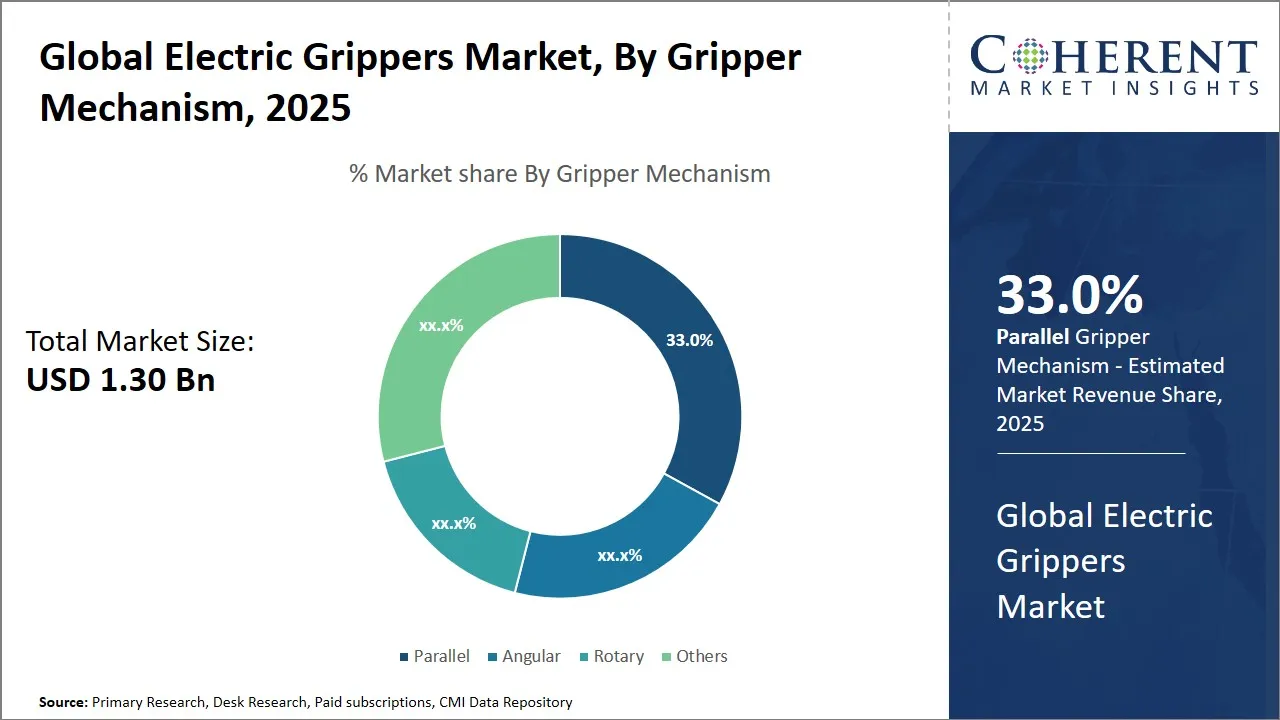
- The parallel segment accounted for 33% of the electric grippers market share in 2025.
- The servo segment captured 35% of the market share in 2025.
- The high precision segment commanded 44% share in 2025.
- Asia Pacific dominated the electric grippers market in 2025 with a market share of 36%.
- North America held 23% share in 2025 and recorded the fastest growth.
Current Events and Its Impact
Current Events | Description and its Impact |
Adaptronics Funding Raise |
|
Segmental Insights
- Current Industry Events of 2026
- Market Size Estimation
- Regional Breakdown
- Competitive Landscape
- Customer Intelligence
- Segmental Analysis
- Pricing Analysis
- Key Market Drivers, Challenges & Future Trends
- Customized Insights Section
Why Does the Parallel Segment Dominates the Global Electric Grippers Market in 2025?
The parallel segment held 33.0% of the global electric grippers market share in 2025, due to strong performance across diverse tasks. As fingers operate in unison in such grippers, pressure spreads evenly during use. Stability arises when items are held firmly without shifting unexpectedly. In sectors like vehicle production or device fabrication, consistent results matter most. Damage prevention becomes possible through controlled movement patterns. Where fine control is necessary, this approach gains favor over alternatives. Slippage rarely happens under normal operating conditions.
For instance, on May 8, 2024, OnRobot launched the new electric parallel gripper 2FG14 capable of handling high-payload applications. Capable of gripping workpieces up to 14 kg, the powerful 2FG14 can handle heavy payloads with the flexibility to accommodate a wide variety of customizations.
(Source: onrobot.com)
Servo Segment Dominates the Global Electric Grippers Market
The servo segment captured 35.0% of the electric grippers market share in 2025. Their rise ties closely to strong performance in control precision and responsiveness. Precision in positioning, along with fluid motion management, sets them apart from alternative drive systems. In fields like semiconductor production, building medical tools, or managing aircraft parts, consistency matters greatly. Because of refined regulation, adjustments in grip strength and finger motion happen mid-task. Variation in size or mass of objects does not slow function down.
Why is High Precision the Most Preferred Precision Type in the Electric Grippers Market?
The high precision segment held 44.0% of the global electric grippers market share in 2025. Industries like pharmaceuticals, biotech, electronics, and microfabrication rely on tools that handle fragile parts without harm or impurity. Precision in grip strength and placement supports consistent results across sensitive processes. Such control preserves reliability while meeting demanding regulatory requirements. Performance depends heavily on consistency under strict conditions.
Energy Consumption per Cycle vs Pneumatic Grippers
Metric | Electric Grippers | Pneumatic Grippers |
Energy per actuation | Only consumes power during motion; typical electric actuator draws ~0.4–1.5 A @ 24 V DC (≈10–36 W) per cycle | Continuous compressed air supply required; compressors ~10–30% efficient with significant idle energy loss |
Relative energy use | ~60–85% lower total energy usage vs pneumatic systems over lifetime | Baseline (100%): compressor + air lines + valves (continuous load even idle) |
Compressor dependency | Does not require air compressor; power only when actuating | Requires compressor, adding base energy draw whether cycling or idle |
Power consumption example | DESTACO DPE electric gripper ~3–4 W per full duty cycle operation | Pneumatic case: compressor & air leaks waste significant power; no direct cycle-specific metric but very high baseline load |
Regional Insights

Asia Pacific Electric Grippers Market Analysis and Trends
Asia Pacific held a market share of 36% in 2025. Expansion originates in a well-established production environment, combined with widespread use of automated systems, while favorable state regulations encourage progress under Industry 4.0 frameworks. In nations including China, Japan, and South Korea, diverse industries like automotive, electronic devices, and household items demand precise robotic handling tools. Major producers like SCHUNK, SMC Corporation, and Festo operate widely here; their intensive research efforts strengthen regional dominance steadily.
North America Electric Grippers Market Analysis and Trends
North America exhibited the fastest growth in the market contributing 23% share in 2025. Supported by forward-looking regulations, the area sees improved operational safety through automated solutions. Innovation in modular gripping systems emerges from major companies based in the U.S. and Canada. Firms including Zimmer Group, OnRobot, and Robotiq shape advancements in collaborative robot technologies.
Global Electric Grippers Market Outlook for Key Countries
Is China the Next Growth Engine for the Electric Grippers Market?
A massive manufacturing sector defines China's economy, particularly in vehicles and electronic devices, increasing need for automated tools such as electric grippers. Driven by national strategies including "Made in China 2025," investments grow in robotic systems and intelligent production facilities. Where local production lacks, international firms support with needed components. Collaboration between homegrown entities like Estun Automation and overseas divisions such as SCHUNK fosters new developments. With urban growth comes industrial change, shaping how gripping systems perform.
Germany Electric Grippers Market Analysis and Trends
Still holding a prominent role in the electric grippers market, Germany draws strength from deep roots in vehicle manufacturing, mechanical engineering, and automated production processes. Firms such as SCHUNK, Zimmer Group, and Festo contribute through exacting design methods and reliable performance outcomes. Subjected to rigorous standards alongside involvement in advancing digital production spaces, machinery installed performs under demanding conditions. As it sits centrally inside the European Union, transit of parts and products between countries avoids extended holdups. Access to interconnected commercial networks expands how widely these tools are distributed.
Why is the U.S. Emerging as a Major Hub in the Electric Grippers Market?
Across the U.S. manufacturing industry, automation plays a central role, notably in making vehicles, aircraft systems, and packaged goods. Based in the U.S., companies like OnRobot and Robotiquity focus on developing adaptive grippers designed for flexible teamwork inside shifting production lines. Momentum grows as government programs encourage digital plant upgrades and machine coordination. Embedded within this landscape is an established ecosystem: system integrators, component suppliers, and robotics manufacturers collaborate closely, enabling swift modifications and tailored configurations suited to diverse workflows.
Japan Electric Grippers Market Analysis and Trends
Japan maintains a strong presence in the electric grippers market, built on long-term progress in robotics. Firms like SMC Corporation, Harmonic Drive, and Panasonic stand at the forefront, offering precise handling solutions. Progress emerges when academic exploration combines with practical engineering knowledge. As fewer people enter the labor force, factories increasingly depend on automated systems for consistent operation. Where risks exist, automation finds stronger footing in manufacturing of devices and vehicles. Tools designed with extreme accuracy continue to support operations demanding minimal margin for error.
South Korea Electric Grippers Market Analysis and Trends
Automation spreads fast in South Korea, shaped largely by industries focused on electronics, chips, and vehicles. Driven forward through national initiatives such as Manufacturing Innovation 3.0, factory upgrades create steady need for responsive, smart gripping systems. Gradually, tighter international ties begin shaping how robotics firms operate. Units designed by Doosan and Hyundai now take up less space, yet deliver stronger function. Export demand drives such change, nudging rivals toward shared efforts. Ideas flow where borders once slowed them. Performance gains emerge not just from hardware, but from adapted processes rooted in joint experience. Refinement becomes steady, quiet, built through repeated exchange.
Market Players, Key Development, and Competitive Intelligence
Key Developments
- In July 2025, DESTACO announced the launch of the eRDH Series Electric Parallel Gripper. This latest addition to the DESTACO Robohand product line represents a significant leap forward in gripping technology, offering unparalleled precision, flexibility, and ease of use.
- In March 2025, OnRobot introduced the VGP30. OnRobot VGP30 is a high-performance, pneumatic vacuum gripper specifically designed to automate demanding palletizing and material handling applications with payloads up to 30 kg.
Top Strategies Followed by Global Electric Grippers Market Players
- Despite varying strategies among businesses active in the global electric grippers market, leading players maintain visibility through sustained investment in exploration and development. Driven by inventive thinking, major firms concentrate on crafting precision devices fit for complex industrial automation roles. What defines their products is accuracy, durability under extended operation, and reduced energy consumption. Though methods shift with company scale, technological depth remains a common thread.
- A shift occurs among mid-tier firms in the electric grippers market as focus turns toward economical designs without sacrificing essential performance. As many buyers prioritize value, certain providers adjust output to match practical needs at lower prices. These adjustments appeal especially to modest-scale operations needing dependable tools. Collaboration becomes a quiet advantage; shared innovation pathways emerge through mutual development deals. Such alliances slowly widen production reach while introducing advanced methods at steady rates.
- A few smaller firms within the electric grippers market find distinct spaces through tailored functions or novel engineering aimed at particular industrial demands. Rather than broad appeal, these organizations lean into emerging tools such as refined sensing systems, reduced-weight components, or adaptable configurations to stand apart from dominant models. Their attention tends to rest on limited geographic zones or narrowly defined uses, shaping partnerships with nearby innovators, production units, or academic centers instead of wide-reaching networks. Such collaborations open doors to essential knowledge pools and pathways for delivery.
Market Report Scope
Electric Grippers Market Report Coverage
| Report Coverage | Details | ||
|---|---|---|---|
| Base Year: | 2025 | Market Size in 2025: | USD 1.30 Bn |
| Historical Data for: | 2020 To 2024 | Forecast Period: | 2026 To 2033 |
| Forecast Period 2026 to 2033 CAGR: | 10.5% | 2033 Value Projection: | USD 3 Bn |
| Geographies covered: |
| ||
| Segments covered: |
| ||
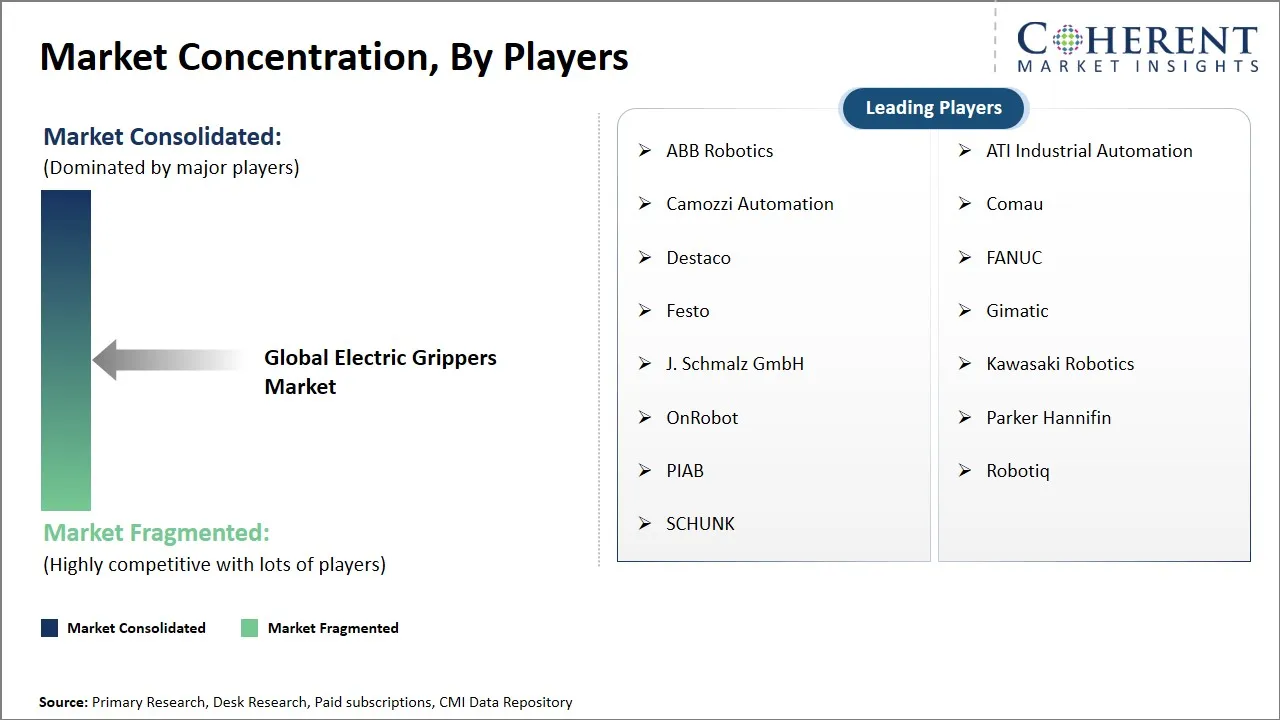
| Companies covered: | ABB Robotics, ATI Industrial Automation, Camozzi Automation, Comau, Destaco, FANUC, Festo, Gimatic, J. Schmalz GmbH, Kawasaki Robotics, OnRobot, Parker Hannifin, PIAB, Robotiq, and SCHUNK | ||
| Growth Drivers: |
| ||
| Restraints & Challenges: |
| ||
Global Electric Grippers Market Dynamics
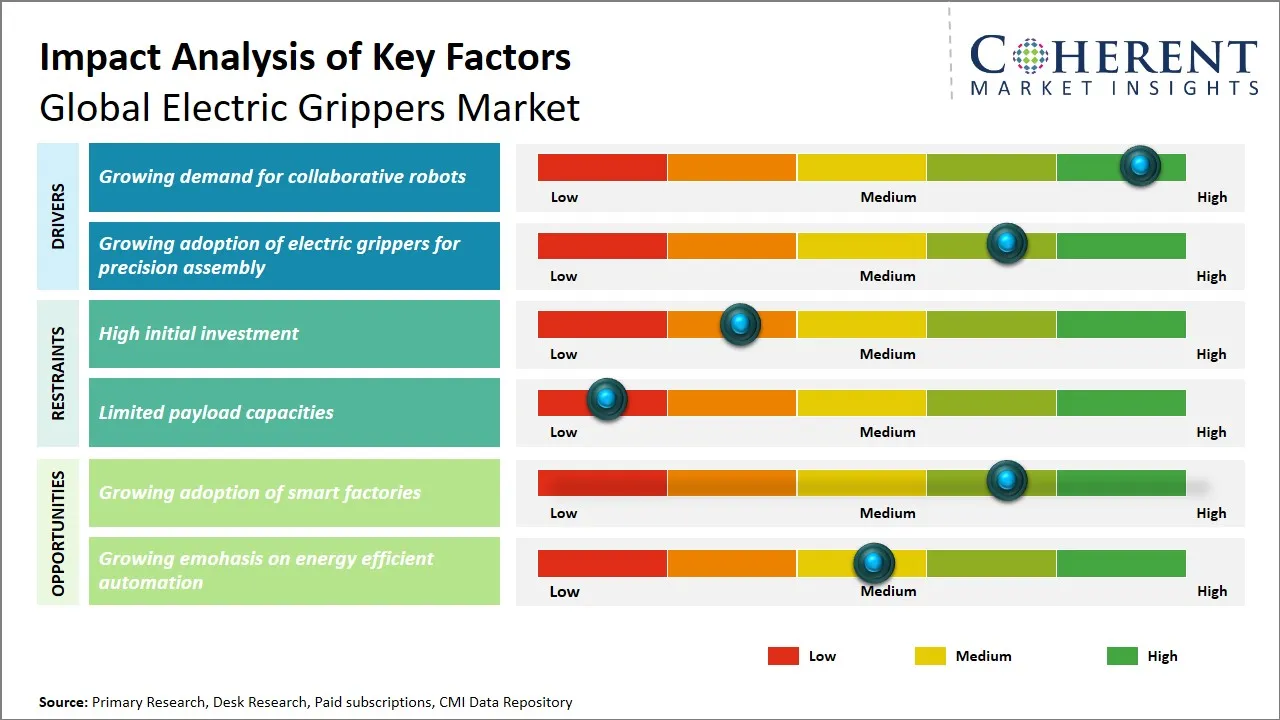
Global Electric Grippers Market Driver - Growing Demand for Collaborative Robots
Growth in the use of collaborative robots across multiple sectors now drives stronger global interest in electric grippers. Where older robotic systems operate separately from people, these newer machines function securely near workers, fitting tasks that depend on exact movements and changeable workflows. Because they allow fine adjustments, consistent results, and handling of fragile or uneven items, electric grippers match closely with what collaborative robots offer. When factories shift toward producing smaller series or personalized goods, tools at the robot’s endpoint such as electric grippers become increasingly relevant.
Global Electric Grippers Market Opportunity - Growing Adoption of Smart Factories
With growing integration of digital technologies into industrial operations, electric grippers find increasing relevance in modern production settings. As smart factories rely heavily on interconnected systems, equipment like electric grippers gains importance due to its consistent performance under variable conditions. Driven by real-time data exchange and machine coordination, these facilities require tools capable of fine motor control without constant manual oversight. Instead of relying on older mechanical models, many producers now favor electrified alternatives that support seamless adjustments during runtime. Enabled by advances in sensor technology and process intelligence, such grippers contribute directly to smoother workflow execution across diverse tasks. Underpinned by the principles of Industry 4.0, automation setups continue shifting toward modular components suited for rapid reconfiguration.
Analyst Opinion (Expert Opinion)
- A surge marks the worldwide demand for electric grippers, supported by broader adoption of automated processes within car production, electronic devices and delivery operations. In contrast to air-powered models, electrical variants deliver finer accuracy, improved grip strength adjustment, reduced power consumption, along with smoother links to cooperative robotic units and interconnected digital factory platforms. Newer versions equipped with sensing technology, adaptable programming features, smaller builds suggest user needs now lean toward adaptability combined with precision rather than sheer holding capacity.
- The marketplace now focuses less on standard equipment, instead shifting toward responsive handling systems. Top firms stand out by using sensor-driven feedback, streamlined setup processes, intelligence-supported control, along with seamless integration across primary robotic frameworks. Research funding and emerging ventures indicate flexible, accurate electromechanical grippers may play a central role in future automated operations.
Speak to the analyst
Want personalized insights?
Take the findings above to one of our principal consultants, or have the report rebuilt around the segments, geographies and competitors you actually track.
Market Segmentation
- Gripper Mechanism Insights (Revenue, USD Billion, 2021 - 2033)
- Parallel
- Angular
- Rotary
- Others
- Actuation Technology Insights (Revenue, USD Billion, 2021 - 2033)
- Servo
- Stepper Motor
- Direct Drive
- Piezoelectric
- Precision Insights (Revenue, USD Billion, 2021 - 2033)
- High Precision
- Standard Precision
- Low Precision
- End User Insights (Revenue, USD Billion, 2021 - 2033)
- Automotive and Auto Components
- Electronics and Semiconductor
- Food and Beverage
- Pharmaceutical and Medical Devices
- Others
- Regional Insights (Revenue, USD Billion, 2021 - 2033)
- North America
- U.S.
- Canada
- Latin America
- Brazil
- Argentina
- Mexico
- Rest of Latin America
- Europe
- Germany
- U.K.
- Spain
- France
- Italy
- Russia
- Rest of Europe
- Asia Pacific
- China
- India
- Japan
- Australia
- South Korea
- ASEAN
- Rest of Asia Pacific
- Middle East
- GCC Countries
- Israel
- Rest of Middle East
- Africa
- South Africa
- North Africa
- Central Africa
- North America
- Key Players Insights
- ABB Robotics
- ATI Industrial Automation
- Camozzi Automation
- Comau
- Destaco
- FANUC
- Festo
- Gimatic
- Schmalz GmbH
- Kawasaki Robotics
- OnRobot
- Parker Hannifin
- PIAB
- Robotiq
- SCHUNK
Sources
Primary Research Interviews
- Electric Gripper Manufacturers and OEMs
- Industrial Automation System Integrators
- Robotics End-users (Automotive, Electronics, Food & Beverage Industries)
- Automation Technology Distributors and Suppliers
Databases
- International Federation of Robotics (IFR) Database
- Industrial Automation Database by Markets and Markets
- Robotics Industry Association (RIA) Statistical Database
- Global Trade Atlas Database
Magazines
- Robotics & Automation Magazine
- Control Engineering Magazine
- Manufacturing Engineering Magazine
- Industrial Automation Magazine
Journals
- IEEE Transactions on Robotics and Automation
- International Journal of Advanced Manufacturing Technology
- Robotics and Computer-Integrated Manufacturing Journal
Newspapers
- Financial Times
- The Wall Street Journal
- Industrial Distribution Magazine
- Automation World News
Associations
- Robotics Industries Association (RIA)
- International Federation of Robotics (IFR)
- Association for Advancing Automation (A3)
- European Robotics Association (euRobotics)
Public Domain Sources
- International Organization for Standardization (ISO) Publications
- Government Industrial Statistics and Reports
- Patent Databases (USPTO, EPO, WIPO)
- Company Annual Reports and SEC Filings
Proprietary Elements
- CMI Data Analytics Tool
- Proprietary CMI Existing Repository of information for last 8 years
Get access to 250+ pages report
Every segment, forecast, competitor profile and data table behind the analysis above — available for instant download.
- ESOMAR Member
- ISO 9001:2015 Certified
- D-U-N-S Registered
- GDPR & CCPA Compliant
Missing comfort of reading report in your local language? Find your preferred language:
Transform your Strategy with Exclusive Trending Reports
Frequently Asked Questions
The global electric grippers market was valued at USD 1.30 Bn in 2025 and is expected to reach USD 3 Bn by 2033.
The CAGR of global electric grippers market is projected to be 10.5% from 2026 to 2033.
Growing demand for collaborative robots and growing adoption of electric grippers for precision assembly are the major factors driving the growth of the global electric grippers market.
High initial investment and limited payload capacities are the major factors hampering the growth of the global electric grippers market.
In terms of gripper mechanism, the parallel segment dominated the market revenue share in 2025.
Yes, electric grippers are ideal for cobots because they offer precise force control and safe human–robot interaction.
High precision allows electric grippers to handle delicate, small, or high-value components without damage.