

Global Fiber Reinforced Polymer Market Size and Forecast: 2026-2033
According to Coherent Market Insights, the global fiber reinforced polymer market is estimated to be valued at USD 99.45 Bn in 2026 and is expected to reach USD 156.59 Bn by 2033, expanding at a compound annual growth rate (CAGR) of 6.7% from 2026 to 2033.
Key Takeaways of the Fiber Reinforced Polymer Market
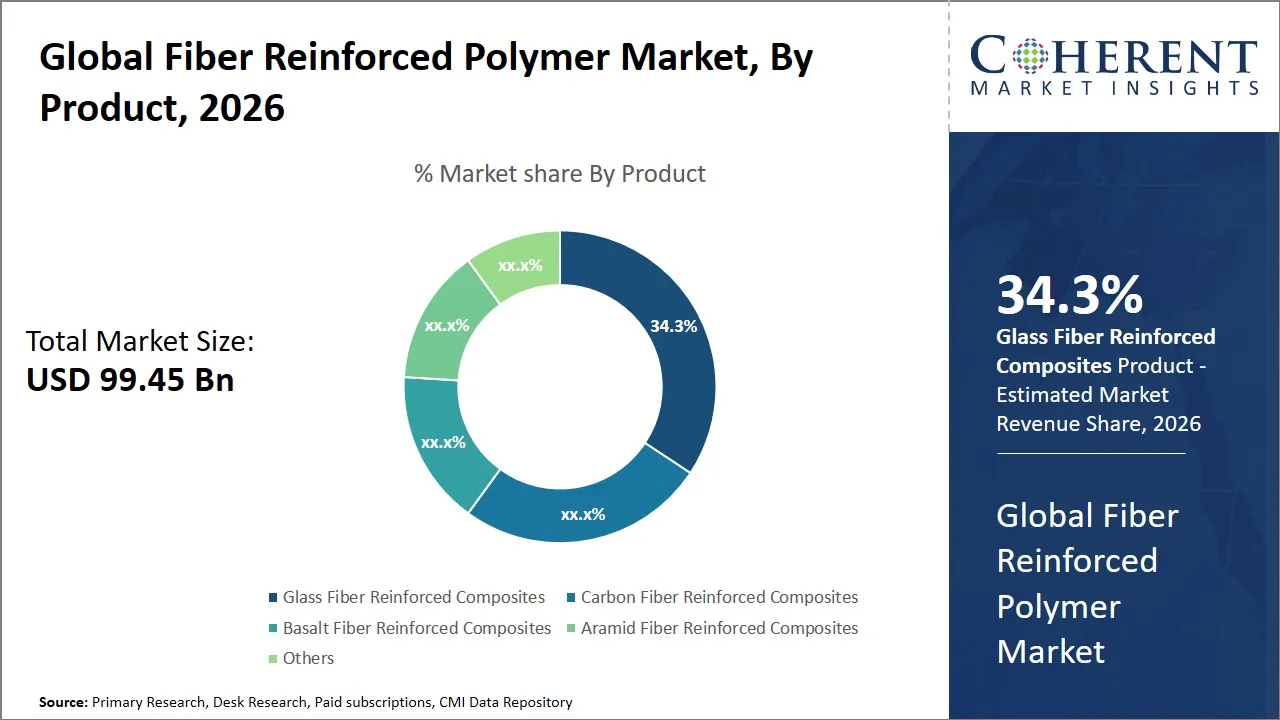
- The glass fiber reinforced composites segment is expected to account for 34.3 % of the global fiber reinforced polymer market share in 2026.
- The automotive segment is projected to hold 32.1 % of the fiber reinforced polymer market share in 2026.
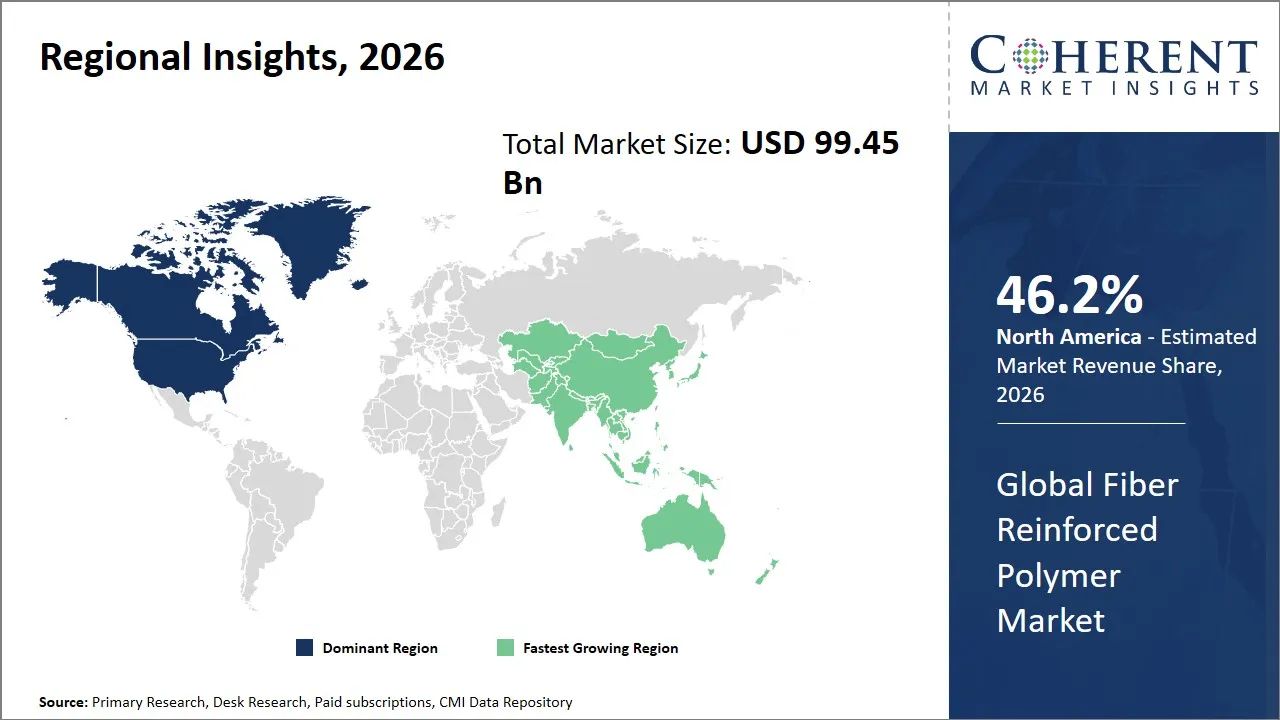
- North America is expected to lead the fiber reinforced polymer market with a 46.2 % share in 2026.
- The Asia Pacific region will hold a 15.3 % share in 2026 and record the fastest growth.
Market Overview
- Key market trends indicate a rising focus on developing advanced fiber reinforced polymer composites with enhanced mechanical properties and environmental resistance.
- Innovations in manufacturing technologies, including automated production and recycling methods, are improving cost-efficiency and environmental sustainability.
- Additionally, growing adoption of these composites in infrastructure projects and electric vehicle production is further propelling market expansion, as industries aim to reduce carbon footprint and improve energy efficiency.
Currents Events and Its Impact
Current Events | Description and its Impact |
Expansion of fiber reinforced polymer (FRP) Rebar Adoption in Infrastructure |
|
Technological Advancements in FRP Materials & Manufacturing |
|
Segmental Insights
- Current Industry Events of 2026
- Market Size Estimation
- Regional Breakdown
- Competitive Landscape
- Customer Intelligence
- Segmental Analysis
- Pricing Analysis
- Key Market Drivers, Challenges & Future Trends
- Customized Insights Section
Why Does the Glass Fiber Reinforced Composites Segment Dominate the Global Fiber Reinforced Polymer Market in 2026?
Glass fiber reinforced composites segment is expected to hold 34.3% of the global fiber reinforced polymer market share in 2026, due to their unique balance of performance and affordability. These composites are not heavy and have good mechanical properties including high tensile strength and durability hence application is very diverse. The cost-effectiveness of the glass fiber reinforced composites (GFRC) versus other fiber composites such as carbon or aramid fibers is one of the main factors that have driven the widespread use of it. This cost-effectiveness facilitates industries to afford high performance materials without having to go overboard with the cost of production, a factor that has seen the wide penetration of the GFRCs in the market.
In the automotive sector, GFRC is widely used in manufacturing body panels and structural components. For instance, BMW utilizes GFRC in some of its vehicles for lightweight body parts, allowing them to achieve improved fuel efficiency without sacrificing safety or performance. This adoption demonstrates how GFRCs enable the automotive industry to balance cost-effective production with the need for durable, lightweight materials.
Automotive Segment Dominates the Fiber Reinforced Polymer Market
The automotive segment is projected to command 32.1% of the fiber reinforced polymer market share in 2026, propelled by the industry’s strategic emphasis on lightweight materials to meet stringent regulatory standards and evolving consumer preferences. Fiber reinforced polymers are also pivotal enablers of automotive companies that want to achieve the reduction of vehicle weight, fuel efficiency and carbon emissions and must be a significant part of the current vehicle design.
The international movement toward sustainability and the necessity to meet more stringent governmental regulations, which pertain to the fuel economy and the emission levels, should be listed among the most efficient growth factors in this segment. Cars in the modern world must meet higher standards of mileage and curb weight reduction is one of the most promising methods of enhancing fuel efficiency. By substituting the traditional metal with the fiber reinforced polymers, the automakers are able to save a lot of weight without affecting the structural integrity and safety of the vehicle, which directly affects the overall performance of the vehicle.
Regional Insights
North America Fiber Reinforced Polymer Market Analysis and Trends
The North America region is projected to lead the market with a 46.2% share in 2026, driven by a highly developed industrial ecosystem, substantial infrastructure investments, and a strong emphasis on innovation and advanced material technologies. The region benefits from robust government policies supporting sustainable construction, aerospace advancements, and automotive lightweighting initiatives, which heavily utilize FRP materials.
The major industry participants including Owens Corning, Hexcel Corporation and Toray Composite Materials America have developing a solid base and have considerable research and development as well as production plants. The high level of adoption of FRP in aerospace, automotive, construction, and wind energy industries is a mature supply chain that has led to the continuum demand and market leadership.
Asia Pacific Fiber Reinforced Polymer Market Analysis and Trends
The Asia Pacific region is expected to exhibit the fastest growth in the market contributing 15.3% share in 2026, as the industrialization, urbanization, and infrastructural development will be at high rates in countries such as China, India and Japan. Favorable government policies that support green construction, renewable energy development and modernization of transport also contribute to the use of FRP materials.
The rising automotive and aerospace market, along with the rise in investment into the wind power generation, demand advanced composites. Such well-known organizations as Jushi Group, Toray Industries, and Mitsubishi Chemical are building up production capacities actively and establish relationships with local manufacturers. Positive trade relations such as export prospects and enhanced availability of raw materials enhance market growth momentum of the region.
Global Fiber Reinforced Polymer Market Outlook for Key Countries:
Why is the U.S. Fiber Reinforced Polymer Market Experiencing Growth?
The fiber reinforced polymer market in the U.S. is characterized by the presence of leading companies such as Hexcel Corporation and Owens Corning who bring on board their high-performance FRP products utilized in aerospace and automotive and infrastructural undertakings. Government incentives of the lightweight materials in the automotive fuel efficiency schemes and renewable energy assistance programs in the country are compatible with the use of FRP. Moreover, the implementation of the advanced manufacturing technology and orientation on sustainability provides increased product innovation making the U.S. one of the leaders in the FRP arena.
Why is China Emerging as a Key Player in the Fiber Reinforced Polymer Market?
The fiber reinforced polymer market of China is driven by the huge infrastructure and renewable energy projects, especially the production and construction of wind turbines. Jushi Group is among the largest fiberglass manufacturers in the world and its domestic competitors such as Sinopec actively invest in the capacity development and technological modernization. The Made in China 2025 program by the Chinese governments promotes the development of advanced material, which creates a friendly atmosphere in terms of FRP innovation. Increasing car industry and environmental regulations on lightweight and fuel-efficient automobiles also boost demand.
Germany Fiber Reinforced Polymer Market Trends
Germany has remained the European leader in the fiber reinforced polymer industry with heavy focus on high value products like the automobile light weight composites and wind structures. Such companies as SGL Carbon and Lanxess are competitive with their developed FRP products lines that are designed to meet durability and performance. The restrictive environmental policies and support of the use of renewable energy that Germanys has established encourage the use of FRP in the transport and energy industry. The networks of suppliers and engineering capabilities of the countries enhance its market position in Europe.
India Fiber Reinforced Polymer Market Trends
The market of fiber reinforced polymer in India is developing fast and is favored by governmental programs according to the improvement of infrastructure, low-cost housing and clean energy. Other firms like Jushi India and Asian Composites are crucial in the local production and technology transfer. Market growth is driven by the increasing need in the automotive, aerospace, and construction industries as well as by the increase in awareness of the benefits of composite such as corrosion resistance and durability. The availability of advanced FRP materials and technologies are also being increased by trade policies and foreign investments.
Japan Fiber Reinforced Polymer Market Trends
The fiber reinforced polymer market in Japan is still targeted to the high-performance field that is being fueled by automobile and aerospace industries with such players as Toray Industries and Mitsubishi Chemical being at the forefront of advancing the advanced FRP composites. The powerful R&D base and the cooperation between the industry and government in the country ensure the ongoing creation of lightweight and durable material that would meet high safety and environmental requirements. The effectiveness of Japan supply chains and its emphasis on export has helped it sustain its strategic position in the local and global markets of FRP.
Recycling / Bio-Based Polymers & Circular Economy Trends
Trend | Description | Example / Case Study |
Recycling of FRPs | The recycling of FRPs, especially thermoset-based composites, is gaining momentum, with new techniques developed for reprocessing materials such as glass and carbon fibers. | BMW’s i3 and i8 electric vehicles incorporate recycled carbon fibers in their design, with a focus on automotive parts that can be recycled and reused. |
Bio-based Polymers | Increased adoption of renewable, bio-based fibers and resins to replace petroleum-based options in the production of FRPs, reducing dependence on fossil fuels. | Hexcel's Biocomposites: A bio-based resin that is used in the aerospace industry, significantly reducing the carbon footprint of composite materials. |
Sustainable Manufacturing | Manufacturers are adopting cleaner production technologies to minimize energy consumption, reduce waste, and increase resource efficiency in FRP production. | DSM’s EcoPaXX: A bio-based polyamide made from castor beans, used in automotive applications, reducing the environmental footprint by using renewable resources. |
Market Players, Key Development, and Competitive Intelligence
Key Developments
- In May 2024, emphasizing sustainability, Hexcel Corporation announced a 10-year agreement with Fairmat to recycle carbon fiber composite materials. Fairmat is an international carbon fiber composite recycler. It recently opened a vast recycling facility near Hexcel Salt Lake City. The duo companies are dedicated to sustainable solutions in the long-term.
- In October 2023, Mitsubishi Chemical Group Corporation announced the acquisition of CPC, an Italian Carbon Fiber Composite Components manufacturer. CPC specializes in manufacturing automobile components made from carbon fiber reinforced plastic (CFRP). The acquisition helps Mitsubishi Chemical Group Corporation expand its carbon fiber supply chain.
Top Strategies Followed by Global Fiber Reinforced Polymer Market Players
Player Type | Strategic Focus | Example |
Established Market Leaders | Heavy investment in R&D and innovation | For example, Hexcel Corporation has taken great steps in aerospace industry by coming up with superior carbon fiber-based composites that are strong as well as saving weight and this is important to the aerospace industries in meeting its fuel efficiency targets. |
Mid-Level Players | Balance cost and sustainability | An example is SGL Carbon has concentrated on the manufacture of superior quality carbon fiber composites that are cost-effective and used in the automotive and industrial industry. They have established a niche in the provision of materials that support the fundamental functional needs of these industries, at prices that are not the high-end of the state-of-the-art composites. |
Small-Scale Players | Niche specialization & innovative variants | An example of a small-scale player is Biocomposites Ltd. that specializes in bio-based composites and has reached the point of producing eco-friendly products in other industries such as construction and automotive. |
Market Report Scope
Fiber Reinforced Polymer Market Report Coverage
| Report Coverage | Details | ||
|---|---|---|---|
| Base Year: | 2025 | Market Size in 2026: | USD 99.45 Bn |
| Historical Data for: | 2020 To 2024 | Forecast Period: | 2026 To 2033 |
| Forecast Period 2026 to 2033 CAGR: | 6.7% | 2033 Value Projection: | USD 156.59 Bn |
| Geographies covered: |
| ||
| Segments covered: |
| ||
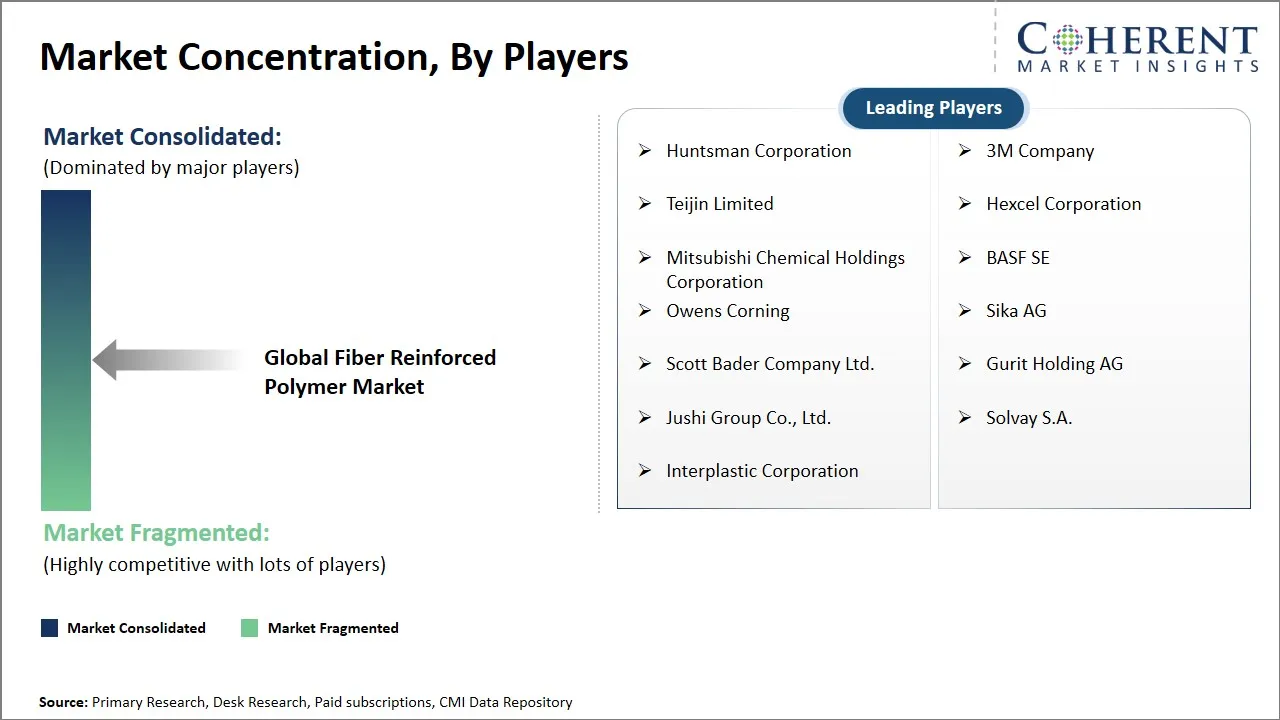
| Companies covered: | Huntsman Corporation, 3M Company, Teijin Limited, Hexcel Corporation, Mitsubishi Chemical Holdings Corporation, BASF SE, Owens Corning, Sika AG, Scott Bader Company Ltd., Gurit Holding AG, Jushi Group Co., Ltd., Solvay S.A., and Interplastic Corporation | ||
| Growth Drivers: |
| ||
| Restraints & Challenges: |
| ||
Fiber Reinforced Polymer Market Dynamics
Fiber Reinforced Polymer Market Driver - Increasing Demand for Lightweight Materials in Automotive and Aerospace Applications
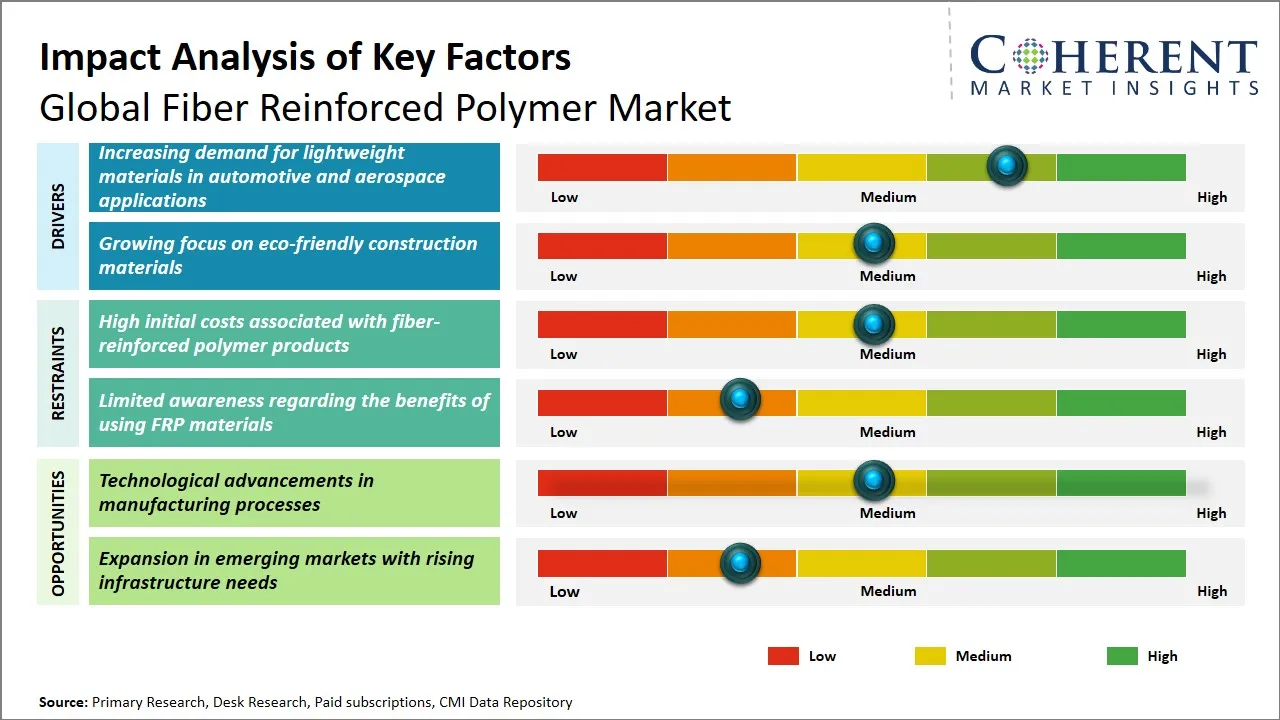
The increased interest in fuel efficiency and the high standards in emissions throughout the world have greatly increased the popularity of lightweight materials, especially within the automotive and aerospace sectors. The fiber reinforced polymer (FRTs), are the perfect solution as they have an excellent strength to weight ratio that allows a manufacturer to save weight in the vehicle without affecting the integrity of the structure or the safety of the vehicle. The use of FRPs instead of traditional metals in the automotive industry also leads to better fuel economy and performance of the vehicle, as well as the creation of electric vehicles due to its ability to increase battery life by reducing weight.
For example, Boeing and Airbus have used FRPs to develop aircrafts that are lighter and more fuel efficient in aerospace. The 787 Dreamliner by Boeing uses more than 50 percent composite materials including the FRPs that are very slender in weight and make the aircraft very fuel efficient. Application of FRPs in aerospace directly correlates with improvement of performance without compromising on the emission and fuel efficiency standards.
Fiber Reinforced Polymer Market Opportunity - Technological Advancements in Manufacturing Processes
The global fiber reinforced polymer market stands to benefit significantly from ongoing technological advancements in manufacturing processes, due to the continued development of technology in the manufacturing process, which is leading to the increase of its performance, cost effectiveness, and the possibility of wider application in a variety of industries. New technologies like Automated Fiber Placement (AFP), Resin Transfer Molding (RTM), composite and newer methods of additive manufacturing are transforming the manufacturing of FRP composites into more precise fiber placement, less waste material and lower manufacturing cycles.
For example, GKN Aerospace uses AFP to manufacture aerospace lightweight parts of high performance. The use of AFP has seen more fiber orientation accuracy hence less material waste and a decrease in the production cycles and this has greatly cut down on cost.
(Source: https://www.gknaerospace.com/)
Analyst Opinion (Expert Opinion)
- The fiber reinforced polymer industry has a strong potential to increase, which is attributed to the growing use of the material in construction, automobile, and aerospace applications, owing to its lightweight and high strength properties. The reflections of the International Conference on Advanced Composite Materials (2023) and the Composites Europe Expo (2022) covered the most recent innovations, and the companies such as Hexcel and Owens Corning are leading the pack regarding the creation of new advanced composite solutions, which would benefit the durability and performance.
- The recent appearance of carbon fiber reinforced polymer emphasized by Hexcel with the primary focus on the aerospace industry is an example of how the industry is focused on innovation and performance optimization. At these conferences, there was a discussion about the increasing need to have sustainable materials especially with the manufacturers trying to find substitutes to the traditional materials that could lead to a decrease in the number of carbon footprints. But other issues like high cost of production and the fact that specialized knowledge was required when working with composite materials were often mentioned as possible obstacles to increased adoption.
- The companies that invest in R&D of cost-effective solutions of FRP and collaborate closely with industries to customize their products will most probably be successful. After all, the future of the fiber reinforced polymer market will be determined by its capability to constantly innovate and take the concept of sustainability and meet the changing demands of the industry.
Speak to the analyst
Want personalized insights?
Take the findings above to one of our principal consultants, or have the report rebuilt around the segments, geographies and competitors you actually track.
Market Segmentation
- Product Insights (Revenue, USD Bn, 2021 - 2033)
- Glass Fiber Reinforced Composites
- Carbon Fiber Reinforced Composites
- Basalt Fiber Reinforced Composites
- Aramid Fiber Reinforced Composites
- Others
- Application Insights (Revenue, USD Bn, 2021 - 2033)
- Automotive
- Construction
- Electronics
- Defense
- Others
- Regional Insights (Revenue, USD Bn, 2021 - 2033)
- North America
- U.S.
- Canada
- Latin America
- Brazil
- Argentina
- Mexico
- Rest of Latin America
- Europe
- Germany
- U.K.
- Spain
- France
- Italy
- Russia
- Rest of Europe
- Asia Pacific
- China
- India
- Japan
- Australia
- South Korea
- ASEAN
- Rest of Asia Pacific
- Middle East
- GCC Countries
- Israel
- Rest of Middle East
- Africa
- South Africa
- North Africa
- Central Africa
- North America
- Key Players Insights
- Huntsman Corporation
- 3M Company
- Teijin Limited
- Hexcel Corporation
- Mitsubishi Chemical Holdings Corporation
- BASF SE
- Owens Corning
- Sika AG
- Scott Bader Company Ltd.
- Gurit Holding AG
- Jushi Group Co., Ltd.
- Solvay S.A.
- Interplastic Corporation
Sources
Primary Research Interviews
- CEO – Leading FRP Composites Producer (e.g., Owens Corning or Hexcel equivalent)
- Supply Chain Director – Major FRP Materials Distributor
- Production Lead – Carbon Fiber Reinforced Polymer Manufacturer
- Sustainability Officer – FRP Composites Certification Authority
Stakeholders
- Manufacturers
- End-use Sectors:
- Automotive Industry (Body Panels, EV Components)
- Aerospace & Defense (Aircraft Structures, Wings)
- Construction (Rebar, Structural Reinforcement)
- Regulatory & Certification Bodies (e.g., NSF for FRP PCR, EPA for composites)
- E-commerce Platforms and Retailers (Alibaba, Industrial Suppliers, Sigma-Aldrich equivalents for composites)
- Technology Integration Players: Wind Energy and EV Producers using FRP
Databases
- UN Comtrade Database (HS codes for composites like 6815/3920)
- India Import Export (EXIM) Database
- USGS Mineral Commodity Summaries (Glass Fiber, Carbon Fiber)
- Eurostat Trade Statistics for Chemicals and Composites
Magazines
- CompositesWorld – Trends in FRP composites supply
- Reinforced Plastics Magazine – Applications in reinforced polymers
- Composites Technology – Market dynamics for fiber reinforced polymers
- JEC Composites Magazine – Innovations in FRP manufacturing
Journals
- Journal of Reinforced Plastics and Composites – Durability and properties of FRP
- Journal of Fibers and Polymer Composites – Processing and applications
- Composites Part B: Engineering – FRP in structural reinforcement
- Polymer Composites – Sustainability and mechanical analysis
Newspapers
- The Wall Street Journal – Global demand for composites in transportation
- Business Standard (India) – FRP market growth in Asia
- Reuters – Supply chain volatility in carbon fiber and resins
Associations
- American Composites Manufacturers Association (ACMA)
- JEC Group
- Composites UK
- European Composites Industry Association (EuCIA)
Public Domain Sources
- EPA – Guidelines for polymer composites handling
- European Commission – REACH regulations on FRP composites
- World Health Organization – Safety standards for composite materials
- USGS – Fiber minerals statistics and trade (glass, carbon fibers)
- OECD – Composites trade and sustainability reports
Proprietary Elements
- CMI Data Analytics Tool
- Proprietary CMI Existing Repository of information for last 8 years.
Get access to 250+ pages report
Every segment, forecast, competitor profile and data table behind the analysis above — available for instant download.
- ESOMAR Member
- ISO 9001:2015 Certified
- D-U-N-S Registered
- GDPR & CCPA Compliant
Missing comfort of reading report in your local language? Find your preferred language:
Transform your Strategy with Exclusive Trending Reports
Frequently Asked Questions
The global fiber reinforced polymer market is estimated to be valued at USD 99.45 Bn in 2026 and is expected to reach USD 156.59 Bn by 2033.
The CAGR of global fiber reinforced polymer market is projected to be 6.7% from 2026 to 2033.
Increasing demand for lightweight materials in automotive and aerospace applications and growing focus on eco-friendly construction materials are the major factors driving the growth of the global fiber reinforced polymer market.
High initial costs associated with fiber-reinforced polymer products and limited awareness regarding the benefits of using FRP materials are the major factors hampering the growth of the global fiber reinforced polymer market.
In terms of product, glass fiber reinforced composites are estimated to dominate the market revenue share in 2026.
Huntsman Corporation, 3M Company, Teijin Limited, Hexcel Corporation, Mitsubishi Chemical Holdings Corporation, BASF SE, Owens Corning, Sika AG, Scott Bader Company Ltd., Gurit Holding AG, Jushi Group Co., Ltd., Solvay S.A., and Interplastic Corporation are the major players.
North America is expected to lead the global fiber reinforced polymer market in 2026.