

Global Fish Oil Market Size and Forecast – 2026-2033
According to Coherent Market Insights, the global fish oil market is estimated to be valued at USD 3.77 Bn in 2026 and is expected to reach USD 5.23 Bn by 2033, exhibiting a compound annual growth rate (CAGR) of 4.8% from 2026 to 2033.
Key Takeaways of the Fish Oil Market
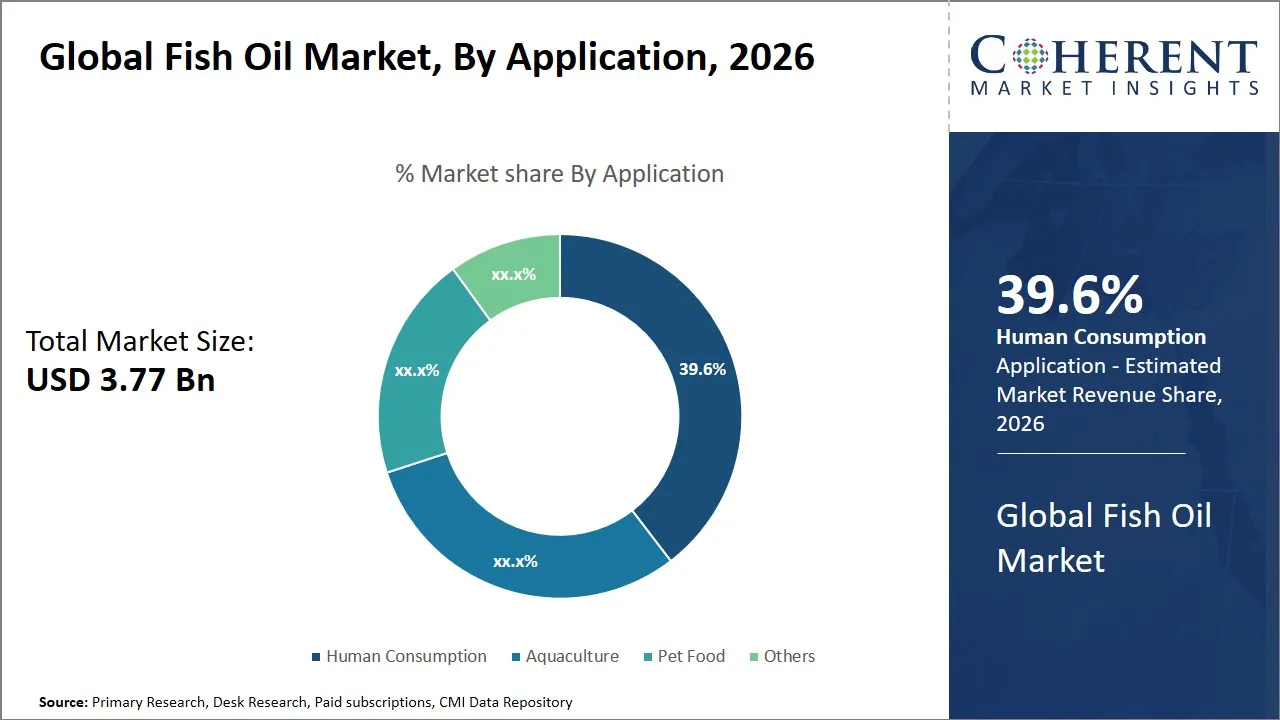
- The human consumption segment is projected to account for 39.6% of the global fish oil market in 2026.
- Pelagic and demersal species are set to account for 24.8% of the global fish oil market in 2026.
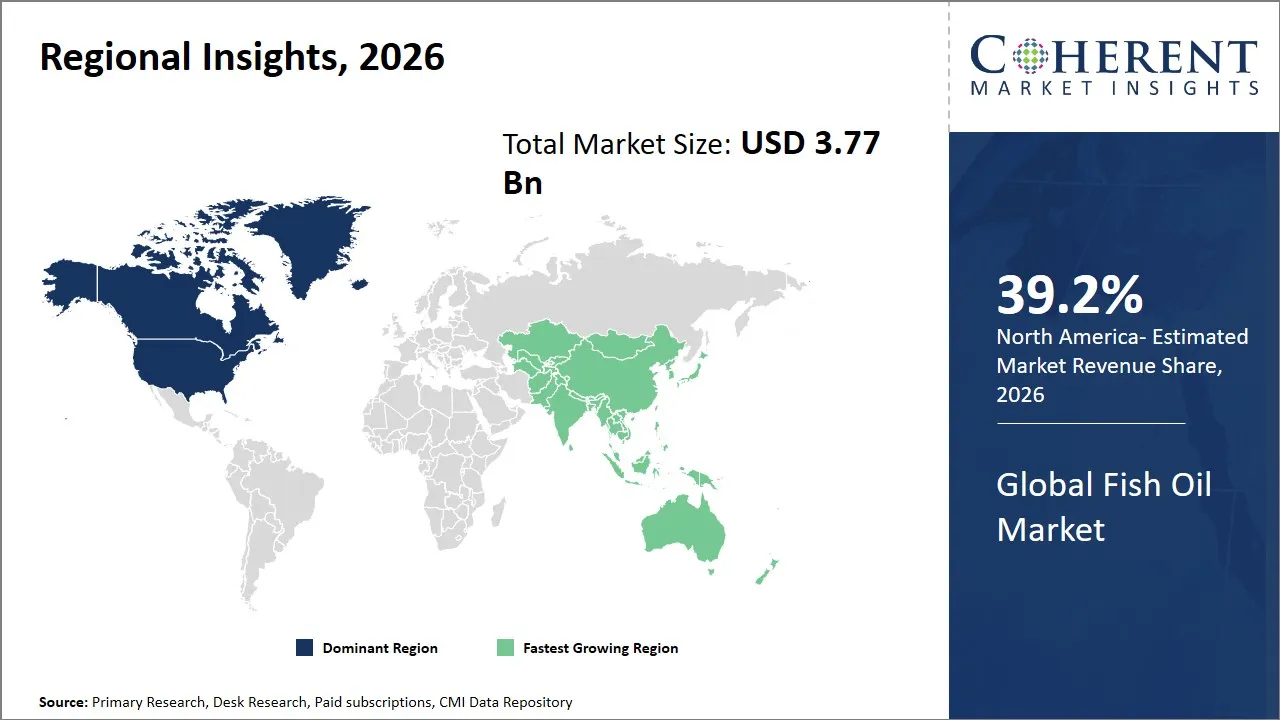
- North America is expected to lead the market with a 39.2% share in 2026.
- The Asia Pacific region is projected to experience the fastest growth, contributing 21.3% of the market share in 2026.
Market Overview
- Market trends indicate a strong shift towards sustainable and high-quality fish oil products driven by advancements in extraction technology and stringent regulatory standards.
- Additionally, the growing popularity of personalized nutrition and preventive healthcare is contributing to the expanded application of fish oil in functional foods, nutraceuticals, and clinical nutrition, further propelling market growth in the coming years.
Currents Events and their Impact
Current Events | Description and its Impact |
China Marine Ingredient Output Decline (2026) |
|
Tariff and Policy Uncertainty in Omega‑3 Sector (2025) |
|
Segmental Insights
- Current Industry Events of 2026
- Market Size Estimation
- Regional Breakdown
- Competitive Landscape
- Customer Intelligence
- Segmental Analysis
- Pricing Analysis
- Key Market Drivers, Challenges & Future Trends
- Customized Insights Section
Why Does Human Consumption Dominate the Global Fish Oil Market in 2026?
The human consumption segment is expected to hold 39.6% of the global fish oil market share in 2026, due to the increasing consumer shift towards health and wellness-oriented dietary supplements. Fishery oil contains omega-3 fatty acids that have been well known to be cardiovascular, cognitive, and anti-inflammatory. With this increased knowledge on these health-related benefits among the various demographics, demand in this segment has been high. With the increasing health awareness, especially in the developed and emerging economies, there has been increased pressure on the demand of natural and preventive health products like fish oil supplements.
In 2025, the global popularity of omega-3 supplements grew significantly following a study published in the Journal of Clinical Lipidology, which highlighted the positive impact of omega-3 on reducing cardiovascular risk. This has prompted both new entrants and established brands in the health supplement sector to expand their fish oil product offerings.
Traditional Pelagic and Demersal Species Dominate the Fish Oil Market
Traditional pelagic and demersal species are expected to hold 24.8% of the global fish oil market share in 2026, linked to their abundant availability and established supply chains, making them the backbone of the fish oil industry. Among the most typical fish that are used as sources of oil are pelagic species (anchovies, sardines, mackerel) or demersal species, which are mostly due to their abundance, quick reproduction rate, and distribution in diverse marine ecosystems across the globe.
A relative sustainability of pelagic and demersal fisheries is one of the factors that have helped to drive the growth of this segment as opposed to other species. The fish will reproduce very fast and live in high population, and therefore it can be harvested regularly and in a sustainable manner, as there would already be proper fishery management policies. Sustainable fishing certification and practices have enhanced consumer trust and corporate pledges regarding responsible sourcing of fish oil, and the segments have grown in popularity in the environmentally conscious markets.
Regional Insights
North America Fish Oil Market Analysis and Trends
The North America region is projected to lead the market with a 39.2% share in 2026, driven by a well-established health supplement ecosystem, high consumer awareness regarding cardiovascular and cognitive health benefits of omega-3 fatty acids, and strong research and development capabilities. The geographical location enjoys sound government regulations and standards on the quality of the products like the U.S. Food and Drug Administration’s guidelines, which increases the confidence of the consumers.
The dominance of the North Americas leadership is further strengthened by the presence of the large nutraceutical firms like Nordic Naturals, Natures Way, and Omega Protein Corporation, the presence of well-established networks within the health stores, pharmacies, and the e-commerce business. In addition, trade dynamics will be in favor of stable import-exports of goods and services, and both local fisheries and foreign suppliers of sustainable fish oil.
Asia Pacific Fish Oil Market Analysis and Trends
The Asia Pacific region is expected to exhibit the fastest growth in the market contributing 21.3% share in 2026, due to the increasing health awareness, growing disposable income, and middle-class population especially in China, India, Japan, and the other countries in Southeast Asia. Market expansion is facilitated by government campaigns on the health of nutritional food and better regulatory systems in other countries such as Japan and Australia.
The areas that have vast natural fish reserves can be strategically used in local production and export. Some prominent companies like Blackmores (Australia), DSM Nutritional Products (with operations in the region) and a number of local manufacturers that are yet to grow are increasing their presence. Furthermore, there is trade liberalization and the enhancement of cold chain logistics, which contribute to the increased consumer-based demand on fish oil supplements and fortified foods.
Fish Oil Market Outlook for Key Countries
Why Are the U.S. Fish Oil Market Benefiting from Consumer Health Trends and Regulatory Support?
The U.S. fish oil market is endowed with the high level of consumer preference towards preventive health care and dietary supplements. Players such as Nordic Naturals and Omega Protein have also played an essential role by coming up with high purity of fish oil products that are backed by intensive clinical studies. The regulatory atmosphere in the country helps to develop consumer confidence because its regulatory environment focuses on safety and efficacy. Also, brand-provider collaborations are another factor that contributes to product adoption.
Why Is China’s Fish Oil Market Growing Amidst Increased Awareness and Strategic Investments?
The fish oil market in China is fast changing with the growing awareness of the benefits of omega-3 and government subsidized health programs. The local firms are expanding with the foreign corporations such as DSM who have invested in the local facilities and research and development. The growing e-commerce industry provides larger access product. Moreover, the extensive seafood market of China provides a stable source of raw materials in extraction of fish oil to support supply chains.
Japan Fish Oil Market Trends
Japan continues to dominate the consumer demand because of the traditional diet with seafood and the historical knowledge of health benefits of fish oils. Such companies like Nippon Suisan Kaisha and Morinaga Milk Industry have been the first to introduce high quality fish oil supplement and functional food. The markets selling high quality products is maintained by strict government quality control and advanced production technologies.
India Fish Oil Market Trends
The fish oil market in India is gaining momentum due to the growing health consciousness and against the background of augmented acceptance of supplements as a result of urbanization and digital health education. Both domestic and foreign brands are spreading distribution in the form of pharmacies and the Internet. The growth of the market can be attributed to government drives to encourage nutritional supplements as a policy to promote the population health, and to the long coastline of the country, which is open to mass production of fish oil.
Australia Fish Oil Market Trends
The combination of local production excellence and a high level of export orientation characterize the fish oil market in Australia. One of its competitors, Blackmores is both powerful in the domestic and international market and it is oriented to sustainable sourcing and high-quality formulations. The sustainable fisheries and the toughness of environmental policies supported by the government are the factors that motivate responsible production practices. Moreover, the demand of natural and organic products among consumers in this region is in line with the fish oil segment.
EPA/DHA Price Volatility vs Raw Fish Catch Correlation
Year | Raw Fish Catch (Million Tons) | EPA/DHA Price Volatility (%) | EPA Price (USD per kg) | DHA Price (USD per kg) |
2022 | 85 | 9% | 1,300 | 1,500 |
2023 | 88 | 6% | 1,350 | 1,475 |
2024 | 80 | 12% | 1,400 | 1,550 |
Market Players, Key Development, and Competitive Intelligence
Key Developments
- In June 2024, GC Rieber VivoMegaopened a new omega-3 manufacturing facility in Norway. The plant, which will operate on 100% renewable energy, is expected to double the current output of triglyceride marine omega-3s and vegan algal oils, addressing the rising demand for omega-3 supplements.
- In March 2024, Pelagiaannounced the acquisition of the UK-based seafood trading firm Ideal Foods Limited. With this, Pelagia plans to develop collaboration and synergy with Ideal Foods to enhance its global supply chain and strengthen its market presence while continuing to innovate and utilize seafood co-products.
Top Strategies Followed by Global Fish Oil Market Players
Player Type | Strategic Focus | Example |
Established Market Leaders | Heavy investment in R&D and innovation | For example, the introduction of an omega-3 fish oil line of products with vitamin D in it by BASF which has been responding to the demand of the consumers in the products to boost their immunity. Through R&D, BASF has positioned itself through the provision of a highly bioavailable product thus establishing the pace to be followed in the industry in relation to the quality of products. |
Mid-Level Players | Balance cost and sustainability | For example, EPAX collaborated with Coastal Biologicals to help them with their extraction procedures of fish oil. This partnership increased their product line-up thus enabling them to provide affordable omega-3 products without compromising on the products. |
Small-Scale Players | Niche specialization & innovative variants | An example is the company NutraScience Labs which is a vegan version of omega-3 which is produced using algae as it is starting to cater to the increasing popularity of plant-based supplements. Through its attention to sustainability and high-quality sourcing, the company has scored in the niche market segment of eco-conscious consumers. |
Market Report Scope
Fish Oil Market Report Coverage
| Report Coverage | Details | ||
|---|---|---|---|
| Base Year: | 2025 | Market Size in 2026: | USD 3.77 Bn |
| Historical Data for: | 2020 To 2024 | Forecast Period: | 2026 To 2033 |
| Forecast Period 2026 to 2033 CAGR: | 4.8% | 2033 Value Projection: | USD 5.23 Bn |
| Geographies covered: |
| ||
| Segments covered: |
| ||
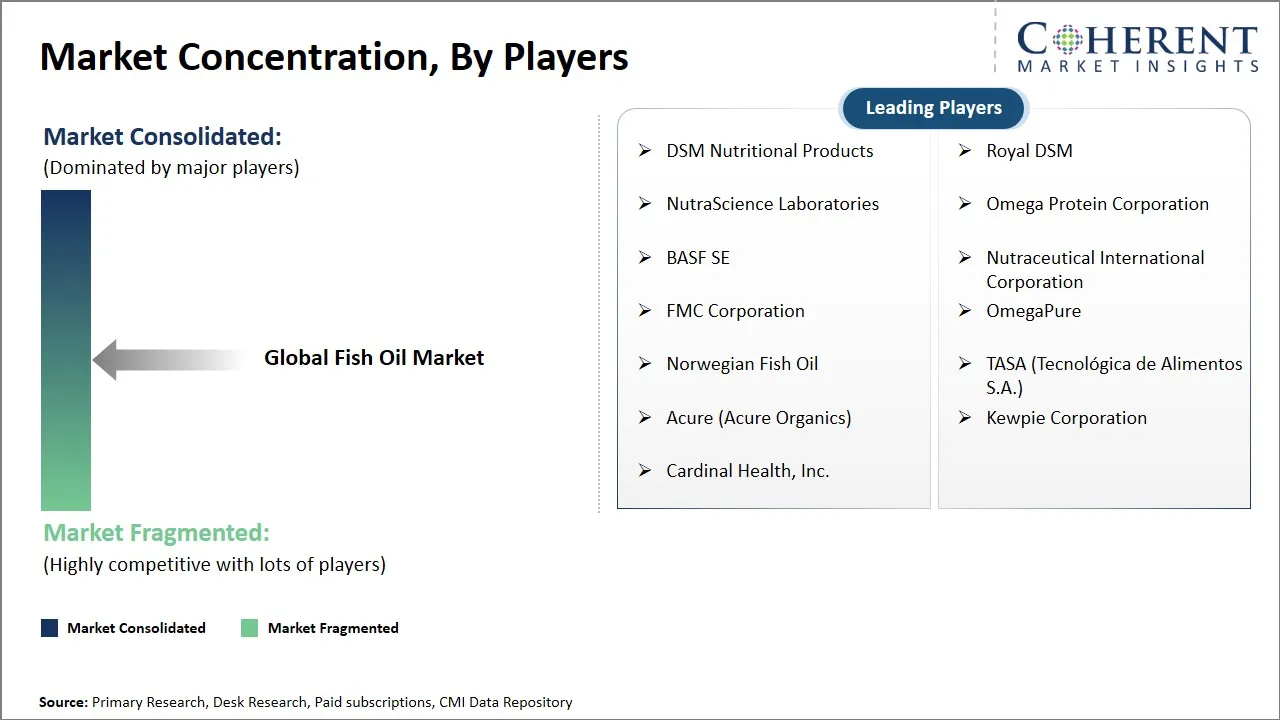
| Companies covered: | DSM Nutritional Products, Royal DSM, NutraScience Laboratories, Omega Protein Corporation, BASF SE, Nutraceutical International Corporation, FMC Corporation, OmegaPure, Norwegian Fish Oil, TASA (Tecnológica de Alimentos S.A.), Acure (Acure Organics), Kewpie Corporation, and Cardinal Health, Inc. | ||
| Growth Drivers: |
| ||
| Restraints & Challenges: |
| ||
Fish Oil Market Dynamics
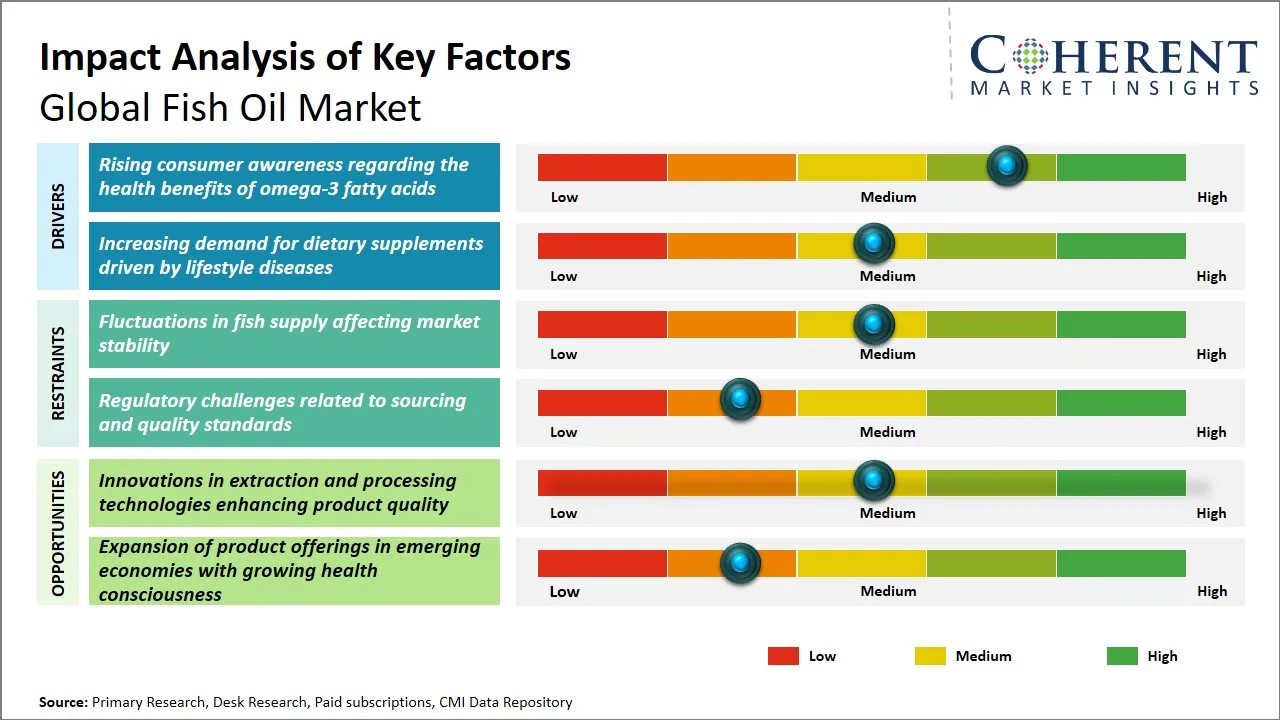
Fish Oil Market Driver - Rising Consumer Awareness Regarding the Health Benefits of Omega-3 Fatty Acids
The increased knowledge of the consumer regarding the beneficial health effects of omega-3 fatty acids is a major force that is pushing the fish oil market in the world. With the increased number of people becoming aware of the importance of omega-3s in promoting cardiovascular health, brain activity and in inflammatory processes, there has been a significant trend where people have shifted away to include the nutrients in their daily diets using supplements and fortified foods. The heightened awareness has been greatly enhanced by educational campaigns, availability of health information through online channels and recommendations by health experts.
An example of the rising consumer awareness regarding the health benefits of omega-3 fatty acids can be seen with the increasing demand for fish oil supplements. According to a 2023 survey by the National Institutes of Health (NIH), over 40% of adults in the U.S. now regularly consume omega-3 supplements, with the primary reason being the associated cardiovascular benefits.
(Source: https://pmc.ncbi.nlm.nih.gov/articles/PMC12524211/)
Fish Oil Market Opportunity - Innovations in Extraction and Processing Technologies Enhancing Product Quality
The global fish oil market is witnessing significant opportunities driven by advancements in extraction and processing technologies that are enhancing the overall quality and efficacy of fish oil products. The conventional approaches to extracting fish oil tended to produce less purified products with increased contamination levels of such substances like heavy metals and oxidants. Nonetheless, the most recent advancements such as the supercritical carbon dioxide extraction, molecular distillation, and enzymatic extraction have transformed the industry because the manufacturers are able to get fish oil with greater amounts of the omega-3 products, fatty acids and lower impurities. All these advanced technologies facilitate the preservation of bioactive components better thus creating fish oil products which can offer greater health benefits to consumers and are also safe to use by consumers.
As an example, the application of supercritical carbon dioxide extraction by such companies as EPAX, which is one of the leading manufacturers of omega-3 fish oil. This purification process enhances purity of the product by applying high pressure and low temperature carbon dioxide, therefore, obtaining high concentrations of omega-3 without lowering the quality of the product.
(Source: https://www.epax.com/)
Analyst Opinion (Expert Opinion)
- The fish oil market has increasingly shifted from a basic commodity to a sophisticated, data‑driven, health‑centric industry where scientific dialogue and business strategy intersect. Beyond macro forecasts, participants are responding to real supply challenges and regulatory debates — for example, 2025 supply adjustments following Peru’s anchovy season disruption forced major producers to rethink inventory and regional flows, illustrating structural vulnerability in supply chains and prompting broader risk management discussions among stakeholders.
- Analysts tracking sector convenings point to the GOED Exchange 2026 in Singapore, a high‑profile omega‑3 industry conference that brought scientists, regulators, and executives together to tackle quality standards, sustainability, and global intake recommendations, shaping prescriptive strategies for fish oil formulations going into 2026.
- The controversy and anticipation around a forthcoming joint U.S.–Canada Dietary Reference Intake for omega‑3s has also galvanized research networks and speakership slots at scientific symposia, indicating that clinical evidence is now as critical to commercial success as traditional marketing.
Speak to the analyst
Want personalized insights?
Take the findings above to one of our principal consultants, or have the report rebuilt around the segments, geographies and competitors you actually track.
Market Segmentation
- Application Insights (Revenue, USD Bn, 2021 - 2033)
- Human Consumption
- Aquaculture
- Pet Food
- Others
- Species Insights (Revenue, USD Bn, 2021 - 2033)
- Traditional Pelagic and Demersal Species
- Tuna
- Salmon
- Pangasius
- Tilapia
- Regional Insights (Revenue, USD Bn, 2021 - 2033)
- North America
- U.S.
- Canada
- Latin America
- Brazil
- Argentina
- Mexico
- Rest of Latin America
- Europe
- Germany
- U.K.
- Spain
- France
- Italy
- Russia
- Rest of Europe
- Asia Pacific
- China
- India
- Japan
- Australia
- South Korea
- ASEAN
- Rest of Asia Pacific
- Middle East
- GCC Countries
- Israel
- Rest of Middle East
- Africa
- South Africa
- North Africa
- Central Africa
- North America
- Key Players Insights
- DSM Nutritional Products
- Royal DSM
- NutraScience Laboratories
- Omega Protein Corporation
- BASF SE
- Nutraceutical International Corporation
- FMC Corporation
- OmegaPure
- Norwegian Fish Oil
- TASA (Tecnológica de Alimentos S.A.)
- Acure (Acure Organics)
- Kewpie Corporation
- Cardinal Health, Inc.
Sources
Primary Research Interviews
- CEO – Leading Fish Oil Producer (e.g., Pelagia AS or TripleNine equivalent)
- Supply Chain Director – Major Omega-3 Distributor
- Production Lead – Aquaculture Feed Manufacturer using Fish Oil
- Sustainability Officer – Marine Stewardship Council (MSC) or GOED Certification Authority
Stakeholders
- Manufacturers
- End-use Sectors
- Aquaculture & Aquafeed Producers
- Nutritional Supplements & Pharmaceuticals
- Animal Nutrition & Pet Food
- Regulatory & Certification Bodies (e.g., FDA/EPA for omega-3 supplements, EFSA for EU claims, GOED standards)
- E-commerce Platforms and Retailers (IndiaMART, Alibaba, Icelandirect, Sigma-Aldrich equivalents)
- Technology Integration Players: Algal oil alternatives and precision omega-3 formulators
Databases
- UN Comtrade Database (fisheries trade data)
- India Import Export (EXIM) Database (fish oil HS codes)
- US NOAA Foreign Fishery Trade Data
- Eurostat Trade Statistics for Fisheries Products
Magazines
- Aqua Star Magazine – Trends in aquaculture and fish oil
- Fish Farming International – Fish oil in feed innovations
- Journals
- Journal of Food Science – Fish oil bioavailability and EPA/DHA
- Aquaculture – Fish oil in feed and sustainability
- Nutrients – Omega-3 health impacts
Newspapers
- The Wall Street Journal – Fish oil health and market developments
- Reuters – Supply chain and price volatility in omega-3
- Business Standard (India) – Fish oil imports and aquaculture growth
Associations
- European Fishmeal and Fish Oil Producers (EFFOP)
- Global Organization for EPA and DHA Omega-3 (GOED)
- North Atlantic Pelagic Advocacy Group (NAPA)
Public Domain Sources
- FDA/EPA – Guidelines for fish oil supplements and contaminants
- European Commission/EFSA – Omega-3 claims and REACH for marine oils
- World Health Organization – Nutritional standards for EPA/DHA
- FAO Fisheries Trade Data – Global fish oil assessments
Proprietary Elements
- CMI Data Analytics Tool, Proprietary CMI Existing Repository of information for last 8 years.
Get access to 250+ pages report
Every segment, forecast, competitor profile and data table behind the analysis above — available for instant download.
- ESOMAR Member
- ISO 9001:2015 Certified
- D-U-N-S Registered
- GDPR & CCPA Compliant
Missing comfort of reading report in your local language? Find your preferred language:
Transform your Strategy with Exclusive Trending Reports
Frequently Asked Questions
The global fish oil market is estimated to be valued at USD 3.77 Bn in 2026 and is expected to reach USD 5.23 Bn by 2033.
Fish oil is a dietary oil extracted from oily fish (e.g., anchovy, sardine, mackerel) rich in omega‑3 fatty acids — primarily EPA (eicosapentaenoic acid) and DHA (docosahexaenoic acid).
The CAGR of global fish oil market is projected to be 4.8% from 2026 to 2033.
Rising consumer awareness regarding the health benefits of omega-3 fatty acids and increasing demand for dietary supplements driven by lifestyle diseases are the major factors driving the growth of the global fish oil market.
Fluctuations in fish supply affecting market stability and regulatory challenges related to sourcing and quality standards are the major factors hampering the growth of the global fish oil market.
In terms of application, human consumption is estimated to dominate the market revenue share in 2026.
DSM Nutritional Products, Royal DSM, NutraScience Laboratories, Omega Protein Corporation, BASF SE, Nutraceutical International Corporation, FMC Corporation, OmegaPure, Norwegian Fish Oil, TASA (Tecnológica de Alimentos S.A.), Acure (Acure Organics), Kewpie Corporation, and Cardinal Health, Inc. are the major players.