

Global Fruit Juice Market Size and Forecast – 2026-2033
The global fruit juice market is estimated to be valued at USD 95.83 Bn in 2026 and is expected to reach USD 153.88 Bn by 2033, exhibiting a compound annual growth rate (CAGR) of 7.0% from 2026 to 2033.
Key Takeaways of the Fruit Juice Market
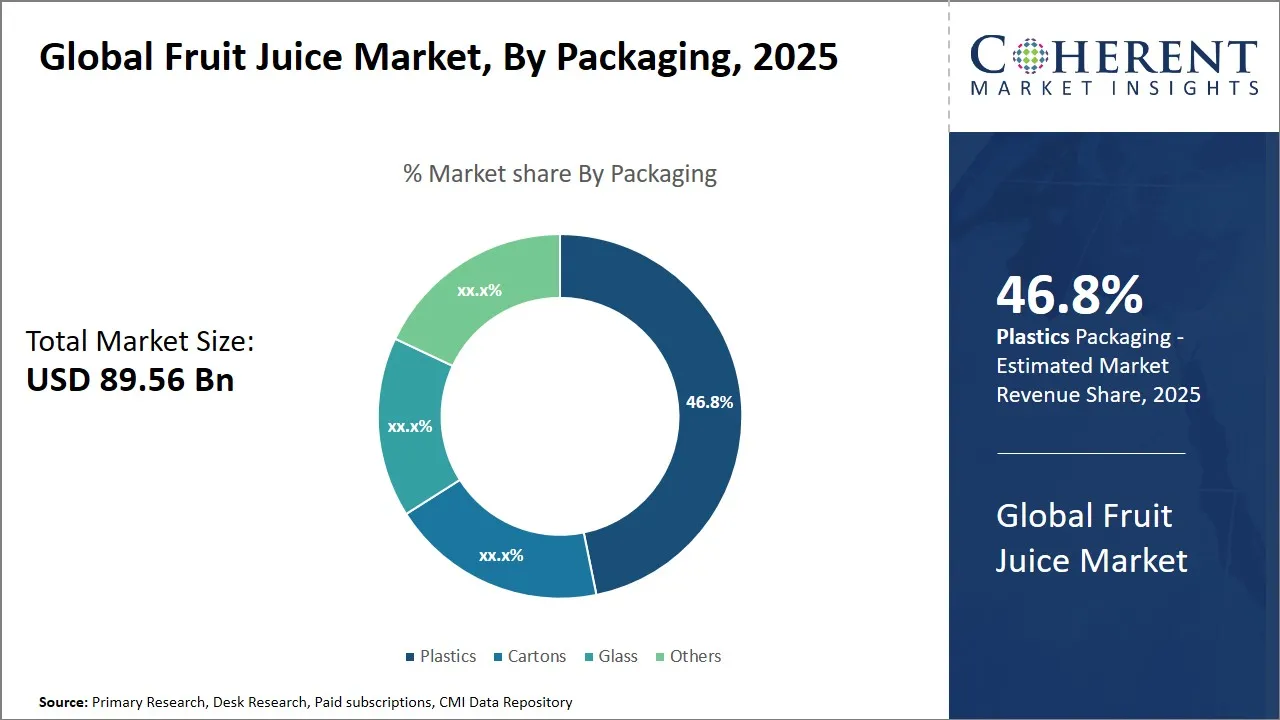
- The plastics segment is projected to account for 47.8 % of the global fruit juice market share in 2026.
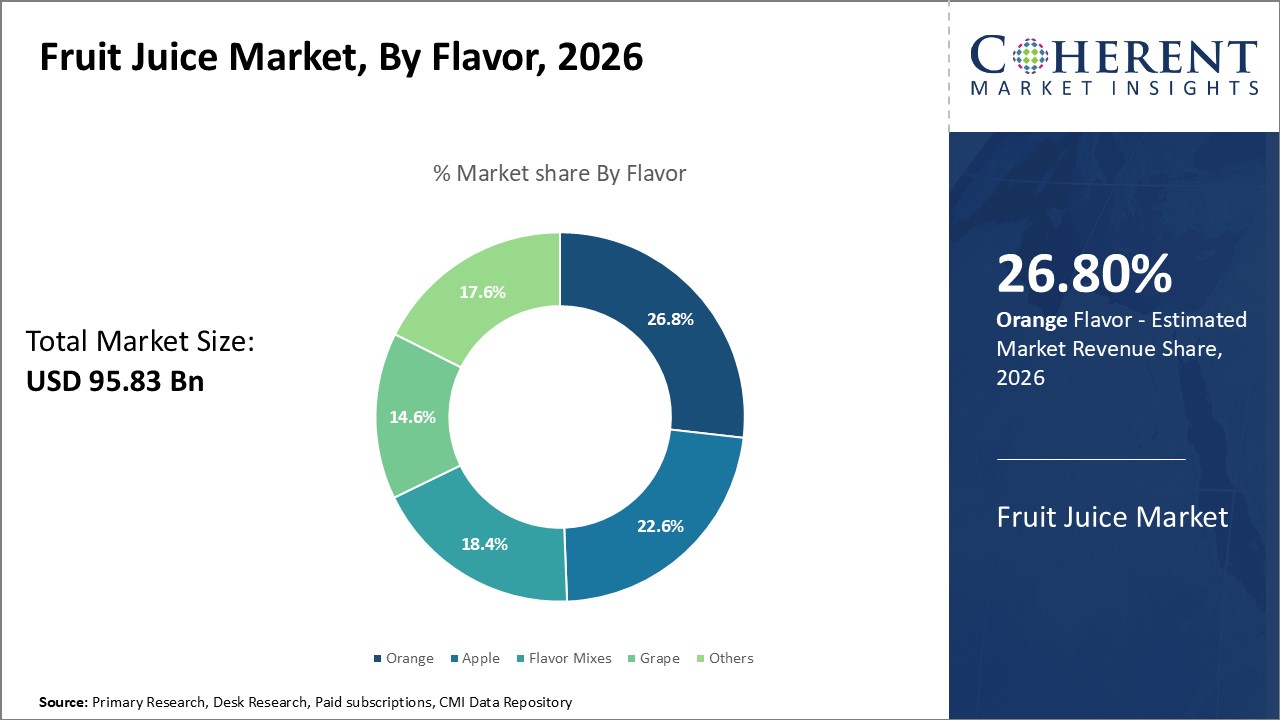
- The orange segment is expected to hold a 26.8 % of the market share in 2026.
- The take home segment is set to capture 37.8 % of the global fruit juice market share in 2026.
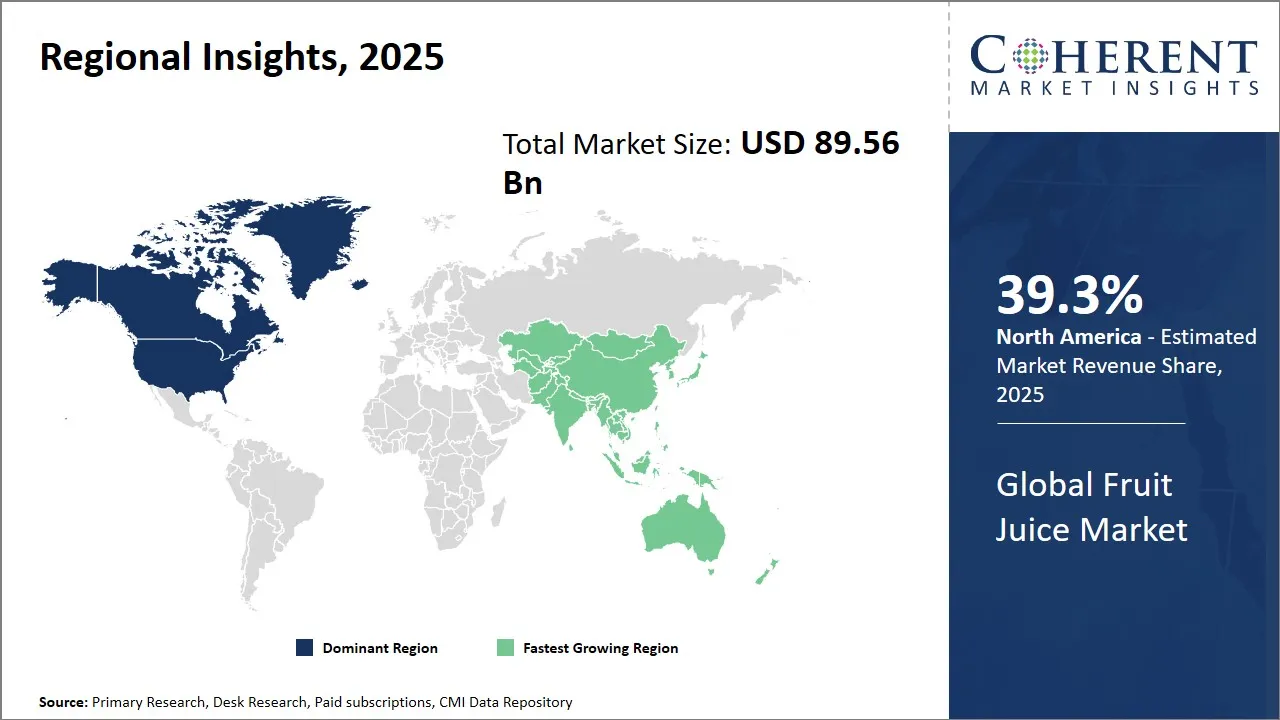
- North America is expected to lead the global fruit juice market in 2026 with a 39.3 % share.
- Asia Pacific follows with a 19.5% share and it is the fastest-growing region.
Market Overview
Current market trends highlight a growing preference for cold-pressed and freshly squeezed fruit juices, driven by consumers’ desire for nutrient-rich and minimally processed products. Moreover, the integration of functional ingredients such as probiotics, vitamins, and antioxidants is gaining traction, catering to the wellness-focused demographic. Sustainability initiatives, including eco-friendly packaging and ethically sourced raw materials, are also becoming critical factors influencing purchasing decisions, propelling the fruit juice market toward a more responsible and consumer-centric future.
Current Events and Its Impact
Current Events | Description and its Impact |
Rising Health Consciousness Among Consumers |
|
Technological Advancements in Juice Production |
|
Segmental Insights
- Current Industry Events of 2026
- Market Size Estimation
- Regional Breakdown
- Competitive Landscape
- Customer Intelligence
- Segmental Analysis
- Pricing Analysis
- Key Market Drivers, Challenges & Future Trends
- Customized Insights Section
Fruit Juice Market Insights, By Packaging – Plastics Segment Dominates the Market due to its Versatility and Convenience
The plastics segment is set to hold 47.8% of the global fruit juice market share in 2026, in part to its unique versatility and convenience, which closely timestamp the shifting consumer lifestyle. Plastic bottles, which are largely made of PET (polyethylene terephthalate), have lightweight, durable, and safe-to-use and carry (shatterproof) properties. These characteristics highlight how plastic packaging is especially conducive to consumption on the go; a major factor in contemporary culture with consumers valuing "grab-and-go" and "spill-proof" properties.
For example, juice brand launching a 300 ml PET bottle with resealable screw-cap targeting working professionals and students. The bottle’s durability supports retail, vending and transport; the lightweight allows distribution cost-efficiency; its reseal feature supports multiple-serving usage rather than requiring single-serve only.
Fruit Juice Market Insights, By Flavor - Orange Segment Dominates the Market Driven by Health Benefits and Consistent Consumer Preference
Orange segment is projected to hold 26.8% of the market share in 2026, remains the most popular flavor of juice across the globe mainly due to its long-established image as a refreshing, healthy and functional beverage choice. Consumers have come to associate drinking orange juice with high content of vitamin C, immune function, health benefits in general. These factors are incredibly helpful for consumers in making their purchasing decisions, especially as health consciousness continues to be on the rise globally. The idea that orange juice is a more natural source of antioxidants and important nutrients also continues to attract interest from customers of all ages.
Orange juice also has a valuable supply component because of the availability of oranges itself in so many major producing countries and while they may not sell at the same price in different parts of the world, the overall supply source calendars for their juice production remain consistent and natural, which allows brands to deliver both quality and affordability. As pioneers in the market, brands that supply orange juice have less volatility as it relates to quality and flavor because of steady global availability. This year-round production and availability contribute further and further to consistency in flavor profiles and freshness for total consumer loyalty and repeat units.
Fruit Juice Market Insights, By Distribution Channel - Take Home Segment Dominates the Market driven by Consumer Convenience and Changing Purchase Behaviors
The take home segment is expected to hold 37.8% of the global fruit juice market share in 2026, by capitalizing on shifting consumer purchasing behaviors and increasing demand for ready-to-consume beverages available for home consumption. Consumers are increasingly purchasing fruit juices for their household consumption fueled by busy lifestyles and convenience. This means consumers want to have fruit juice in their home for convenience, and availability. Take-home formats allow consumers flexibility in a juice product for a number of servings that meet their needs. For families or individuals, a take-home product allows them to control their portion size, frequency of consumption, and spend less on juice products.
The development of modern retail channels such as supermarkets, hypermarkets and online grocery shopping is expanding the accessibility of various fruit juice products in the take-home segment. Often these retail outlets will stock fruit juice products in numerous packaging sizes and flavors all in the same location that is easily accessible to consumers and offers comparison of product. This can improve purchase frequency by convenience.
Regional Insights
North America Fruit Juice Market Analysis and Trends
The North America region is projected to lead the market with a 39.3% share in 2026, and already developed and established market with high health awareness and stable demand of natural and organic fruit juices. North America has an established retail channel in this market, which comprises of large supermarkets and retailers that specialize in health and wellness and have a well-developed infrastructure to serve the consumers with availability and distribution of products.
The government agencies in the United States and Canada favor further attention to food safety and reinforce the regulatory advice and other provisions of food safety regulations which meet the consumer confidence, health, and wellness. Many giant companies in the world like The Coca-Cola Company, PepsiCo, and Ocean Spray have also been attracted to North America and these companies help in the betterment of the market by heavily investing in the R&D of product innovation like fortified juices and organic blends. Another opportunity that these companies exploit in the global trade involves, exportation of fruit varieties, which are of exotic nature, and using concentrate as a raw material in enhancing the development of products.
Asia Pacific Fruit Juice Market Analysis and Trends
The Asia Pacific region is projected to have the highest growth in the market, with a projection of 19.5% share in 2026, due to increased disposable income, rising levels of urbanization, and a growing middle class with a strong interest in leading healthier lifestyles. The agricultural foundation of the markets, such as India, China and Thailand is friendly to the farmers aiming at the local fruit production and then paying the price of raw materials, which keeps on increasing the regional fruit brands. The trade in the region has also liberalized and more capacity and other smart solutions in cold chain logistics have made it possible to access products and improved freshness through distribution.
The Asia Pacific region has several government programs and initiatives that have helped in the promotion of nutrition and food safety in the countries that gave rise to consumer confidence. The companies like Dabur (India), Tingyi (China), and Sinar Mas (Indonesia) are also expanding their product range to include healthy products like low-sugar and functional fruit juices so as to keep pace with the consumer tastes. The young populations combined with the increased retail markets can explain the rapid growth of the fruit juice market in the Asia Pacific region.
Global Fruit Juice Market Outlook for Key Countries
U.S. Fruit Juice Market Analysis and Trends
The fruit juice market in the U.S. shows a consumer base that is focused on health and wellness trends, and this drives innovations, as well as increases in the variety of organic and cold-pressed juices. Global companies such as The Coca-Cola Company, and PepsiCo are major players with extensive product lines that often span from traditional orange juice to juice infused with nutrients. Regulatory compliance under the Food and Drug Administration provides transparency and helps to ensure product quality.
In addition, longstanding marketing traditions, both online and at the retail level, help to create active consumer engagement. Finally, the U.S. has strong trade relations that allow access to wide range of raw materials that support product diversification.
China Fruit Juice Market Analysis and Trends
China fruit juice market has been rapidly modernized, and consumption has accelerated with increased health consciousness and urbanization. Key players that dominate the market, such as Tingyi Holding Corporation and Uni-President Enterprises, take advantage of their depth of distribution networks while also sourcing locally to respond to regional demand. Government programs directed toward nutrition and investment in cold storage infrastructure have led to increased juice variety and freshness. Moreover, e-commerce channels and online sales continue to grow and help to meet expanding consumer demand. Trade policies and robust domestic production for fruit also supports scaling the market.
India Fruit Juice Market Analysis and Trends
The India fruit juice business has had the advantage of having a significant number of people who belong to the increasing incomes and the tendency toward ready to drink products. Dabur and Parle Agro are major players that have been taking advantage of the rich history of fruit growing in Indias so that they can offer cheap and innovative juices that can fit the tastes and preferences of the region. These trends have been supported by government policies to encourage agriculture and food processing industries in the country to enhance availability and quality of raw material. Moreover, retailing formats and e-commerce have developed new avenues of distribution and availability. Then there is a recent need of fruit juices made of herbal and ayurvedic products that have cut a distinct niche among the general market.
Brazil Fruit Juice Market Analysis and Trends
The Brazilian country has a strong presence in the fruit juice market since it has vast production levels of products based on tropical fruits, oranges, mangoes and guavas. The firms like CitrusBR and JBS Friboi have found their way into the business by integrating fruit and processing and attained two objectives affordably at the same time; to produce a quality product at low costs.
The positive farming policies and export subsidies favor local and foreign consumption and exports, which makes Brazil a key player in the international trade arena. Consumers continue to gain interest in the natural and minimally processed juices, which has created additional growth and product innovation. Modernization of retail and the use of modernization cold chain logistics aids in better access to the consumer markets, all-year round.
Germany Fruit Juice Market Analysis and Trends
Germany is a strategic European market, which is driven by the consumer demands of the natural, organic and ethically produced fruit juice products. The intensity of the market competition suggests that the industry leaders, Eckes-Granini and Rabenhorst, are highly concerned with quality premium products and sustainable products, which implies high environmental regulatory frameworks and consumer demands. The government also encourages food safety and sustainable agriculture which facilitates integrity in the products.
Consumer Behavior Analysis for the Fruit Juice Market
- The global fruit juice market is influenced by increasing health awareness, change in lifestyles, and changing buying patterns to influence consumer behavior. Consumers in the modern world move towards wellness-friendly beverages and prefer natural, organic and minimally processed products.
- There has been an increase in demand of juices high in vitamins, antioxidants and other functional ingredients like probiotics and plant-based extracts due to the rising cases of lifestyle-related diseases. The younger generation, especially the millennials and Gen z share preferences towards sustainable, environmentally friendly packaging, and labeling transparency due to their tendency to engage in ethical consumption.
- E-commerce and online retail systems have greatly affected the consumer purchase habits where many of the purchases are done through the online system because of the convenience, product diversity, and promotional pricing. Influencer marketing and social media have become the important elements that influence the perception of the brand as people use peer reviews and endorsements to prove the legitimacy of the product.
Market Players, Key Development, and Competitive Intelligence
Key Developments
- In July 2025, PIM Brands introduced Welch’s Juicefuls Fusions in the U.S. the dual‑flavor fruit snack featured a chewy fruit exterior paired with a contrasting juicy center, available in Watermelon & Lemon, Green Apple & Peach, and Blueberry & Raspberry. It was gluten‑ and peanut‑free, naturally colored, and fortified with vitamins A, C, and E.
- In December 2024, Ocean Spray Cranberries (U.S.) partnered with Dyla Brands to launch a zero‑sugar, powdered drink‑mix line. Featuring White Cran × Strawberry, Cran × Grape, and White Cran × Peach flavors made from real cranberry juice powder, the portfolio delivered 100 % daily vitamin C in convenient on‑the‑go stick packs.
Top Strategies Followed by Global Fruit Juice Market Players
- Established market Leading brands in the market typically invest heavily in R&D to reveal new, cutting-edge, and high-quality products that satisfy changing consumer desires. The fruit juice segment has witnessed emergence of fortified juices, functional drinks, and organic fruit juices. This level of research and innovation helps established brands to maintain differentiation and loyalty in crowded brand markets. As a result, these types of consumer products position leading brands to deliver entrenched strategies to counterbalancing the evolution of the market.
- PepsiCo's Tropicana brand is an example of a brand that continually refreshes its product offerings by bringing fortification (with vitamins and minerals) to growing health and wellness consumer marketplace. The product offering of Sprout organically-focused juices or the new cold-pressed juice offering are demonstration of continuation of the Tropicana brand engaging and serving respected for premium health and wellness juice products.
- Medium-size brands serving fruit juice beverage segment usually employ targeted strategies to satisfy both quality and affordability for an increasingly price-conscious consumer base in the age of economic uncertainties and competition. Independent brands are focused principally on a 'smart value' is the key advantage or lever against competitors. Practical costing and principles around accepted quality standards help independent juice producers balance the notional impacts of perpetrating food product quality, processing initiatives and supply channel sourcing are necessary conditions or standards actual production and manufacturing strategies.
- For instance, Coca-Cola's Minute Maid approaches price-sensitive customers with low-cost options regarding juice, while also offering a line of premium, juice products from time to time, such as Minute Maid Essentials, that contains functional ingredients such as added calcium or fiber.
- Smaller firms within the global fruit juice market occupy a specialized 'niche' sector by creating products that focus on some key product attribute or innovatively provide unique formulations to appeal to higher-end customer segments. Many take advantage of advanced technologies such as cold-pressed extraction technology, plant-based preservatives, and biodegradable packaging to produce unique product offerings and entrench their brand identities among larger companies and competitors.
- Suja Juice, is a smaller but growing brand that utilizes cold-pressed juice technology as well as organic and plant-based offering to appeal to growing segments of health-conscious consumers and environmentally aware consumers. Suja's sustainable packaging model and also becoming a recognizable firm in their local market in the U.S. helped the company gain further market acceptance.
Market Report Scope
Fruit Juice Market Report Coverage
| Report Coverage | Details | ||
|---|---|---|---|
| Base Year: | 2025 | Market Size in 2026: | USD 95.83 Bn |
| Historical Data for: | 2020 To 2024 | Forecast Period: | 2026 To 2033 |
| Forecast Period 2026 to 2033 CAGR: | 7.0% | 2033 Value Projection: | USD 153.88 Bn |
| Geographies covered: |
| ||
| Segments covered: |
| ||
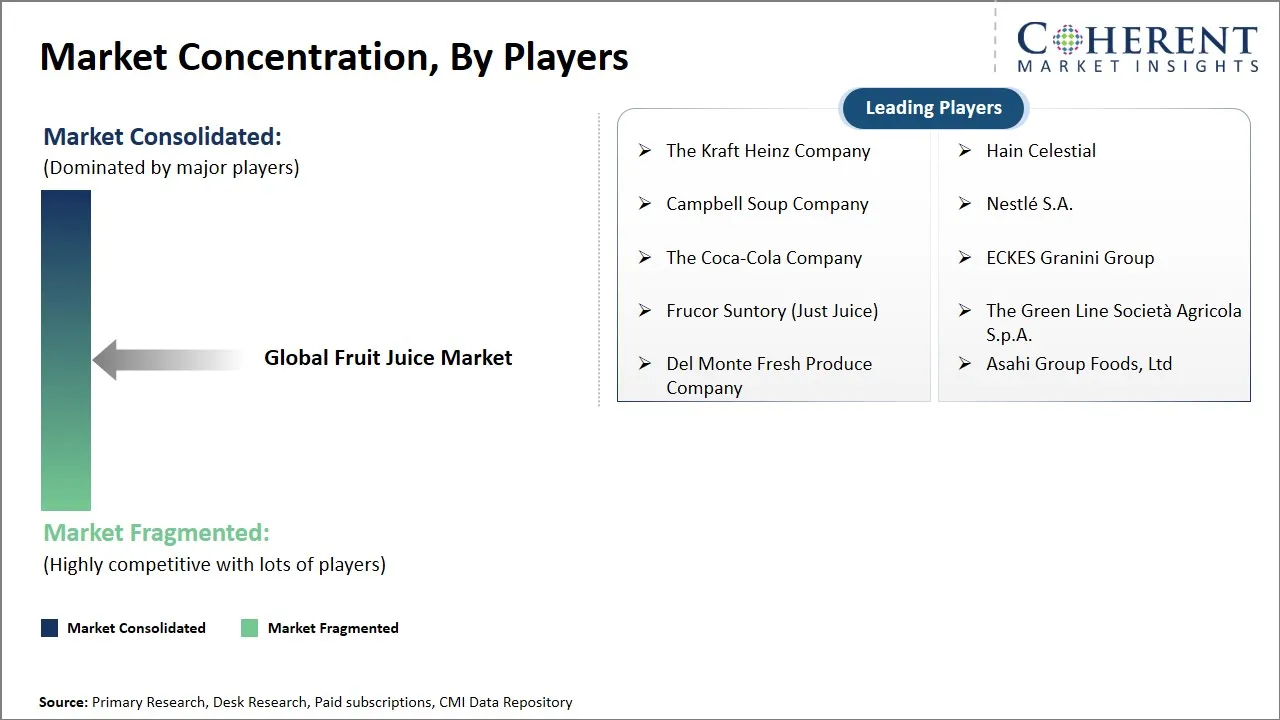
| Companies covered: | The Kraft Heinz Company, Hain Celestial, Campbell Soup Company, Nestlé S.A., The Coca-Cola Company, ECKES Granini Group, Frucor Suntory (Just Juice), The Green Line Società Agricola S.p.A., Del Monte Fresh Produce Company, and Asahi Group Foods, Ltd | ||
| Growth Drivers: |
| ||
| Restraints & Challenges: |
| ||
Fruit Juice Market Dynamics
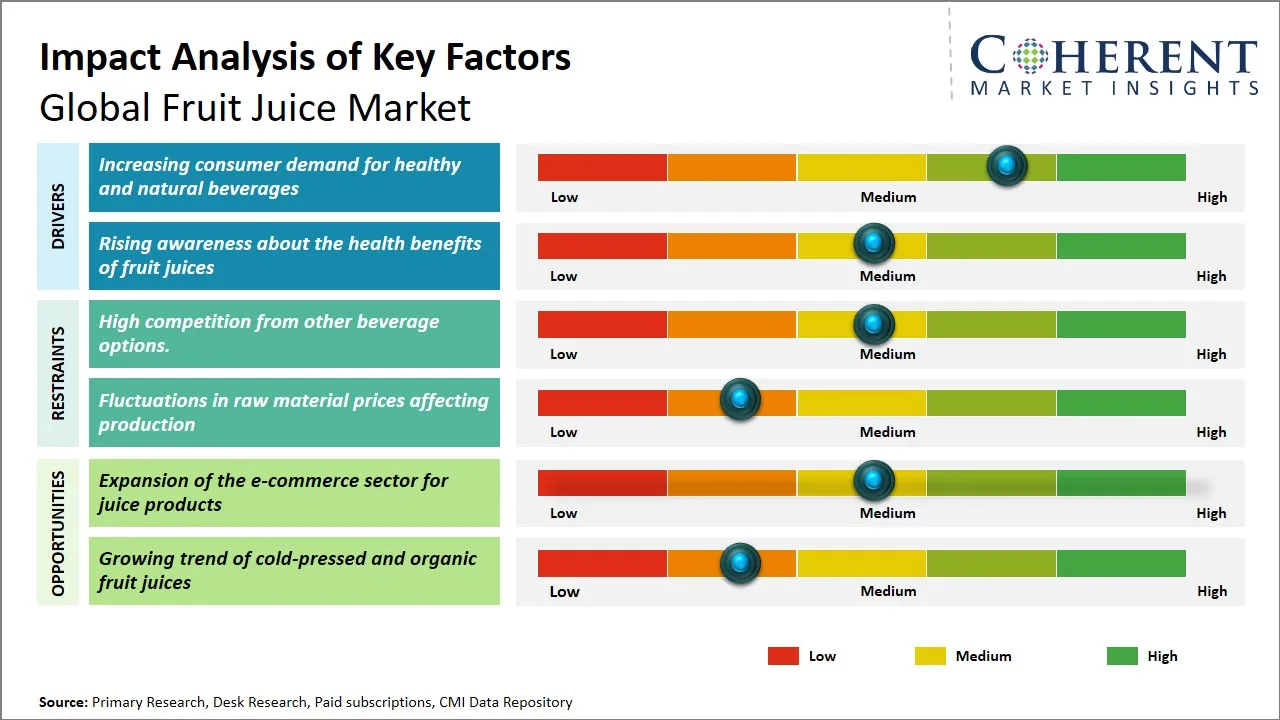
Fruit Juice Market Driver - Increasing Consumer Demand for Healthy and Natural Beverages
The rise in consumer awareness about health and wellness has significantly increased the demand for fruit juices globally as consumers are more frequently choosing a nutritious beverage option over sugary soft drinks and artificially flavored beverages. The trend with modern consumers is to purchase beverages that include natural ingredients, vitamins, and antioxidants, and are marketed as beneficial to overall health and immune systems. This trend is further fueled by an increase in lifestyle diseases and a desire for a balanced lifestyle, motivating many people to add fruit juices to their diets as a convenient way to obtain hydration and proper nutrition.
For example, Tropicana, a world leader in fruit juice, has taken advantage of the increasing consumer interest in healthy and natural beverages by offering more products in its line such as 100% pure fruit juice with no added sugar. They have also introduced products with added vitamins and antioxidants to fit the needs of a health-conscious consumer group.
Fruit Juice Market Opportunity - Expansion of the E-commerce Sector for Fruit Juice Products
E-commerce is rapidly expanding, creating a huge opportunity for the global fruit juice market. It is changing the way juice is available and making it more accessible to consumers. Increased internet access, widespread smartphone use, and updated digital payment systems have all increased internet shopping for various segments of consumers. Now, manufacturers and retailers of fruit juice can reach a broader market, beyond existing retail outlets in urban and remote markets, at a lower cost through existing e-commerce platforms.
Naked Juice, a well-known fruit juice brand, is one example of a juice company, which has used e-commerce platforms to grow market access. Naked Juice makes their product available to a wider group of consumers through partnerships with e-commerce companies, such as Amazon and Walmart.
Analyst Opinion (Expert Opinion)
- The global fruit juice industry is a vibrant market with high growth potential due to a rising interest in healthier drinks and all-natural ingredients. The Juice Summit (2023) and the International Fruit and Vegetable Juice Association Conference (2022) revealed meaningful new development in fruit juices, with major brands, including Tropicana and Naked Juice, launching new cold-pressed and organic juices production. Just this year, Tropicana introduced a new line of organic fruit juices that demonstrates the industry's evolution to address increasing attention consumers are placing on "clean" labels and overall health.
- At both of these meetings, the focus on sustainable sourcing emerged as an important topic, with many brands developing packaging solutions intended to be more environmentally friendly for the environmentally conscious consumer. However, there was also acknowledgment of the impact flavored waters and other non-juice drinks on market potential, which was addressed in ideas and dialogue.
- Companies that market the health benefits of their products, in addition to consumer education and campaigns, will likely capture a larger share of the market. As an additional pathway to the product, partnering with food retailers, groceries, caffe's, and health-conscious consumers will also add to awareness and accessibility of their product. When considering all these factors, the market growth of the global fruit juice market ultimately depends on its capacity to progress and innovate with respect to consumer interests associated with health and sustainability.
Speak to the analyst
Want personalized insights?
Take the findings above to one of our principal consultants, or have the report rebuilt around the segments, geographies and competitors you actually track.
Market Segmentation
- Packaging Insights (Revenue, USD Bn, 2021 - 2033)
- Plastics
- Cartons
- Glass
- Others
- Flavor Insights (Revenue, USD Bn, 2021 - 2033)
- Orange
- Apple
- Flavor Mixes
- Grape
- Others
- Distribution Channel Insights (Revenue, USD Bn, 2021 - 2033)
- Take Home
- On Premise
- Impulse
- Others
- Regional Insights (Revenue, USD Bn, 2021 - 2033)
- North America
- U.S.
- Canada
- Latin America
- Brazil
- Argentina
- Mexico
- Rest of Latin America
- Europe
- Germany
- U.K.
- Spain
- France
- Italy
- Russia
- Rest of Europe
- Asia Pacific
- China
- India
- Japan
- Australia
- South Korea
- ASEAN
- Rest of Asia Pacific
- Middle East
- GCC Countries
- Israel
- Rest of Middle East
- Africa
- South Africa
- North Africa
- Central Africa
- North America
- Key Players Insights
- The Kraft Heinz Company
- Hain Celestial
- Campbell Soup Company
- Nestlé S.A.
- The Coca-Cola Company
- ECKES Granini Group
- Frucor Suntory (Just Juice)
- The Green Line Società Agricola S.p.A.
- Del Monte Fresh Produce Company
- Asahi Group Foods, Ltd
Sources
Primary Research Interviews
- Product Development Manager – Leading Global Fruit Juice Manufacturer
- Supply Chain Head – Major Fruit Juice Retailer
- Innovation Director – Well-Known Fruit Juice Brand
- Sustainability Officer – Fruit Juice Industry Certification Body
Stakeholders
- Manufacturers
- End-use Sectors
- Retail Beverage Chains
- Foodservice Providers
- Health & Wellness Brands focusing on fruit-based drinks
- Regulatory & Certification Bodies
- E-commerce Platforms and Distributors
- Technology Integration Players: AI-driven consumer taste personalization in beverages
Databases
- UN Comtrade Database
- India Import Export (EXIM) Database
Magazines
- Beverage Industry Magazine – Trends in global fruit juice consumption
- Juice World Magazine – Innovations in fruit juice formulations
- Global Beverage Insights – Consumer trends in fruit juice markets
- Fruit Juice Business Journal – Market developments and growth opportunities
Journals
- Journal of Food Science & Technology – Advances in fruit juice processing
- International Journal of Beverage Technology – Formulation and preservation methods
- Journal of Nutrition & Food Sciences – Nutritional benefits of fruit juices
- Food Chemistry – Quality and safety assessment of fruit juices
- Food Research International – Bioavailability and health impact of fruit juices
Newspapers
- The Financial Times – Market growth and investments in fruit juice sector
- The Guardian – Shifts in consumer preferences towards natural juices
- Asia Health Journal – Growth dynamics of fruit juice consumption in Asia Pacific
- European Nutrition News – Regulatory updates on fruit juice standards
- The New York Times – Trends and innovations in fruit-based beverages
Associations
- International Fruit & Vegetable Juice Association (IFU)
- American Beverage Association (ABA)
- European Fruit Juice Association (AIJN)
- Global Juice Industry Council
- Clean Label Project
- World Health Organization – Fruit juice safety and health guidelines
Public Domain Sources
- FDA – Food and beverage safety guidelines, including fruit juices
- European Commission – Fruit juice regulation and labeling standards
- World Health Organization – Health impact studies on fruit juices
Proprietary Elements
- CMI Data Analytics Tool, Proprietary CMI Existing Repository of information for last 8 years.
Get access to 250+ pages report
Every segment, forecast, competitor profile and data table behind the analysis above — available for instant download.
- ESOMAR Member
- ISO 9001:2015 Certified
- D-U-N-S Registered
- GDPR & CCPA Compliant
Missing comfort of reading report in your local language? Find your preferred language:
Transform your Strategy with Exclusive Trending Reports
Frequently Asked Questions
The global fruit juice market is estimated to be valued at USD 95.83 Bn in 2026 and is expected to reach USD 153.88 Bn by 2033.
The CAGR of the global fruit juice market is projected to be 7.0% from 2026 to 2033.
Increasing consumer demand for healthy and natural beverages and rising awareness about the health benefits of fruit juices are the major factor driving the growth of the global fruit juice market.
High competition from other beverage options and fluctuations in raw material prices affecting production are the major factor hampering the growth of global the fruit juice market.
In terms of packaging, the plastics are estimated to dominate the market revenue share in 2026.
Cold-pressed fruit juice retains more nutrients, enzymes, and antioxidants due to minimal heat and oxidation during extraction.
Exporting fruit juice requires certifications like FSSC 22000, HACCP, FDA/FSSAI, Phytosanitary, and Certificate of Origin to ensure food safety and regulatory compliance.