

Global Humidity Sensor Market Size and Forecast – 2026-2033
The Global Humidity Sensor Market is estimated to be valued at USD 4.31 Bn in 2026 and is expected to reach USD 7.78 Bn by 2033, exhibiting a compound annual growth rate (CAGR) of 8.8% from 2026 to 2033.
Key Takeaways of the Global Humidity Sensor Market
- The capacitive segment leads the market holding an estimated share of 46.3 % in 2026.
- The sensor ICs segment is expected to dominate with a share of 52.5 % in 2026.
- The HVAC & building automation segment leads the market holding an estimated share of 32.1 % in 2026.
- Asia Pacific, holding a share of 35.4 % in 2026, is projected to dominate the market.
- North America, holding a share of 26.8 % in 2026, is anticipated to show the fastest growth in the market.
Market Overview
The market is seeing a move towards advanced technologies like IoT and AI in humidity sensors, making possible real-time monitoring and data analytics. Also, there is a lot of demand for miniaturized and highly accurate sensors to support smart devices and climate control applications. Rising environmental concerns and regulatory standards are also driving innovations, contributing to the expansion and diversification of the humidity sensor market globally.
Current Events and its Impact
Current Events | Description and its impact |
Geopolitical and Trade Developments |
|
Economic and Industrial Trends |
|
Segmental Insights
- Current Industry Events of 2026
- Market Size Estimation
- Regional Breakdown
- Competitive Landscape
- Customer Intelligence
- Segmental Analysis
- Pricing Analysis
- Key Market Drivers, Challenges & Future Trends
- Customized Insights Section
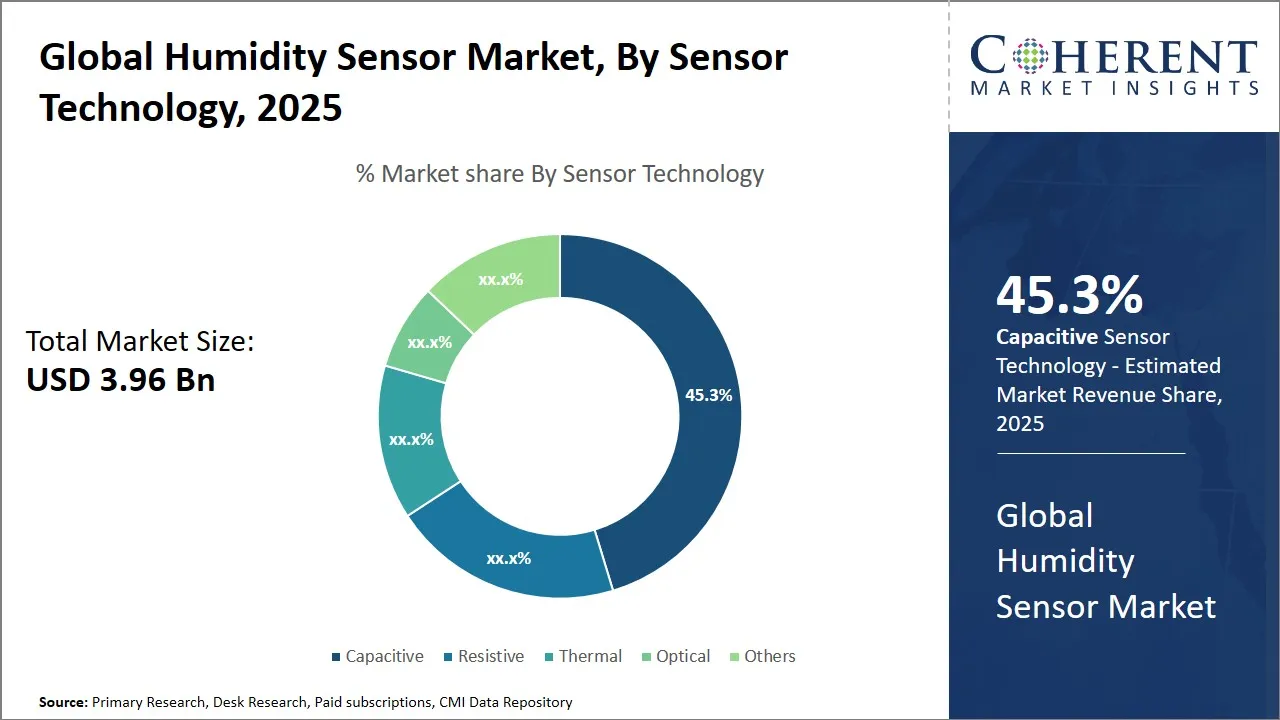
Global Humidity Sensor Market Insights, By Sensor Technology – Capacitive Sensors are Leading Due to Their Precision and Versatility in Sensor Technology
The capacitive segment is expected to dominate the global humidity sensor market with a 46.3% share in 2026 because of their high accuracy, responsiveness, and stability in different conditions. These sensors detect changes in dielectric constant because of moisture, ensuring reliable performance in industrial, pharmaceutical, and HVAC environments. Their low power use and miniaturization potential make them useful for IoT and portable systems. Sensirion’s SHT4x capacitive humidity sensor series is highly adopted in HVAC and wearable devices for reliable real-time humidity tracking.
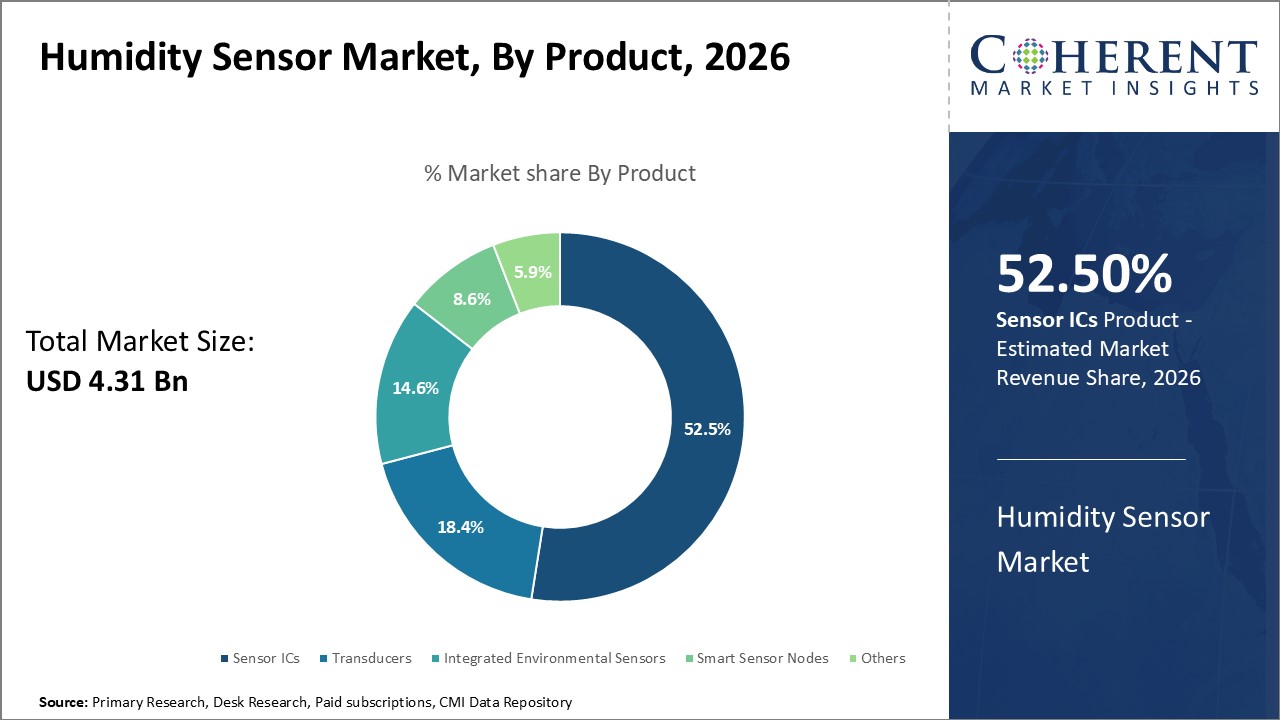
Global Humidity Sensor Market Insights, By Product – Sensor ICs Drive Market Expansion Through Integration and Functionality
Sensor ICs are expected to hold the largest market share of 52.5% in 2026 because of the integration of sensing elements and signal processing on a single chip. Their digital output and low power consumption make them suited for smart devices and IoT systems needing compact, efficient solutions. Bosch Sensortec’s BME688 environmental sensor IC, which brings together humidity, gas, pressure, and temperature sensing, is used in smartphones and smart home devices to optimize indoor comfort and air quality.
Global Humidity Sensor Market Insights, By Application – HVAC & Building Automation Shows the Highest Demand Because of Energy Efficiency and Indoor Air Quality
The HVAC and building automation segment is projected to lead with a 32.1% share in 2026, propelled by the need for energy efficiency and indoor air quality management in smart buildings. Humidity sensors optimize ventilation and cooling, reduce energy waste, and ensure occupant comfort. Integration into building management systems also makes possible predictive maintenance and compliance with green building standards. Honeywell’s HIH series humidity sensors are used in commercial HVAC systems to maintain optimal air moisture levels, supporting LEED-certified energy-efficient building designs.
Pricing Analysis of the Humidity Sensor Market
Segment/Type | Example/Model | Unit Price (USD) |
Commodity digital humidity/temperature sensor IC | TI HDC3120 | ~ USD 0.85 (1ku) |
Integrated RH/Temp sensor IC | TI HDC2022 | ~ USD 1.436 (1 ku) |
Board-mount I²C RH/T sensor (mid-tier) | Sensirion SHT30A-DIS | ~ USD 3.21 |
Board-mount sensor IC (higher accuracy) | Amphenol ChipCap2 CC2D33S | ~ USD 5.86 |
Simple consumer module | DHT22 sensor module | ~ USD 9.95 (1–9 units) |
Industrial RS-485 humidity + temperature sensor | RS-485 Temp/Humidity Sensor | ~ USD 8.75 |
Industrial module (DIN-rail, networked) | Advantech WISE-4220-S231A | ~ USD 256.37 |
Low-cost hobby/breakout module | DHT11 Temperature & Humidity Sensor Module | ~ ≈ USD 1–3 (prices vary by seller/region) |
Mid-range sensor module example | DHT22 Digital Temperature & Humidity Sensor Module | ~ ≈ USD 9–10 |
Multi-parameter sensor module (humid + pressure + temp) | Temperature Humidity and Pressure Sensor Module | ~ ≈ USD 5–10 |
Basic humidity detection (analog module) | HR202 Humidity Detection Sensor Module | ~ ≈ USD 2–4 |
Regional Insights
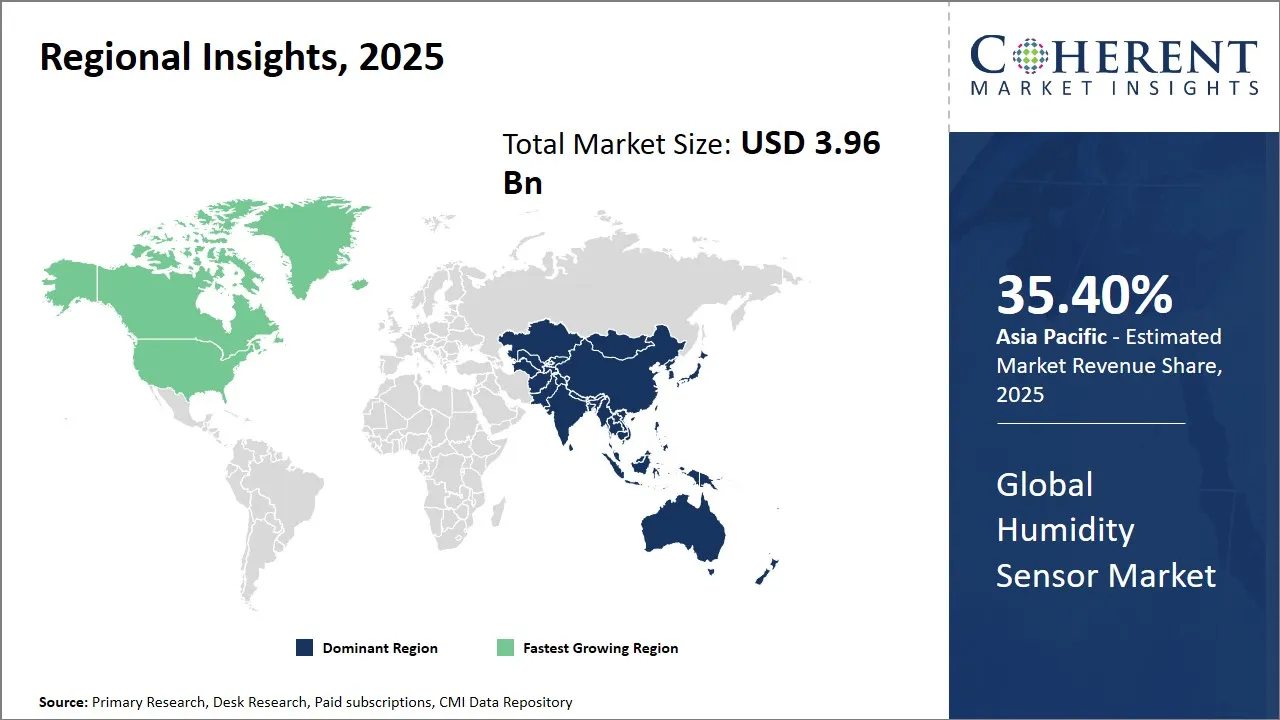
Asia Pacific Humidity Sensor Market Analysis and Trends
Asia Pacific, holding an estimated share of 35.4% in 2026, dominates the global humidity sensor market because of a robust industrial ecosystem, rapid urbanization, and strong government initiatives geared towards smart infrastructure and IoT integration.
Also, supportive government policies for Industry 4.0, smart cities, and environmental monitoring bolster investments and innovation in sensor technologies. The region also sees a mature supply chain, extensive R&D centers, and the presence of big companies like Honeywell International Inc., Amphenol Corporation, and Panasonic Corporation, which innovate and expand their product portfolios for different humidity sensing applications.
North America Humidity Sensor Market Analysis and Trends
North America, holding a share of 26.8% in 2026, shows the fastest growth in the humidity sensor market, driven by advancements in healthcare, automotive, and building automation sectors that increasingly demand precision sensing solutions.
The presence of big industry players, such as Texas Instruments, Sensirion AG, and TE Connectivity, facilitates rapid innovation and market penetration. Also, North America’s well-established trade networks and collaborations between startups and established firms add to the introduction of advanced humidity sensing technologies in segments like wearables, environmental monitoring, and industrial automation.
Humidity Sensor Market Outlook for Key Countries
China Humidity Sensor Market Analysis and Trends
China humidity sensor market is propelled by vast manufacturing bases and significant investments in IoT infrastructure. Big manufacturers, like Amphenol and Honeywell, have localized production to meet domestic demand effectively. Government initiatives focusing on environmental monitoring and building energy efficiency further stimulate the integration of humidity sensors in smart infrastructure, giving China a strong position in the market.
Japan Humidity Sensor Market Analysis and Trends
Japan continues to lead with its focus on precision electronics and industrial automation. Companies like Panasonic and Omron contribute a lot through the development of highly accurate and miniaturized humidity sensors. The country’s focus on robotics and automotive electronics also makes demand, supported by a well-coordinated ecosystem of suppliers and manufacturers.
U.S. Humidity Sensor Market Analysis and Trends
The U.S. humidity sensor market sees an active technology innovation landscape and a lot of investments in healthcare and smart home devices. Key players, such as Texas Instruments and TE Connectivity, dominate through cutting-edge sensor designs optimized for performance in medical devices and consumer electronics.
Germany Humidity Sensor Market Analysis and Trends
Germany humidity sensor market grows because of its engineering excellence and strong automotive industry, which uses humidity sensors for climate control and safety systems. Companies like Bosch and Sensirion AG lead the technological advancements here, because of strict environmental regulations that require precise monitoring of humidity in industrial processes.
India Humidity Sensor Market Analysis and Trends
India’s fast growing industrial base and increasing smart city projects contribute to its expanding market. Honeywell and local manufacturers focus on affordable sensor solutions made for the country's climatic challenges. Government schemes pushing renewable energy and efficient building technologies also play a pivotal role in accelerating humidity sensor adoption.
Market Players, Key Development, and Competitive Intelligence
Key Developments
- In June 2025, Sensirion launched the SHT40-AD1P-R2 and SHT41-AD1P-R2 digital humidity and temperature sensors
- In April 2025, TE Connectivity plc, a world leader in connectors and sensors, completed the previously announced the acquisition of Richards Manufacturing Co.
- In February 2025, Honeywell announced obsoletion of humidity sensor part numbers from its Honeywell Healthcare portfolio. This announcement represents a full discontinuation of the impacted part numbers. The discontinuation is triggered by obsolescence of some critical raw materials in the near future, limiting Honeywell’s ability to continue manufacturing these product lines.
- In August 2024, Renesas Electronics Corporation, a premier supplier of advanced semiconductor solutions, introduced an advanced all-in-one sensor module designed for indoor air quality monitoring. The RRH62000, the first multi-sensor air quality module from Renesas, integrates multiple sensor parameters in a compact design and accurately detects different particle sizes, volatile organic compounds, and gasses harmful to human health.
Top Strategies Followed by Humidity Sensor Market Players
- Established market leaders invest a lot in research and development to drive innovation and make high-performance humidity sensors.
- Sensirion AG has consistently expanded its portfolio through R&D, launching the SHT4x and SHT41 humidity sensor series, featuring ultra-low power consumption and advanced protective membranes.
- Mid-level players in the humidity sensor market make their share by focusing on cost-effective solutions that offer a balance between quality and affordability.
- Amphenol Advanced Sensors and Honeywell’s HIH series produce affordable, calibrated humidity sensors with reliable accuracy for HVAC and general-purpose industrial uses.
- Small-scale players use a niche-focused strategy to differentiate themselves in the humidity sensor market by concentrating on specialized features or innovative applications that larger competitors might overlook.
- Vaisala Oyj targets niche high-precision applications such as meteorology, calibration laboratories, and pharmaceutical environments. For example, Vaisala’s HMT370EX series offers explosion-proof humidity transmitters for hazardous zones.
Market Report Scope
Humidity Sensor Market Report Coverage
| Report Coverage | Details | ||
|---|---|---|---|
| Base Year: | 2025 | Market Size in 2026: | USD 4.31 Bn |
| Historical Data for: | 2020 To 2024 | Forecast Period: | 2026 To 2033 |
| Forecast Period 2026 to 2033 CAGR: | 8.8% | 2033 Value Projection: | USD 7.78 Bn |
| Geographies covered: |
| ||
| Segments covered: |
| ||
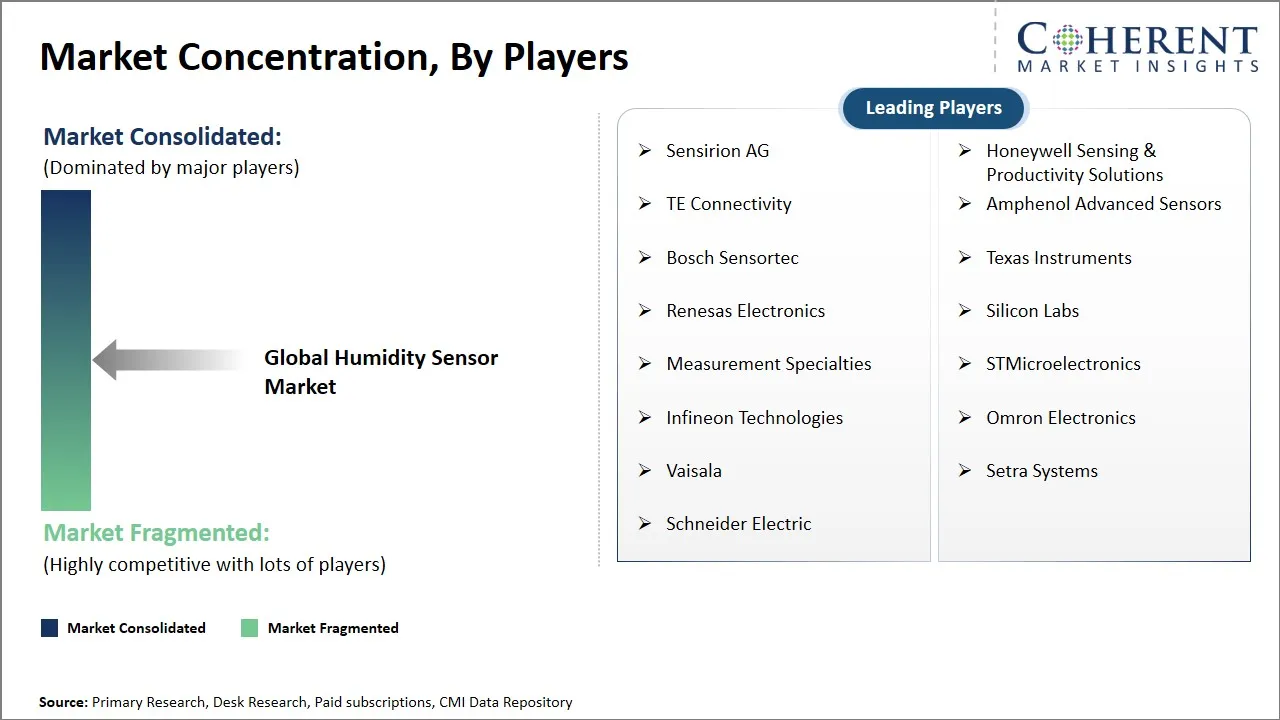
| Companies covered: | Sensirion AG, Honeywell Sensing & Productivity Solutions, TE Connectivity, Amphenol Advanced Sensors, Bosch Sensortec, Texas Instruments, Renesas Electronics, Silicon Labs, Measurement Specialties, STMicroelectronics, Infineon Technologies, Omron Electronics, Vaisala, Setra Systems, and Schneider Electric | ||
| Growth Drivers: |
| ||
| Restraints & Challenges: |
| ||
Market Dynamics
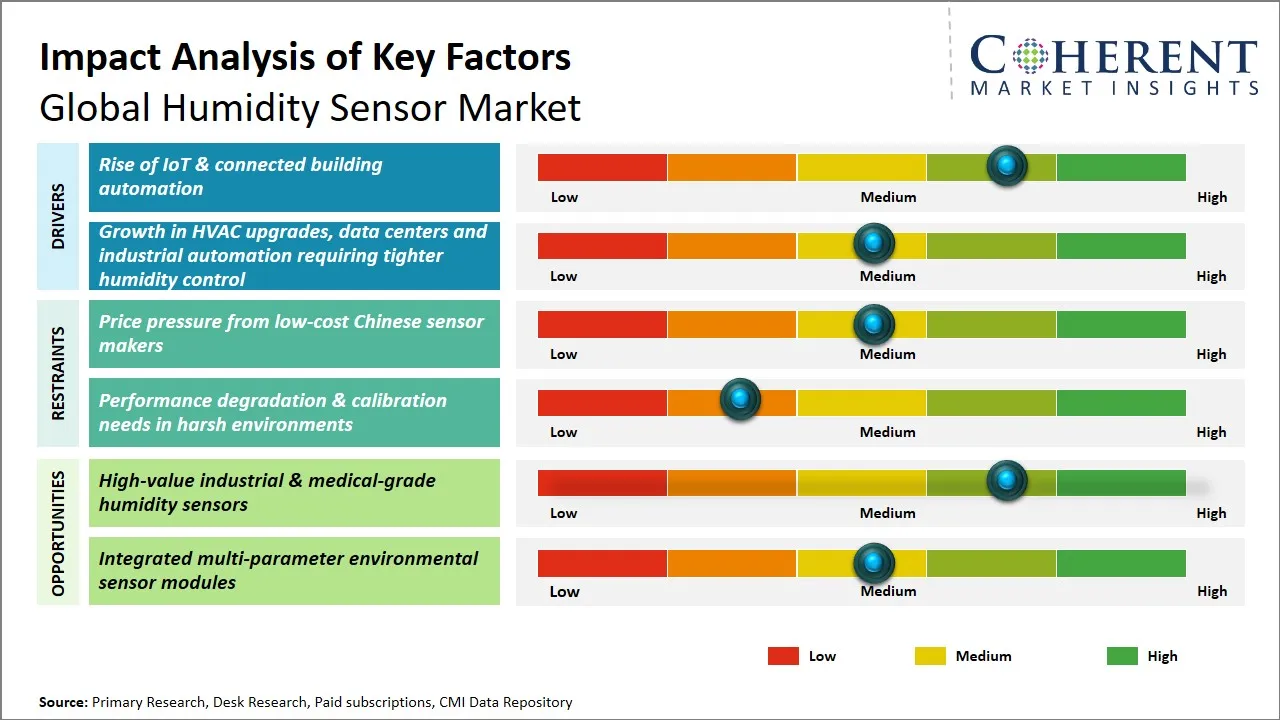
Global Humidity Sensor Market Driver – Rise of IoT & Connected Building Automation
The rapid proliferation of Internet of Things (IoT) technology and the growing adoption of connected building automation systems have become significant drivers for the global humidity sensor market. As smart buildings increasingly rely on integrated sensors to optimize indoor environmental quality, humidity sensors play a crucial role in maintaining comfortable and healthy conditions by accurately monitoring moisture levels. These sensors facilitate real-time data collection and seamless communication with HVAC, lighting, and security systems to enhance energy efficiency and occupant well-being.
For instance, Honeywell’s HIH-5030/5031 series and Sensirion’s SHT4x series are embedded into smart HVAC and air-quality monitoring systems used in commercial and residential buildings. These sensors communicate via IoT platforms such as BACnet and Modbus, providing real-time humidity and temperature data to optimize air handling and energy consumption.
Moreover, advancements in wireless connectivity and sensor miniaturization have enabled easier deployment of humidity sensors in IoT-enabled infrastructure, simplifying maintenance and improving response times for automated climate control. The push towards smart homes, commercial complexes, and industrial facilities adopting automated systems has accelerated the integration of humidity sensors, thereby expanding their applications and boosting market growth.
Global Humidity Sensor Market Opportunity – High-Value Industrial and Medical-Grade Humidity Sensors
The growing demand for precision and reliability in industrial and medical environments presents a significant opportunity for the global humidity sensor market, particularly in the development and adoption of high-value industrial and medical-grade humidity sensors. In industries such as pharmaceuticals, semiconductor manufacturing, food processing, and healthcare, maintaining optimal humidity levels is critical to product quality, safety, and regulatory compliance. Advanced humidity sensors with high accuracy, stability, and resistance to harsh environments are increasingly sought after to meet these stringent requirements.
Medical applications like respiratory monitoring, sterilization processes, and controlled drug delivery systems make demand for sophisticated humidity sensing technologies that offer real-time data and seamless integration with other healthcare devices. TE Connectivity’s HTU21D(F) and HCZ-D5 series are used in medical respirators, sterilization units, and patient monitoring systems where humidity accuracy directly affects performance and safety.
Also, the rise of Industry 4.0 and smart manufacturing platforms creates the need for sensors that can provide precise environmental data to enable predictive maintenance and improve operational efficiency. High-value sensors with features like digital interfaces, wireless connectivity, and miniaturization align with these evolving industrial and medical needs, helping manufacturers and healthcare providers improve process control, product reliability, and patient outcomes. The continuous advancements in sensor materials, signal processing algorithms, and calibration techniques contribute to the adoption of these premium humidity sensors in sectors needing stringent environmental monitoring.
Analyst Opinion (Expert Opinion)
- Despite technological advancements, the market still struggles to balance precision and affordability. High-end capacitive and digital sensors give excellent accuracy but remain cost-prohibitive for mass-market applications, especially in consumer electronics and low-cost IoT devices.
- Even leading manufacturers face ongoing challenges with sensor drift, contamination, and response degradation over prolonged exposure to high humidity or pollutants. This undermines data reliability in critical applications such as pharmaceuticals or industrial automation, forcing end users into frequent recalibration cycles.
- The market’s expansion into connected ecosystems exposes a major hurdle: interoperability and integration. Many sensors struggle with standardization across diverse IoT platforms and communication protocols. The lack of unified data formats and plug-and-play compatibility continues to slow adoption in smart infrastructure projects.
Speak to the analyst
Want personalized insights?
Take the findings above to one of our principal consultants, or have the report rebuilt around the segments, geographies and competitors you actually track.
Market Segmentation
- Sensor Technology Insights (Revenue, USD Bn, 2021 - 2033)
- Capacitive
- Resistive
- Thermal
- Optical
- Others
- Product Insights (Revenue, USD Bn, 2021 - 2033)
- Sensor ICs
- Transducers
- Integrated Environmental Sensors
- Smart Sensor Nodes
- Others
- Application Insights (Revenue, USD Bn, 2021 - 2033)
- HVAC & Building Automation
- Consumer Electronics
- Industrial & Process
- Automotive
- Medical & Healthcare
- Meteorology & Agriculture
- Others
- Regional Insights (Revenue, USD Bn, 2021 - 2033)
- North America
- U.S.
- Canada
- Latin America
- Brazil
- Argentina
- Mexico
- Rest of Latin America
- Europe
- Germany
- U.K.
- Spain
- France
- Italy
- Russia
- Rest of Europe
- Asia Pacific
- China
- India
- Japan
- Australia
- South Korea
- ASEAN
- Rest of Asia Pacific
- Middle East
- GCC Countries
- Israel
- Rest of Middle East
- Africa
- South Africa
- North Africa
- Central Africa
- North America
- Key Players Insights
- Sensirion AG
- Honeywell Sensing & Productivity Solutions
- TE Connectivity
- Amphenol Advanced Sensors
- Bosch Sensortec
- Texas Instruments
- Renesas Electronics
- Silicon Labs
- Measurement Specialties
- STMicroelectronics
- Infineon Technologies
- Omron Electronics
- Vaisala
- Setra Systems
- Schneider Electric
Sources
Primary Research Interviews
Stakeholders
- Sensor Manufacturers and Component Suppliers (e.g., Honeywell, Sensirion, Bosch Sensortec, TE Connectivity)
- OEMs integrating environmental sensors into HVAC, automotive, and IoT systems
- Building Automation System Integrators and Smart Home Solution Providers
- Distributors and Retailers of Environmental Monitoring Equipment
- Industrial Process Engineers and Facility Managers (pharma, semiconductor, food processing)
- IoT Solution Architects and Cloud Platform Developers (e.g., AWS IoT, Azure IoT)
- Healthcare Equipment Designers and Medical Device OEMs
Databases
- World Sensors Database (WSD)
- U.S. Department of Energy Data Portal
- European Environment Agency (EEA) Sensor Data Network
- Asian Smart Manufacturing Index (ASMI)
- OECD Tech and Innovation Statistics
- Global Smart Infrastructure Repository (GSIR)
Magazines
- Sensor Technology Today
- Electronics Design World
- Smart Building Review
- Automation Insights
- Industrial IoT Quarterly
- Cleanroom Technology Journal
Journals
- IEEE Sensors Journal
- Measurement Science and Technology
- Sensors and Actuators A: Physical
- International Journal of Smart and Nano Sensors
- Journal of Building Performance & Automation
Newspapers
- Tech Chronicle (US)
- The Engineering Times (UK)
- Asia-Pacific Industry Daily (Singapore)
- The Economic Times (India)
- Business Standard (India)
- Global Technology Herald
Associations
- International Society of Automation (ISA)
- American Society of Heating, Refrigerating and Air-Conditioning Engineers (ASHRAE)
- International Federation of Automatic Control (IFAC)
- European Sensor Systems Association (ESSA)
- Asia-Pacific Smart Manufacturing Alliance (APSMA)
- Smart Buildings Alliance for Smart Cities (SBA)
Public Domain Sources
- U.S. Census Bureau
- EUROSTAT
- World Bank Open Data
- United Nations Industrial Development Organization (UNIDO)
- ResearchGate
- Japan Ministry of Economy, Trade and Industry (METI)
- National Renewable Energy Laboratory (NREL)
Proprietary Elements
- CMI Data Analytics Tool, Proprietary CMI Existing Repository of Information for Last 8 Years
Get access to 250+ pages report
Every segment, forecast, competitor profile and data table behind the analysis above — available for instant download.
- ESOMAR Member
- ISO 9001:2015 Certified
- D-U-N-S Registered
- GDPR & CCPA Compliant
Missing comfort of reading report in your local language? Find your preferred language:
Transform your Strategy with Exclusive Trending Reports
Frequently Asked Questions
The global humidity sensor market is estimated to be valued at USD 4.31 billion in 2026 and is expected to reach USD 7.78 billion by 2033.
The CAGR of global humidity sensor market is projected to be 8.8% from 2026 to 2033.
Rise of IoT & connected building automation and growth in HVAC upgrades, data centers and industrial automation requiring tighter humidity control are the major factors driving the growth of the global humidity sensor market.
Price pressure from low-cost Chinese sensor makers and performance degradation & calibration needs in harsh environments are the major factors hampering the growth of the global humidity sensor market.
In terms of sensor technology, capacitive is estimated to dominate the market revenue share in 2026.
Sensirion AG, Honeywell Sensing & Productivity Solutions, TE Connectivity, Amphenol Advanced Sensors, Bosch Sensortec, Texas Instruments, Renesas Electronics, Silicon Labs, Measurement Specialties, STMicroelectronics, Infineon Technologies, Omron Electronics, Vaisala, Setra Systems, and Schneider Electric are the major players.
Asia Pacific is expected to lead the global humidity sensor market in 2026.