

Global Hybrid Cable Market Size and Forecast – 2026-2033
The global hybrid cable market is estimated to be valued at USD 158.89 Bn in 2026 and is expected to reach USD 338.29 Bn by 2033, exhibiting a compound annual growth rate (CAGR) of 11.4% from 2026 to 2033.
Key Takeaways of the Global Hybrid Cable Market
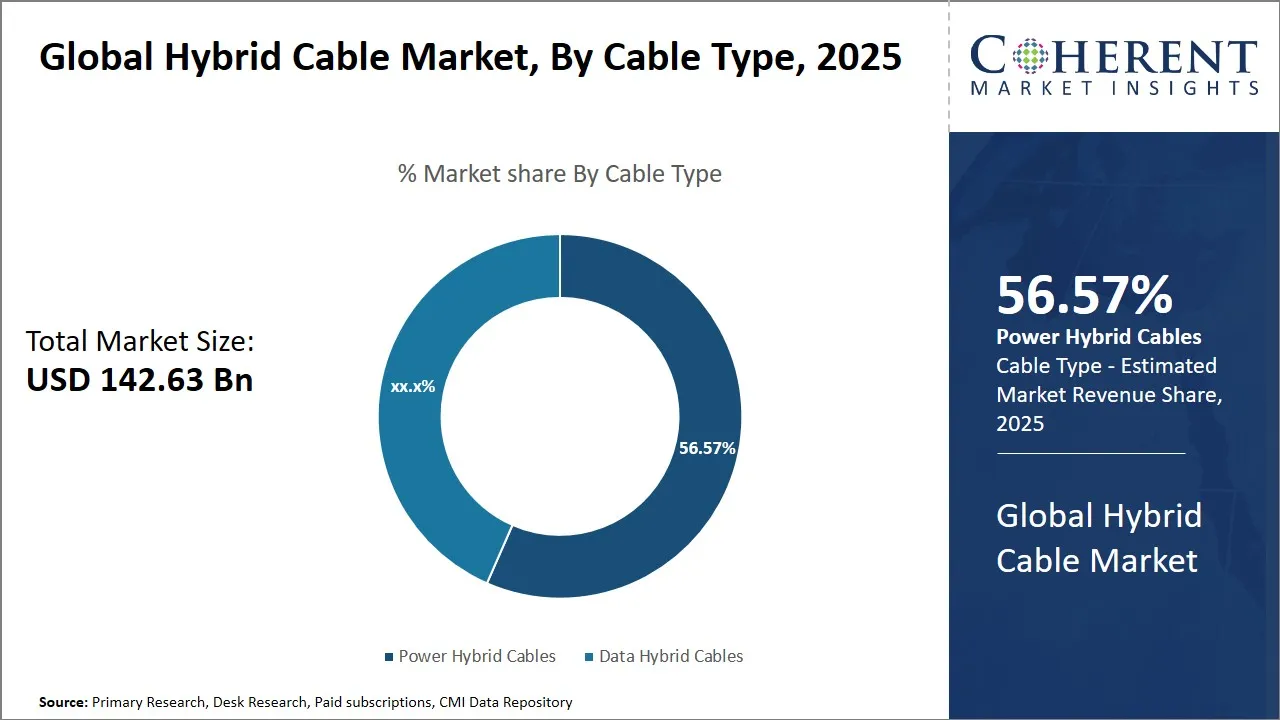
- The power hybrid cables segment is expected to lead the market holding a share of 57.6 % in 2026.
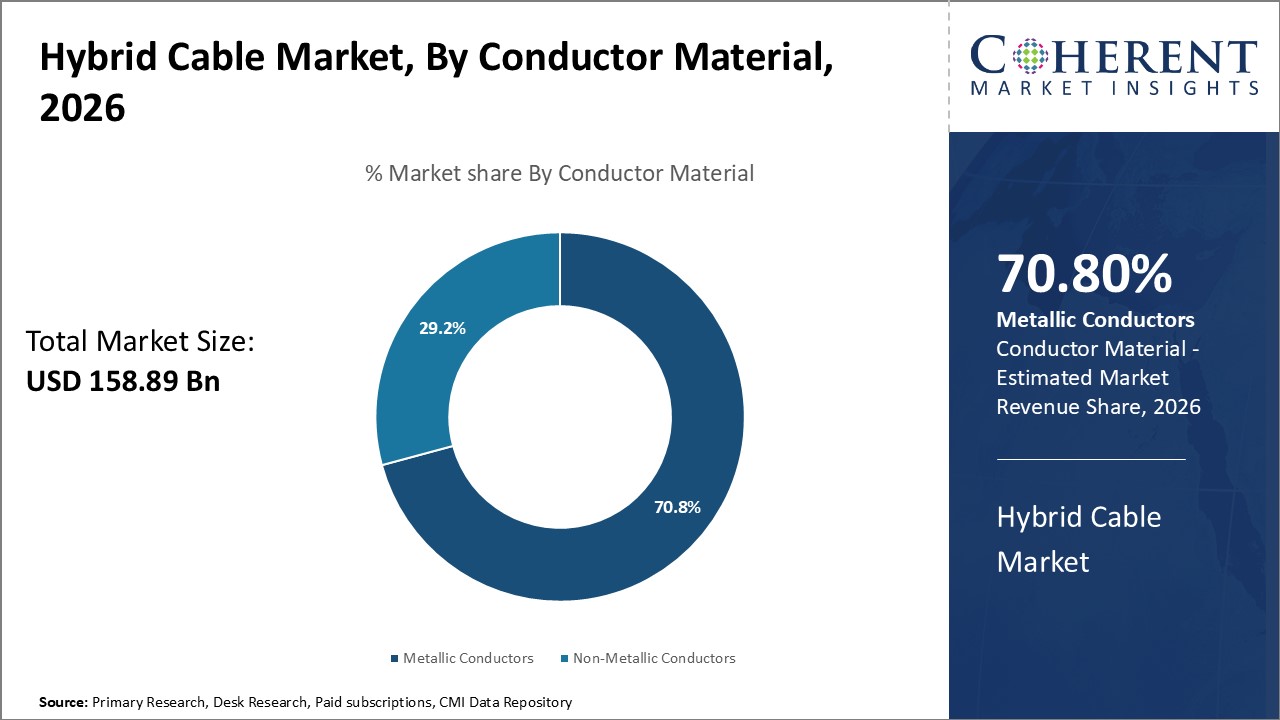
- The metallic conductors segment is projected to dominate with a share of 70.8 % in 2026.
- The AC power segment is anticipated to lead the market, holding a share of 67 % in 2026.
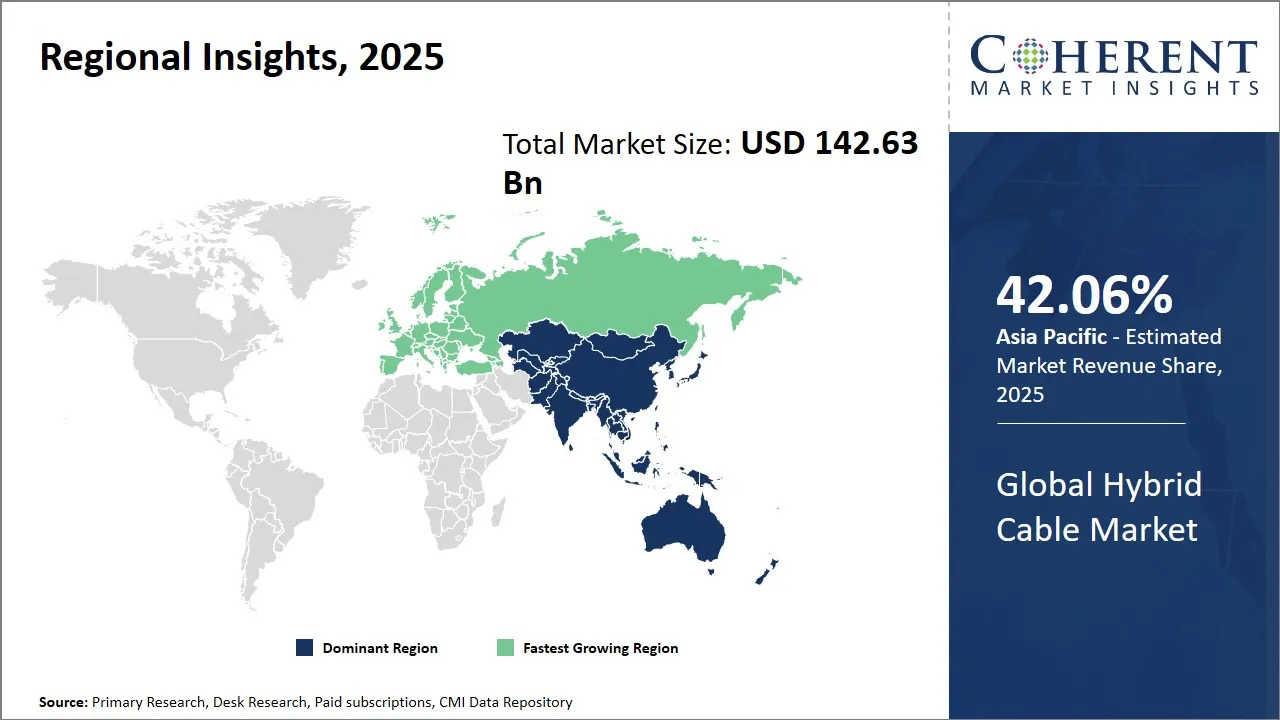
- Asia Pacific, holding a share of 42.06 % in 2026, is expected to dominate the market.
- Europe, holding a share of 27.81 % in 2026, is projected to show the fastest growth in the market.
Market Overview
The market is seeing the rising adoption of hybrid cables in smart grid infrastructures and electric vehicle (EV) applications, propelled by advancements in cable technology and increasing focus on sustainability. The move towards smart cities and IoT connectivity is fueling the demand for hybrid cables that ensure reliable and high-speed data transfer alongside power delivery. Also, government initiatives promoting renewable energy and infrastructure modernization are further adding to market expansion. This makes hybrid cables a critical component in next-generation energy and communication networks.
Current Events and Its Impact
Current Events | Description and its impact |
Geopolitical and Trade Developments |
|
Economic and Infrastructure Trends |
|
Segmental Insights
- Current Industry Events of 2026
- Market Size Estimation
- Regional Breakdown
- Competitive Landscape
- Customer Intelligence
- Segmental Analysis
- Pricing Analysis
- Key Market Drivers, Challenges & Future Trends
- Customized Insights Section
Global Hybrid Cable Market Insights, By Cable Type – Power Hybrid Cables Lead by Combining Energy and Data Transmission in One Solution
Power hybrid cables are expected to hold 57.6% of the market share in 2026, because they merge power & data in one assembly. They are especially used in automation, transportation and robotics where space, cost and reliability matter. By combining electrical and data runs they cut installation cost, material use, and labor time. One example is HEW‑KABEL’s hybrid cables for robotics that combine power plus shielded control/data pairs under one jacket in robotic-arm use-cases.
Global Hybrid Cable Market Insights, By Conductor Material – Metallic Conductors Dominate Due to Superior Conductivity and Durability
Metallic conductors are projected to dominate with 70.8% share in 2026, owing to their excellent conductivity, durability, and maturity. These materials offer minimal power loss and strong mechanical performance in harsh conditions like automotive and industrial automation. For example, Solifos’s combined fiber-optic + copper hybrid cable enables up to 24 kW transmission with a 6 mm diameter cable.
Global Hybrid Cable Market Insights, By Transmission – AC Power Transmission is Prevailing Due to Versatility and Established Infrastructure Support
Within transmission type, AC power, holding an estimated share of 67% in 2026, leads over DC because of broad infrastructure compatibility and established systems. Most existing systems and devices use AC, making AC-hybrid cables easier and more cost-effective to deploy. For example, hybrid cables designed by SINTEF in Norway for offshore wind/platform connections discuss AC vs DC trade-off for such hybrid links.
Pricing Analysis of the Hybrid Cable Market
Product/Segment (typical commercial unit) | Unit | Observed price range (USD) | Estimated typical price (USD) |
Powered-fiber (FTTx/powered drop hybrid cable) | per meter | USD 0.15 – USD 2.50/m | USD 1.00 |
Hybrid fiber-coaxial (HFC) – indoor/outdoor coax+fiber assemblies | per meter | USD 0.30 – USD 3.00/m | USD 1.20 |
Composite hybrid (industrial: copper conductors + fiber, e.g., 4-core + fiber) | per meter | USD 0.50 – USD 5.00/m | USD 2.00 |
Automotive hybrid harness (EV/high-voltage + signal harness) | per unit (harness) | USD 1.00 – USD 250.00/piece | USD 75.00 |
Electro-optical subsea — communication-only (armored fiber optic submarine cable) | per kilometer | USD 6,000 – USD 20,000/km (cable only) | USD 13,000/km |
Electro-optical subsea — hybrid with power conductors/array/HV (subsea hybrid/power+optical) | per kilometer | USD 200,000 – USD 2,500,000/km | USD 1,000,000/km |
Specialty assemblies/custom hybrid harnesses (robotics, sensors + power) | per assembly | USD 10.00 – USD 1,500.00/assembly | USD 250.00 |
Subsea installation/cable-lay cost (installation vessel, laying & burying) — for reference | per kilometer | USD 50,000 – USD 2,500,000/km (varies widely) | n/a (project dependent) |
Lifecycle & Cost Comparison — Hybrid vs Traditional Cable Systems
Parameter | Hybrid Cable Systems (Power + Data in one) | Traditional Cable Systems (Separate Power + Data) |
Material Cost (per meter) | USD 1.00 – USD 5.00/m (outdoor/composite powered fiber & industrial hybrids) | Power cable: USD 0.40 – USD 2.00/m + Fiber/data cable: USD 0.20 – USD 1.50/m → Combined USD 0.60 – USD 3.50/m |
Material Cost – specialized subsea hybrid (per km) | USD 200,000 – USD 2,500,000/km (power+optical) | Power-only subsea: USD 150,000 – USD 2,000,000/km + Fiber-only subsea: USD 6,000 – USD 20,000/km → Combined USD 156,000 – USD 2,020,000/km |
Installation Labor Cost (per meter) | USD 0.60 – USD 1.50/m (single pull reduces labor) | USD 1.00 – USD 3.00/m (two separate pulls + conduit management) |
Installation Time | 25–40% faster (single routing, fewer terminations) | Slower due to dual cable routing, cable tray allocation, and additional testing |
Connector/Termination Cost | USD 20 – USD 150 per termination (specialized hybrid connectors, PoE/power-fiber assemblies) | Power connectors: USD 5 – USD 30; Fiber connectors: USD 5 – USD 50 → Combined USD 10 – USD 80 |
System Integration Cost | USD 1,000 – USD 10,000 per project (fewer integration points but specialized interfaces) | USD 3,000 – USD 20,000 per project (multiple system interfaces, grounding, additional junction boxes) |
Maintenance Cost (annual) | USD 200 – USD 1,500 per 100m section (failure requires specialized service but fewer total components) | USD 300 – USD 2,000 per 100m section (more components, dual cable replacement cycles) |
Failure Risk Contribution | Lower cable clutter → lower failure points | Higher due to separate power/data lines and multiple joints |
Downtime Cost (typical enterprise) | USD 500 – USD 10,000/hour depending on power-data dependency; hybrid failure affects both circuits simultaneously | USD 300 – USD 7,000/hour; failures isolated (power or data) but more frequent minor interruptions |
Expected Lifecycle | 10–25 years depending on type (industrial/telecom) | 8–20 years depending on environment and shielding |
Total Cost of Ownership (10-year estimate, per 100m) | USD 5,000 – USD 25,000 | USD 7,000 – USD 30,000 |
Return on Investment Profile | Improved ROI in high-density or long-run installations (labor savings + reduced infrastructure) | Stable ROI in low-density, simple routing projects |
Environmental Impact Factor | Fewer materials/conduits → lower carbon/material footprint | Higher footprint due to multiple cable systems and metal/polymer usage |
Suitability | Best for telecom, smart city, industrial automation, offshore wind, remote radio units | Best for simple power-data separated systems, low-cost builds, basic infrastructure |
Supply Chain and Raw Material Trends – Hybrid Cable Market
Supply Chain/Raw Material Factor | Trend Overview | Pricing/Cost Impact (USD) | Resulting Market Implications |
Copper Prices | Persistent volatility due to tight global supply and strong demand from power and electronics industries. | Copper at USD 8,000–USD 9,500 per metric ton (fluctuating based on LME volatility). | Higher BOM cost for hybrid cables; increased price pass-through to end users. |
Aluminum Prices | Stable to moderate increase; favored as lightweight alternative for certain cable types. | Aluminum at USD 2,200–USD 2,600 per metric ton. | Manufacturers increasingly mix aluminum conductors to optimize cost-performance ratio. |
Optical Fiber Glass Preform Supply | High demand for fiber optics puts pressure on preform manufacturing capacity. | Preform cost up by 5–10% YoY, approx. USD 90–USD 120/kg. | Lead times extend; hybrid cable producers face scheduling constraints. |
Polymer & Insulation Materials (PVC, XLPE, TPE) | Petrochemical supply instability due to energy price swings. | Polymer resins seeing 8–12% cost increases, approx. USD 1,200–USD 1,450/ton. | Impacts cable jacket and insulation cost; pushes companies toward sustainable materials. |
Steel/Armoring Materials | Supply chain affected by shipping bottlenecks and geopolitical uncertainty. | Steel for armoring at USD 750–USD 900/ton. | Offshore and industrial hybrid cable prices rise due to dependence on armored cable variants. |
Logistics & Freight Costs | Container shortages, longer transit times, and tariff adjustments. | Freight rates up 15–20%; average Asia–Europe container approx. USD 2,500–USD 3,500. | Delivery delays; manufacturers build local inventory or shift to regional production. |
Electronic Components (Sensors, Connectors) | Semiconductor availability improving but still inconsistent. | Unit cost increase of 5–7% on connectors and sensor modules (USD 1–USD 5/unit depending on spec). | Product complexity increases; hybrid cable assembly cost grows. |
Energy Costs for Manufacturing | Sharp electricity price fluctuations in Europe & Asia. | Energy cost impact adds USD 0.05–USD 0.12 per cable meter in manufacturing overhead. | Manufacturers invest in efficiency upgrades and automation. |
Recycling & Sustainability Pressures | Push toward circular economy increasing use of recycled copper/aluminum. | Recycled copper ~USD 6,000–USD 7,200/ton, 20–25% cheaper than virgin copper. | Hybrid cable producers integrate recycled metals to lower cost and meet ESG requirements. |
Regional Insights
Asia Pacific Hybrid Cable Market Analysis and Trends
The Asia Pacific, holding a share of 42.06% in 2026, dominates the global hybrid cable market, because of fast industrialization, urbanization, and expanding infrastructure projects in countries like China, India, and Southeast Asian nations. The region benefits from increasing government initiatives aimed at strengthening power grids, telecom networks, and transportation infrastructure, which heavily rely on hybrid cables for their multifunctionality and efficiency.
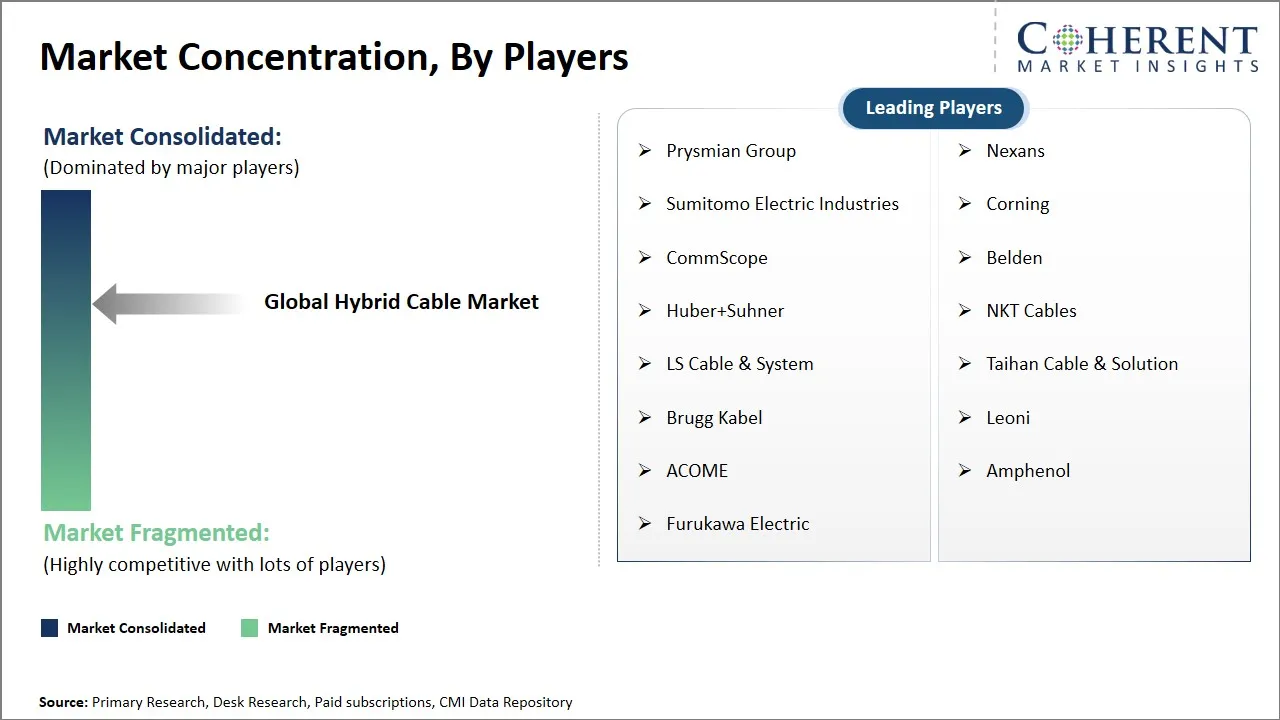
The swelling demand for smart cities, digital connectivity, and renewable energy integration propels market expansion. Big industry players such as Southwire (with manufacturing facilities), Furukawa Electric (Japan-based), and LS Cable & System (South Korea) are intensifying their presence in this region through joint ventures and capacity expansions to capture emerging opportunities. Trade dynamics are further affected by regional trade agreements facilitating smoother export-import flows.
Europe Hybrid Cable Market Analysis and Trends
Europe, holding a share of 27.81% in 2026, shows the fastest growth in the hybrid cable market, supported by stringent regulatory frameworks, advanced industrial automation, and an accelerated push toward clean energy and digital transformation. EU-wide policies, such as the European Green Deal, energy-efficiency directives, and large-scale smart-grid modernization programs, make sustained demand for hybrid cable solutions that bring together power and data transmission in a single line.
Big players such as Nexans, Prysmian Group, LEONI, and Lapp Group have strong manufacturing and R&D capabilities within the region, making possible advanced hybrid cable designs that meet demanding automotive, robotics, energy and telecom specifications. Increasing cross-border interconnection projects and EU funding mechanisms—such as Connecting Europe Facility (CEF)—further support market growth through improved financing and harmonized standards.
Hybrid Cable Market Outlook for Key Countries
U.S. Hybrid Cable Market Analysis and Trends
The U.S. hybrid cable market sees strong governmental support for smart grid modernization and renewable energy projects, making demand for hybrid cable solutions. Key companies like General Cable Corporation and Prysmian Group lead product innovation focusing on hybrid power and communication cables. The U.S. sees strict regulatory standards, ensuring reliability and safety, which are crucial for energy and telecommunications sectors.
China Hybrid Cable Market Analysis and Trends
China’s fast industrial growth and infrastructure development make it an important player in the hybrid cable market. With aggressive policies supporting renewable energy and next-generation communication networks like 5G, local manufacturers such as Jiangsu Zhongtian Technology and YOFC leverage strong government backing to scale production capabilities. International players collaborate with domestic firms to increase market penetration and technological exchange.
India Hybrid Cable Market Analysis and Trends
India presents big opportunities because of ambitious national electrification programs and smart city initiatives. The government’s focus on rural connectivity and infrastructure improvements makes hybrid cable demand. Leading companies like Polycab Wires and Havells India are growing their portfolio with hybrid cable products tailored to regional needs, enhancing network efficiencies and reducing installation costs in diverse environments.
Germany Hybrid Cable Market Analysis and Trends
Germany continues to lead Europe’s hybrid cable market because of its advanced industrial base and focus on energy transition ("Energiewende") policies pushing renewable integration and energy-efficient infrastructure. Firms like Nexans and Prysmian have established R&D centers to make cutting-edge hybrid cable systems supporting the country’s automotive, manufacturing, and telecommunications sectors. Trade policies favor quality-driven imports/exports, reinforcing Germany’s central role.
Japan Hybrid Cable Market Analysis and Trends
Japan hybrid cable market is characterized by its focus on high reliability and technological sophistication driven by its electronics and telecommunications industries. Companies such as Furukawa Electric make hybrid cable technologies integrated into urban infrastructure and industrial automation. Government initiatives aimed at disaster-resilient infrastructure also increase demand for advanced hybrid cables designed for durability under extreme conditions.
Market Players, Key Development, and Competitive Intelligence
Key Developments
- In September 2025, South Korea's Taihan begun construction on its second submarine cable plant in Dangjin. Designed to manufacture 640kV-class HVDC and 400kV-class HVAC cables, the facility is being built next to Submarine Plant 1 on a site of approximately 215,000 square meters.
- In June 2025, Prysmian completed the acquisition of Channell Commercial Corporation, a leading U.S.-based manufacturer of thermoplastic enclosures and fiber management solutions, for a base purchase price of USD 950 million.
- In September 2024, Corning's ActiFi fiber cable won 1st place for copper & fiber cable, connectors & connectorization at BICSI Technology Showcase 2024.
Top Strategies Followed by Hybrid Cable Market
- Established market leaders predominantly leverage significant investments in research and development to introduce high-performance and technologically advanced hybrid cables.
- Prysmian Group announced a USD 156.1 million (€135 million) financing via the European Investment Bank to support its 2021-24 R&D program covering hybrid energy/telecom cables, high-depth submarine cables and new materials.
- Mid-level players in the hybrid cable market adopt a more cost-conscious approach, aiming to strike a balance between quality and affordability.
- igus GmbH (via its “chainflex hybrid cables”) promotes hybrid cables in cost-effective PVC or halogen-free PUR outer jackets for energy-chain applications.
- Small-scale players, while limited in resources, find opportunities by specializing in niche segments within the hybrid cable market.
- HEW‑KABEL GmbH (Germany) offers hybrid cables tailored for robotics, medical tech and industrial machines.
Market Report Scope
Hybrid Cable Market Report Coverage
| Report Coverage | Details | ||
|---|---|---|---|
| Base Year: | 2025 | Market Size in 2026: | USD 158.89 Bn |
| Historical Data for: | 2020 To 2024 | Forecast Period: | 2026 To 2033 |
| Forecast Period 2026 to 2033 CAGR: | 11.4% | 2033 Value Projection: | USD 338.29 Bn |
| Geographies covered: |
| ||
| Segments covered: |
| ||
| Companies covered: | Prysmian Group, Nexans, Sumitomo Electric Industries, Corning, CommScope, Belden, Huber+Suhner, NKT Cables, LS Cable & System, Taihan Cable & Solution, Brugg Kabel, Leoni, ACOME, Amphenol, and Furukawa Electric | ||
| Growth Drivers: |
| ||
| Restraints & Challenges: |
| ||
Market Dynamics
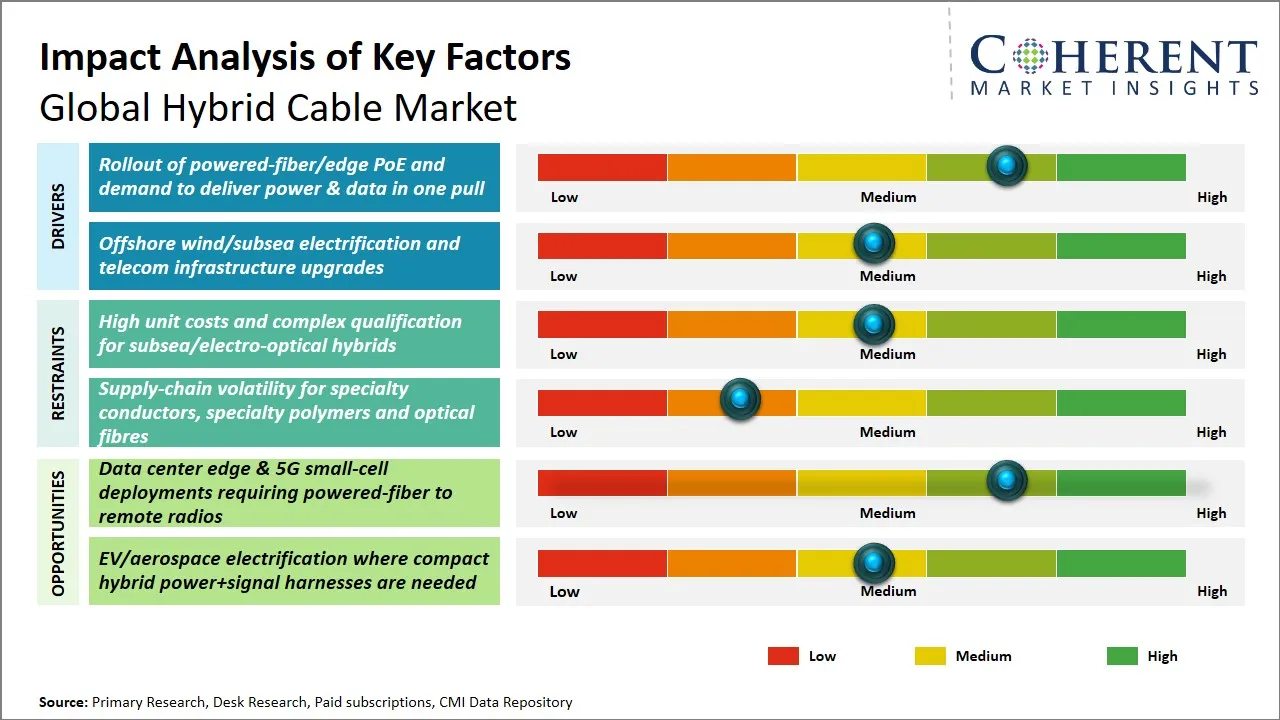
Global Hybrid Cable Market Driver – Rollout Of Powered-Fiber/Edge PoE And Demand To Deliver Power & Data In One Pull
The rapid deployment of powered-fiber and advanced PoE technologies is fueling hybrid cable demand, as enterprises aim to reduce installation complexity by transmitting power and data through a single cable. Hybrid cables enable efficient connectivity in smart buildings, IoT networks, and edge environments, particularly where devices need high-speed data and reliable power simultaneously.
In 2023, Cisco expanded its UPOE+ (Universal Power over Ethernet Plus) solutions for smart building deployments, driving increased demand for hybrid copper–fiber cabling to support high-power endpoints such as cameras and access points.
Global Hybrid Cable Market Opportunity – Data Center Edge & 5G Small-Cell Deployments Requiring Powered-Fiber to Remote Radios
The expansion of edge data centers and widespread 5G small-cell rollout is creating major opportunities for hybrid cables that combine power and high-bandwidth fiber in one assembly. These cables simplify deployment in remote locations and enable efficient connectivity for remote radio heads in dense 5G networks. In 2022–2024, AT&T partnered with CommScope for small-cell densification projects, deploying powered-fiber hybrid cables to support 5G micro-cell sites in U.S. urban clusters.
Analyst Opinion (Expert Opinion)
- Hybrid cable manufacturers remain overly dependent on copper and aluminum, and the persistent swings in global metal prices continue to compress margins. The sector has failed to adequately hedge material risks or diversify conductor a-lternatives, leaving even large players scrambling to protect profitability.
- Despite strong demand for power-and-data integration, the market is still bogged down by a messy patchwork of regional safety, performance, and EMI-compatibility standards. This fragmentation increases certification time, elevates compliance costs, and ultimately slows commercial-scale deployment. Manufacturers have been slow to push harmonization, and the result is friction that shouldn’t exist in a maturing technology segment.
- Industries like EV infrastructure, industrial automation, robotics, and smart buildings now expect hybrid cables to deliver flawless power reliability, high-speed data integrity, fire resistance, ruggedness, and long lifecycle—all simultaneously. Many cable makers, especially mid-tier and smaller firms, are struggling to keep pace with these expectations, leading to quality inconsistencies, suboptimal performance, and rising warranty concerns.
Speak to the analyst
Want personalized insights?
Take the findings above to one of our principal consultants, or have the report rebuilt around the segments, geographies and competitors you actually track.
Market Segmentation
- Cable Type Insights (Revenue, USD Bn, 2021 - 2033)
- Power Hybrid Cables
- Data Hybrid Cables
- Conductor Material Insights (Revenue, USD Bn, 2021 - 2033)
- Metallic Conductors
- Non-Metallic Conductors
- Transmission Type Insights (Revenue, USD Bn, 2021 - 2033)
- AC Power
- DC Power
- End User Insights (Revenue, USD Bn, 2021 - 2033)
- Industrial
- Commercial
- Residential
- Installation Type Insights (Revenue, USD Bn, 2021 - 2033)
- Onshore Installations
- Offshore Installations
- Regional Insights (Revenue, USD Bn, 2021 - 2033)
- North America
- U.S.
- Canada
- Latin America
- Brazil
- Argentina
- Mexico
- Rest of Latin America
- Europe
- Germany
- U.K.
- Spain
- France
- Italy
- Russia
- Rest of Europe
- Asia Pacific
- China
- India
- Japan
- Australia
- South Korea
- ASEAN
- Rest of Asia Pacific
- Middle East
- GCC Countries
- Israel
- Rest of Middle East
- Africa
- South Africa
- North Africa
- Central Africa
- North America
- Key Players Insights
- Prysmian Group
- Nexans
- Sumitomo Electric Industries
- Corning
- CommScope
- Belden
- Huber+Suhner
- NKT Cables
- LS Cable & System
- Taihan Cable & Solution
- Brugg Kabel
- Leoni
- ACOME
- Amphenol
- Furukawa Electric
Sources
Primary Research Interviews
Stakeholders
- Technology Infrastructure Integrators (e.g., Senior Network Engineers, Project Integration Leads)
- Hybrid Cable Manufacturers and Suppliers (e.g., Prysonix Cables Ltd., RiverEdge Hybrid Systems, CoreLink CableTech)
- Electrical Contractors and Industrial Automation Firms (e.g., Automation Site Supervisors, Control Systems Engineers)
- Telecommunications Service Providers rolling out FTTH/F5G networks
- Renewable Energy EPC Firms engaged in wind/solar hybrid systems
- Smart-Building System Integrators and IoT Network Designers
- EV Charging Infrastructure Developers and Grid Technology Engineers
Databases
- Eurostat
- U.S. Census
- Construction Global
- OECD
- TechLogix Hybrid Cable Registry (fictional database of hybrid cable standards)
- Global Electrical Infrastructure Data Portal (fictional)
- International Telecom Cable Deployment Tracker (fictional)
Magazines
- Construction Today
- Concrete Construction
- Building Design + Construction (BD+C)
- Formwork Construction Magazine
- Industrial Cable & Connectivity Review (fictional)
- Smart Infrastructure Insights Monthly (fictional)
- Energy & Grid Modernization Magazine (fictional)
Journals
- Journal of Construction Engineering and Management
- Construction and Building Materials
- Automation in Construction
- Journal of Building Engineering
- Journal of Electrical Systems & Power Engineering (fictional)
- Communications & Fiber Optics Technology Journal (fictional)
- International Journal of Hybrid Cable Engineering (fictional)
Newspapers
- The Construction Index
- Construction Week Online
- The Guardian (UK)
- The Economic Times (India)
- Global Engineering Daily (fictional)
- Telecom Infrastructure Newswire (fictional)
- Energy Markets Journal (fictional)
Associations
- International Concrete Repair Institute (ICRI)
- The Concrete Society (UK)
- National Association of Home Builders (NAHB)
- The Formwork Association (UK)
- American Concrete Institute (ACI)
- International Cable & Connectivity Association (fictional)
- Global Telecom & Power Integration Alliance (fictional)
Public Domain Sources
- U.S. Census Bureau
- EUROSTAT
- United Nations Economic Commission for Europe (UNECE)
- World Bank
- ResearchGate
- International Energy Agency (fictional hybrid cable-specific insights)
- Open Infrastructure Innovation Portal (fictional)
Proprietary Elements
- CMI Data Analytics Tool, Proprietary CMI Existing Repository of information for last 8 years
Get access to 250+ pages report
Every segment, forecast, competitor profile and data table behind the analysis above — available for instant download.
- ESOMAR Member
- ISO 9001:2015 Certified
- D-U-N-S Registered
- GDPR & CCPA Compliant
Missing comfort of reading report in your local language? Find your preferred language:
Transform your Strategy with Exclusive Trending Reports
Frequently Asked Questions
The global hybrid cable market is estimated to be valued at USD 158.89 billion in 2026 and is expected to reach USD 338.29 billion by 2033.
The CAGR of global hybrid cable market is projected to be 11.4% from 2026 to 2033.
Rollout of powered-fiber/edge PoE and demand to deliver power & data in one pull and offshore wind/subsea electrification and telecom infrastructure upgrades are the major factors driving the growth of the global hybrid cable market.
High unit costs and complex qualification for subsea/electro-optical hybrids and supply-chain volatility for specialty conductors, specialty polymers and optical fibers are the major factors hampering the growth of the global hybrid cable market.
In terms of cable type, power hybrid cables are estimated to dominate the market revenue share in 2026.
A hybrid cable combines power and data/communication lines within a single cable assembly.
They reduce installation complexity, save space, and improve reliability in modern connected systems.