

Global Hybrid Train Market Size and Forecast – 2026-2033
Coherent Market Insights estimates that the global hybrid train market is expected to reach USD 24 Bn in 2026 and will expand to USD 43 Bn by 2033, registering a CAGR of 6.5% between 2026 and 2033.
Key Takeaways of the Hybrid Train Market
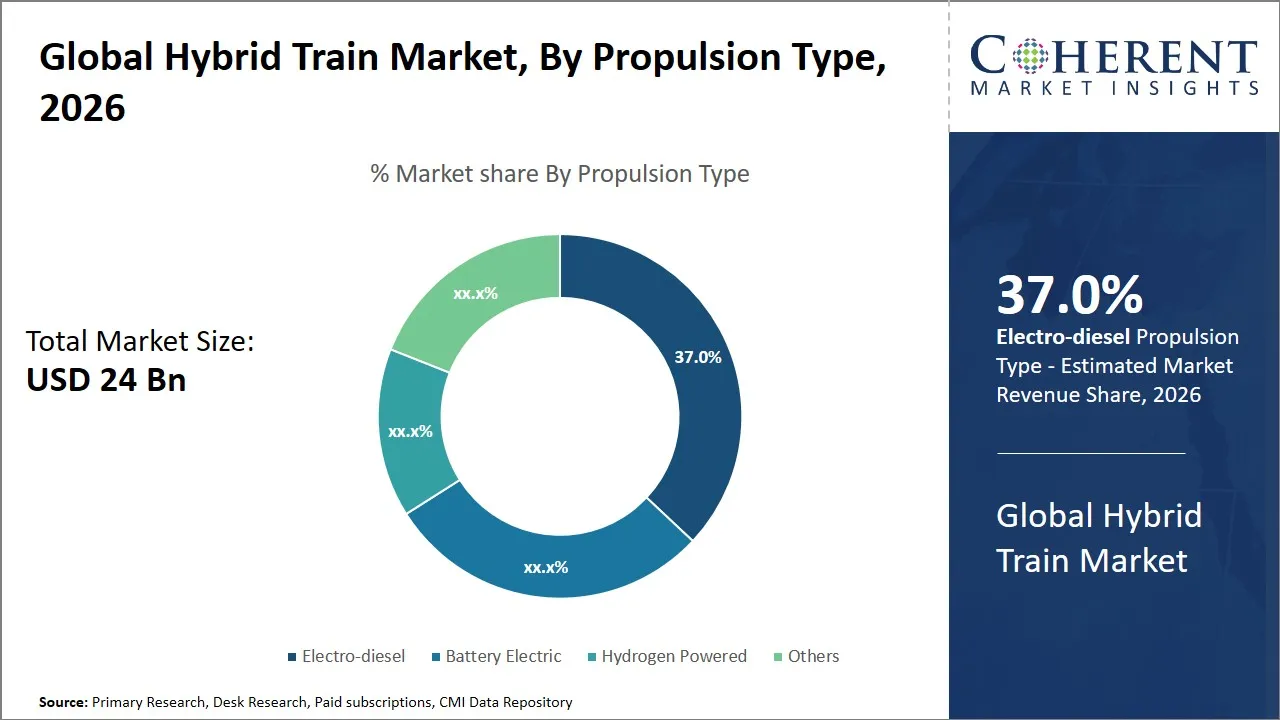
- The electro-diesel segment is expected to account for 37% of the hybrid train market share in 2026.
- The below 100 Kmph segment is estimated to hold 43% of the market share in 2026.
- The passenger segment is projected to capture 56% of the global hybrid train market share in 2026.
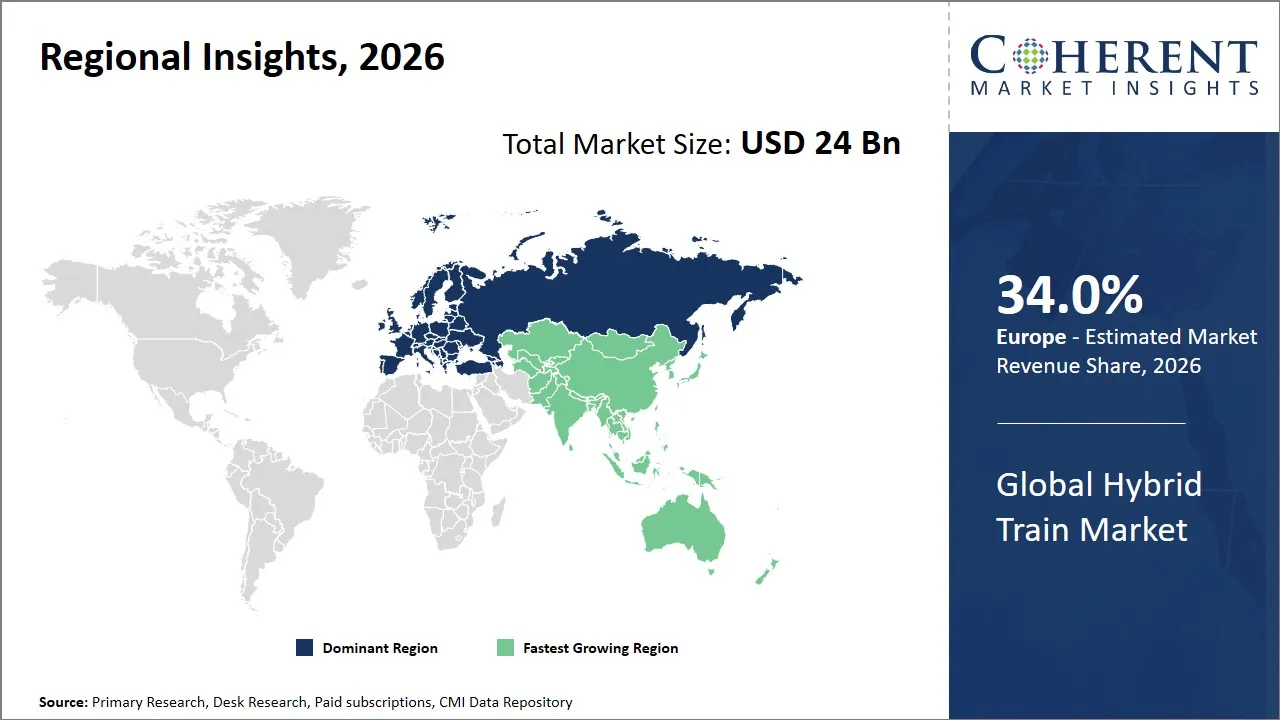
- Europe will dominate the hybrid train market in 2026 with an estimated 34% Share.
- Asia Pacific will hold 25% share in 2026 and is expected to record the fastest growth over the forecast period.
Current Events and Its Impact
Current Events | Description and its Impact |
Denmark Milestone in Green Transition |
|
Segmental Insights
- Current Industry Events of 2026
- Market Size Estimation
- Regional Breakdown
- Competitive Landscape
- Customer Intelligence
- Segmental Analysis
- Pricing Analysis
- Key Market Drivers, Challenges & Future Trends
- Customized Insights Section
Why Does Electro-Diesel Segment Dominate the Global Hybrid Train Market in 2026?
The electro-diesel segment is expected to account for 37.0% of the global hybrid train market share in 2026. The growth is primarily due to its ability to seamlessly operate across electrified and non-electrified railway tracks. Such versatility proves useful where power supply networks exist only in parts of the rail system. Where wires run above tracks, electricity drives the train; without them, fuel takes over and this shift happens seamlessly during travel. Moving across zones feels smooth because operation continues regardless of infrastructure gaps.
For instance, on September 4, 2025, Stadler delivered its milestone 100th locomotive to European Loc Pool. The handover marks a new chapter in the success story of the EURODUAL locomotive platform. By placing this landmark locomotive with HVL, the launch customer of the EURODUAL, Stadler and its partners demonstrate their ongoing commitment to flexibility, efficiency and greener transport solutions.
(Source: stadlerrail.com)
Below 100 Kmph Segment Dominates the Global Hybrid Train Market
The below 100 Kmph segment is expected to account for 43.0% of the global hybrid train market share in 2026. Growth stems mainly from how well these systems fit regional and suburban travel demands. Where trips cover short or moderate spans, performance lies less in top speed, instead depending on quick pick up and regular halting. Beginning often at standstill, hybrid models manage power more efficiently through repeated starting and stopping. For commuter lines and city-based transport, this trait becomes a key factor in selection. Frequent pauses do not hinder them; rather, they operate best under such conditions.
Why is Passenger the Most Widespread Application in the Hybrid Train Market?
The passenger segment is expected to account for 56.0% of the hybrid train market share in 2026. The growth follows as urbanization and population growth drive substantial increases in the demand for mass transit solutions. Urban and suburban areas worldwide are emphasizing sustainable transport options to alleviate congestion, reduce greenhouse gas emissions, and improve air quality, all of which benefit from hybrid passenger trains’ ability to operate efficiently on partially electrified routes.
Battery, Energy Storage & Powertrain Choices
Model | Powertrain Type | Battery Capacity | Range (Battery Only) | Top Speed |
Siemens Mireo Plus B | Battery‑Electric Hybrid (BEMU) | Lithium‑titanate batteries (LTO) (approx.) | ~80–120 km on battery alone | ~140 km/h |
Stadler FLIRT Akku | Battery‑Electric Multiple Unit | Lithium‑ion energy storage | ~224 km historic record; other tests ~150–320 km | ~140 km/h |
British Rail Class 756 (Stadler FLIRT Tri‑mode) | Tri‑mode (Electric + Diesel + Battery) | Lithium‑titanium‑oxide, 447–559 kWh (varies by formation) | ~depends on config; batteries boost diesel/electric | ~121 km/h (75 mph) |
Stadler FLIRT (modular powerpacks) | Modular hybrid (electric + battery + diesel/hydrogen) | Varies by powerpack type | Up to 150 km+ battery autonomy (config‑dependent) | 127–200 km/h |
Stadler Class 93 (Hybrid Freight) | Electro‑diesel + Battery boost | 80 kWh battery (rapid charge) | Battery used for traction boost / regen use | 110 mph (~177 km/h) |
Regional Insights
Europe Hybrid Train Market Analysis and Trends
The Europe region is projected to lead the market with a 34% share in 2026. As rail systems here are advanced, rules on pollution are tight, one path stands clear - sustainable transit has long been a priority. Financial backing from government entities arrives via funding, tax reductions, while emissions goals follow broader European ecological plans. In this space, major players like Siemens Mobility and Alstom operate prominently, shaping development in hybrid transit solutions. Former Bombardier Transport units, now absorbed into Alstom, contribute significantly to this landscape. Research efforts focus on dual-system propulsion together with non-conventional energy sources. Collaboration with local vendors and academic institutions strengthens these initiatives. Integrated railway systems across national borders assist in deploying multi-energy locomotives more effectively. Meanwhile, conditions within the domestic marketplace help move parts and knowledge efficiently.
For instance, on October 9, 2025, Akiem, the European leader in locomotive and passenger train leasing and maintenance, placed a firm order with Siemens Mobility for 10 additional Vectron Dual Mode (VDM) locomotives. This order is part of the framework agreement signed in August 2021 for the supply of locomotives. The first locomotives are to be delivered in the 4th quarter of 2027.
(Source: press.siemens.com)
Asia Pacific Hybrid Train Market Analysis and Trends
The Asia Pacific region is expected to exhibit the fastest growth in the market contributing 25% share in 2026. Urban expansion, broader rail systems, while environmental goals push change. Investment intensifies in nations including China, India, Japan to handle higher transport needs. Policies favoring cleaner transit, alongside costlier fuels, shift momentum toward hybrid solutions. Manufacturing strength rises across Asia Pacific, especially within China and Japan, forming hubs for advanced yet economical train models sent worldwide. Firms like CRRC Corporation Limited, Hitachi Rail maintain strong regional presence, advancing progress via collaboration under public programs.
Global Hybrid Train Market Outlook for Key Countries
Why is Germany Emerging as a Major Hub in the Hybrid Train Market?
Still ahead in Europe’s hybrid locomotive sector, Germany combines an extensive railway system with forward-looking environmental rules. Leading the national service, Deutsche Bahn brings hybrid models into regular use to align with long-term carbon goals. Companies like Siemens Mobility contribute through precision design and worldwide experience in transit solutions. Encouraged by clear regulations, financial support targets cleaner propulsion methods - especially hydrogen and battery-based systems. Innovation thrives where policy meets industrial capability across the region's busiest tracks.
Is Japan the Next Growth Engine for the Hybrid Train Market?
Despite global trends, Japan's hybrid train sector grows through precision engineering and deliberate policy choices. Development thrives where advanced rail expertise meets long-term energy goals. Firms such as Hitachi Rail alongside Toshiba shape innovation in hybrid electric multiple units, along with battery-driven models. Their work emphasizes lower emissions during service, combined with smarter capture of recovered energy. Suburban corridors and local lines offer practical environments for these trains to operate effectively. Support arrives through state funding mechanisms, together with collaborations between agencies and enterprises aiming at greener mobility solutions.
China Hybrid Train Market Analysis and Trends
From within global networks, movement grows fastest where tracks multiply quickly under strict ecological rules, a pattern clear across China. Leading this shift stands CRRC Corporation Limited, active domestically while advancing power systems blending electricity and fuel efficiency for city-to-city as well as local travel. Backed by national priorities rooted deeply in long-term planning cycles, financial support reaches sustainable transport innovations, enabling wide manufacturing and rollout. The outcome forms not from bold visions but steady coordination of policy, industry, and infrastructure. Because of massive internal needs paired with expanding overseas delivery capacity, developments here influence equipment design and operational choices far beyond borders.
U.K. Hybrid Train Market Analysis and Trends
A change takes shape throughout the U.K., as hybrid systems gradually take over from diesel on lines lacking overhead cables. Rather than complete electrification, certain producers opt for combined power solutions - Hitachi Rail operates with homegrown facilities while collaborating with allies; meanwhile, Stadler follows parallel paths by combining reserves of electricity with combustion units. Rooted in these decisions is an overarching ambition: cutting carbon emissions to zero ahead of 2050. Support arrives via focused financial incentives, guiding rail services toward implementation across regional and commuter routes.
India Hybrid Train Market Analysis and Trends
A shift emerges across India’s rail network, driven by needs for better energy efficiency and lighter environmental impact. Where full electric coverage remains absent, hybrid solutions offer practical pathways forward - fitting within larger modernization goals. Policies including support for battery-powered transit and tighter usage rules push progress along long-distance corridors. Knowledge flows into local production centers through collaboration between homegrown builders such as Integral Coach Factory and global firms like CRRC. Instead of waiting for complete infrastructure overhaul, interim solutions take shape through battery-aided rolling stock favored by railway planners.
Market Players, Key Development, and Competitive Intelligence
Key Developments
- On January 7, 2026, Wabtec Corporation secured a USD 386 million follow-on order to deliver additional R255 hybrid battery-diesel work locomotives to New York’s Metropolitan Transportation Authority (MTA). The order is a major step in the Authority’s Capital Plan to revitalize the city’s transit network infrastructure and improve the capabilities and safety of its maintenance crews.
- On December 16, 2025, Siemens and Rock Rail announced they have been selected to Deliver 61 Innovative Battery-Powered Trains for the Northern Westphalia Network. A total of 61 state-of-the-art Mireo Plus B battery-powered trains from Siemens Mobility will be deployed on the routes of the Northern Westphalia Network (NNW) starting in December 2029.
- On August 12, 2025, Stadler, Inc. announced Lokaltog A/S has placed an order for ten more battery-powered FLIRT Akku trains, which were included as an option in the contract signed in October 2024.
Top Strategies Followed by Global Hybrid Train Market Players
Player Type | Strategic Focus | Example |
Established Market Leaders | Siemens Product Showcase | On November 7, 2025, Siemens Mobility today presented the train models of the state-of-the-art regional fleets for S-Bahn Mitteldeutschland to the public at its Wegberg-Wildenrath Test Center. The new fleets, consisting of 75 Mireo trains, including the innovative, battery-powered Mireo Plus B, will significantly strengthen public transport in the Leipzig region starting in December 2026. |
Mid-Level Players | Nexrail Order Confirmation | On November 12, 2025, NEXRAIL placed an order with Stadler for the supply of up to 200 EURO9000 panto-battery hybrid locomotives. This EURO9000 combines up to 9MW of pantograph power with 1,2MW of high-performance battery power. |
Small-Scale Players | Innovative Rail Technologies Order Confirmation | On February 25, 2025, Innovative Rail Technologies (IRT) announced they have chosen Forsee Power to supply battery systems for the electrification of shunting locomotives in the United States. IRT specializes in converting diesel locomotives into electric ones using its proprietary retrofit technology. |
Market Report Scope
Hybrid Train Market Report Coverage
| Report Coverage | Details | ||
|---|---|---|---|
| Base Year: | 2025 | Market Size in 2026: | USD 24 Bn |
| Historical Data for: | 2020 To 2024 | Forecast Period: | 2026 To 2033 |
| Forecast Period 2026 to 2033 CAGR: | 6.5% | 2033 Value Projection: | USD 43 Bn |
| Geographies covered: |
| ||
| Segments covered: |
| ||
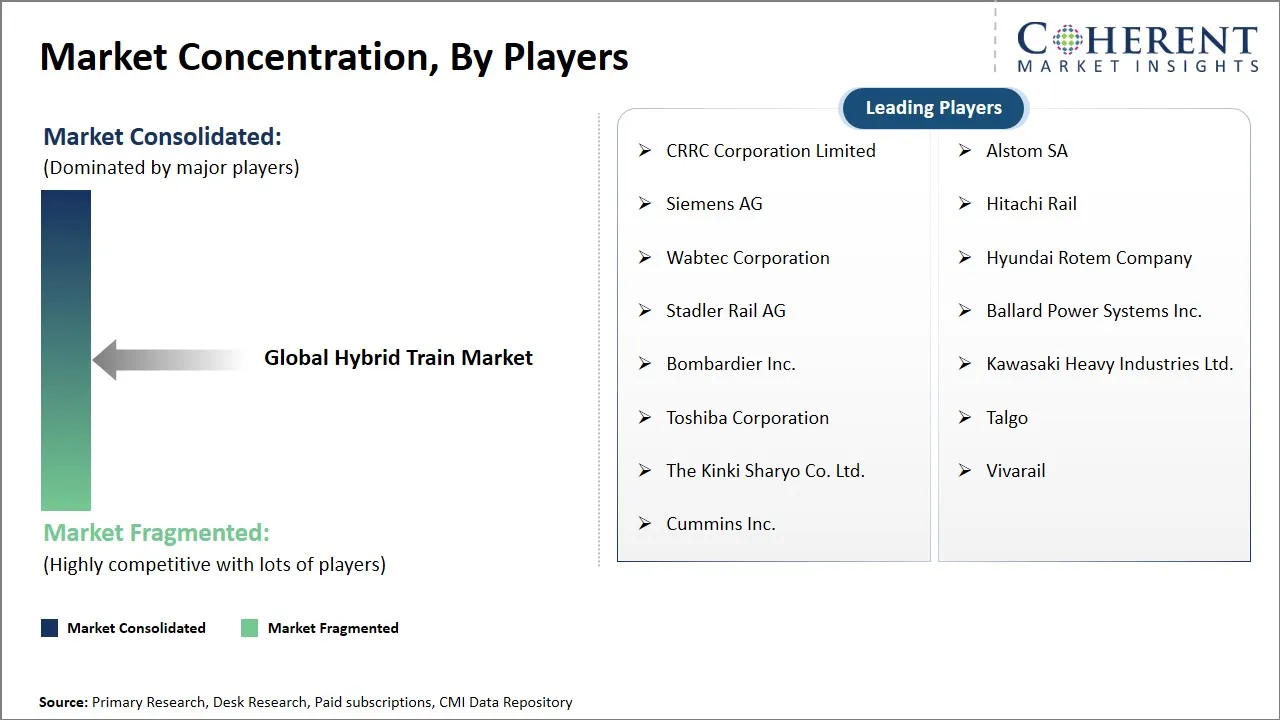
| Companies covered: | CRRC Corporation Limited, Alstom SA, Siemens AG, Hitachi Rail, Wabtec Corporation, Hyundai Rotem Company, Stadler Rail AG, Ballard Power Systems Inc., Bombardier Inc., Kawasaki Heavy Industries Ltd., Toshiba Corporation, Talgo, The Kinki Sharyo Co. Ltd., Vivarail, and Cummins Inc. | ||
| Growth Drivers: |
| ||
| Restraints & Challenges: |
| ||
Global Hybrid Train Market Dynamics
Global Hybrid Train Market Driver - Rising Passenger Demand for Noise Reduction
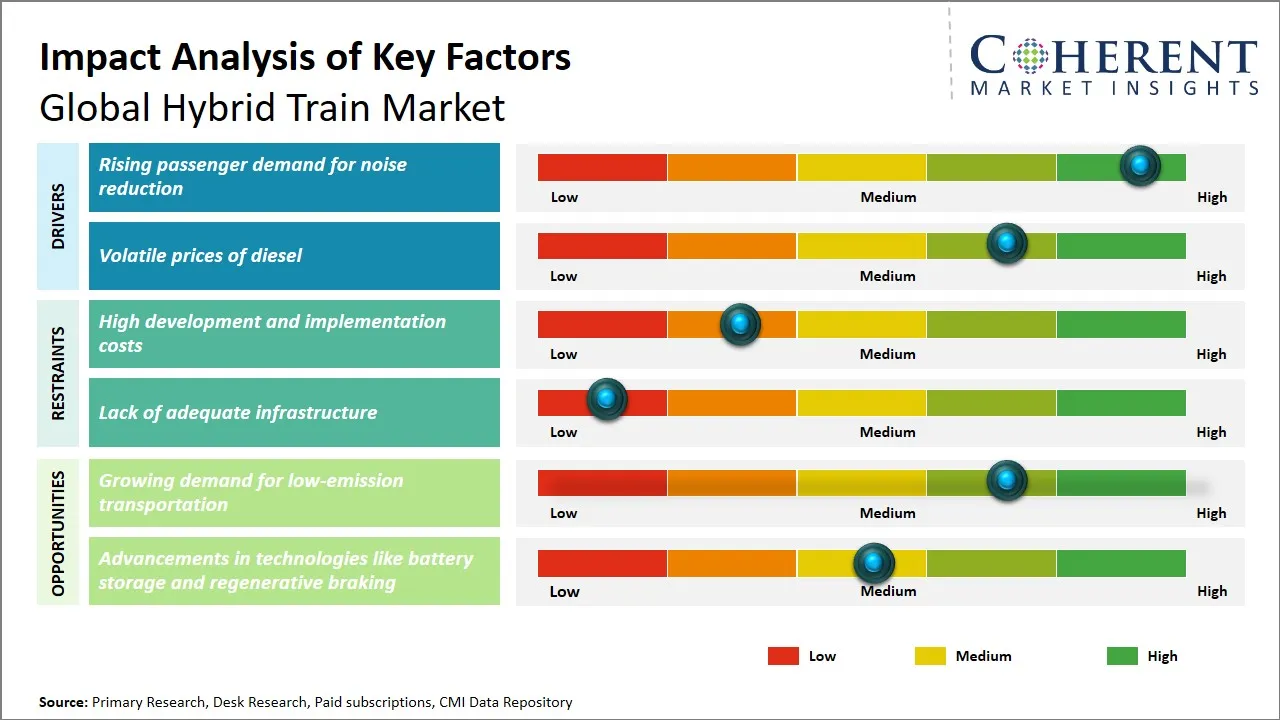
With cities expanding, alongside rising demand across rail lines, attention turns toward smoother journeys, sound control now standing central. Where older diesel engines generate persistent loudness, disturbing those onboard along with communities nearby, discomfort spreads widely. Operating more softly, hybrid units merge two power sources: their electric function dominates during city and outer-city runs. Because of this shift, especially where people gather closely, background sound drops noticeably.
For instance, on April 30, 2025, Arriva Group announced an order for nine cutting-edge battery hybrid trains to replace its entire Grand Central fleet, providing a major boost to regional economies and offering passengers more comfortable, greener travel options. The order for 45 Hitachi Rail 'tri-mode' cars comes with flexibility to run on electrified and non-electrified tracks, along with a 10-year maintenance contract.
(Source: railindustryconnect.co.uk)
Global Hybrid Train Market Opportunity - Growing Demand for Low-Emission Transportation
A shift toward cleaner travel methods opens new paths for hybrid locomotives across international markets. Because of tighter ecological rules, authorities in many nations now push transport networks to cut exhaust output. These updated standards shape how railways choose their future power sources. Instead of relying only on fuel-burning electric motors, some models use stored electrical energy alongside standard combustion units. Such combinations result in fewer harmful gases released during service. Pressure builds as public expectations rise along with policy demands. Operators find value in balancing eco-friendly upgrades with reliable daily performance. Progress unfolds gradually within existing infrastructure limits.
Analyst Opinion (Expert Opinion)
- A shift takes place as combined systems move forward, addressing exhaust output in train travel while complete electrified tracks remain under development. Where consistent charging exists, battery-supported locomotives gradually take over older diesel units along regional routes. Still, throughout areas of differing conditions - sections with wires linked to unwired spans - trains capable of two energy sources prevail, fitting more smoothly into uneven setups. In freight operations, patterns follow those seen in passenger service, shaped by present rail layouts and limited disruption.
- A shift in expansion momentum emerges through leasing-based rollouts, unified vehicle configurations, alongside blended cargo transport methods - extending beyond individual transit vehicles. Success favors manufacturers and system builders offering verified operating distances, prompt servicing cycles, sustained support agreements. Battery providers, drive component makers, control technology developers gain increasing relevance as commercial fleets grow. For now, hydrogen remains limited in reach. Industry alignment strengthens around electric storage and combined propulsion types, due to their present-day performance clarity.
Speak to the analyst
Want personalized insights?
Take the findings above to one of our principal consultants, or have the report rebuilt around the segments, geographies and competitors you actually track.
Market Segmentation
- Propulsion Type Insights (Revenue, USD Billion, 2021 - 2033)
- Electro-diesel
- Battery Electric
- Hydrogen Powered
- Others
- Speed Insights (Revenue, USD Billion, 2021 - 2033)
- Below 100 Kmph
- 100 to 200 Kmph
- Above 200 Kmph
- Application Insights (Revenue, USD Billion, 2021 - 2033)
- Passenger
- Freight
- Regional Insights (Revenue, USD Billion, 2021 - 2033)
- North America
- U.S.
- Canada
- Latin America
- Brazil
- Argentina
- Mexico
- Rest of Latin America
- Europe
- Germany
- U.K.
- Spain
- France
- Italy
- Russia
- Rest of Europe
- Asia Pacific
- China
- India
- Japan
- Australia
- South Korea
- ASEAN
- Rest of Asia Pacific
- Middle East
- GCC Countries
- Israel
- Rest of Middle East
- Africa
- South Africa
- North Africa
- Central Africa
- North America
- Key Players Insights
- CRRC Corporation Limited
- Alstom SA
- Siemens AG
- Hitachi Rail
- Wabtec Corporation
- Hyundai Rotem Company
- Stadler Rail AG
- Ballard Power Systems Inc.
- Bombardier Inc.
- Kawasaki Heavy Industries Ltd.
- Toshiba Corporation
- Talgo
- The Kinki Sharyo Co. Ltd.
- Vivarail
- Cummins Inc.
Sources
Primary Research Interviews
- Hybrid train manufacturers and OEMs
- Railway operators and transportation authorities
- Battery and propulsion system suppliers
- Railway infrastructure development companies
Databases
- Railway Industry Association Database
- International Union of Railways (UIC) Database
- Global Transportation Statistics Database
- Rail Technology Database
Magazines
- Railway Gazette International
- International Railway Journal
- Rail Engineer
- Progressive Railroading
Journals
- Journal of Rail Transport Planning & Management
- Transportation Research Part D: Transport and Environment
- IEEE Transactions on Transportation Electrification
Newspapers
- Railway Age
- Metro Report International
- Rail Business Daily
Associations
- International Association of Railway Operating Companies (UIC)
- American Public Transportation Association (APTA)
- European Rail Industry Association (UNIFE)
- International Heavy Haul Association (IHHA)
Public Domain Sources
- Government transportation department reports
- International Energy Agency (IEA) publications
- World Bank transport sector data
- European Commission transport statistics
Proprietary Elements
- CMI Data Analytics Tool
- Proprietary CMI Existing Repository of information for last 8 years
Get access to 250+ pages report
Every segment, forecast, competitor profile and data table behind the analysis above — available for instant download.
- ESOMAR Member
- ISO 9001:2015 Certified
- D-U-N-S Registered
- GDPR & CCPA Compliant
Missing comfort of reading report in your local language? Find your preferred language:
Transform your Strategy with Exclusive Trending Reports
Frequently Asked Questions
The global hybrid train market stood at USD 24 Bn in 2026 and is expected to reach USD 43 Bn by 2033.
The CAGR of global hybrid train market is projected to be 6.5% from 2026 to 2033.
Rising passenger demand for noise reduction and volatile prices of diesel are the major factors driving the growth of the global hybrid train market.
High development and implementation costs and lack of adequate infrastructure are the major factors hampering the growth of the global hybrid train market.
In terms of propulsion type, electro-diesel is estimated to dominate the market revenue share in 2026.
They cut diesel engine runtime by using electric power and batteries for acceleration, station zones, and low-speed travel.
They offer faster decarbonization at lower upfront cost than building overhead electrification.