

Global Icebreakers Market Size and Forecast – 2026-2033
The Global Icebreakers Market is estimated to be valued at USD 1.54 Bn in 2026 and is expected to reach USD 2.19 Bn by 2033, exhibiting a compound annual growth rate (CAGR) of 5.1% from 2026 to 2033.
Key Takeaways of the Icebreakers Market
- The scientific research segment leads the market holding an estimated share of 35.3% in 2026.
- North America is estimated to lead the market with a share of 35. 6% in 2026.
- Asia Pacific, holding a share of 22. 1% in 2026, is projected to be the fastest growing region.
Market Overview
Current trends in the icebreakers market highlight a shift towards more environment-friendly and energy-efficient vessels. The integration of hybrid propulsion systems and the adoption of alternative fuels such as LNG are becoming prevalent to reduce carbon emissions. Additionally, growing geopolitical interest and exploratory missions in polar regions are boosting the demand for advanced icebreaking capabilities. Innovation in ship design to enhance ice navigation efficiency and safety continues to be a strategic focus area for market players aiming to cater to evolving governmental and commercial objectives.
Current Events and Its Impact
Current Events | Description and its impact |
Canada races to build a 520‑foot polar icebreaker |
|
ICE Pact (U.S.–Canada–Finland trilateral agreement, July 11, 2024) |
|
Trump‑era U.S. funding boost: USD 8.6 Bn in Arctic icebreaker spending (July 3, 2025) |
|
Segmental Insights
- Current Industry Events of 2026
- Market Size Estimation
- Regional Breakdown
- Competitive Landscape
- Customer Intelligence
- Segmental Analysis
- Pricing Analysis
- Key Market Drivers, Challenges & Future Trends
- Customized Insights Section
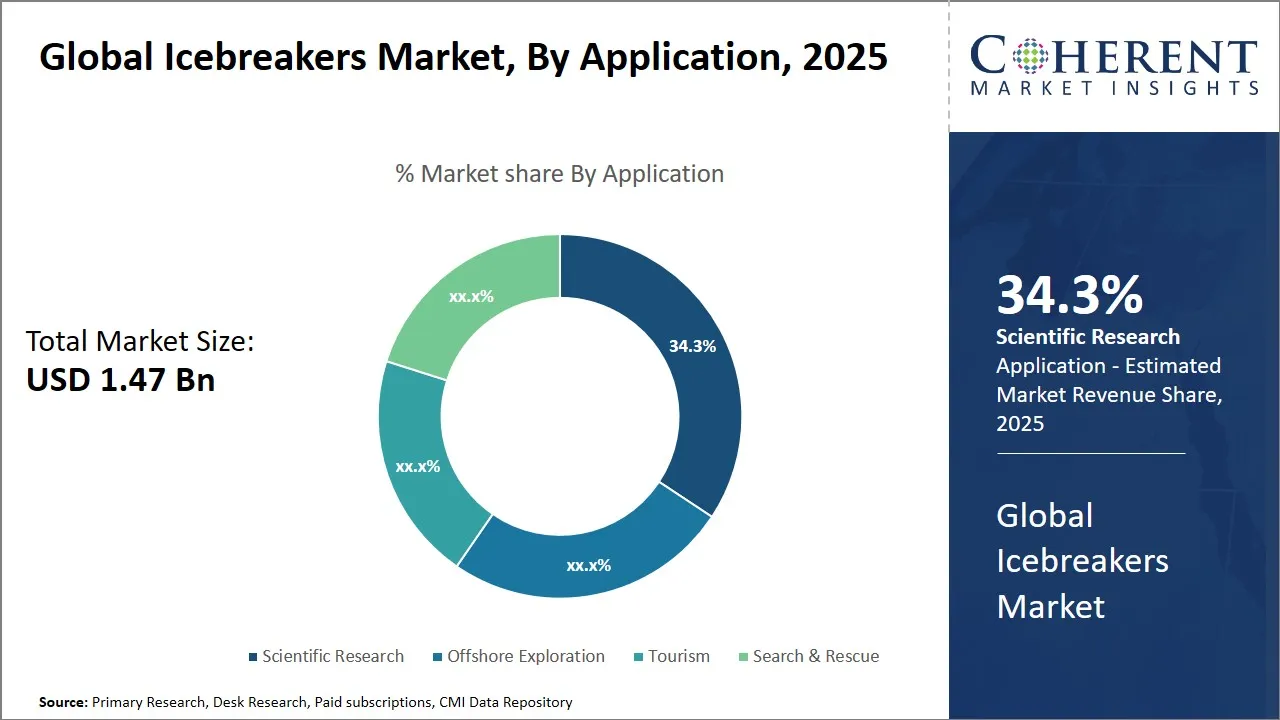
Global Icebreakers Market Insights, by Application - Scientific Research Leads Owing to Increasing Polar Exploration and Climate Studies
Scientific research is expected to contribute the highest share of 35.3% in the global icebreakers market in 2026. As climate change accelerates, understanding polar regions—both the Arctic and Antarctic—has become critical for global scientific communities. Icebreakers are indispensable in facilitating access to these harsh, ice-covered environments, enabling researchers to conduct vital studies on glacial dynamics, marine ecosystems, and atmospheric conditions.
The demand for icebreakers within scientific research is further amplified by the expansion of multidisciplinary expeditions aimed at monitoring melting ice sheets, sea ice variability, and its consequent impact on global sea levels. Governments and environmental organizations across the world are increasingly allocating resources toward these initiatives, necessitating reliable vessels capable of navigating through thick Arctic and Antarctic ice. These vessels provide not only transportation but also serve as floating laboratories equipped with advanced instrumentation for real-time data acquisition, supporting research in oceanography, biology, and geology.
Technological advancements in icebreaker design, including improved icebreaking capabilities and enhanced onboard research facilities, have also contributed to the segment's growth. Modern research icebreakers offer greater endurance, safety, and operational efficiency, enabling longer missions and more comprehensive scientific campaigns. This has made icebreaker-supported research more feasible and productive, attracting interest from academic institutions, government research bodies, and international collaborations.
Additionally, geopolitical factors surrounding polar sovereignty and natural resource management encourage continued scientific presence in these regions, further sustaining the demand for icebreakers. Scientific research missions in ice-covered waters often serve dual purposes of data gathering and asserting territorial claims, intertwining scientific objectives with strategic interests.
Price Analysis of the Icebreakers Market
Icebreaker Type/Project | Estimated Unit Cost |
Russian Project 22220 Nuclear Icebreaker | USD 1.16 Bn (first unit, 2012) |
Subsequent Project 22220 Units | USD 1.2–1.5 Bn |
Canadian Polar Icebreaker (2 units) | USD 7.25 Bn total (~USD 3.6 Bn each) |
U.S. Polar Security Cutter (PSC) – Contract | USD 746 Mn (builder) up to USD 1.9 Bn (with options) |
U.S. PSC – CBO Total Lifecycle Cost (3 ships) | USD 5.1 Bn (build) + USD 12.4 Bn (O&S) |
Commercial “Aiviq”-type Lease/Conversion (medium-class) | ~USD 1 Bn per vessel |
Norwegian/Estonian MSV Botnica (multipurpose diesel-electric) | USD 54 Mn |
German River Icebreaker “Frankfurt” | USD 4.5 Mn |
Norwegian NoCGV Svalbard (offshore patrol/icebreaker) | USD 67 Mn |
Regional Insights
North America Icebreakers Market Analysis and Trends
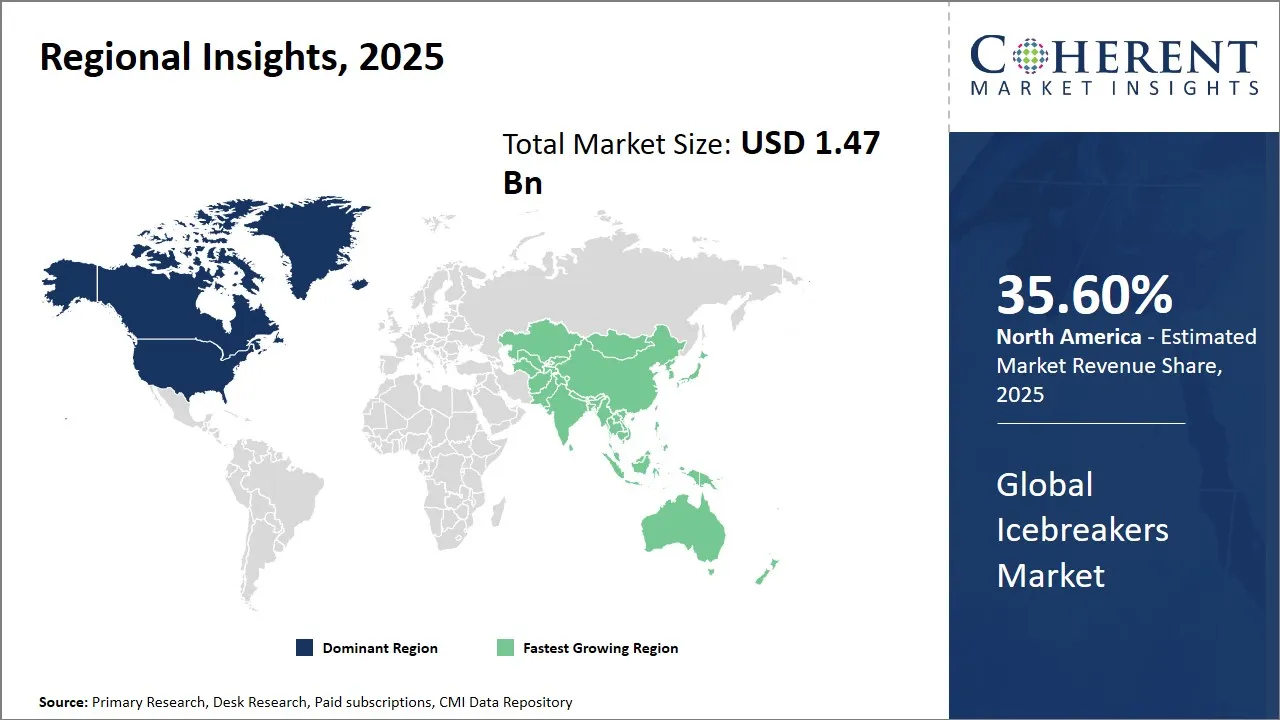
North America, holding a share of 35.6% in 2026, is expected to dominate the global icebreakers market, driven by growing strategic interests in the Arctic, increased maritime traffic, and large-scale governmental investments in fleet renewal. The U.S. and Canada are prioritizing icebreaker capabilities to ensure sovereignty, enable Arctic logistics, and support scientific missions in increasingly navigable polar waters. Government programs such as the U.S. Coast Guard’s Polar Security Cutter initiative, which awarded a USD 745 million contract to Halter Marine for constructing next-generation heavy icebreakers, exemplify this commitment.
Canada’s National Shipbuilding Strategy also supports the development of Arctic-class vessels, enhancing operational readiness. North America’s industrial base, including major players like General Dynamics and Chantier Davie Canada Inc., contributes to domestic innovation in ice-strengthened design and polar-capable propulsion systems. These efforts are further strengthened by trilateral Arctic cooperation with allies and private sector involvement in dual-use commercial and defense-oriented icebreaker platforms.
Asia Pacific Icebreakers Market Analysis and Trends
The Asia Pacific region, holding a share of 22.1% in 2026, is projected to exhibit the fastest growth in the global icebreakers market due to increasing geopolitical focus on Arctic routes and enhanced trade ambitions. Countries like China, Japan, and South Korea are investing heavily to develop and expand their icebreaker fleets both for scientific research and commercial shipping purposes. The region benefits from dynamic shipbuilding industries with advanced technological know-how and strong governmental incentives supporting maritime security and polar exploration.
Notably, China’s aggressive push into polar activities and icebreaker research has catalyzed substantial market growth, backed by state funding and a growing maritime ecosystem. Companies such as China State Shipbuilding Corporation (CSSC), Hyundai Heavy Industries, and Mitsui E&S Holdings play pivotal roles by delivering technologically sophisticated vessels that meet stringent ice-class requirements. China National Nuclear Corporation (CNNC), in collaboration with China State Shipbuilding Corporation (CSSC), is currently developing first domestically developed nuclear-powered icebreaker, which will be the world’s first non-Russian civilian nuclear icebreaker.
Global Icebreakers Market Outlook for Key Countries
Finland Icebreakers Market Analysis and Trends
Finland icebreakers market is highly advanced, underpinned by the expertise of industry stalwarts such as Aker Arctic Technology Inc. and Arctech Helsinki Shipyard. The Finnish government’s commitment to Arctic research and sustainable shipping has led to the development of next-generation icebreakers equipped with cutting-edge propulsion and environmental technologies. Finland’s ecosystem is marked by strong public-private partnerships that drive continuous innovation, enabling Finnish companies to export icebreaker technology worldwide, securing the country’s role as a global leader.
Russia Icebreakers Market Analysis and Trends
Russia continues to lead the global icebreakers market due to its enormous geographic expanse across Arctic waterways and strategic imperative to maintain sovereignty in the polar region. The Russian government heavily invests in building and modernizing nuclear-powered icebreakers through major state-owned enterprises such as Atomflot and United Shipbuilding Corporation. Russia’s large icebreaker fleet supports the Northern Sea Route, fostering trade and natural resource exploitation.
China Icebreakers Market Analysis and Trends
China icebreakers market is rapidly evolving, driven by the country’s ambitions to expand its presence in the Arctic for scientific, commercial, and strategic advantages. Supported by government funding, Chinese shipyards such as CSSC and China Shipbuilding Industry Corporation (CSIC) are advancing technologically to design and construct powerful icebreakers tailored for harsh polar conditions.
South Korea Icebreakers Market Analysis and Trends
South Korea’s contribution to the global icebreakers market stems from its prominent shipbuilding clusters and advanced maritime technology firms like Hyundai Heavy Industries, Daewoo Shipbuilding & Marine Engineering, and Samsung Heavy Industries. The government’s support for innovation in polar vessel technology and export-oriented strategies has positioned South Korea as a key supplier of icebreakers with sophisticated capabilities.
U.S. Icebreakers Market Analysis and Trends
The U.S. icebreakers market is shaped largely by strategic naval and scientific interests in polar regions. The U.S. Coast Guard plays a major role in icebreaker operations and procurement, commissioning vessels capable of both military and research functions. Significant contributions come from private contractors such as VT Halter Marine and Ingalls Shipbuilding, along with active policy leadership focused on securing Arctic and Antarctic maritime domains.
Market Players, Key Developments, and Competitive Intelligence
Key Developments
- In May 2025, Aker Arctic, a leading company specialized in the design of icebreakers and ice-going vessels, acquired Bluetech, its Finnish long-time ship design partner, to meet the growing demand for icebreakers. Both companies continue to operate under their own brands.
- In March 2025, Davie, which owns the Helsinki Shipyard, signed an agreement with the Canadian government to construct a heavy icebreaker. The new vessel will be based on Davie’s advanced Polar Max icebreaker, created by the Helsinki Shipyard basing on Aker Arctic’s original Aker ARC 148 hull form.
- In November 2024, the Honorable Jean-Yves Duclos, Minister of Public Services and Procurement and Quebec Lieutenant, joined by Mr. Alejandro Mayorkas, U.S. Secretary of Homeland Security, and Wille Rydman, Finland’s Minister of Economic Affairs, signed a joint Memorandum of Understanding to establish the Icebreaker Collaboration Effort (ICE Pact). This partnership will enhance industry collaboration among these countries, coordinate expertise, and strengthen their abilities to produce best-in-class polar vessels, including icebreakers.
- In October 2024, as part of a Russian-Chinese joint venture, NewNew Shipping Line announced plans to construct five Arc7 ice-class container ships. The vessels will be deployed on the Arctic Express route connecting Chinese ports of Shanghai and Ningbo with St. Petersburg and Arkhangelsk.
Top Strategies Followed by the Icebreakers Market Players
- Established companies dominate the industry by heavily investing in research and development (R&D) to innovate and produce high-performance icebreaking vessels that meet the rigorous demands of polar and harsh sea conditions.
- Russia’s United Shipbuilding Corporation (USC) have made heavy R&D investments into next-generation nuclear-powered icebreakers (e.g., Project 10510 “Leader-class”).
- Mid-level players in the icebreakers market adopt a different approach that centers around offering cost-effective yet dependable products catering to price-sensitive customers such as smaller shipping companies and regional governments.
- Damen Shipyards offers modular, diesel-electric ice-capable support vessels with shorter build timelines and lower capex.
- Small-scale players carve out their niche within the global icebreakers market by focusing on specialized features or highly innovative products that cater to specific operational needs or regional requirements.
- Aker Arctic Technology Inc. specializes in icebreaker design, simulation services, and testing, rather than shipbuilding. It provides custom hull optimization, model testing in ice tanks, and polar logistics consulting.
Market Report Scope
Icebreakers Market Report Coverage
| Report Coverage | Details | ||
|---|---|---|---|
| Base Year: | 2025 | Market Size in 2026: | USD 1.54 Bn |
| Historical Data for: | 2020 To 2024 | Forecast Period: | 2026 To 2033 |
| Forecast Period 2026 to 2033 CAGR: | 5.1% | 2033 Value Projection: | USD 2.19 Bn |
| Geographies covered: |
| ||
| Segments covered: |
| ||
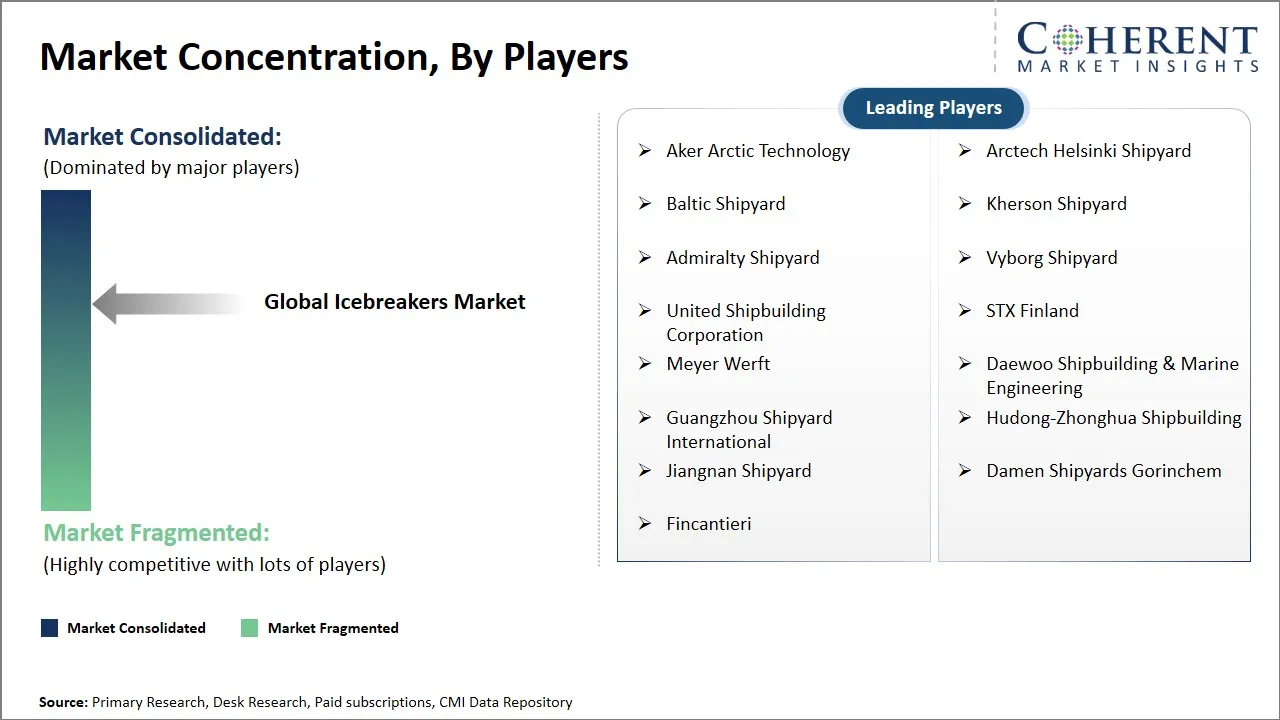
| Companies covered: | Aker Arctic Technology, Arctech Helsinki Shipyard, Baltic Shipyard, Kherson Shipyard, Admiralty Shipyard, Vyborg Shipyard, United Shipbuilding Corporation, STX Finland, Meyer Werft, Daewoo Shipbuilding & Marine Engineering, Guangzhou Shipyard International, Hudong-Zhonghua Shipbuilding, Jiangnan Shipyard, Damen Shipyards Gorinchem, and Fincantieri | ||
| Growth Drivers: |
| ||
| Restraints & Challenges: |
| ||
Market Dynamics
Global Icebreakers Market Driver – Expansion of Arctic Shipping Eoutes
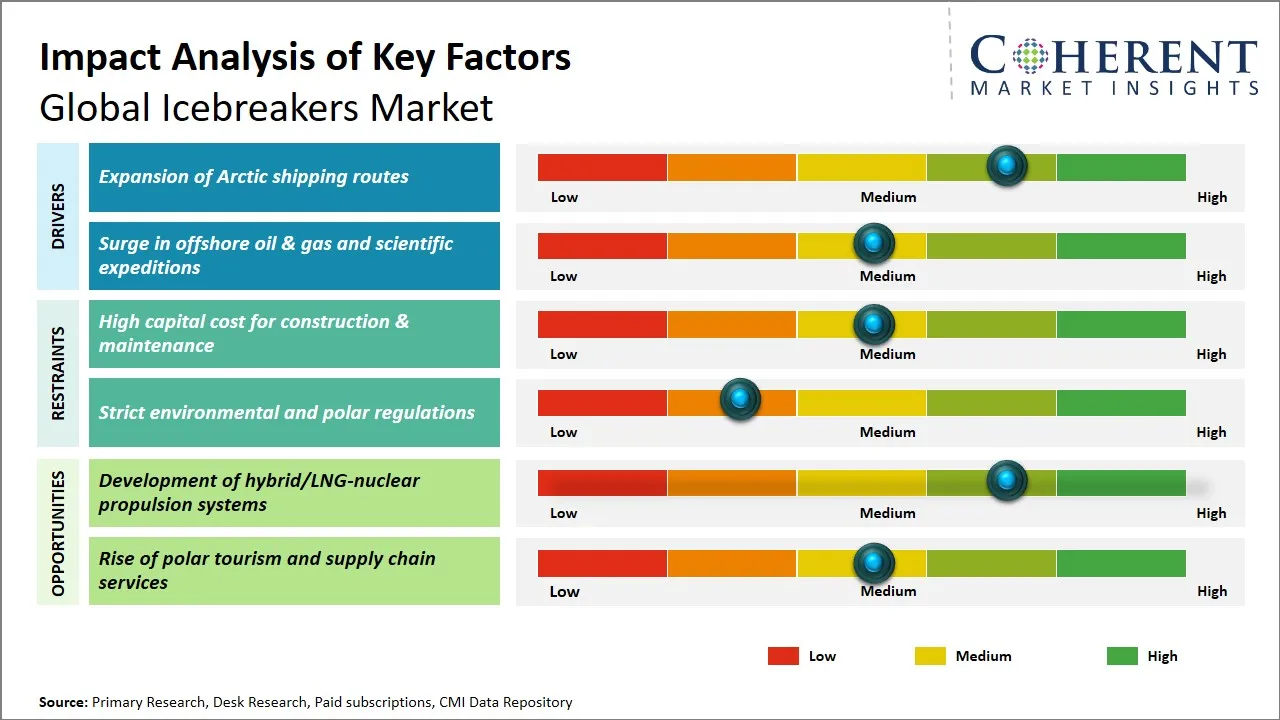
As climate change accelerates the melting of sea ice in the Arctic region, previously inaccessible maritime pathways such as Russia’s Northern Sea Route (NSR) are becoming increasingly navigable for extended periods each year. This transformative shift offers shipping companies reduced transit times between major markets in Europe, Asia Pacific, and North America, enhancing trade efficiency and cost-effectiveness. In 2023–2024, cargo traffic on the NSR reached an all-time high of 36.254 million tons, with over 2,900 voyages. However, navigating these icy waters remains inherently challenging, prompting a rising need for advanced icebreaker vessels capable of ensuring safe passage through hazardous frozen conditions.
Additionally, the growth in resource exploration and extraction activities, including oil, gas, and minerals in the Arctic, further amplifies the reliance on icebreaker fleets for logistical support and escort services. Governments and private stakeholders are investing heavily in the modernization and expansion of their icebreaking capabilities.
Global Icebreakers Market Opportunity – Development of Hybrid/LNG-Nuclear Propulsion Systems in the Global Icebreakers Market
As environmental regulations become increasingly stringent and the demand for sustainable maritime operations grows, icebreaker operators and manufacturers are actively seeking propulsion systems that reduce emissions and improve fuel efficiency while delivering the robustness required for polar conditions. Hybrid propulsion systems leveraging Liquefied Natural Gas (LNG) offer a cleaner alternative to traditional heavy fuel oils by reducing sulfur oxides (SOx), nitrogen oxides (NOx), and carbon dioxide (CO2) emissions.
Meanwhile, nuclear propulsion stands out due to its unmatched endurance and power output, enabling icebreakers to operate for extended periods in remote polar regions without frequent refueling stops. The fusion of these technologies—combining the low emission benefits of LNG with the high energy density and reliability of nuclear power—can revolutionize icebreaker performance, lowering operational costs and environmental impact. China National Nuclear Corporation (CNNC) and China State Shipbuilding Corporation (CSSC) are currently designing a hybrid-powered icebreaker using nuclear propulsion for core endurance and electric/LNG systems for modular efficiency during lower-demand operations.
Analyst Opinion (Expert Opinion)
- North America—particularly the U.S. and Canada—is undergoing a pivotal strategic shift as Arctic accessibility rises. With melting ice unlocking shipping lanes and natural resources, governments are pouring billions into new polar-class vessels. The U.S.’s USD 8.6 Bn investment in icebreaker procurement and Canada’s twin-fleet project underscore a renewed sense of urgency. However, domestic production delays and workforce constraints are pushing both countries to seek collaborative builds (e.g., with Finnish yards), signaling a move toward cross-border industrial cooperation to close capability gaps.
- While North America and Russia dominate the headlines, Asia Pacific—particularly China—is advancing a long-term polar strategy. Through infrastructure development along the "Polar Silk Road," China is diversifying energy routes and investing in nuclear-powered icebreakers. These developments aren’t purely scientific; they’re deeply tied to economic and geopolitical ambitions. The emergence of hybrid-propulsion designs in China also points to a growing focus on technological parity with the West and Russia.
- Europe remains a hub for cutting-edge icebreaker design (e.g., Aker Arctic, Helsinki Shipyard), but policy-driven constraints—especially related to emissions (e.g., EU Green Deal, CBAM)—are both a challenge and a differentiator. These regulations are forcing innovation in low-emission, modular, and multi-role vessels, helping European players stay competitive in eco-conscious government contracts.
Speak to the analyst
Want personalized insights?
Take the findings above to one of our principal consultants, or have the report rebuilt around the segments, geographies and competitors you actually track.
Market Segmentation
- Application Insights (Revenue, USD Bn, 2021 - 2033)
- Scientific Research
- Offshore Exploration
- Tourism
- Search & Rescue
- Regional Insights (Revenue, USD Bn, 2021 - 2033)
- North America
- U.S.
- Canada
- Latin America
- Brazil
- Argentina
- Mexico
- Rest of Latin America
- Europe
- Germany
- U.K.
- Spain
- France
- Italy
- Russia
- Rest of Europe
- Asia Pacific
- China
- India
- Japan
- Australia
- South Korea
- ASEAN
- Rest of Asia Pacific
- Middle East
- GCC Countries
- Israel
- Rest of Middle East
- Africa
- South Africa
- North Africa
- Central Africa
- North America
- Key Players Insights
- Aker Arctic Technology
- Arctech Helsinki Shipyard
- Baltic Shipyard
- Kherson Shipyard
- Admiralty Shipyard
- Vyborg Shipyard
- United Shipbuilding Corporation
- STX Finland
- Meyer Werft
- Daewoo Shipbuilding & Marine Engineering
- Guangzhou Shipyard International
- Hudong-Zhonghua Shipbuilding
- Jiangnan Shipyard
- Damen Shipyards Gorinchem
- Fincantieri
Sources
Primary Research Interviews
Stakeholders
- Navy Procurement Officers and Maritime Logistics Planners
- Polar Research Institutes (e.g., Arctic Research Centre, Indian National Centre for Polar and Ocean Research)
- Shipbuilding Engineers and Naval Architects specializing in ice-class vessels
- Shipyard Operators and Arctic Vessel Maintenance Contractors
- Arctic Shipping Route Authorities and Port Management Officials
- Sustainability Officers focused on decarbonization in marine propulsion
Databases
- U.S. Census
- Arctic Maritime Statistics Bureau (AMSB)
- Oceanic Trade & Logistics Database (OTLD)
- OECD
Magazines
- Maritime Executive Review
- Polar Shipping & Ice Class Vessels Quarterly
- Naval Engineering & Shipbuilding Digest
- Icebreaker Technology Today
Journals
- Journal of Arctic Maritime Operations
- Journal of Naval Architecture and Ocean Engineering
- Polar Engineering and Ice Navigation Journal
- Journal of Sustainable Marine Transportation
Newspapers
- Arctic Times Global
- Naval Construction Daily
- The Maritime Standard (Asia-Pacific Edition)
- The Economic Times (India)
Associations
- International Association of Arctic Maritime Operators (IAAMO)
- Canadian Polar Ice Navigation Society (CPINS)
- United States Naval Engineering Association (USNEA)
- International Federation of Polar Researchers (IFPR)
- American Society of Naval Engineers (ASNE)
Public Domain Sources
- U.S. Census Bureau
- EUROSTAT
- United Nations Economic Commission for Europe (UNECE)
- World Bank
- ResearchGate
Proprietary Elements
- CMI Data Analytics Tool, Proprietary CMI Existing Repository of Information for the Last 8 Years
Get access to 250+ pages report
Every segment, forecast, competitor profile and data table behind the analysis above — available for instant download.
- ESOMAR Member
- ISO 9001:2015 Certified
- D-U-N-S Registered
- GDPR & CCPA Compliant
Missing comfort of reading report in your local language? Find your preferred language:
Transform your Strategy with Exclusive Trending Reports
Frequently Asked Questions
The global icebreakers market is estimated to be valued at USD 1.54 billion in 2026 and is expected to reach USD 2.19 billion by 2033.
The CAGR of global icebreakers market is projected to be 5.1% from 2026 to 2033.
Expansion of Arctic shipping routes and surge in offshore oil & gas and scientific expeditions are the major factors driving the growth of the global icebreakers market.
High capital cost for construction & maintenance and strict environmental and polar regulations are the major factors hampering the growth of the global icebreakers market.
In terms of application, scientific research is estimated to dominate the market revenue share in 2026.
Climate change is increasing demand for icebreakers as melting polar ice expands seasonal access to Arctic routes, necessitating more vessels for navigation safety, scientific research, and environmental monitoring.
Yes, icebreakers can support commercial shipping, especially along the Northern Sea Route and Northwest Passage, by escorting cargo vessels through partially frozen waters and ensuring uninterrupted maritime transit in polar regions.