

Global IoT in Agriculture Market Size and Forecast – 2026-2033
The Global IoT in Agriculture Market is estimated to be valued at USD 32.08 Bn in 2026 and is expected to reach USD 57.52 Bn by 2033, exhibiting a compound annual growth rate (CAGR) of 8.7% from 2026 to 2033.
Key Takeaways of the Global IoT in Agriculture Market
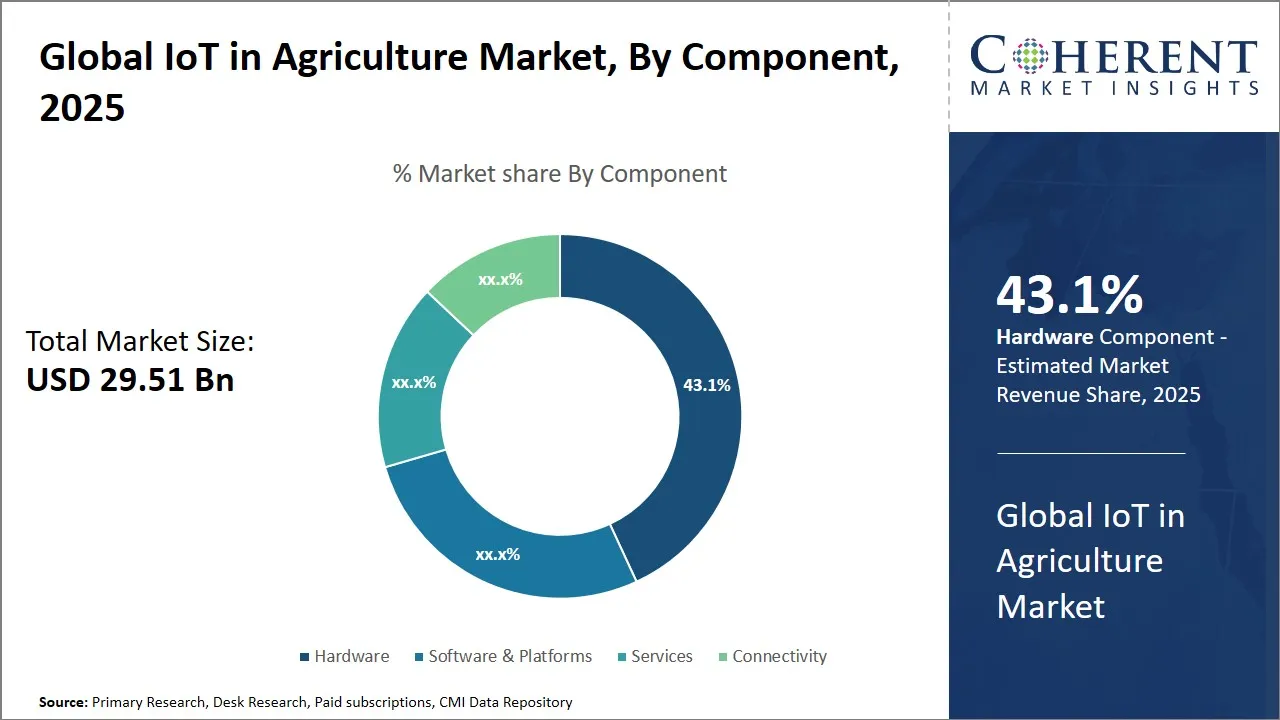
- The hardware segment leads the market holding an estimated share of 44.1% in 2026.
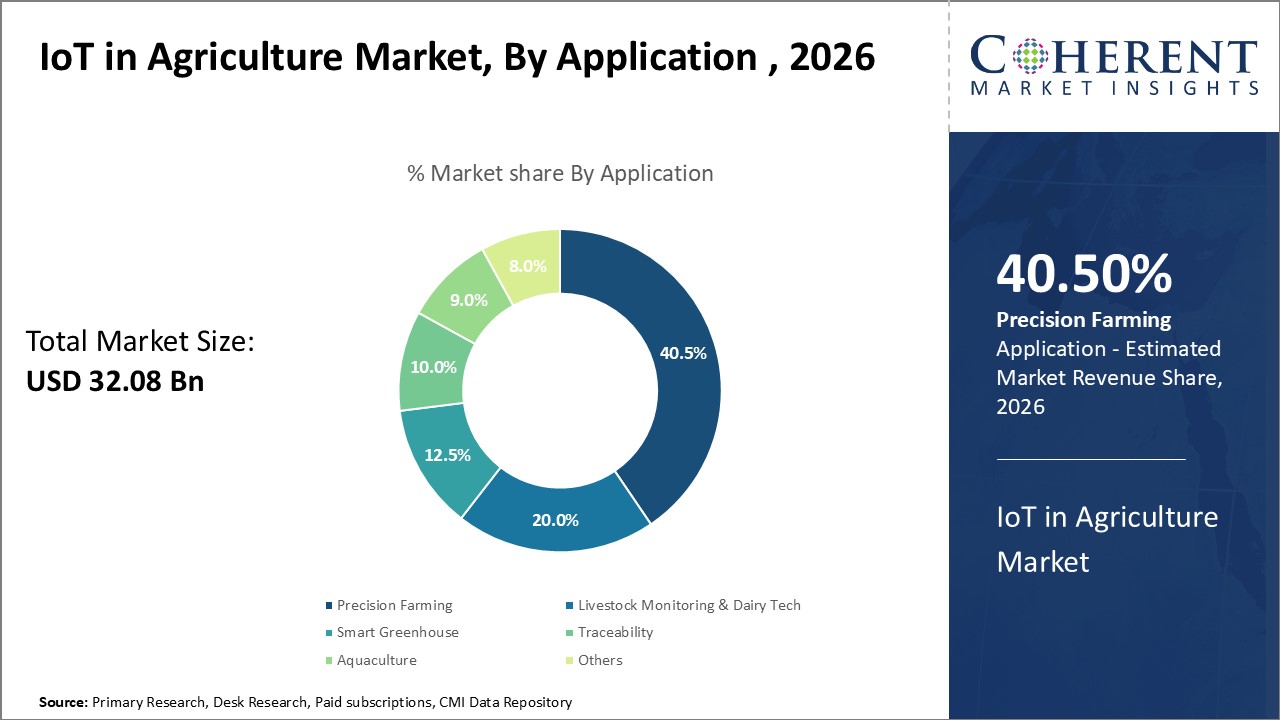
- The precision farming segment is expected to dominate with a share of 40.5% in 2026.
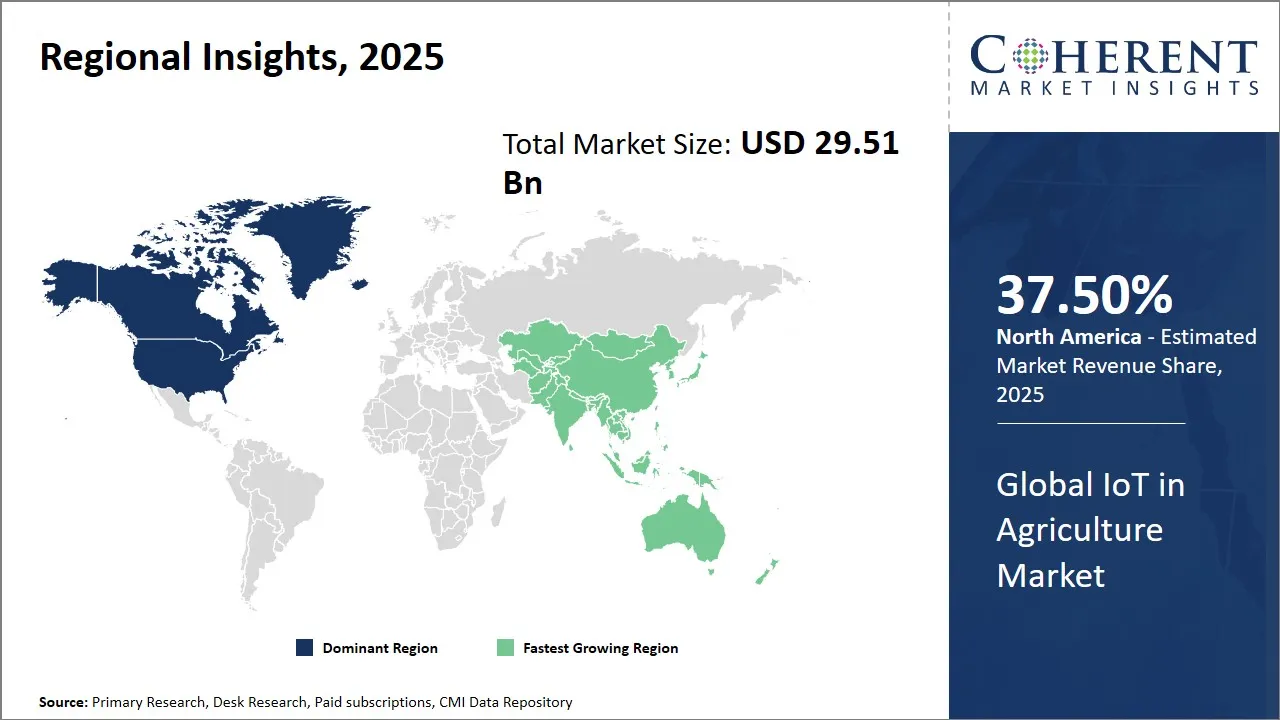
- North America, holding a share of 37.5% in 2026, is projected to dominate the market.
- Asia Pacific, holding an estimated share of 29.3% in 2026, shows the fastest growth in the market.
Market Overview
The market is seeing the use of advanced IoT solutions such as sensors, drones, and data analytics platforms, which enable real-time monitoring and automation in farming operations. Also, the emphasis on sustainability and the adoption of climate-smart agriculture practices are driving innovation. The growing penetration of connectivity in rural areas further adds to the expansion of IoT applications, making agriculture more data-driven and efficient globally.
Current Events and Its Impact
Current Events | Description and its impact |
Geopolitical and Trade Developments |
|
Economic and Infrastructure Trends |
|
Segmental Insights
- Current Industry Events of 2026
- Market Size Estimation
- Regional Breakdown
- Competitive Landscape
- Customer Intelligence
- Segmental Analysis
- Pricing Analysis
- Key Market Drivers, Challenges & Future Trends
- Customized Insights Section
Global IoT in Agriculture Market Insights, By Component – Hardware Leads Owing to Increasing Demand for Advanced Sensing and Data Acquisition Technologies
The hardware segment—projected to hold 44.1% of the global IoT in agriculture market in 2026—leads because it forms the core data-collection layer of smart farming. Devices such as sensors, actuators, GPS units, drones, and livestock wearables gather real-time information on soil conditions, crop health, weather, and animal activity, enabling precise, data-based decisions.
Advancements in LPWAN-compatible, low-cost, and energy-efficient sensors, along with improved miniaturization, have made hardware deployments more scalable, especially in remote fields. Hardware also supports sustainability goals by reducing waste. Also, traceability and food-safety regulations are adding to the adoption of RFID tags and livestock monitoring devices.
John Deere’s See & Spray system, which uses onboard cameras and sensors to detect weeds and apply herbicides only where needed, demonstrates how hardware-driven data acquisition directly lowers chemical use and boosts precision in field operations.
Global IoT in Agriculture Market Insights, By Application – Precision Farming Leads as It is Imperative for Optimizing Crop Yield and Resource Utilization
Precision farming, expected to hold 40.5% of the market in 2026, leads because of its role in maximizing crop yields and minimizing input costs through site-specific management. IoT-enabled tools provide granular insights into soil moisture, nutrient levels, crop stress, and weather variability, allowing optimized irrigation, fertilization, and pest control.
Its growth is driven because of food-security pressures, the need for sustainable resource use, and regulatory demands to limit chemical overuse. The increasing availability of cloud platforms, mobile dashboards, and predictive analytics enables farmers to act on real-time insights remotely. Automation, such as variable-rate seeding and spraying, further adds to efficiency and reduces waste.
CropX’s soil-sensor and irrigation-optimization platform, used across farms in the U.S. and Europe, provides real-time moisture and nutrient data that has been documented to reduce water use by up to 20% while improving crop uniformity.
Pricing Analysis of the IoT in Agriculture Market
Component/Solution | Typical Price (USD) |
GPS Guidance System (Auto-Steering) | USD 5,000 – USD 20,000 |
Yield Monitor | USD 3,000 – USD 5,000 |
Drone (Scouting/Imagery) | USD 2,000 – USD 10,000 |
Basic IoT Sensor (e.g., Soil Moisture) | USD 100+ per sensor |
Complete Sensor Network Setup | USD 5,000 – USD 150,000 |
Monthly Connectivity/Data Transfer (per sensor) | ~ USD 25/month |
Farm-Management/Analytics Software (Subscription) | USD 3 – USD 15 per acre/year (or USD 500 – USD 10,000+ per year) |
One-Time Software License (Farm-Management) | USD 4,950 – USD 10,000+ |
Drone Analytics/Mapping Subscription | USD 500 – USD 1,000/year |
IoT Scale System (Lysimeter/Weighing System) | USD 343.32 |
Application-Level Breakdown
Application Area | Key Functions | Primary Technologies Used | End-User Benefits |
Precision Farming | Soil health tracking, variable rate application, crop growth monitoring | GPS/GNSS, IoT soil sensors, drones, AI analytics, satellite imagery | Higher crop yield, reduced input costs, optimized fertilizer/pesticide use |
Livestock Monitoring | Health tracking, location monitoring, automated feeding, behavior analysis | Wearables, RFID tags, biometric sensors, machine vision, cloud dashboards | Improved herd health, reduced labor, higher productivity, early disease detection |
Smart Irrigation | Automated water control, moisture-level monitoring, pump/valve management | IoT moisture sensors, flow meters, automated controllers, edge computing | Water savings, reduced operational costs, better irrigation scheduling |
Predictive Maintenance | Machinery diagnostics, fault detection, performance analytics, lifecycle monitoring | Vibration sensors, telematics, predictive AI models, onboard diagnostics | Reduced downtime, lower repair costs, longer equipment life |
Climate Monitoring | Weather tracking, microclimate analysis, frost/drought alerts | Weather stations, IoT climate sensors, remote sensing, data analytics | Better farm planning, reduced climate risk, higher crop resilience |
Revenue Breakdown – IoT in Agriculture Market
Segment | 2023 Revenue (USD Bn) | 2024 Revenue (USD Bn) | 2030 Forecast (USD Bn) | CAGR 2024–2030 | Share Trend | Key Value-Chain Shifts |
Hardware (Sensors, Drones, Controllers, Gateways) | 6.8 | 7.4 | 11.2 | ~7.2% | Declining share (from ~52% in 2023 to ~41% in 2030) | Hardware is becoming commoditized; margins shrinking as low-cost sensor makers enter. Growth driven by drone adoption & multi-parameter sensors. |
Software/Analytics Platforms (Farm Mgmt Systems, AI/ML analytics, dashboards) | 4.5 | 5.3 | 13.6 | ~17.3% | Fastest-growing share (from ~34% in 2023 to ~50%+, becoming core monetization layer) | Shift toward SaaS revenue; predictive analytics, yield modelling, and automation orchestration drive recurring revenue dominance. |
Connectivity (Cellular, LPWAN, Satellite IoT, private LTE/5G) | 1.7 | 2.1 | 5.4 | ~16.5% | Moderate but rising share (from ~14% in 2023 to ~19%) | Adoption of NB-IoT/LTE-M, LoRaWAN, and low-Earth-orbit satellite IoT expands coverage in rural zones; telcos & satellite players enter the agri ecosystem. |
Regional Insights
North America IoT in Agriculture Market Analysis and Trends
North America, expected to hold a share of 37.5% in 2026, dominates the global IoT in agriculture market because of the advanced technological infrastructure, early adoption of precision agriculture solutions, and strong use of IoT with data analytics and AI. The region sees a lot of investment in smart farming initiatives, supported by the U.S. and Canada’s government policies aimed at increasing agricultural productivity and sustainability.
A mature ecosystem of IoT device manufacturers, software developers, and system integrators makes a robust market environment. The presence of industry leaders such as John Deere, Trimble Inc., and Raven Industries underscores North America's leadership. These companies pioneer innovations in connected machinery, soil sensors, and crop monitoring systems, allowing farmers to improve operational efficiency and resource management.
Asia Pacific IoT in Agriculture Market Analysis and Trends
The Asia Pacific region, expected to hold a share of 29.3% in 2026, exhibits the fastest growth in the IoT in agriculture market, because of the increasing need to enhance agricultural output for its vast and growing population. Fast modernization of agriculture in countries like China, India, and Australia, along with rising government support for smart farming initiatives and digital infrastructure development, fuels this expansion.
The market ecosystem in Asia Pacific is growing fast, with startups and established companies alike (such as DJI in China and Teralytics in India) developing innovative IoT applications tailored for diverse crop types and climatic conditions. Also, increasing smartphone penetration and affordable IoT sensors have accelerated adoption among small and medium-sized farms in this region. Trade dynamics involving technology transfers and investment inflows from global players also contribute significantly to the market growth.
IoT in Agriculture Market Outlook for Key Countries
U.S. IoT in Agriculture Market Analysis and Trends
The U.S. IoT in agriculture market leads because of a lot of adoption of precision agriculture championed by companies like John Deere and Trimble. Government programs such as the USDA’s Smart Agriculture initiative add to the innovation and the use of IoT solutions like autonomous tractors, drone surveillance, and IoT-enabled irrigation systems. A mature technological infrastructure supports the use of IoT devices with big data analytics, helping optimize yield and resource efficiency on large-scale farms.
China IoT in Agriculture Market Analysis and Trends
China IoT in agriculture market sees strong government backing under its “Digital Agriculture” strategy for improving productivity and monitoring food security. Companies like DJI have improved drone technology for crop surveillance and pesticide application, while firms such as Hikvision are investing a lot in sensor technologies. Fast adoption is propelled by growing smartphone use among farmers and a strong push toward digitizing rural agricultural operation.
India IoT in Agriculture Market Analysis and Trends
India’s agriculture sector is seeing a digital transformation because of IoT applications that address challenges like water management and crop disease monitoring. Startups and tech companies are introducing affordable IoT solutions for smallholder farmers, supported by government initiatives such as Digital India and the National e-Governance Plan. Key Indian players, including Teralytics and CropIn, offer platforms adding IoT with data analytics to improve decision-making for farmers.
Australia IoT in Agriculture Market Analysis and Trends
Australia IoT in agriculture market grows because of the need to maximize efficiency in its huge and often arid agricultural landscapes. Government incentives add to IoT adoption in sectors such as livestock monitoring and water management. Big companies like Agersens and AgriWebb specialize in IoT-enabled livestock tracking and farm management platforms made for the country’s unique agricultural conditions. Australia also benefits from strong export links that encourage technology adoption to meet international quality standards.
Market Players, Key Development, and Competitive Intelligence
Key Developments
- In August 2025, Wipro Ltd., a leading AI-powered technology services and consulting company, entered into an agreement to acquire the Digital Transformation Solutions (DTS) business unit of HARMAN, a Samsung company.
- In August 2025, researchers at Indian Institute of Information Technology Allahabad (IIIT-A) developed CVGG-16, a new and efficient AI-Model to detect crop diseases. The technology allows farmers to detect crop diseases directly in their fields without any oversight from experts.
- In June 2025, The Watercress Company made a significant leap into precision agriculture by investing USD 104,974.8 (£80,000) in three Agras T50 drones—manufactured by DJI in China—each capable of carrying up to 50 kg of fertilizer, seed, or feed, due to four rotary blades.
- In January 2024, John Deere selected SpaceX’s Starlink for its agricultural connectivity solution, after a long RFP process with the satellite industry. The satcom solution will connect both new and existing machines through satellite internet service and terminals.
Top Strategies Followed by IoT in Agriculture Market Players
- Established players, often global giants with substantial resources, focus a lot on research and development (R&D) to make high-performance, reliable, and scalable IoT solutions made for varied agricultural applications.
- In its 2023 data book, Deere reported over USD 2,177 million spent on R&D to build precision-ag systems, alternative power (hybrid/electric), and autonomous machines.
- Mid-level players in the IoT agriculture sector adopt a balanced approach by offering cost-effective solutions that address the needs of price-sensitive customers without compromising on key performance metrics.
- Solinftec is a Brazilian ag-tech firm that offers lower-cost connectivity and automation. For instance, it offers SolinfNet, a proprietary low-cost network for remote farm telemetry in areas lacking conventional connectivity.
- Small-scale players carve out their market niches by focusing on specialized features or highly innovative products designed to address specific challenges within the agricultural value chain.
- Nofence is a Norwegian company that makes solar-powered GPS collars for livestock to implement virtual fencing.
Market Report Scope
IoT in Agriculture Market Report Coverage
| Report Coverage | Details | ||
|---|---|---|---|
| Base Year: | 2025 | Market Size in 2026: | USD 32.08 Bn |
| Historical Data for: | 2020 To 2024 | Forecast Period: | 2026 To 2033 |
| Forecast Period 2026 to 2033 CAGR: | 8.7% | 2033 Value Projection: | USD 57.52 Bn |
| Geographies covered: |
| ||
| Segments covered: |
| ||
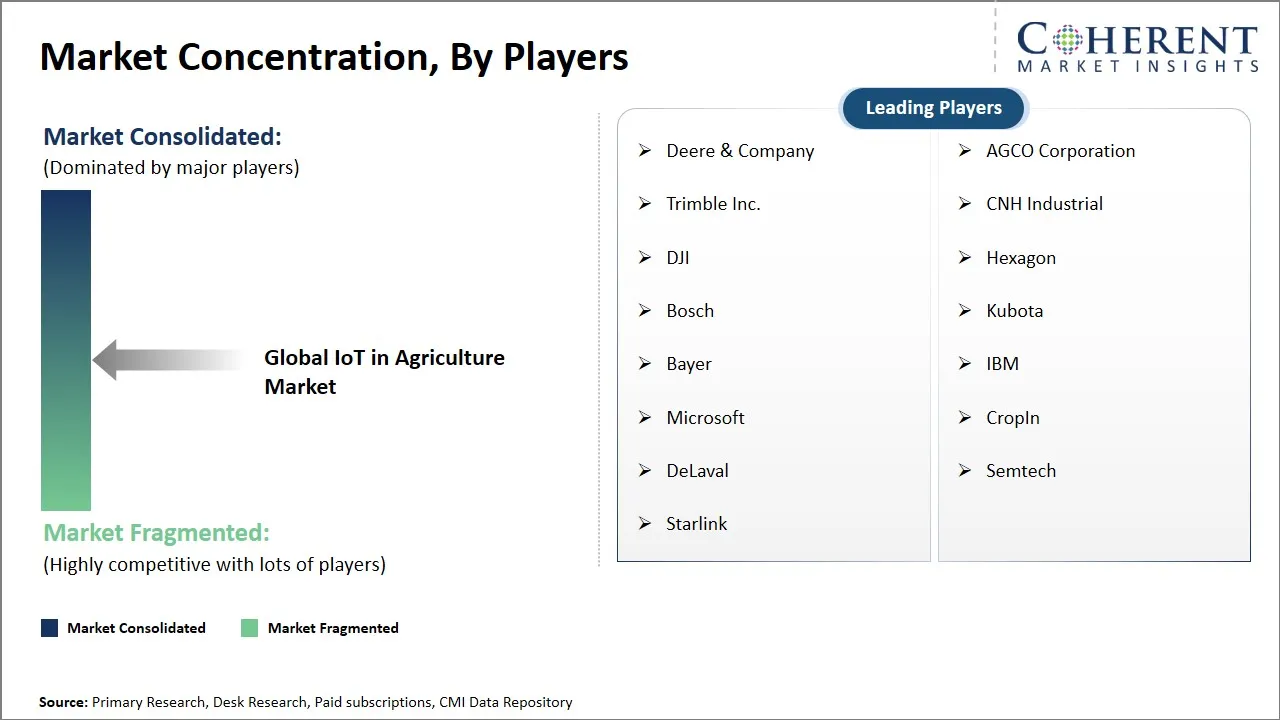
| Companies covered: | Deere & Company, AGCO Corporation, Trimble Inc., CNH Industrial, DJI, Hexagon, Bosch, Kubota, Bayer, IBM, Microsoft, CropIn, DeLaval, Semtech, and Starlink | ||
| Growth Drivers: |
| ||
| Restraints & Challenges: |
| ||
Market Dynamics
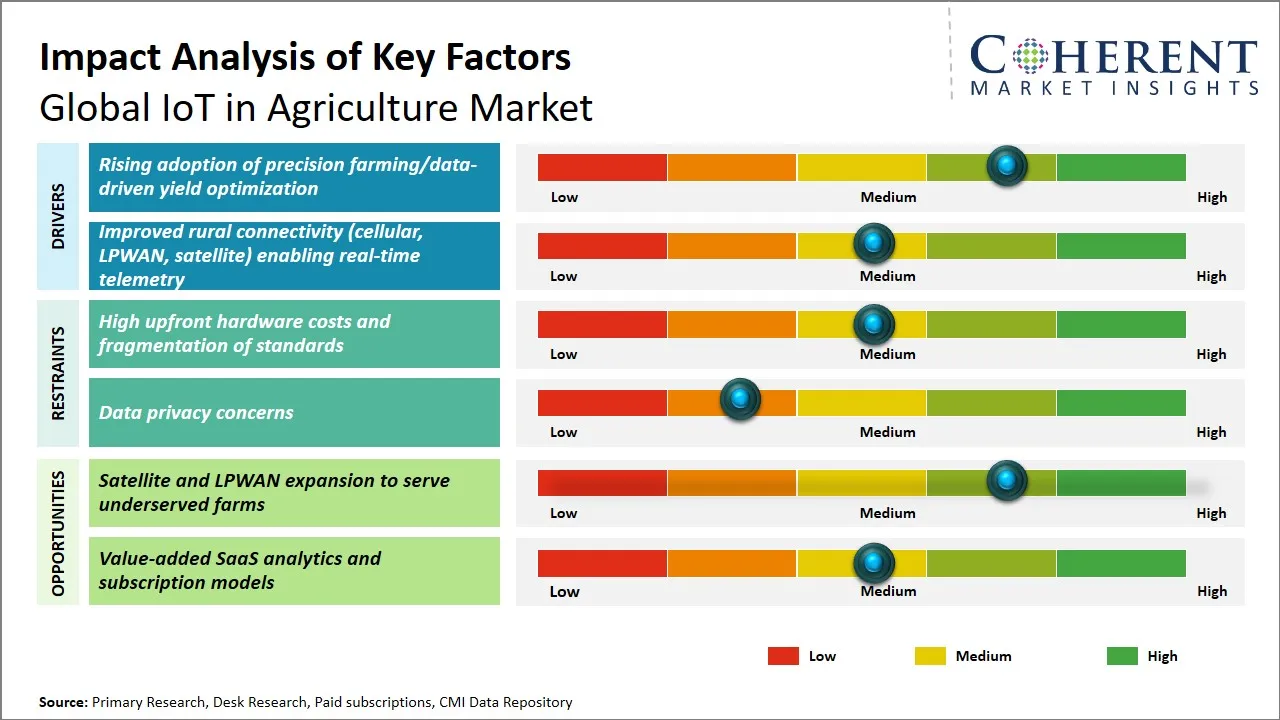
Global IoT in Agriculture Market Driver – Rising Adoption of Precision Farming/Data-Driven Yield Optimization
The rapid adoption of precision farming is a major growth driver, as farmers increasingly use IoT devices—sensors, drones, GPS units—to collect real-time data on soil, crop health, and weather. This data enables accurate input management, predictive analytics for pest/disease risks, and improved yield and resource efficiency. The economic value from reduced waste and higher productivity is accelerating global adoption of IoT-enabled precision agriculture.
John Deere’s Operations Center adds data from thousands of connected tractors and field sensors to give farmers real-time insights on seeding, spraying, and harvesting, helping optimize yields and input usage across millions of acres globally.
Global IoT in Agriculture Market Opportunity – Satellite and LPWAN Expansion to Serve Underserved Farms
Growing satellite and LPWAN (LoRaWAN, NB-IoT) coverage is expanding IoT adoption in remote and underserved farming regions with limited cellular connectivity. These technologies support low-power, long-range sensors for soil, weather, livestock, and irrigation monitoring, making IoT more accessible and cost-effective for small and rural farms. As satellite costs fall and LPWAN networks expand, IoT solutions become more affordable, unlocking large new user segments.
Swarm (acquired by SpaceX) provides ultra-low-cost satellite IoT connectivity for remote farms, enabling devices like soil sensors, pump controllers, and weather stations to operate far from cellular networks with subscription fees as low as USD 5 per month per device.
Analyst Opinion (Expert Opinion)
- Despite all the hype around IoT-driven smart farming, huge agricultural regions still lack basic, reliable connectivity. This digital divide severely limits IoT penetration, and until satellite & LPWAN ecosystems mature, adoption will continue to be far slower than the industry projects.
- Vendors often oversell precision-ag benefits, but many small and mid-sized farmers struggle to see immediate ROI. High upfront hardware costs, the need for technical skills, and long payback cycles make IoT tools a risky investment. Unless pricing becomes more transparent and value delivery more tangible, hesitancy will persist.
- The IoT agriculture landscape is filled with incompatible sensors, proprietary data platforms, and non-standardized communication protocols. This burdens farmers with multiple dashboards and inconsistent data quality. The market desperately needs ecosystem consolidation and open standards.
Speak to the analyst
Want personalized insights?
Take the findings above to one of our principal consultants, or have the report rebuilt around the segments, geographies and competitors you actually track.
Market Segmentation
- Component Insights (Revenue, USD Bn, 2021 - 2033)
- Hardware
- Software & Platforms
- Services
- Connectivity
- Application Insights (Revenue, USD Bn, 2021 - 2033)
- Precision Farming
- Livestock Monitoring & Dairy Tech
- Smart Greenhouse
- Traceability
- Aquaculture
- Others
- Regional Insights (Revenue, USD Bn, 2021 - 2033)
- North America
- U.S.
- Canada
- Latin America
- Brazil
- Argentina
- Mexico
- Rest of Latin America
- Europe
- Germany
- U.K.
- Spain
- France
- Italy
- Russia
- Rest of Europe
- Asia Pacific
- China
- India
- Japan
- Australia
- South Korea
- ASEAN
- Rest of Asia Pacific
- Middle East
- GCC Countries
- Israel
- Rest of Middle East
- Africa
- South Africa
- North Africa
- Central Africa
- North America
- Key Players Insights
- Deere & Company
- AGCO Corporation
- Trimble Inc.
- CNH Industrial
- DJI
- Hexagon
- Bosch
- Kubota
- Bayer
- IBM
- Microsoft
- CropIn
- DeLaval
- Semtech
- Starlink
Sources
Primary Research Interviews
Stakeholders
- Large-Scale Commercial Farms (e.g., Farm Managers, Agronomists)
- IoT Hardware Manufacturers (e.g., sensor, drone, GPS device makers)
- Precision Agriculture Software Providers
- AgTech Startups specializing in predictive analytics & automation
- Livestock Monitoring System Providers
- Irrigation Equipment Manufacturers integrating IoT controls
- Satellite Connectivity & LPWAN Network Providers
- Agricultural Cooperatives & Farm Advisory Service Providers
- Smart Greenhouse Technology Integrators
- Sustainability & Regenerative Agriculture Consultants
Databases
- AgroData European Farm Statistics Repository
- USDA National Agricultural Statistics Service (NASS)
- AgTech Insights Open Sensor Database
- OECD Agricultural Data Exchange
- Remote Sensing & Crop Health Global Satellite Database
- India Agri-Digital Infrastructure Portal (IADIP)
- FAO Agro-Climate Monitoring Datasets
Magazines
- Precision Farming Today
- Smart Agriculture Review
- Digital Farming Insights Magazine
- Drone & Sensor Technology Monthly
- Global Agri-Innovation Magazine
Journals
- Journal of Precision Agriculture Technology
- International Journal of Smart Farming Systems
- IoT Applications in Agronomy Journal
- Agricultural Data Science & Automation Journal
- Remote Sensing and Smart Irrigation Research Journal
Newspapers
- AgriTech Times
- Farming Technology Daily
- The Agri-Innovation Post
- The Guardian – Agriculture & Environment Section
- The Economic Times – Agri Business Section
Associations
- International Society of Precision Agriculture (ISPA)
- Global AgTech Alliance (GATA)
- Smart Farming Network (SFN)
- Association for Unmanned Farm Systems (AUFS)
- International Irrigation & Sensor Technology Association (IISTA)
Public Domain Sources
- USDA Economic Research Service (ERS)
- EUROSTAT Agriculture Statistics
- World Bank – Agriculture & Rural Development
- United Nations Food and Agriculture Organization (FAO)
- ResearchGate Open Agricultural Research Papers
- UNECE Agricultural Trade and Technology Reports
Proprietary Elements
- CMI Data Analytics Tool, Proprietary CMI Existing Repository of information for last 8 years
Get access to 250+ pages report
Every segment, forecast, competitor profile and data table behind the analysis above — available for instant download.
- ESOMAR Member
- ISO 9001:2015 Certified
- D-U-N-S Registered
- GDPR & CCPA Compliant
Missing comfort of reading report in your local language? Find your preferred language:
Transform your Strategy with Exclusive Trending Reports
Frequently Asked Questions
The global IoT in agriculture market is estimated to be valued at USD 32.08 billion in 2026 and is expected to reach USD 57.52 billion by 2033.
The CAGR of global IoT in agriculture market is projected to be 8.7% from 2026 to 2033.
Rising adoption of precision farming/data-driven yield optimization and improved rural connectivity (cellular, LPWAN, satellite) enabling real-time telemetry are the major factors driving the growth of the global IoT in agriculture market.
High upfront hardware costs and fragmentation of standards and data privacy concerns are the major factors hampering the growth of the global IoT in agriculture market.
Yes, though many platforms are becoming more user-friendly to reduce complexity.
They enable aerial monitoring, crop imaging, and mapping for precise field insights.
In terms of component, hardware is estimated to dominate the market revenue share in 2026.