

Global Live Traffic Camera Market Size and Forecast – 2026-2033
The global live traffic camera market is estimated to be valued at USD 5.27 Bn in 2026 and is expected to reach USD 9.89 Bn by 2033, exhibiting a compound annual growth rate (CAGR) of 9.4% from 2026 to 2033.
Key Takeaways of the Global Live Traffic Camera Market
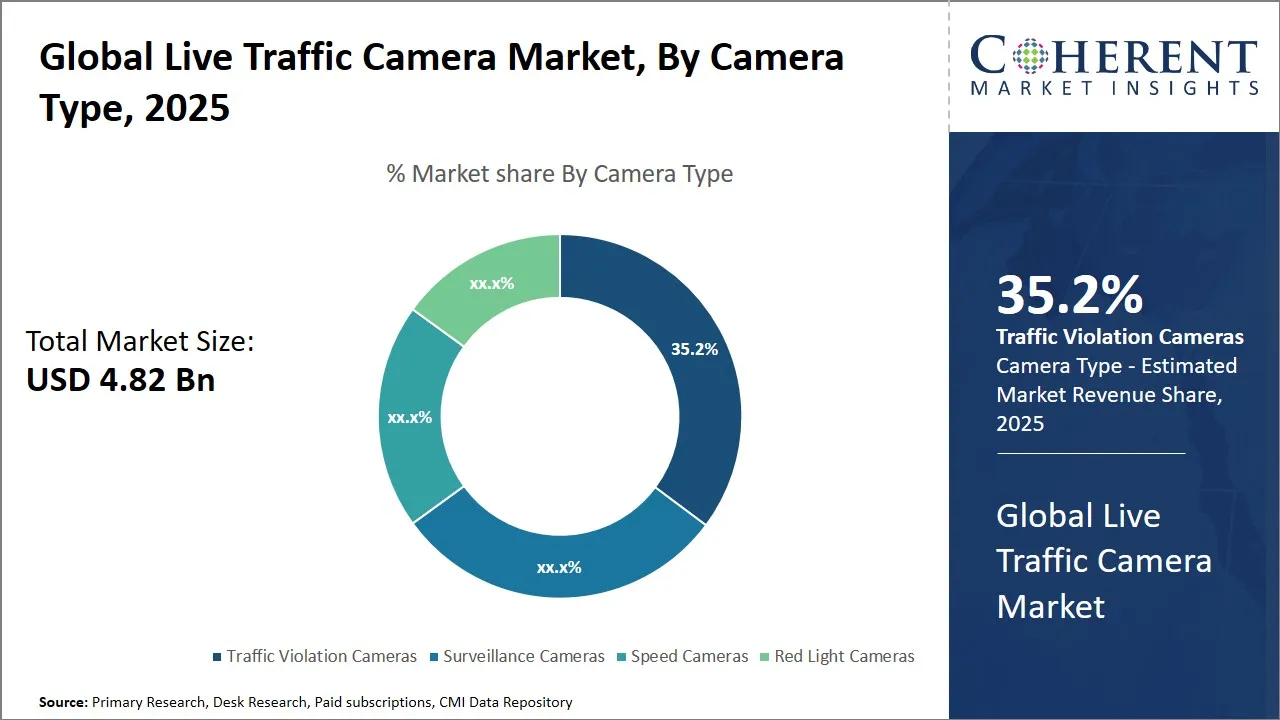
- The traffic violation cameras segment leads the market holding an estimated share of 36.2 % in 2026.
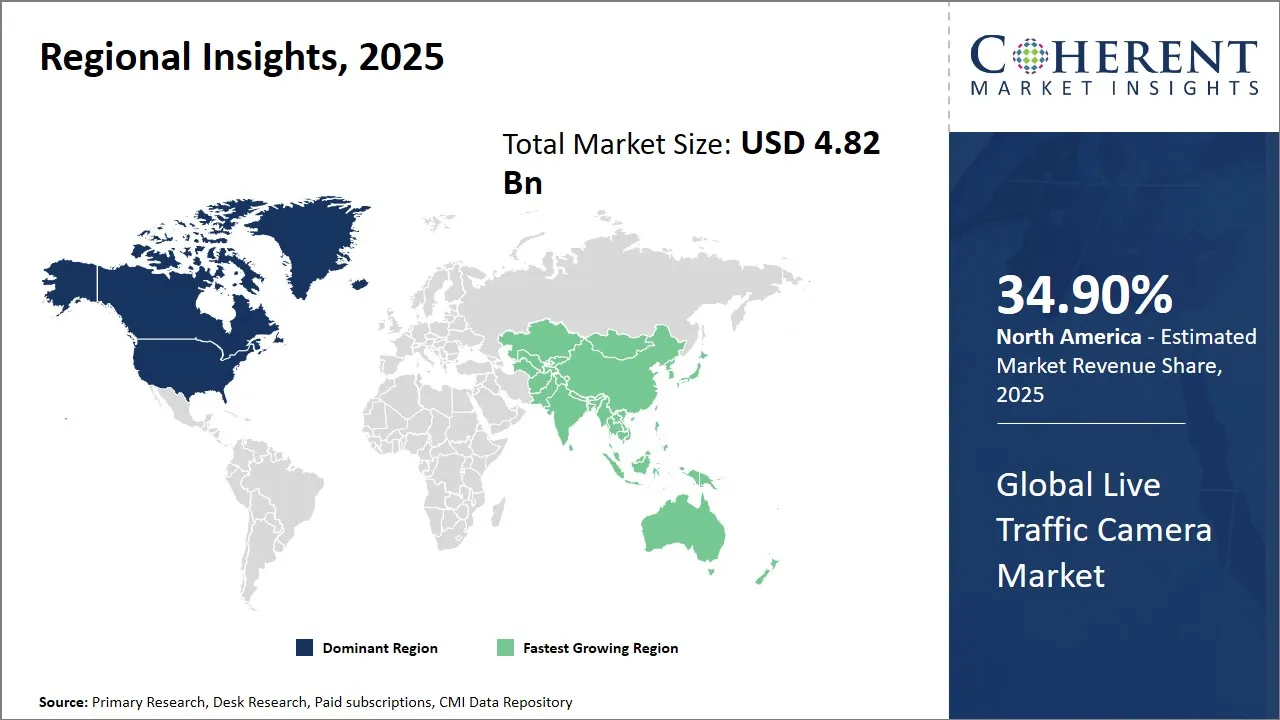
- North America is estimated to lead the market with a share of 34.9 % in 2026.
- Asia Pacific, holding a share of 30.3 % in 2026, and it is projected to be the fastest growing region.
Market Overview
The market is seeing the integration of AI and IoT technologies, allowing improved traffic analytics and predictive capabilities. Also, growing congestion in metropolitan areas adds to the need for advanced traffic management systems, ensuring safer and more efficient road networks. The shift toward sustainable and smart urban planning adds to innovation and adoption in this market.
Current Events and Its Impact
Current Events | Description and their Impact |
Geopolitical and Trade Developments |
|
Economic and Infrastructure Trends |
|
Segmental Insights
- Current Industry Events of 2026
- Market Size Estimation
- Regional Breakdown
- Competitive Landscape
- Customer Intelligence
- Segmental Analysis
- Pricing Analysis
- Key Market Drivers, Challenges & Future Trends
- Customized Insights Section
Global Live Traffic Camera Market Insights, by Camera Type – Traffic Violation Cameras Segment Leads with Rising Enforcement of Traffic Regulations and Technological Advancements
In the global live traffic camera market, traffic violation cameras are expected to hold the highest share of 36.2% in 2026 because of their important role in improving road safety and law enforcement. The growing emphasis on reducing traffic infractions and curbing road accidents is a big factor for the adoption of these cameras globally. Governments and municipal authorities are investing a lot in smart traffic management systems where traffic violation cameras are a very useful tool for monitoring and penalizing unlawful driver behavior like illegal turns, lane violations, and unauthorized use of bus lanes.
Technological advancements have highly boosted the performance of traffic violation cameras. Modern systems come with high-resolution imaging, infrared night vision, and real-time data transmission capabilities, making possible continuous and reliable surveillance even under adverse conditions. Integration with Automated Number Plate Recognition (ANPR) and AI-powered analytics makes possible accurate identification and prompt processing of violations, increasing enforcement efficiency and reducing human errors.
Also, increasing urbanization and vehicle density, especially in developing regions, have added to traffic congestion and the frequency of violations. This necessitates robust monitoring infrastructure, making demand for traffic violation cameras. The state of Kerala, India has put in place over 700 AI-powered cameras under the 'Safe Kerala' initiative. These cameras can issue up to 30,000 penalty notices daily, detecting violations such as helmetless riding, seat belt non-compliance, and mobile phone usage while driving. The shift towards smart city initiatives globally also add to the deployment of these cameras as integral components of Intelligent Transportation Systems (ITS), aiming to streamline traffic flow and improve compliance with traffic laws.
Public safety campaigns and stricter government regulations mandating the installation of traffic violation cameras on key highways and intersections have also added to segment growth. These cameras act as a deterrent against reckless driving, reducing fatalities and improving overall traffic discipline, which adds to widespread adoption in urban and suburban zones.
Pricing Analysis of the Live Traffic Camera Market
Type/Specification | Price Estimate (USD) |
Basic fixed CCTV traffic camera (low-end resolution, for non-ANPR/violation monitoring) | USD 200 - USD 600 each |
ANPR/License Plate Recognition Camera module/system | USD 270 - USD 1,000+ |
Mid-range smart traffic camera (fixed + integrated sensors, better optics, low-light/HDR, perhaps some analytics) | USD 1,000 - USD 5,000 |
High-end enforcement camera (red light/speed/mobile speed/average speed/high resolution/4K/embedded AI/global shutter) | USD 5,000 - USD 20,000+ |
Full system deployment (camera + mounting infrastructure + software + network + installation + calibration + supporting services) | USD 25,000 - USD 100,000+ per intersection/enforcement site |
Regional Insights
North America Live Traffic Camera Market Analysis and Trends
North America, holding a share of 34.9% in 2026, dominates the global live traffic camera market because of its advanced technological ecosystem, well-established infrastructure, and proactive government initiatives aimed at smarter urban mobility and traffic management. The presence of key technology providers and integrators, supported by big public sector investments, adds to the market leadership. Government policies focusing on Intelligent Transportation Systems (ITS) and smart cities make demand for live traffic monitoring solutions. The regional industry benefits from strong collaborations between tech firms, municipal authorities, and automotive companies. Key players like Cisco Systems, FLIR Systems, and Genetec have been very important in developing cutting-edge live traffic camera technologies, including AI-driven analytics and real-time data processing, improving traffic flow and safety in urban and suburban networks. Trade dynamics also support North America because of its openness to technology imports and exports, facilitating a broad adoption of innovative live traffic camera solutions.
Asia Pacific Live Traffic Camera Market Analysis and Trends
The Asia Pacific, holding a share of 30.3% in 2026, exhibits the fastest growth traction in the live traffic camera market because of fast urbanization, increasing government infrastructure spending, and rising adoption of smart city projects. Countries in the region are increasingly using traffic monitoring technologies to manage high vehicle populations and complex traffic conditions. Strategic government policies focusing on digital infrastructure, smart mobility, and public safety have added to market penetration. The diversity of the market ecosystem, from large metropolitan hubs like Shanghai, Tokyo, and Mumbai to emerging cities, provides fertile ground for innovation and deployment. Big regional players and multinational corporations like Hikvision, Dahua Technology, and Panasonic are expanding their footprint and actively collaborating with local governments to put in place scalable live traffic camera networks. Trade policies encouraging technology transfers and foreign investments also add to growth, making Asia Pacific a dynamic and competitive market landscape.
Global Live Traffic Camera Market Outlook for Key Countries
U.S. Live Traffic Camera Market Analysis and Trends
The U.S. live traffic camera market sees a lot of investments in intelligent transportation systems and smart city initiatives, primarily at state and municipal levels. Market leaders like Cisco Systems and FLIR Systems have made strong partnerships with government agencies to deploy advanced live traffic camera infrastructures with real-time video analytics and incident detection. Also, strong R&D efforts focusing on AI integration and edge computing improve system efficiency and responsiveness. The regulatory environment, focusing on data privacy and security, also affects the deployment strategies of the market participants.
Germany Live Traffic Camera Market Analysis and Trends
Germany continues to lead the Europe live traffic camera market because of a strong focus on sustainable mobility and smart urban technology integration. The country benefits from strict regulations on traffic management and environmental standards, which create demand for advanced live traffic monitoring solutions. Siemens and Bosch, as prominent systemic integrators, play important roles in providing state-of-the-art camera technologies combined with intelligent transport software platforms. Germany’s extensive highway and public transit networks make many opportunities for comprehensive traffic surveillance systems, supported by government funding and collaborative projects in the European Union framework.
China Live Traffic Camera Market Analysis and Trends
China live traffic camera market is expanding fast because of huge government investments in smart city infrastructure and urban traffic management projects. Domestic companies like Hikvision and Dahua Technology lead the supply of advanced camera technologies like AI-powered image recognition and cloud connectivity. The government’s focus on reducing traffic congestion and improving public safety adds to the deployment of live traffic cameras in cities and highways. Favorable trade and investment policies support the scaling of production and export capabilities, and local partnerships make possible the customization of solutions to meet different traffic management needs in provinces.
Japan Live Traffic Camera Market Analysis and Trends
Japan live traffic camera market shows mature technology adoption and use of live traffic cameras in broader intelligent transport systems. Companies like Panasonic and Sony add a lot to innovation in high-definition imaging and sensor fusion technologies, improving traffic monitoring accuracy and incident response times. The government’s commitment to road safety and efficient traffic management, and its strict quality standards, makes demand for reliable and advanced live camera solutions. The country’s well-developed automotive and electronics industries adds to the strong market ecosystem that promotes continuous innovation and system integration.
India Live Traffic Camera Market Analysis and Trends
India is seeing a lot of adoption of live traffic camera systems because of its growing urbanization and government initiatives to modernize traffic management. Key players including multinational firms and emerging local vendors are deploying camera networks to alleviate congestion and enforce traffic regulations. The government’s Smart Cities Mission promotes the use of live traffic cameras with other urban sensing and surveillance technologies. Challenges like infrastructure variability and regulatory complexities are being addressed through pilot projects and public-private partnerships, indicating a positive outlook for the market expansion.
Market Players, Key Development, and Competitive Intelligence
Key Developments
- In July 2025, Hikvision, a global leader in the AI-powered Internet of Things (AIoT), released a suite of next generation checkpoint cameras, traffic incident detection cameras, and servers, powered by advanced large-scale Traffic AI models. These innovative products are designed to significantly enhance detection accuracy, reduce false alarms, and improve overall traffic safety.
- In June 2025, Kapsch TrafficCom announced the successful bids for the operation of two Traffic Management Centers (TMCs) in New York, U.S. The contracts were awarded by the New York State Department of Transportation. The two centers are located in the cities of Rochester and Hornell.
- In April 2025, Kapsch TrafficCom announced a significant advancement in the ÖTS3 project in collaboration with the Swedish Transport Administration, Trafikverket. The ÖTS3 project, designed to replace the previous ÖTS2 system, involves implementing Kapsch TrafficCom’s innovative EcoTrafiX solution. This upgrade will enhance Trafikverket’s ability to control and monitor approximately 360 traffic signals nationwide, ensuring improved efficiency and reliability in traffic management.
- In October 2023, Dahua Technology released its Intelligent Traffic Solution to provide comprehensive and intelligent road transportation solutions and smart technologies.
Top Strategies Followed by the Live Traffic Camera Market Players
- Established market leaders focus on big investments in research and development (R&D) to add to innovation in high-performance, technologically advanced live traffic camera solutions.
- In March 2025, Axis announced next-generation traffic cameras with on-edge AI analytics for vehicle counting and incident detection. The company invests over 15% of its annual revenue in R&D, maintaining technological leadership in smart-city surveillance.
- Mid-level competitors in the live traffic camera market use a practical approach focusing on cost-effective offerings that offer a balance between quality and affordability.
- Hikvision’s India subsidiary launched a value-line of Automatic Number Plate Recognition (ANPR) cameras in 2024 targeted at municipal corporations with constrained budgets, providing important features at lower price points to increase adoption in tier-2 and tier-3 cities.
- Small-scale players in the global live traffic camera market distinguish themselves by targeting niche segments and making specialized or innovative products suited to unique regional or use-case requirements.
- Sensys Gatso Group focuses on speed enforcement systems and average-speed cameras, a narrow but high-expertise niche.
Market Report Scope
Live Traffic Camera Market Report Coverage
| Report Coverage | Details | ||
|---|---|---|---|
| Base Year: | 2025 | Market Size in 2026: | USD 5.27 Bn |
| Historical Data for: | 2020 To 2024 | Forecast Period: | 2026 To 2033 |
| Forecast Period 2026 to 2033 CAGR: | 9.4% | 2033 Value Projection: | USD 9.89 Bn |
| Geographies covered: |
| ||
| Segments covered: |
| ||
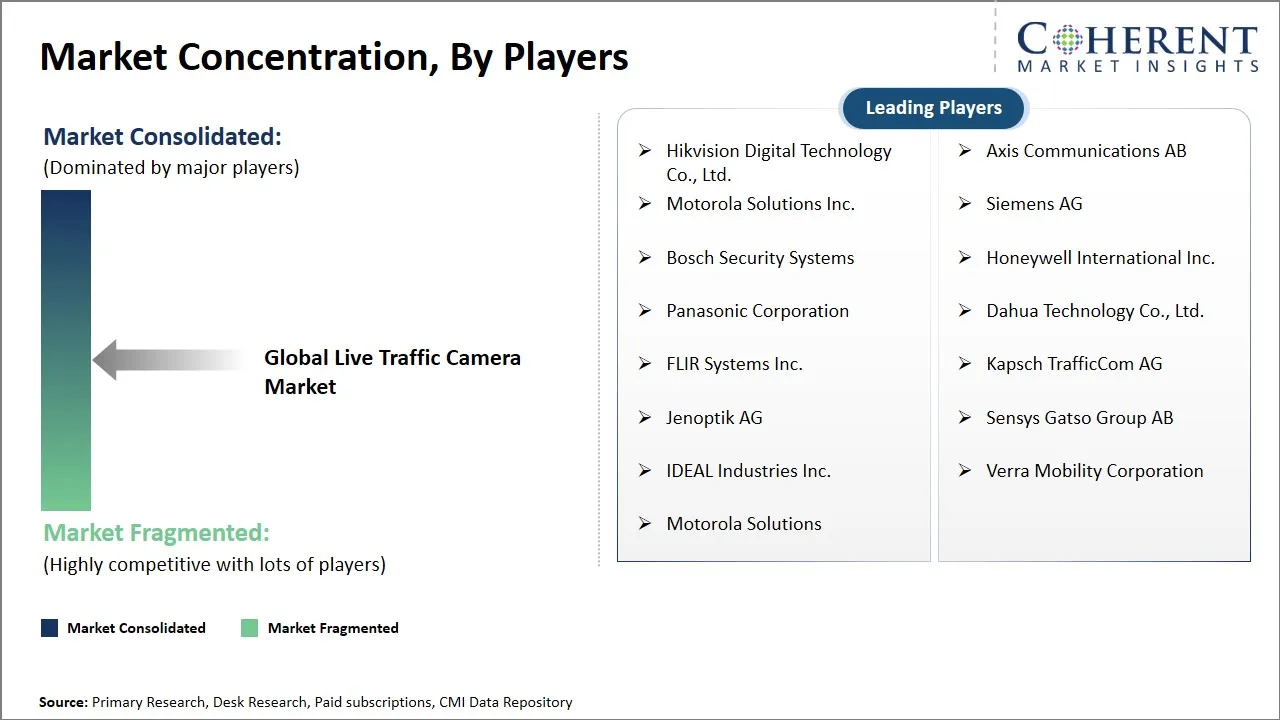
| Companies covered: | Hikvision Digital Technology Co., Ltd., Axis Communications AB, Motorola Solutions Inc., Siemens AG, Bosch Security Systems, Honeywell International Inc., Panasonic Corporation, Dahua Technology Co., Ltd., FLIR Systems Inc., Kapsch TrafficCom AG, Jenoptik AG, Sensys Gatso Group AB, IDEAL Industries Inc., Verra Mobility Corporation, and Motorola Solutions | ||
| Growth Drivers: |
| ||
| Restraints & Challenges: |
| ||
Market Dynamics
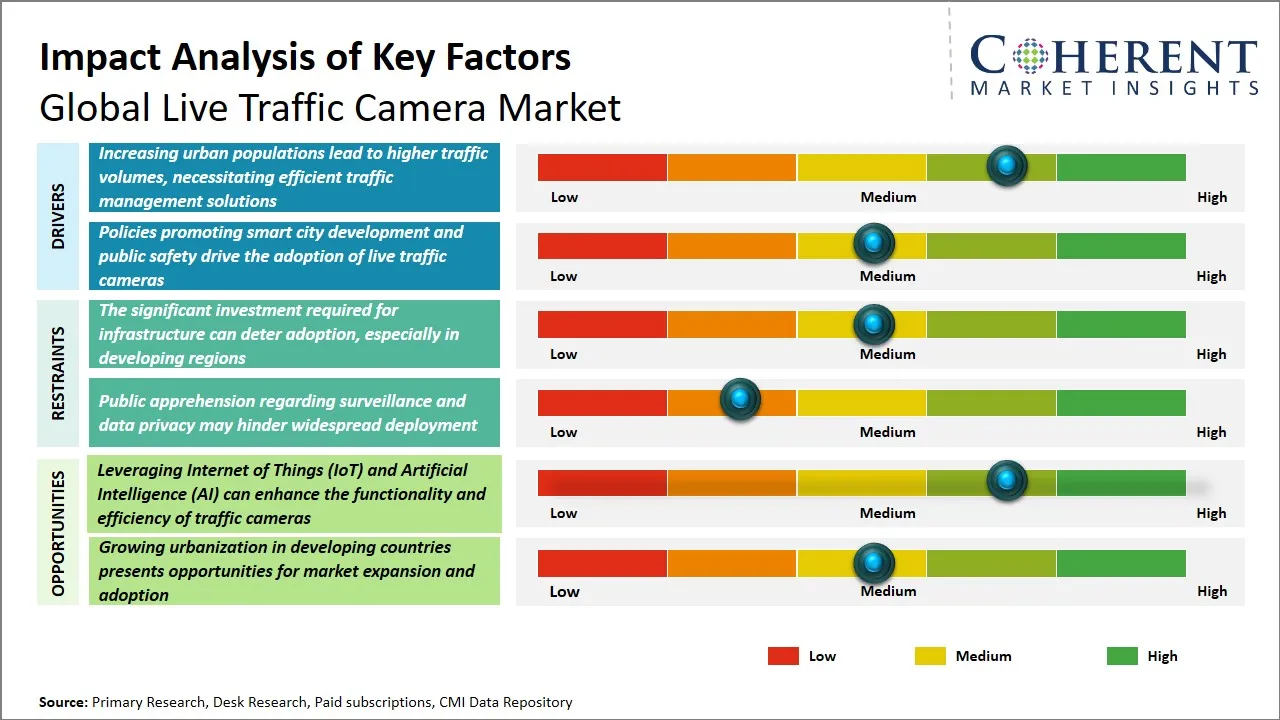
Global Live Traffic Camera Market Driver - Increasing Urban Populations Lead to Higher Traffic Volumes, Necessitating Efficient Traffic Management Solutions
As urban populations continue to grow fast across the globe, cities are seeing a big rise in vehicular traffic volumes, resulting in increased congestion and delays. This urbanization makes demand for efficient traffic management systems that can oversee and control the flow of vehicles in real time. Live traffic cameras are a great technological solution in this context, providing continuous monitoring and fast data collection to support intelligent transportation systems. These cameras help traffic authorities detect incidents, optimize signal timings, and manage congestion proactively, making possible smoother and safer commutes.
Also, with growing urban density, the complexity of traffic networks also rises, creatin the need for comprehensive surveillance and data-driven decision-making. The addition of live traffic cameras with advanced analytics and IoT platforms makes possible dynamic responses to evolving traffic conditions.
Global Live Traffic Camera Market Opportunity – Leveraging Internet of Things (IoT) and Artificial Intelligence (AI) to Enhance Traffic Camera Functionality
The use of Internet of Things (IoT) and Artificial Intelligence (AI) show a big opportunity to revolutionize urban traffic management and road safety systems. IoT-enabled traffic cameras can connect easily with many sensors and smart devices, making possible real-time data collection and transmission in interconnected networks. This makes possible more comprehensive monitoring of traffic flow, congestion patterns, and environmental conditions. Also, AI-driven analytics help these systems process huge amounts of visual and sensor data fast, offering predictive traffic modeling, automated incident detection, and adaptive signal control. Such intelligent traffic management solutions can reduce bottlenecks, improve emergency response times, and improve overall commuter experience.
Also, AI algorithms can support advanced functionalities like license plate recognition, anomaly detection, and behavior analysis, which are very important for law enforcement and urban planning. The adoption of IoT and AI increases the operational efficiency of traffic cameras and reduces the need for manual monitoring, thus lowering personnel costs and minimizing errors.
Analyst Opinion (Expert Opinion)
- Cameras are evolving fast from passive imaging devices to edge-computing platforms that can perform real-time vehicle classification, incident detection, and behavioral analytics without depending on centralized servers. This reduces latency and bandwidth costs and makes possible faster enforcement and adaptive traffic control.
- Integration with 5G networks and vehicle-to-everything (V2X) protocols is making possible ultra-low-latency video transmission and direct communication with connected vehicles. This supports next-generation applications like dynamic congestion pricing, real-time hazard alerts, and coordinated autonomous vehicle corridors.
- Vendors are using thermal, infrared, LiDAR, and radar sensors with traditional optical imaging to ensure accurate monitoring in poor lighting, fog, or extreme weather. These hybrid systems improve reliability by a lot and are becoming very useful for smart-city deployments in different climates.
Speak to the analyst
Want personalized insights?
Take the findings above to one of our principal consultants, or have the report rebuilt around the segments, geographies and competitors you actually track.
Market Segmentation
- Camera Type Insights (Revenue, USD Bn, 2021 - 2033)
- Traffic Violation Cameras
- Surveillance Cameras
- Speed Cameras
- Red Light Cameras
- Regional Insights (Revenue, USD Bn, 2021 - 2033)
- North America
- U.S.
- Canada
- Latin America
- Brazil
- Argentina
- Mexico
- Rest of Latin America
- Europe
- Germany
- U.K.
- Spain
- France
- Italy
- Russia
- Rest of Europe
- Asia Pacific
- China
- India
- Japan
- Australia
- South Korea
- ASEAN
- Rest of Asia Pacific
- Middle East
- GCC Countries
- Israel
- Rest of Middle East
- Africa
- South Africa
- North Africa
- Central Africa
- North America
- Key Players Insights
- Hikvision Digital Technology Co., Ltd.
- Axis Communications AB
- Motorola Solutions Inc.
- Siemens AG
- Bosch Security Systems
- Honeywell International Inc.
- Panasonic Corporation
- Dahua Technology Co., Ltd.
- FLIR Systems Inc.
- Kapsch TrafficCom AG
- Jenoptik AG
- Sensys Gatso Group AB
- IDEAL Industries Inc.
- Verra Mobility Corporation
- Motorola Solutions
Sources
Primary Research Interviews
Stakeholders
- City Traffic Management Authorities
- Intelligent Transportation System (ITS) Integrators
- Traffic Camera Manufacturers and Suppliers
- Law Enforcement & Highway Patrol Agencies
- Smart City Project Developers and Urban Mobility Consultants
- Telecommunications Providers supporting 5G-enabled camera networks
- Data Privacy and Cybersecurity Experts (for surveillance compliance perspectives)
Databases
- Eurostat
- U.S. Department of Transportation (DOT) ITS Data Hub
- International Road Federation (IRF) Statistics Portal
- OECD Transport Database
Magazines
- Intelligent Transport Magazine
- Traffic Technology International
- Smart Cities World
- Urban Mobility Today
Journals
- IEEE Transactions on Intelligent Transportation Systems
- Journal of Transportation Engineering, Part A: Systems
- Sensors (MDPI) – Special Issues on Traffic Monitoring
- Transportation Research Part C: Emerging Technologies
Newspapers
- The Guardian (UK)
- The Economic Times (India)
- The New York Times – Technology Section
- South China Morning Post – Tech & Innovation
Associations
- International Road Federation (IRF)
- Institute of Transportation Engineers (ITE)
- Intelligent Transportation Society of America (ITS America)
- European Traffic Safety Council (ETSC)
Public Domain Sources
- U.S. Census Bureau
- EUROSTAT
- United Nations Economic Commission for Europe (UNECE)
- World Bank
- ResearchGate
Proprietary Elements
- CMI Data Analytics Tool, Proprietary CMI Existing Repository of information for last 8 years
Get access to 250+ pages report
Every segment, forecast, competitor profile and data table behind the analysis above — available for instant download.
- ESOMAR Member
- ISO 9001:2015 Certified
- D-U-N-S Registered
- GDPR & CCPA Compliant
Missing comfort of reading report in your local language? Find your preferred language:
Transform your Strategy with Exclusive Trending Reports
Frequently Asked Questions
The global live traffic camera market is estimated to be valued at USD 5.27 billion in 2026 and is expected to reach USD 9.89 billion by 2033.
The CAGR of the global live traffic camera market is projected to be 9.4% from 2026 to 2033.
Increasing urban populations lead to higher traffic volumes, necessitating efficient traffic management solutions and policies promoting smart city development and public safety drive the adoption of live traffic cameras are the major factors driving the growth of the global live traffic camera market.
The significant investment required for infrastructure can deter adoption, especially in developing regions and public apprehension regarding surveillance and data privacy may hinder widespread deployment are the major factors hampering the growth of the global live traffic camera market.
In terms of camera type, the traffic violation cameras segment is estimated to dominate the market revenue share in 2026.
Live traffic cameras are used for real-time monitoring, traffic law enforcement, and data collection for intelligent transportation systems.
5G Provides low-latency, high-bandwidth transmission for instant data sharing and advanced analytics.