

Global Low Speed Trucks Market Size and Forecast – 2026-2033
The Global Low Speed Trucks Market is estimated to be valued at USD 494.1 Mn in 2026 and is expected to reach USD 695.3 Mn by 2033, exhibiting a compound annual growth rate (CAGR) of 5.0% from 2026 to 2033.
Key Takeaways of the Low Speed Trucks Market
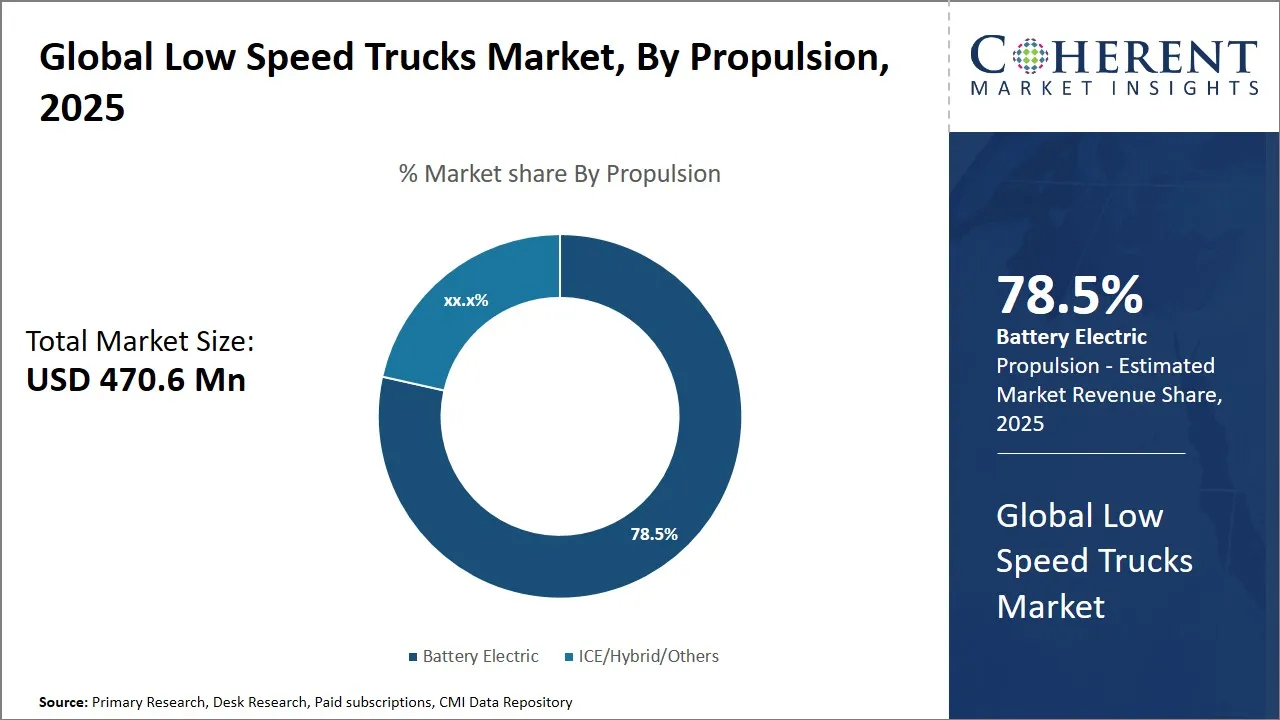
- The battery electric segment leads the market holding an estimated share of 79.5 % in 2026.
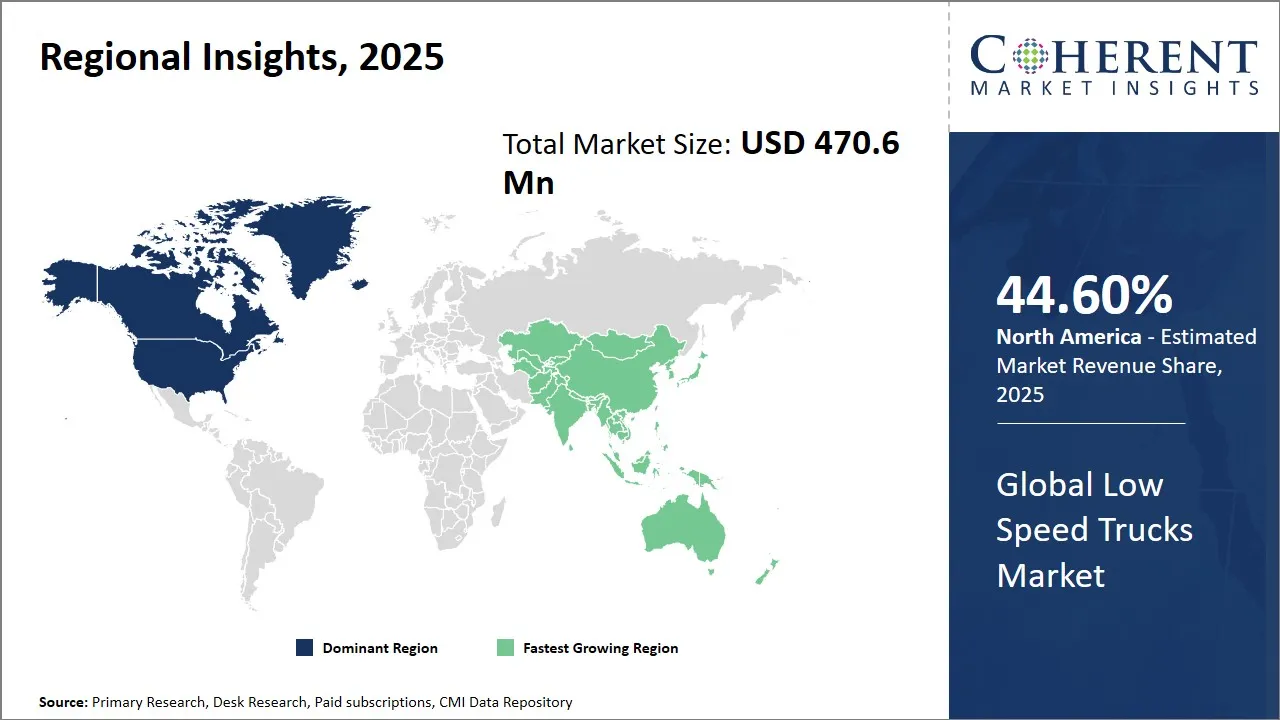
- North America is estimated to lead the market with a share of 44.6 % in 2026.
- Asia Pacific, holding a share of 29.8% in 2026, is projected to be the fastest growing region.
Market Overview
The market is seeing a focus on the use of electric powertrains in low speed trucks to reduce carbon footprints and operational costs. Also, manufacturers are focusing on improving vehicle range, load capacity, and safety features to cater to last-mile delivery and intra-city logistics. The rising adoption of autonomous technology and connected vehicle systems also contributes to market expansion, as industries seek to improve efficiency and reliability in short-distance transportation services.
Current Events and Its Impact
Current Events | Description and its impact |
Geopolitical and Trade Developments |
|
Economic and Infrastructure Trends |
|
Segmental Insights
- Current Industry Events of 2026
- Market Size Estimation
- Regional Breakdown
- Competitive Landscape
- Customer Intelligence
- Segmental Analysis
- Pricing Analysis
- Key Market Drivers, Challenges & Future Trends
- Customized Insights Section
Global Low Speed Trucks Market Insights, by Propulsion – Battery Electric Leads Due to Rapid Advancements in Sustainability and Regulatory Support
Battery electric is expected to contribute the highest share of 79.5% in the global low speed trucks market in 2026. Battery electric vehicles (BEVs) offer zero tailpipe emissions, making them a preferred option for fleet operators aiming to comply with increasingly strict environmental regulations put in place by governments worldwide.
Improvements in lithium-ion battery energy density, charging speed, and overall lifespan have substantially elevated the performance and operational efficiency of battery electric low speed trucks. Urbanization and the rise of e-commerce also fuel the demand for battery electric low speed trucks. Cities are focusing on sustainable last-mile delivery solutions to alleviate traffic congestion and meet local emission standards. BEVs are particularly suitable for last-mile logistics due to their quiet operation, which is beneficial in noise-restricted areas, and their efficiency in frequent stop-and-go driving conditions typical of urban deliveries.
Government incentives and subsidies specifically targeting electrification further propel market growth. Financial benefits such as tax rebates, grants, and favorable policies for electric vehicles encourage manufacturers and fleet operators to invest in battery electric trucks. Coupled with expanding charging infrastructure, these factors mitigate range anxiety and improve operational convenience.
Price Analysis of the Low Speed Trucks Market
Truck Category | Example Model(s) | Typical Price Range (USD) |
Street-legal electric LSV utility truck | Club Car Carryall 510 LSV/710 LSV | USD 18,800 – USD 20,100 |
Electric LSV utility truck (base models) | Columbia Utilitruck 100-2X | USD 17,700 – USD 18,500 |
Kei mini truck (new, Japan domestic) | Suzuki Carry (2025) | USD 7,500 – USD 9,000 |
Indian mini truck (ICE) | Mahindra Jeeto (2025) | USD 5,800 – USD 6,800 |
Budget LSV/utility truck (used reference) | Columbia Journeyman (used) | USD 11,000 – USD 14,000 (used) |
Premium compact electric mini-truck (pre-production; estimate) | TELO MT1 | USD 30,000 – USD 45,000 (estimate) |
Regional Insights
North America Low Speed Trucks Market Analysis and Trends
North America, holding a share of 44.6% in 2026, is expected to dominate the global low speed trucks market. This is due to the region’s well-established industrial ecosystem, advanced infrastructure, and stringent environmental regulations favoring electric and low-emission vehicles. The presence of major automotive and specialty vehicle manufacturers, along with robust logistics and warehousing industries, supports a high demand for low speed trucks primarily used for last-mile delivery and intra-facility transportation.
Furthermore, proactive government policies incentivizing electric vehicle adoption, such as tax credits and subsidies, bolster the market’s expansion. Key companies like Polaris Industries, Taylor-Dunn (a division of SP Industries), and Club Car contribute significantly through innovation in electric low speed trucks are catering to commercial and industrial sectors. The region’s strong aftermarket and service network also enhance user confidence and vehicle uptime, sustaining its market leadership.
Asia Pacific Low Speed Trucks Market Analysis and Trends
The Asia Pacific region, holding a share of 29.8% in 2026, is expected to exhibit the fastest growth in the global low speed trucks market due to rapid urbanization, expanding e-commerce sectors, and increasing investments in smart city initiatives. Countries in this region are embracing low speed trucks, particularly electric models, to address environmental concerns and traffic congestion in urban delivery contexts. Government initiatives aimed at reducing carbon emissions, alongside rising infrastructure modernization, are also catalyzing market expansion.
Additionally, a growing manufacturing base and competitive production costs attract numerous global and domestic players. Notable regional companies such as Jinhua Yuantong Vehicle Technology (China), TVS Motor Company (India), and Yamaha Motor Co. (Japan) are innovating with electric and hybrid low speed truck models, tailoring solutions for local market needs including logistics, agriculture, and industrial uses. Trade dynamics, including favorable export-import policies within trade blocs like ASEAN, further support fast-paced market penetration.
Low Speed Trucks Market Outlook for Key Countries
U.S. Low Speed Trucks Market Analysis and Trends
The U.S. remains a cornerstone for the low speed trucks market with a strong focus on electric and environmentally friendly models. The demand is driven by growth in sectors such as agriculture, tourism, and large campuses requiring efficient internal transportation solutions. Incentives like federal and state tax credits for electric vehicles, along with robust investment in clean energy infrastructure, encourage the adoption of electric low speed trucks. Polaris and Club Car dominate the market offering a wide range of electric and petrol variants, with a focus on technological innovation and after-sales services that refine customer experience and operational efficiency.
China Low Speed Trucks Market Analysis and Trends
China low speed trucks market is growing fast because of urbanization and government mandates pushing for electric mobility to combat pollution. Chinese manufacturers like Jinhua Yuantong and BYD are increasing production of electric low speed trucks tailored for urban logistics and industrial applications, benefiting from abundant raw materials and a mature supply chain for battery technology. The country’s supportive policies, including subsidies for new energy vehicles and stringent emissions standards, add to domestic consumption and export growth. Also, China's integration into global supply chains grows the reach of its low speed trucks in neighboring Asian markets.
Germany Low Speed Trucks Market Analysis and Trends
Germany continues to lead Europe’s low speed trucks market because of its strong automotive heritage and cutting-edge engineering capabilities. The country’s focus on sustainability and smart urban mobility adds to the demand for low-speed electric trucks in sectors such as manufacturing and local delivery. Leading companies like E.G.O. Fahrzeugtechnik and REFORM provide advanced electric mobility solutions, incorporating high efficiency and safety standards. Germany’s industrial ecosystem, combined with European Union directives on emissions reductions and urban vehicle regulations, cultivates a fertile environment for progressive market development.
India Low Speed Trucks Market Analysis and Trends
India low speed trucks market is growing dynamically, driven by expanding e-commerce, agriculture modernization, and increasing use of efficient last-mile delivery vehicles in congested urban areas. Domestic manufacturers such as TVS Motor Company and Mahindra Electric are innovating affordable, reliable electric low speed trucks tailored to the needs of small and medium enterprises. Government initiatives like the Faster Adoption and Manufacturing of Hybrid & Electric Vehicles (FAME) scheme give subsidies and infrastructure support, adding to market growth. The country’s rising urban population and government support for sustainable transport position India as a key emerging player in the global market.
Brazil Low Speed Trucks Market Analysis and Trends
Brazil low speed trucks market is influenced by its growing logistics and agriculture sectors, where cost-effective and environment-friendly vehicles are increasingly preferred. The government’s emphasis on renewable energy and biofuel utilization provides unique opportunities for hybrid low speed trucks. Local manufacturers and international players, such as Agrale and Club Car, address the market with models suited for rough terrain and rural deliveries, reflecting regional needs. Brazil’s trade agreements within Mercosur facilitate the distribution of these vehicles across Latin America, contributing to a broader regional uptake of low speed trucks.
Market Players, Key Development, and Competitive Landscape
Key Developments
- In June 2025, Vantage Vehicle, a pioneer in low-speed vehicle (LSV) innovation, announced the launch of its next-generation electric propulsion system: Terradrive-a fully environmentally sealed, high-efficiency EV drivetrain.
- In May 2025, Telo Trucks, the company building a compact, modular electric pickup truck called MT1 mini-truck, revealed its new preproduction prototype in Los Angeles, U.S. The startup had recently closed a USD 5.4 million funding round and is working with bespoke manufacturing partner, Aria Group, to enter the next development phase towards the final mini-truck.
- In June 2024, Columbia Vehicle Group, an electric vehicle manufacturer, selected Aiken County for its first South Carolina (U.S.) facility, announcing USD 12.2 million investment.
- In June 2021, Club Car, a global leader in golf, consumer and utility vehicles, announced the launch of an all-new electric vehicle (EV), the Club Car Current, in partnership with AYRO, Inc. Current is a compact all-electric light-duty truck equipped with automotive features and comforts.
Top Strategies Followed by Low Speed Trucks Market Players
- Established players dominate through substantial investments in research and development, continuously innovating to produce high-performance, fuel-efficient, and environment-friendly low speed trucks.
- Club Car’s street-legal Carryall 510/710 LSV utility trucks pair 48V AC electric drivetrains with the Club Car Connect telematics platform (for fleet monitoring/optimization)—an R&D-driven push into connected, data-centric LSV trucks.
- Mid-level players in the low speed trucks market adopt a strategy centered around offering cost-effective yet reliable solutions tailored to price-sensitive consumers, particularly small and medium enterprises that require functional vehicles without premium pricing.
- In June 2025, Vintage Vehicle unveiled the Terradrive sealed EV propulsion system—a more durable yet affordable drivetrain solution, aimed at commercial operators seeking lower maintenance costs while keeping vehicle pricing competitive.
- Small-scale players differentiate themselves by carving out specialized niches within the broader market by introducing innovative and tailored features that appeal to narrowly defined customer groups.
- Westward’s GO-4/MAX-EV low-speed utility trucks focus on the parking-enforcement niche, offering factory integration with license plate recognition (LPR) platforms (e.g., Genetec AutoVu, Vigilant), a clear specialization beyond general-purpose LSV trucks.
Market Report Scope
Low Speed Trucks Market Report Coverage
| Report Coverage | Details | ||
|---|---|---|---|
| Base Year: | 2025 | Market Size in 2026: | USD 494.1 Mn |
| Historical Data for: | 2020 To 2024 | Forecast Period: | 2026 To 2033 |
| Forecast Period 2026 to 2033 CAGR: | 5.0% | 2033 Value Projection: | USD 695.3 Mn |
| Geographies covered: |
| ||
| Segments covered: |
| ||
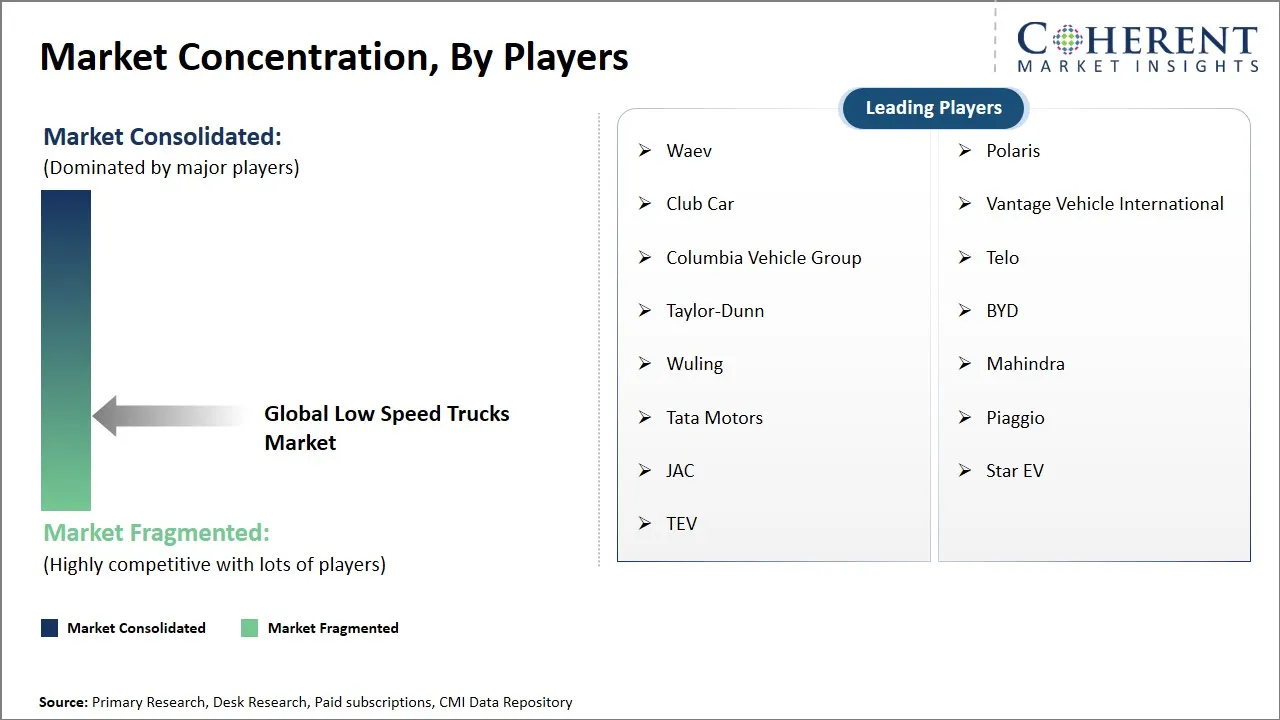
| Companies covered: | Waev, Polaris, Club Car, Vantage Vehicle International, Columbia Vehicle Group, Telo, Taylor-Dunn, BYD, Wuling, Mahindra, Tata Motors, Piaggio, JAC, Star EV, and TEV | ||
| Growth Drivers: |
| ||
| Restraints & Challenges: |
| ||
Market Dynamics
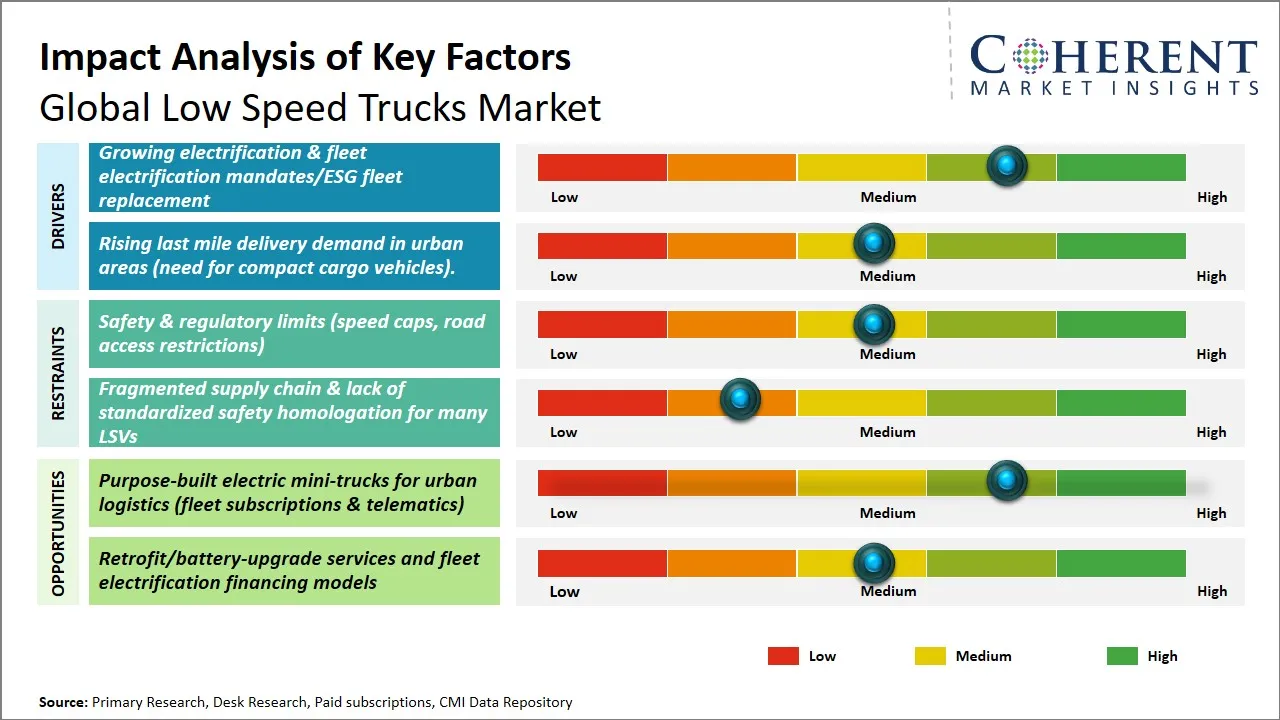
Global Low Speed Trucks Market Driver - Growing Electrification & Fleet Electrification Mandates/ESG Fleet Replacement
The increasing emphasis on electrification across various transportation sectors is significantly propelling the adoption of low speed trucks, particularly within urban and last-mile delivery applications. Governments around the world are enacting stringent fleet electrification mandates as part of broader Environmental, Social, and Governance (ESG) initiatives aimed at reducing carbon footprints and improving air quality in densely populated areas. These mandates require commercial fleets to transition from traditional internal combustion engine vehicles to electric alternatives, encouraging fleet operators to replace aging diesel and gasoline-powered trucks with low speed electric models that offer lower emissions and enhanced operational efficiency.
In 2024, Amazon announced it had deployed 6,000+ electric delivery vehicles across India (in partnership with Mahindra Electric and other OEMs) as part of its Climate Pledge commitment to net-zero carbon by 2040.
Global Low Speed Trucks Market Opportunity – Purpose-Built Electric Mini-Trucks for Urban Logistics with Fleet Subscriptions and Telematics
As cities worldwide grapple with increasing congestion, stringent emission regulations, and rising demand for last-mile delivery services, electric mini-trucks emerge as an ideal solution due to their compact size, zero-emission operation, and operational flexibility. Integrating fleet subscription models into this segment enhances accessibility for small and medium-sized logistics operators, enabling businesses to avoid heavy upfront investments in vehicle purchases while benefiting from maintenance and upgrade services included in subscription plans. In May 2025, a startup, TELO Trucks, unveiled the MT1 preproduction prototype, a compact, purpose-built electric mini-truck designed for urban delivery fleets, offering a pickup bed in a footprint smaller than many sedans.
Additionally, embedding advanced telematics systems within these electric mini-trucks offers real-time tracking, route optimization, predictive maintenance, and fleet management capabilities, significantly improving operational efficiency and reducing downtime. The synergy between electric powertrains, flexible fleet usage, and intelligent telematics platforms enables logistics companies to better address the challenges of urban delivery such as narrow streets, strict delivery time windows, and fluctuating demand patterns.
Analyst Opinion (Expert Opinion)
- Demand for purpose-built low-speed electric trucks is accelerating as e-commerce and food delivery platforms prioritize compact, zero-emission fleets for congested cities. Startups like Telo in the U.S. and established OEMs in China and India are positioning mini-trucks as scalable solutions for high-frequency, short-haul logistics.
- Universities, business parks, factories, and city governments are driving institutional demand for fleet electrification, especially in North America, where fleet replacement aligns with ESG targets. Utility LSVs (e.g., GEM, Columbia, Club Car Carryall) are becoming the default choice for maintenance, security, and light logistics on closed campuses.
- Resorts, golf courses, and gated communities continue to sustain stable baseline demand for LSVs. At the same time, niche products such as ambulance-configured LSVs (Waev GEM) demonstrate how manufacturers are leveraging specialized designs to capture new revenue streams beyond traditional passenger carts.
Speak to the analyst
Want personalized insights?
Take the findings above to one of our principal consultants, or have the report rebuilt around the segments, geographies and competitors you actually track.
Market Segmentation
- Propulsion Insights (Revenue, USD Mn, 2021 - 2033)
- Battery Electric
- ICE/Hybrid/Others
- Regional Insights (Revenue, USD Mn, 2021 - 2033)
- North America
- U.S.
- Canada
- Latin America
- Brazil
- Argentina
- Mexico
- Rest of Latin America
- Europe
- Germany
- U.K.
- Spain
- France
- Italy
- Russia
- Rest of Europe
- Asia Pacific
- China
- India
- Japan
- Australia
- South Korea
- ASEAN
- Rest of Asia Pacific
- Middle East
- GCC Countries
- Israel
- Rest of Middle East
- Africa
- South Africa
- North Africa
- Central Africa
- North America
- Key Players Insights
- Waev
- Polaris
- Club Car
- Vantage Vehicle International
- Columbia Vehicle Group
- Telo
- Taylor-Dunn
- BYD
- Wuling
- Mahindra
- Tata Motors
- Piaggio
- JAC
- Star EV
- TEV
Sources
Primary Research Interviews
Stakeholders
- Low-Speed Truck Manufacturers & OEMs
- Fleet Operators & Logistics Companies (urban delivery firms, campus fleet managers)
- Municipal & Campus Transportation Authorities (universities, gated communities, smart city planners)
- Automotive Dealerships & Distribution Networks specializing in LSVs and mini-trucks
- Battery & EV Component Suppliers (lithium battery pack, motor, and controller suppliers)
- Sustainability Experts and EV Policy Consultants (focusing on fleet electrification and ESG compliance)
Databases
- Eurostat
- U.S. Census
- EV Volumes Database
- OECD
- Transport Data International
Magazines
- EV Fleet World
- Green Car Journal
- Urban Mobility Today
- Fleet Management Weekly
- Electric Vehicle Business Magazine
Journals:
- Journal of Electric Vehicles
- Sustainable Transportation Journal
- IEEE Transactions on Vehicular Technology
- Journal of Cleaner Production
- International Journal of Automotive Technology and Management
Newspapers
- The Guardian (U.K.)
- The Economic Times (India)
- Automotive News (U.S.)
- China Daily (China)
- Nikkei Asia (Japan)
Associations
- Electric Drive Transportation Association (EDTA, U.S.)
- Society of Manufacturers of Electric Vehicles (SMEV, India)
- European Association for Electromobility (AVERE)
- China EV100 Forum
- National Association of Fleet Administrators (NAFA, U.S.)
Public Domain Sources
- U.S. Census Bureau
- EUROSTAT
- United Nations Economic Commission for Europe (UNECE)
- World Bank
- International Energy Agency (IEA)
- ResearchGate
Proprietary Elements
- CMI Data Analytics Tool
- Proprietary CMI Existing Repository of information for last 8 years
Get access to 250+ pages report
Every segment, forecast, competitor profile and data table behind the analysis above — available for instant download.
- ESOMAR Member
- ISO 9001:2015 Certified
- D-U-N-S Registered
- GDPR & CCPA Compliant
Missing comfort of reading report in your local language? Find your preferred language:
Transform your Strategy with Exclusive Trending Reports
Frequently Asked Questions
The global low speed trucks market is estimated to be valued at USD 494.1 million in 2026 and is expected to reach USD 695.3 million by 2033.
The CAGR of global low speed trucks market is projected to be 5.0% from 2026 to 2033.
Growing electrification & fleet electrification mandates/ESG fleet replacement and rising last mile delivery demand in urban areas (need for compact cargo vehicles). are the major factors driving the growth of the global low speed trucks market.
Safety & regulatory limits (speed caps, road access restrictions) and fragmented supply chain & lack of standardized safety homologation for many LSVs are the major factors hampering the growth of the global low speed trucks market.
In terms of propulsion, battery electric is estimated to dominate the market revenue share in 2026.
A low-speed truck is a compact, street-legal vehicle with speed limits (generally ≤25 mph/40 km/h) used for light transport, logistics, and utility applications.
Some use-cases for low-speed trucks are last-mile logistics, municipal services, campus fleets, industrial facilities, hospitality, and leisure mobility.