

Global Malt Beverages Market Size and Forecast – (2026-2033)
According to Coherent Market Insights, the global malt beverages market is estimated to be valued at USD 882.34 Bn in 2026 and is expected to reach USD 1,531.89 Bn by 2033, expanding at a compound annual growth rate (CAGR) of 8.2% from 2026 to 2033.
Key Takeaways of the Malt Beverages Market
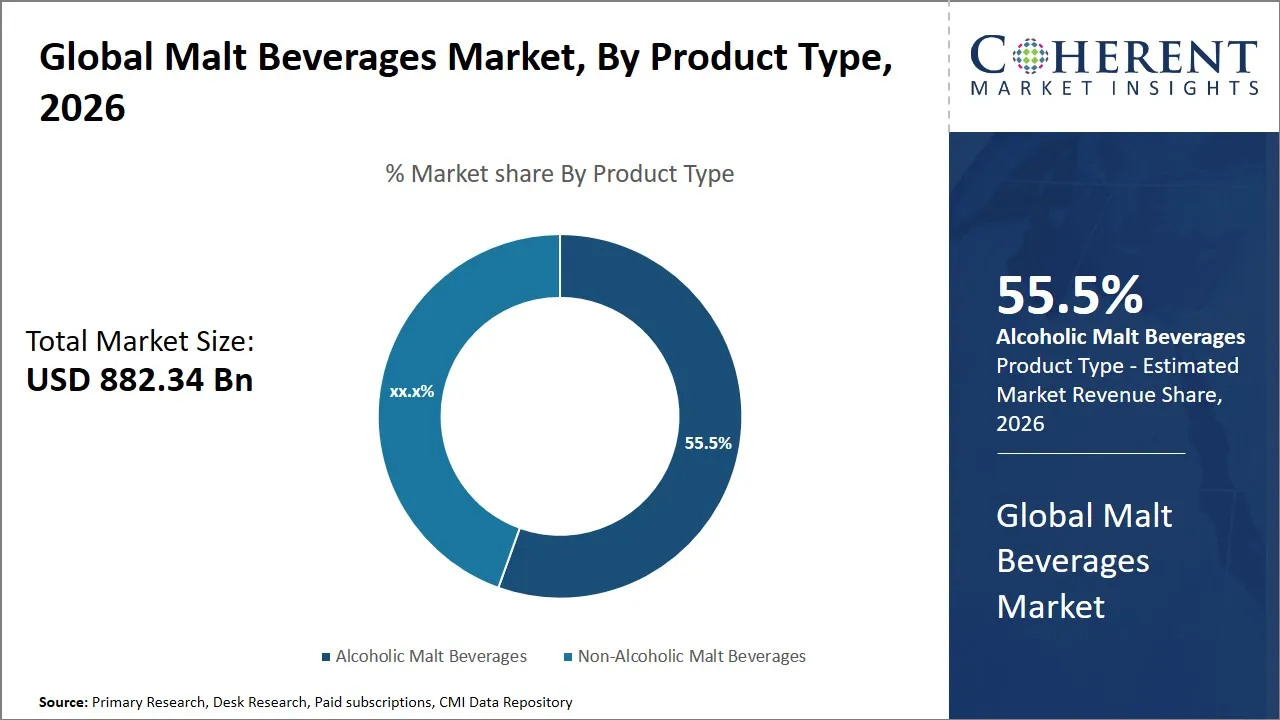
- The alcoholic malt beverages segment is projected to hold 55.5 % of the market share in 2026.
- The on-trade segment is expected to capture 58.9 % of the global malt beverages market share in 2026.
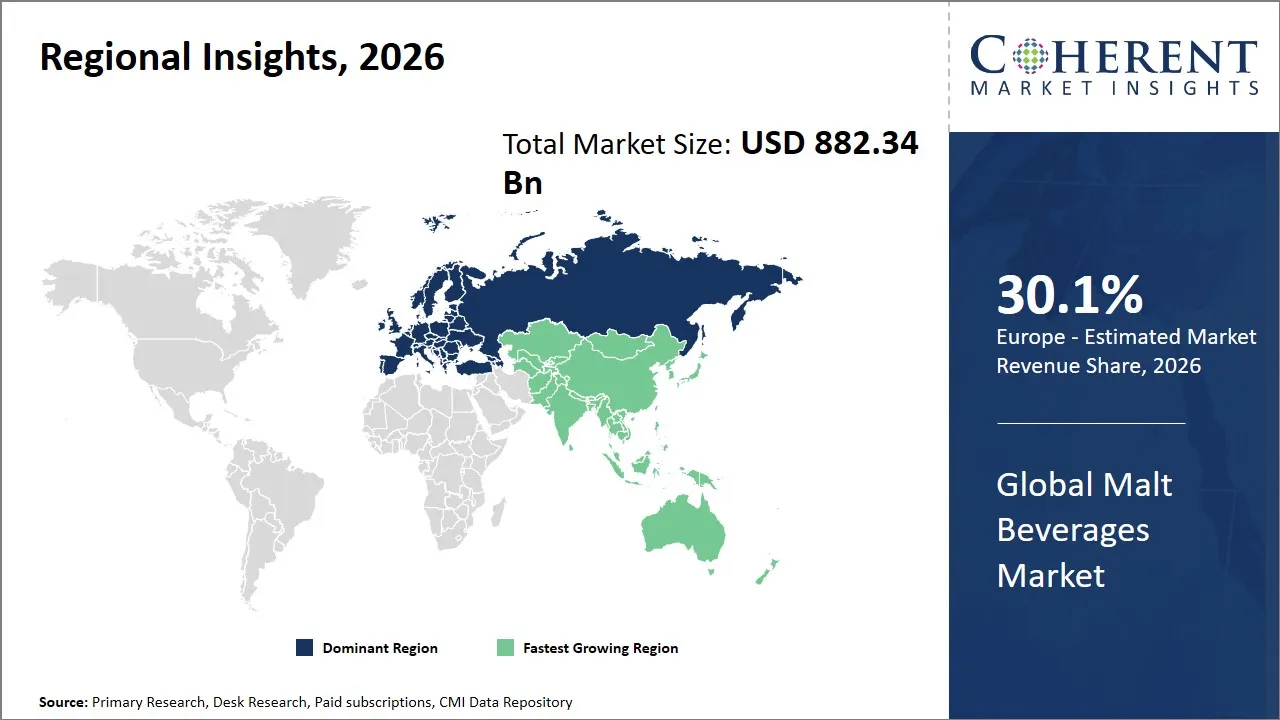
- Europe is expected to lead the malt beverages market in 2026, capturing 30.1 % share.
- The Asia Pacific region is projected to see the fastest growth, contributing 15.3% to the market share in 2026.
Market Overview
- Market trends indicate a growing preference for craft and flavored malt beverages, as consumers seek unique taste experiences and healthier alternatives.
- Additionally, the rise of e-commerce platforms is accelerating market accessibility and distribution. Sustainability initiatives, including the use of natural ingredients and eco-friendly packaging, are also shaping the industry.
- These developments, combined with strategic collaborations and technological advancements in brewing, are fueling long-term expansion and consumer engagement within the malt, functional beverages sector.
Currents Events and Its Impact
Current Events | Description and its Impact |
Shift Toward Non‑Alcoholic & Functional Beverages (Global Consumer Trends 2025–2026) |
|
Regulatory & Labeling Changes (U.S. Alcohol Labeling Proposals) |
|
Segmental Insights
- Current Industry Events of 2026
- Market Size Estimation
- Regional Breakdown
- Competitive Landscape
- Customer Intelligence
- Segmental Analysis
- Pricing Analysis
- Key Market Drivers, Challenges & Future Trends
- Customized Insights Section
Why Does the Alcoholic Malt Beverages Segment Dominate the Global Malt Beverages Market in 2026?
The alcoholic malt beverages segment is expected to hold 55.5% of the global malt beverages market share in 2026, due to the changing demands and cultural inclination of consumers in consuming alcoholic beverages that provide not only the refreshing effects but also a social aspect to the consumption. The increasing trend of socializing and outdoor recreational behavior has greatly increased the consumption of alcoholic malt drinks like beer and malt liquor that have always been linked with recreation and partying. This is a changing lifestyle trend, which is a key factor in the continued demand of these products.
In June 2024, Heineken expanded its low- and mid-alcohol malt beverage portfolio across Southeast Asia and Latin America, targeting social drinking occasions and outdoor events. The company reported higher on-trade volumes in key urban markets, directly reflecting how socializing and experiential consumption continue to drive alcoholic malt beverage dominance.
(Source: https://www.theheinekencompany.com/newsroom/the-low-the-slow-and-the-no/)
On-Trade Dominates the Global Malt Beverages Market
The on-trade segment is projected to command 58.9% of the global malt beverages market share in 2026, fueled by consumers’ growing preference for experiential drinking occasions. Eating out provides not only an opportunity to take drinks but also a rich experience characterized by ambience, service and interaction which adds to the attractiveness of the malt beverages. This immersive aspect is a key developmental element, as customers are becoming more after the product, in terms of product experience.
The malt beverages category is highly preimmunized such that it promotes on-trade growth. An increasing disposable income and increased demand of high and craft versions causes individuals to go to an establishment where they can find these special products that are commonly only promoted or served in these establishments. In addition, the food and beverage establishments have retaliated by designing high-quality malt beer collections, designing food and drink matches, and hosting tasting experiences, which inform and enhance the value of such drinks. These programs increase the valuation and promote recurrent visits.
Consumption Occasion & Functional Segmentation (Quantified)
Consumption Occasion | Share (%) | Core Consumption Logic |
Post-Workout/Physical Activity Recovery | 18% | Refreshment, mild energy replenishment, social cooldown |
On-the-Go/Convenience Drinking | 34% | Ready-to-drink, portability, impulse consumption |
Meal Replacement/Meal Adjunct | 26% | Used alongside light meals or as partial meal substitute |
Functional Segmentation by Demographic (Share % within each cohort)
Demographic Group | Pre/post-workout (%) | Meal Replacement (%) |
Youth (18–25) | 22% | 20% |
Young Adults (26–35) | 20% | 24% |
Adults (36–45) | 15% | 35% |
Regional Insights
Europe Malt Beverages Market Analysis and Trends
The Europe region is projected to lead the market with a 30.1% share in 2026, due to the rich heritage of malt beverage production in the region with Germany, the U.K. and Belgium having good traditions of brewing and well-established industry infrastructures. The ecosystems in the regions of the mature market are characterized by a mix of both large multinational companies as well as a developing craft and artisanal market of malt beverages.
Policies of the government in most European countries favor the beverage industry with favorable policies, quality assurance and export incentives to stimulate competitiveness in international trade. Europe enjoys high availability of raw materials especially of high quality barley and malt and hence innovation and variety of products. There are notable companies like Heineken N.V., Carlsberg Group and SABMiller that have a huge presence here and have contributed by offering a wide range of products through large amounts of R&D, large distribution network and offering a wide range of products varying between the traditional malt beverages to flavored malt drinks.
Asia Pacific Malt Beverages Market Analysis and Trends
The Asia Pacific region is expected to exhibit the fastest growth in the market contributing 15.3% share in 2026, due to rising disposable incomes, urbanization, and the rising consumer awareness about the varieties of malt beverages. The ecosystem of this area is fast changing where production capacity and investment in modern technologies of brewing are growing. The moves by governments in nations such as China and India have begun to ease market creation, through regulation associated with alcohol production and sale, promotion of foreign direct investment and enhancement of distribution channels.
Global Malt Beverages Market Outlook for Key Countries:
Why is Germany's Malt Beverages Market Thriving Amidst Strong Brewing Culture and Innovation?
Germany’s malt beverages market is anchored by its longstanding brewing culture and strict adherence to quality regulations such as the Reinheitsgebot (beer purity law). The most successful companies such as MillerCoors (Molson Coors) and Boston Beer Company have also stimulated the growth by providing new malt drinks that are able to satisfy the changing consumer preferences such as flavored malt drinks, and hard seltzers. The regulatory environment has fostered a competitive brewing environment and the distribution networks including on-premise and retail outlets are strong.
U.S. Malt Beverages Market Trends
The U.S. malt beverages market stands out due to its expansive craft malt beverage segment and diversified consumer base. Leading companies like MillerCoors (Molson Coors) and Boston Beer Company have fueled growth by offering innovative malt beverages that cater to evolving consumer tastes, such as flavored malt beverages and hard seltzers. Regulatory frameworks support a competitive brewing environment, while distribution channels ranging from on-premise to retail outlets remain robust. The U.S. market benefits from high consumption levels and rapid product innovation.
Why is China’s Malt Beverages Market Experiencing Rapid Growth and Increased Competition?
The market of malt beverages in China has experienced a revolution in its growth due to the increasing number of middle-class consumers and the growth of urban populations. It is dominated by giant domestic breweries like Tsingtao and Snow Beer, and there is growing competition by foreign producers which introduce foreign standards and a variety of flavors. The government policies that promote modernization of brewing technology and improvement of infrastructure have also contributed to an increase in the efficiency of production. Overall, there is an increasing trade agreement in the Asian continent, which enhances increased penetration of malt drinks in Asia and its surrounding areas.
India Malt Beverages Market Trends
India is a growing market that is becoming more open to the use of malt drinks other than the traditional alcoholic beverages. United Breweries and Radico Khaitan companies have played a critical role in expanding market spaces and product lines. The formalization and regulation of alcohol distribution by the government has made supply chains better and more available. The market has a growing trend, as flavored malt drinks and health-conscious beverages are in accordance with the tastes of the young population, which is a force to grow the market.
U.K. Malt Beverages Market Trends
The U.K. maintains a strong malt beverage industry characterized by a well-developed craft beer and malt beverages scene. Large companies like Diageo and Camra are very influential and the innovation is oriented towards the artisanal and premium drink made out of malt. The U.K. government policies focus on quality, sustainability, and export promotion and help the industry in gaining a competitive edge. The market’s resilience is supported by intra- European trade and international export, whereas the product development is influenced by consumer tendencies to new and healthier malt varieties.
Market Players, Key Development, and Competitive Intelligence
Key Developments
- In April 2024, Boston Beer Company, Inc. introduced General Admission, a non-alcoholic ready-to-drink (RTD) fruit brew in the U.S. This new offering blends fruit-infused seltzer water with low-alcohol beer. Initially available in select markets such as New York, Albany, Raleigh, North Carolina, and Indiana, the product can also be purchased online for direct-to-consumer shipping across various states.
- In July 2024, Carlsberg Group expanded its partnership with Foodpanda to enhance consumer access to its range of beverages through digital transformation and e-commerce. This collaboration included campaigns such as exclusive gifts, special promotions, and bundles, leveraging Foodpanda’s cloud grocery stores and extensive retail network. By integrating Carlsberg’s offerings into Foodpanda’s platform, the initiative aims to provide consumers with personalized recommendations and swift delivery, ensuring a seamless and enjoyable beer-purchasing experience.
- In November 2023, United Breweries, part of the HEINEKEN group, launched Heineken Silver Draught Beer in India, marking the brand's first entry into the draught beer market in the country. Initially available in premium bars and pubs across selected cities. This beer features a smooth, refreshing taste crafted from 100% malt and natural ingredients. The launch aims to cater to evolving consumer preferences and enhance the beer experience for a new generation of enthusiasts in India.
Top Strategies Followed by Global Malt Beverages Market Players
Player Type | Strategic Focus | Example |
Established Market Leaders | Heavy investment in R&D and innovation | Anheuser-Busch InBev has been persistently working on reduced-sugar and low-calorie drinks made of malt and has opened new flavors to address the increased demand for healthier beverages. Moreover, Heineken also introduced its non-alcoholic malt drinks to meet the growing consumer group that is becoming health-conscious, using the global trend of responsible drinking. |
Mid-Level Players | Cost-effective solutions with balanced quality | For example, Carlsberg Group has aimed at providing quality, though affordable malt beverages to the market through tactical partnership with local distributors to enjoy wider coverage in the emerging markets. |
Small-Scale Players | Niche specialization & innovative variants | For instance, BrewDog, a smaller craft brewery, which has innovative and focused malt drinks with distinctive flavor additions and organic substances. These firms give rise to high level of customer loyalty because they produce their products based on the local tastes and usually this approach enables them to compete favorably with the large players in the niche markets. |
Market Report Scope
Global Malt Beverages Market Report Coverage
| Report Coverage | Details | ||
|---|---|---|---|
| Base Year: | 2025 | Market Size in 2026: | USD 882.34 Bn |
| Historical Data for: | 2020 To 2024 | Forecast Period: | 2026 To 2033 |
| Forecast Period 2026 to 2033 CAGR: | 8.2% | 2033 Value Projection: | USD 1,531.89 Bn |
| Geographies covered: |
| ||
| Segments covered: |
| ||
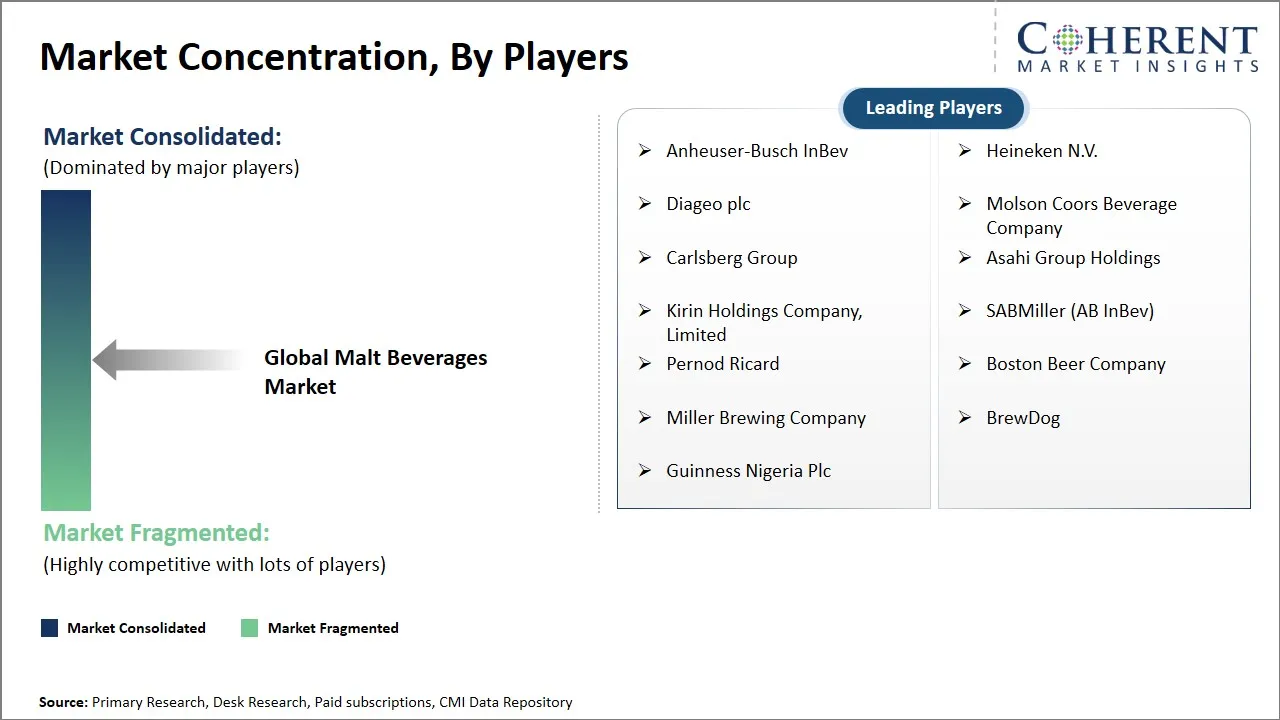
| Companies covered: | Anheuser-Busch InBev, Heineken N.V., Diageo plc, Molson Coors Beverage Company, Carlsberg Group, Asahi Group Holdings, Kirin Holdings Company, Limited, SABMiller (AB InBev), Pernod Ricard, Boston Beer Company, Miller Brewing Company, BrewDog, and Guinness Nigeria Plc | ||
| Growth Drivers: |
| ||
| Restraints & Challenges: |
| ||
Malt Beverages Market Dynamics
Malt Beverages Market Driver - Increasing Demand for Premium and Craft Malt Beverages
The increasing demand for high quality and craft malt drinks among consumers is an instrumental factor affecting the dynamics of the malt beverages market. With the increasing fussy and experience-oriented consumers, a rather pronounced trend is a tendency of choosing products with unique flavors, high quality ingredients, and being brewed with artisanal brewing techniques.
The trend is based on heightened sensitivity to the craftsmanship of beverages and the need to have custom drinking experiences, which portray individual tastes as well as lifestyles. Craft malt beverages, malt ingredient usually brewed in small batches and with flavor profiles that are interesting and new, are particularly attractive to the younger generation who value authenticity and exclusivity.
For example, the Brewers Association has recorded that the U.S. craft beer market is increasing by more than 4% in 2020, and the market is still expanding faster than the larger one.
(Source: https://www.brewersassociation.org/statistics-and-data/national-beer-stats/)
Malt Beverages Market Opportunity - Expansion in Developing Markets with Rising Disposable Incomes
Global malt beverages market offers a great growth opportunity by the way of market expansion in the developing countries, the major factor that will influence such expansion is the increase of disposable income and changing consumer behaviors. The emerging economies in regions like Asia Pacific, Latin America and Africa are fast developing economically which has led to an emerging middle class, which has a greater purchasing power. This population trend has seen increased consumer expenditure on lifestyle and leisure consumer goods, such as alcohol and non-alcohol malt drinks. Also, the urbanization process and the exposure of people to world trends are leading to a rise in the acceptability and demand of the variety of malt drinks.
As an example, the consumption of imported high-quality malt liquor such as Heineken and craft beer is set to increase in China due to the increase in the middle-class population and disposable income.
Analyst Opinion (Expert Opinion)
- The malt beverages market is undergoing a tremendous growth due to the increased interest of the consumers to non-alcoholic and craft beer products. The information of the Global Beverage Innovations Conference (2023) and the International Craft Brewing Expo (2022) help to understand the main tendencies, as the brands such as Malt Garden and Clausthaler are the first to introduce the concept of unique malt drinks with distinct flavors that can suit the taste of a wide variety of customers.
- A recent development by Malt Gardens to launch a range of products with exotic flavors and low-sugar formulas, is one of the industry trends to the healthier ones without sacrificing the flavor. Conferences held here have noted the growing popularity and demand of malt-based beverages especially by the younger generation who are looking to experience something new with drinks.
- The saturation of the market and the existence of traditional soft drinks and alcoholic substitutes were also mentioned as the obstacles. The companies that emphasize on product differentiation and invest in successful marketing strategies to inform the consumers about the virtues of malt drinks will be successful. Finally, the development of the malt beverages market will rely on its capacity to keep innovating and keep in line with the changes in the consumer tastes in terms of quality, taste, and health-conscious products.
Speak to the analyst
Want personalized insights?
Take the findings above to one of our principal consultants, or have the report rebuilt around the segments, geographies and competitors you actually track.
Market Segmentation
- Product Type Insights (Revenue, USD Bn, 2021 - 2033)
- Alcoholic Malt Beverages
- Beer
- Malt Liquor
- Non-Alcoholic Malt Beverages
- Malt-based Soft Drinks
- Malt Extracts
- Alcoholic Malt Beverages
- Distribution Channel Insights (Revenue, USD Bn, 2021 - 2033)
- On-Trade
- Off-Trade
- Liquor Stores
- Hypermarkets/Supermarkets
- Online
- Others
- Regional Insights (Revenue, USD Bn, 2021 - 2033)
- North America
- U.S.
- Canada
- Latin America
- Brazil
- Argentina
- Mexico
- Rest of Latin America
- Europe
- Germany
- U.K.
- Spain
- France
- Italy
- Russia
- Rest of Europe
- Asia Pacific
- China
- India
- Japan
- Australia
- South Korea
- ASEAN
- Rest of Asia Pacific
- Middle East
- GCC Countries
- Israel
- Rest of Middle East
- Africa
- South Africa
- North Africa
- Central Africa
- North America
- Key Players Insights
- Anheuser-Busch InBev
- Heineken N.V.
- Diageo plc
- Molson Coors Beverage Company
- Carlsberg Group
- Asahi Group Holdings
- Kirin Holdings Company, Limited
- SABMiller (AB InBev)
- Pernod Ricard
- Boston Beer Company
- Miller Brewing Company
- BrewDog
- Guinness Nigeria Plc
Sources
Primary Research Interviews
- CEO – Leading Malt Beverage Producer (e.g., Anheuser-Busch InBev or Heineken equivalent)
- Supply Chain Director – Major Malt Beverages Distributor
- Production Lead – Craft Malt Brewery Manufacturer
- Sustainability Officer – Malt Beverage Certification Authority
Stakeholders
- Manufacturers
- End-use Sectors:
- On-Trade (Bars, Pubs, Restaurants)
- Off-Trade (Supermarkets, Convenience Stores)
- E-commerce Platforms and Retailers (Amazon, Drizly, Supermarkets)
- Regulatory & Certification Bodies (e.g., TTB for malt beverages, EU alcohol regulations)
- Technology Integration Players: Flavored malt beverage (FMB) and RTD producers
Databases
- UN Comtrade Database (HS 2203 Beer from malt)
- India Import Export (EXIM) Database
- USITC DataWeb (Beverage imports/exports)
- Eurostat Trade Statistics for Beverages
- FAO Food Outlook (Global malt demand)
Magazines
- Beverage Industry Magazine – Trends in malt beverages
- Craft Beer & Brewing Magazine – Malt in beer innovations
- The New Brewer – Craft malt beverage production
- Brewers Journal – Global malt market dynamics
- Beer Business Daily – Industry news and pricing
Journals
- Journal of Agricultural and Food Chemistry – Malt composition in beverages
- Journal of the Institute of Brewing – Beer quality from malt
- Food Chemistry – Malt-derived flavors and stability
- Resources Policy – Global malt supply chains
- Journal of Food Engineering – Malt processing techniques
Newspapers
- The Wall Street Journal – Global beverage demand trends
- Reuters – Malt beverages market volatility
- Business Standard (India) – Asia malt growth
- The Drinks Business – Beer industry news
- VinePair – Beer sector developments
Associations
- Brewers Association
- The Brewers of Europe
- Maltsters Association of Great Britain
- Brewers Law Support Network (global)
- American Beverage Association
- International Alliance of Beer Associations
Public Domain Sources
- TTB – Guidelines for malt beverage labeling
- European Commission – Alcohol beverage regulations
- World Health Organization – Alcohol consumption standards
- FAO – Malt and barley statistics
- OECD – Beverage trade reports
Proprietary Elements
- CMI Data Analytics Tool
- Proprietary CMI Existing Repository of information for last 8 years.
Get access to 250+ pages report
Every segment, forecast, competitor profile and data table behind the analysis above — available for instant download.
- ESOMAR Member
- ISO 9001:2015 Certified
- D-U-N-S Registered
- GDPR & CCPA Compliant
Missing comfort of reading report in your local language? Find your preferred language:
Transform your Strategy with Exclusive Trending Reports
Frequently Asked Questions
The global malt beverages market is estimated to be valued at USD 882.34 Bn in 2026 and is expected to reach USD 1,531.89 Bn by 2033.
The CAGR of global malt beverages market is projected to be 8.2% from 2026 to 2033.
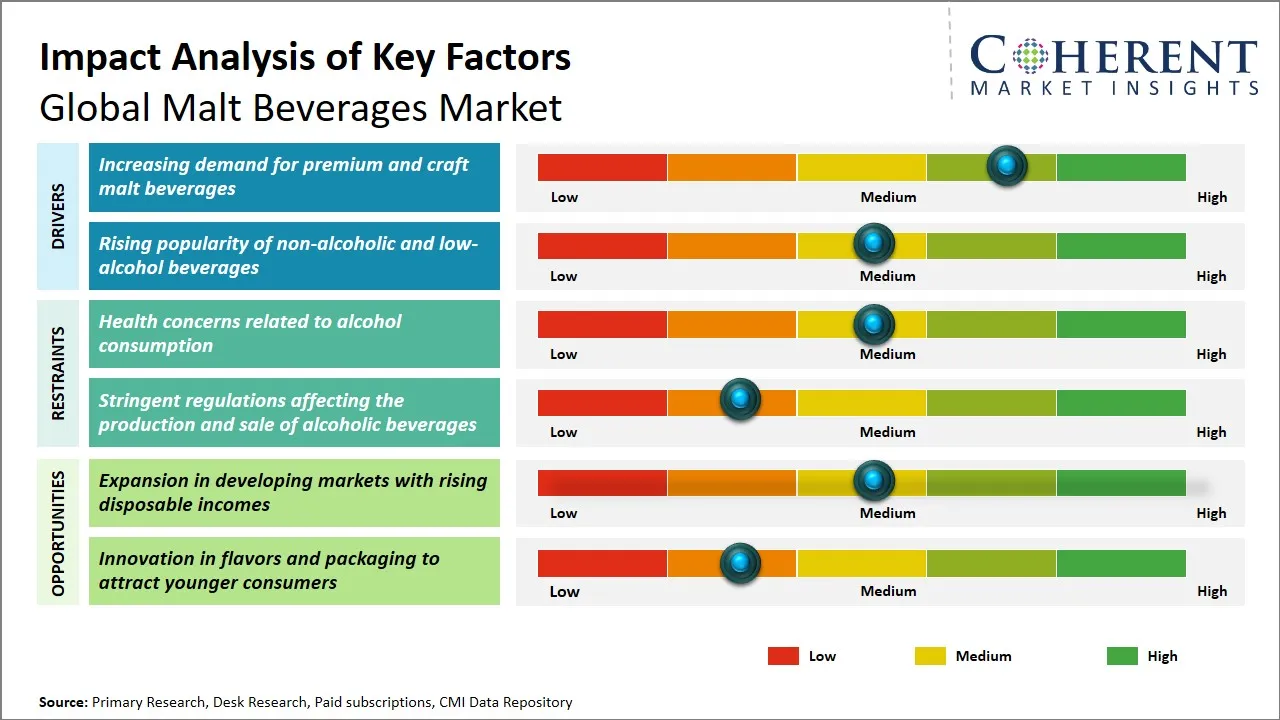
Increasing demand for premium and craft malt beverages and rising popularity of non-alcoholic and low-alcohol beverages are the major factors driving the growth of the global malt beverages market.
Health concerns related to alcohol consumption and stringent regulations affecting the production and sale of alcoholic beverages are the major factors hampering the growth of the global malt beverages market.
In terms of product type, alcoholic malt beverages are estimated to dominate the market revenue share in 2026.
Anheuser-Busch InBev, Heineken N.V., Diageo plc, Molson Coors Beverage Company, Carlsberg Group, Asahi Group Holdings, Kirin Holdings Company, Limited, SABMiller (AB InBev), Pernod Ricard, Boston Beer Company, Miller Brewing Company, BrewDog, and Guinness Nigeria Plc are the major players.
Europe is expected to lead the global malt beverages market in 2026.