

Global Merchant Cash Advance Market Size and Forecast – 2026 To 2033
The global merchant cash advance market is expected to grow from USD 32 Bn in 2026 to USD 59 Bn by 2033, registering a compound annual growth rate (CAGR) of 9.5% from 2026 to 2033. The global merchant cash advance market is driven by rising digital payment and card transaction volumes. On February 12, 2026, Adyen reported that its volume of processed payments reached USD 1,616 trillion in 2025, with point-of-sale transaction volumes growing 34% year-over-year. The strong increase was driven by expanding digital commerce activity and higher merchant transaction volumes across global markets. (Source: Adyen)
Key Takeaways of the Global Merchant Cash Advance Market
- The MCA split segment is expected to account for 36.0 % of the global merchant cash advance market share in 2026. The expansion of fintech lending platforms and embedded finance is driving the growth of the segment. On September 29, 2025, Worldpay launched the Embedded Finance Engine, a new suite of best-in-class financial service products that its software platform partners can quickly integrate to drive higher retention and revenue growth while streamlining their tech stacks and ecosystems. (Source: Worldpay)
- The retail and e-commerce segment is estimated to capture 26.0 % of the market share in 2026. Growth of e-commerce and omnichannel retail merchants is driving the growth of the segment. On May 18, 2026, Amazon announced the expansion of Amazon Now, its ultra-fast delivery services, to 100 cities across India. Amazon will scale its specialized fulfilment infrastructure to over 1,000 micro-fulfilment centers (MFCs) to support this growth. (Source: Amazon)
- North America is expected to dominate the merchant cash advance market in 2026 with a market share of 40.0 %. Increasing adoption of AI-based underwriting and risk assessment in North America is driving the growth of the regional market. On May 6, 2025, Upstart announced a forward-flow commitment from funds managed by affiliates of Fortress Investment Group LLC. Fortress has agreed to purchase up to USD 1.2 billion of consumer loans originated on the Upstart platform through March 2026. (Source: Upstart)
- Asia Pacific is expected to account for 32.0 % share in 2026 and is projected to record the fastest growth over the forecast period. Faster approval and funding processes compared with conventional loans in Asia Pacific is driving the growth of the regional market. On June 15, 2026, OnDeck Australia announced an increase in its Lightning Loan limits, now offering up to USD 300,000 in unsecured funding for small and medium-sized enterprises. (Source: OnDeck)
- AI-Powered Underwriting and Real-Time Credit Assessment: Merchant cash advance providers are increasingly leveraging artificial intelligence, machine learning and alternative data sources such as payment transactions, bank account activity, e-commerce sales and point of sale data to assess creditworthiness. This allows for speedier approval decisions, better risk management, lower default rates and greater access to finance for enterprises with minimal credit history.
- Growth of Embedded Finance and Platform-Based Lending: Merchant cash advances are becoming embedded in payment processing systems, e-commerce marketplaces, accounting software and business management platforms. Stripe, Shopify, PayPal and Block are among the companies now offering finance inside their ecosystems, making it easier for merchants to acquire and retain customers and get capital without going to their bank.
Segmental Insights
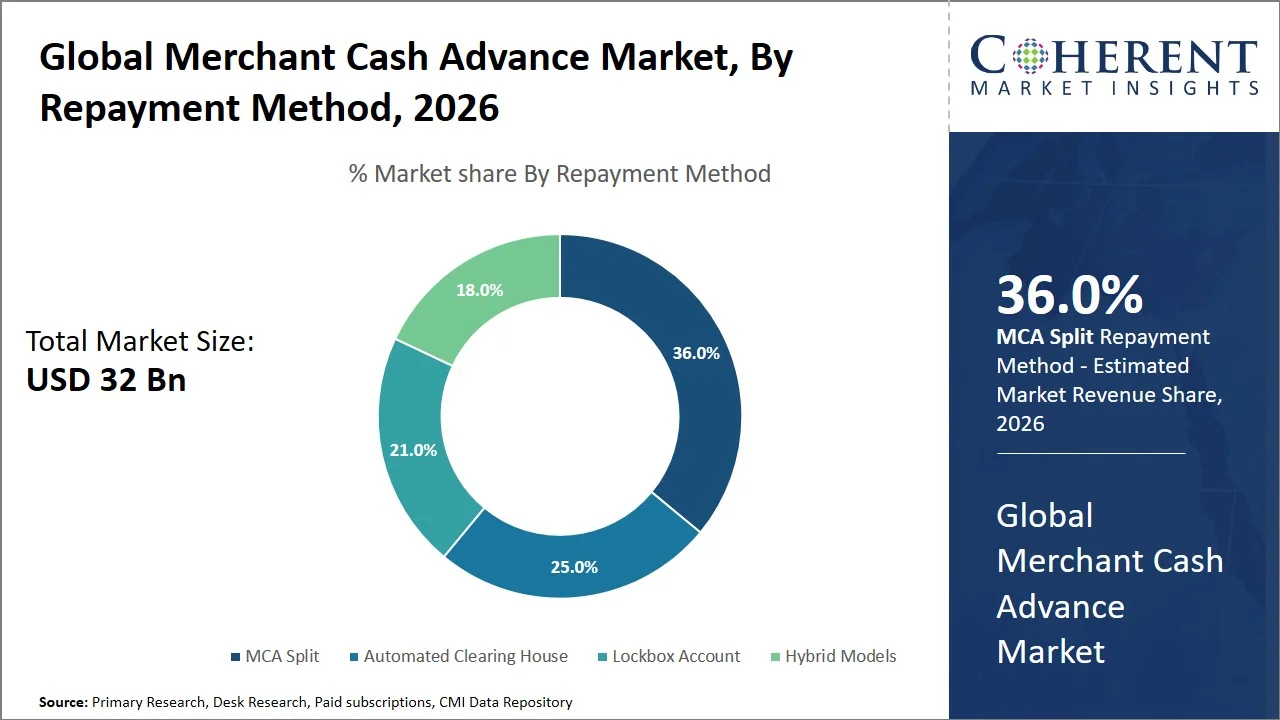
Why Does MCA Split Dominate the Global Merchant Cash Advance Market?
The MCA split segment is expected to account for 36.0% of the global merchant cash advance market share in 2026. MCA split is dominant in the worldwide merchant cash advance industry as it enables the providers to automatically collect repayments as a fixed proportion of a merchant’s daily credit and debit card sales. This revenue-based repayment structure scales with business performance, easing the burden of payments during sluggish sales periods while also reducing the risk of default for lenders. The flexibility, convenience of collection and excellent fit for retail, restaurant and e-commerce firms have made MCA split the most used payback option on the market. For example, Shopify Capital offers merchant cash advances and funding options directly via its commerce platform. The merchants pay back the financing with a fixed percentage of daily sales which makes this solution very attractive to businesses seeking flexible repayments based on the performance of their income. (Source: Shopify)
- Current Industry Events of 2026
- Market Size Estimation
- Regional Breakdown
- Competitive Landscape
- Customer Intelligence
- Segmental Analysis
- Pricing Analysis
- Key Market Drivers, Challenges & Future Trends
- Customized Insights Section
Why is Retail and E-commerce the Most Crucial End User?
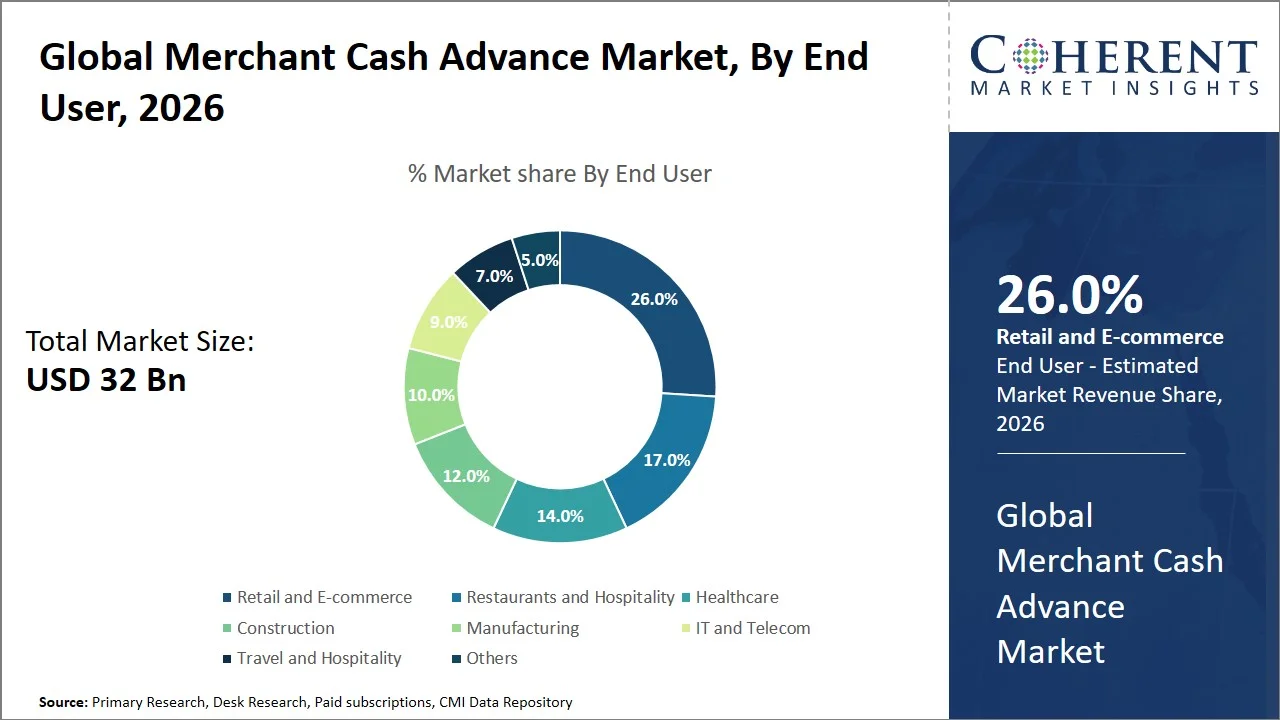
The retail and e-commerce segment is expected to account for 26.0% of the global merchant cash advance market share in 2026. Merchant cash advances are returned as a percentage of daily card and online sales, making them well-suited to firms with significant transaction volumes and ongoing income streams. The retail and e-commerce end user group is the most important. Widely used solutions, such as merchant cash advance, are often used as industry needs operating capital to deal with inventory, marketing campaigns, seasonal demand changes and business expansion.
On December 9, 2025, Parafin announced a partnership with NMI, a global leader in embedded payments infrastructure, to offer flexible capital to small business merchants through NMI’s extensive reseller network. Through this partnership, over one million merchants in the U.S. will gain access to financing designed to help them scale their businesses. (Source: Parafin)
Currents Events and their Impact
Current Events | Description and its Impact |
New York Sales-Based Financing Disclosure Law (U.S.) |
|
Financial Services and Markets Act 2000 Amendment Order 2025 (U.K.) |
|
(Source: New York Government, UK Government)
Merchant Cash Advance Market Dynamics
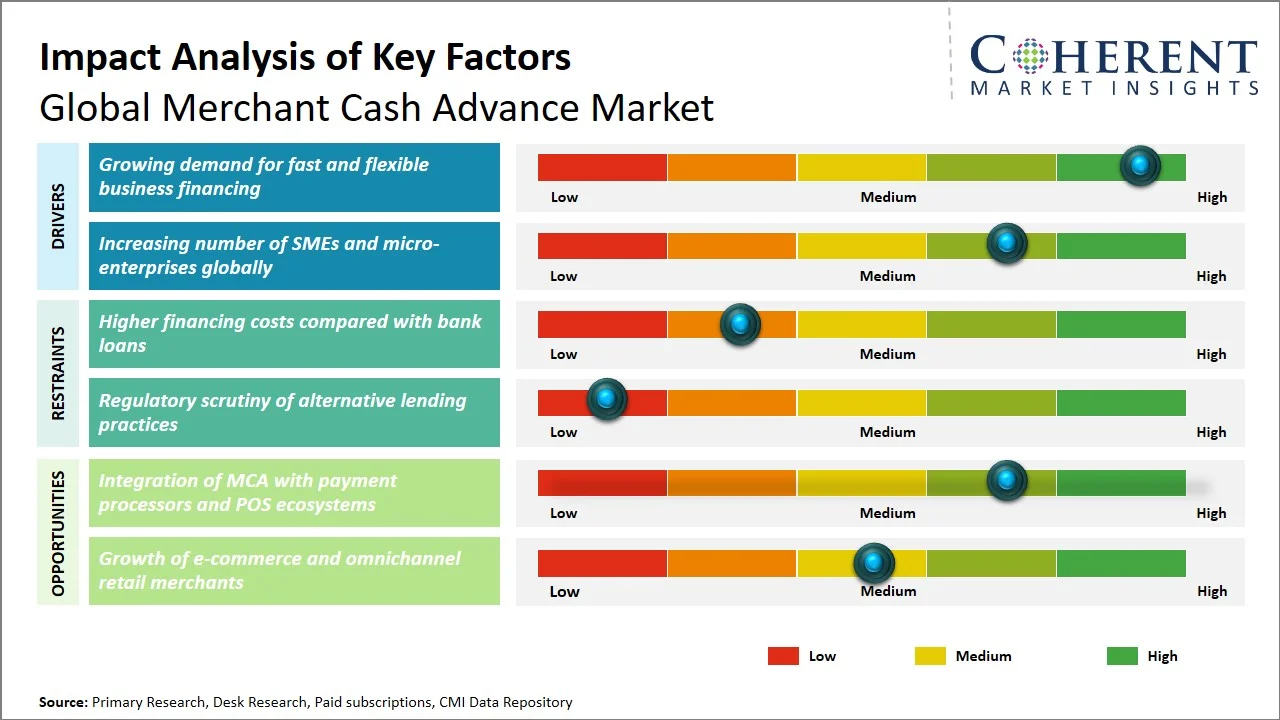
Market Drivers
Growing demand for fast and flexible business financing
The merchant cash advance market is propelled by the increasing demand for fast and flexible business financing, as small and medium-sized businesses today are in greater need for quick access to working capital without the lengthy approval processes and stringent credit requirements that are associated with traditional bank loans. Merchant cash advances provide fast finance, limited paperwork, and repayment terms based on daily sales, allowing businesses to fill cash flow gaps, buy goods, fund growth efforts, and better navigate seasonal demand variations. That level of flexibility makes merchant cash advances especially attractive to retailer, restaurant, e-commerce sellers and other businesses that need to tap into liquidity quickly to help fund operations and growth.
On May 5, 2026, Parafin announced the renewal and upsizing of its warehouse credit facility. With Silicon Valley Bank, which joins as a new A-note lender; and Trinity Capital Inc., the expanded facility increases Parafin’s borrowing capacity and reduces its cost of capital. (Source: Parafin)
Increasing number of SMEs and micro-enterprises globally
The rising number of SMEs and micro-enterprises across the globe is a key factor driving the merchant cash advance market as these businesses often face challenges in obtaining funding from traditional financial institutions owing to lack of credit histories, lack of collateral or shorter operating histories. Merchant cash advances are a convenient alternative that allow users to gain quick access to financing depending on the performance of business revenues rather than the traditional lending requirements. As entrepreneurship, internet commerce, and small business development continue to increase throughout both established and emerging economies, the demand for accessible and flexible financing solutions is expanding, supporting the growth of the merchant cash advance market.
On July 7, 2025, Mastercard expanded its U.S. Small Business Navigator platform with a new offer from Fiserv’s Clover, one of the country’s largest point-of-sale and business management systems. (Source: Mastercard)
Emerging Trends
- Expansion of MCA Solutions for E-Commerce and Digital Businesses: The exponential rise of online retail, digital services, subscription businesses, and marketplace sellers leads to increased demand for flexible revenue-based financing. MCA providers are creating niche products for e-commerce merchants that use live sales data from online platforms to give bespoke funding and payback structures that match fluctuating revenues.
- Increasing Regulatory Focus and Transparency Initiatives: Governments and financial authorities in major economies are introducing more stringent disclosure requirements and consumer protection measures for alternative financing solutions. MCA providers are working to improve openness on factor rates, payback terms, fees, and effective financing costs to assist create trust with small firms while also ensuring long-term market sustainability.
Regional Insights
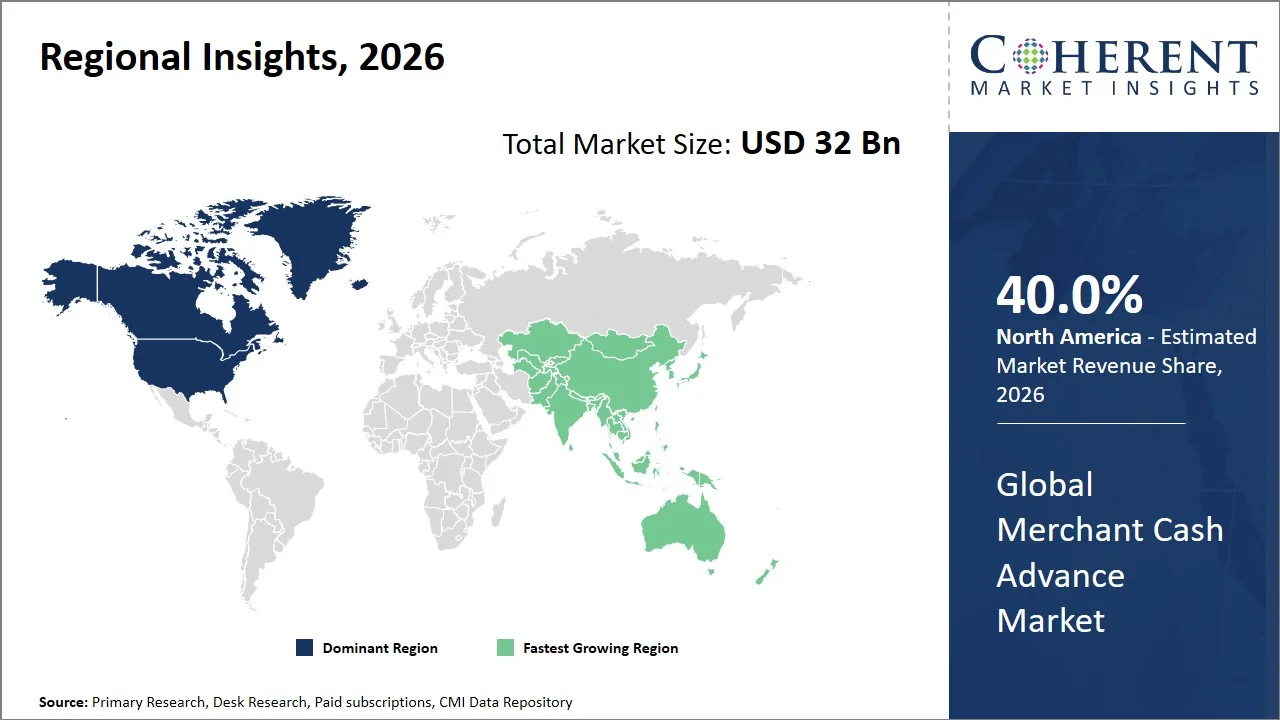
Why is North America a Strong Market for Merchant Cash Advance?
North America is expected to account for a market share of 40.0% in 2026. The large number of fintech lenders and payment-processing ecosystems still make North America the hub of merchant cash advance innovation. PayPal, Stripe, Block (Square), and Shopify have integrated financing into the merchant platforms, enabling businesses to borrow based on real-time transactions. Regulatory changes such as New York’s commercial financing disclosure requirements and California’s financing transparency legislation have also helped shape market development by raising the bar for disclosure and supporting responsible lending practices among MCA providers.
In addition, the ongoing consolidation trend in the global fintech and payment services industry provides an impetus to the growth of the regional market. On June 15, 2026, Nuvei and Payoneer announced that they have entered into a definitive agreement under which Nuvei will acquire Payoneer. Under the terms of the agreement, Nuvei will acquire all of the issued and outstanding shares of common stock of Payoneer Global Inc. for USD 7.40 per share in cash, representing a total transaction equity value of approximately USD 2.75 billion. (Source: Nuvei)
Why Does the Asia Pacific Merchant Cash Advance Market Exhibit High Growth?
Asia Pacific is projected to account for 32.0% of the global merchant cash advance market and is expected to register the fastest growth. Rapid merchant cash advance use in Asia Pacific is being fueled by growing SME activity and digital payment ecosystems. Fintech firms are increasingly using transaction data from e-commerce platforms, QR-code payments and digital wallets to provide loans to merchants that do not have traditional credit histories. Working-capital finance is also filtering into payment platforms in countries such as India, Australia, Singapore and Indonesia, where merchants can tap into funds based on daily sales success rather than collateral-backed credit.
On November 12, 2025, Antom, a leading provider of merchant payment and digitization services under Ant International, announced EPOS360, an app that brings point-of-sale (POS) system, payments, banking, lending, and growth support together to help micro, small and medium‑sized enterprises (MSMEs) move from setup to scale efficiently. (Source: Antom)
Global Merchant Cash Advance Market Outlook for Key Countries
Why is the U.S. Emerging as a Major Hub in the Merchant Cash Advance Market?
The U.S. has the most sophisticated merchant cash advance ecosystem in the world, underpinned by deep card payment penetration and a big small company sector. More vendors are providing automated funding programs that use merchant sales data to underwrite, including OnDeck, CAN Capital and PayPal Working Capital. Across the industry, product design has been impacted by recent state-level regulatory efforts, including disclosure regulations in New York and California that have raised the bar for clarity on financing costs, payback obligations and predicted annualized rates.
Is China the Next Growth Engine for the Merchant Cash Advance Market?
The activity of merchant cash advance in China is increasingly connected to its digital commerce ecosystem rather than the traditional MCA structures of Western markets. Financing solutions are generally provided through large payment and marketplace platforms like the Alibaba Group and Tencent, who exploit merchant transaction records to give short-term working money. The extensive use of mobile payments via Alipay and WeChat Pay has allowed lenders to analyze cash flows in real time, resulting in speedy credit decisions for millions of small businesses doing business on digital platforms.
Canada Merchant Cash Advance Market Analysis and Trends
Canada is a widespread market for merchant cash advance. Alternative finance providers such as Merchant Advance Capital and Thinking Capital have broadened their revenue-based financing packages for merchants, restaurants and service firms. The market has also benefited from increasing relationships between fintech lenders and payment processors, which provide faster access to finance via automated payback processes related to card sales.
India Merchant Cash Advance Market Analysis and Trends
India’s digital public infrastructure and fast-growing electronic payments are changing the country’s merchant cash advance market. As UPI transactions gain wider acceptance, fintechs may now assess merchant cash flows using real-time payment data instead of relying on traditional credit records. Lendingkart, NeoGrowth and FlexiLoans are some companies that are providing revenue-linked lending solutions to small shops and e-commerce sellers, particularly those who do not get adequate support from traditional banking channels.
Australia Merchant Cash Advance Market Analysis and Trends
Australia has a strong alternative business finance market, driven by strong card payment usage and a vibrant SME economy. Fintechs, including Prospa and Moula, have pioneered data-driven lending strategies that use business transaction histories to enable quick access to working capital. The growth of online retail and hotel businesses looking for flexible funding solutions where repayments can be tied to their sales performance rather than fixed monthly instalments has also helped the sector.
Global Merchant Cash Advance Market - Digital Merchant Lending Penetration (2026)
Region | Digital Merchant Lending Penetration (%) |
North America | 38.5% |
Europe | 31.2% |
Asia Pacific | 28.7% |
Latin America | 24.8% |
Middle East & Africa | 18.9% |
Global Merchant Cash Advance Market - MCA Approval Rate by Industry (2026)
Industry | Estimated MCA Approval Rate (%) |
Retail & E-commerce | 72% |
Restaurants & Food Service | 69% |
Healthcare Clinics | 66% |
Transportation & Logistics | 64% |
Hospitality & Hotels | 63% |
Construction & Contracting | 58% |
Professional Services | 55% |
Manufacturing | 52% |
Wholesale & Distribution | 50% |
Education & Training | 48% |
Real Estate Services | 45% |
Technology Startups | 42% |
Nonprofit Organizations | 38% |
Agriculture & Farming | 35% |
How is the Integration of MCA with Payment Processors and POS Ecosystems Creating New Growth Opportunities in the Merchant Cash Advance Market?
Lenders can access real-time transaction data, automate underwriting decisions, and fund merchants directly within the platforms they already use for daily operations. Integration with payment processors and POS ecosystems is creating significant growth opportunities in the merchant cash advance market. They include: PayPal, Stripe, Shopify, and Block, who harness merchant sales history and payment processes to deliver pre-qualified finance offers with quicker approvals and less paperwork. The embedded financing model improves customer acquisition, increases repayment collection by automatically deducting from sales transactions, lowers credit risk for providers, and extends access to capital for small businesses that might not qualify for traditional bank loans, thereby accelerating market adoption and scalability.
On December 4, 2025, Flex raised USD 60 million in a Series B fundraising round to scale its platform that provides commercial finance, payments and private credit services. The company said it tripled payment volume to USD 3 billion in a year, showing growing usage of alternative finance platforms among North American companies. (Source: Flex)
Market Players, Key Development, and Competitive Intelligence
Key Developments
- On March 24, 2026, Klarna, the global digital bank and flexible payments provider, doubled its existing forward-flow and whole-loan sale agreement with investment funds managed by Elliott Investment Management. The facility size doubles to USD 2 billion and the term extends by one year to three years, enabling Klarna to facilitate up to USD 17 billion-worth of US Financing loans during the remaining life of the program.
- On March 26, 2025, PayPal Holdings, Inc. announced that it has passed USD 30 billion in global loan originations and has extended more than 1.4 million loans and cash advances to more than 420,000 business accounts globally since 2013, filling a critical gap for small businesses looking for capital to maintain a healthy cashflow and grow.
Competitive Landscape
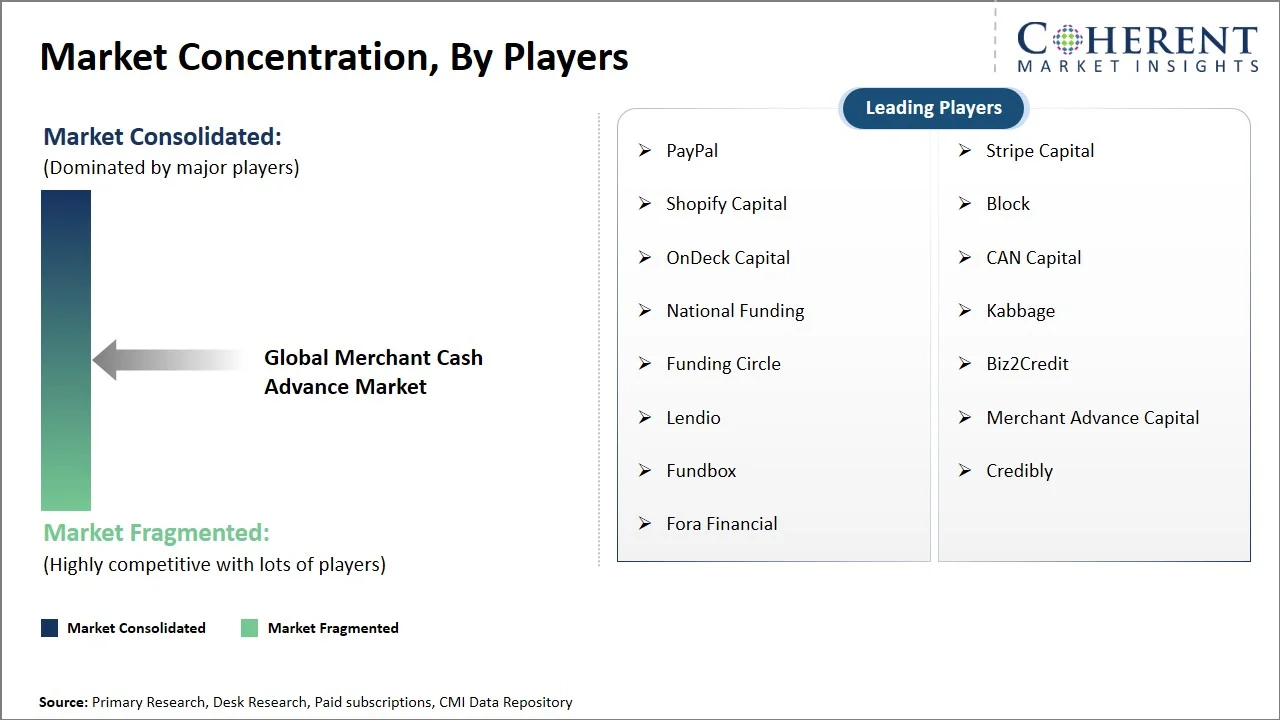
Established fintech lenders, payment processors, specialized MCA providers, and embedded finance platforms compete based on timeliness of funding, underwriting capabilities, digital integration, and customer experience in the worldwide merchant cash advance industry. More and more companies like PayPal, Stripe, Shopify, Block, OnDeck, CAN Capital, National Funding and others are using transaction data and payment infrastructures to increase their finance portfolios, hence intensifying market rivalry. Partnerships with payment processors, POS providers, e-commerce platforms, and accounting software vendors are increasingly being used to enhance market presence and optimize merchant acquisition.
Market Report Scope
Merchant Cash Advance Market Report Coverage
| Report Coverage | Details | ||
|---|---|---|---|
| Base Year: | 2025 | Market Size in 2026: | USD 32 Bn |
| Historical Data for: | 2020 To 2024 | Forecast Period: | 2026 To 2033 |
| Forecast Period 2026 to 2033 CAGR: | 9.5% | 2033 Value Projection: | USD 59 Bn |
| Geographies covered: |
| ||
| Segments covered: |
| ||
| Companies covered: | PayPal, Stripe Capital, Shopify Capital, Block, OnDeck Capital, CAN Capital, National Funding, Kabbage, Funding Circle, Biz2Credit, Lendio, Merchant Advance Capital, Fundbox, Credibly, and Fora Financial | ||
| Growth Drivers: |
| ||
| Restraints & Challenges: |
| ||
Analyst Opinion (Expert Opinion)
- The continuous digitalization of small business financing and increased acceptance of embedded lending solutions are projected to have a beneficial impact on the merchant cash advance market. There is increasing focus on AI-led underwriting, real-time transaction analysis and automated repayment processes to increase risk management and operational efficiency. While large markets are likely to see more regulatory monitoring and transparency requirements, these changes are usually seen as positive for long-term credibility and sustainable expansion of the industry.
- Deeper integration with payment platforms, digital wallets, e-commerce marketplaces and POS ecosystems are projected to drive strong development potential. Increased use is predicted among SMEs, online merchants and underserved firms seeking quick access to working cash without typical collateral restrictions. In addition, the market is expected to be driven by advancements in open banking, alternative data analytics, and embedded finance models, which would likely increase the accessibility of financing and the scalability of merchant cash advance solutions worldwide.
Speak to the analyst
Want personalized insights?
Take the findings above to one of our principal consultants, or have the report rebuilt around the segments, geographies and competitors you actually track.
Market Segmentation
- Repayment Method Insights (Revenue, USD Billion, 2021 - 2033)
- MCA Split
- Automated Clearing House
- Lockbox Account
- Hybrid Models
- End User Insights (Revenue, USD Billion, 2021 - 2033)
- Retail and E-commerce
- Restaurants and Hospitality
- Healthcare
- Construction
- Manufacturing
- IT and Telecom
- Travel and Hospitality
- Others
- Regional Insights (Revenue, USD Billion, 2021 - 2033)
- North America
- U.S.
- Canada
- Latin America
- Brazil
- Argentina
- Mexico
- Rest of Latin America
- Europe
- Germany
- U.K.
- Spain
- France
- Italy
- Russia
- Rest of Europe
- Asia Pacific
- China
- India
- Japan
- Australia
- South Korea
- ASEAN
- Rest of Asia Pacific
- Middle East
- GCC Countries
- Israel
- Rest of Middle East
- Africa
- South Africa
- North Africa
- Central Africa
- North America
- Key Players Insights
- PayPal
- Stripe Capital
- Shopify Capital
- Block
- OnDeck Capital
- CAN Capital
- National Funding
- Kabbage
- Funding Circle
- Biz2Credit
- Lendio
- Merchant Advance Capital
- Fundbox
- Credibly
- Fora Financial
Sources
Primary Research Interviews
- Merchant Cash Advance Providers & Lenders
- Small and Medium Enterprise (SME) Business Owners
- Financial Technology (FinTech) Solution Providers
- Banking & Alternative Finance Consultants
Magazines
- Forbes Finance Magazine
- American Banker Magazine
- FinTech Magazine
- Business Finance Magazine
Journals
- Journal of Financial Services Research
- Journal of Alternative Finance & Banking
- International Journal of FinTech and Financial Innovation
Associations
- Electronic Transactions Association (ETA)
- Small Business Finance Association (SBFA)
- National Federation of Independent Business (NFIB)
- Commercial Finance Association (CFA)
Public Domain Sources
- U.S. Small Business Administration (SBA) – Official Reports & Data
- Federal Reserve Bank – Small Business Credit Survey
- Consumer Financial Protection Bureau (CFPB) – Published Guidelines & Reports
- World Bank – Financial Inclusion Data & Reports
Proprietary Elements
- CMI Data Analytics Tool
- Proprietary CMI Existing Repository of Information for the Last 10 Years
Get access to 250+ pages report
Every segment, forecast, competitor profile and data table behind the analysis above — available for instant download.
- ESOMAR Member
- ISO 9001:2015 Certified
- D-U-N-S Registered
- GDPR & CCPA Compliant
Missing comfort of reading report in your local language? Find your preferred language:
Transform your Strategy with Exclusive Trending Reports
Frequently Asked Questions
The global merchant cash advance market is expected to stand at USD 32 Bn in 2026 and is expected to reach USD 59 Bn by 2033.
The CAGR of the global merchant cash advance market is projected to be 9.5% from 2026 to 2033.
Growing demand for fast and flexible business financing and increasing number of SMEs and micro-enterprises globally are the major factors driving the growth of the global merchant cash advance market.
Higher financing costs compared with bank loans and regulatory scrutiny of alternative lending practices are the major factors hampering the growth of the global merchant cash advance market.
In terms of repayment method, the MCA split segment is estimated to dominate the market revenue share in 2026.
A merchant cash advance is repaid through future sales receipts rather than fixed monthly installments and is not typically structured as a conventional loan.
Repayments are generally collected as a fixed percentage of daily or weekly sales transactions.