

Middle East & Africa Electric Scooter Market Size and Forecast – 2026-2033
The Middle East & Africa electric scooter market is estimated to be valued at USD 1.23 Bn in 2026 and is expected to reach USD 2.24 Bn by 2033, exhibiting a compound annual growth rate (CAGR) of 8.9% from 2026 to 2033.
Key Takeaways of the Middle East & Africa Electric Scooter Market
- The shared dockless segment is expected to lead the market holding a share of 46.2 % in 2026.
- The fixed segment is projected to dominate with a share of 61.7 % in 2026.
Market Overview
The market is seeing a rise in government initiatives pushing green transportation, including subsidies and incentives for electric scooter purchases. Also, advancements in battery technology and charging infrastructure are improving scooter efficiency and convenience, further boosting consumer demand. The growing preference for last-mile connectivity options in congested urban centers also adds to the market expansion, positioning electric scooters as a popular alternative to traditional fuel-based vehicles.
Current Events and Its Impact
Current Events | Description and its Impact |
Geopolitical and Trade Developments |
|
Economic and Infrastructure Trends |
|
Segmental Insights
- Current Industry Events of 2026
- Market Size Estimation
- Regional Breakdown
- Competitive Landscape
- Customer Intelligence
- Segmental Analysis
- Pricing Analysis
- Key Market Drivers, Challenges & Future Trends
- Customized Insights Section
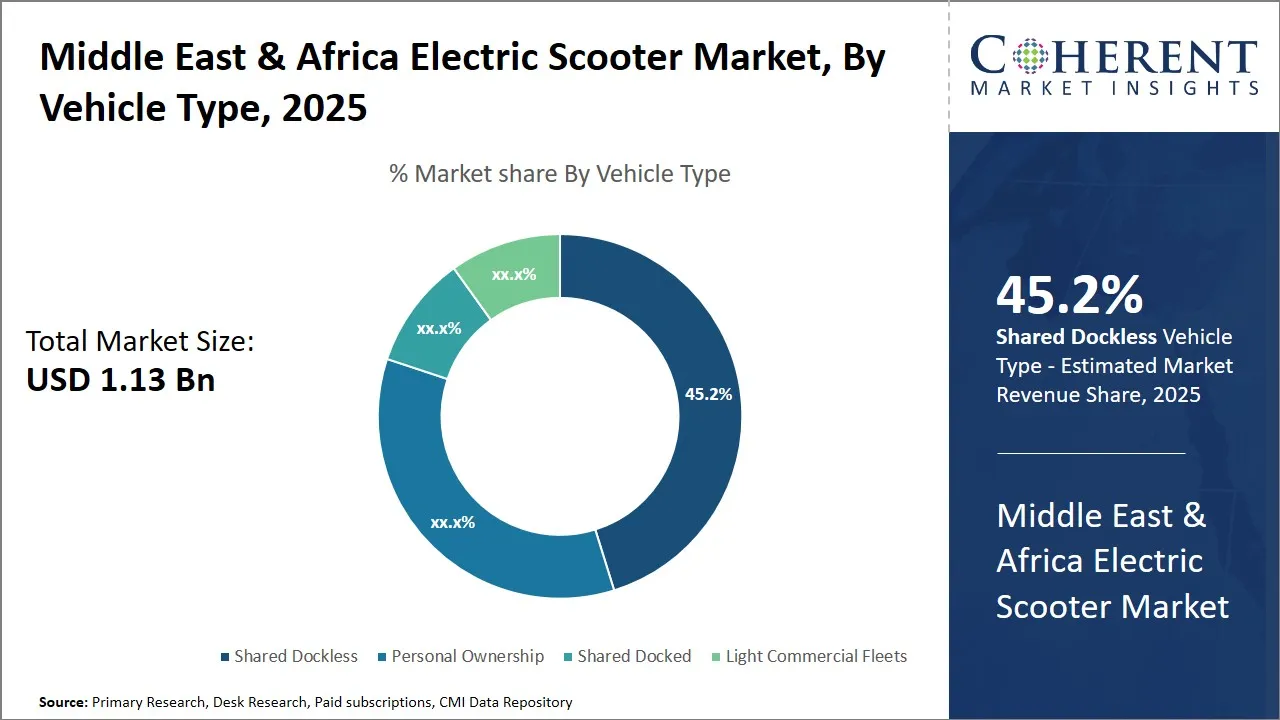
Middle East & Africa Electric Scooter Market Insights, By Vehicle Type – Shared Dockless Leads Because of its Convenience and Urban Mobility Advantages
The shared dockless segment, holding an estimated 46.2% of the market share in 2026, leads the Middle East & Africa electric scooter market because of its unmatched convenience and flexibility. It allows users to pick up and drop off scooters anywhere, removing dependence on docking stations—a key advantage in congested urban centers where parking and infrastructure are limited.
Fast urbanization and rising traffic congestion across GCC and African cities drive adoption, as these scooters ensure smooth last-mile connectivity between public transport and destinations. App-based rentals, GPS tracking, and mobile payments further increase user accessibility.
Governments across the region are also encouraging eco-friendly, low-emission transport, aligning dockless scooters with national sustainability goals and smart city initiatives. Also, their low operational cost appeals to students, gig workers, and budget commuters looking for short-distance mobility.
In Dubai, companies like Tier Mobility and Lime have deployed big dockless e-scooter fleets under the Roads and Transport Authority (RTA) framework, enabling riders to access scooters seamlessly across business districts and residential zones.
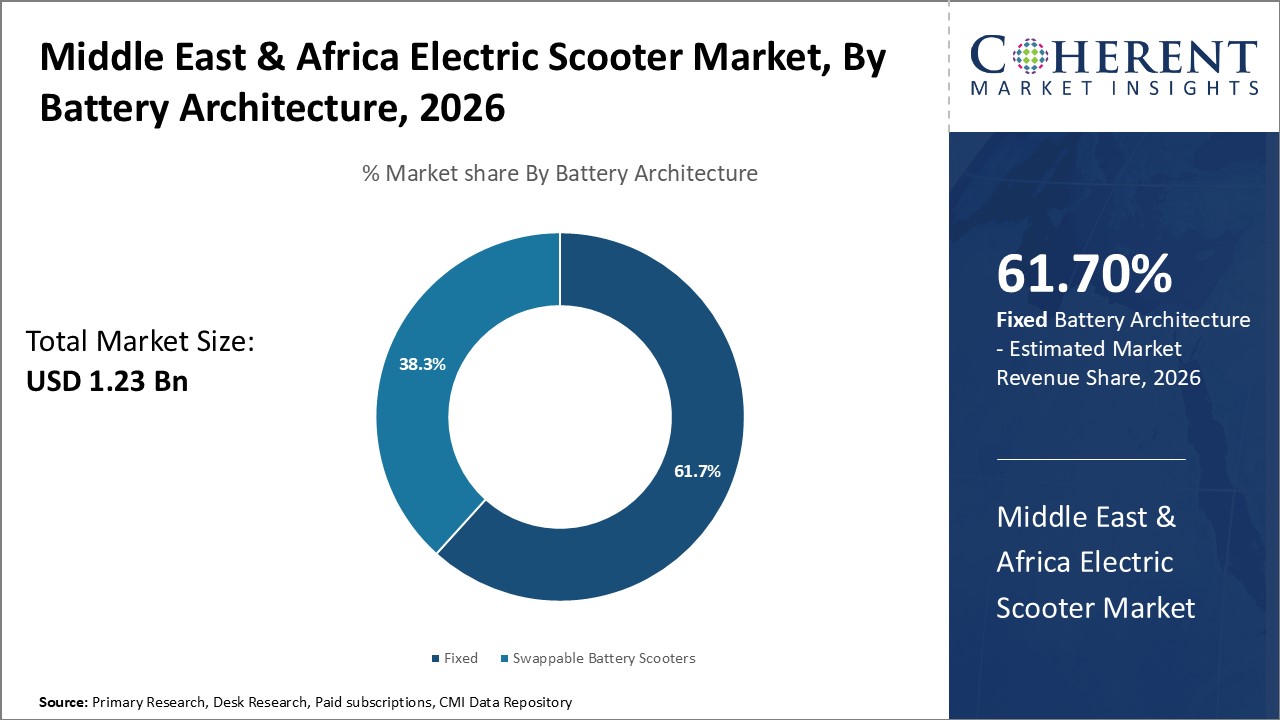
Middle East & Africa Electric Scooter Market Insights, By Battery Architecture – Fixed Battery Scooters Lead the Market Due to Enhanced Reliability and Cost Efficiency
The fixed segment, with an estimated 61.7% of the market share in 2026, dominates the Middle East & Africa electric scooter market because of its reliability, lower costs, and reduced maintenance needs. Fixed battery scooters offer consistent power performance and a simple design with fewer mechanical issues, making them suited for regions where charging or swapping infrastructure is still limited.
Users can get longer battery life per charge and the ability to conveniently recharge at home or in-office, reducing downtime. The sealed battery design also performs better in harsh climates—resisting dust and heat common in GCC and African countries.
Technological advances, including better energy density and faster charging, have added to user confidence and grown ride ranges, further adding to the segment’s appeal to both individuals and fleet operators. In Kenya, startup Roam offers fixed-battery electric scooters and motorcycles designed for African road conditions, emphasizing durability and cost efficiency for daily commuters and delivery riders.
Pricing Analysis of the Middle East & Africa Electric Scooter Market
Product/Segment | Price |
Yakuza Neu Electric Scooter – lower-cost import for Africa/MEA | USD 260.00 |
Xiaomi Electric Scooter 5 Pro – higher spec consumer model | USD 515.00 |
Electric Scooter 72 V 5000 W 30 Ah – high-power/long-range import model | Estimate USD 450–500 |
Xiaomi Electric Scooter 4 – budget foldable commuter model | USD 218.00 |
Local premium brand (example: Inokim Light 2 Max) | ≈ USD 735.00 |
Middle East & Africa Electric Scooter Market – Usage Patterns and Average Trip Metrics (2025)
Parameter | Estimate/Observation |
Average Trip Distance | 2.5 – 3.8 km per ride |
Average Trip Duration | 10 – 15 minutes |
Average Trips per Scooter per Day (Shared Fleet) | 4 – 7 trips/day |
Average Fare per Trip (Shared Models) | USD 1.5 – 3.0 per ride |
Average Daily Travel Distance (Personal Ownership) | 5 – 10 km/day |
Peak Usage Hours | 7:00–9:00 a.m. and 5:00–8:00 p.m. |
User Demographics | 18–35 years old; 65% male/35% female |
Ownership vs. Shared Usage Ratio | Personal: 35%/Shared: 65% |
Average Fleet Turnover Rate (Shared Operators) | 12–18 months |
Most Common Usage Purpose | Last-mile commute (45%), short leisure rides (30%), delivery/logistics (25%) |
Fleet Business Model Metrics for Shared E-Scooter Operators for the Middle East & Africa Electric Scooter Market
Metric | Value (2025) |
Avg. purchase price (CapEx) per scooter (unit cost to operator) | USD 450 – 850 |
Average trips per scooter per day (shared fleets) | 4.5 – 7.0 trips/day (MEA average) |
Avg. trip distance | 2.0 – 3.5 km |
Avg. revenue per trip (operator gross) | USD 1.50 – 3.00 |
Avg. gross revenue per scooter per day | USD 7 – 15 |
Average monthly maintenance & repair cost per scooter | USD 8 – 25/month |
Charging/energy cost per scooter per day | USD 0.20 – 1.20 |
Rebalancing & collection cost per scooter per month | USD 10 – 45/month |
Insurance & permits per scooter per year | USD 20 – 80/year |
Avg. fleet uptime (availability) per scooter | ~85% availability |
Typical useful fleet lifespan (before replacement) | 18 – 36 months |
Replacement/churn rate (annual) | 30% – 70% of fleet/year |
Payback period (unit-level, ignoring corporate overheads) | 6 – 20 months |
Contribution margin per scooter (after direct OPEX excluding depreciation & overheads) | ~20% – 45% of gross revenue |
Breakdown of OPEX as % of gross revenue (typical) | Charging 6–12%; Maintenance 10–18%; Rebalancing 12–30%; Insurance/permits 2–5% |
Typical fleet scale for viable city launch (minimum) | ~500 – 2,000 scooters |
KPIs operators watch (key thresholds) | Utilization ≥5 trips/day, Avg fare ≥USD 1.5, Lifespan ≥18 months |
Battery-Chemistry & Lifecycle Cost Breakdown for the Middle East & Africa Electric Scooter Market
Chemistry | Pack cost (USD/kWh) | Pack size (Wh) | Replacement cost per pack (USD) | Lifetime full cycles (cycles) | Estimated lifetime range (km) = throughput × 60 km/kWh | Replacement frequency (years) @ 15 km/day |
NMC (e.g., NMC111/532/622 variants) | USD 120/kWh (pack-level). | 250 Wh (0.25 kWh) | USD 30.00 (0.25 kWh × USD 120) | 1,500 cycles | 22,500 km (375 × 60) | ~4.11 years (22,500 ÷ (15×365)) |
500 Wh (0.50 kWh) | USD 60.00 (0.5 × USD 120) | 1,500 cycles | 45,000 km | ~8.22 years | ||
LFP (Li-Fe-PO₄) | USD 80/kWh (pack-level). | 250 Wh (0.25 kWh) | USD 20.00 (0.25 × USD 80) | 4,000 cycles | 60,000 km | ~10.96 years |
Regulatory Policy & Incentive Mapping — MEA (2025)
Country | Policy & incentive mapping (2025) |
U.A.E. (Dubai, Abu Dhabi) |
|
Saudi Arabia |
|
Qatar |
|
Oman |
|
Bahrain |
|
Kuwait |
|
Egypt |
|
Morocco |
|
Tunisia |
|
Algeria |
|
South Africa |
|
Kenya |
|
Nigeria |
|
Rwanda |
|
Ghana |
|
Market Players, Key Development, and Competitive Intelligence
Key Developments
- In October 2025, Spiro, the African leader in two-wheel transportation and battery swapping, announced a landmark USD 100 million investment round, the largest investment in African two-wheel electric mobility ever. This includes USD 75 million from The Fund for Export Development in Africa (FEDA), the development impact investment arm of African Export-Import Bank (Afreximbank).
- In December 2024, Bolt, one of the international leading ride-hailing platforms present currently in over 600 cities across 50 countries, launched its operations in the U.A.E.
- In November 2024, Pure EV, an Indian electric two-wheeler manufacturer, partnered with Arva Electric Vehicles Manufacturing LLC, a subsidiary of Clarion Investment LLC, to distribute and sell electric motorcycles in the Middle East and Africa.
- In June 2024, the Ministry of Transport, Communications and Information Technology (MTCIT) in Oman, in collaboration with Knowledge Oasis Muscat (KOM), the technical arm of Madayn, initiated a pioneering experiment called the Smart Mobility Service Using Electric Scooters.
Top Strategies Followed by the Middle East & Africa Electric Scooter Market Players
- Established players in the region, often global leaders with huge resources, invest a lot in research and development (R&D) to continuously innovate high-performance electric scooters that cater to both urban commuters and environmentally conscious consumers.
- Tier Mobility has made scooters with replaceable battery modules and AI-driven geofencing, integrated with Dubai RTA’s smart mobility system to enhance safety and energy efficiency.
- Mid-level players in the Middle East & Africa electric scooter market adopt a somewhat different approach by concentrating on cost-effective solutions that strike a careful balance between quality and affordability.
- FENIX focuses on affordable, region-adapted scooters with simplified mechanics and durable frames to reduce maintenance costs, while offering flexible ride passes and subscription-based ownership models.
- Small-scale players in the competitive landscape make their niche by emphasizing innovative and specialized products made for unique consumer preferences or unmet needs within specific regional markets.
- Roam is a local startup producing electric motorcycles and scooters tailored for delivery services and African road conditions, emphasizing fixed-battery durability and cost savings for fleet operators.
Market Report Scope
Middle East & Africa Electric Scooter Market Report Coverage
| Report Coverage | Details | ||
|---|---|---|---|
| Base Year: | 2025 | Market Size in 2026: | USD 1.23 Bn |
| Historical Data for: | 2020 To 2024 | Forecast Period: | 2026 To 2033 |
| Forecast Period 2026 to 2033 CAGR: | 8.9% | 2033 Value Projection: | USD 2.24 Bn |
| Segments covered: |
| ||
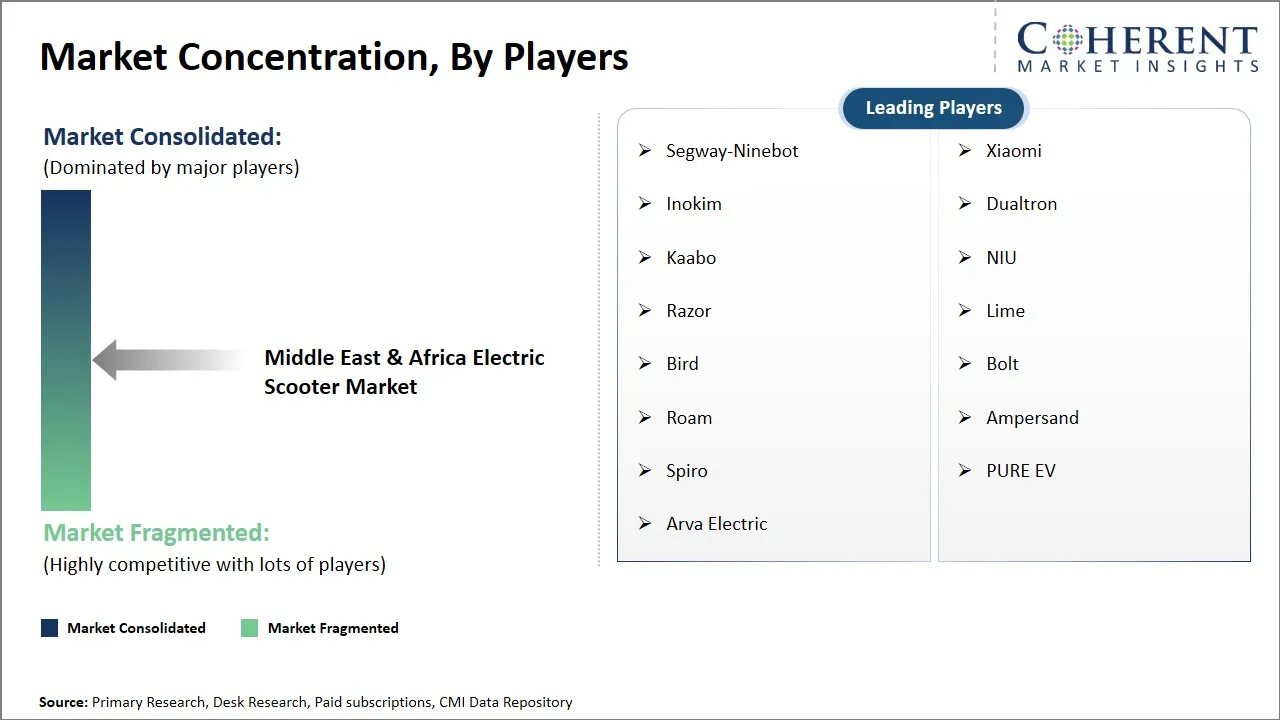
| Companies covered: | Segway-Ninebot, Xiaomi, Inokim, Dualtron, Kaabo, NIU, Razor, Lime, Bird, Bolt, Roam, Ampersand, Spiro, PURE EV, and Arva Electric | ||
| Growth Drivers: |
| ||
| Restraints & Challenges: |
| ||
Market Dynamics
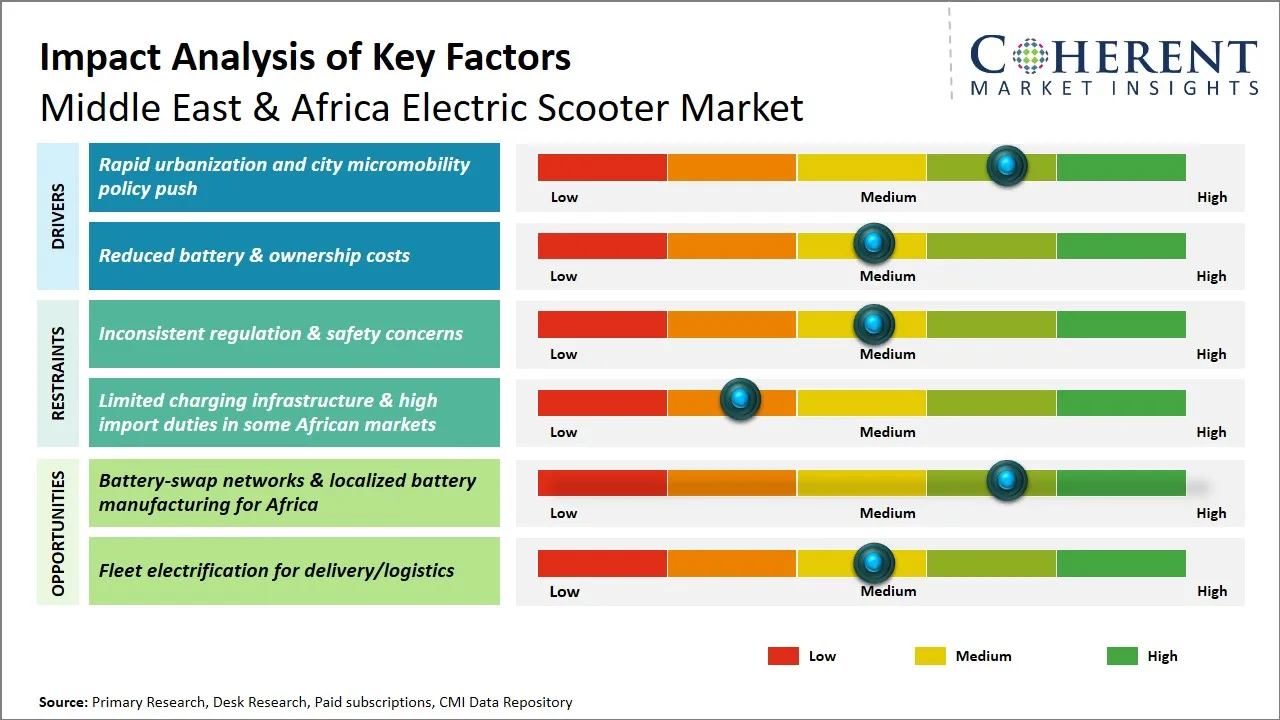
Middle East & Africa Electric Scooter Market Driver – Rapid Urbanization and City Micromobility Policy Push
The fast pace of urbanization in the Middle East and Africa is changing mobility patterns, pushing cities to adopt sustainable and efficient transport modes. Governments are pushing micromobility integration by introducing dedicated scooter lanes, linking shared scooters to public transport systems, and issuing supportive regulations to reduce congestion and emissions. These city-level initiatives make e-scooters a good last-mile alternative for growing urban populations seeking affordable, flexible commutes. In Dubai, the RTA’s Smart Mobility Plan expanded e-scooter zones across 21 districts in 2025, adding them with metro and bus routes to improve last-mile connectivity and reduce private car dependence.
Middle East & Africa Electric Scooter Market Opportunity – Battery-Swap Networks & Localized Battery Manufacturing for Africa
The region’s electric scooter market sees growth because of battery-swap infrastructure and localized battery production, particularly in Africa. Swapping networks address long charging times and limited charging access, while local manufacturing can reduce costs, make supply chains stronger, and create jobs. Together, they form a sustainable ecosystem supporting wider electric mobility adoption. In Kenya, Ampersand and Spirra Africa have launched battery-swap networks for electric two-wheelers, complemented by local battery assembly facilities in Nairobi, improving operational uptime and cutting import reliance for fleet operators.
Analyst Opinion (Expert Opinion)
- Despite ambitious micromobility policies, the region’s charging and road infrastructure remains very inadequate. Most cities lack dedicated scooter lanes or accessible charging points, pushing operators to work in fragmented, unsafe environments that affect scalability and consumer trust.
- The market’s dependence on imported scooters, batteries, and components—especially from China and Europe—keeps unit economics fragile. Currency fluctuations and tariffs further add to operational costs, preventing many startups from achieving profitability or growing beyond pilot programs.
- While governments are increasingly aware of e-mobility’s potential, regulations remain inconsistent and reactive. Some cities still see electric scooters as nuisances rather than integral to transport ecosystems, resulting in frequent policy reversals, limited licenses, and poor enforcement standards.
Speak to the analyst
Want personalized insights?
Take the findings above to one of our principal consultants, or have the report rebuilt around the segments, geographies and competitors you actually track.
Market Segmentation
- Vehicle Type Insights (Revenue, USD Bn, 2021 - 2033)
- Shared Dockless
- Personal Ownership
- Shared Docked
- Light Commercial Fleets
- Battery Architecture Insights (Revenue, USD Bn, 2021 - 2033)
- Fixed
- Swappable Battery Scooters
- Key Players Insights
- Segway-Ninebot
- Xiaomi
- Inokim
- Dualtron
- Kaabo
- NIU
- Razor
- Lime
- Bird
- Bolt
- Roam
- Ampersand
- Spiro
- PURE EV
- Arva Electric
Sources
Primary Research Interviews
Stakeholders
- Urban Mobility Authorities and Transport Regulators
- Electric Scooter Manufacturers and Importers
- Shared Mobility Operators
- Battery and Powertrain Suppliers
- Municipal and Smart City Planners
- Environmental and Sustainability Experts focusing on Green Mobility Integration
- Fleet Leasing and Micromobility Service Providers operating in GCC and African cities
Databases
- World Bank Open Data – Urban Transport & Electrification Statistics
- African Development Bank (AfDB) Transport Sector Database
- GulfStat – GCC Sustainable Transport Database
- BloombergNEF Electric Mobility Insights
- OECD Transport and Innovation Statistics
Magazines
- Smart Mobility Middle East
- Africa Transport Review
- EV Tech Africa
- Mobility Business Weekly
- CleanTech Arabia
Journals
- Journal of Sustainable Transportation Systems
- Urban Mobility and Policy Journal
- Renewable Energy & Electric Vehicle Journal
- African Journal of Transport and Logistics
- Journal of Urban Technology and Development
Newspapers
- The National (U.A.E.)
- Gulf News
- Business Day (South Africa)
- The East African
- Khaleej Times
- The Guardian (Nigeria)
Associations
- Middle East Electric Mobility Association (MEEMA)
- Africa E-Mobility Alliance (AfEMA)
- International Energy Agency (IEA) – Electric Vehicle Division
- Global Sustainable Transport Forum (GSTF)
- United Nations Environment Programme (UNEP) – Electric Mobility Initiative
Public Domain Sources
- United Nations Economic Commission for Africa (UNECA)
- International Renewable Energy Agency (IRENA)
- World Bank Group – Sustainable Mobility Program
- African Union (AU) Transport Policy Documents
- ResearchGate – Open Access EV and Micromobility Studies
Proprietary Elements
- CMI Data Analytics Tool, Proprietary CMI Existing Repository of information for the Last 8 Years
Get access to 250+ pages report
Every segment, forecast, competitor profile and data table behind the analysis above — available for instant download.
- ESOMAR Member
- ISO 9001:2015 Certified
- D-U-N-S Registered
- GDPR & CCPA Compliant
Missing comfort of reading report in your local language? Find your preferred language:
Transform your Strategy with Exclusive Trending Reports
Frequently Asked Questions
The Middle East & Africa electric scooter market is estimated to be valued at USD 1.23 billion in 2026 and is expected to reach USD 2.24 billion by 2033.
The CAGR of the Middle East & Africa electric scooter market is projected to be 8.9% from 2026 to 2033.
Rapid urbanization and city micromobility policy push and reduced battery & ownership costs are the major factors driving the growth of the Middle East & Africa electric scooter market.
Inconsistent regulation & safety concerns and limited charging infrastructure & high import duties in some African markets are the major factors hampering the growth of the Middle East & Africa electric scooter market.
In terms of vehicle type, the shared dockless segment is estimated to dominate the market revenue share in 2026.
Segway-Ninebot, Xiaomi, Inokim, Dualtron, Kaabo, NIU, Razor, Lime, Bird, Bolt, Roam, Ampersand, Spiro, PURE EV, and Arva Electric are the major players.
Governments are supporting electric scooters through incentives such as reduced import duties, pilot-sharing licenses, and emission reduction programs.