

Global Mobile Entertainment Market Size and Forecast: 2026-2033
Coherent Market Insights estimates that the global mobile entertainment market is expected to reach USD 200 Bn in 2026 and will expand to USD 480 Bn by 2033, registering a CAGR of 11% between 2026 and 2033.
Key Takeaways of the Mobile Entertainment Market
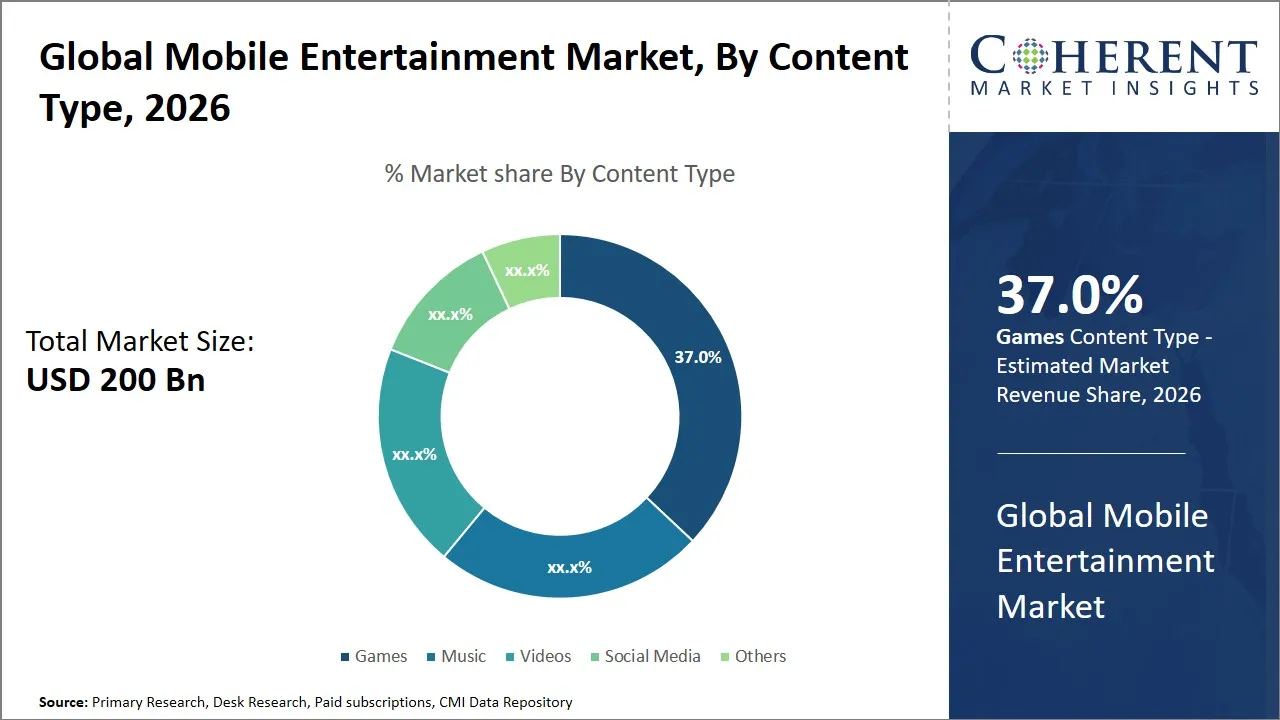
- The games segment is expected to account for 37% of the mobile entertainment market share in 2026.
- The Android segment is estimated to capture 41% of the market share in 2026.
- The subscription segment is projected to hold 48% of the global mobile entertainment share in 2026.
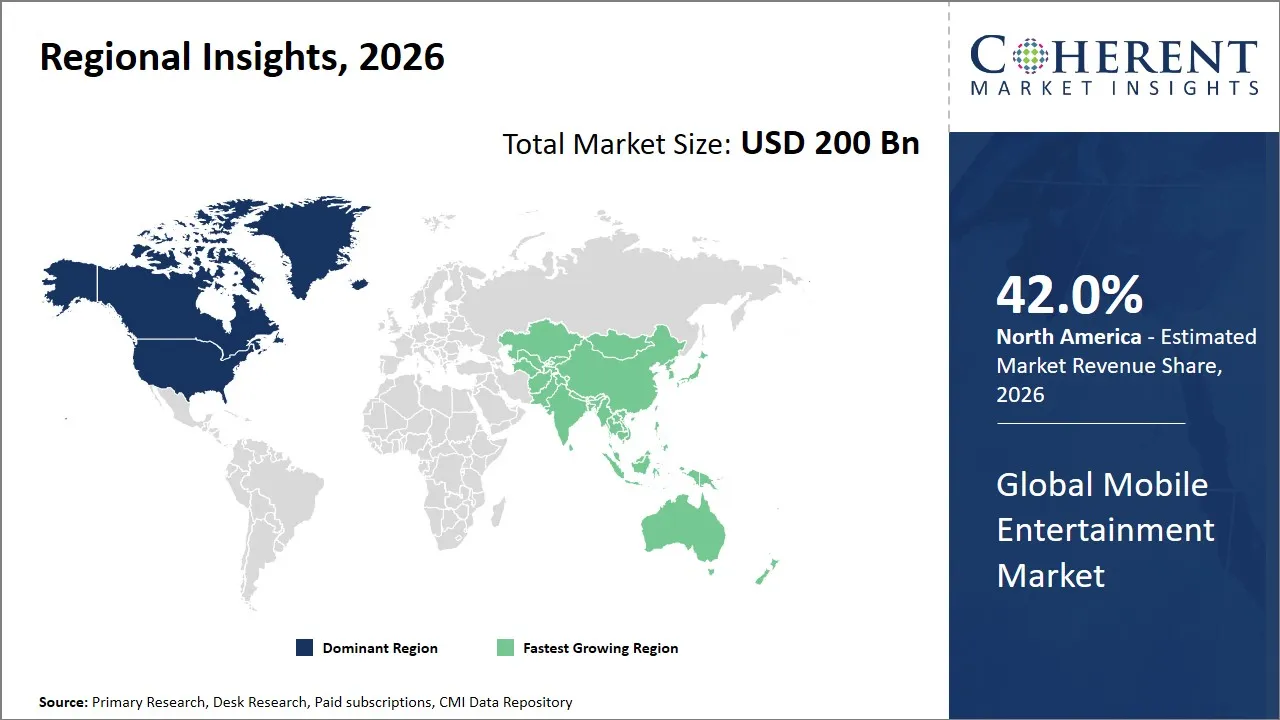
- North America will dominate the mobile entertainment market in 2026 with an estimated 42%
- Asia Pacific will hold 27% share in 2026 and is expected to record the fastest growth over the forecast period.
Currents Events and Its Impact
Current Events | Description and its Impact |
Krafton Blue Ocean Games Fund |
|
Segmental Insights
- Current Industry Events of 2026
- Market Size Estimation
- Regional Breakdown
- Competitive Landscape
- Customer Intelligence
- Segmental Analysis
- Pricing Analysis
- Key Market Drivers, Challenges & Future Trends
- Customized Insights Section
Why Does the Games Segment Dominate the Global Mobile Entertainment Market in 2026?
The games segment is expected to account for 37.0% of the global mobile entertainment market share in 2026. The growth is largely driven by the dynamic nature of interactive content that games offer compared to other content types such as music, videos, or social media. Mobile games provide a personalized and engaging environment that appeals to a vast demographic spectrum, from casual gamers to hardcore enthusiasts. This diverse appeal is supported by continuous advancements in game design, graphics quality, and augmented reality (AR) integration, which together have elevated the user experience to new levels.
For instance, on November 14, 2025, Netflix confirmed the release of WWE 2K mobile games exclusively for subscribers, expanding mobile interactive offerings beyond video streaming.
(Source: netflix.com)
Android Segment Dominates the Global Mobile Entertainment Market
The android segment is projected to account for 41.0% of the mobile entertainment market share in 2026. Available across many devices at different prices, expansion begins here. Where some systems demand specific hardware or charge more, one alternative runs on countless phones and tablets worldwide. Emerging regions benefit just as much as wealthier nations do. Broader reach means wider usage, which leads naturally to increased media engagement through that ecosystem.
Why is Subscription the Most Crucial Revenue Model in the Mobile Entertainment Market?
The subscription segment is expected to account for 48.0% of the market share in 2026. The growth is due to their alignment with evolving consumer consumption habits. Subscriptions enable users to access a wide variety of entertainment content continuously for a fixed periodic fee, reducing the friction of one-time purchases and encouraging prolonged engagement. This model ensures predictable and steady revenue streams for service providers while delivering ongoing value to consumers.
Global Mobile Entertainment Market - Creator Economy Integration
Creator | Primary Platforms | Total Followers |
MrBeast (Jimmy Donaldson) | YouTube, Instagram | ~634 million |
Dhar Mann | YouTube, TikTok | ~137 million |
Jake Paul | Multi-platform | ~79 million |
Matt Rife | Multi-platform | ~42 million |
Rhett & Link | YouTube | ~33.8 million |
Regional Insights
North America Mobile Entertainment Market Analysis and Trends
The North America region is projected to lead the market with a 42% share in 2026. Driven by advanced tech systems, quick uptake of mobile devices emerges. A mature digital space follows closely behind. Strong phone usage spreads across populations here. Fast internet access enables smooth delivery of games, video streams, also AR tools. Innovation thrives under policy frameworks focused on secure data practices. Legal safeguards around inventions add stability.
Major players including Apple and Microsoft shape how markets evolve. Netflix influences user habits noticeably. This area hosts key centers where new media forms develop. Venture funding flows steadily into emerging firms working in mobile experiences. Growth continues amid steady support for experimental projects. Regional strengths align with long-term shifts in digital behavior.
For instance, on December 9, 2025, Spotify officially expanded music video support in beta to Premium users in the U.S. and Canada. This expansion gives millions more listeners access to a catalog of official music videos, from studio versions to live performances and covers.
(Source: newsroom.spotify.com)
Asia Pacific Mobile Entertainment Market Analysis and Trends
The Asia Pacific region is expected to exhibit the fastest growth in the market contributing 27% share in 2026. Growth finds its roots in fast-spreading smartphone usage, rising numbers of middle-income households, while internet access spreads widely through countries like India and parts of Southeast Asia. Younger users set the pace, their ease with gadgets reshaping how mobile entertainment unfolds, attention turns toward interactive games, real-time sound platforms, or setups built around sharing.
When public institutions step in, progress in digital spaces often follows infrastructure expansion coupled with support for homegrown ideas. Companies such as Tencent, Sony Interactive Entertainment from Japan, and NetEase continue to hold sway, adjusting services to match local tastes, exploring algorithms that adapt, experimenting with gaming delivered remotely. Over time, regulations formed within regional agreements let digital content cross frontiers more smoothly, subtly guiding market direction.
Global Mobile Entertainment Market Outlook for Key Countries
Why is the U.S. Emerging as a Major Hub in the Mobile Entertainment Market?
Innovation defines the U.S. marketplace, where advanced technology meets high demand for mobile-based leisure activities. From companies like Apple to Amazon's Prime Video, alongside Activision Blizzard, control flows over how people engage with gaming, streaming, and interactive platforms. Because 5G spreads widely, those already comfortable with digital interfaces find expanded reach into these spaces. Underlying access shifts quietly beneath user habits, shaped by speed and corporate presence alike. Rules supporting fair digital development, safety for individuals online, and responsible handling of personal information contribute steadily to trust within the sector. Growth continues under conditions shaped by infrastructure strength and policy consistency.
Is China the Next Growth Engine for the Mobile Entertainment Market?
Driven by immense population scale, China's marketplace thrives alongside state-backed digital expansion goals. Instead of broad alliances, firms like Tencent and NetEase lead gaming and media delivery through original funding techniques, examples include mini-transaction systems and real-time broadcasts. While promoting local tech independence, authorities simultaneously enforce strict material oversight, influencing how platforms evolve. At the same time, upgrades in artificial intelligence combined with fifth-generation networks allow deeper engagement formats to take root. Growth remains steady because infrastructure progress matches consumer behavior shifts.
Japan Mobile Entertainment Market Analysis and Trends
Ahead lies steady motion, fueled by lasting cultural patterns in play and ongoing attraction to phone-centered entertainment. Beyond firms like Sony Interactive Entertainment and Nintendo, fresh ideas form when durable console expertise meets handheld functionality. Mobile role-playing titles, story-rich software, and sound-sharing networks often pull attention, guiding commercial directions. Support flows quietly, shaped by state-backed digital upgrades and protections for intellectual property, letting progress unfold undisturbed.
India Mobile Entertainment Market Analysis and Trends
From rural outposts toward urban hubs, expansion unfolds through rising smartphone ownership across India. Though data costs drop steadily, advancement depends heavily on deeper skill development in digital navigation. Rather than global brands dominating, homegrown players like Jio, Disney+ Hotstar, and Relance Entertainment shape media offerings in local tongues. Backed by state-led drives like Digital India, network systems strengthen, lifting services such as online games, video platforms, and interactive social content. Because carriers now work closely with creators, combined packages emerge naturally, helping users adopt new tech at quicker rates.
South Korea Mobile Entertainment Market Analysis and Trends
Despite its compact size, South Korea hosts a mobile entertainment sector built on strong digital foundations. Driven by widespread tech engagement among users, innovation thrives under firms such as NCSoft. Through strong network frameworks, Kakao Games builds responsive digital environments. Efficiency in connections opens space for novel gameplay patterns. Supported by state initiatives focused on growth in creative sectors and tech advancement, the ecosystem gains resilience. With leading 5G coverage and progress in artificial intelligence, fresh modes like streamed games and immersive overlays take form. This infrastructure anchors South Korea's position amid international markets.
Market Players, Key Development, and Competitive Intelligence
Key Developments
- On December 10, 2025, Spotify announced Prompted Playlists, a new feature letting users steer the recommendation algorithm directly with natural language prompts, a major mobile UX innovation in content discovery and personalization
- On May 7, 2025, Netflix press office published coverage of a Marian Lee keynote at Online Marketing Rockstars 2025, reflecting the company’s ongoing marketing and experience strategy, while not exclusively mobile, its core to Netflix’s content engagement ecosystem
Top Strategies Followed by Global Mobile Entertainment Market Players
Player Type | Strategic Focus | Example |
Established Market Leaders | Business Collaboration | On December 18, 2025, ReLU Games and KRAFTON, Inc. announced that MIMESIS, its four-player co-op horror title, surpassed one million global sales just 50 days after launching in Early Access on Steam. |
Mid-Level Players | Immutable Gaming Division Launch | On September 19, 2025, Immutable, the global leader in gaming, announced the launch of its Mobile Gaming Division, a specialist taskforce dedicated to bringing their partner games into the USD 121 billion mobile market. |
Small-Scale Players | Bitkraft Investment | On June 4, 2025, Bitkraft Ventures, a U.S.-based early-stage investor focused on gaming and interactive media, announced plans to increase investments in India, as the market is expected to witness "exponential growth" over the next two to three years. |
Market Report Scope
Mobile Entertainment Market Report Coverage
| Report Coverage | Details | ||
|---|---|---|---|
| Base Year: | 2025 | Market Size in 2026: | USD 200 Bn |
| Historical Data for: | 2020 To 2024 | Forecast Period: | 2026 To 2033 |
| Forecast Period 2026 to 2033 CAGR: | 11 % | 2033 Value Projection: | USD 480 Bn |
| Geographies covered: |
| ||
| Segments covered: |
| ||
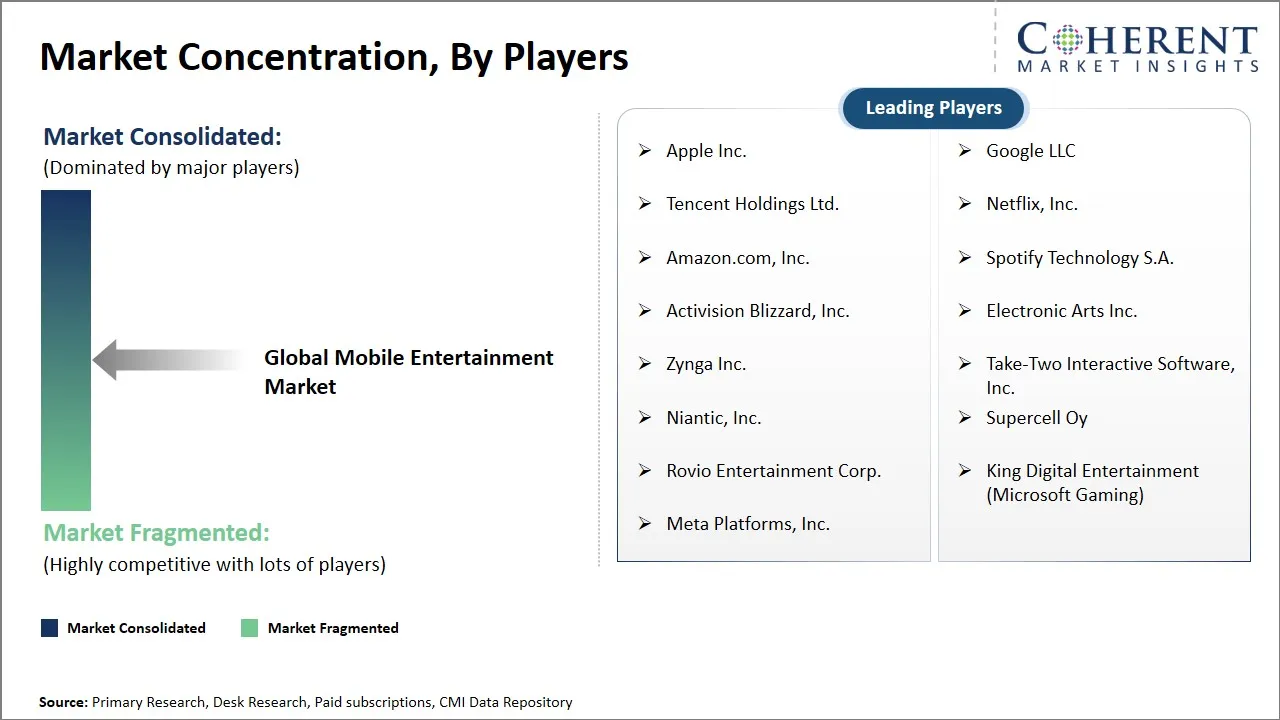
| Companies covered: | Apple Inc., Google LLC, Tencent Holdings Ltd., Netflix, Inc., Amazon.com, Inc., Spotify Technology S.A., Activision Blizzard, Inc., Electronic Arts Inc., Zynga Inc., Take‑Two Interactive Software, Inc., Niantic, Inc., Supercell Oy, Rovio Entertainment Corp., King Digital Entertainment (Microsoft Gaming), and Meta Platforms, Inc. | ||
| Growth Drivers: |
| ||
| Restraints & Challenges: |
| ||
Global Mobile Entertainment Market Dynamics
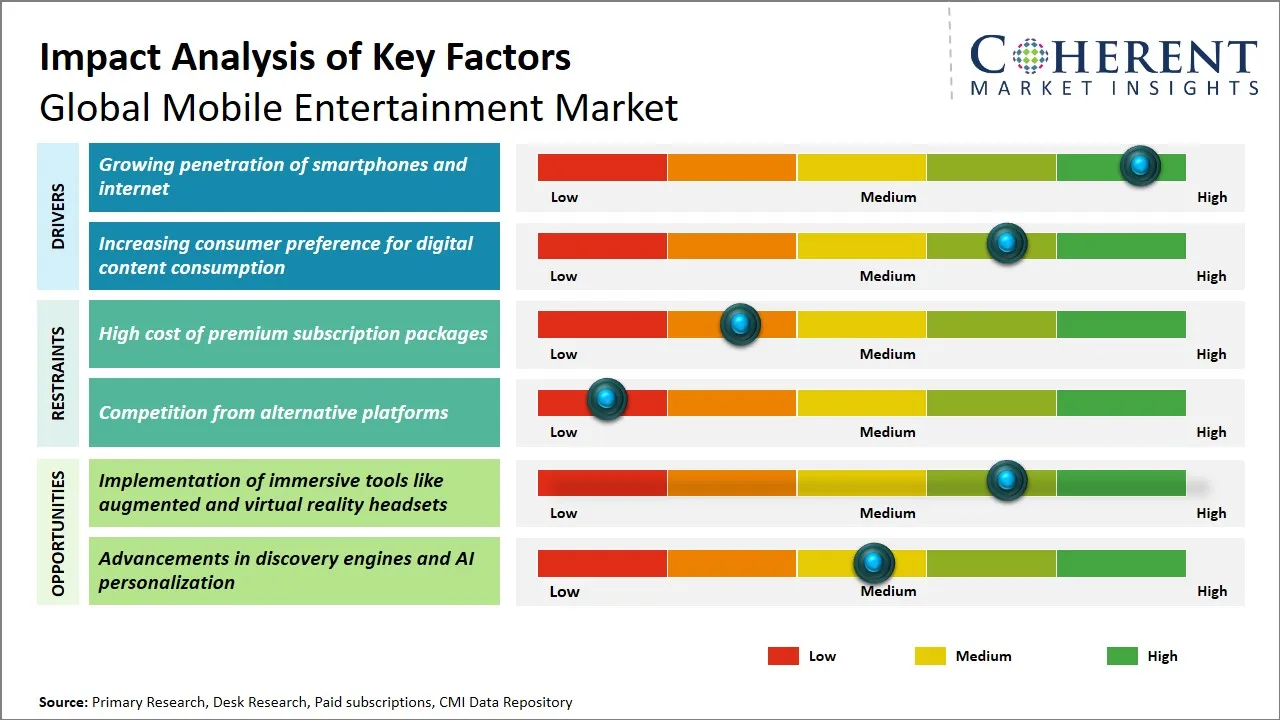
Global Mobile Entertainment Market Driver - Growing Penetration of Smartphones and Internet
A major outcome of more people owning smartphones is how entertainment reaches them today. Because internet access spreads further, staying connected shapes new patterns in what users explore online. Devices now handle tasks once limited to larger systems, offering games, videos, music, and communication tools together. With better network quality, experiences grow smoother across regions previously left behind. Lower prices on phones let distant areas join digital spaces they could not reach before. Progress in technology quietly shifts where and how audiences engage with media.
For instance, on August 26, 2025, AT&T announced it has agreed to purchase certain wireless spectrum licenses from EchoStar for a total of approximately USD 23 billion, subject to certain adjustments. AT&T and EchoStar have also agreed to enhance their long-term wholesale network services agreement, enabling EchoStar to operate as a hybrid mobile network operator (MNO) providing wireless service under the Boost Mobile brand.
(Source: about.att.com)
Global Mobile Entertainment Market Opportunity - Implementation of Immersive Tools Like Augmented and Virtual Reality Headsets
Immersive tools like virtual reality headsets or virtual and augmented reality overlays are finding space in today’s mobile entertainment landscape. Change shows most clearly in human interaction, shifting from passive watching to active participation. Mobile devices grow stronger, networks move faster, especially with broader 5G access, so rich visual data flows more freely. Because of this, what was once held back by technology now becomes possible, giving space for innovation in creation.
For instance, on October 22, 2025, Samsung Electronics unveiled Galaxy XR, introducing a new category of AI-native devices designed to deliver immersive experiences in a form factor optimized for multimodal AI. As the first product built on the new Android XR platform developed together by Samsung, Google and Qualcomm Technologies, Galaxy XR showcases the future of discovery, play and work, enabling users to enjoy natural, deeply immersive experiences from daily tasks to bold new frontiers.
(Source: news.samsung.com)
Analyst Opinion (Expert Opinion)
- Now beginning to stabilize, the worldwide mobile entertainment sector moves beyond simple expansion toward stronger revenue strategies. Rather than focusing on new users, attention turns to holding interest longer, especially where networks grow faster and gadgets improve. Video streams blend with games, brief clips, social features that bound together by smarter software that learns preferences. In regions gaining access, audiences rise steadily; elsewhere, income per person climbs via recurring fees, digital buys, or mixed systems. Growth patterns differ, yet progress continues across both landscapes.
- Future dynamics point toward tighter rivalry focused on integrated content environments instead of isolated applications. Success now favors systems combining play features, user networks, tools for creators, and region-specific material - linked through seamless access. Challenges persist: oversight demands grow stronger, concerns about personal data sharpen, and expenses tied to media creation climb steadily. Yet progress in artificial intelligence that generates output, along with improvements in game streaming via remote servers, opens real opportunity by reducing how hard it is to make content while enabling deeper, continuous engagement through handheld devices.
Speak to the analyst
Want personalized insights?
Take the findings above to one of our principal consultants, or have the report rebuilt around the segments, geographies and competitors you actually track.
Market Segmentation
- Content Type Insights (Revenue, USD Bn, 2026 - 2033)
- Games
- Music
- Videos
- Social Media
- Others
- Platform Type Insights (Revenue, USD Bn, 2026 - 2033)
- Android
- iOS
- Windows
- Others
- Revenue Model Insights (Revenue, USD Bn, 2026 - 2033)
- Subscription
- Advertisement
- Pay Per Download
- Others
- Regional Insights (Revenue, USD Bn, 2026 - 2033)
- North America
- U.S.
- Canada
- Latin America
- Brazil
- Argentina
- Mexico
- Rest of Latin America
- Europe
- Germany
- U.K.
- Spain
- France
- Italy
- Russia
- Rest of Europe
- Asia Pacific
- China
- India
- Japan
- Australia
- South Korea
- ASEAN
- Rest of Asia Pacific
- Middle East
- GCC Countries
- Israel
- Rest of Middle East
- Africa
- South Africa
- North Africa
- Central Africa
- North America
- Key Players Insights
- Apple Inc.
- Google LLC
- Tencent Holdings Ltd.
- Netflix, Inc.
- com, Inc.
- Spotify Technology S.A.
- Activision Blizzard, Inc.
- Electronic Arts Inc.
- Zynga Inc.
- Take‑Two Interactive Software, Inc.
- Niantic, Inc.
- Supercell Oy
- Rovio Entertainment Corp.
- King Digital Entertainment (Microsoft Gaming)
- Meta Platforms, Inc.
Sources
Primary Research Interviews
- Mobile game developers and publishers
- Streaming platform executives
- Mobile application distributors
- Telecommunications service providers
Databases
- Newzoo Global Games Database
Magazines
- Mobile Entertainment Magazine
- Pocket Gamer Magazine
- Games Industry International
- Digital Entertainment World
Journals
- International Journal of Mobile Communications
- Journal of Interactive Media in Education
- Entertainment Computing Journal
Newspapers
- Financial Times Technology Section
- Wall Street Journal Tech News
- Reuters Technology News
- TechCrunch Mobile Coverage
- VentureBeat Gaming Section
Associations
- Entertainment Software Association (ESA)
- Mobile Marketing Association (MMA)
- Interactive Advertising Bureau (IAB)
- Global System for Mobile Communications Association (GSMA)
- International Association of Mobile Operators (IAMO)
Public Domain Sources
- Federal Communications Commission (FCC) reports
- World Bank Digital Development reports
- ITU ICT Statistics database
- OECD Digital Economy Outlook
- European Commission Digital Single Market reports
Proprietary Elements
- CMI Data Analytics Tool
- Proprietary CMI Existing Repository of information for last 8 years
Get access to 250+ pages report
Every segment, forecast, competitor profile and data table behind the analysis above — available for instant download.
- ESOMAR Member
- ISO 9001:2015 Certified
- D-U-N-S Registered
- GDPR & CCPA Compliant
Missing comfort of reading report in your local language? Find your preferred language:
Transform your Strategy with Exclusive Trending Reports
Frequently Asked Questions
The global mobile entertainment market is expected to stand at USD 200 Bn in 2026 and is expected to reach USD 480 Bn by 2033.
The CAGR of global mobile entertainment market is projected to be 11.00% from 2026 to 2033.
Growing penetration of smartphones and internet and increasing consumer preference for digital content consumption are the major factors driving the growth of the global mobile entertainment market.
High cost of premium subscription packages and competition from alternative platforms are the major factors hampering the growth of the global mobile entertainment market.
In terms of content type, games are estimated to dominate the market revenue share in 2026.
Apple Inc., Google LLC, Tencent Holdings Ltd., Netflix, Inc., Amazon.com, Inc., Spotify Technology S.A., Activision Blizzard, Inc., Electronic Arts Inc., Zynga Inc., Take‑Two Interactive Software, Inc., Niantic, Inc., Supercell Oy, Rovio Entertainment Corp., King Digital Entertainment (Microsoft Gaming), and Meta Platforms, Inc. are the major players.
North America is expected to lead the global mobile entertainment market in 2026.