

Global Neuromorphic Hardware Market Size and Forecast – 2026-2033
The global neuromorphic hardware market is estimated to be valued at USD 3.52 Bn in 2026 and is expected to reach USD 17.45 Bn by 2033, reflecting a compound annual growth rate (CAGR) of 25.7% from 2026 to 2033.
Key Takeaways of the Neuromorphic Hardware Market
- The processors segment is expected to account for 58% of the neuromorphic hardware market share in 2026.
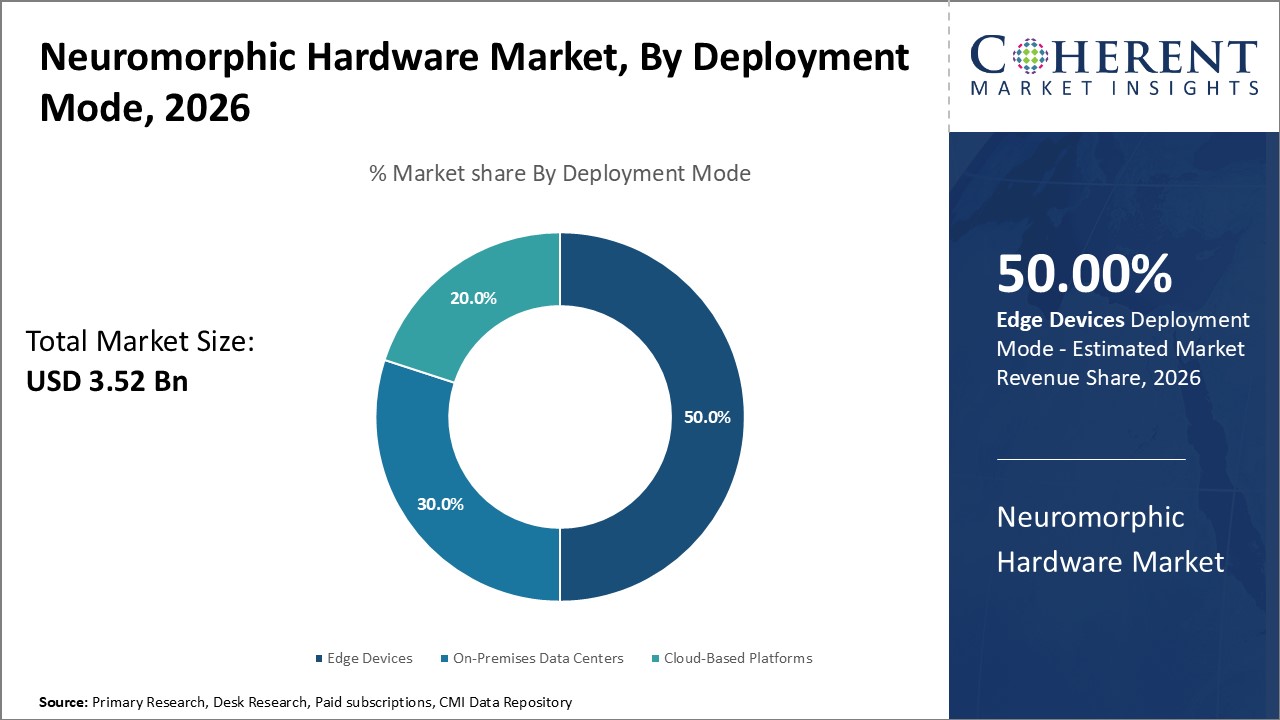
- The edge devices segment is projected to capture 50% of the market share in 2026.
- The image and signal processing segment is expected to command 35% share in 2026.
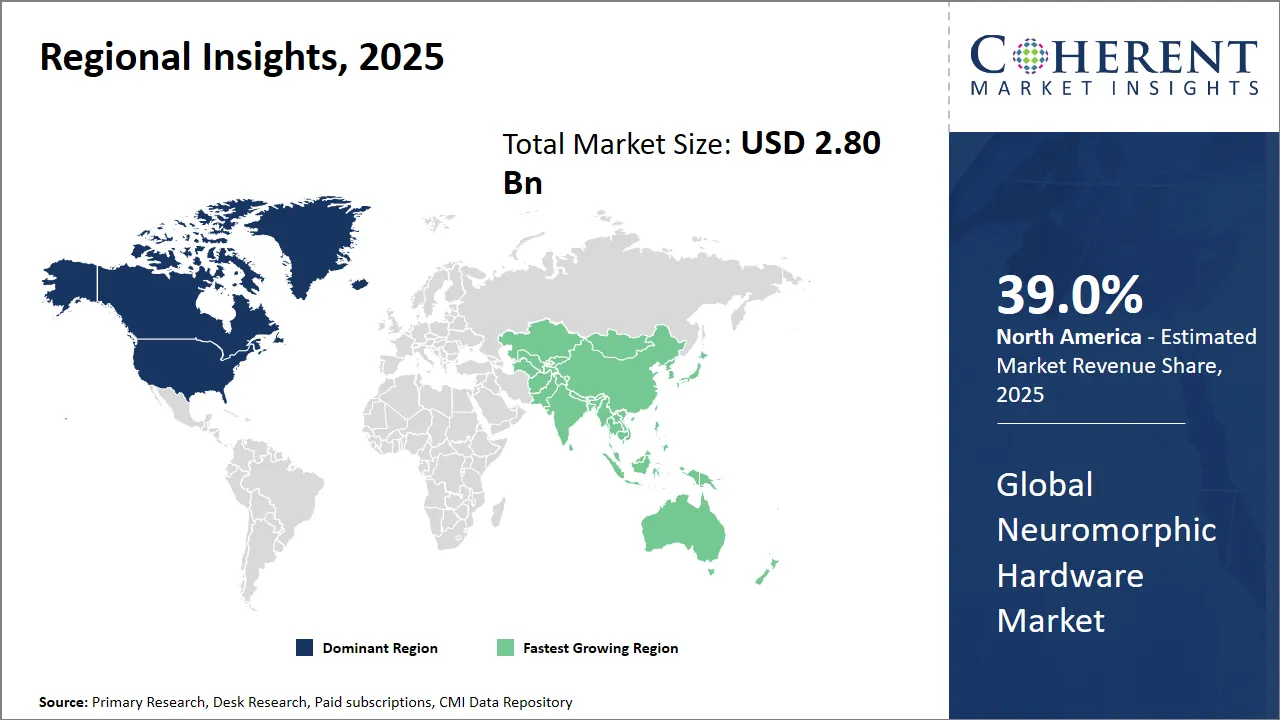
- North America will dominate the neuromorphic hardware market in 2026 with an estimated 39% share.
- Asia Pacific will hold 23% share in 2026 and record the fastest growth.
Current Events and Its Impact
Current Events | Description and its Impact |
Invention by RMIT Engineers |
|
Segmental Insights
- Current Industry Events of 2026
- Market Size Estimation
- Regional Breakdown
- Competitive Landscape
- Customer Intelligence
- Segmental Analysis
- Pricing Analysis
- Key Market Drivers, Challenges & Future Trends
- Customized Insights Section
Why Does the Processors Segment Dominate the Global Neuromorphic Hardware Market in 2026?
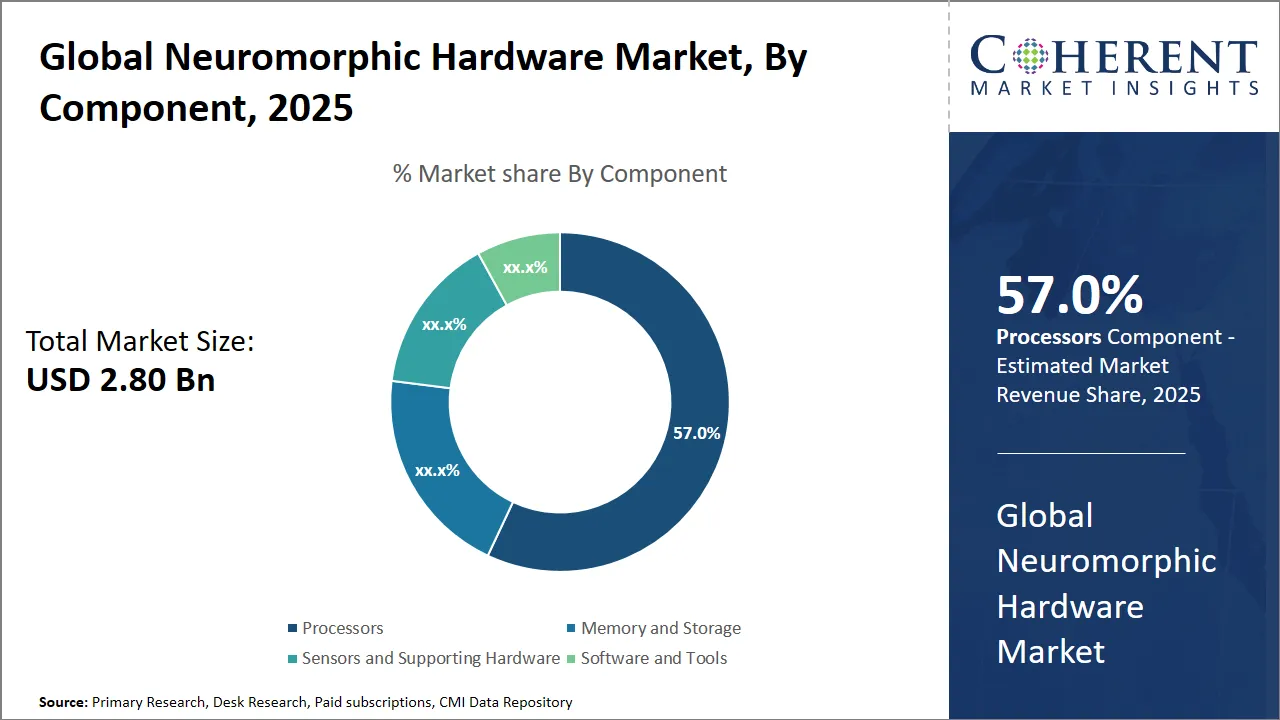
The processors segment is expected to hold 58.0% of the global neuromorphic hardware market share in 2026. The expansion comes mostly from how they copy brain functions to boost computer performance. Because neuromorphic chips mimic nerve structures, they allow fast, simultaneous operations triggered by events, unlike standard von Neumann designs. Since these systems tackle key flaws in classic processors, like excessive energy use and limited multitasking, they support efficient, instant data handling.
The growth of neuromorphic processors comes from progress in material research along with improvements in chip architecture - especially seen in spiking neural network (SNN) designs that mimic brain-like signals quite accurately. Since these systems manage uneven, sparse data well, they’re essential in areas needing quick reactions and less power, so usage grows across sectors. Also, placing memristor-like storage directly inside processors speeds up data handling by cutting lag from traditional memory designs.
For instance, on November 28, 2025, ACL Digital, a global leader in design-led digital transformation, enterprise modernization, and product engineering services, today announced a strategic partnership with AIM Future, a leader in neuromorphic AI processors. The collaboration aims to develop and deliver cutting-edge AI solutions across diverse industries.
(Source: acldigital.com)
Edge Devices Segment Dominates the Global Neuromorphic Hardware Market
The edge devices segment is expected to hold 50.0% of the market share in 2026. The expansion comes from their ability to manage live data near its origin, so edge systems cut down delays much more than central cloud setups, which matters most when quick choices are needed. Being closer speeds things up in time-sensitive tasks instead of relying on distant servers.
Edge systems gain from neuromorphic chips due to their naturally low energy use, along with flexibility, suited for settings with scarce power supply. Examples like self-driving cars, factory-connected sensors, or medical wearables require instant analysis, yet can't risk latency caused by sending data to distant cloud hubs. By integrating such processors directly into edge gadgets, on-site decision-making improves which supports fast identification of patterns, spotting irregularities, while interacting dynamically with surroundings is crucial when reliability affects core operations.
Why is Image and Signal Processing the Most Widespread Application in the Neuromorphic Hardware Market?
The image and signal processing segment is expected to hold 35.0% of the neuromorphic hardware market share in 2026. The rise is due to a pressing demand for fast, flexible, computing that saves power. Because they imitate how brains handle information, neuromorphic chips perform well in interpreting moving images and sensor data. While processing inputs on the fly, these systems detect patterns quickly. As a result, responses happen without delay. Their design supports continuous adjustment under changing conditions.
The broad use of computer vision across fields like self-driving cars, monitoring systems, AR, or factory inspections has increased need for brain-inspired chips that process visual input quickly and efficiently. Conventional methods face limits in energy use and learning flexibility, issues these new designs address using pulse-driven networks alongside dynamic sensing devices.
Memory & Interconnect Bottleneck Impact
Aspect | Traditional CPU/GPU (Von Neumann) | Neuromorphic Hardware |
Memory/Compute Separation | Yes, physical separation | No, memory & compute co-located |
Data Movement Energy Overhead | High (dominates energy cost) | Low (event-driven) |
Interconnect Latency | Higher (bus traffic & contention) | Lower (spike routing) |
Scaling Challenge | Bottleneck worsens with model size | Limited by routing & memory density |
Regional Insights
North America Neuromorphic Hardware Market Analysis and Trends
North America region is projected to lead the market with a 39% share in 2026. The regional expansion comes from a dynamic network of high-level research centers, established tech firms, together with public strategies that back AI and future computing. In this area, the U.S., being the main force, supports key players like Intel, IBM, or Hewlett Packard Enterprise - each putting significant resources into brain-inspired chip designs. Close ties between universities and businesses help speed up testing and bring new neuromorphic processors to market quickly.
On top of that, federal programs led by DARPA or the National Science Foundation provide grants for cutting-edge work in this field, helping North America stay ahead. The existence of large financial markets, alongside a strong focus on new business ideas, helps smaller firms grow, strengthening the broader environment. North America benefits from trade patterns owing to advanced chip production networks and collaborations with friendly nations.
Asia Pacific Neuromorphic Hardware Market Analysis and Trends
Asia Pacific is expected to exhibit the fastest growth in the market contributing 23% share in 2026. The increase is driven by rising funding in AI and chips from fast-growing economies like China, Japan, and South Korea. Owing to state-backed programs, such as Made in China 2026 or Society 5.0, progress in advanced computing hardware gains momentum, especially in brain-inspired systems for smarter machines and production lines. Due to the presence of abundant engineers, stronger research facilities, along with ties between regional schools and technology businesses, growth continues steadily.
Firms including Samsung, Sony, and Huawei are refining neural chip architectures while partnering with researchers to shorten time-to-market. Moreover, the Asia Pacific region uses its strong manufacturing base to enable large-scale output while cutting hardware costs worldwide. Instead of standalone efforts, cooperation under agreements such as RCEP strengthens trade flows across borders, helping faster entry into new markets.
Neuromorphic Hardware Market Outlook for Key Countries
Why is the U.S. Emerging as a Major Hub in the Neuromorphic Hardware Market?
The U.S. tops the neuromorphic hardware sector owing to funding from public and private sources. While Intel advances with its Loihi processor, IBM progresses through the TrueNorth initiative, both pushing key breakthroughs in system design. Support from agencies such as DARPA and NSF strengthens R&D efforts, enabling real-world use in areas like military tech, self-driving machines, or expansive AI models. Meanwhile, startup culture and investor networks across Silicon Valley help turn lab ideas into mass-producible devices.
Is China the Next Growth Engine for the Neuromorphic Hardware Market?
China's neuromorphic hardware sector is growing fast, driven by strong state investment through science ministry initiatives alongside broader national AI plans. Firms like Huawei and Alibaba are pursuing this technology to boost performance in cloud systems or enhance edge devices. Moreover, domestic manufacturing networks and chip production facilities help speed up design cycles. With an emphasis on independence and breakthroughs in advanced computing, China emerges as a key player worldwide.
Japan Neuromorphic Hardware Market Analysis and Trends
Japan stays ahead in neuromorphic hardware market owing to steady corporate research paired with state backing. Sony and NEC stand out by using their electronic know-how to build low-power chips suited for gadgets or robotic systems. The country's focus on Society 5.0, linking AI with real-world networks, boosts need for such hardware, especially within medical fields or self-driving transport. Close ties between universities and companies help turn ideas into market-ready solutions consistently.
South Korea Neuromorphic Hardware Market Analysis and Trends
South Korea’s neuromorphic hardware sector is growing fast, supported by state programs focused on artificial intelligence and advanced chips, including the Korean New Deal. Instead of just competing locally, big firms such as Samsung and LG are pouring resources into brain-inspired tech to upgrade phones and network systems. Owing to a strong foundation in chip fabrication, scaling up production happens smoothly here. Moreover, joint projects between academic institutes and innovation hubs add momentum to progress in this field.
Germany Neuromorphic Hardware Market Analysis and Trends
Germany drives progress in brain-inspired tech by combining public research support with a robust industrial sector. Instead of relying solely on private investment, it leverages institutes like Fraunhofer alongside firms such as Infineon Technologies to build systems for factory automation, self-driving vehicles, and low-power computing devices. Owing to its focus on digital manufacturing, often linked to Industry 4.0, it offers practical testbeds where neuromorphic chips can be applied across production lines or urban infrastructure. As it exports heavily while collaborating within European innovation networks, Germany strengthens its role in shaping next-gen technology markets globally.
Energy & Power Efficiency Benchmarks
Metric | Neuromorphic | Edge TPU/NPU | CPU/GPU |
Inference Latency | ~8 ms | 12–18 ms | 35 ms+ |
Power Draw | ~0.8 W | 1.5–2.8 W | ~4.2 W |
TOPS/W | ~38 | 28–32 | ~6 |
Market Players, Key Development, and Competitive Intelligence
Key Developments
- On May 21, 2025, Innatera announced the release of Pulsar, its first commercially available neuromorphic microcontroller, designed to embed brain-like intelligence directly into edge devices. Built on over 10 years of innovative work, Pulsar achieves 100 times less delay compared to standard AI chips while using 500 times less power.
- In July 2025, Samsung announced a significant advancement in neuromorphic AI chip technology tailored for edge computing. These new brain-inspired chips replicate neural processes to enable highly efficient, low-power computing on devices such as wearables and sensors.
Top Strategies Followed by Neuromorphic Hardware Market Players
Player Type | Strategic Focus | Example |
Established Market Leaders | Product Development & Innovation | On April 17, 2024, Intel announced that it has built the world's largest neuromorphic system. Code-named Hala Point, this large-scale neuromorphic system, initially deployed at Sandia National Laboratories, utilizes Intel’s Loihi 2 processor, aims at supporting research for future brain-inspired artificial intelligence (AI), and tackles challenges related to the efficiency and sustainability of today’s AI. |
Mid-Level Players | Funding & Investment | On December 10, 2025, BrainChip Holdings Ltd. secured a capital raise of USD 25 million to fuel the development and commercialization of its neuromorphic AI technology and expansion of its product offerings in chips and modules. |
Small-Scale Players | Business Collaboration | On May 29, 2025, Khalifa University of Science and Technology today announced a strategic collaboration between its spin-off Kumrah Artificial Intelligence (AI), a deep-tech startup from the Advanced Research and Innovation Center (ARIC) and Swiss neuromorphic technology leader iniVation, a SynSense Group company, aimed at establishing a global joint venture to develop and commercialize advanced neuromorphic vision-based inspection and autonomy systems. |
Market Report Scope
Neuromorphic Hardware Market Report Coverage
| Report Coverage | Details | ||
|---|---|---|---|
| Base Year: | 2025 | Market Size in 2026: | USD 3.52 Bn |
| Historical Data for: | 2020 To 2024 | Forecast Period: | 2026 To 2033 |
| Forecast Period 2026 to 2033 CAGR: | 25.7% | 2033 Value Projection: | USD 17.45 Bn |
| Geographies covered: |
| ||
| Segments covered: |
| ||
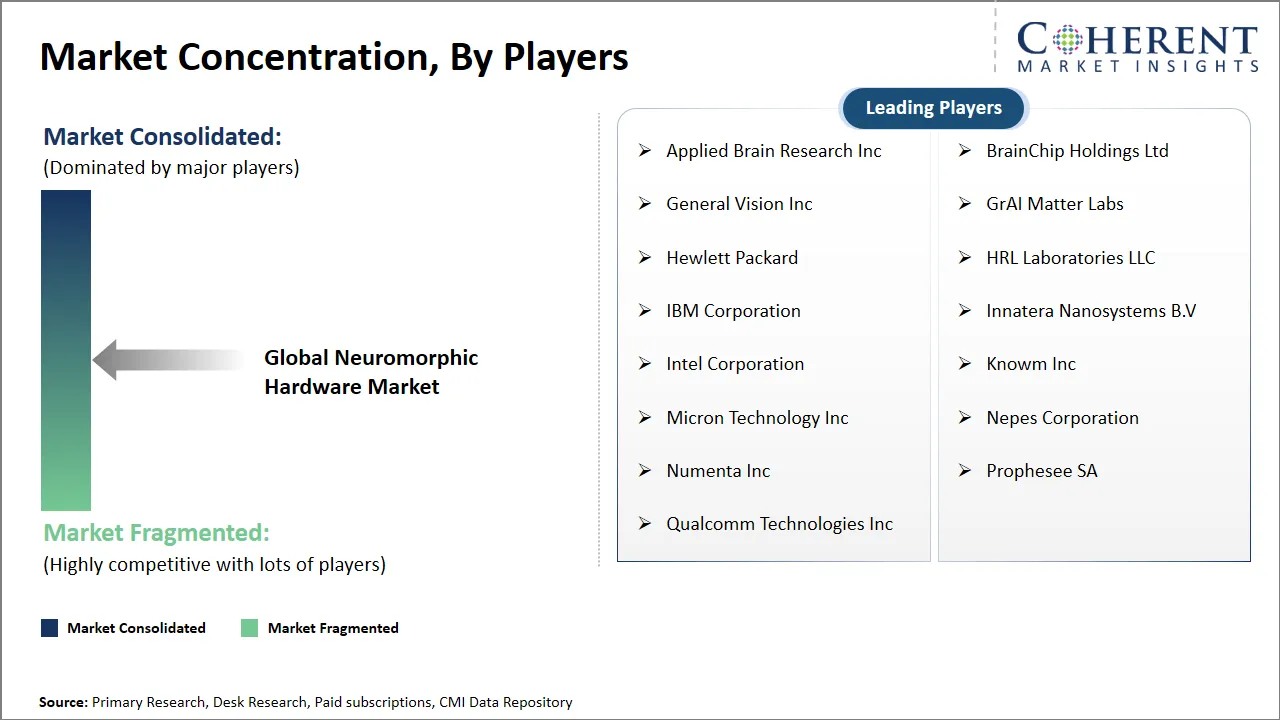
| Companies covered: | Applied Brain Research Inc, BrainChip Holdings Ltd, General Vision Inc, GrAI Matter Labs, Hewlett Packard, HRL Laboratories LLC, IBM Corporation, Innatera Nanosystems B.V, Intel Corporation, Knowm Inc, Micron Technology Inc, Nepes Corporation, Numenta Inc, Prophesee SA, and Qualcomm Technologies Inc | ||
| Growth Drivers: |
| ||
| Restraints & Challenges: |
| ||
Global Neuromorphic Hardware Market Dynamics
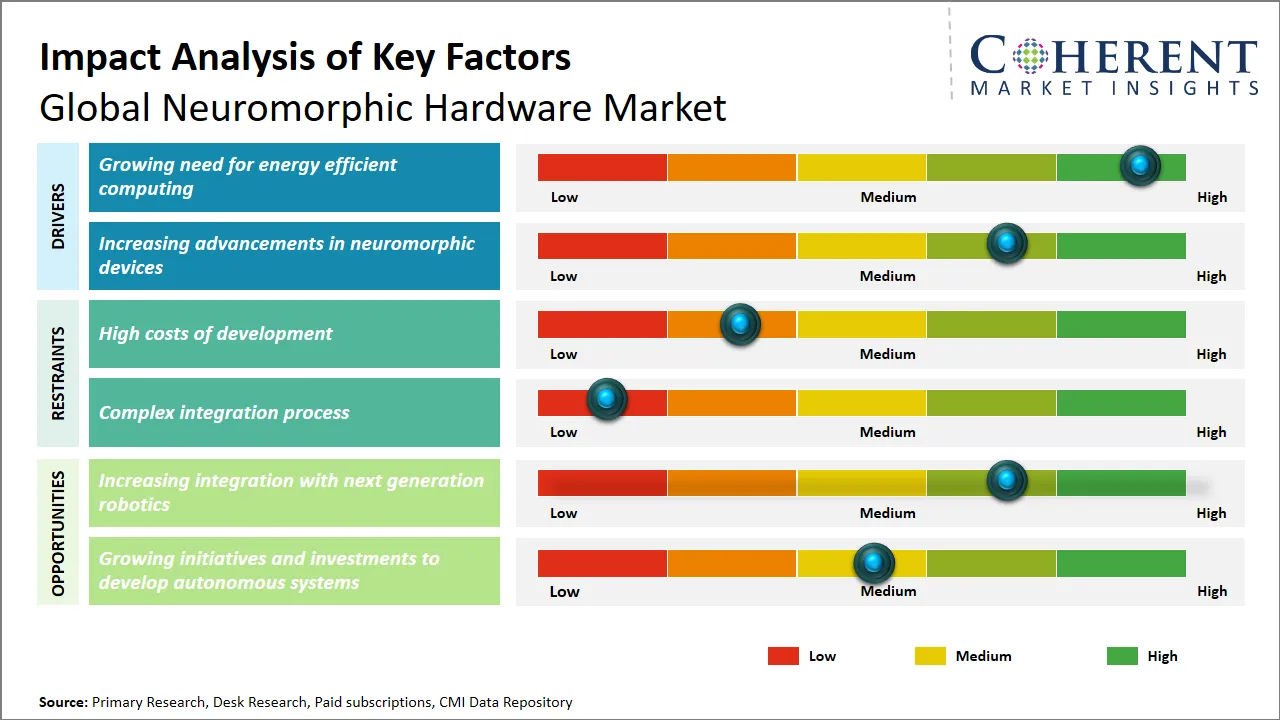
Global Neuromorphic Hardware Market Driver - Growing Need for Energy Efficient Computing
The rising need for low-energy computing is pushing growth in neuromorphic hardware. Because standard computer designs, especially von Neumann types, struggle with power use and speed, sectors now explore options delivering strong output with less electricity. Brain-based chips process data in parallel, respond only when needed, so they use far less energy than typical processors. This change matters most in areas like smart sensors, smart machines, or connected gadgets, where battery life affects how well systems work over time. For this reason, companies focused on cutting costs and environmental impact are putting more funds into neural-style tech, seeing its ability to handle increasing tasks efficiently, leading to broader real-world use.
For instance, on December 2, 2025, AWS announced its new AI Factories, a dedicated infrastructure service combining Trainium chips and optimized AWS data center systems designed to deliver high-performance computing with reduced power demands.
(Source: aboutamazon.com)
Global Neuromorphic Hardware Market Opportunity - Increasing Integration with Next Generation Robotics
The global neuromorphic hardware market gains ground through stronger ties with advanced industrial robotics. Since robotic tech keeps evolving, there is rising need for smarter, faster machines able to handle unpredictable settings - this drives interest in brain-inspired designs. Instead of traditional chips, these systems copy how neurons work, delivering quicker responses, less energy use, while supporting on-the-fly learning. Because of this edge, robots manage sensing, choices, and movement more smoothly, without delays or high power demands typical in standard setups.
As AI-driven robots advance, neuromorphic chips enable real-time learning and sensor integration, opening paths for machines that adapt through experience, improving how they function. The close link between these chips and robotic systems speeds up progress in self-governing devices, likely expanding market opportunities by supporting more intelligent, flexible automation across industries.
Analyst Opinion (Expert Opinion)
- The global neuromorphic hardware market is shifting from lab-based exploration to initial commercial use, fueled by demand for low-energy, instant decision-making in edge devices. While conventional AI systems struggle with power limits, delays, and data transfer expenses, alternatives emerge. Especially in robotics, self-driving machines, factory automation, or intelligent sensors, these drawbacks become critical. Instead of small improvements, neuromorphic designs bring a new approach - embedding sensing, storage, and computation within event-triggered frameworks.
- From an investment angle, short-term expansion hinges less on broad public uptake - instead, niche but impactful applications drive progress. Examples include advanced robotics, military sensing systems, or low-power AI at the network edge. Despite ongoing hurdles like inconsistent standards, immature development tools, or production scalability issues, cooperation among universities, emerging firms, and major chipmakers gradually eases constraints.
Speak to the analyst
Want personalized insights?
Take the findings above to one of our principal consultants, or have the report rebuilt around the segments, geographies and competitors you actually track.
Market Segmentation
- Component Insights (Revenue, USD Billion, 2021 - 2033)
- Processors
- Memory and Storage
- Sensors and Supporting Hardware
- Software and Tools
- Deployment Mode Insights (Revenue, USD Billion, 2021 - 2033)
- Edge Devices
- On-Premises Data Centers
- Cloud-Based Platforms
- Application Insights (Revenue, USD Billion, 2021 - 2033)
- Image and Signal Processing
- Natural Language Processing
- Robotics and Autonomous Systems
- Cybersecurity and Edge AI
- Healthcare and Medical Imaging
- Industrial Automation
- Others
- Regional Insights (Revenue, USD Billion, 2021 - 2033)
- North America
- U.S.
- Canada
- Latin America
- Brazil
- Argentina
- Mexico
- Rest of Latin America
- Europe
- Germany
- U.K.
- Spain
- France
- Italy
- Russia
- Rest of Europe
- Asia Pacific
- China
- India
- Japan
- Australia
- South Korea
- ASEAN
- Rest of Asia Pacific
- Middle East
- GCC Countries
- Israel
- Rest of Middle East
- Africa
- South Africa
- North Africa
- Central Africa
- North America
- Key Players Insights
- Applied Brain Research Inc
- BrainChip Holdings Ltd
- General Vision Inc
- GrAI Matter Labs
- Hewlett Packard
- HRL Laboratories LLC
- IBM Corporation
- Innatera Nanosystems B.V
- Intel Corporation
- Knowm Inc
- Micron Technology Inc
- Nepes Corporation
- Numenta Inc
- Prophesee SA
- Qualcomm Technologies Inc
Sources
Primary Research Interviews
- Neuromorphic chip manufacturers and developers
- AI hardware engineers and architects
- Research institutes and academia specialists
- Technology integrators and system designers
Databases
- IEEE Xplore Digital Library
- Semiconductor Industry Association (SIA) Database
- TechNavio Market Research Database
Magazines
- IEEE Spectrum Magazine
- Electronic Design Magazine
- AI Magazine
- Semiconductor Engineering Magazine
Journals
- Nature Electronics
- IEEE Transactions on Neural Networks and Learning Systems
- Frontiers in Neuroscience
Newspapers
- The Wall Street Journal
- Financial Times
- Reuters Technology News
- Bloomberg Technology
Associations
- Semiconductor Industry Association (SIA)
- IEEE Computer Society
- International Neural Network Society (INNS)
- Neuromorphic Engineering Community
Public Domain Sources
- Government technology research publications
- Patent databases (USPTO, EPO)
- Academic research repositories
- Industry white papers and technical reports
Proprietary Elements
- CMI Data Analytics Tool
- Proprietary CMI Existing Repository of information for last 8 years
Get access to 250+ pages report
Every segment, forecast, competitor profile and data table behind the analysis above — available for instant download.
- ESOMAR Member
- ISO 9001:2015 Certified
- D-U-N-S Registered
- GDPR & CCPA Compliant
Missing comfort of reading report in your local language? Find your preferred language:
Transform your Strategy with Exclusive Trending Reports
Frequently Asked Questions
The global neuromorphic hardware market is estimated to be valued at USD 3.52 Bn in 2026 and is expected to reach USD 17.45 Bn by 2033.
The CAGR of global neuromorphic hardware market is projected to be 25.7% from 2026 to 2033.
Growing need for energy efficient computing and increasing advancements in neuromorphic devices are the major factors driving the growth of the global neuromorphic hardware market.
High costs of development and complex integration process are the major factors hampering the growth of the global neuromorphic hardware market.
In terms of component, processors are estimated to dominate the market revenue share in 2026.
Neuromorphic systems can be orders of magnitude more energy efficient for event-based and continuous sensing tasks.
Academic institutions are critical innovation sources, often transferring breakthroughs into startups and industry partnerships.