

North America Homecare Rehabilitation Service Market Size and Forecast – 2026 to 2033
The North America homecare rehabilitation service market is estimated to be valued at USD 5,964.1 Mn in 2026 and is expected to reach USD 9,077.6 Mn by 2033, exhibiting a compound annual growth rate (CAGR) of 7.2% from 2026 to 2033. This steady growth highlights increasing demand for personalized rehabilitation services delivered in home settings, driven by an aging population and rising prevalence of chronic illnesses requiring long-term care outside traditional healthcare facilities.
Key Takeaways of the North America Homecare Rehabilitation Service Market
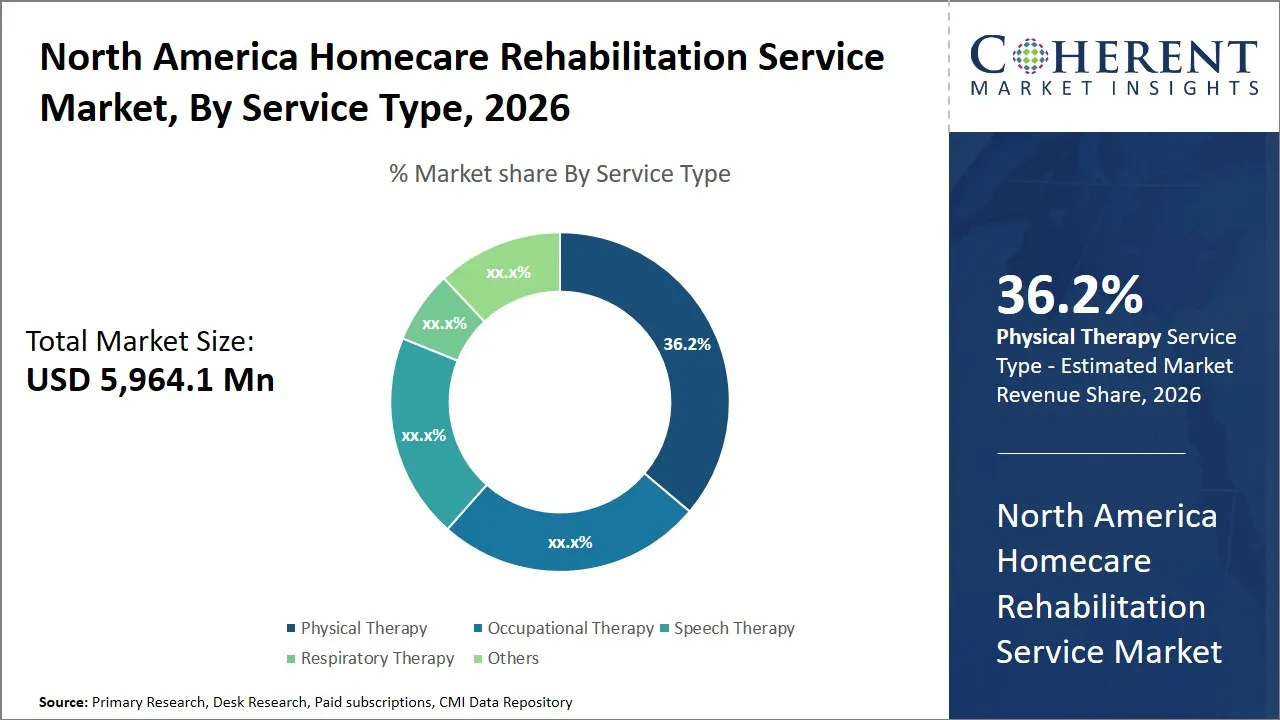
- Physical therapy segment is expected to lead the North America homecare rehabilitation service market, capturing 36.2% share in 2026.
- Geriatric segment is estimated to represent 46.2% of the North America homecare rehabilitation service market share in 2026.
- Offline segment is projected to dominate with 72.7% of the North America homecare rehabilitation service market share in 2026.
Market Overview
- The North America homecare rehabilitation service market is experiencing steady growth driven by an aging population and increasing prevalence of chronic diseases requiring long-term rehabilitation.
- Medicare and Medicaid, along with private insurers, are key drivers, providing reimbursement and coverage for home-based rehabilitation services.
- Tele-rehabilitation and remote monitoring technologies are gaining traction, enabling wider access and improving patient adherence.
- The market is highly competitive, with regional and national providers focusing on service differentiation through specialized programs and technology integration.
Currents Events and their Impact
Current Events | Description and its Impact |
Expansion of Medicare Coverage for Homecare Rehabilitation |
|
Rise of Tele-rehabilitation Services |
|
Segmental Insights
- Current Industry Events of 2026
- Market Size Estimation
- Regional Breakdown
- Competitive Landscape
- Customer Intelligence
- Segmental Analysis
- Pricing Analysis
- Key Market Drivers, Challenges & Future Trends
- Customized Insights Section
Why Does the Physical Therapy Segment Dominate the North America Homecare Rehabilitation Service Market in 2026?
The physical therapy segment is expected to hold the largest market share of 36.2% in 2026, due to its critical role in addressing a wide spectrum of physical impairments and functional limitations among patients of all age groups. The growing number of musculoskeletal disorders, orthopedic injuries, post stroke rehabilitation cases and the rehabilitation cases after surgery in the homecare environment has largely driven the need in physical therapy services. Surgery patients that underwent a joint replacement operation or cardiac surgery need physical therapy to restore their strength, flexibility and normal functioning, timely and continuous exercises are the best way to achieve this, and home-based care is the most effective way to achieve that by eliminating the need to visit a hospital and giving patients personal attention.
For instance, in November 2025, Vantive Health announced strategic innovations following its Fall 2025 launch of HomeAdvantage powered by Vantive CONNECT, a digital platform designed to enhance home‑based therapy delivery across the U.S. The system integrates patient‑centered tools to support individualized rehabilitation plans, improve engagement, and streamline in‑home care workflows for therapists and care teams.
Why Does the Geriatric Segment Dominate the North America Homecare Rehabilitation Service Market in 2026?
The geriatric segment is expected to hold 46.2% of the market share in 2026, largely fueled by the region’s aging population and the growing prevalence of chronic conditions such as arthritis, stroke, and cardiovascular diseases. The previously mentioned healthcare services, such as personalized therapy sessions, remote monitoring, and telehealth, are in demand because older people prefer home-based rehabilitation over staying in hospitals due to convenience, safety, and affordability. This is a positive development that is prompting service providers to invest in geriatric-specific solutions, adaptive equipment, and outcome-tracking technologies, which has made the elderly population the most important as far as growth is concerned in the market.
Geriatric patients have been known to be discharged to their homes under the care of their family and caregivers as a means of home-based rehabilitation as it offers the geriatric patients a home like environment that promotes active engagement as well as assuage of the elderly. Multi-disciplinary care teams, virtual care communities, and AI-based progress monitoring are among the emerging options by providers to meet the complex needs of older adults. The growing emphasis on preventive care, fall prevention interventions, and chronic disease care in the elderly is also increasing the use of services. Not only do they constitute the main force behind the increased demand but also the innovation of new ways of rehabilitating the elderly at home, which is why the elderly population becomes the center of the market growth strategies.
For instance, in October 2025, Pride Mobility’s Quantum Rehab introduced the Quantum Edge 4, a next‑generation rehab power wheelchair for elderly and disabled users. It features advanced suspension, TRU‑Balance 4 and iLevel positioning, Bluetooth controls, and improved battery access, enhancing mobility and independence at home. The launch highlights innovation targeting the geriatric segment, the largest group in North America’s homecare rehabilitation service market.
The Offline Segment Dominates the North America Homecare Rehabilitation Service Market
The offline segment is expected to hold the largest market share of 72.2% in 2026, largely due to the intrinsic need for direct, hands-on interaction between therapists and patients in rehabilitation processes. The physical examination, therapy modification, and manual treatment are usually important elements that need personal attention which cannot be completely emulated by virtual or online communications. Such necessity will make sure that the old offline services are still necessary, especially in the cases of complicated cases, when patients suffered severe disabilities, or when they will need to use special equipment and observe their condition closely.
The already strengthened networks of providers and healthcare organizations possess strong offline systems that enable smooth scheduling, frequent visits, and direct contact with caregivers that improve patient compliance and satisfaction. The therapeutic relationship gained due to face-to-face communication enhances motivation and trust, which is vital in ensuring the outcomes of rehabilitation are successful. Insurance companies and healthcare systems also focus on covering offline homecare services, which makes them more accessible to more patients.
Reimbursement and Coverage Trends in North America Homecare Rehabilitation Service Market
- Medicare and Medicaid are also increasing their support of home-based rehabilitation, particularly of post-acute rehabilitation and chronic disease management. This extended coverage enhances the accessibility of patients and promotes the demand of homecare rehabilitation services in the region.
- Insurance covers in the private sector are considerably different, and in most cases, authorization is needed beforehand. These variations affect how patients use the services and compel providers to provide services to meet certain insurer needs to be reimbursed.
- It is characterized by a strong move towards the value-based care models where the payments are based on patient outcomes and decreased hospital readmissions. Those providers whose improvement in functionality is measurable are better to receive favorable reimbursement rates and this encourages outcome-based practices.
- Payers are becoming more receptive to the use of technology-enabled services because of tele-rehabilitation and digital monitoring. The comprehensive recording and incorporation of digital tools enable the providers to maximize the reimbursement without failing to comply with the demands of payers and reporting requirements.
Market Players, Key Developments, and Competitive Intelligence
Key Developments
- On March 12, 2026, Aveanna Healthcare Holdings announced an agreement to acquire Family First Homecare, a multi‑state provider of pediatric home care services, in a strategic deal expected to close in 2Q 2026, expanding its in‑home care and rehabilitation footprint in the U.S.
- In June 2025, DispatchHealth and Medically completed their merger to enhance combined home care delivery capabilities, including physical therapy and rehabilitation services.
- In June 2025, Lucet acquired Emcara Health to combine behavioral and home‑based care, expanding integrated rehabilitation and medical services for complex patients in the U.S. financial terms were not disclosed.
Technology Adoption and Innovation in North America Homecare Rehabilitation Service Market
- Although not all, some providers are adopting technology in the North America homecare rehabilitation service market to enhance efficiency, patient outcomes, and accessibility of care. Home-based rehabilitation programs are becoming more and more emulated by digital platforms, remote monitoring devices, and wearable sensors, which make it possible to track the progress of patients and adherence to therapy in real-time. This adoption allows minimizing hospitalizations and makes the services more cost-effective and scalable.
- Such aspects as tele-rehabilitation, AI-based analytics, and cloud-based management are also being incorporated due to innovation efforts. These technologies enable customized therapy schedules, preemptive intervention and uninterrupted data exchange with health practitioners. Due to the growing focus on outcomes-based care by payers and regulators, technology enabled solutions are becoming a necessity in compliance, reimbursement and competitive differentiation in the market.
Top Strategies Followed by North America Homecare Rehabilitation Service Market Players
Player Type | Strategic Focus | Examples |
Established Market Leaders | Leading players in the North America homecare rehabilitation service market invest heavily in R&D to develop advanced solutions like smart mobility aids, therapeutic devices, and digital health platforms that improve patient outcomes. They also form strategic partnerships with OEMs to co-develop technology and strengthen supply chains while expanding into emerging markets. | Ottobock reinforces its market leadership through continuous innovation in advanced prosthetics and digital rehabilitation solutions, including sensor-based and data-driven technologies that enhance patient mobility. Its strong global distribution network and partnerships with healthcare providers also support wider adoption, particularly in homecare settings. |
Mid-Level Players | Mid-level players in the homecare rehabilitation service market focus on delivering cost-effective solutions that balance quality and affordability, targeting smaller clinics, caregivers, and budget-conscious patients. They often collaborate with technology providers and contract manufacturers to enhance capabilities, introduce incremental innovations, and expand reach without high costs. | Drive DeVilbiss Healthcare offers a wide range of affordable mobility aids, respiratory equipment, and homecare rehabilitation products designed for cost-sensitive users without compromising essential quality. The company leverages strategic partnerships with distributors and manufacturers to expand its market reach, streamline production, and maintain competitive pricing. |
Small-Scale Players | Small-scale players in the North America homecare rehabilitation service market focus on niche innovations such as IoT-enabled devices, AI-driven therapy tools, and personalized rehab solutions to differentiate themselves. Their agility allows quick response to unmet needs, while local partnerships help them expand regionally with lower costs. | Reflexion Health leverages virtual therapy platforms combined with motion-tracking technology to deliver personalized, clinically guided home-based rehabilitation programs. Its systems use real-time feedback and data analytics to monitor patient progress, improve adherence, and optimize outcomes without frequent in-clinic visits. |
Market Report Scope
North America Homecare Rehabilitation Service Market Report Coverage
| Report Coverage | Details | ||
|---|---|---|---|
| Base Year: | 2025 | Market Size in 2026: | USD 5,964.1 Mn |
| Historical Data for: | 2020 To 2024 | Forecast Period: | 2026 To 2033 |
| Forecast Period 2026 to 2033 CAGR: | 7.2% | 2033 Value Projection: | USD 9,077.6 Mn |
| Segments covered: |
| ||
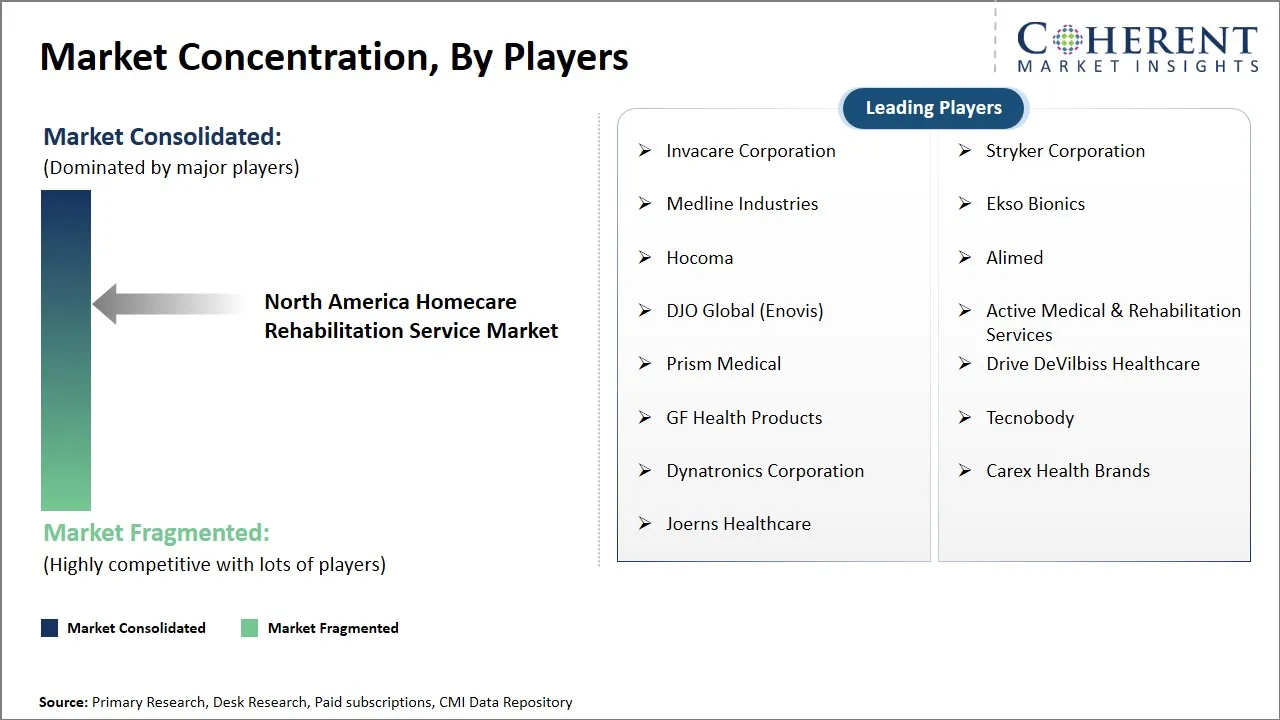
| Companies covered: | Invacare Corporation, Stryker Corporation, Medline Industries, Ekso Bionics, Hocoma, Alimed, DJO Global (Enovis), Active Medical & Rehabilitation Services, Prism Medical, Drive DeVilbiss Healthcare, GF Health Products, Tecnobody, Dynatronics Corporation, Carex Health Brands, and Joerns Healthcare | ||
| Growth Drivers: |
| ||
| Restraints & Challenges: |
| ||
North America Homecare Rehabilitation Service Market Dynamics
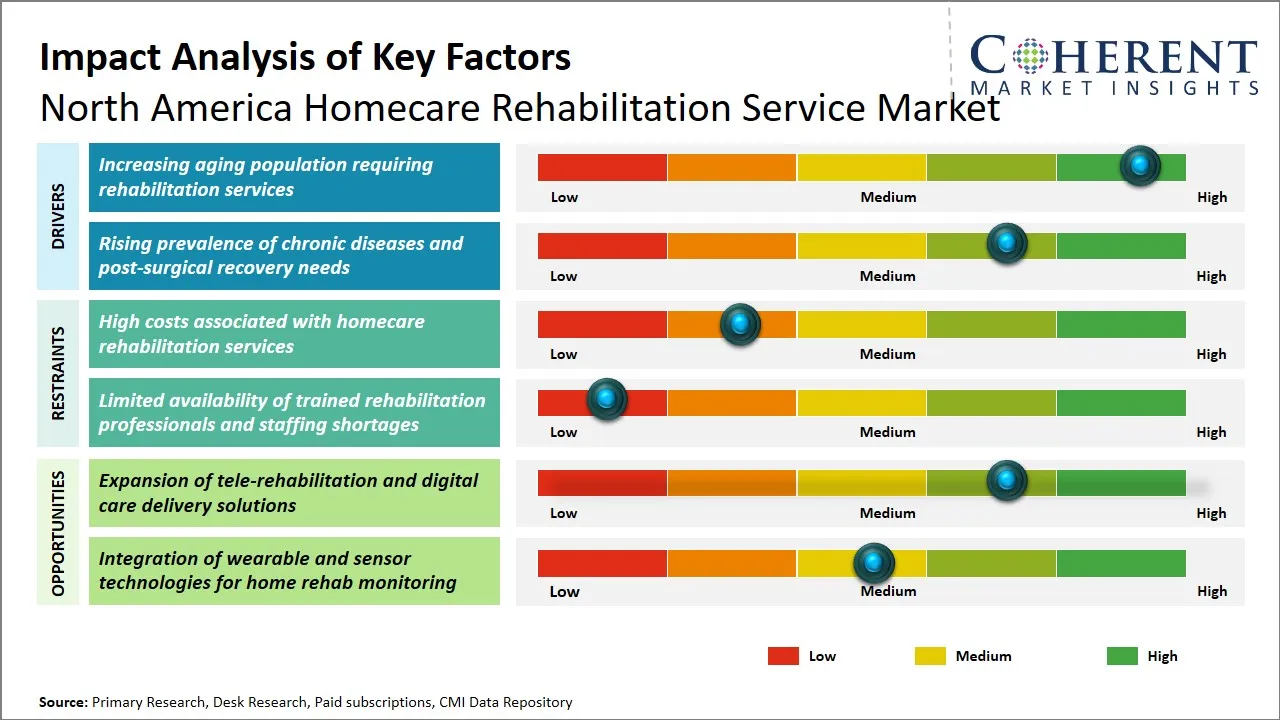
North America Homecare Rehabilitation Service Market Driver - Increasing Aging Population Requiring Rehabilitation Services
The growing aging demographic in North America is a major force that is fueling the demand of the homecare rehabilitation services. Along with the aging population, the age-related health conditions like stroke, arthritis, osteoporosis, and neurodegenerative diseases are increasing, and frequently demand physical therapy and rehabilitation as life-long support. Most elderly people will be more comfortable with an environment that gives them the opportunity to be attended to at home instead of taking them to institutions, thus the favorable response to home-based rehabilitation methods. This preference is not only useful in ensuring that they are independent but also that they limit the chances of getting infected and rehospitalized.
Moreover, chronic diseases among aging population demand special rehabilitative services to deal with the mobility issues and improve the quality of life. Healthcare providers and caregivers are therefore investing more in homecare programs where professional rehabilitation services are integrated with remote monitoring technologies to ensure that the dynamic needs of the elderly patients in North America are met.
For instance, in August 2025, Rehasense unveiled its PAWS Power Assisted Wheelchair, an electric add-on that converts manual wheelchairs into powered mobility devices. Available in CITY, CRUISER, and TOURER models, the system features a 48 V battery, quick-release docking, and adjustable handlebars, enhancing independence and ease of movement for users with limited strength or endurance.
North America Homecare Rehabilitation Service Market Opportunity - Expansion of Tele ‑ rehabilitation and Digital Care Delivery Solutions
The growth in the tele-rehabilitation and digital care delivery solutions is a major opportunity that the North America homecare rehabilitation service market is experiencing. Technological progress, alongside the growing popularity of tele-rehabilitation with patients willing to consult remote healthcare providers have increased the rate of uptake of tele-rehabilitation platforms. These e-solutions also enable patients to enjoy customized therapy and rehabilitation services at the comfort of their homes hence enhancing access, particularly to patients living in rural or underserved places. Virtual consultations and remote monitoring tools are not only more convenient and increase patient engagement and adherence to treatment plans, but they also provide healthcare providers with a chance to provide patients with ongoing care and real-time feedback and track outcomes.
For instance, on March 17, 2026, Sword Health announced the launch of its new AI Care Platform, marking a significant step forward in tele-rehabilitation and digital care delivery. The platform integrates advanced technologies such as artificial intelligence, computer vision, and natural language processing to deliver personalized, real-time therapy guidance to patients in home settings.
Analyst Opinion (Expert Opinion)
- Northern America homecare rehabilitation service market is steadily increasing due to the aging of people, increase in number of chronic diseases, and need to be cared at home. Individualized, performance-based care is being made possible by technology such as tele-rehabilitation, wearable monitors, and AI analytics; Medicare and Medicaid reimbursement and value-based models are also being used to adopt them. There are opportunities in geriatric care, chronic disease care and tech-enabled services with workforce shortages and fluctuating private insurance cover being a challenge.
- Recent trends such as the Home Health Care Virtual Expo and the American Telehealth Association Conference have facilitated the exchange of knowledge and innovation. Such efforts as the Humana CenterWell Home Health expansion and the Quantum Edge 4 introduced by Quantum Rehab, coupled with local piloting tele-rehab are making the market more accessible, more efficient, and patient-centered.
Speak to the analyst
Want personalized insights?
Take the findings above to one of our principal consultants, or have the report rebuilt around the segments, geographies and competitors you actually track.
Market Segmentation
- Service Type Insights (Revenue, USD Mn, 2021- 2033)
- Physical Therapy
- Occupational Therapy
- Speech Therapy
- Respiratory Therapy
- Others
- Patient Type Insights (Revenue, USD Mn, 2021- 2033)
- Pediatric
- Adult
- Geriatric
- Distribution Channel Insights (Revenue, USD Mn, 2021- 2033)
- Offline
- Online
- Application Insights (Revenue, USD Mn, 2021- 2033)
- Post- surgery
- Acute Injuries
- Chronic Conditions
- Cardiovascular
- Diabetes Disorders
- Cancer Recovery
- Neurological Disorders and Stroke Management
- Others
- Mental Health and Behavioral Conditions
- Others
- Key Players Insights
- Invacare Corporation
- Stryker Corporation
- Medline Industries
- Ekso Bionics
- Hocoma
- Alimed
- DJO Global (Enovis)
- Active Medical & Rehabilitation Services
- Prism Medical
- Drive DeVilbiss Healthcare
- GF Health Products
- Tecnobody
- Dynatronics Corporation
- Carex Health Brands
- Joerns Healthcare
Sources
Primary Research Interviews
Industry Stakeholders
- Hospital rehabilitation directors
- Homecare agency executives
- Physical therapy service providers
- Occupational therapy department heads
- Medical equipment suppliers (non-commercial)
- Healthcare technology solution leads
End Users
- Geriatric patients receiving home rehabilitation
- Chronic disease patients enrolled in homecare programs
- Caregivers of elderly or disabled patients
- Post-surgical patients undergoing home-based therapy
- Patients with mobility impairments
- Patients using tele-rehabilitation services
Government and International Databases
- Centers for Medicare & Medicaid Services (CMS)
- U.S. Census Bureau
- National Institutes of Health (NIH)
- Agency for Healthcare Research and Quality (AHRQ)
- World Health Organization (WHO)
- Health Resources & Services Administration (HRSA)
Trade Publications
- Home Health Care News
- HomeCare Magazine
- Rehab Management
- Healthcare Design Magazine
- Physical Therapy Products Magazine
- Caregiver Resource Publications
Academic Journals
- Journal of Geriatric Physical Therapy
- Archives of Physical Medicine and Rehabilitation
- American Journal of Occupational Therapy
- Journal of Telemedicine and Telecare
- Disability and Rehabilitation Journal
- BMC Geriatrics
Reputable Newspapers
- The New York Times – Health Section
- The Washington Post – Health & Science
- USA Today – Health & Wellness
- The Wall Street Journal – Health & Care Reports
- Los Angeles Times – Health & Fitness
- Chicago Tribune – Health News
Industry Associations
- American Physical Therapy Association (APTA)
- American Occupational Therapy Association (AOTA)
- National Association for Home Care & Hospice (NAHC)
- American Telemedicine Association (ATA)
- Rehabilitation Engineering and Assistive Technology Society of North America (RESNA)
- National Council on Aging (NCOA)
Public Domain Resources
- National Library of Medicine (NLM)
- Open Access Journals in Rehabilitation
- Government Health Reports (CDC, NIH)
- WHO Global Health Observatory
- ClinicalTrials.gov
Proprietary Elements
- CMI Data Analytics Tool: Proprietary analytics tool to analyze real-time market trends, consumer behavior, and technology adoption in market
- Proprietary CMI Existing Repository of Information for Last 10 Years
Get access to 250+ pages report
Every segment, forecast, competitor profile and data table behind the analysis above — available for instant download.
- ESOMAR Member
- ISO 9001:2015 Certified
- D-U-N-S Registered
- GDPR & CCPA Compliant
Missing comfort of reading report in your local language? Find your preferred language:
Transform your Strategy with Exclusive Trending Reports
Frequently Asked Questions
The North America Homecare rehabilitation service market is estimated to be valued at USD 5,964.1 million in 2026 and is expected to reach USD 9,077.6 million by 2033.
The CAGR of North America homecare rehabilitation service market is projected to be 7.20% from 2026 to 2033.
Increasing aging population requiring rehabilitation services and rising prevalence of chronic diseases and post‑surgical recovery needs are the major factors driving the growth of the North America homecare rehabilitation service market.
High costs associated with homecare rehabilitation services and limited availability of trained rehabilitation professionals and staffing shortages are the major factors hampering the growth of the North America homecare rehabilitation service market.
Telehealth platforms, wearable sensors, and AI enabled tools are increasingly integrated into rehabilitation care, allowing real time remote monitoring, personalized treatment, and hybrid models that combine virtual and in person therapy, improving patient engagement and recovery.
Providers are increasingly adopting tele-rehabilitation, digital monitoring, and AI-assisted therapy tools to extend the reach of limited staff, optimize scheduling, and maintain high-quality care despite workforce constraints.
In terms of service type, physical therapy is estimated to dominate the market revenue share in 2026.