

North America Industrial Reverse Osmosis System Market Size and Forecast – 2026-2033
The North America industrial reverse osmosis system market is estimated to be valued at USD 2.32 Bn in 2026 and is expected to reach USD 3.65 Bn by 2033, exhibiting a compound annual growth rate (CAGR) of 6.7% from 2026 to 2033.
Key Takeaways of the North America Industrial Reverse Osmosis System Market
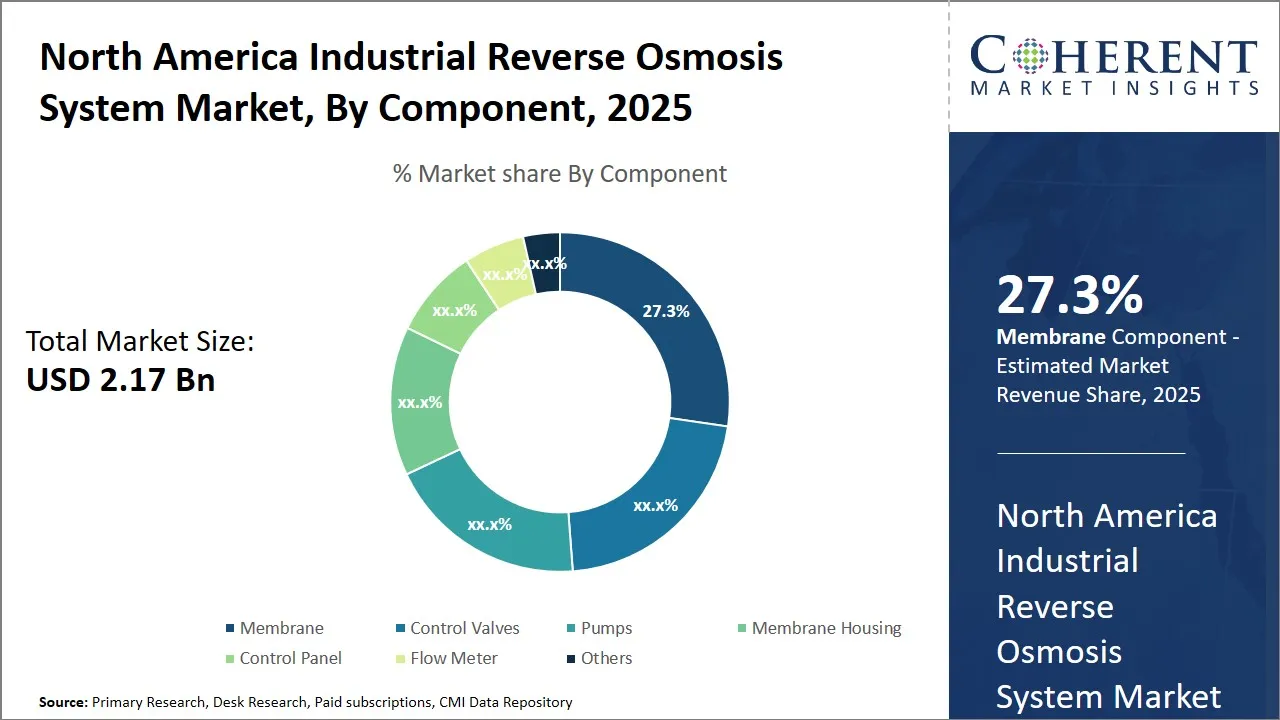
- The membrane segment leads the market holding an estimated share of 28.3 % in 2026.
- The preventative maintenance segment is projected to dominate with a share of 39.2 % in 2026.
- The medium scale segment is estimated to lead the market with a share of 47.5 % in 2026.
Market Overview
The market is seeing a rising adoption of advanced reverse osmosis technologies that improve water recovery rates and reduce energy consumption, aligning with global sustainability goals. Also, the use of smart monitoring systems and IoT-enabled devices is getting popular, making possible real-time performance tracking and predictive maintenance. These innovations are adding to operational efficiency and reducing downtime, making industrial reverse osmosis systems more attractive to end users looking for cost-effective and eco-friendly water treatment chemicals and solutions.
Current Events and their Impact
Current Events | Description and its Impact |
Geopolitical and Trade Developments |
|
Economic and Infrastructure Trends |
|
Segmental Insights
- Current Industry Events of 2026
- Market Size Estimation
- Regional Breakdown
- Competitive Landscape
- Customer Intelligence
- Segmental Analysis
- Pricing Analysis
- Key Market Drivers, Challenges & Future Trends
- Customized Insights Section
North America Industrial Reverse Osmosis System Market Insights, by Component – Membrane Leads Because of its Central Role In Filtration Efficiency and Technological Advancements
The membrane segment is expected to hold a share of 28.3% in 2026 because of its big role in the filtration process, separating impurities from water. The membrane is responsible for removing dissolved salts, organic compounds, bacteria, and other contaminants, which affects the quality and purity of the final output. Its contribution to the system's performance makes it the most demanded and technologically advanced component in industrial RO setups.
The continuous innovation in membrane materials and designs, improving permeability, selectivity, and fouling resistance, adds to segment growth. Advances in thin-film composite (TFC) membranes, for instance, have greatly improved salt rejection rates and operating lifespan. These improvements lower the total cost of ownership for industrial users and add to reliability.
Also, membranes are often customized to cater to specific industrial processes, making possible flexible adaptation in different applications. The scalability and modularity of membrane technology also appeal to industries looking for tailor-made solutions without major infrastructure overhauls. To add, increasing environmental regulations around wastewater disposal and stringent quality standards have made demand for high-performance membranes that can support Zero Liquid Discharge (ZLD) and water reuse initiatives, adding to the segment’s market dominance.
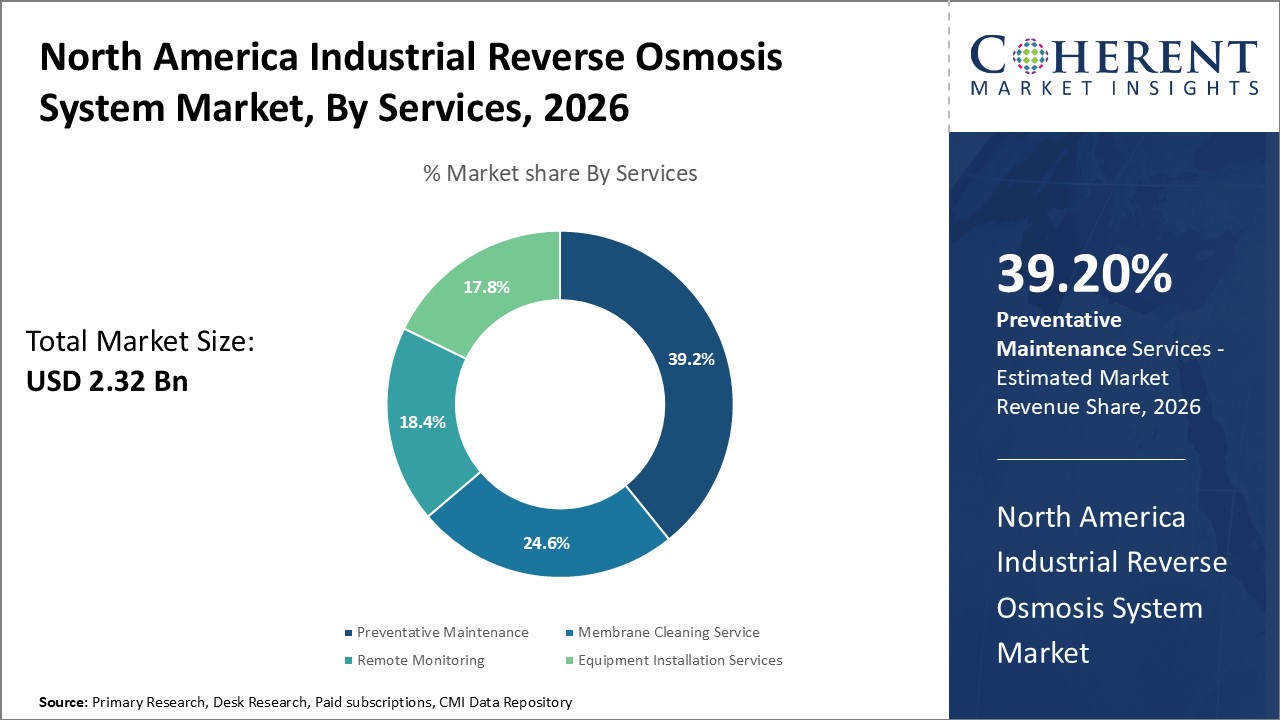
North America Industrial Reverse Osmosis System Market Insights, by Services – Preventative Maintenance Leads Because of the Critical Need to Ensure System Longevity and Operational Reliability
The preventative maintenance is projected to account for 39.2% of the North America industrial reverse osmosis system market share in 2026, because these services play a big role in maximizing system uptime and mitigating costly downtimes. Given the complexity of RO systems and their sensitivity to feedwater quality and operational parameters, regular preventive maintenance is very important to identify and rectify issues before they lead to huge damage or performance degradation.
Industrial users see that scheduled inspection, membrane cleaning, calibration of control valves, pump performance checks, and timely replacement of consumables are important for maintaining optimal system functionality. Preventative maintenance services help extend membrane life, reduce energy consumption by ensuring pumps and control systems operate at peak efficiency, and avoid unexpected breakdowns which could interrupt production processes and lead to big financial losses.
North America Industrial Reverse Osmosis System Market Insights, by System Capacity – Medium Scale Systems Segment Leads Because of their Balance Between Operational Efficiency and Affordability
The medium scale segment is projected to hold 48.5% share in 2026. This segment caters to industries that need a considerable volume of purified water but do not possess the infrastructure or need for large-scale RO systems. Medium scale systems offer a balance between capacity and cost-effectiveness, making them highly appealing to different industrial sectors.
For many manufacturing and processing plants, small-scale systems are insufficient to meet daily operational water demands, but large-scale systems come with a lot of capital expenditures and complex maintenance requirements. Medium scale systems offer a modular approach that is easier to add to existing plant layouts and provide flexibility to scale operations as demand grows. This adaptability is especially important for mid-sized enterprises and facilities undergoing expansion. For instance, Xylem and Evoqua have supplied modular medium-capacity RO systems (500–5,000 m³/day) to multiple food processing facilities and mid-sized manufacturing plants in the U.S., including operations in Texas and California.
Also, medium scale systems tend to use less energy per unit of purified water compared to small-scale counterparts because of efficiencies realized in equipment sizing and operational parameters. This energy efficiency aligns well with rising corporate sustainability goals and regulatory pressures around water conservation and operational carbon footprints. Medium scale RO systems often deliver quicker return on investment as they improve production capabilities without the extended lead times or large initial investments needed for very large systems. These factors add to the strong preference and dominant positioning of medium scale systems in North America.
Pricing Analysis of the North America Industrial Reverse Osmosis System Market
Item (USD) | Price/Range (USD) |
CAPEX — Seawater RO (SWRO) (per 1 m³/day of capacity) | USD 1,000 — USD 2,500 per m³/day capacity |
CAPEX — Brackish/Industrial RO (per 1 m³/day of capacity) | USD 600 — USD 1,500 per m³/day capacity |
Skid-mounted/packaged RO (small commercial) — price examples | 1–10 m³/day: USD 3,000 — USD 20,000 |
Large EPC plant example (500,000 m³/day total plant CAPEX) | ~USD 400 million (example) → ~USD 800 per m³/day capacity equivalent |
RO membrane element — 4" × 40" (BW30/brackish) | USD 200 — USD 300 per element (unit price) |
RO membrane element — 8" × 40" (seawater/high-capacity) | USD 400 — USD 1,200 per element (typical) |
Membrane replacement — amortized cost contribution (worked example) | ~USD 0.01 — USD 0.03 per m³ |
Energy consumption — SWRO | ~2.5 — 7.0 kWh per m³ |
Energy consumption — Brackish RO | ~0.5 — 2.5 kWh per m³ |
Energy cost contribution (example @ USD 0.10/kWh) | SWRO: USD 0.25 — USD 0.70 per m³ |
Chemicals & consumables (antiscalant, acid/caustic, CIP chemicals) | USD 0.02 — USD 0.12 per m³ |
Labor & maintenance (small-medium plant) | USD 0.01 — USD 0.08 per m³ |
Total OPEX (operating cost) — SWRO (all in) | USD 0.30 — USD 2.50 per m³ |
Total OPEX — Brackish/industrial RO | USD 0.10 — USD 0.80 per m³ |
Levelized cost of water (LCOW) — delivered, included amortized CAPEX + OPEX (SWRO) | ~USD 0.30 — USD 1.50 per m³ (typical large-scale range) |
Levelized cost of water (LCOW) — brackish/industrial RO | ~USD 0.20 — USD 0.90 per m³ |
Typical payback/simple amortization contribution of CAPEX (worked example) | If CAPEX = USD 1,500 per m³/day capacity → amortized over 20 yrs → ≈ USD 0.21 per m³ |
Typical skid resale/small system vendor prices (online listings) | USD 3,000 — USD 15,000 for consumer/commercial units; USD 20k–USD 150k for higher capacity skids |
Market Players, Key Development, and Competitive Intelligence
Key Developments
- In September 2025, H2O Innovation Inc. announced the acquisition of Lama Sistemas de Filtrados S.L., a Spanish water filtration system manufacturer. This acquisition makes its position stronger as a global market leader in components and consumables for the membrane filtration industry.
- In July 2025, Toray Industries, Inc., announced that it had supplied Reverse Osmosis (RO) membranes to the Shuaibah 3 IWP seawater desalination plant in Saudi Arabia through Dammam-based subsidiary Toray Membrane Middle East LLC. The Plant’s daily potable water production capacity is 600,000 cubic meters. This facility provides stable supplies of drinking water to Mecca, Jeddah, Taif, and Bahah, where water demand has risen because of population and inbound tourism growth.
- In June 2025, DuPont announced the launch of FilmTec Hypershell XP RO-8038 element, an advanced reverse osmosis (RO) solution made to meet the evolving needs of the dairy processing industry.
- In September 2024, DuPont announced that FilmTec Nanofiltration (NF) membrane portfolio was named the 2024 Sustainable Technology of the Year at the Global Sustainability & ESG Awards.
Top Strategies Followed by North America Industrial Reverse Osmosis System Market Players
- Established players dominate the landscape with a lot of investments in research and development (R&D), continuously innovating to develop high-performance, energy-efficient, and durable RO systems that meet strict industrial standards.
- DuPont Water Solutions launched the FilmTec Hypershell XP RO-8038 element (2025), designed to improve efficiency in dairy and food processing. This is part of DuPont’s consistent investment in R&D to push membrane performance and reduce operating costs.
- Mid-level players in the North American industrial RO system market focus on delivering cost-effective solutions that offer a balance between performance and affordability.
- H2O Innovation has expanded its industrial systems portfolio with acquisitions while focusing affordable, modular RO systems for mid-sized industrial customers.
- Small-scale market participants, though operating with limited resources, make their niches by focusing on specialized or innovative product features that larger players may miss.
- Aquatech has made a strong footprint by focusing on zero-liquid discharge (ZLD) and lithium brine purification systems, specialized applications where RO is part of a hybrid solution.
Market Report Scope
North America Industrial Reverse Osmosis System Market Report Coverage
| Report Coverage | Details | ||
|---|---|---|---|
| Base Year: | 2025 | Market Size in 2026: | USD 2.32 Bn |
| Historical Data for: | 2020 To 2024 | Forecast Period: | 2026 To 2033 |
| Forecast Period 2026 to 2033 CAGR: | 6.7% | 2033 Value Projection: | USD 3.65 Bn |
| Segments covered: |
| ||
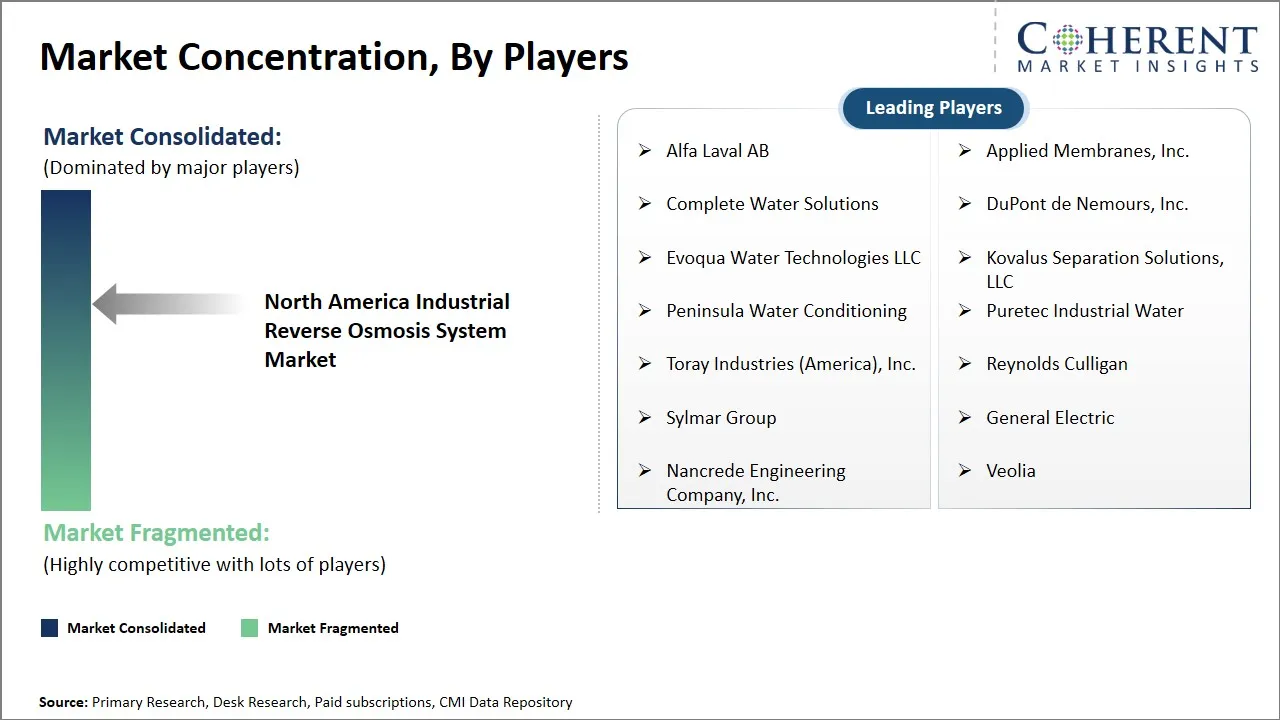
| Companies covered: | Alfa Laval AB, Applied Membranes, Inc., Complete Water Solutions, DuPont de Nemours, Inc., Evoqua Water Technologies LLC, Kovalus Separation Solutions, LLC, Peninsula Water Conditioning, Puretec Industrial Water, Toray Industries (America), Inc., Reynolds Culligan, Sylmar Group, General Electric, Nancrede Engineering Company, Inc., and Veolia | ||
| Growth Drivers: |
| ||
| Restraints & Challenges: |
| ||
Market Dynamics
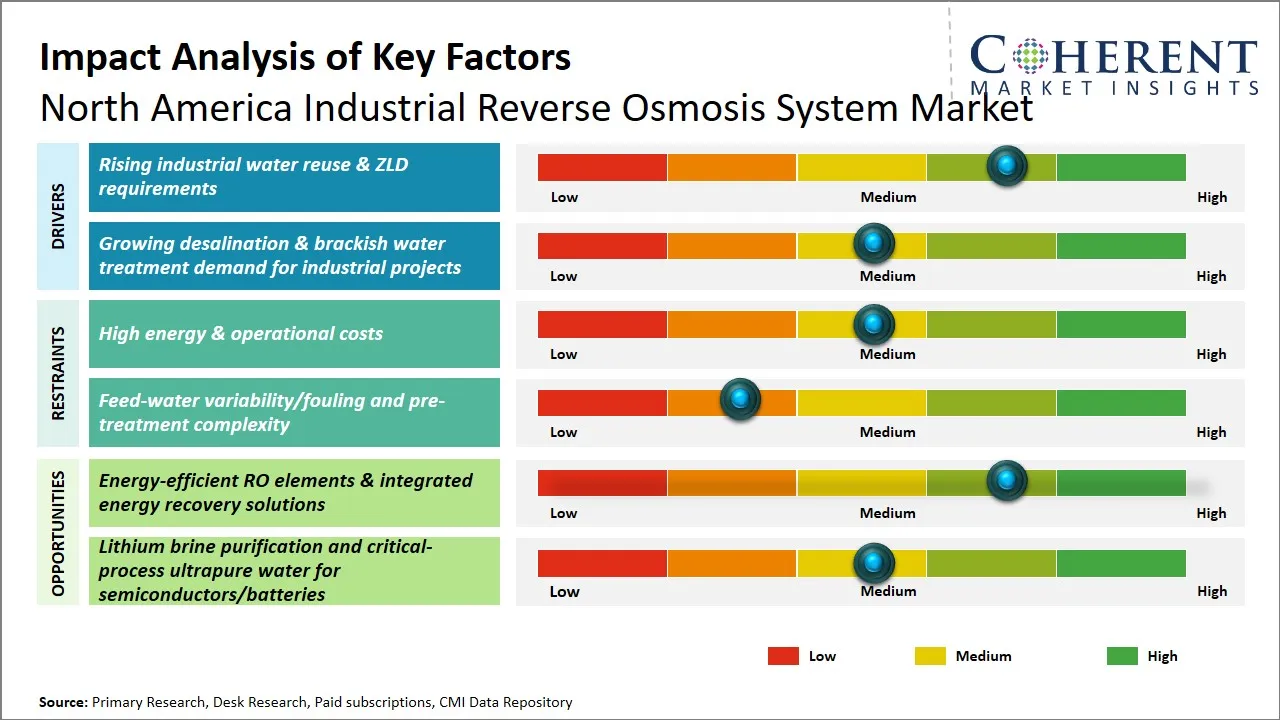
North America Industrial Reverse Osmosis System Market Driver – Rising Industrial Water Reuse & ZLD Requirements
The increasing focus on sustainable water management practices is adding to the adoption of the industrial reverse osmosis system in North America. As industries see growing pressures to minimize freshwater consumption and reduce effluent discharge, water reuse has become a big operational priority. Regulatory frameworks and environmental standards are increasingly putting strict limits on wastewater disposal, pushing manufacturers and processing plants to put in place advanced treatment technologies.
Reverse osmosis systems offer an effective solution by making possible high-purity water recovery from industrial wastewater streams, facilitating recycling in production processes. Also, the Zero Liquid Discharge (ZLD) approach, which aims to eliminate any liquid waste from industrial operations, is getting popular in sectors like chemicals, power generation, and textiles. The use of RO systems in ZLD setups ensures maximal water recovery and concentrate volume reduction, aligning with corporate sustainability goals and regulatory compliance.
North America Industrial Reverse Osmosis System Market Opportunity – Energy-Efficient RO Elements & Integrated Energy Recovery Solutions
The North America industrial reverse osmosis system market will benefit a lot from the growing demand for energy-efficient RO elements and integrated energy recovery solutions. With mounting environmental regulations and escalating energy costs, industries are increasingly prioritizing sustainability alongside operational efficiency. Energy-efficient RO membranes, designed to reduce power consumption without compromising water recovery rates, offer a tangible advantage for industrial users aiming to optimize their processes. Additionally, integrated energy recovery devices—such as pressure exchangers and turbine-based systems—enable the capture and reuse of hydraulic energy within RO processes, substantially lowering operational expenditures.
Furthermore, utility providers and industrial clients are increasingly influenced by corporate social responsibility (CSR) initiatives and government incentives promoting green technologies. Consequently, RO system manufacturers and service providers who incorporate energy-efficient elements and energy recovery solutions can enhance the value proposition of their offerings, gaining competitive advantage in the North American market. This creates avenues for innovation, strategic partnerships, and market expansion as industries seek to meet rigorous environmental standards while maintaining cost-effective water treatment operations.
Analyst Opinion (Expert Opinion)
- In the U.S., stricter regulations on wastewater discharge, especially in California and Texas, are pushing industrial facilities toward water reuse. This is significantly increasing demand for advanced RO systems in manufacturing, petrochemicals, and power generation.
- Canada’s mining and oil sands industries are increasingly adopting RO for process water treatment and environmental compliance. The need to treat brackish groundwater and wastewater in remote industrial zones is expected to sustain steady growth in Canadian RO demand.
- Both U.S. and Canadian food processing and pharmaceutical sectors are expanding capacity, requiring ultrapure process water. RO systems are becoming the preferred solution due to their ability to meet stringent purity standards while aligning with sustainability goals.
Speak to the analyst
Want personalized insights?
Take the findings above to one of our principal consultants, or have the report rebuilt around the segments, geographies and competitors you actually track.
Market Segmentation
- Component Insights (Revenue, USD Bn, 2021 - 2033)
- Membrane
- Control Valves
- Pumps
- Membrane Housing
- Control Panel
- Flow Meter
- Others
- Services Insights (Revenue, USD Bn, 2021 - 2033)
- Preventative Maintenance
- Membrane Cleaning Service
- Remote Monitoring
- Equipment Installation Services
- System Capacity Insights (Revenue, USD Bn, 2021 - 2033)
- Medium Scale
- Large Scale
- Small Scale
- End-use Industry Insights (Revenue, USD Bn, 2021 - 2033)
- Food & Beverages
- Semiconductors and Electronics
- Pharmaceuticals
- Chemicals
- Healthcare
- Energy & Power
- Metals & Mining
- Energy & Power
- Others
- Key Players Insights
- Alfa Laval AB
- Applied Membranes, Inc.
- Complete Water Solutions
- DuPont de Nemours, Inc.
- Evoqua Water Technologies LLC
- Kovalus Separation Solutions, LLC
- Peninsula Water Conditioning
- Puretec Industrial Water
- Toray Industries (America), Inc.
- Reynolds Culligan
- Sylmar Group
- General Electric
- Nancrede Engineering Company, Inc.
- Veolia
Sources
Primary Research Interviews
Stakeholders
- Water Treatment Plant Operators and Managers
- RO Membrane Manufacturers and Suppliers
- EPC Contractors specializing in desalination and industrial water treatment
- Industrial End Users (Food & Beverage, Pharmaceuticals, Petrochemical Companies)
- Water Technology Consultants and System Integrators
- Sustainability & Water Reuse Experts (for ZLD and circular water economy insights)
Databases
- Eurostat
- U.S. Geological Survey (USGS) – Water Data
- Global Water Intelligence (GWI) Database
- OECD
- International Desalination Association (IDA) Database
Magazines
- Water & Wastewater International (WWi)
- Water Technology Magazine
- Industrial WaterWorld
- Filtration + Separation Magazine
Journals
- Desalination Journal
- Journal of Membrane Science
- Water Research Journal
- Journal of Water Process Engineering
- Environmental Science: Water Research & Technology
Newspapers
- Water Desalination Report (WDR)
- The Guardian (UK) – Environment Section
- The Economic Times (India) – Energy & Infrastructure Section
- Gulf News (UAE) – Water & Utilities Coverage
- The New York Times – Climate & Water Section
Associations
- International Desalination Association (IDA)
- American Water Works Association (AWWA)
- European Desalination Society (EDS)
- Water Environment Federation (WEF)
- International Water Association (IWA)
Public Domain Sources
- U.S. Census Bureau
- EUROSTAT
- United Nations Economic Commission for Europe (UNECE)
- World Bank – Water Data Portal
- ResearchGate (Academic Publications)
Proprietary Elements
- CMI Data Analytics Tool
- Proprietary CMI Existing Repository of information for last 8 years
Get access to 250+ pages report
Every segment, forecast, competitor profile and data table behind the analysis above — available for instant download.
- ESOMAR Member
- ISO 9001:2015 Certified
- D-U-N-S Registered
- GDPR & CCPA Compliant
Missing comfort of reading report in your local language? Find your preferred language:
Transform your Strategy with Exclusive Trending Reports
Frequently Asked Questions
The North America industrial reverse osmosis system market is estimated to be valued at USD 2.32 billion in 2026 and is expected to reach USD 3.65 billion by 2033.
The CAGR of the North America industrial reverse osmosis system market is projected to be 6.7% from 2026 to 2033.
Rising industrial water reuse & ZLD requirements and growing desalination & brackish water treatment demand for industrial projects are the major factors driving the growth of the North America industrial reverse osmosis system market.
High energy & operational costs and feed-water variability/fouling and pre-treatment complexity are the major factors hampering the growth of the North America industrial reverse osmosis system market.
In terms of component, the membrane segment is estimated to dominate the market revenue share in 2026.
It’s a water purification system that removes salts, minerals, and contaminants from feedwater using semipermeable membranes under high pressure.
Seawater RO requires higher pressure and more energy due to higher salinity, while brackish RO operates at lower pressure and cost.