

Global Online Substation Monitoring System Market Size and Forecast – 2026 To 2033
The global online substation monitoring system market is expected to grow from USD 2,507.5 Mn in 2026 to USD 4,220.4 Mn by 2033, registering a compound annual growth rate (CAGR) of 7.7% from 2026 to 2033. The global online substation monitoring system market growth is primarily driven by the increasing adoption of IoT, AI, and cloud-based monitoring systems.
For instance, on March 25, 2025, Hitachi and Amazon Web Services announced a multi-year collaboration, accelerating how utility and energy-intensive companies deploy cloud-based solutions and advance energy transition.
(Source: Hitachi)
Key Takeaways of the Global Online Substation Monitoring System Market
- The hardware segment is expected to account for 54.5% of the global online substation monitoring system market share in 2026. A substantial increase in aging infrastructure looking for modernization and upgradation is a major factor driving the demand for monitoring system hardware. In September 2025, Pacific Gas and Electric Company undertook a major modernization of its substation automation systems to strengthen grid reliability and prepare for a cleaner energy future. The utility faces the challenge of replacing thousands of aging Remote Terminal Units (RTUs) installed in the 1990s. (Source: SwitchGear)
- The condition and asset health monitoring segment is estimated to capture 27.0% of the market share in 2026. A key reason for the rising use of condition and asset health monitoring is the steady growth in renewable energy integration. On June 12, 2025, LONGi announced two groundbreaking technological breakthroughs at the Technology Innovation Session. Certified by the authoritative U.S. National Renewable Energy Laboratory (NREL), LONGi self-developed large-area (260.9 cm²) crystalline silicon-perovskite two-terminal tandem solar cell achieved a conversion efficiency of 33%, setting a new global efficiency record for large-area tandem cells. (Source: LONGi)
- The on-premises deployment segment is projected to hold 52.2% of the global online substation monitoring system market share in 2026. The growing need for early fault detection at site and quick response is a major factor driving the segment growth. On October 8, 2025, in a major tech-driven reform, the Andhra Pradesh Energy Department took decisions to convert all substations to unmanned facilities with the use of advanced automation. Line clearance and fault response operations will be managed remotely from a central command control center. (Source: Times of India)
- North America is expected to dominate the online substation monitoring system market in 2026 with a market share of 35.3% The North America market growth is driven by the growing adoption of digital twins. In July 2024, Siemens Energy developed AI surrogate models using NVIDIA PhysicsNeMo, an open-source framework for building, training, and fine-tuning physics-informed machine learning (physics-ML) models. These surrogate models are for complex engineering systems that will power industrial digital twins of modern power grids. (Source: NVIDIA)
- Asia Pacific is expected to account for 25.2% share in 2026 and record the fastest growth over the forecast period. Asia Pacific sees growth in online substation monitoring system due to the rapid development of 5G networks for reliable grid communication. In December 2025, India effectively rolled out 5G in all its states and union territories, covering 99.9% districts and reaching a staggering 85% of the total population. (Source: Times of India)
- Expansion of smart grids: Increasing investments in smart grids and renewable energy projects are pushing a strong need for real-time visibility and control substations. The use of online monitoring systems has eased operations like maintaining grid stability, handling power flows, and supporting maintenance for distributed energy networks.
- Modernization of aging transmission infrastructure: Multiple industries across the globe are upgrading aging transmission networks and legacy equipment. Utilities are heavily investing in monitoring systems to enhance asset durability, reduce unwanted failures & outages and shift towards condition-based maintenance using IoT sensors and analytics platforms.
Segmental Insights
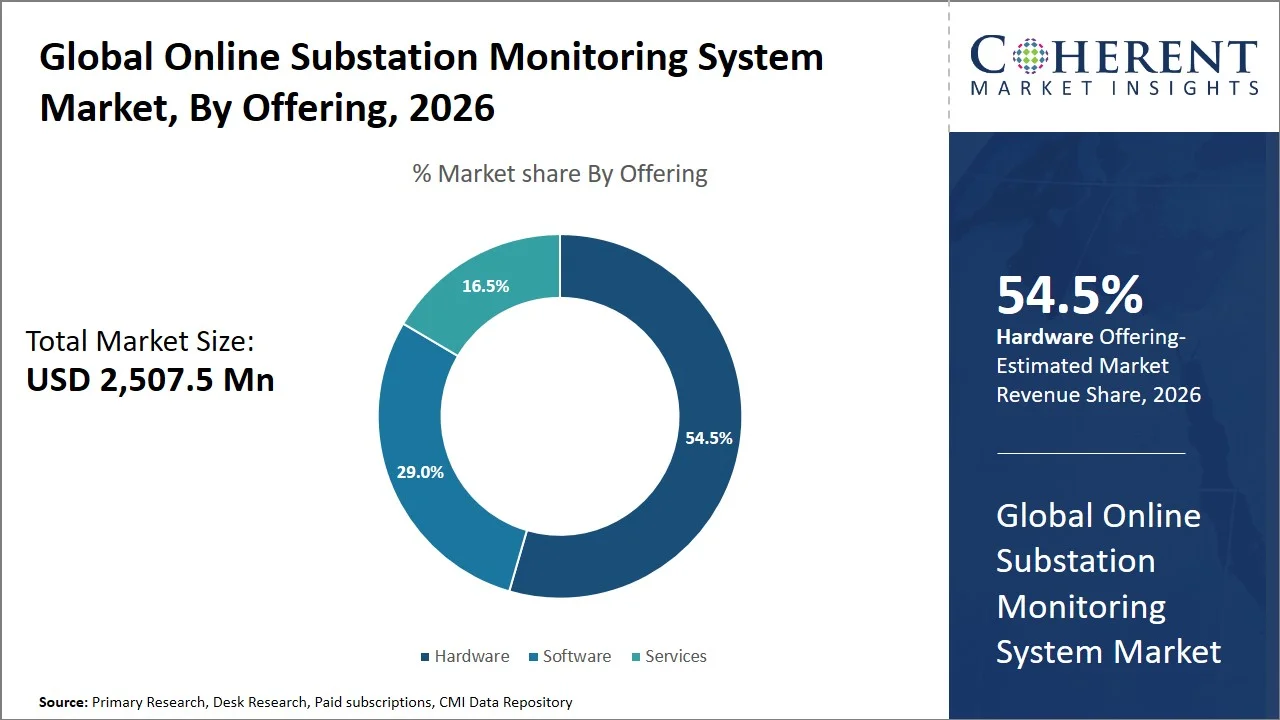
Why Does the Hardware Segment Dominate the Global Online Substation Monitoring System Market?
The hardware segment is expected to account for 54.5% of the global online substation monitoring system market share in 2026. The growth of the segment is driven by aging infrastructure of substations. A substantial portion of assets such as transformers, breakers and substations have been operating beyond their lifespan. This has pushed industries to adopt the use of monitoring system hardware to keep a track of equipment health, early threat detection and predictive maintenance.
On April 22, 2026, a line breaker at the 220 KV substation in Somanahalli in the outskirts of Bengaluru, India, that supplies power to the BWSSB pumping station, witnessed a rare flashover, briefly disrupting power supply to the Cauvery pumping station at Tataguni, India. It impacted water supply to parts of the city.
(Source: Times of India)
- Current Industry Events of 2026
- Market Size Estimation
- Regional Breakdown
- Competitive Landscape
- Customer Intelligence
- Segmental Analysis
- Pricing Analysis
- Key Market Drivers, Challenges & Future Trends
- Customized Insights Section
Why is Condition and Asset Health Monitoring the Most Crucial Functionality?
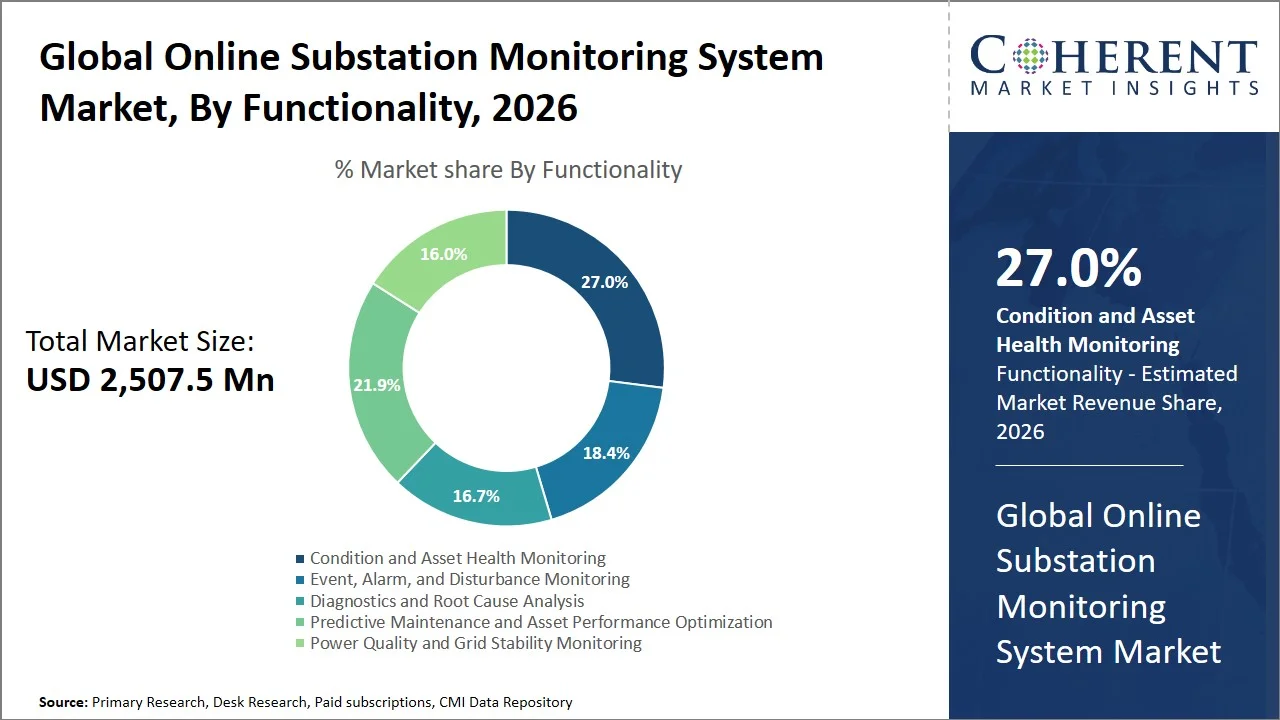
The condition and asset health monitoring segment is expected to account for 27.0% of the global online substation monitoring system market share in 2026. The demand is fueled by increasing renewable energy integration projects across the world. New green projects require condition and health monitoring of equipment and software alike for maximizing their productivity and lifespan. It is also important for keeping of check on emissions from production processes.
In addition, major companies worldwide are increasingly investing in renewable energy projects for a cleaner future. On April 24, 2026, TotalEnergies announced that it has secured financing for the Mirny onshore wind and Battery Energy Storage System (BESS) project in Kazakhstan. Located in the southeast of the country, Mirny aims to generate 100 TWh of renewable electricity over 25 years, enough to supply about 1 million people in Kazakhstan.
(Source: TotalEnergies)
On-Premises Deployment Segment Dominates the Global Online Substation Monitoring System Market
The on-premises deployment segment is expected to account for 52.2% of the global online substation monitoring system market share in 2026. Substations require detection systems to keep track of possible faults and defects. The installation of monitoring systems ensures the early detection of possible faults and automate quick responses to solve the issue. Moreover, on-premises deployment helps to control multiple substations from a single central command center.
On February 16, 2026, the Maharashtra State Electricity Distribution Company Limited (MSEDCL) rolled out a state-wide substation monitoring system (SMS) to strengthen power reliability and improve customer service across Maharashtra, India. The new platform provides live digital surveillance of substations, helping officials spot and fix issues quickly before they impact supply.
(Source: Switchgear)
Currents Events and their Impact
Current Events | Description and its Impact |
International Electrotechnical Commission - New IEC 61850 updates |
|
Cybersecurity Regulations - IEC 62351 |
|
Global Online Substation Monitoring System Market Dynamics
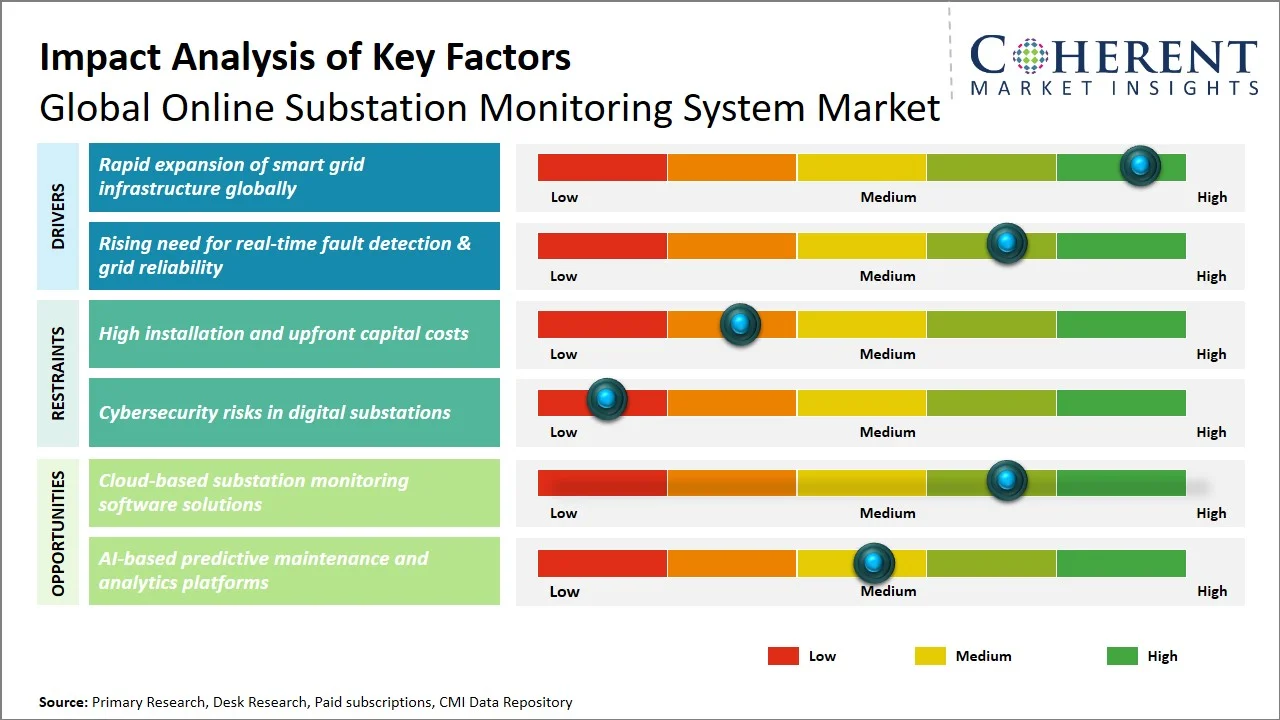
Market Drivers
- Rapid expansion of smart grid infrastructure globally: Increased deployment of renewable energy sources alongside growing electricity consumption drives rapid development of smart grid infrastructure. As cities expand their power needs, investment flows into upgrading legacy systems through digital substations and networked sensor technologies. Such upgrades emerge where real-time data meets adaptive control mechanisms across transmission pathways. Modernization efforts unfold mainly within national energy frameworks aiming at stability under variable supply conditions. On December 4, 2025, energy regulator, Ofgem approved a funding in a five-year plan to improve electricity and gas grids. The money will go towards maintaining gas networks and strengthening the electricity transmission network. (Source: BBC)
- Rising need for real-time fault detection & grid reliability: Should demand continue rising for immediate fault detection, strain on power grids will increase, prompting upgrades. Visibility of hardware conditions persists via real-time monitoring systems; here, anomalies such as overheating, voltage fluctuations, or deteriorating insulation appear earlier. Because alerts arrive ahead of failure points, responses occur faster, reducing cascading outages and aiding consistent supply flow. Enhanced reliability does not happen randomly, it follows precise awareness of operational patterns. On January 11, 2025, faults along Los Angeles’ power grid reportedly surged in the same areas where three major wildfires, the Eaton, Palisades, and Hurst Fires, broke out. According to Whisker Labs, electrical monitoring data showed sharp increases in grid faults just hours before the fires began. In the Palisades area, which experienced the largest blaze, 63 faults were recorded within a 2-3 hours window prior to ignition, suggesting unusual electrical activity in the affected zones. (Source: New York Post)
Emerging Trends
- AI & predictive analytics for fault detection in smart substations: Utility operators integrate machine learning tools by linking them with sensor networks into current control setups. Though new, these connections function within established operational boundaries using layered data pathways instead of standalone integration. Such integration detects irregular patterns by using data flows from smart devices across power infrastructure. Predictions about component breakdown emerge from continuous observation of operational signals.
- Digital substations with real-time condition monitoring & self-healing capabilities: Now manual inspections are replaced by constant sensor monitoring of heat, movement, and current faults. As information streams without pause, anomalies appear earlier through changes in behavior. Should interruptions arise, separation follows instantly since the network reacts fast.
Regional Insights
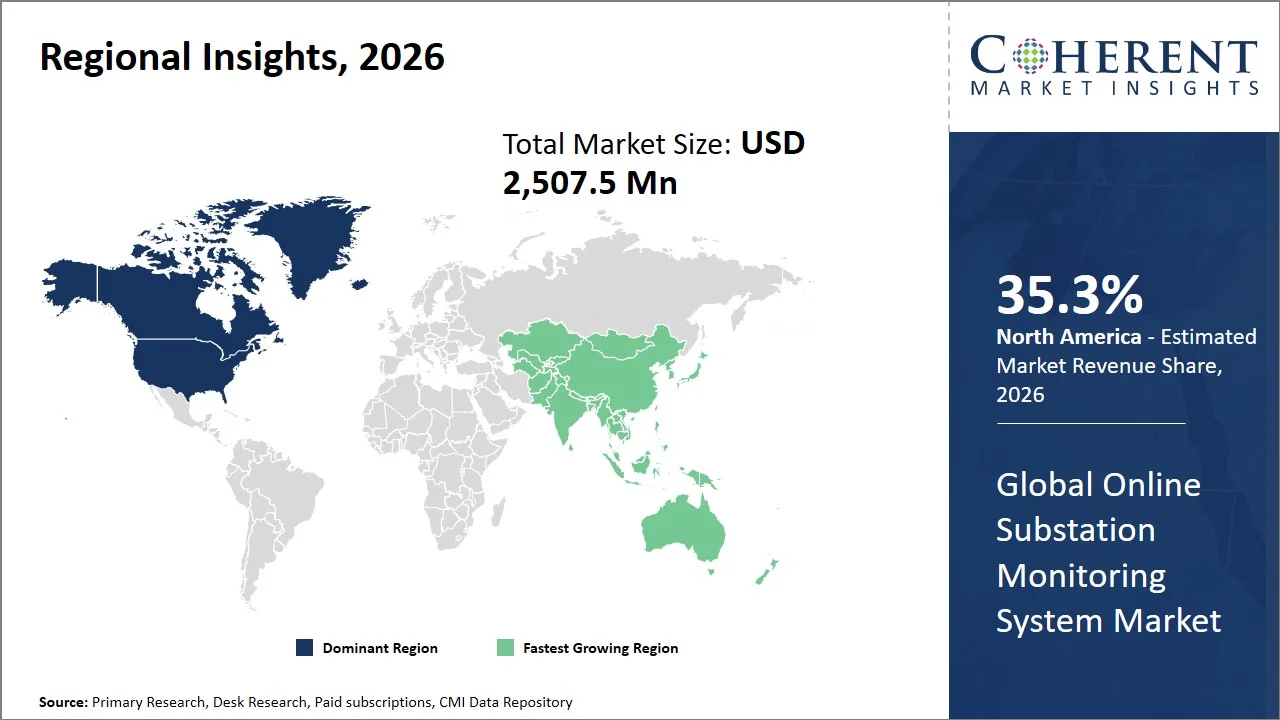
Why is North America a Strong Market for Online Substation Monitoring Systems?
North America is expected to account for a market share of 35.3% in 2026. One key factor behind North America’s lead in deploying web-based substation observation is the push by utilities toward digital improvements, meant to boost network stability while reducing large-scale outages. Rather than waiting, Southern California Edison uses advanced diagnostics and anomaly detection across its transmission framework, primarily targeting a drop in electricity-linked wildfires.
Duke Energy, on the opposite end, expands real-time asset supervision paired with predictive maintenance strategies at multiple facilities - this supports quicker responses once disruptions appear. Hydro-Québec, operating north of the border, embeds intelligent sensors along with remote viewing functions within its stations, enabling steadier operation amid extreme weather patterns. North American utilities are accelerating investments in grid modernization, with total capital spending expected to reach nearly USD 1.4 trillion between 2026 and 2030. U.S. investor-owned utilities are planning significant capital expenditures over the next five years, focusing on infrastructure modernization, reliability and new generation capacity to meet heightened energy demand from new large-load customers.
(Source: MSN)
Why Does the Asia Pacific Online Substation Monitoring System Market Exhibit High Growth?
Asia Pacific is expected to account for a market share of 25.2% in 2026 and is expected to register the fastest growth rate over the forecast period. Growth in the Asia Pacific market for online substation monitoring systems stems largely from extensive upgrades to smart grids across nations such as China, India, Japan, and South Korea; these efforts focus on digital substations alongside continuous surveillance tools aimed at meeting higher power needs and handling variable energy sources.
Rather than relying on traditional methods, electric providers now implement live data tracking so disruptions can be spotted early, especially where solar and wind inputs fluctuate. India is undertaking the world’s largest smart metering rollout. Under a government mandate to replace 250 million conventional electricity meters with smart Advanced Metering Infrastructure (AMI) devices, the country has launched an unprecedented TOTEX-based AMISP financing model. With almost USD 10.50 billion worth of sanctioned works across 45 DISCOMs installed in December 2025, India is attempting a digital transformation of its power distribution backbone at a scale, speed, and complexity that no other nation has attempted simultaneously.
(Source: NES)
Why is the U.S. Emerging as a Major Hub in the Online Substation Monitoring System Market?
Among global regions, the U.S. now stands prominent in adopting web-connected substation surveillance tools. Despite outdated grids, upgrades now respond to reliability concerns, extreme weather patterns intensifying, along with greater integration of renewable generation. Following earlier fire incidents tied to equipment issues, Pacific Gas and Electric expanded monitoring through automated systems capable of detecting disruptions without human initiation. Support also flows from national policy; financial backing through measures such as the Infrastructure Investment and Jobs Act pushes smarter network tracking into wider use across states. As these patterns converge, U.S.-based utilities increasingly shape the frontier of live substation insight platforms.
Is China the Next Growth Engine for the Online Substation Monitoring System Market?
Nowhere is the push for smarter electricity networks more visible than in China, where State Grid Corporation advances large-scale projects integrating digital substations along ultra-high-voltage corridors, each fitted with live diagnostic capabilities. Owing to these efforts, monitoring systems grow rapidly, fueled by national priorities emphasizing continuous data capture. From provinces like Jiangsu and Zhejiang, machine-based analysis maintains unbroken watch over transformers and network dynamics, helping balance supply from remote photovoltaic and turbine-rich areas. Rather than relying on legacy practices, planners align investments with long-term visions called "new power systems," directing resources toward sensor-enabled control and predictive upkeep strategies. Over time, such moves position the country high among global adopters of advanced grid observation technologies deployed at scale.
India Online Substation Monitoring System Market Analysis and Trends
Despite modest beginnings, India's push toward digitizing power networks has sharpened focus on substation oversight tools, driven by nationwide initiatives such as RDSS that prioritize data-rich infrastructure through layered deployment of SCADA units alongside networked sensing devices. Instead of legacy setups, modern installations now rely heavily on continuous data streams fed into analytical platforms, allowing clearer insight across operations. Even so, utility-led expansion projects in high-voltage transmission corridors have begun favoring standardized digital architectures compliant with IEC 61850 protocols, embedding forward-looking service models rooted in forecast-driven upkeep and off-site troubleshooting capabilities. As green sources feed more output into the main lines and maximum usage periods grow longer, automatic response mechanisms gain importance within reinforced electricity frameworks designed for stability.
Growth in the U.K. market for online substation monitoring systems stems largely from efforts to renew electrical infrastructure, driven by large-scale upgrades coordinated by entities including National Grid Electricity Transmission. Real-time oversight and digitized substations now support greater volumes of renewable output, adapting networks once built for conventional supply patterns. For example, the Eastern Green Link high-voltage connections linking Scotland and southern regions integrate refined tracking mechanisms capable of spotting irregularities early during cross-country transfer of offshore-generated electricity. Progress under regulatory mandates such as those defined in Ofgem’s RIIO-ED2 phase prompts regional utilities like UK Power Networks to install diagnostic sensors within local stations.
Global Online Substation Monitoring System Market - Substation Asset Aging & Retrofit Rate
Region | Substations operating beyond 20 years (%) | Beyond 30 years (%) | Typical retrofit / modernization rate per year (%) |
North America | ~70–80% | ~55–65% | ~2–4% |
Europe | ~60–75% | ~40–55% | ~3–5% |
Asia Pacific | ~40–60% | ~25–40% | ~4–7% |
Latin America | ~50–70% | ~30–45% | ~2–4% |
Middle East & Africa | ~40–60% | ~20–35% | ~3–6% |
How is Cloud-Based Substation Monitoring Software Solutions Creating New Growth Opportunities in the Global Online Substation Monitoring System Market?
Away from physical servers, monitoring systems now operate online, opening paths for energy providers to observe electrical networks instantly, no matter the distance. As updates arrive continuously, teams adjust more quickly when disruptions appear. One site after another connects under a single digital roof, pooling information from far-flung stations into unified views. When equipment behaves unusually, warnings form ahead of failure, guided by patterns machines detect over time. Instead of storing files locally, companies rely on remote storage that grows as needed. With solar and wind contributing uneven output, constant tracking becomes essential to balance supply. On February 2, 2026, Systems With Intelligence (SWI) announced the launch of INTELLINSPECT, a cloud-based inspection automation platform that enables utilities to streamline the analysis of visual and thermal sensor data. (Source: SWI)
Market Players, Key Development, and Competitive Intelligence
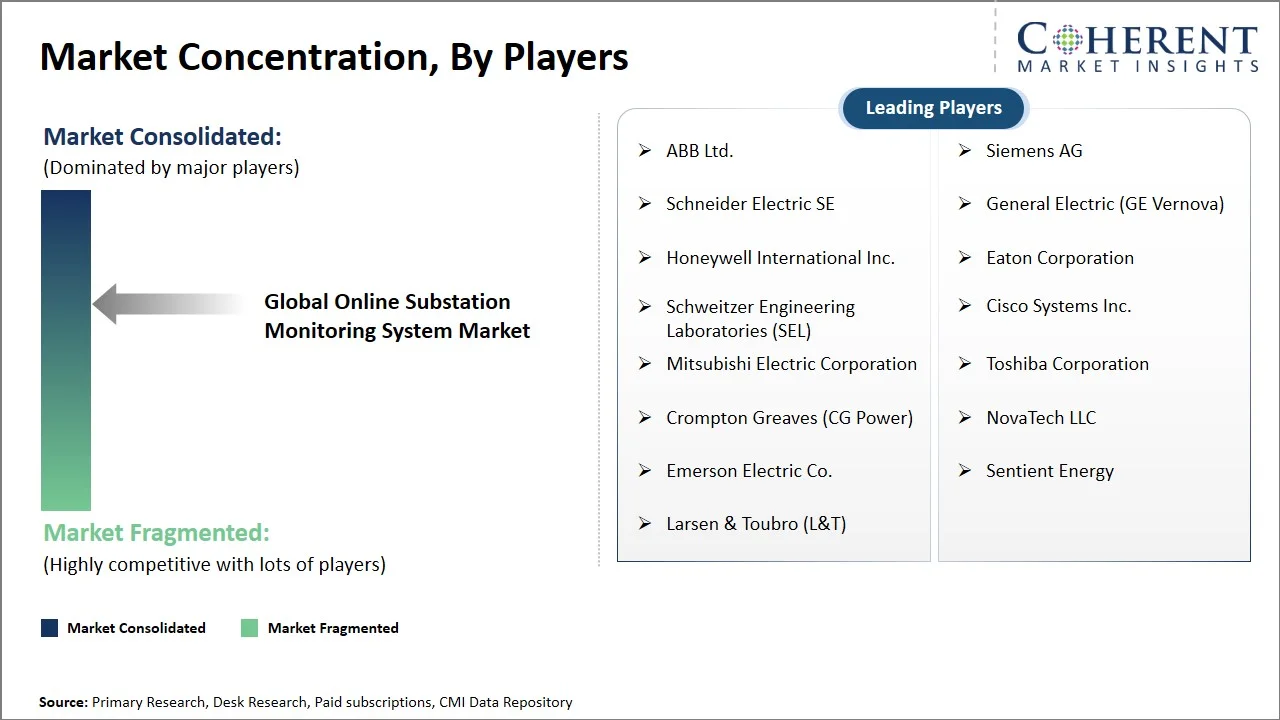
Key Developments
- On December 2, 2025, ABB announced the completion of its acquisition of Gamesa Electric’s power electronics business in Spain from Siemens Gamesa, originally announced on December 18, 2024. By combining ABB’s global reach and Gamesa Electric’s portfolio and expertise, ABB’s is well positioned to capture growing demand and accelerate renewable energy adoption worldwide.
- On April 8, 2025, Revolve Renewable Power Corp., a North America-based Aoperator and developer of renewable energy projects, announced that project development work in the company’s two utility scale wind projects in Mexico is being accelerated as a result of increased regulatory certainty.
Competitive Landscape
Though only a few major firms shape it, the worldwide market for online substation monitoring systems remains intensely contested. Dominance in big utility agreements rests largely with top-tier industrial automation providers. Firms including ABB, Siemens Energy, Schneider Electric, GE Vernova, and Hitachi Energy maintain strong positions via unified digital systems that blend instant data tracking, supervisory controls, sensor networks, and forward-looking analysis tools - frequently winning expansive upgrades across national power grids.
Market Report Scope
Online Substation Monitoring System Market Report Coverage
| Report Coverage | Details | ||
|---|---|---|---|
| Base Year: | 2025 | Market Size in 2026: | USD 2,507.5 Mn |
| Historical Data for: | 2020 To 2024 | Forecast Period: | 2026 To 2033 |
| Forecast Period 2026 to 2033 CAGR: | 7.7% | 2033 Value Projection: | USD 4,220.4 Mn |
| Geographies covered: |
| ||
| Segments covered: |
| ||
| Companies covered: | ABB Ltd., Siemens AG, Schneider Electric SE, General Electric (GE Vernova), Honeywell International Inc., Eaton Corporation, Emerson Electric Co., Schweitzer Engineering Laboratories (SEL), Cisco Systems Inc., Mitsubishi Electric Corporation, Toshiba Corporation, Crompton Greaves (CG Power), NovaTech LLC, Sentient Energy, and Larsen & Toubro (L&T) | ||
| Growth Drivers: |
| ||
| Restraints & Challenges: |
| ||
Analyst Opinion (Expert Opinion)
- The global online substation monitoring system market is a critical pillar of modern grid transformation, driven by the shift from manual inspection to continuous, data-driven asset intelligence. They emphasize that utilities are increasingly prioritizing AI-enabled monitoring, IoT sensor integration, and cloud-based analytics to improve outage prevention and asset lifecycle management, especially as extreme weather events and renewable energy variability stress existing grids. Software-driven systems now shape the direction of industry shifts, as reliance on physical equipment declines. Predictive capabilities begin to define performance more than machinery alone does. Real-time analysis stands central in separating leading approaches from outdated ones.
- Steady expansion is expected to appear, driven by utility companies worldwide moving faster toward digital substations while prioritizing independent grid management. Shaping what comes next: edge computing finds broader use, alongside virtual replicas of physical systems and intelligent models forecasting failures before they occur - systems capable of automatic recovery emerge, along with operations designed to avoid interruptions. Electrification climbs higher, renewable sources connect more frequently, major power lines stretch across continents - projects surge notably in areas such as Asia Pacific and North America, pulling real-time oversight into essential roles within modernized electrical networks.
Speak to the analyst
Want personalized insights?
Take the findings above to one of our principal consultants, or have the report rebuilt around the segments, geographies and competitors you actually track.
Market Segmentation
- Offering Insights (Revenue, USD Million, 2021 - 2033)
- Hardware
- Intelligent Electronic Devices (IEDs)
- Sensors and Transducers
- Data Acquisition Units and RTUs
- Transformer Monitoring Systems
- Partial Discharge Monitoring Systems
- Communication Gateways and Edge Devices
- Others (Power Quality Monitoring Devices, Metering and Measurement Devices, Time Synchronization Devices, etc.)
- Software
- Monitoring and Visualization Platforms
- Analytics and Fault Diagnosis Software
- Asset Management and CMMS Integrations
- Others (Cybersecurity Software for Substations, etc.)
- Services
- Managed Services
- Professional Services
- Hardware
- Functionality Insights (Revenue, USD Million, 2021 - 2033)
- Condition and Asset Health Monitoring
- Event, Alarm, and Disturbance Monitoring
- Diagnostics and Root Cause Analysis
- Predictive Maintenance and Asset Performance Optimization
- Power Quality and Grid Stability Monitoring
- Deployment Model Insights (Revenue, USD Million, 2021 - 2033)
- On-Premises Deployment
- Cloud-Based Deployment
- Hybrid Deployment
- Communication and Integration Layer Insights (Revenue, USD Million, 2021 - 2033)
- Wired Communication
- Wireless Communication
- Substation Type Insights (Revenue, USD Million, 2021 - 2033)
- Transmission Substations
- Distribution Substations
- Voltage Range Insights (Revenue, USD Million, 2021 - 2033)
- 110 to 220 kV
- 220 to 400 kV
- 400 to 765 kV
- Above 765 kV
- End User Insights (Revenue, USD Million, 2021 - 2033)
- Electric Utilities
- Independent Power Producers and Grid Asset Owners
- Industrial Substation
- Oil and Gas
- Mining and Metals
- Manufacturing
- Infrastructure
- Railways
- Metros
- Airports
- Others (Data Centers, Defense, etc.)
- Regional Insights (Revenue, USD Million, 2021 - 2033)
- North America
- U.S.
- Canada
- Latin America
- Brazil
- Argentina
- Mexico
- Rest of Latin America
- Europe
- Germany
- U.K.
- Spain
- France
- Italy
- Russia
- Rest of Europe
- Asia Pacific
- China
- India
- Japan
- Australia
- South Korea
- ASEAN
- Rest of Asia Pacific
- Middle East
- GCC Countries
- Israel
- Rest of Middle East
- Africa
- South Africa
- North Africa
- Central Africa
- North America
Sources
Primary Research Interviews
- Utility Grid Operators and System Engineers
- Substation Monitoring Equipment Manufacturers
- Power Transmission and Distribution Companies
- Smart Grid Technology Solution Providers
Magazines
- Transmission & Distribution World Magazine
- Electric Light & Power Magazine
- Power Engineering International Magazine
- Smart Grid Today Magazine
Journals
- IEEE Transactions on Power Delivery
- Electric Power Systems Research Journal
- International Journal of Electrical Power & Energy System
Associations
- International Council on Large Electric Systems (CIGRE)
- Institute of Electrical and Electronics Engineers (IEEE)
- Edison Electric Institute (EEI)
- International Electrotechnical Commission (IEC)
Public Domain Sources
- National Renewable Energy Laboratory (NREL) Reports
- Department of Energy (DOE) Publications
- International Energy Agency (IEA) Reports
- World Bank Energy Sector Publications
Proprietary Elements
- CMI Data Analytics Tool
- Proprietary CMI Existing Repository of information for last 10 years
Get access to 250+ pages report
Every segment, forecast, competitor profile and data table behind the analysis above — available for instant download.
- ESOMAR Member
- ISO 9001:2015 Certified
- D-U-N-S Registered
- GDPR & CCPA Compliant
Missing comfort of reading report in your local language? Find your preferred language:
Transform your Strategy with Exclusive Trending Reports
Frequently Asked Questions
The global online substation monitoring system market is expected to stand at USD 2,507.5 Mn in 2026 and is expected to reach USD 4,220.4 Mn by 2033.
The CAGR of the global online substation monitoring system market is projected to be 7.7% from 2026 to 2033.
Rapid expansion of smart grid infrastructure globally and rising need for real-time fault detection & grid reliability are the major factors driving the growth of the global online substation monitoring system market.
High installation and upfront capital costs and cybersecurity risks in digital substations are the major factors hampering the growth of the global online substation monitoring system market.
In terms of offering, hardware is estimated to dominate the market revenue share in 2026.
AI predicts equipment failures by analyzing patterns in operational data.
ABB Ltd., Siemens AG, Schneider Electric SE, General Electric (GE Vernova), Honeywell International Inc., Eaton Corporation, Emerson Electric Co., Schweitzer Engineering Laboratories (SEL), Cisco Systems Inc., Mitsubishi Electric Corporation, Toshiba Corporation, Crompton Greaves (CG Power), NovaTech LLC, Sentient Energy, and Larsen & Toubro (L&T) are the major players.