

Global Open Banking Market Size and Forecast – 2026 To 2033
The global open banking market is expected to grow from USD 51 Bn in 2026 to USD 287 Bn by 2033, registering a compound annual growth rate (CAGR) of 28% from 2026 to 2033. The global open banking market is driven by rising demand for account-to-account (A2A) payments. On June 2, 2025, Visa, announced that its new pay by bank solution is ready for market in the U.K. Built on Visa’s decades of payments expertise, Visa A2A gives consumers greater choice, control and protection over how they pay through bank transfers. (Source: Visa)
Key Takeaways of the Global Open Banking Market
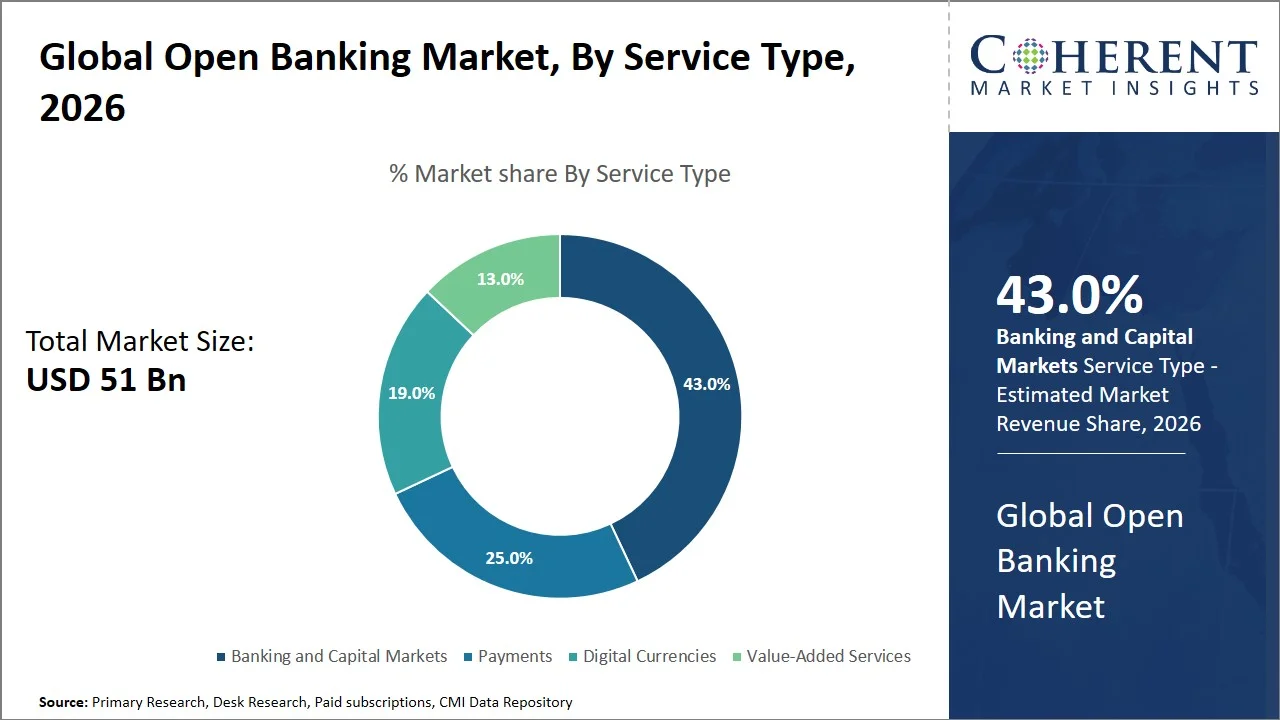
- The banking and capital markets segment is expected to account for 43.0 % of the global open banking market share in 2026. Higher consumer demand for AI-based personalized financial services is driving the growth of the segment. On June 22, 2026, Lloyds Banking Group announced it is accelerating its use of AI, investing in new tools, talent and training to embed the technology across the business and support more convenient services for customers. (Source: Lloyds Banking Group)
- The cloud segment is estimated to capture 62.0 % of the market share in 2026. Increasing use of AI and data analytics in banking is driving the growth of the segment. SoFi Technologies, Inc. announced the launch of Composer by SoFi, an AI-powered investing platform that allows investors to go from investing ideas to automated execution within minutes.
- The banks segment is estimated to capture 49.0 % of the market share in 2026. Increasing enhancements in API security and identity verification technologies is majorly driving the growth of the segment. On September 16, 2025, Ping Identity announced that it has extended support for FAPI 2.0 (Financial-grade API) standards to enable financial institutions to implement more robust OAuth-based authorization, comprehensive authorization requests and sophisticated identity verification for open banking ecosystems.
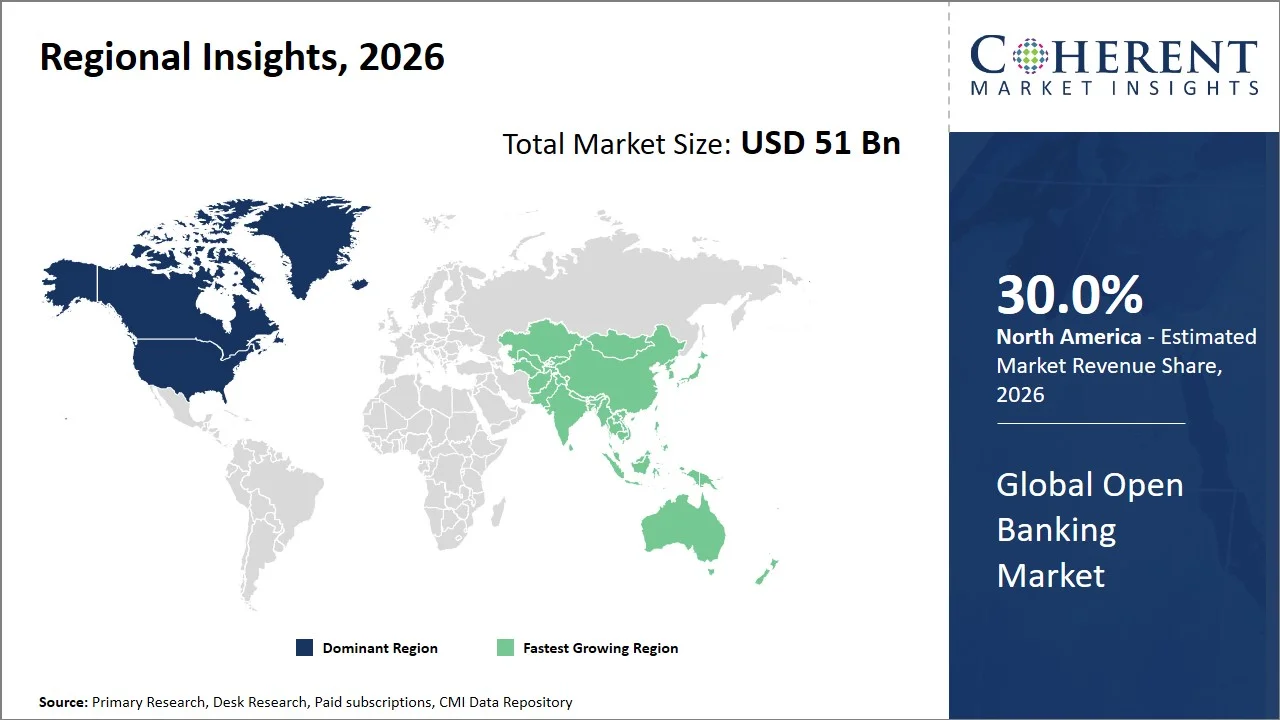
- North America is expected to dominate the open banking market in 2026 with a market share of 30.0 %. Growing expansion of AI-driven financial management and advisory services in North America is driving the growth of the regional market. On June 3, 2026, Morgan Stanley announced the impending launch of a major wealth management funnel to artificial intelligence agents from thousands of firms.
- Asia Pacific is expected to account for 21.0 % share in 2026 and is projected to record the fastest growth over the forecast period. Increasing investments in fintech services across Asia Pacific is primarily driving the growth of the regional market. On June 26, 2026, Airwallex announced a USD 320 million Series H investment round to accelerate product development across autonomous banking and agentic commerce, while also expanding its infrastructure and regulatory footprint into new markets.
- Expansion of Open Finance Beyond Traditional Banking: The concept of open banking is gradually changing into open finance, allowing for the secure sharing of data not just in banking but also in insurance, investments, pensions and lending services. This broader ecosystem allows financial institutions to offer holistic personalized fintech solutions and generate new revenue streams through API-driven collaboration.
- Accelerating Adoption of Embedded Finance and Banking-as-a-Service (BaaS): E-commerce, healthcare, travel and retail businesses are integrating financial products like digital payments, lending and insurance directly into their digital platforms. Thanks to Banking-as-a-Service (BaaS) providers’ safe open banking APIs, non-bank enterprises can now provide regulated financial services, dramatically expanding their market reach.
Segmental Insights
Why Do Banking and Capital Markets Dominate the Global Open Banking Market?
The banking and capital markets segment is expected to account for 43.0% of the global open banking market share in 2026. The banking and capital markets category is expected to hold the greatest part of the worldwide open banking market, driven by the increased adoption of application programming interfaces (APIs) to modernize core banking operations and boost customer-centric financial services. To allow for secure data sharing, speed up digital payments, make lending easier, improve investment management, and meet changing regulatory requirements, banks and capital market institutions are adopting open banking platforms. The general digital transformation enables financial institutions to provide individualized products and increase client interaction, lower operational costs and collaborate more efficiently with fintech firms, all of which supports the consistent desire for open banking. On May 21, 2025, Citizens Bank announced a commercial open banking API platform that allows business customers to safely share their banking data with enterprise software suppliers. According to the company, screen scraping was reduced by 95% following deployment.
- Current Industry Events of 2026
- Market Size Estimation
- Regional Breakdown
- Competitive Landscape
- Customer Intelligence
- Segmental Analysis
- Pricing Analysis
- Key Market Drivers, Challenges & Future Trends
- Customized Insights Section
Why is Cloud the Most Preferred Deployment Type?
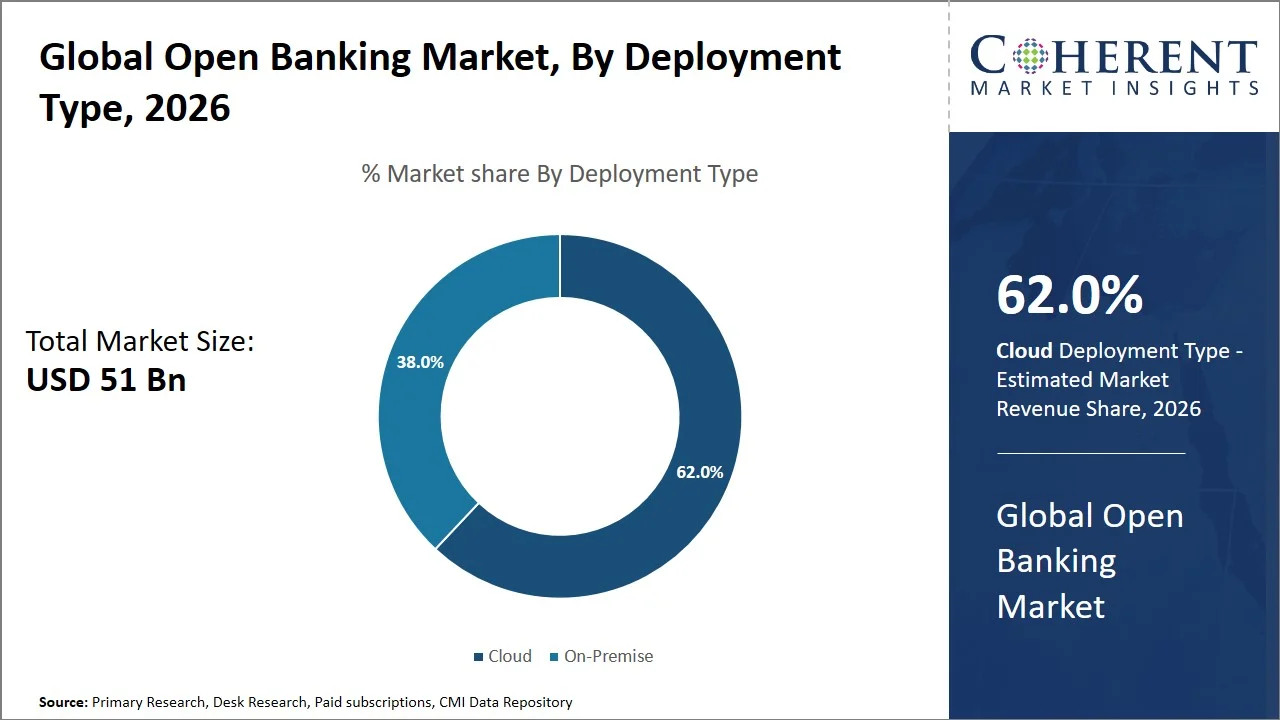
The cloud segment is expected to account for 62.0% of the global open banking market share in 2026. Cloud deployment is the recommended deployment choice, as it offers the scalability and flexibility needed to serve the fast growing open banking ecosystems. Financial institutions and fintech companies may develop application programming interfaces (APIs) rapidly, integrate third-party services, handle massive volumes of real-time transactions and launch new digital products with no investment in on-premises infrastructure. In addition, cloud platforms provide automatic software updates, improved disaster recovery, improved security capabilities and reduced operational expenses, allowing enterprises to speed innovation while ensuring regulatory compliance and service uptime. On June 17, 2026, HSBC announced a multi-year partnership with Google Cloud to build and deploy artificial intelligence capabilities across HSBC’s operations. The partnership, announced to coincide with the Google Cloud Summit in London, will aim to accelerate innovation in areas such as hyper-personalized wealth management advice for customers and financial crime risk management. (Source: HSBC)
Banks Dominate the Global Open Banking Market
The banks segment is expected to account for 49.0% of the global open banking market share in 2026. The main adopters of open banking are banks as they hold the largest amount of client financial data and are accountable for meeting changing regulatory requirements around secure data exchange. Open banking platforms can help banks connect securely with fintech providers, provide customized financial solutions, boost their digital payment business, increase client loyalty and unlock other revenue streams through services based on APIs. Their continued efforts in digital transformation, cybersecurity, and customer experience continue to accelerate the use of open banking technology across the global banking sector. On March 12, 2026, Truist Financial Corporation and Plaid Inc. announced a data‑access agreement expanding secure open banking access for Truist clients, delivering increased control over their finances. (Source: Truist)
Currents Events and their Impact
Current Events | Description and its Impact |
European Union - Financial Data Access (FiDA) Regulation (2025–ongoing legislative process) |
|
U.K. - Data (Use and Access) Act 2025 |
|
Open Banking Market Dynamics
Market Drivers
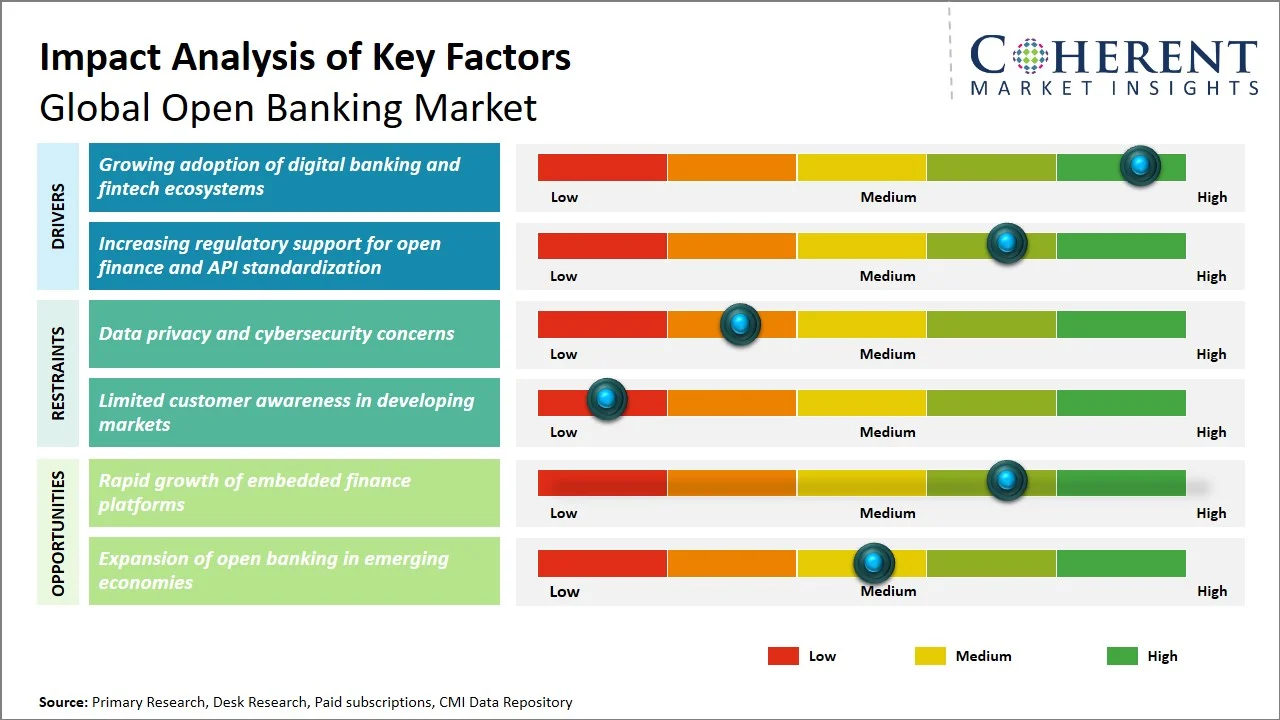
- Growing adoption of digital banking and fintech ecosystems: The growing use of digital banking and fintech ecosystems is a major factor driving the worldwide open banking industry, as customers are rapidly becoming mobile-first, seeking seamless and personalized financial services. Banks are working with fintech startups to deliver innovative products such as quick payments, digital loans, personal financial management and automated investing services using secure application programming interfaces (APIs). This growing ecosystem is accelerating product innovation, customer experience, operational efficiency and new revenue streams, pushing wider use of open banking systems across developed and developing markets. On June 2, 2026, Meta Platforms, announced it will invest USD 900 million in Indian financial company CRED, which values it at USD 4.5 billion. It is one of the biggest investments in India’s financial technology sector in recent years.
- Increasing regulatory support for open finance and API standardization: Growing regulatory support for open finance and application programming interface (API) standardization is driving the growth of the global open banking market by creating secure, interoperable, and transparent data-sharing environments. Regulatory bodies and governments across the globe are laying down frameworks that call for standardized APIs, improved customer consent processes, and better data security so that banks and third-party suppliers may work seamlessly together. These policies drive greater competition, boost financial innovation, increase customers’ access to tailored financial services, build trust in digital financial ecosystems, and drive wider adoption of open banking solutions. On April 14, 2026, Financial Data Exchange (FDX), a leading technical standards body representing banks, fintechs, consumer advocates, and others, launched a new initiative to promote safety and innovation when AI agents are used by consumers and companies to transmit sensitive financial account data. (Source: Financial Data Exchange)
Emerging Trends
- Increasing Use of AI and Advanced Analytics for Personalized Banking: Banks and financial institutions are using artificial intelligence and machine learning with open banking data to offer real-time financial insights, automated budgeting, personalized lending decisions, fraud detection, and predictive financial planning. This trend is increasing consumer involvement and improving operational efficiency.
- Growing Adoption of Real-Time Account-to-Account (A2A) Payments: Open banking is fueling the shift away from card-based payments towards real-time account-to-account payments. Organizations are increasingly turning to A2A payment solutions to lower transaction costs, speed up settlement times, enhance cash flow and provide consumers with faster, more secure payment experiences across digital commerce channels.
Regional Insights
Why is North America a Strong Market for Open Banking?
North America is expected to account for a market share of 30.0% in 2026. North America is improving its position in the open banking sector with regulatory reforms and strong fintech-bank collaboration. In the U.S., the Section 1033 rule of the Consumer Financial Protection Bureau has accelerated API-enabled data sharing. Financial institutions including JPMorgan Chase, Bank of America and Wells Fargo have stepped up secure API integrations with fintechs such as Plaid, MX and Finicity. Canada is also improving its consumer-driven banking infrastructure, with major institutions such as the Royal Bank of Canada and TD Bank collaborating in trial projects to enable standardization of financial data exchange and digital financial innovation. On January 29, 2026, GFT Technologies teamed up with Ozone API to enable Canadian financial institutions to build standardized open banking APIs and get ready for the Consumer-Driven Banking framework in Canada
Why Does the Asia Pacific Open Banking Market Exhibit High Growth?
Asia Pacific is projected to account for 21.0% of the global open banking market and expected to register the fastest growth. Open banking is growing rapidly in the Asia Pacific with government-backed digital finance programs and increasing usage of fintech. Australia is working to expand its Consumer Data Right (CDR) setting, and Singapore’s API Exchange (APIX) platform is helping banks and fintechs to work together across Southeast Asia. India has emerged as a global leader in the Account Aggregator ecosystem, where institutions such as HDFC Bank, ICICI Bank, Axis Bank, and fintech companies share financial data on a consent basis to promote digital lending, wealth management, and financial inclusion. On January 21, 2026, Airwallex, a leading global financial platform for modern businesses, acquired Paynuri Co. Ltd., an entity holding Payment Gateway and Prepaid Electronic Payment Instrument licenses as well as a Foreign Exchange Business registration, in South Korea.
Global Open Banking Market Outlook for Key Countries
Why is the U.S. Emerging as a Major Hub in the Open Banking Market?
With the introduction of the CFPB’s Personal Financial Data Rights Rule under Section 1033 of the Dodd-Frank Act, the U.S. is racing towards open banking adoption. As they move away from screen scraping and toward standardized data-sharing protocols, major financial institutions such as JPMorgan Chase, Capital One and PNC Bank are extending their secure API collaborations with fintechs such as Plaid, Akoya and MX. Open banking is increasingly supporting instant account verification, embedded finance, personal financial management and real-time payment services across the country’s digital financial ecosystem.
Is Australia the Next Growth Engine for the Open Banking Market?
Australia is one of the world’s most mature open banking markets, supported by its Consumer Data Right framework, managed by the Australian Competition and Consumer Commission. The major banks – Commonwealth Bank of Australia, National Australia Bank, Westpac and ANZ – have standardized APIs that enable accredited third parties to safely access financial data that customers have approved. This becomes the foundation for Australian fintechs such as Basiq and Frollo to supply digital financing, budgeting and cash flow management solutions for consumers and business.
Germany Open Banking Market Analysis and Trends
Germany remains at the forefront of the open banking revolution in Europe with its robust implementation of PSD2 and the move towards open finance. Financial institutions including Deutsche Bank, Commerzbank and digital bank N26 are among those incorporating open banking APIs to support digital payments, lending and financial aggregation services. With the help of Berlin-based fintechs like Tink Germany and FinTecSystems, the German API ecosystem has been improved by providing banks, merchants and financial service providers with safe account information services and payment initiation.
India Open Banking Market Analysis and Trends
India has built one of the most advanced open banking ecosystems, backed by the Reserve Bank of India’s Account Aggregator framework and the Digital Public Infrastructure stack. Financial institutions such as HDFC Bank, ICICI Bank, State Bank of India and Kotak Mahindra Bank are adopting Account Aggregator services to enable consent-based sharing of financial data for retail and MSME lending. The integration of the Unified Payments Interface (UPI), Aadhaar, and the Account Aggregator framework offers speedier loan approvals, improved credit underwriting, and broader access to digital financial services.
U.K. Open Banking Market Analysis and Trends
The U.K. remains the global benchmark for open banking implementation, backed by the Open Banking Implementation Entity and a well-developed regulatory environment. The country’s nine main banks continue to offer standardized APIs to enable fintechs such as TrueLayer, Token.io and Yapily to offer account-to-account payments, identity verification and personal finance management solutions. Open banking is widely used by lenders, accounting platforms and payment providers to enable real-time payment initiation, affordability assessments and automated financial data sharing across the U.K. financial services industry.
Global Open Banking Market - Consumers Actively Using Open Banking Services (2025)
Region | Active Open Banking Consumers (Million) |
Europe | 108 |
North America | 63 |
Asia Pacific | 71 |
Latin America | 25 |
Middle East & Africa | 21 |
Global Open Banking Market - Connected Fintech Applications per Bank (2025)
Bank Type | Average Connected Fintech Applications per Bank |
Tier-1 Global Banks | 95 |
Large National Banks | 68 |
Regional Banks | 39 |
Digital-Only (Neobanks) | 82 |
Community/Local Banks | 21 |
Cooperative & Mutual Banks | 18 |
How is Rapid Growth of Embedded Finance Platforms Creating New Growth Opportunities in the Open Banking Market?
The burgeoning embedded finance platforms are paving immense growth opportunities in the open banking market as non-financial firms can now embed banking services such as payments, lending, insurance and savings into their digital platforms directly through secure application programming interfaces (APIs). E-commerce companies, mobility providers, healthcare platforms, travel businesses and software providers are increasingly partnering with banks and fintech firms to provide seamless financial services within their customer journeys, without the need to switch between applications. This momentum is allowing open banking APIs to be used outside of traditional financial institutions to boost transaction volumes, improve bank-fintech collaborations, enhance engagement with clients, and generate new revenue streams for API providers, banks, and embedded finance platforms around the world.
On September 29, 2025, Worldpay introduced Embedded Finance Engine, a new suite of best-in-class financial service products that its software platform partners can quickly integrate to generate stronger retention and revenue growth while simplifying their tech stacks and ecosystems.
Market Players, Key Development, and Competitive Intelligence
Key Developments
- On June 2, 2025, Tink became one of the first members of Visa A2A, which helps to enable the true scale of Pay by Bank and variable recurring payments (VRP) in the U.K. Visa A2A is a framework that connects banks and third-party providers (like Tink) under a common rulebook, API standard, commercial model, liability framework, and disputes management platform.
- On September 9, 2024, TrueLayer deployed Stripe’s Pay by Bank offering across its payments products in the UK. In May 2025, Stripe unveiled Pay by Bank, a new payment method letting merchants to accept payments directly from customers’ bank accounts, streamlining the payment process and lowering fees.
Competitive Landscape
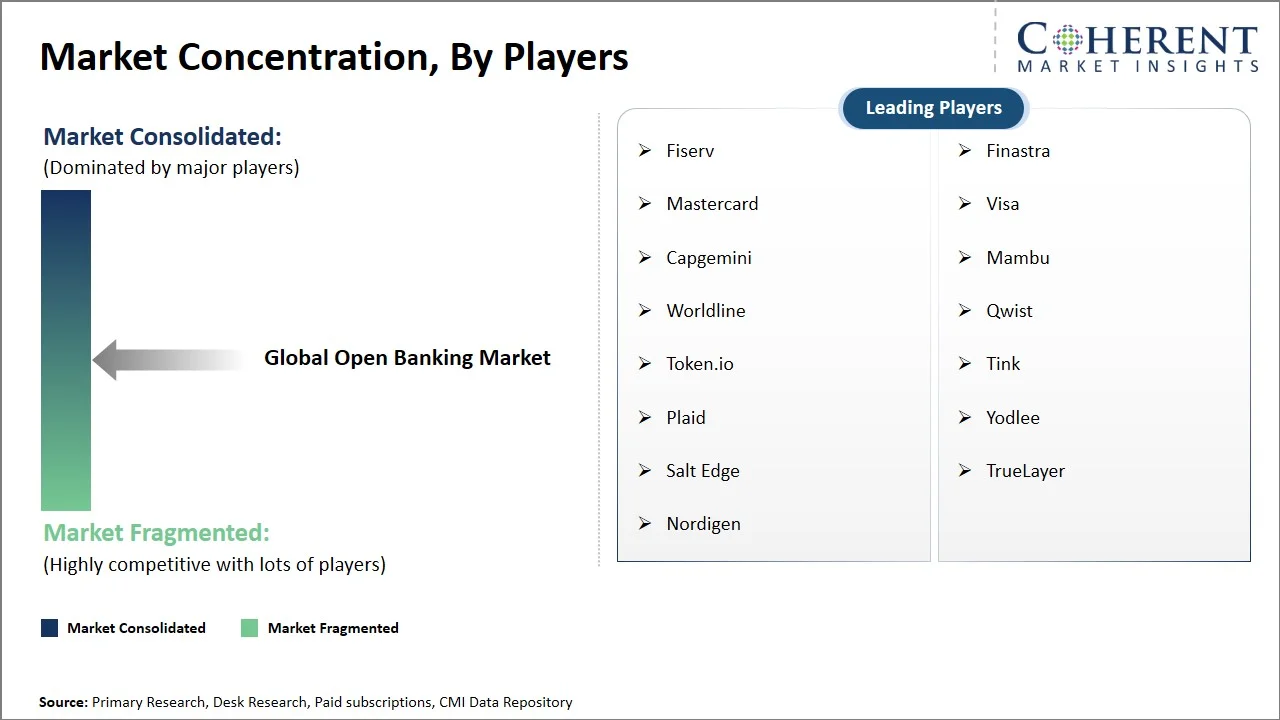
The global open banking market is highly competitive and fragmented with a number of key players competing for a share of the market. Leading players include established financial technology providers, global payment companies, core banking software vendors and niche API platform providers. Major companies such as Fiserv, Finastra, Visa, Mastercard, Plaid, Tink, TrueLayer, Salt Edge, Mambu, and Token.io are focusing on expanding API capabilities, strengthening cybersecurity, enhancing cloud-based platforms, and forming strategic partnerships with banks and fintech companies. Also, market players are investing in artificial intelligence, real-time payment infrastructure, embedded finance solutions, and open finance capabilities to differentiate their offers and improve their worldwide footprint due to the growing regulatory requirements.
Market Report Scope
Report Coverage
| Report Coverage | Details | ||
|---|---|---|---|
| Base Year: | 2025 | Market Size in 2026: | USD 51 Bn |
| Historical Data for: | 2020 To 2024 | Forecast Period: | 2026 To 2033 |
| Forecast Period 2026 to 2033 CAGR: | 28% | 2033 Value Projection: | USD 287 Bn |
| Geographies covered: |
| ||
| Segments covered: |
| ||
| Companies covered: | Fiserv, Finastra, Mastercard, Visa, Capgemini, Mambu, Worldline, Qwist, Token.io, Tink, Plaid, Yodlee, Salt Edge, TrueLayer, and Nordigen | ||
| Growth Drivers: |
| ||
| Restraints & Challenges: |
| ||
Analyst Opinion (Expert Opinion)
- Continued regulatory backing, faster digital transformation, and growing collaboration between banks and fintechs are projected to alter the open banking sector. There is a greater focus on secure API ecosystems and customer-controlled data sharing and embedded financial services. Huge amounts of investment are being poured into cloud infrastructure, cybersecurity and artificial intelligence. Strong growth is projected as open banking is gradually spread into broader open finance ecosystems across both developed and emerging markets.
- The future of the global open banking market is predicted to be driven by the growth of open finance, increased use of account-to-account payments, and increasing integration of financial services into non-banking digital platforms. Advancements in artificial intelligence, digital identity verification, cloud-native banking, and real-time payment infrastructure are likely to accelerate innovation and improve customer experiences. Governments are establishing standardized data-sharing frameworks and financial institutions are deepening partnerships with fintech providers. The market is poised to continue to innovate, expand financial inclusion and develop highly personalized digital financial ecosystems.
Speak to the analyst
Want personalized insights?
Take the findings above to one of our principal consultants, or have the report rebuilt around the segments, geographies and competitors you actually track.
Market Segmentation
- Service Type Insights (Revenue, USD Billion, 2021 - 2033)
- Banking and Capital Markets
- Payments
- Digital Currencies
- Value-Added Services
- Deployment Type Insights (Revenue, USD Billion, 2021 - 2033)
- Cloud
- On-Premise
- End User Insights (Revenue, USD Billion, 2021 - 2033)
- Banks
- Financial Institutions
- FinTech Companies
- Individual Consumers
- Regional Insights (Revenue, USD Billion, 2021 - 2033)
- North America
- U.S.
- Canada
- Latin America
- Brazil
- Argentina
- Mexico
- Rest of Latin America
- Europe
- Germany
- U.K.
- Spain
- France
- Italy
- Russia
- Rest of Europe
- Asia Pacific
- China
- India
- Japan
- Australia
- South Korea
- ASEAN
- Rest of Asia Pacific
- Middle East
- GCC Countries
- Israel
- Rest of Middle East
- Africa
- South Africa
- North Africa
- Central Africa
- North America
- Key Players Insights
- Fiserv
- Finastra
- Mastercard
- Visa
- Capgemini
- Mambu
- Worldline
- Qwist
- io
- Tink
- Plaid
- Yodlee
- Salt Edge
- TrueLayer
- Nordigen
Sources
Primary Research Interviews
- Banking & Financial Services Executives
- FinTech Solution Providers & Developers
- API Technology Specialists
- Regulatory & Compliance Officers
Magazines
- The Banker Magazine
- FinTech Magazine
- Banking Technology Magazine
- Payments & FinTech Lawyer
Journals
- Journal of Financial Regulation
- Journal of Banking & Finance
- International Journal of Financial Studies
Associations
- Open Banking Implementation Entity (OBIE)
- European Banking Federation (EBF)
- Financial Data Exchange (FDX)
- Bank for International Settlements (BIS)
Public Domain Sources
- European Banking Authority (EBA) – PSD2 Guidelines & Reports
- Consumer Financial Protection Bureau (CFPB) – Open Banking Frameworks
- World Bank – Financial Inclusion & Open Finance Data
- Bank of England – Financial Stability Reports
Proprietary Elements
- CMI Data Analytics Tool
- Proprietary CMI Existing Repository of Information for Last 10 Years
Get access to 250+ pages report
Every segment, forecast, competitor profile and data table behind the analysis above — available for instant download.
- ESOMAR Member
- ISO 9001:2015 Certified
- D-U-N-S Registered
- GDPR & CCPA Compliant
Missing comfort of reading report in your local language? Find your preferred language:
Transform your Strategy with Exclusive Trending Reports
Frequently Asked Questions
The global open banking market is expected to stand at USD 51 Bn in 2026 and is expected to reach USD 287 Bn by 2033.
The CAGR of the global open banking market is projected to be 28% from 2026 to 2033.
Account-to-account payment is a direct bank transfer that eliminates the need for traditional card payment networks.
Artificial intelligence improves fraud detection, credit assessment, customer personalization, and financial insights.
Growing adoption of digital banking and fintech ecosystems and increasing regulatory support for open finance and API standardization are the major factors driving the growth of the global open banking market.
Data privacy and cybersecurity concerns and Limited customer awareness in developing markets are the major factors hampering the growth of the global open banking market.
In terms of service type, the banking and capital markets segment is estimated to dominate the market revenue share in 2026.