

Global Parabens Market Size and Forecast – 2026 to 2033
According to Coherent Market Insights, the global parabens market is estimated to be valued at USD 278.5 Mn in 2026 and is expected to reach USD 306.9 Mn by 2033, expanding at a compound annual growth rate (CAGR) of 1.4% from 2026 to 2033.
Key Takeaways of the Parabens Market
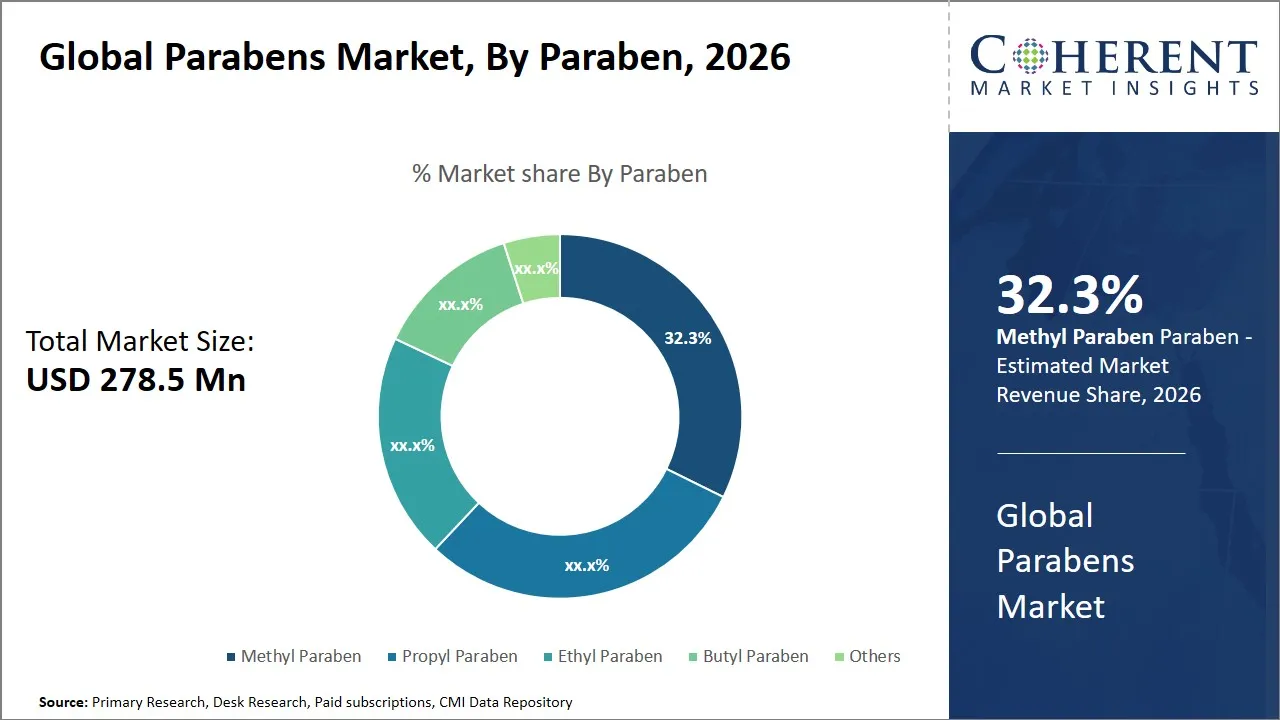
- Methyl Paraben is projected to hold 32.3% of the global parabens market share in 2026.
- The preservatives segment is expected to account for 65.7% of the market share in 2026.
- The cosmetics & personal care segment is projected to hold 34.8% of the parabens market share in 2026.
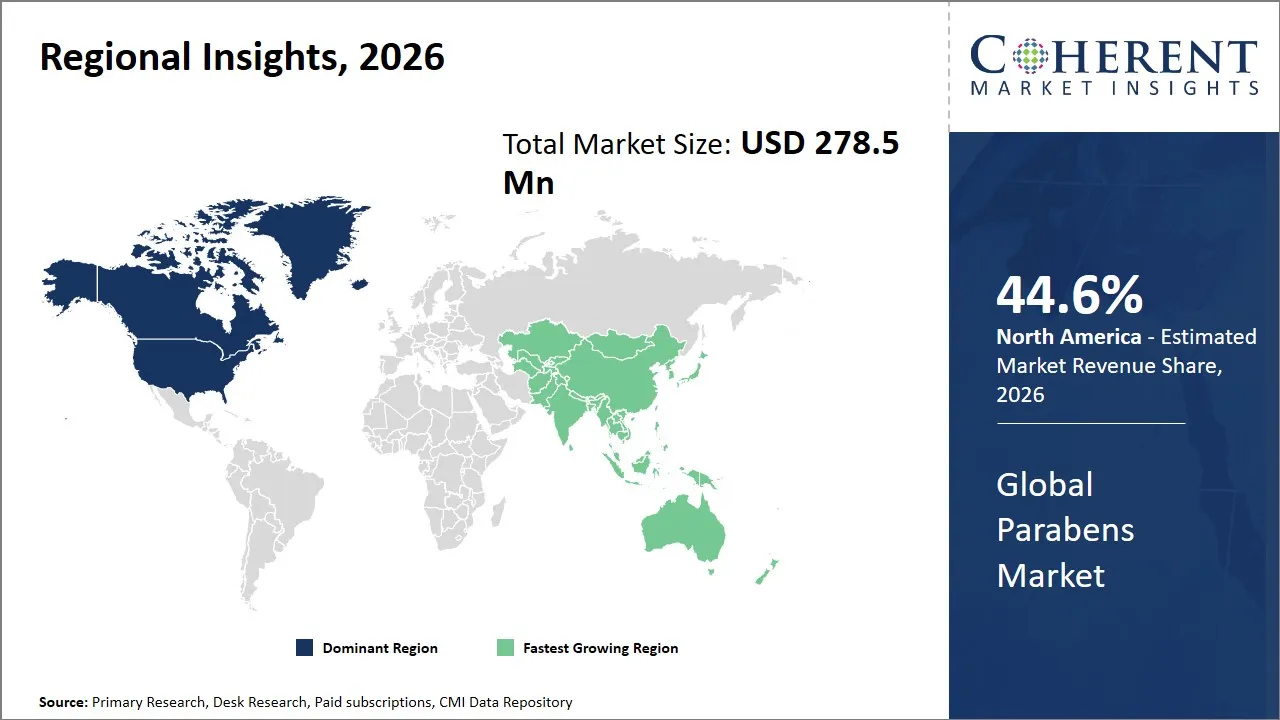
- North America is expected to dominate the parabens market with a 44.6% share in 2026.
- The Asia Pacific region is projected to show the fastest market growth, contributing a 15.3% share in 2026.
Market Overview
- In terms of market trends, there is a notable shift towards the development of paraben alternatives due to increasing consumer awareness and regulatory scrutiny concerning potential health risks.
- However, parabens remain widely used as cost-effective and efficient preservatives in cosmetics, pharmaceuticals, and food preservatives
- The market is witnessing gradual innovation as manufacturers aim to balance safety concerns with efficacy, driving slower yet consistent adoption aligned with regulatory compliance and consumer preferences.
Currents Events and Its Impacts
Current Events | Description and its Impact |
Global Price Volatility & Oversupply (Q3 2025) |
|
Surge in Paraben‑Free Product Demand (Clean/Clean‑Beauty Trends) |
|
Segmental Insights
- Current Industry Events of 2026
- Market Size Estimation
- Regional Breakdown
- Competitive Landscape
- Customer Intelligence
- Segmental Analysis
- Pricing Analysis
- Key Market Drivers, Challenges & Future Trends
- Customized Insights Section
Why Does the Methyl Paraben Segment Dominate the Global Parabens Market in 2026?
Methyl paraben segment is expected to hold 32.3% in the global parabens market share in 2026, due to its widespread effectiveness as a preservative against a broad range of bacteria and fungi. This molecular structure of chemicals enables it to enter inside the cells of microorganisms preventing their multiplication and hence increasing the shelf life of products. It is also relatively low in molecular weight and therefore very soluble in water and oil based formulations, further diversifying its applications in products of various types. Formulators prefer Methyl Paraben due to its ability to keep the product stable without affecting the texture or smell, which is essential in consumer product goods.
In August 2025, global cosmetics company, Estée Lauder launched a new skincare line that utilizes methyl paraben for product preservation. This decision was made after extensive research showing that methyl paraben significantly extended the shelf life of their new products without compromising the fragrance or texture. The brand's use of methyl paraben in their formulations exemplifies the ingredient's dominance in the market for its cost-effectiveness and stability-enhancing properties.
Preservatives Dominate the Global Parabens Market
The preservatives segment is projected to hold 65.7% of the parabens market share in 2026, reflecting the critical role parabens play in enhancing product shelf life and safety. As consumer awareness of hygiene and health rises, producers are now forced to add efficient preservatives to their products as a way of avoiding microbial contamination and spoilage. It is of greater concern with those products that have a long period of use like cosmetic and pharmaceutical products in the sense that the integrity of the products is the most important issue.
The preservative property of parabens occurs because it does not subject the product under preservation to changes in sensorial characteristics. This is one of the key reasons parabens remain widely used as preservatives. In contrast to other preservatives, which may affect color, fragrance or consistency, parabens, in particular, methyl and propyl parabens, do not intrude on the sensory attributes of the products, which is a conclusive factor of consumer acceptance. Such compatibility with various formulations and types allows maintaining sensitive ingredients and active formulations, thus increasing the effectiveness of products.
Why Does the Cosmetics & Personal Care Segment Dominate in the Parabens Market?
The cosmetics & personal care segment is expected to account for 34.8% of the parabens market share in 2026, due to the growing demand for the products due to their safety and their prolonged effect on beauty and grooming among the global population. Parabens are used as preservatives that cannot be replaced in the cosmetic field and they are really efficient in preserving the growth of microbes in water based and emulsion products such as lotions, creams, shampoos and deodorants. The growing range of products in skincare, haircare and color cosmetics industries require a preservation that is reliable without affecting the effectiveness or safety.
The desire by the consumer to have multifunctional and natural-feeling products has forced manufacturers to invest in formulations that preserve the freshness of the product without any synthetic odors or textures. The innovations are made possible by parabens (especially, methyl paraben), which contributes to microbial safety without interfering with the sensory quality of cosmetics. This capacity to keep the consistency of complicated formulas is in line with changing fashion trends that emphasize on clean, safe, and effective ingredients.
Regional Insights
North America Parabens Market Analysis and Trends
The North America region is projected to lead the market with a 44.6% share in 2026, owing to the fact that the cosmetic, pharmaceutical, and personal care product industries are well established and the industries are highly dependent on parabens as preservatives. The mature market ecosystem and environment comprise strict regulatory environment by the agencies including the FDA of the U.S. and Health Canada, which despite placing some limitations on the use of parabens, provides a means to operate under control of the environment, in a way that the product is safe and the effect is safe with the consumers.
The area also enjoys the improved research facilities and close cooperation between producers and the regulatory agencies. There is also strong trade infrastructure that allows easy exportation and importation of raw materials and finished products. Major players, including Ashland Global Holdings, Inc., and Eastman Chemical Company, play an important role, and they continue to innovate in order to achieve equilibrium between efficacy and compliance and health rules to strengthen the North American dominance on this market.
Asia Pacific Parabens Market Analysis and Trends
The Asia Pacific region is expected to exhibit the fastest growth in the market, contributing 15.3% share in 2026, owing to increasing consumer awareness, rapid urbanization, and growing number of middle-class population that will demand personal care and cosmetic products. The changing regulatory landscape in the major economies, such as China, Japan, India, and South Korea, is gradually supporting international standards, which is stimulating market growth.
The rising industrialization and investment in research and development promotes product diversification in which parabens still have a role to play in maintaining the shelf life of products irrespective of the tropical weather conditions. The region is also advantaged by the trade dynamics and improved export-import structures facilitate business across borders. The major companies like Clariant AG, BASF SE as well as local firms like Tata Chemicals are taking advantage of this increase by setting up manufacturing centers and creating formulations that suit the local tastes.
Parabens Market Outlook for Key Countries
Why is the U.S. Parabens Market Evolving Towards Safer Alternatives?
The parabens market in the U.S. is a well-regulated usage of the parabens which are subject to continued examination on the possible effects of the health factor. Larger multinational organizations such as Ashland and Eastman Chemical dominate product innovation with reduced parabens and other preservative alternatives in order to comply with consumer trends of clean label products. Market penetration is further enhanced by the fact that the country has well established retail and e-commerce outlets that offer diverse product options to a well-formed consumer base.
Why is China's Parabens Market Experiencing Rapid Growth and Regulatory Alignment?
The China parabens market is fast growing as more people are increasingly moving towards the urbanization and more incomes are available to purchase skincare, cosmetics and pharmaceutical products. The regulatory agencies, such as the China National Medical Products Administration (NMPA) are slowly aligning their standards with those of the global standards, to promote the use of parabens, which are safer and can be used more widely. Major corporations, both local ones such as China Petrochemical Corporation and international ones like BASF are putting a lot of money into the production capacity and marketing policies that suit the local consumer response.
Germany Parabens Market Trends
Germany is still dominating the European market of parabens, with the country relying on its established powerful chemical industry and innovation focus. The strict compliance with EU regulation in the country is pushing the firms to come up with the formulations of paraben that would be environment-friendly and safe. The market is dominated by industry giants like Evonik Industries and Clariant AG that have a strong investment in sustainable preservative technologies and are able to sustain high exports across Europe.
India Parabens Market Trends
The India parabens market is characterized by rapid adoption due to an upsurge in the cosmetics and pharmaceutical industry that serves a youthful population. The not so strict regulatory framework permits the utilization of some of the parabens giving chances to both the domestic and foreign firms such as Tata Chemicals and BASF respectively to introduce low cost preservative interventions. The rapid distribution in urban and rural markets is also supported by trade development and logistics in improving supply chains.
Japan Parabens Market Trends
The market in Japan has a mature demand for high quality and technologically advanced personal care products. The Ministry of Health, Labor and Welfare (MHLW) makes wise laws on parabens, as well as focusing on the safety of the consumers and encouraging the research of alternatives. The major powers of the industry such as Kao Corporation, and Shiseido have become the drivers of innovation of the preservative systems and have set a balance between the functionality and the more advanced consumer needs of soft, lasting formulations. Japan high level of research and product effectiveness still has an impact on the larger trends in the Asia Pacific markets.
Cost-Performance vs Alternative Preservatives
Criteria | Parabens (Cost-Performance) | Alternative Preservatives |
Cost | Low-cost, cost-effective for mass-market products. | Higher cost for natural/organic preservatives, depending on source |
Shelf Life | Extends product shelf life significantly. | Shorter shelf life for some alternatives, or requires higher concentrations. |
Regulatory Acceptance | Generally well-regulated, but facing scrutiny over health impacts. | Increasing regulatory support for safer, natural alternatives, but inconsistent worldwide. |
Market Players, Company Insights, and Competitive Intelligence
Company Insights
- Alta Laboratories Ltd, is a leading manufacturer of parabens and related chemicals, with a long-standing presence in the pharmaceutical, cosmetic, and industrial chemicals markets. The company manufactures a range of paraben preservatives, including Methyl Paraben, Propyl Paraben, and Sodium Methyl Paraben, which are widely used for their antimicrobial properties in a variety of applications.
- Foodchem International Corporation is a Shanghai‑based food additives and ingredient, operating as a leading manufacturer, marketer, distributor, and exporter of food ingredients, food additives, feed additives, and related chemical products. The company serves a global customer base of 5,000+ clients across 150+ countries and regions, with a vision to be the premier Chinese export brand for food ingredient solutions.
Top Strategies Followed by Global Parabens Market Players
Player Type | Strategic Focus | Example |
Established Market Leaders | Heavy investment in R&D and innovation | For example, the production of parabens-based preservatives which not only have better effectiveness but also adhere to the changing laws directed towards cosmetic additives across the globe. BASF added Preservative Booster that is intended to enhance the stability and shelf life of the cosmetic products and lessen the use of increased concentrations of parabens. |
Mid-Level Players | Balance cost and sustainability | For instance, Lonza Group, which is a company with a reputation of supplying preservatives, though concentrating on the mass-market cosmetic products at a relatively low cost by a high quality of preservatives. This will enable them to serve wider range of customers especially in Southeast Asia and South America where price sensitivity stands as one of the key determinants. |
Small-Scale Players | Niche specialization & innovative variants | For example, a small player, ECOCERT, which is developing green alternatives to parabens, including natural preservative blends and botanical extracts, which meet the criteria of organic certification. These small players also cash in on the increased demand of natural and organic products, which is increasing the demand of alternative paraben products. |
Market Report Scope
Parabens Market Report Coverage
| Report Coverage | Details | ||
|---|---|---|---|
| Base Year: | 2025 | Market Size in 2026: | USD 278.5 Mn |
| Historical Data for: | 2020 To 2024 | Forecast Period: | 2026 To 2033 |
| Forecast Period 2026 to 2033 CAGR: | 1.4% | 2033 Value Projection: | USD 306.9 Mn |
| Geographies covered: |
| ||
| Segments covered: |
| ||
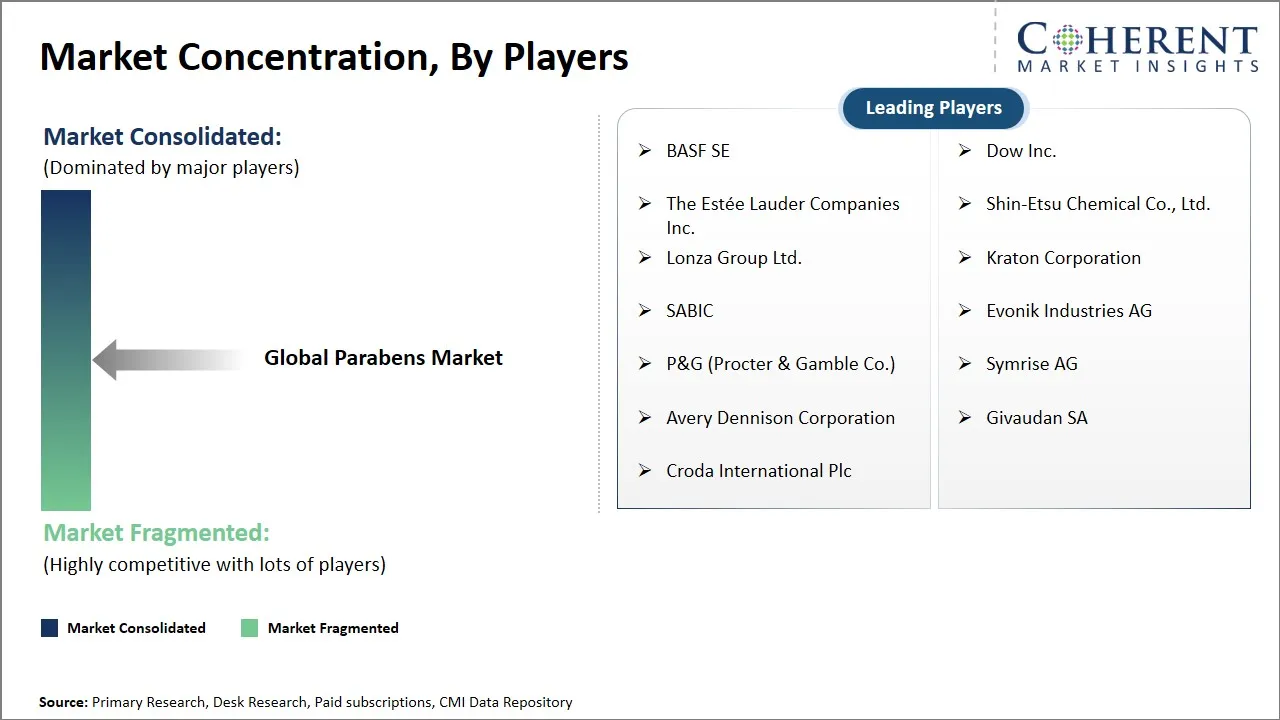
| Companies covered: | BASF SE, Dow Inc., The Estée Lauder Companies Inc., Shin-Etsu Chemical Co., Ltd., Lonza Group Ltd., Kraton Corporation, SABIC, Evonik Industries AG, P&G (Procter & Gamble Co.), Symrise AG, Avery Dennison Corporation, Givaudan SA, and Croda International Plc | ||
| Growth Drivers: |
| ||
| Restraints & Challenges: |
| ||
Parabens Market Dynamics
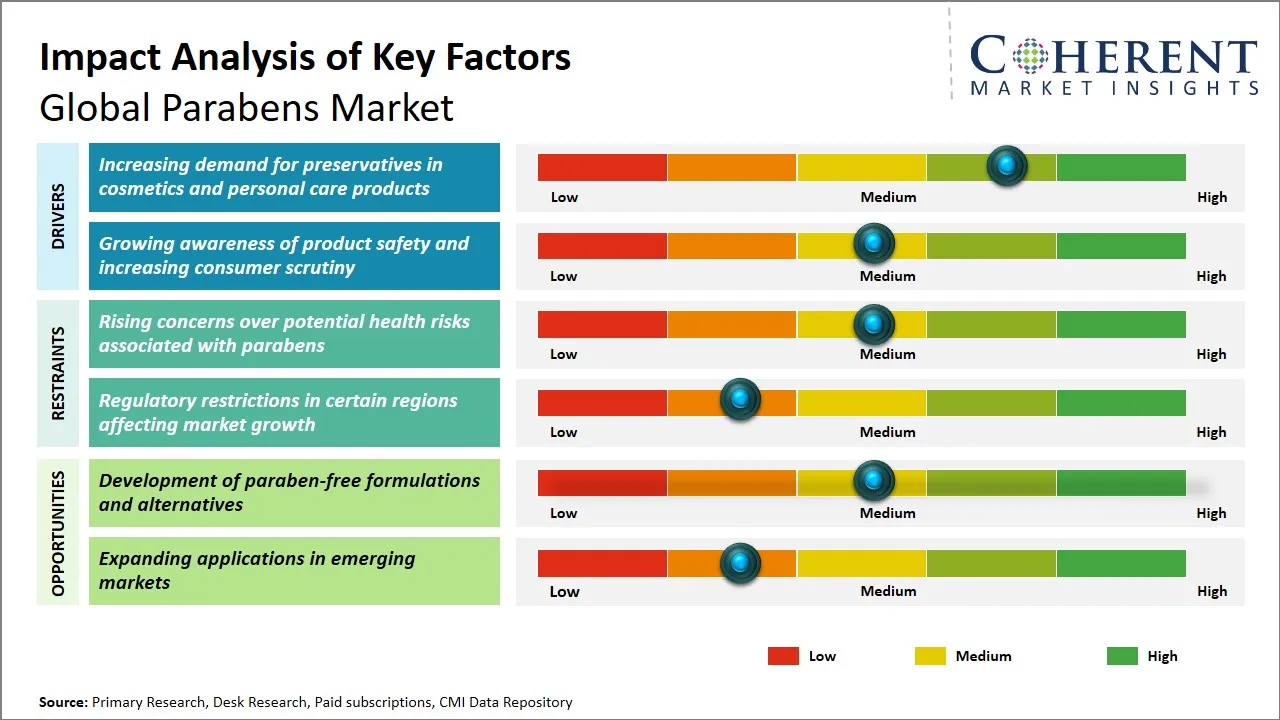
Parabens Market Driver - Increasing Demand for Preservatives in Cosmetics and Personal Care Products
The increasing sensitivity and consciousness of consumers towards product protection and durability has greatly enhanced the need of dependability in preservatives used in cosmetics and personal care products making the parabens a prime solution. The more complicated the cosmetic formula, the more manufacturers are focusing on preservatives with the capability to prevent microbial contamination without affecting the integrity of the product or the user experience. Parabens are the ones that meet these needs, as they have a wide spectrum of antimicrobial activity and are inexpensive, thus preferable in any lotion, cream, shampoo, hair care products or makeup products. Also, the boom of personal care practices and increased new product development with longer shelf life have increased the pressure on the necessity of preservatives with a permanence.
As an example, in 2023, the European commission issued a revised regulation of cosmetic products restating that the use of parabens is safe within recommended limits. This law highlights the fact that they still need to protect the integrity of the products in the EU market where there is a high demand of safe and durable personal care products.
Parabens Market Opportunity - Development of Paraben-Free Formulations and Alternatives
The increasing consumer awareness about health and environmental safety is also making a radical change in the world market of parabens as disparate to the creation of the paraben-free formulations and natural substitutes. The growing anxiety surrounding the possible endocrine disrupting properties of parabens has led to tighter and more stringent regulations and labeling of the products containing the preservatives. This has presented a large market potential to the manufacturers to innovate and come up with safer and more sustainable preservatives which are natural in nature like plant extracts, essential oils and biodegradable compounds.
For example, in 2022, foremost cosmetics brand LOreal has launched a new collection of paraben-free product, using plant-based preservatives, as the consumer need of clean beauty products starts growing. On the same note, the U.S. Food and Drug Administration (FDA) has contributed to paraben-free awareness, including the campaign that pushed some of the beauty and skincare brands into reformulating their products to fit the increasing demand of safer and natural products.
Analyst Opinion (Expert Opinion)
- The parabens market is at the time sailing through a tricky terrain, as it is facing increased consumer perceptions as far as health and safety consequences of these preservatives in beauty and personal care products are concerned. The international Cosmetic Science Conference (2023) and the Global Personal Care Expo (2022) have provided some implications regarding the key shifts in the industry, with brands such as Estee Lauder and LOreal redefining their products to include no parabens following the demand of consumers to use cleaner and safer products.
- The recent announcement by Estee Lauders to completely deactivate its use of parabens in all its products can be viewed as an illustration of the pressing need to change and become more transparent in the industry. The growing use of paraben-free alternatives and the need to educate consumers about preservation alternatives, including natural and plant-based preservatives, have been discussed at these events and have become popular.
- The difficulties in keeping the product unchanged and ensuring its shelf life in the absence of parabens were often mentioned as a major obstacle to it. The firms that concentrate on the innovation and communication effectiveness in terms of safety and efficacy of ingredients are likely to gain market share. Finally, the future of the parabens market will lie in its capacity to change in accordance with changes in the consumer preferences towards safety, transparency, and quality.
Speak to the analyst
Want personalized insights?
Take the findings above to one of our principal consultants, or have the report rebuilt around the segments, geographies and competitors you actually track.
Market Segmentation
- Paraben Insights (Revenue, USD Mn, 2021 - 2033)
- Methyl Paraben
- Propyl Paraben
- Ethyl Paraben
- Butyl Paraben
- Others
- Application Insights (Revenue, USD Mn, 2021 - 2033)
- Preservatives
- Others
- End-use Industry Insights (Revenue, USD Mn, 2021 - 2033)
- Cosmetics & Personal Care
- Pharmaceuticals
- Food & Beverages
- Others
- Regional Insights (Revenue, USD Mn, 2021 - 2033)
- North America
- U.S.
- Canada
- Latin America
- Brazil
- Argentina
- Mexico
- Rest of Latin America
- Europe
- Germany
- U.K.
- Spain
- France
- Italy
- Russia
- Rest of Europe
- Asia Pacific
- China
- India
- Japan
- Australia
- South Korea
- ASEAN
- Rest of Asia Pacific
- Middle East
- GCC Countries
- Israel
- Rest of Middle East
- Africa
- South Africa
- North Africa
- Central Africa
- North America
- Key Players Insights
- BASF SE
- Dow Inc.
- The Estée Lauder Companies Inc.
- Shin-Etsu Chemical Co., Ltd.
- Lonza Group Ltd.
- Kraton Corporation
- SABIC
- Evonik Industries AG
- P&G (Procter & Gamble Co.)
- Symrise AG
- Avery Dennison Corporation
- Givaudan SA
- Croda International Plc
Sources
Primary Research Interviews
- CEO – Leading Paraben Producer (e.g., UENO Fine Chemicals or Gujarat Organics equivalent)
- Supply Chain Director – Major Preservatives Distributor
- Production Lead – Specialty Paraben Manufacturer
- Sustainability Officer – Cosmetics Ingredient Certification Authority
Stakeholders
- Manufacturers
- End-use Sectors
- Personal Care & Cosmetics Industry
- Pharmaceuticals & Healthcare
- Food & Beverages
- Regulatory & Certification Bodies (e.g., FDA for cosmetics preservatives, EU REACH compliance, Cosmetic Ingredient Review (CIR) )
- E-commerce Platforms and Retailers (Alibaba, Industrial Suppliers, Sigma-Aldrich equivalents for parabens)
- Technology Integration Players: Formulators in cosmetics and pharma using parabens as preservatives
Databases
- UN Comtrade Database (HS codes for organic chemicals like parabens)
- India Import Export (EXIM) Database
- USITC or Eurostat Trade Statistics for Chemicals
Magazines
- Personal Care Magazine – Trends in cosmetic preservatives
- HPC Today – Parabens in personal care innovations
- Food Processing – Preservatives in food industry
- Cosmetics & Toiletries – Regulatory updates on parabens
Journals
- Journal of Cosmetic Dermatology – Parabens safety and usage
- Environment International – Parabens environmental impact
- Contact Dermatitis – Allergenicity of parabens
- Science of the Total Environment – Parabens as contaminants
- Regulatory Toxicology and Pharmacology – Health assessments
Newspapers
- The Wall Street Journal – Chemical preservatives demand
- Reuters – Regulatory changes in cosmetics ingredients
- Business Standard (India) – Paraben imports and Asia growth
- Chemical Week – Supply issues in preservatives
Associations
- Personal Care Products Council (PCPC)
- European Cosmetics Association (Cosmetic Europe)
- International Fragrance Association (IFRA)
- Society of Cosmetic Chemists
- Personal Care Products Council (for preservatives guidelines)
Public Domain Sources
- FDA – Guidelines for parabens in cosmetics
- European Commission – REACH regulations on parabens
- World Health Organization – Safety data on preservatives
- EPA – Environmental guidelines for paraben compounds
- OECD – Chemical trade and safety reports
Proprietary Elements
- CMI Data Analytics Tool
- Proprietary CMI Existing Repository of information for last 8 years.
Get access to 250+ pages report
Every segment, forecast, competitor profile and data table behind the analysis above — available for instant download.
- ESOMAR Member
- ISO 9001:2015 Certified
- D-U-N-S Registered
- GDPR & CCPA Compliant
Missing comfort of reading report in your local language? Find your preferred language:
Transform your Strategy with Exclusive Trending Reports
Frequently Asked Questions
The global parabens market is estimated to be valued at USD 278.5 Mn in 2026 and is expected to reach USD 306.9 Mn by 2033.
The CAGR of global parabens market is projected to be 1.4% from 2026 to 2033.
Increasing demand for preservatives in cosmetics and personal care products and growing awareness of product safety and increasing consumer scrutiny are the major factors driving the growth of the global parabens market.
Rising concerns over potential health risks associated with parabens and regulatory restrictions in certain regions affecting market growth are the major factors hampering the growth of the global parabens market.
In terms of paraben, methyl paraben is estimated to dominate the market revenue share in 2026.
BASF SE, Dow Inc., The Estée Lauder Companies Inc., Shin-Etsu Chemical Co., Ltd., Lonza Group Ltd., Kraton Corporation, SABIC, Evonik Industries AG, P&G (Procter & Gamble Co.), Symrise AG, Avery Dennison Corporation, Givaudan SA, and Croda International Plc are the major players.
North America is expected to lead the global parabens market in 2026.