

Global Random Access Memory Market Size and Forecast – 2026-2033
The global random access memory market is estimated to be valued at USD 259.34 Bn in 2026 and is expected to reach USD 876.38 Bn by 2033, exhibiting a compound annual growth rate (CAGR) of 19.0% from 2026 to 2033.
Key Takeaways of the Global Random Access Memory Market
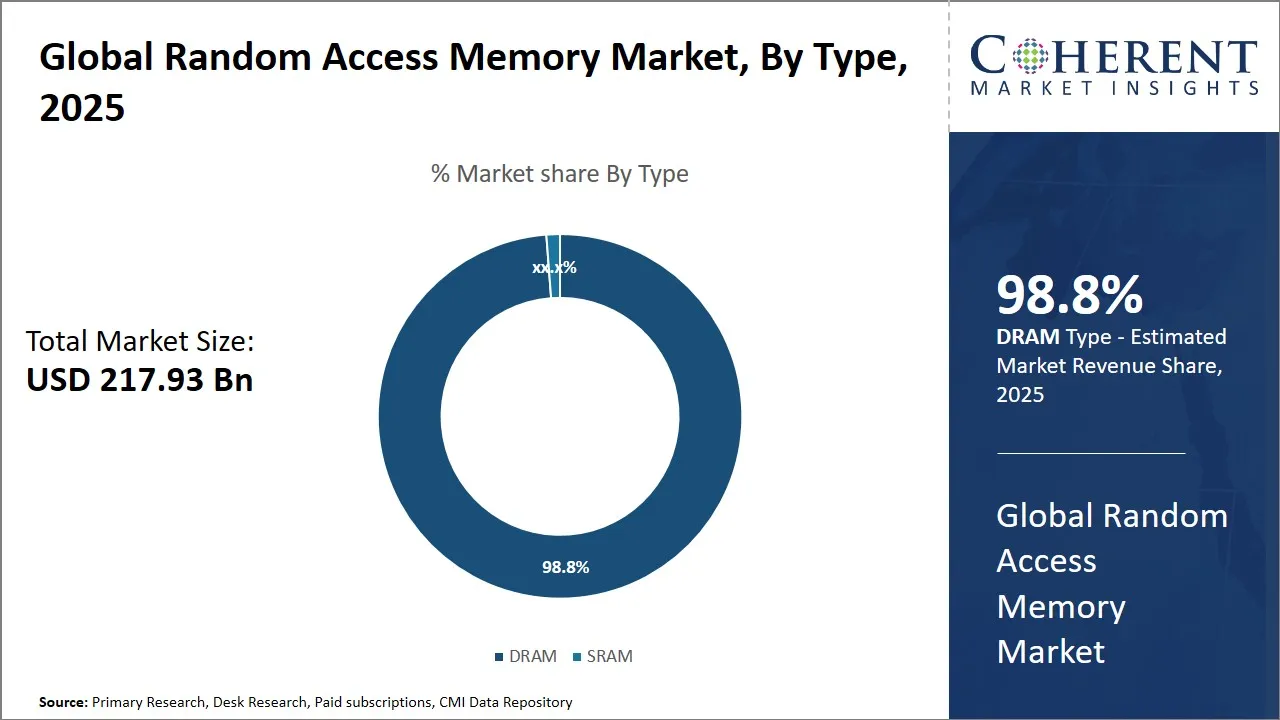
- The DRAM segment is expected to lead the market holding a share of 99.8 % in 2026.
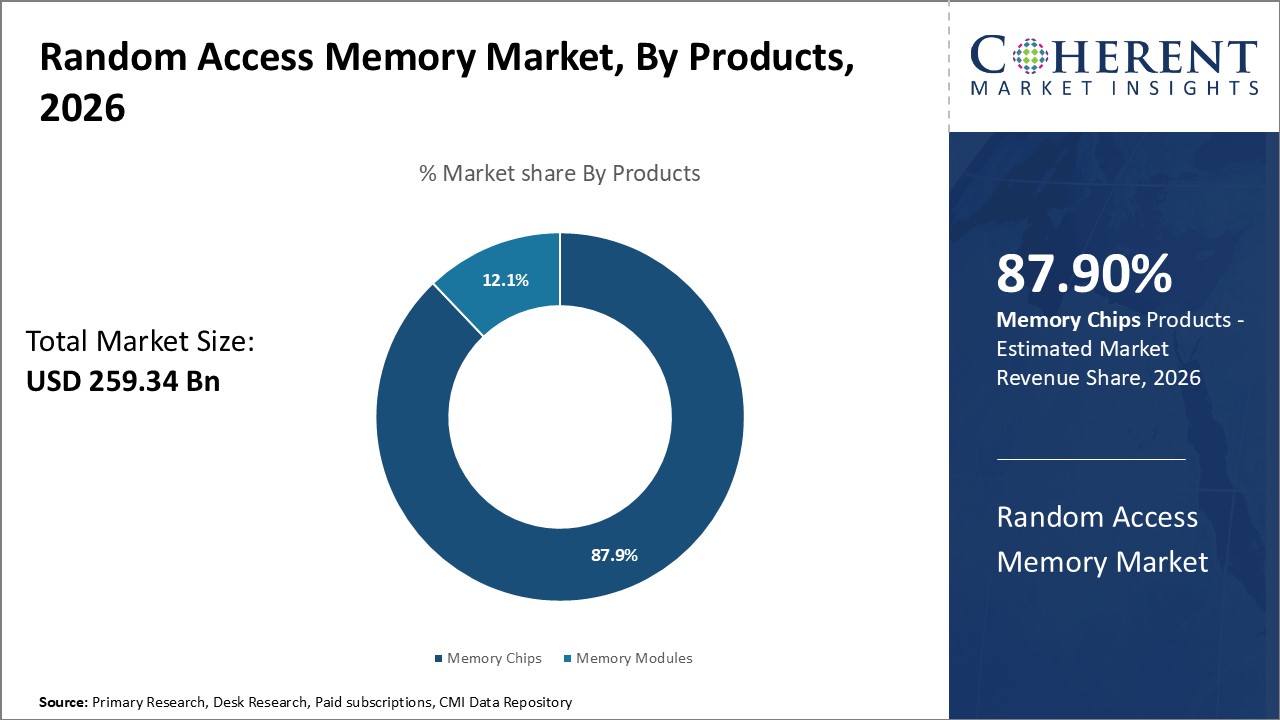
- The memory chips segment is projected to dominate with a share of 87.9 % in 2026.
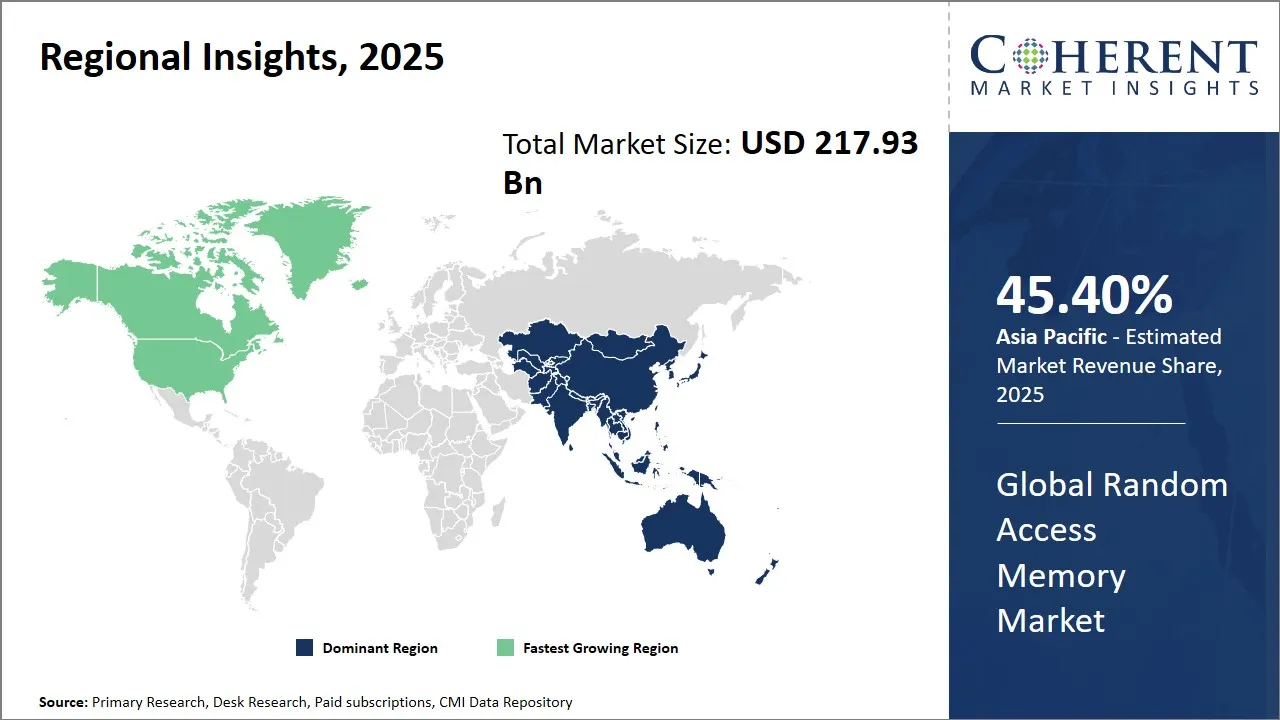
- Asia Pacific, expected to hold a share of 45.4% in 2026, dominates the market.
- North America, projected to hold a share of 26.3 % in 2026, shows the fastest growth in the market.
Market Overview
Market trends indicate a strong move toward advanced memory technologies like DDR5 and LPDDR5, which offer higher speed and improved energy efficiency. Also, the rise of artificial intelligence, cloud computing, and big data analytics is fueling the demand for faster and larger memory capacities. Manufacturers are also focusing on adding memory with processing units to reduce latency and power consumption, also adding to innovation and adoption in emerging applications.
Current Events and Its Impact
Current Events | Description and its Impact |
Geopolitical and Trade Developments |
|
Economic and Infrastructure Trends |
|
Segmental Insights
- Current Industry Events of 2026
- Market Size Estimation
- Regional Breakdown
- Competitive Landscape
- Customer Intelligence
- Segmental Analysis
- Pricing Analysis
- Key Market Drivers, Challenges & Future Trends
- Customized Insights Section
Global Random Access Memory Market Insights, By Type – DRAM Leads Because of its Essential Role in High-Speed Computing and Widespread Adoption Across Multiple Industries
DRAM is projected to command 99.8% of the global random access memory market share in 2026, because of its essential role in high-speed data processing across PCs, servers, mobile devices, and data centers. Its low latency, high bandwidth, and continuous architectural improvements make it the backbone of modern computing workloads including AI/ML, cloud infrastructure, high-performance gaming, and 5G-enabled devices.
The rise of data-center deployments and real-time analytics continues to make demand for DRAM, while energy-efficient, higher-density nodes add to adoption in compact and battery-sensitive devices.
In 2024, Samsung began mass-producing its 1bn-class 32Gb DDR5 DRAM, allowing major hyperscalers to boost server memory capacity for AI training clusters.
Global Random Access Memory Market Insights, By Product – Memory Chips Dominate the Market Driven by their Fundamental Necessity and Scalability Across Electronic Devices
Memory chips are expected to hold 87.9% of the random access memory market share in 2026, driven by their foundational role across nearly every electronic device—smartphones, laptops, servers, vehicles, and IoT systems. Rising smartphone shipments, growing IoT ecosystems, and fast integration of ADAS and connected-car systems continue to make demand. Fabrication advances that produce smaller, faster, and energy-efficient chips add to the segment’s dominance as device performance requirements rise. In July 2025, Micron announced volume production of its 1β (1-beta) LPDDR5X memory chips.
Pricing Analysis of the Random Access Memory Market
Memory Type/Segment | Estimated Price/Cost (USD) |
DDR4 DRAM (Module, Consumer/PC) | ~ USD 3.50 – 5.00 per GB |
DDR5 DRAM (Module) | ~ USD 7 – 9 per GB (contract/spot) |
GDDR6 (Graphics/VRAM) | ~ USD 2.50 – 3.30 per GB |
High-Bandwidth Memory (HBM) | USD 15+ per GB (estimated) |
DRAM (Chip/Die price) | ~ USD 2 – 3 per GB (raw chip) |
Technology Evolution of Random Access Memory
Generation/Technology | Approx. Introduction Year | Key Technical Advancements | Typical Speed/Bandwidth | Voltage | Primary Applications |
SDRAM | ~1993 | Synchronous operation with CPU clock; higher reliability vs FPM/EDO | ~100–133 MHz | 3.3V | Early PCs, servers |
DDR SDRAM (DDR1) | ~2000 | Double Data Rate (data on rising & falling clock edges) | 200–400 MT/s | 2.5V | PCs, early laptops |
DDR2 | ~2003 | Improved prefetch buffer, lower power, higher density | 400–800 MT/s | 1.8V | PCs, mid-range servers |
DDR3 | ~2007 | Higher clock speeds, improved bandwidth efficiency | 800–1600 MT/s | 1.5V - 1.35V | PCs, gaming systems, early data centers |
DDR4 | ~2014 | Increased density, reduced voltage, improved error correction | 1600–3200 MT/s | 1.2V | Modern PCs, servers, enterprise data centers |
DDR5 | ~2020 | Doubled bandwidth, on-die ECC, higher capacity DIMMs | 4800–8400+ MT/s | 1.1V | High-performance PCs, AI servers, hyperscale data centers |
Mobile DDR (mDDR) | ~2005 | Low-power DDR for mobile environments | 200–400 MT/s | 1.8V | Early smartphones, handheld devices |
LPDDR2 | ~2009 | Major power efficiency upgrade, reduced heat | 400–800 MT/s | 1.2V | Smartphones, tablets |
LPDDR3 | ~2013 | Higher bandwidth, better power/performance ratio | 800–1600 MT/s | 1.2V | Smartphones, ultrathin laptops |
LPDDR4/LPDDR4X | ~2015–2017 | Dual-channel architecture, big latency reduction | 3200–4266 MT/s | 1.1V - 0.6V | Premium smartphones, IoT, automotive |
LPDDR5/LPDDR5X | ~2020–2023 | High bandwidth for 5G, AI & imaging; large power savings | 5500–8533 MT/s | 1.05V - 0.5V | Flagship smartphones, AI edge devices, ADAS |
HBM (HBM1) | ~2015 | 3D-stacked DRAM, extreme bandwidth for GPUs | 128 GB/s per stack | 1.2V | GPUs, HPC accelerators |
HBM2/HBM2E | 2016–2018 | Higher capacity & bandwidth | 256–410+ GB/s | 1.2V | AI accelerators, data centers |
HBM3/HBM3E | 2022–2024 | Ultra-high speed for LLM training; premium AI workloads | 600–1,000+ GB/s | ~1.1V | AI training GPUs (NVIDIA H100/H200, AMD MI300) |
GDDR5 | ~2007 | High bandwidth for graphics | 100+ GB/s | 1.5V | GPUs, gaming consoles |
GDDR6/GDDR6X | ~2018–2020 | PAM4 signaling (X version), extreme gaming speeds | 448–800+ GB/s | 1.35V | Gaming GPUs, automotive vision systems |
Demand Breakdown by Device
Device Category | Estimated DRAM Demand (2025, % of total) |
Data Centers/Servers | 38.00% |
PCs & Laptops | 26.00% |
Smartphones/Mobile Devices | 23.00% |
Gaming Consoles & High-End Graphics Devices | 7.00% |
Automotive Electronics (ADAS, Infotainment, EVs) | 6.00% |
Regional Insights
Asia Pacific Random Access Memory Market Analysis and Trends
Asia Pacific, expected to hold a share of 45.4% in 2026, leads the global random access memory market. The growth is because of strong semiconductor manufacturing hubs, advanced technological infrastructure, and a lot of government backing. Countries like South Korea, Japan, Taiwan, and China are adding to semiconductor innovation and production, with big RAM manufacturers such as Samsung Electronics, SK Hynix, Micron Technology (with significant operations), and Nanya Technology. These companies benefit from strong supply chains, skilled workforces, and huge semiconductor R&D ecosystems.
Government policies in countries like China and South Korea emphasize self-reliance in semiconductor manufacturing through subsidies, tax incentives, and infrastructure investments, which further consolidate the region's leading position. Also, Asia Pacific's strong export-oriented trade dynamics make possible widespread access to global markets, reinforcing its dominance in the random access memory market.
North America Random Access Memory Market Analysis and Trends
North America, expected to hold a share of 26.3% in 2026, exhibits the fastest growth in the random access memory market, fueled by innovation-driven demand and a strong presence of cutting-edge technology companies. The U.S., being home to influential players like Micron Technology and emerging startups in memory solutions, sees a thriving ecosystem of research institutions, venture capital funding, and collaboration between government and industry. Policies for adding to domestic semiconductor manufacturing, including significant public investments and incentives, have accelerated growth opportunities.
North America market is characterized by a focus on advanced memory solutions tailored for AI, cloud computing, and high-performance computing sectors, which drives demand for next-generation RAM technologies. Trade dynamics involving strategic partnerships and supply chain diversification efforts also support fast market expansion in this region.
Global Random Access Memory Market Outlook for Key Countries
South Korea Random Access Memory Market Analysis and Trends
South Korea random access memory market continues to lead globally due to its mature semiconductor industry, anchored by Samsung Electronics and SK Hynix—two of the largest memory chip manufacturers worldwide. These companies are pioneers in cutting-edge DRAM and NAND flash technologies, investing a lot in R&D and capacity expansion. The government’s high support through funding programs and favorable policies adds to the innovation landscape. South Korea’s well-established supply chains and export networks add to its competitive edge, meeting global demand for memory solutions across consumer electronics, data centers, and automotive sectors.
China Random Access Memory Market Analysis and Trends
China random access memory market grows because of aggressive government strategies for achieving semiconductor self-sufficiency, with programs fostering domestic champions such as YMTC and ChangXin Memory Technologies. These companies have made significant strides in producing DRAM and NAND memory, supported by extensive state funding and policy incentives. China’s huge electronics manufacturing ecosystem and growing end user markets in smartphones, PCs, and automotive industries make demand. However, trade tensions and export controls limit access to some advanced technologies, adding to focus on indigenous innovation and vertical integration within the supply chain.
Japan Random Access Memory Market Analysis and Trends
Japan is an important player in the random access memory market because of its technological advancements and contributions in specialized semiconductor equipment and materials, supporting global memory chip production. Companies such as Kioxia (formerly Toshiba Memory) are influential in the NAND flash segment, while the country’s strong R&D focus adds to innovation in memory reliability and performance improvements. Japan’s industry sees a stable regulatory environment and strategic collaborations with international memory manufacturers, adding to product development and market reach across Asia and globally.
Taiwan Random Access Memory Market Analysis and Trends
Taiwan random access memory market grows because of its world-class semiconductor fabrication capabilities, with companies like Nanya Technology playing a big role in DRAM production. Taiwan’s ecosystem includes key foundries and suppliers of semiconductor manufacturing equipment, making a synergistic environment that supports memory chip innovation and volume manufacturing. Government initiatives to make the semiconductor sector stronger and maintain global competitiveness are influential, alongside strategic trade partnerships that facilitate access to raw materials and international markets. Taiwan’s role as a technology and manufacturing hub adds to its importance in the global random access memory market.
Market Players, Key Development, and Competitive Intelligence
Key Developments
- In October 2025, OpenAI, Samsung Electronics, Samsung SDS, Samsung C&T and Samsung Heavy Industries announced a letter of intent (LOI) for their strategic partnership to add to advancements in global AI data center infrastructure and make future technologies together in relevant fields. This expansive collaboration will bring together the collective strengths and leadership of Samsung companies across semiconductors, data centers, shipbuilding, cloud services and maritime technologies.
- In August 2025, Sandisk Corporation signed a landmark Memorandum of Understanding (MOU) with SK hynix to work together to establish the specification for High Bandwidth Flash, a new technology made to deliver breakthrough memory capacity and performance for the next generation of AI inferences. Through this collaboration, the companies expect to standardize the specification, define technology requirements and explore the creation of a technology ecosystem for High Bandwidth Flash.
- In July 2025, Micron Technology, Inc., a U.S.-based memory manufacturer, launched the industry’s highest-density, radiation-tolerant single-level cell (SLC) NAND product.
- In March 2025, Intel and SK hynix finalized their nearly USD 8.85 billion transaction of Intel's NAND flash memory operations, completing a two-part process that began in 2020.
Top Strategies Followed by Random Access Memory Market Players
- Established market leaders invest heavily in research and development (R&D) to design and manufacture high-performance RAM products that meet the increasingly demanding needs of consumers and enterprises.
- Samsung invested over USD 230 billion (2023–2028 plan) to advance next-gen DRAM nodes, HBM3E, and DDR5 at its Korean mega-cluster.
- Mid-level players in the global RAM landscape typically use strategies that prioritize cost-effectiveness while maintaining acceptable performance standards.
- Nanya Technology released budget-friendly LPDDR4X and DDR4 DRAM lines for consumer electronics and value notebooks (2023–24).
- Small-scale players in the random access memory market find competitive advantages by concentrating on niche segments or specialized features that distinguish their offerings from the mainstream.
- Winbond strengthened its position in automotive-grade DRAM and industrial SRAM, launching 32–256Mb specialty DRAM for EVs (2023–24).
Market Report Scope
Random Access Memory Market Report Coverage
| Report Coverage | Details | ||
|---|---|---|---|
| Base Year: | 2025 | Market Size in 2026: | USD 259.34 Bn |
| Historical Data for: | 2020 To 2024 | Forecast Period: | 2026 To 2033 |
| Forecast Period 2026 to 2033 CAGR: | 19.0% | 2033 Value Projection: | USD 876.38 Bn |
| Geographies covered: |
| ||
| Segments covered: |
| ||
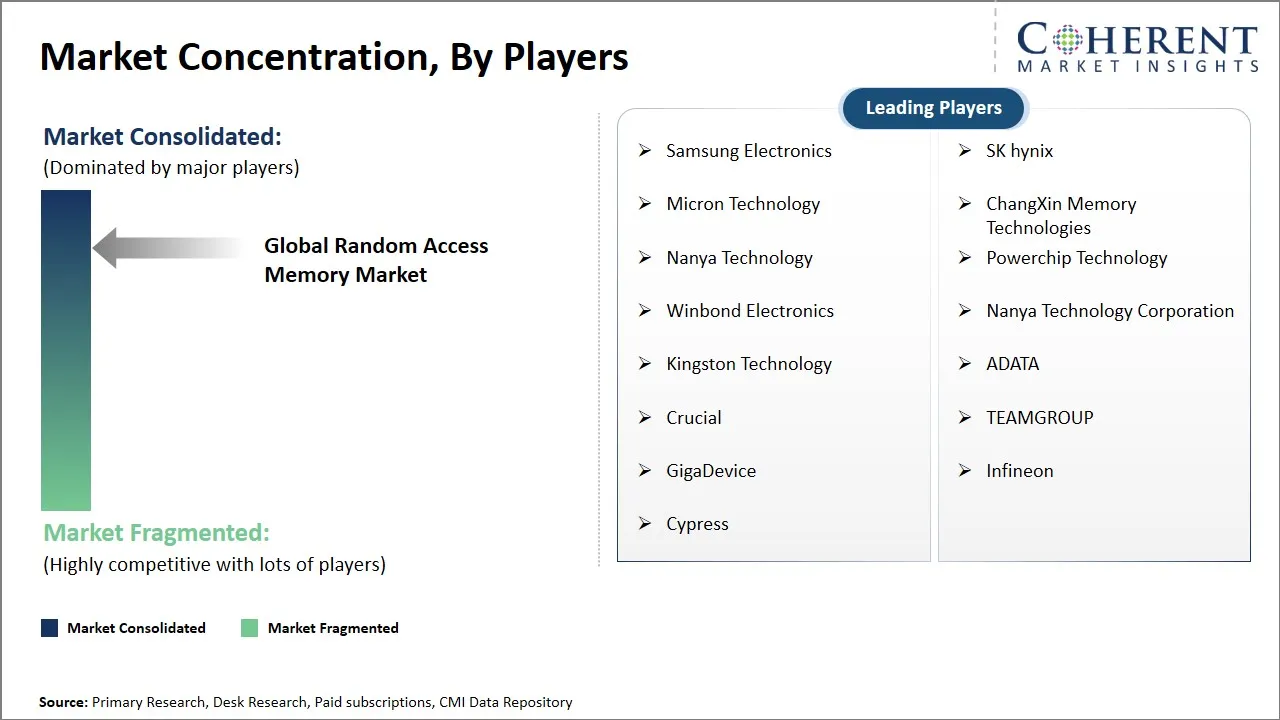
| Companies covered: | Samsung Electronics, SK hynix, Micron Technology, ChangXin Memory Technologies, Nanya Technology, Powerchip Technology, Winbond Electronics, Nanya Technology Corporation, Kingston Technology, ADATA, Crucial, TEAMGROUP, GigaDevice, Infineon, and Cypress | ||
| Growth Drivers: |
| ||
| Restraints & Challenges: |
| ||
Market Dynamics
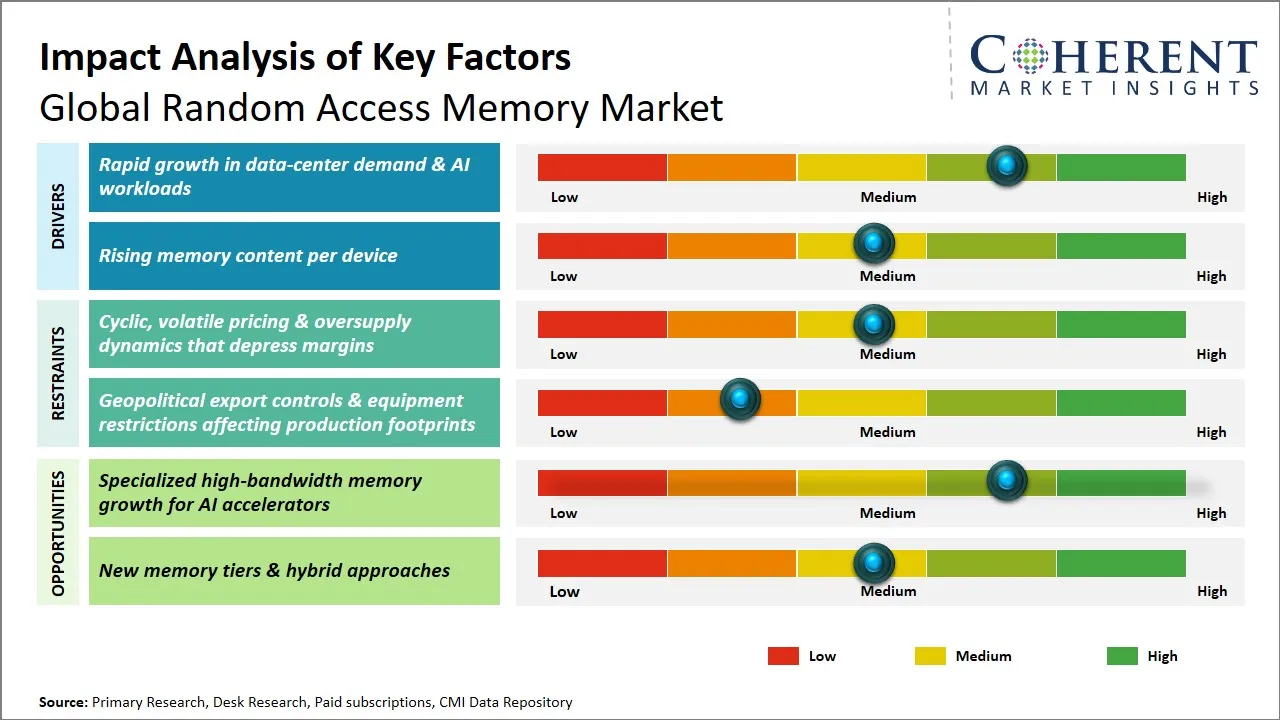
Global Random Access Memory Market Driver – Rapid Growth in Data-Center Demand & AI Workloads
The surge in cloud services and AI workloads is accelerating the need for high-speed, high-capacity RAM in modern data centers. AI models, real-time analytics, and machine learning pipelines demand large memory pools with extremely low latency, making manufacturers enhance DRAM bandwidth, efficiency, and scalability. The growth of edge computing further adds to this need as devices process increasing amounts of distributed data.
In 2024, Micron began mass production of its 128GB DDR5 RDIMMs made specifically for AI and hyperscale data centers, offering higher bandwidth to support large language models and cloud workloads.
Global Random Access Memory Market Opportunity – Specialized High-Bandwidth Memory Growth for AI Accelerators
The rapid adoption of AI accelerators—GPUs, TPUs, and NPUs—is fueling strong demand for high-bandwidth memory (HBM), which solves performance bottlenecks by providing ultra-fast data transfer and superior energy efficiency. As AI becomes foundational across industries, HBM integration is becoming essential for next-gen compute platforms.
In 2024, SK Hynix launched its HBM3E memory, which Nvidia adopted for its H200 AI GPU, increasing bandwidth for training and inference workloads.
Analyst Opinion (Expert Opinion)
- The RAM industry is effectively at the mercy of Samsung, SK Hynix, and Micron—an oligopoly that dictates pricing cycles, supply levels, and technology migration. This concentration leaves OEMs with little bargaining power, and any production hiccup—such as the 2022 SK Hynix Wuxi fab contamination incident—immediately sends shockwaves through global supply chains.
- RAM pricing swings are notoriously brutal, whiplashing between shortages and oversupply. The 2023–2024 cycle saw DRAM contract prices jump over 80% in just months due to AI-server demand, making it nearly impossible for device manufacturers to forecast costs. This instability discourages smaller players from entering or scaling operations.
- Migration to DDR5, LPDDR5X, HBM3E, and soon HBM4 comes with astronomical R&D and capex requirements. Only a few top-tier companies can keep pace. Smaller memory manufacturers are essentially pushed out before they even have a chance to innovate. The rising cost of EUV-driven process nodes has created a technological barrier that feels almost insurmountable.
Speak to the analyst
Want personalized insights?
Take the findings above to one of our principal consultants, or have the report rebuilt around the segments, geographies and competitors you actually track.
Market Segmentation
- Type Insights (Revenue, USD Bn, 2021 - 2033)
- DRAM
- SRAM
- Product Insights (Revenue, USD Bn, 2021 - 2033)
- Memory Chips
- Memory Modules
- Regional Insights (Revenue, USD Bn, 2021 - 2033)
- North America
- U.S.
- Canada
- Latin America
- Brazil
- Argentina
- Mexico
- Rest of Latin America
- Europe
- Germany
- U.K.
- Spain
- France
- Italy
- Russia
- Rest of Europe
- Asia Pacific
- China
- India
- Japan
- Australia
- South Korea
- ASEAN
- Rest of Asia Pacific
- Middle East
- GCC Countries
- Israel
- Rest of Middle East
- Africa
- South Africa
- North Africa
- Central Africa
- North America
- Key Players Insights
- Samsung Electronics
- SK hynix
- Micron Technology
- ChangXin Memory Technologies
- Nanya Technology
- Powerchip Technology
- Winbond Electronics
- Nanya Technology Corporation
- Kingston Technology
- ADATA
- Crucial
- TEAMGROUP
- GigaDevice
- Infineon
- Cypress
Sources:
Primary Research Interviews
Stakeholders
- Semiconductor Manufacturers
- Memory Module Suppliers & Distributors
- Cloud Service Providers & Data-Center Operators
- Consumer Electronics Manufacturers (Smartphone, PC & Gaming OEMs)
- Automotive Electronics System Integrators
- AI Accelerator and HPC Hardware Developers
- Sustainability Experts & Green Chip-Design Consultants
Databases
- Eurostat
- U.S. Census
- Construction Global (used for macro-industrial indicators relevant to supply chain)
- OECD
Magazines
- Semiconductor Manufacturing Today
- Microchip Engineering Review
- Electronics & Memory Architecture Magazine
- High-Performance Computing Monthly (HPCM)
Journals
- Journal of Semiconductor Devices & Materials
- Advanced Electronics Systems Journal
- Microelectronics Fabrication & Packaging Journal
- Automation in Computing Hardware Journal
- Journal of High-Density Memory Engineering
Newspapers
- Tech Innovation Daily
- Silicon Valley Hardware Times
- The Guardian (U.K.)
- The Economic Times (India)
Associations
- International DRAM Development Consortium (IDDC)
- Global Semiconductor Trade Association (GSTA)
- National Electronics Manufacturers Forum (NEMF)
- AI Hardware Standards Association (AIHSA)
- American Microelectronics Institute (AMI)
Public Domain Sources
- U.S. Census Bureau
- EUROSTAT
- United Nations Economic Commission for Europe (UNECE)
- World Bank
- ResearchGate
Proprietary Elements
- CMI Data Analytics Tool
- Proprietary CMI Existing Repository of information for last 8 years
Get access to 250+ pages report
Every segment, forecast, competitor profile and data table behind the analysis above — available for instant download.
- ESOMAR Member
- ISO 9001:2015 Certified
- D-U-N-S Registered
- GDPR & CCPA Compliant
Missing comfort of reading report in your local language? Find your preferred language:
Transform your Strategy with Exclusive Trending Reports
Frequently Asked Questions
The global random access memory market is estimated to be valued at USD 259.34 billion in 2026 and is expected to reach USD 876.38 billion by 2033.
The CAGR of the global random access memory market is projected to be 19.0% from 2026 to 2033.
Rapid growth in data-center demand & AI workloads and rising memory content per device are the major factors driving the growth of the global random access memory market.
Cyclic, volatile pricing & oversupply dynamics that depress margins and geopolitical export controls & equipment restrictions affecting production footprints are the major factors hampering the growth of the global random access memory market.
AI workloads require high-bandwidth, low-latency memory, pushing HBM adoption.
Memory chips dominate due to ubiquitous integration in electronic systems.
Smartphones and laptops continuously push for higher-capacity memory.