

Global Roaming Tariff Market Size and Forecast – 2026 To 2033
The global roaming tariff market is expected to grow from USD 86 Bn in 2026 to USD 130 Bn by 2033, registering a compound annual growth rate (CAGR) of 7% from 2026 to 2033. The global roaming tariff market is driven by growing mobile data consumption while traveling. On June 5, 2025, Vodafone announced the launch of a new digital travel platform centered around a Travel eSIM, providing users of any network with affordable and reliable data connectivity while travelling. (Source: Vodafone)
Key Takeaways of the Global Roaming Tariff Market
- The national roaming segment is expected to account for 58.0% of the global roaming tariff market share in 2026. Expansion of IoT and connected device roaming is driving the growth of the segment. On September 8, 2025, Tata Communications announced a new strategic collaboration with Cisco to reshape the future of how businesses connect, manage, and scale their connected devices around the world. This collaboration will embed Tata Communications MOVE, an intelligent, multi-generational, global eSIM orchestration solution, delivering 350+ million eSIM Operating Systems (OS) and managed SIM lifecycle with reach across 200+ countries and territories. (Source: Tata Communications)
- The voice segment is estimated to capture 46.0% of the market share in 2026. Increasing introduction of bundled international travel packages is driving the growth of the segment. On May 12, 2026, Orange Travel officially introduced 5 new regional eSIM plans, each designed to cover an entire continent or geographic zone on a single eSIM plan.
- Europe is expected to dominate the roaming tariff market in 2026 with a market share of 39.0%. Growth of wholesale roaming agreements between telecom operators in Europe is driving the growth of the regional market. On November 21, 2025, BICS, a Proximus Global firm, has been named a ‘Champion Roaming Vendor’ and ‘High-Flyer Roaming Vendor’ in Kaleido Intelligence’s 2025 Roaming Vendor Hub review. This distinction further consolidates BICS’ leadership position in the roaming market and its commitment to providing the best connectivity solutions.
- Asia Pacific is expected to account for 26.0% share in 2026 and is projected to record the fastest growth over the forecast period. Growth in enterprise IoT and connected vehicle roaming across Asia Pacific is a major factor driving the growth of the regional market. In 2025, Geespace, a unit of Geely, increased the deployment of its Future Mobility satellite network to serve connected vehicles across China and the wider the Asia Pacific region.
- Rapid Adoption of eSIM-Based International Roaming Solutions: The increasing penetration of eSIM-compatible smartphones is reshaping the market for roaming tariffs, allowing travelers to activate overseas data plans digitally without the need to change physical SIM cards. Mobile carriers are increasingly cooperating with eSIM vendors to offer flexible, app-based roaming packages that improve convenience and reduce activation time and user acquisition expenses.
- Expansion of 5G Roaming Agreements Across Global Networks: Telecom operators are increasing the rollout of 5G roaming through bilateral and multilateral agreements, allowing users to enjoy high-speed, low-latency services when traveling globally. This trend bodes well for premium roaming plans for services such as HD video streaming, cloud gaming, workplace collaboration and real-time communication.
Segmental Insights
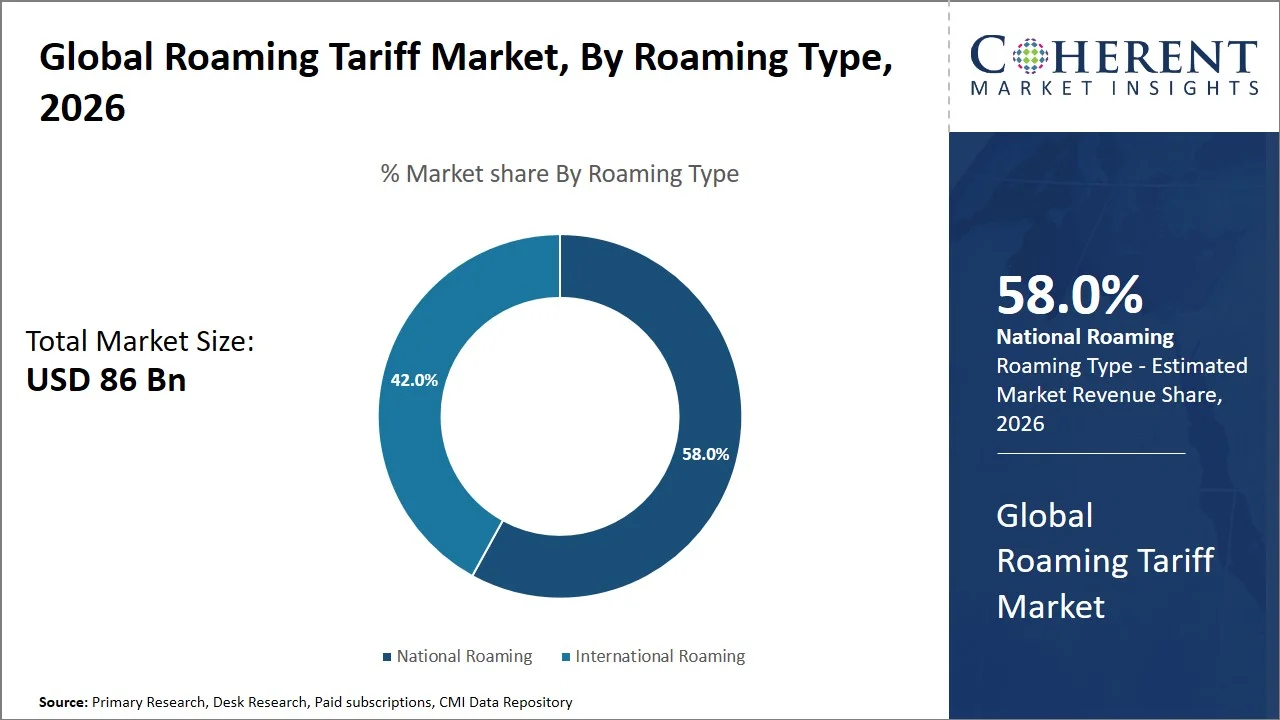
Why Does National Roaming Dominate the Global Roaming Tariff Market?
The national roaming segment is expected to account for 58.0% of the global roaming tariff market share in 2026. The growth of mobile network infrastructure across countries and the governmental backing for expanding coverage are pushing national roaming services. National roaming allows users to continue using voice and data services when they are roaming outside of their home operator’s coverage region, by using partner networks in the same country. This improves service stability in rural and distant areas, increases customer satisfaction, reduces network investment needs for operators and enables greater digital inclusion, making national roaming an integral part of modern telecoms services. On August 23, 2024 Vodafone and 1&1 signed a countrywide roaming cooperation in Germany which enables 1&1 users to access Vodafone’s 5G mobile network.
- Current Industry Events of 2026
- Market Size Estimation
- Regional Breakdown
- Competitive Landscape
- Customer Intelligence
- Segmental Analysis
- Pricing Analysis
- Key Market Drivers, Challenges & Future Trends
- Customized Insights Section
Why is Voice the Most Preferred Service Type?
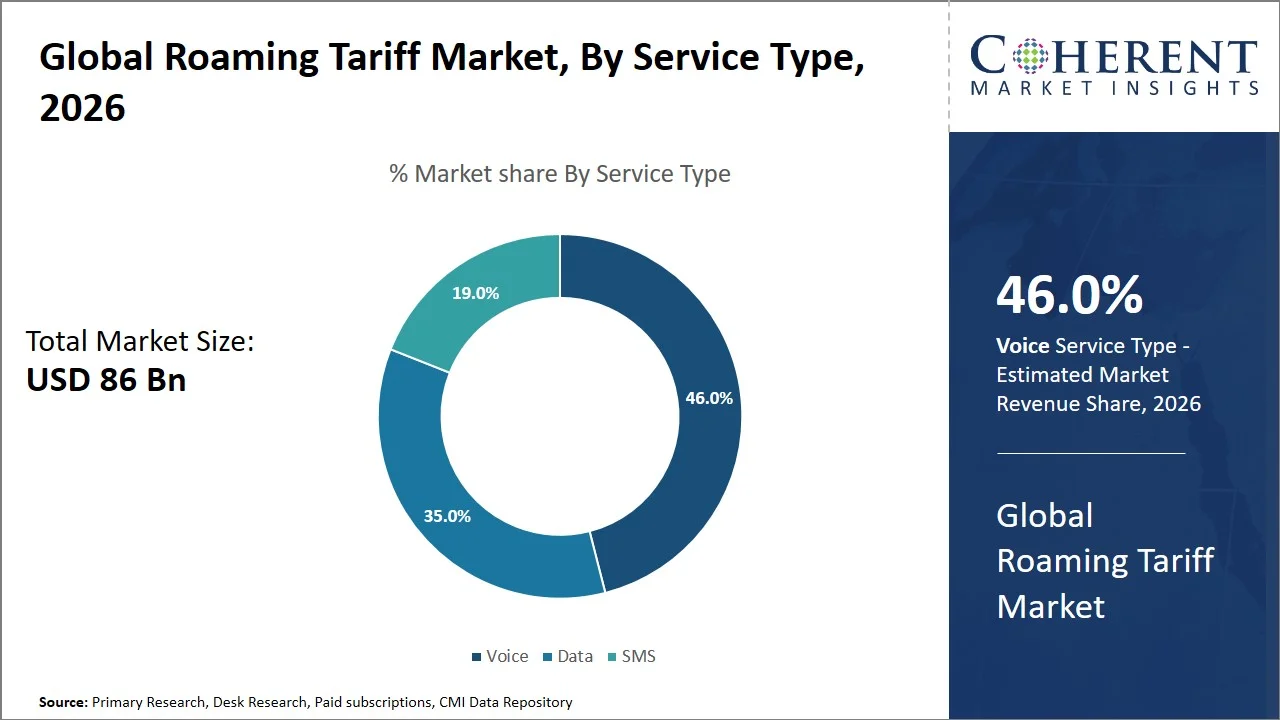
The voice segment is expected to account for 46.0% of the global roaming tariff market share in 2026. The continuous significance of dependable voice communication for business travelers, emergencies and personal discussions is a primary driver of the choice for voice roaming services. Despite the explosion of mobile data usage, many travelers still rely on voice conversations to connect instantly and reliably in places with poor internet availability or where messaging services are not available. The telecom carriers are also bundling voice minutes with international roaming packages that makes voice services more accessible and affordable and seamless communication across different nations and networks. On April 25, 2025, Airtel launched a unique recharge plan with one-year validity. The plan offers 5GB data and 100 voice minutes for use when abroad, while in India customers can use the same plan and get 1.5 GB daily data and unlimited call benefits. (Source: Airtel)
Currents Events and their Impact
Current Events | Description and its Impact |
European Union - Roam Like at Home (RLAH) Regulation (extended through 2032) |
|
European Union - Fair Use Policy and Wholesale Roaming Price Caps (2025 updates) |
|
Roaming Tariff Market Dynamics
Market Drivers
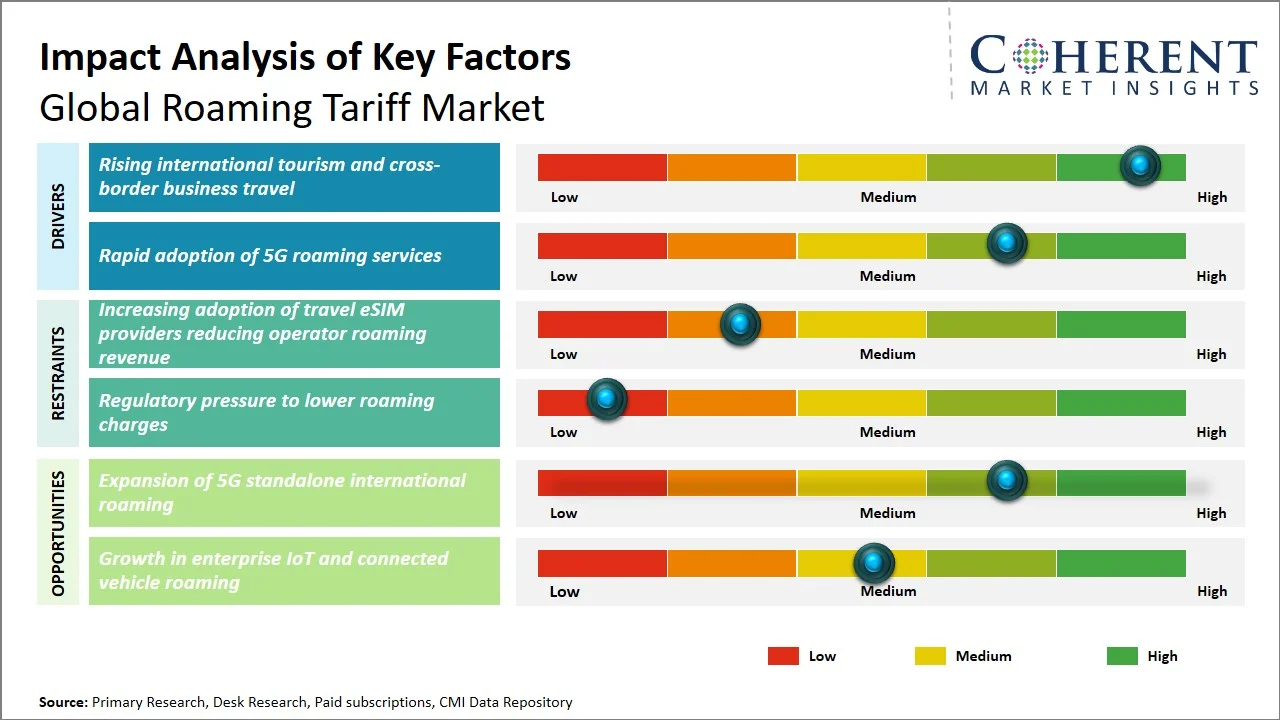
- Rising international tourism and cross-border business travel
Rapid growth in international tourism and cross border business travel is one of the key factors driving the growth of global roaming tariff market. With increasing numbers of people travelling overseas for leisure, corporate meetings, trade events, education and international assignments, the demand for uninterrupted voice, data and messaging services is rising. Increasing preference of travelers for convenient roaming packages to stay connected without changing SIM cards and need for enterprises to support communication and business operations across multiple countries through seamless mobile connectivity are driving higher adoption of international roaming services. On June 23, 2026, Saily released dedicated cruise data plans, giving travelers the ability to stay connected on their vacation on some of the world's most popular cruise ships.
- Rapid adoption of 5G roaming services
The fast adoption of 5G roaming services is driving the growth of the worldwide roaming tariff market by enabling passengers to enjoy high-speed, low-latency mobile connectivity across international networks. Telecom operators are scaling up bilateral and multilateral 5G roaming agreements to enable bandwidth hungry applications such as high-definition video streaming, cloud collaboration, online gaming, and real-time workplace communications. With the global expansion of 5G networks, operators are launching premium roaming plans and value-added services that are driving client adoption and roaming income. On March 4, 2026, Syniverse became the first roaming services provider to comply with the GSMA’s Billing and Charging Evolution (BCE) 2.0, the latest and most advanced standard for wholesale roaming and settlement.
Emerging Trends
- AI-Driven Personalized and Dynamic Roaming Tariff Plans
Operators are using artificial intelligence and sophisticated analytics to design tailored roaming packages according to client travel patterns, destination, previous usage and spending history. Dynamic pricing, real-time usage notifications and automatic plan recommendations are improving the consumer experience, while raising roaming revenue and decreasing bill shock.
- Rising Demand for IoT and Enterprise Roaming Connectivity
Beyond consumer mobile services, roaming tariffs are being formulated for connected IoT devices such as fleet management, connected vehicles, industrial sensors, logistics tracking devices, and smart healthcare equipment. Telecom providers are developing enterprise roaming solutions that are scalable, secure and cost-effective, with centralized administration capabilities, as multinational enterprises expand their activities across borders.
Regional Insights
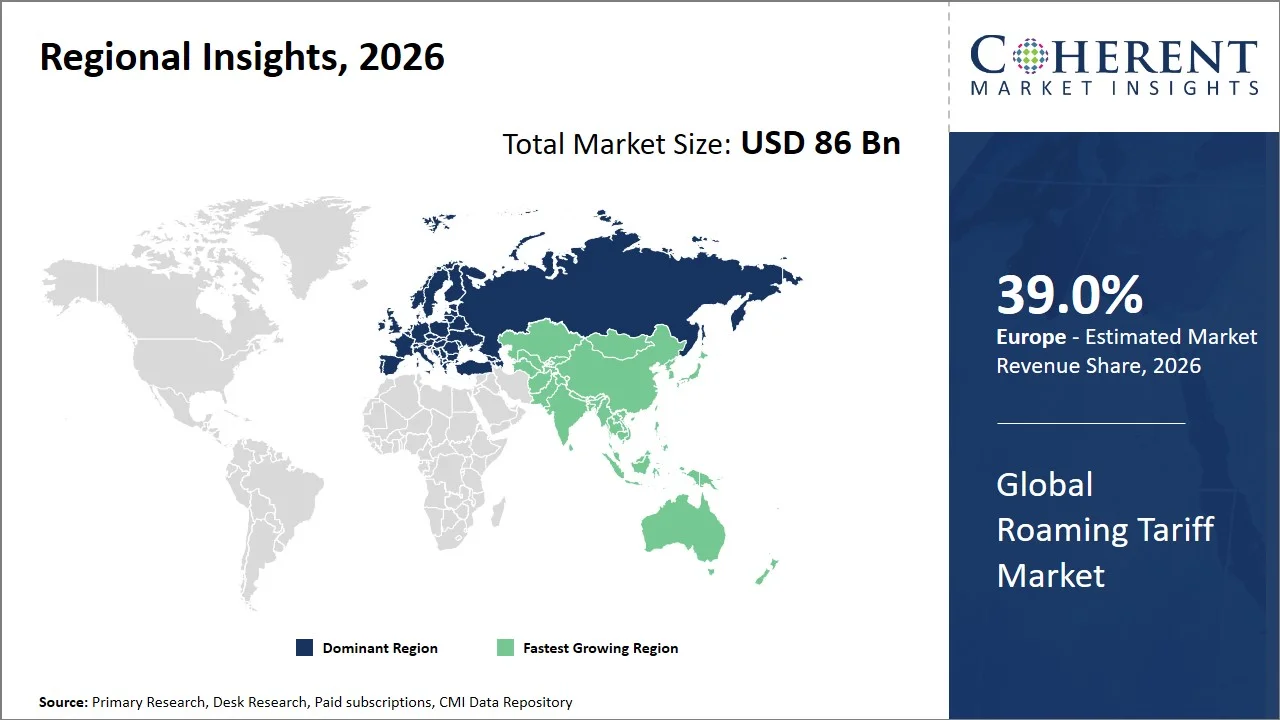
Why is Europe a Strong Market for Roaming Tariff?
Europe is expected to account for a market share of 39.0% in 2026. The roaming tariff market is most developed in Europe, driven by the European Union's consolidated regulatory framework under the Roam Like at Home (RLAH) policy, which enables subscribers to use their domestic mobile plans across EU member states without incurring additional retail roaming charges. Operators like Vodafone, Orange, Deutsche Telekom, Telefónica and Elisa have extended 5G roaming deals across the area, and the European Commission continues to tweak wholesale roaming caps and quality-of-service standards. High roaming traffic is still driven by strong business and leisure travel, as well as cross-border commuting between countries such as France, Germany, Belgium and the Netherlands, which, in turn, drives carriers to offer premium 5G roaming services with better data speeds. On May 5, 2026, Vodafone Group Plc agreed to purchase CK Hutchison Group Telecom Holding Limited out of the VodafoneThree joint venture. On completion of the Transaction, Vodafone will acquire 100% of VodafoneThree and become the largest mobile operator in the U.K. and one of the fastest growing suppliers of internet services.
Why Does the Asia Pacific Roaming Tariff Market Exhibit High Growth?
Asia Pacific is projected to account for 26.0% of the global roaming tariff market and is expected to register the fastest growth. Rapid increase in regional tourism, rising outbound travel and wide-scale deployment of 5G networks are driving the Asia Pacific as the fastest evolving roaming tariff market. Telecom carriers like Singtel, NTT DOCOMO, China Mobile, SK Telecom and Bharti Airtel have dramatically increased their international roaming partnerships across Southeast Asia, East Asia and Oceania. Regional initiatives such as the introduction of lower-cost roaming packages in ASEAN and the rising adoption of eSIM-enabled travel plans are enhancing customer convenience, while high travel volumes between destinations such as Singapore, Thailand, Japan, South Korea, Australia and China continue to drive demand for affordable roaming services. For example, Singtel added to its ReadyRoam portfolio improved 5G roaming access to several Asia Pacific locations, including Japan, South Korea, Australia, Thailand, Malaysia and Indonesia.
Why is Germany Emerging as a Major Hub in the Roaming Tariff Market?
Germany is an important market for roaming tariffs due to its strategic location in Europe and the enormous amount of cross-border business and commuter travel. Deutsche Telekom has widespread 5G roaming connection through partnerships with hundreds of international mobile operators, which means German subscribers may enjoy seamless services while travelling around the world. With a large automotive, manufacturing and commerce industry, international business travel is common in the country. Austria, Poland, France, Switzerland, Belgium and the Netherlands are all close by, which ensures roaming usage remains high throughout the year.
Is China the Next Growth Engine for the Roaming Tariff Market?
Increasing outbound travel and more extensive overseas commercial activities with major carriers such as China Mobile, China Telecom and China Unicom are expanding China’s roaming rate market. China Mobile has steadily expanded 5G international roaming services to more countries and regions, and launched destination-based roaming packages for popular tourist destinations across Asia, Europe and the Middle East. The development of international trade through projects like the Belt and Road Initiative has further raised enterprise roaming demand from logistics companies, manufacturers and multinational organizations working across numerous nations.
U.S. Roaming Tariff Market Analysis and Trends
The U.S. is one of the largest roaming tariff markets in the world, driven by intense foreign business travel and the high penetration of premium mobile services. Major operators including AT&T, Verizon and T-Mobile US provide unlimited or fixed-price international roaming options for over 200 destinations, and broad 5G roaming agreements throughout Europe, Asia Pacific and Latin America. Multinational corporations, regular business travelers, and outbound tourists are fueling the rise in demand, with operators further improving roaming services with real-time use notifications, eSIM activation, and packaged overseas travel plans.
U.K. Roaming Tariff Market Analysis and Trends
Despite leaving the European Union, the U.K. remains a major market for roaming tariffs, with operators offering a range of European travel rates. EE, Vodafone UK, Three UK and Virgin Media O2 have announced destination-based roaming packages, premium travel passes and increased 5G roaming coverage in key global markets. London as a global financial and business center generates significant international travel and high levels of passenger traffic through airports including Heathrow continue to drive demand for business and leisure roaming services.
Japan Roaming Tariff Market Analysis and Trends
Japan's roaming tariff market is characterized by modern mobile infrastructure and the widespread availability of high-quality foreign roaming services. NTT DOCOMO, KDDI and SoftBank are expanding 5G roaming pacts with operators in North America, Europe and Asia and offering flexible daily and location-specific roaming options for outbound travelers. Operators have been incentivized by the surge of inbound tourists to Japan, foreign business activity and preparations for big global events to improve roaming network quality, enhance eSIM compatibility and expand high-speed roaming coverage for consumers and enterprise customers.
Global Roaming Tariff Market - International Roaming Subscribers by Region
Region | Estimated International Roaming Subscribers (Million) |
Europe | 415 |
Asia Pacific | 355 |
North America | 215 |
Latin America | 135 |
Middle East & Africa | 100 |
How is the Expansion of 5G Standalone International Roaming Creating New Growth Opportunities in the Roaming Tariff Market?
The 5G standalone international roaming rollout opens up huge development prospects in the roaming pricing industry, enabling telecom operators to offer premium, high-performance connection services to passengers across numerous countries. The architecture of 5G standalone network is different from non-standalone network as it allows ultra-low latency, network slicing, high security and high data rate, which makes it suitable for applications like cloud computing, augmented and virtual reality, real-time video conferencing, connected vehicles and industrial IoT. With more operators signing 5G standalone roaming agreements and expanding network interoperability, they are offering differentiated roaming packages with value-added services, increasing average revenue per user, and attracting both enterprise customers and high-data-consuming international travelers.
On March 3, 2026, Syniverse and BICS partnered to expand the reach of 5G Standalone (SA) roaming. Through this collaboration, Syniverse and BICS are integrating their 5G Signaling Hub solutions and establishing peering arrangements to significantly enhance 5G SA roaming capabilities for operators worldwide. (Source: Syniverse)
Market Players, Key Development, and Competitive Intelligence
Key Developments
- On June 2, 2026, and Trip.com announced the signing of a global distribution partnership. This partnership aims to meet the growing demand for connectivity while travelling, by facilitating access to simple, reliable and competitively priced Orange Travel eSIM offers directly through the Trip.com platform.
- On June 2, 2026, Airalo, the world's leading eSIM platform, announced that it has surpassed 30 million customers, a milestone that reflects how quickly eSIMs have shifted from a niche convenience to the default way travelers stay connected abroad.
Competitive Landscape
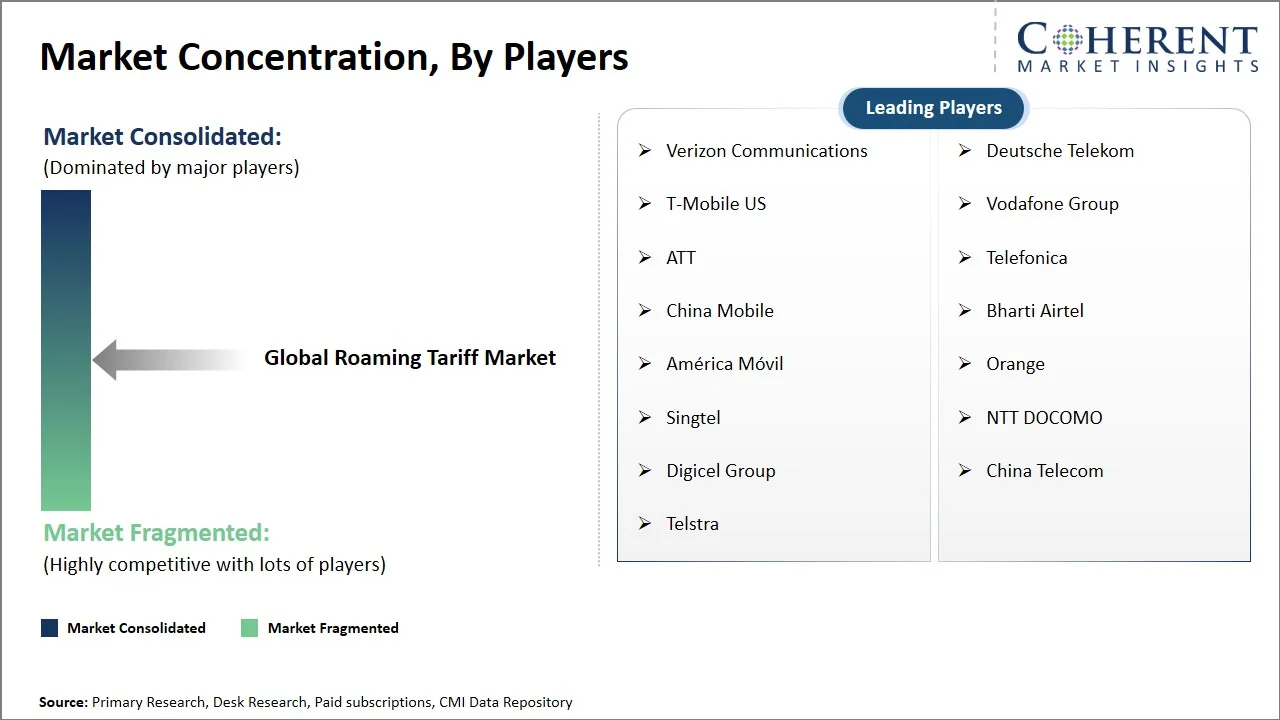
The market for roaming tariff is a highly competitive landscape with international telecommunication operators, regional mobile network providers and digital connectivity service providers competing to get market share. Strategic collaborations, bilateral and multilateral roaming agreements, eSIM-enabled travel solutions, and 5G roaming expansion are all in focus to strengthen market position and enhance customer experience. Operators are increasingly competing on destination-specific roaming packages, unlimited data plans, AI-enabled usage management, and value-added enterprise mobility services, investing in network modernization and expanded international coverage.
Market Report Scope
Roaming Tariff Market Report Coverage
| Report Coverage | Details | ||
|---|---|---|---|
| Base Year: | 2025 | Market Size in 2026: | USD 86 Bn |
| Historical Data for: | 2020 To 2024 | Forecast Period: | 2026 To 2033 |
| Forecast Period 2026 to 2033 CAGR: | 7 % | 2033 Value Projection: | USD 130 Bn |
| Geographies covered: |
| ||
| Segments covered: |
| ||
| Companies covered: | Verizon Communications, Deutsche Telekom, T-Mobile US, Vodafone Group, ATT, Telefonica, China Mobile, Bharti Airtel, América Móvil, Orange, Singtel, NTT DOCOMO, Digicel Group, China Telecom, and Telstra | ||
| Growth Drivers: |
| ||
| Restraints & Challenges: |
| ||
Analyst Opinion (Expert Opinion)
- The roaming tariff market is likely to be driven by continuous growth in international travel, increased deployment of 5G standalone networks and growing usage of enterprise mobility solutions. Competition is heating up, leading to a greater focus on economical roaming bundles, smooth cross-border connectivity and innovation in digital services. The pricing pressure from regulatory measures and eSIM-based alternatives are predicted to continue. However, technological developments, operator collaborations and the extension of premium roaming services are expected to underpin sustainable growth.
- The global roaming tariff market is projected to be affected by the broader rollout of 5G standalone roaming, AI-powered tailored pricing plans, and the increasing adoption of eSIM technology in smartphones and connected devices. Demand for enterprise IoT, linked vehicles, smart logistics and foreign company operations is anticipated to provide new revenue prospects away from the typical consumer roaming. The market is expected to transition to intelligent, high-speed, and value-based roaming services as telecom operators sign up for more global roaming partnerships and flexible subscription models with seamless access across international networks.
Speak to the analyst
Want personalized insights?
Take the findings above to one of our principal consultants, or have the report rebuilt around the segments, geographies and competitors you actually track.
Market Segmentation
- Roaming Type Insights (Revenue, USD Billion, 2021 - 2033)
- National Roaming
- International Roaming
- Service Type Insights (Revenue, USD Billion, 2021 - 2033)
- Voice
- Data
- SMS
- Regional Insights (Revenue, USD Billion, 2021 - 2033)
- North America
- U.S.
- Canada
- Latin America
- Brazil
- Argentina
- Mexico
- Rest of Latin America
- Europe
- Germany
- U.K.
- Spain
- France
- Italy
- Russia
- Rest of Europe
- Asia Pacific
- China
- India
- Japan
- Australia
- South Korea
- ASEAN
- Rest of Asia Pacific
- Middle East
- GCC Countries
- Israel
- Rest of Middle East
- Africa
- South Africa
- North Africa
- Central Africa
- North America
Sources
Primary Research Interviews
- Mobile Network Operators (MNOs)
- Telecom Regulatory Authorities
- Roaming Agreement Managers & Wholesale Carriers
- Enterprise Mobility Solution Providers
Magazines
- Telecom Asia Magazine
- Mobile World Magazine
- Total Telecom Magazine
- Wireless Week
Journals
- Journal of Telecommunications and Information Technology
- International Journal of Mobile Communications (IJMC)
- IEEE Transactions on Mobile Computing
Associations
- GSM Association (GSMA)
- International Telecommunication Union (ITU)
- Telecom Infra Project (TIP)
- CTIA – The Wireless Association
Public Domain Sources
- Federal Communications Commission (FCC) – Official Reports & Publications
- European Commission – Digital Agenda & Roaming Regulations Portal
- ITU – ICT Data and Statistics Division
- TRAI (Telecom Regulatory Authority of India) – Public Reports
Proprietary Elements
- CMI Data Analytics Tool
- Proprietary CMI Existing Repository of information for last 10 years
Get access to 250+ pages report
Every segment, forecast, competitor profile and data table behind the analysis above — available for instant download.
- ESOMAR Member
- ISO 9001:2015 Certified
- D-U-N-S Registered
- GDPR & CCPA Compliant
Missing comfort of reading report in your local language? Find your preferred language:
Transform your Strategy with Exclusive Trending Reports
Frequently Asked Questions
The global roaming tariff market is expected to stand at USD 86 Bn in 2026 and is expected to reach USD 130 Bn by 2033.
The CAGR of the global roaming tariff market is projected to be 7% from 2026 to 2033.
Rising international tourism and cross-border business travel and rapid adoption of 5G roaming services are the major factors driving the growth of the global roaming tariff market.
Increasing adoption of travel eSIM providers reducing operator roaming revenue and regulatory pressure to lower roaming charges are the major factors hampering the growth of the global roaming tariff market.
In terms of roaming type, the national roaming segment is estimated to dominate the market revenue share in 2026.
5G enables faster international connectivity and supports premium roaming services with enhanced performance.
eSIM technology allows travelers to activate roaming plans digitally without replacing physical SIM cards