

Global Rum Market Size and Forecast – 2026 To 2033
The global rum market is estimated to be valued at USD 21.8 Bn in 2026 and is expected to reach USD 31.29 Bn by 2033, exhibiting a compound annual growth rate (CAGR) of 5.3% from 2026 to 2033. Market growth is supported by rising consumer preference for premium, aged, spiced, and flavored rum varieties, expanding cocktail culture across on-trade and at-home consumption, and increasing disposable incomes across emerging markets. White rum continues to gain strong traction due to its use in cocktails and mixed drinks, while aged and limited-edition rum expressions are strengthening the premium and luxury segments.
The market is also benefiting from brand-led innovation, premium packaging, origin-based storytelling, and wider availability through modern retail, travel retail, and ready-to-drink channels. A recent example includes Mount Gay Rum’s launch of its Exceptionally Aged Collection in June 2026, featuring limited 15-year-old and 25-year-old aged rum expressions. This highlights how leading rum producers are using age transparency, scarcity, and premium positioning to capture high-value consumers and strengthen the market’s long-term value growth. (Source: Mount Gay Rum)
Key Takeaways of the Global Rum Market
- White rum is expected to account for 37.8 % share in 2026, supported by its high mixability and use in core cocktails such as mojitos, daiquiris, and Cuba Libre. BACARDÍ highlights Carta Blanca white rum as ideal for mojitos due to its clean profile, reinforcing white rum’s strong on-trade and home-mixology relevance. (Source: BACARDÍ)
- Molasses based rum is expected to hold 72.4 % share in 2026, as it remains commercially efficient and widely used by established rum producers. Appleton Estate states that its rums begin with molasses sourced for Jamaican rum producers, showing how traditional molasses fermentation continues to support quality, scalability, and brand authenticity. (Source: Appleton Estate)
- 700 to 750 ml bottles are expected to command 56.4 % share in 2026, supported by global retail familiarity, gifting suitability, and regulatory acceptance across spirits markets. The U.S. TTB lists 750 mL and 700 mL among approved distilled spirits fill sizes, supporting cross-border packaging flexibility for rum brands. (Source: Tax & Trade Bureau)
- North America is expected to lead with 35.8 % share in 2026, backed by mature spirits consumption, strong cocktail culture, and organized retail and on-trade channels. DISCUS reported in February 2026, that spirit ready-to-drink cocktails became a nearly USD 4 billion category in 2025, indicating continued consumer engagement with spirits-based formats. (Source: Distilled Spirits Council of the United States)
- Europe is the fastest growing region with 27.4 % share in 2026, supported by premium cocktail culture, expanding bar-led consumption, and growing preference for super-premium rum. In the U.K., International Wines and Spirits Record (IWSR) estimates 8% CAGR for super-premium-and-above rums during 2022–2027, highlighting Europe’s rising shift toward premium rum occasions. (Source: The Spirits Business)
- Premiumization Driving Consumer Demand: Consumers across global markets are increasingly shifting toward premium and super-premium rum varieties, driven by evolving taste preferences, higher disposable incomes, and growing interest in aged and craft spirits. Manufacturers are responding by expanding premium product portfolios, introducing limited-edition offerings, and emphasizing heritage, quality, and unique flavor profiles to attract discerning consumers.
- Expanding Cocktail Culture and On-Trade Consumption: The rising popularity of cocktails and mixology in bars, restaurants, and hospitality venues is boosting rum consumption worldwide. Bartenders are increasingly incorporating white, dark, and spiced rum into innovative cocktail menus, while younger consumers are exploring diverse spirit categories. This growing cocktail culture is strengthening rum’s position in both developed and emerging beverage markets.
Segmental Insights
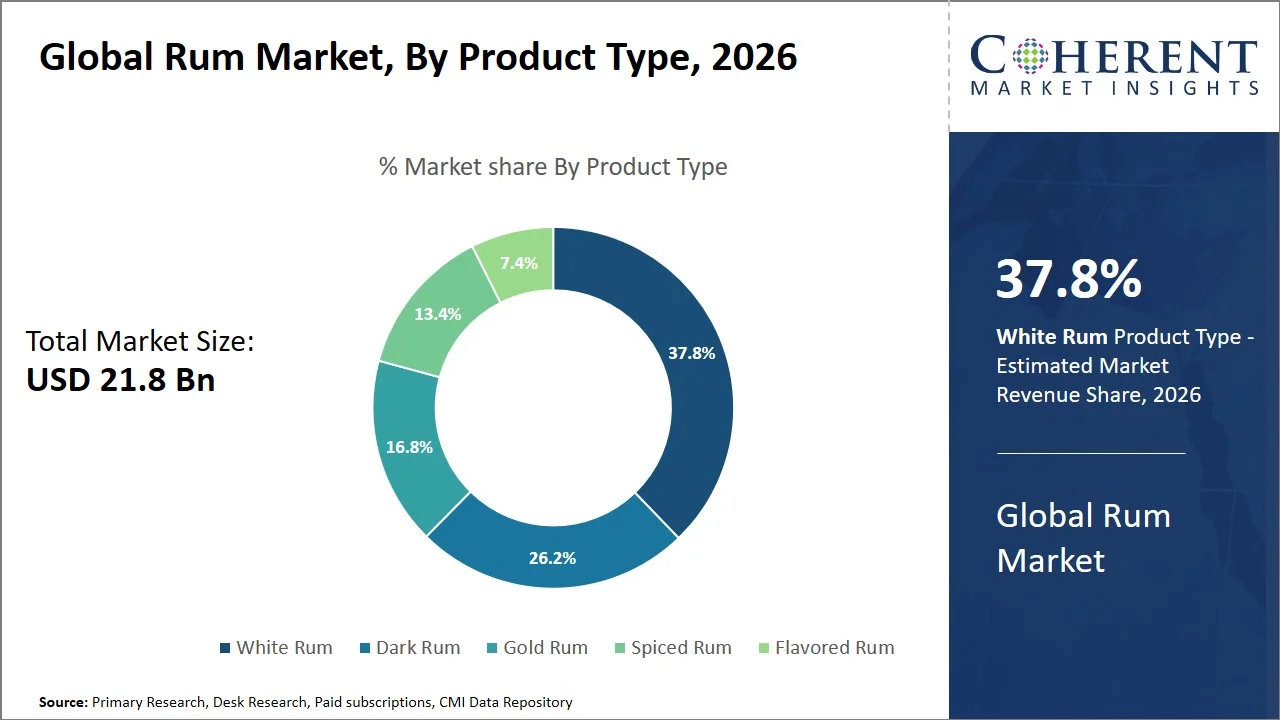
Why Does the White Rum Segment Dominate the Global Rum Market?
White rum is expected to dominate the global rum market with 37.8% share in 2026, mainly due to its strong relevance in cocktails, ready-to-drink formats, and casual drinking occasions. Its lighter body, clean taste, and easy blending profile make it highly suitable for mojitos, daiquiris, piña coladas, and other rum-based mixed drinks. On the demand side, bars, hotels, restaurants, and home consumers prefer white rum for versatile cocktail preparation. On the supply side, white rum benefits from faster production cycles compared to aged dark or gold rum, allowing brands to scale output efficiently. In March 2024, BrewDog Distilling Co. launched DUO White Rum as a standalone product after using it in its Wonderland canned mojitos, highlighting white rum’s growing role in cocktails and RTD innovation. (Source: Retail Times News)
- Current Industry Events of 2026
- Market Size Estimation
- Regional Breakdown
- Competitive Landscape
- Customer Intelligence
- Segmental Analysis
- Pricing Analysis
- Key Market Drivers, Challenges & Future Trends
- Customized Insights Section
Why Does Molasses-based Rum Represent the Largest Raw Material Base Segment in the Global Rum Market?
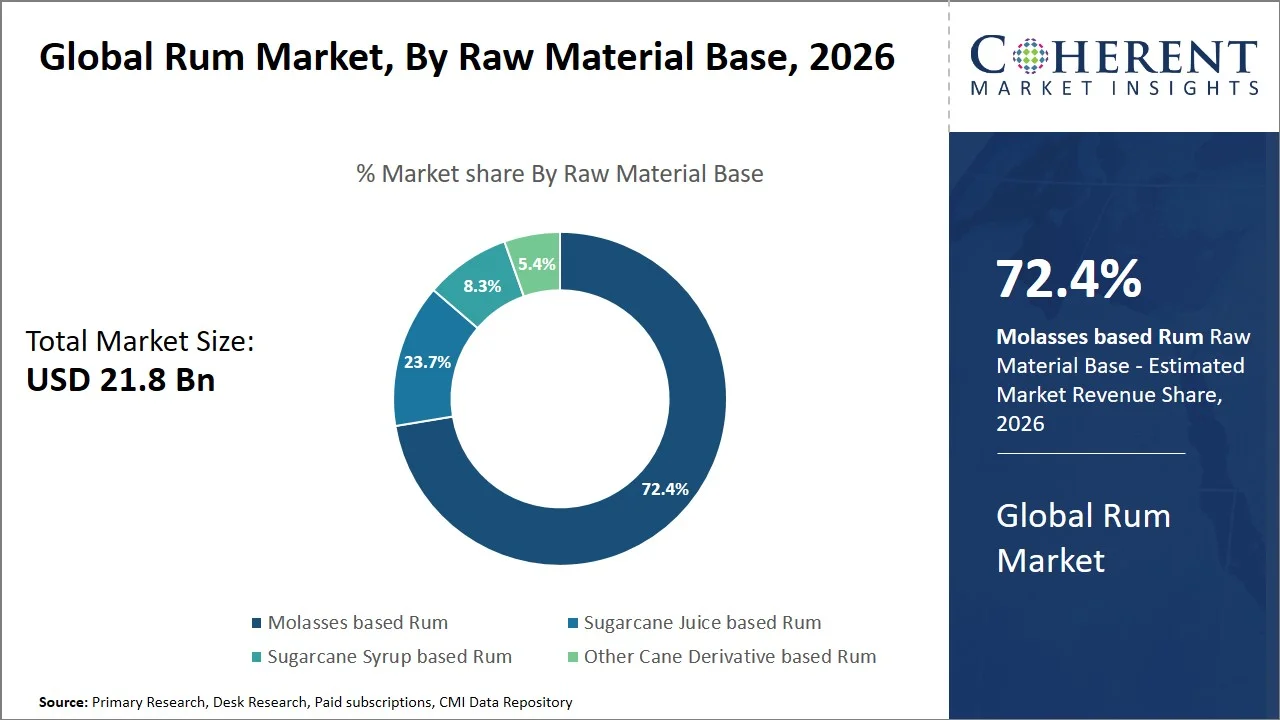
Molasses based rum is expected to represent the largest raw material base segment with 72.4% share in 2026, owing to its wide availability, cost efficiency, and deep integration with traditional rum-making supply chains. Molasses is a by-product of sugar refining, making it easier to store, transport, and procure compared to fresh sugarcane juice, which requires rapid processing near cane fields. Demand remains strong because molasses-based rum supports multiple product styles, including white, dark, spiced, aged, and blended rum. Supply-side advantages include established fermentation systems, yeast handling, and barrel-aging processes that allow consistent taste and large-scale production. In 2024, Planteray unveiled Mister Fogg Navy Rum, a premium blended rum positioned around rich molasses-led flavor notes, showing continued commercial relevance of molasses-based rum in premium portfolios. (Source: Uncut Stories by Maison Ferrand)
Why Does the 700 to 750 ml Bottles Segment Dominate the Global Rum Market?
700 to 750 ml bottles are expected to dominate the global rum market with 56.4% share in 2026, as this format is the most commercially accepted full-size bottle across retail, duty-free, and on-trade channels. The pack size offers an effective balance between affordability, volume, gifting suitability, and shelf visibility, making it suitable for both mass and premium rum brands. On the demand side, consumers prefer this bottle size for home consumption, parties, and cocktail preparation. On the supply side, glass bottle manufacturers, labeling lines, closures, cartons, and logistics systems are already standardized around this format, reducing packaging complexity
Currents Events and their Impact
Current Events | Description and its Impact |
EU Packaging and Packaging Waste Regulation Enters Transition Phase February 2025 onward |
|
Ireland Defers Alcohol Health Labelling Implementation to Later Date July 2025 onward |
|
U.K. Alcohol Duty Rates Updated from February 2026 |
|
India Updates Alcoholic Beverage Regulations through FSSAI Amendments 2025 onward |
|
(Source: European Commission, HRB National Drugs Library, & Government of U.K.)
Global Rum Market Dynamics
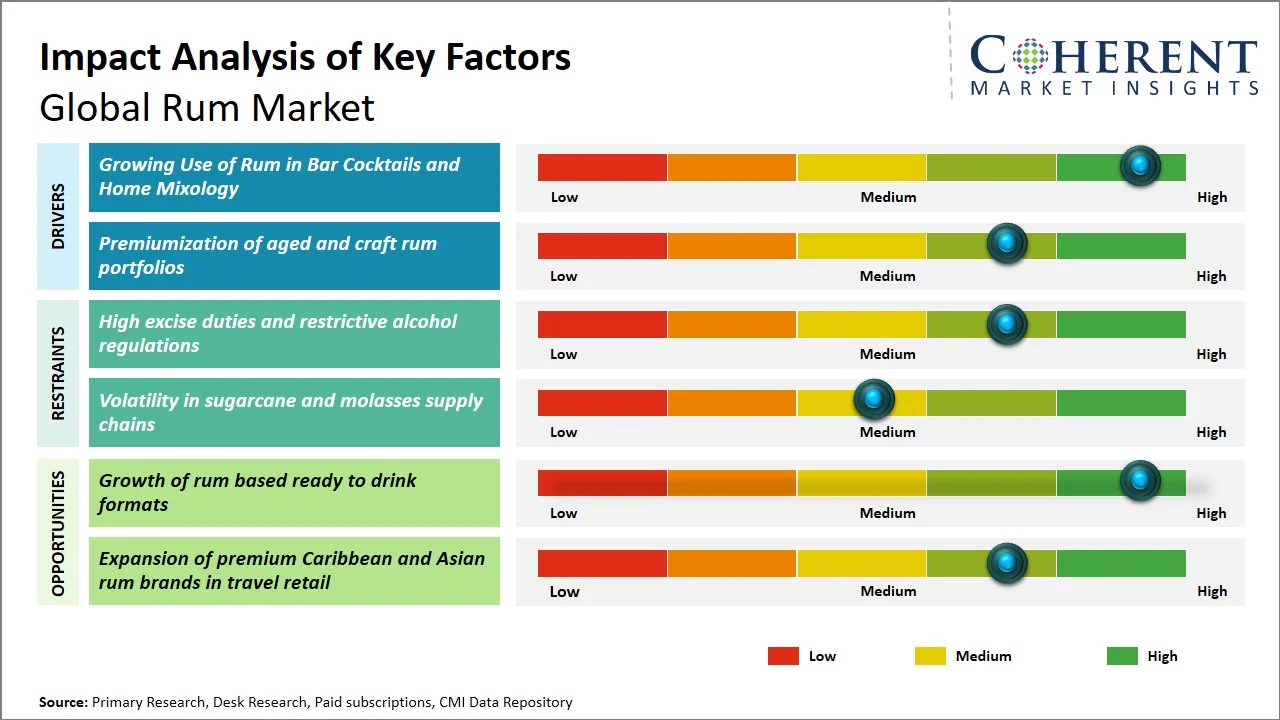
Market Drivers
- Growing Use of Rum in Bar Cocktails and Home Mixology: Cocktail-led consumption is strengthening rum demand across bars, restaurants, hotels, retail shelves, and home-mixology occasions. Rum’s versatility in mojitos, daiquiris, piña coladas, rum punch, and cola-based serves gives it wider usage flexibility than many other spirits. This supports both white rum volumes and flavored or spiced rum innovation. On-trade channels benefit from bartender-led menu experimentation, while at-home consumers are increasingly buying full-size bottles and mixers for social occasions. For instance, A key market signal is the strong growth of spirits-based RTDs in the U.S. In 2025, premixed cocktails reached USD 3.8 billion, increasing 16.4% year over year. This reflects rising consumer preference for convenient cocktail formats and creates additional opportunities for rum-based ready-to-drink offerings. (Source: Forbes Media LLC)
- Premiumization of aged and craft rum portfolios: Premiumization is reshaping the rum category as consumers shift from basic mixing spirits toward aged, craft, cask-finished, origin-led, and small-batch rum expressions. This trend improves value growth by encouraging higher price points, gifting purchases, and collector-oriented consumption. Producers are using barrel aging, multi-country blends, higher ABV formats, and heritage-led storytelling to position rum closer to premium whisky, cognac, and tequila. This is commercially important because it allows brands to expand margins even in mature markets where volume growth may be slower. In 2024, Planteray launched Mister Fogg Navy Rum, positioned around ancestral know-how, innovative techniques, and a bold blended profile, reflecting how premium rum brands are building differentiated portfolios beyond standard mass-market offerings. (Source: Uncut Stories by Maison Ferrand)
Emerging Trends
- Expansion of Flavor Led and Culinary Rum Innovation: Rum manufacturers are increasingly developing flavored, spiced, botanical, and culinary-inspired variants to attract younger legal-age consumers and support cocktail-led consumption. This trend is helping brands move beyond traditional white and dark rum positioning toward more occasion-based products suited for home mixology, bars, and ready-to-drink formats. Industry focus on savory flavors, immersive drinking experiences, and bartender-led creativity is expected to encourage wider adoption of differentiated rum products and strengthen premium shelf visibility.
- Growing Shift toward Sustainable and Compliant Rum Packaging: Rum producers are increasingly expected to improve packaging recyclability, reduce excess materials, and align bottle, closure, label, and secondary packaging formats with circular economy requirements. This trend is especially relevant for brands exporting to Europe, where packaging rules are becoming stricter and all packaging placed on the EU market is expected to be recyclable in an economically viable way by 2030.
Regional Insights
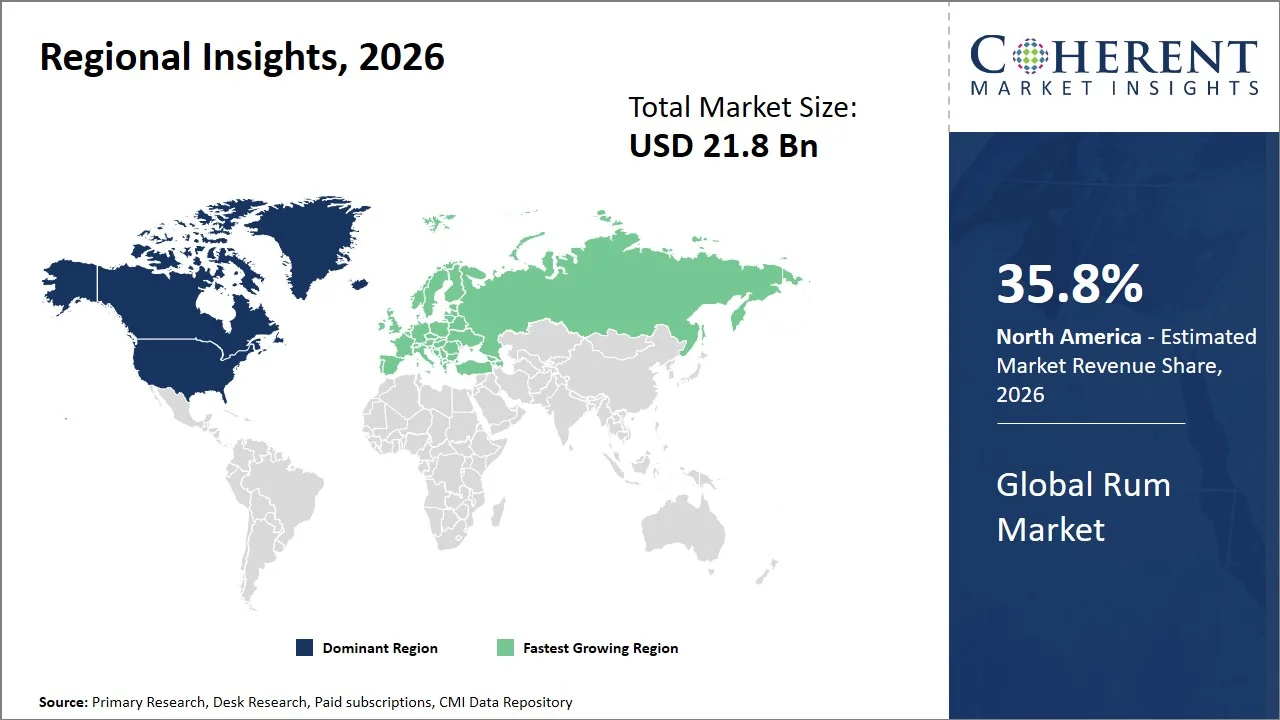
Why is North America a Strong Market for Rum?
North America is projected to remain the leading regional market for rum, accounting for 35.8% of global market share in 2026, driven by high consumer preference for distilled spirits, expanding premium beverage trends, and a strong hospitality sector. Demand is particularly robust across the U.S. and Canada, where rum is widely consumed in cocktails, flavored alcoholic beverages, and premium craft spirit offerings. Growth is further supported by widespread availability through supermarkets, liquor stores, specialty retailers, and digital alcohol delivery platforms. The region’s sophisticated supply chain, marketing capabilities, and consumer willingness to experiment with new spirit categories continue to strengthen rum sales. Additionally, the popularity of Caribbean-inspired drinks and seasonal cocktail menus contributes to sustained market expansion. In February 2025, DISCUS reported that U.S. spirits supplier sales declined by 1.1% in 2024 to reach USD 37.2 billion, while spirits maintained a leading 42.2% revenue share of the total beverage alcohol market. This indicates that, despite softer discretionary spending, spirits remained a resilient category, supporting continued opportunities for premium alcoholic beverages, including rum products. Source: Distilled Spirits Council of the United States via Fred Minnick coverage. (Source: Fred Minnick)
Why Does the Europe Rum Market Exhibit High Growth?
Europe is expected to emerge as the fastest-growing region in the global rum market with 27.4% share in 2026, supported by premiumization, cocktail-led consumption, craft spirits adoption, and rising interest in aged and origin-led rum expressions. The region has a strong bar culture, high tourism-linked beverage demand, and established premium retail channels, which support growth of dark, spiced, and aged rum portfolios. European consumers are also showing stronger willingness to explore rum beyond basic mixers, especially in premium sipping and cocktail occasions. The U.K., Germany, France, Spain, and Italy are important contributors due to their active spirits trade and cocktail ecosystems. A recent indication of category momentum is the German Rum Festival 2025 in Berlin, where more than 150 brands were showcased across over 70 booths, with tastings and masterclasses covering rum production, barrel aging, and sustainability. (Source: Source: Berlin.de)
Global Rum Market Outlook for Key Countries
Why is the U.S. Leading Innovation and Adoption in the Rum Market?
The U.S. is one of the most important countries in the global rum market due to its large spirits consumer base, mature cocktail culture, strong premium retail networks, and well-established bar and restaurant channels. Rum demand is supported by high-volume white rum usage in mixed drinks as well as premium growth across dark, spiced, and aged variants. The country also plays an important role in imported rum consumption, supported by a broad distributor network and consumer openness to Caribbean, Latin American, and craft-origin rum brands. A recent market signal is the continued rise of spirits-based ready-to-drink cocktails in the U.S., where premixed cocktails reached USD 3.8 billion in 2025, up 16.4% year over year, highlighting strong consumer demand for convenient cocktail formats that can support rum-based RTD innovation. (Source: Distilled Spirits Council of the United States)
Is China Emerging as a Key Growth Hub for the Rum Market?
China is an important country in the global rum market due to its expanding urban drinking culture, rising experimentation with international spirits, and growing interest in flavored and cocktail-based alcoholic beverages among younger legal-age consumers. Although baijiu remains the dominant domestic spirit, global rum brands can benefit from China’s developing bar scene, premium hotel channels, night-time economy, and demand for fruit-forward or mixed-drink formats. Rum has strong potential in cocktails because its sweetness, spice notes, and tropical positioning align with China’s growing preference for innovative and social drinking occasions. A recent industry signal is that young consumers in Chinese bars are increasingly choosing fruit-infused spirits and creative craft beverage formats, showing the market’s shift toward flavor-led alcohol experiences. (Source: Xinhua)
Why is India Important for Mass and Premium Rum Demand?
India is a key country in the global rum market due to its large legal-age consumer population, strong mass spirits base, expanding premiumization, and established domestic rum brand ecosystem. Rum has long-standing relevance in India through mass and mid-priced formats, while premium and craft-positioned variants are gradually gaining traction among urban consumers. The country’s organized spirits companies, broad retail footprint, and high-volume The Indian Made Foreign Liquor industry provide a strong platform for both domestic and imported rum. Demand is supported by social occasions, affordability-led consumption, and growing experimentation in cocktails across metro cities. For instance, Radico Khaitan’s rum portfolio, including Contessa Rum and 1965 Spirit of Victory Rum, reflects the continued strength of domestic producers in India’s rum market and their role in serving both mass and premium consumer segments. (Source: Radico Khaitan)
Why Does Germany Hold Strong On-Trade Potential in the Rum Market?
Germany is important in the rum market due to its developed spirits retail structure, strong bar and restaurant culture, and consumer openness to imported and premium spirits. Rum benefits from Germany’s cocktail ecosystem, specialist liquor stores, festivals, and demand for Caribbean, Latin American, and craft-style spirits. Although the broader spirits market has faced pressure, the on-trade channel remains commercially important because rum-based cocktails are strongly linked to bars, restaurants, hotels, and nightlife venues. This supports premium bottle rotation, bartender-led discovery, and higher-value consumption occasions. For Instance, in June 2025, NielsenIQ analysis noted that the on-premise channel generated 54.5% of consumer spending on spirits in Germany, confirming the strategic importance of bars and hospitality for rum brand visibility. (Source: Nielsen Consumer LLC)
Why is the U.K. Emerging as a Premium and Ready to Drink Rum Innovation Market?
The U.K. is a key country in the global rum market due to its active cocktail culture, high exposure to premium spirits, strong supermarket and convenience retail channels, and fast innovation in ready-to-drink alcoholic beverages. Rum has strong relevance in the U.K. through spiced rum, dark rum, cocktail serves, and premixed formats. The market is also important for brand testing because successful U.K. launches can influence broader European retail and on-trade strategies. Demand is supported by younger legal-age consumers seeking convenience, flavor, and lower-effort cocktail experiences. In September 2025, the launch of Captain Morgan Original Spiced Gold and Pepsi Max Premix in Great Britain, combining rum-based spirit and cola in a ready-to-drink format. (Source: Captain Morgan)
Regulatory Landscape of the Global Rum Market
Regulatory Area | Description and Market Impact |
Alcoholic Beverage Classification and Product Standards | Rum is regulated as a distilled alcoholic beverage across major markets, with rules covering product identity, alcohol content, raw material base, maturation claims, additives, and labelling. These standards are important for molasses-based rum, sugarcane juice-based rum, aged rum, spiced rum, and flavored rum positioning. For manufacturers, clear product standards help reduce misclassification risk and support smoother import approvals, while stricter definitions may require better documentation of ingredients, age claims, and formulation. |
Packaging Size and Standards of Fill Regulations | Distilled spirits, including rum, are subject to permitted bottle sizes and container standards in regulated markets. In the U.S., expanded standards of fill now allow additional distilled spirits sizes, including 700 ml, which is widely used in international spirits’ trade. This improves packaging flexibility for imported rum brands and reduces the need for market-specific repackaging. For rum companies, bottle-size harmonization supports better inventory planning, export efficiency, and premium portfolio launches. |
Health Warning and Alcohol Labelling Rules | Governments are increasingly strengthening alcohol labelling rules to improve consumer awareness around health risks, pregnancy warnings, calorie disclosure, and alcohol content. These requirements directly affect rum packaging, especially for imported bottles, premium formats, and small-batch brands with limited label space. Rum manufacturers may need country-specific labels, additional compliance review, and higher packaging adaptation costs. Over the forecast period, health-warning regulations may become more prominent across Europe and other mature alcohol markets. |
Excise Duty and Alcohol Taxation Policies | Rum is usually taxed based on alcohol strength, product category, and volume of pure alcohol. Higher excise rates can directly affect retail pricing, distributor margins, and consumer movement between mass, premium, and luxury rum tiers. Since most rum products are sold above 22% ABV, duty changes in major markets can influence price positioning and promotional strategy. For producers and importers, alcohol taxation remains a key factor in route-to-market planning and profitability. |
Packaging Waste and Sustainability Compliance | Rum packaging is strongly exposed to sustainability regulations because the category depends heavily on glass bottles, closures, labels, cartons, and secondary packaging. New packaging waste rules in Europe are increasing pressure on beverage companies to improve recyclability, reduce unnecessary packaging, and strengthen packaging documentation. For premium rum brands, this may affect heavy glass bottles, decorative cartons, and luxury packaging formats. Compliance could encourage lighter bottles, recyclable labels, and more standardized packaging systems. |
Advertising, Promotion, and Responsible Drinking Controls | Rum marketing is regulated through alcohol advertising rules, responsible drinking codes, age-gating requirements, and restrictions on targeting minors. These controls influence brand campaigns, influencer marketing, sports sponsorships, digital advertising, and retail promotions. As rum brands increasingly use social media, cocktail content, and lifestyle-led positioning, compliance with alcohol promotion rules becomes more important. Stronger advertising oversight may raise marketing review costs but also supports responsible category development and brand trust. |
Import Licensing and Route to Market Controls | Rum trade is affected by country-level import duties, state excise laws, distributor licensing, customs rules, and retail sale restrictions. These regulations are especially important in markets such as India, China, the U.S., and Europe, where alcohol distribution can vary by state, province, or member country. For global rum companies, regulatory complexity can affect pricing, market entry timing, distributor selection, and product availability. Clear compliance with import and sale permissions remains essential for scaling international rum portfolios. |
How are ready to drink rum cocktails creating new growth opportunities in the global rum market?
Ready to drink rum cocktails are creating strong growth opportunities in the global rum market by expanding rum consumption beyond traditional bottle purchases and bar-prepared cocktails. The format improves convenience, supports impulse buying, and helps rum brands reach younger legal-age consumers seeking portable, consistent, and easy-to-serve alcoholic beverages. This is especially important for white rum and flavored rum portfolios, as RTD products convert popular mixed drinks into standardized retail formats. The trend also strengthens distribution through supermarkets, convenience stores, travel retail, and event channels, helping brands increase frequency of consumption. For instance, in September 2024, Bacardi Limited and The Coca Cola Company announced plans to debut BACARDÍ rum and Coca-Cola as a ready to drink premixed cocktail, with initial launch planned for select European markets and Mexico in 2025. (Source: The Coca‑Cola Company)
Market Players, Key Development, and Competitive Intelligence
Key Developments
- In June 2026, Mount Gay Rum launched its Exceptionally Aged Collection, featuring limited 15-year-old and 25-year-old aged rum expressions for select global markets. This development aligns with the premiumization trend in the Global Rum Market, as leading rum producers are strengthening aged and limited-edition portfolios to target collectors, connoisseurs, and high-value sipping occasions.
- In January 2025, Diageo plc completed the sale of Cacique rum to Bardinet S.A., strengthening Bardinet’s position in the Spanish and Venezuelan rum markets. This development reflects strategic portfolio optimization in the rum industry, as large spirits companies continue to refine brand portfolios while regional players expand their category presence.
Competitive Landscape
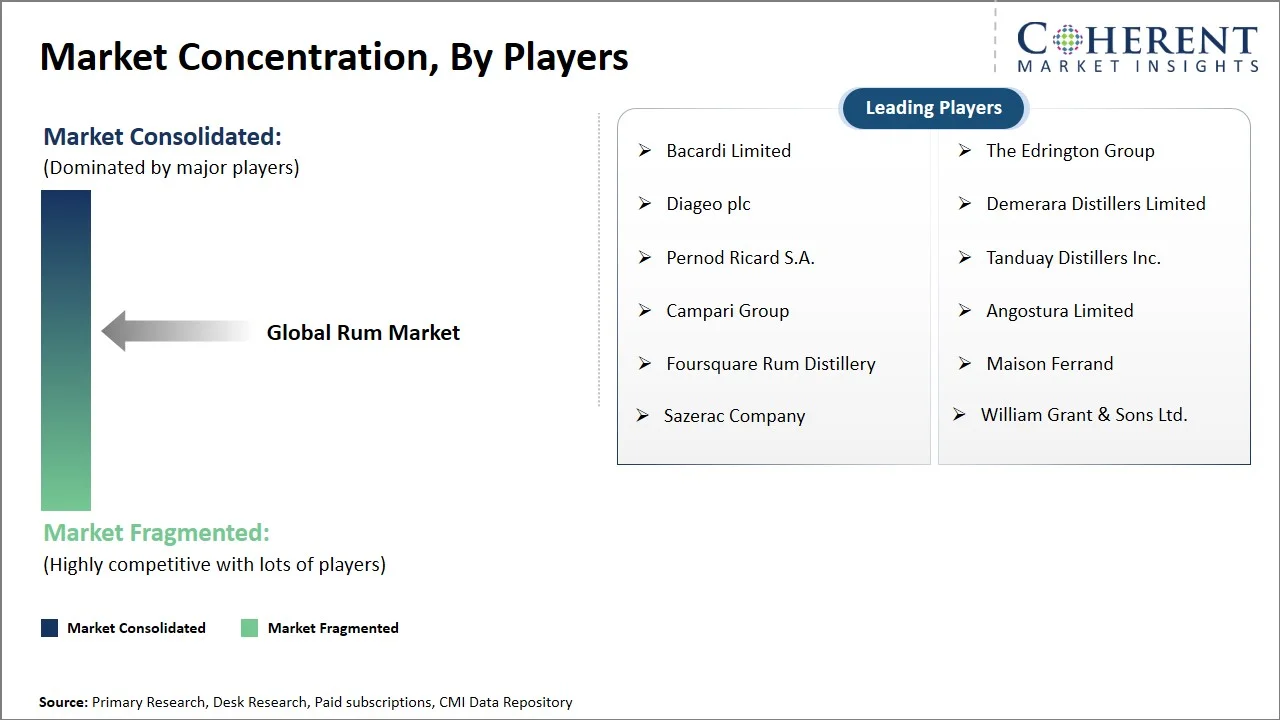
The global rum market is moderately fragmented, with competition shaped by global spirits companies, Caribbean origin-based producers, regional distilleries, and emerging craft rum brands. Key players compete through premium aged portfolios, flavored and spiced rum innovation, cocktail-led positioning, packaging differentiation, and wider distribution across retail, on-trade, travel retail, and ready-to-drink channels. Companies are increasingly focusing on premiumization, limited-edition releases, sustainable packaging, and brand storytelling linked to origin, aging, and craftsmanship. Strategic partnerships with beverage companies, distributors, bars, and retail chains are also strengthening market reach. Rising consumer interest in premium sipping rum, convenient premixed cocktails, and flavored variants is expected to influence competitive strategies over the forecast period.
Key focus areas include
- Development of premium aged, craft, and limited-edition rum portfolios to capture higher-value consumption occasions
- Expansion of flavored, spiced, and cocktail-ready rum variants to attract younger legal-age consumers and home mixology users
- Growth of ready-to-drink rum-based cocktails through partnerships with soft drink and beverage companies
- Investment in sustainable packaging, lighter glass bottles, recyclable materials, and premium bottle design to support brand differentiation
- Strengthening of distribution networks across supermarkets, liquor stores, bars, restaurants, e-commerce platforms, and travel retail
- Use of origin-led branding, barrel aging claims, and heritage-based storytelling to improve consumer trust and premium positioning
- Strategic acquisitions, divestments, and portfolio optimization by global spirits companies to strengthen category focus and regional presence
Market Report Scope
Rum Market Report Coverage
| Report Coverage | Details | ||
|---|---|---|---|
| Base Year: | 2025 | Market Size in 2026: | USD 21.8 Bn |
| Historical Data for: | 2020 To 2024 | Forecast Period: | 2026 To 2033 |
| Forecast Period 2026 to 2033 CAGR: | 5.3% | 2033 Value Projection: | USD 31.29 Bn |
| Geographies covered: |
| ||
| Segments covered: |
| ||
| Companies covered: | Bacardi Limited, Diageo plc, Pernod Ricard S.A., Campari Group, Foursquare Rum Distillery, The Edrington Group, Demerara Distillers Limited, Tanduay Distillers Inc., Angostura Limited, Maison Ferrand, Sazerac Company, and William Grant & Sons Ltd. | ||
| Growth Drivers: |
| ||
| Restraints & Challenges: |
| ||
Analyst Opinion (Expert Opinion)
- The global rum market is expected to witness steady long-term growth, supported by expanding cocktail culture, rising demand for premium and flavored rum variants, and increasing consumer preference for differentiated spirits. White rum will continue to benefit from strong use in cocktails and mixed drinks, while aged, dark, spiced, and flavored rum portfolios are expected to gain relevance among consumers seeking richer taste profiles and premium drinking experiences.
- The largest opportunities are expected in North America, where mature spirits consumption, developed on-trade channels, and strong ready-to-drink cocktail adoption continue to support rum demand. Europe is likely to emerge as the fastest-growing region, driven by premiumization, craft spirits adoption, and increasing interest in aged and origin-led rum expressions. China and India are also expected to create new demand opportunities as urban consumers experiment with international spirits and cocktail-led consumption.
- To strengthen competitive positioning, rum manufacturers should invest in premium aged portfolios, flavored and spiced innovations, ready-to-drink formats, and sustainable packaging solutions. Strong distribution partnerships with bars, restaurants, liquor retailers, e-commerce platforms, and travel retail operators will be critical for wider market penetration. Companies that combine authentic origin-based storytelling with modern packaging and cocktail-focused marketing are expected to gain stronger consumer recall and pricing power.
Speak to the analyst
Want personalized insights?
Take the findings above to one of our principal consultants, or have the report rebuilt around the segments, geographies and competitors you actually track.
Market Segmentation
- Product Type Insights (Revenue, USD Bn, 2021 - 2033)
- White Rum
- Dark Rum
- Gold Rum
- Spiced Rum
- Flavored Rum
- Raw Material Base Insights (Revenue, USD Bn, 2021 - 2033)
- Molasses based Rum
- Sugarcane Juice based Rum
- Sugarcane Syrup based Rum
- Other Cane Derivative based Rum
- Price Tier Insights (Revenue, USD Bn, 2021 - 2033)
- Mass
- Premium
- Luxury
- Packaging Size Insights (Revenue, USD Bn, 2021 - 2033)
- 700 to750 ml Bottles
- 1 Liter and Above Bottles
- 200 to 500 ml Bottles
- Miniatures Below 200 ml
- Others
- Distribution Channel Insights (Revenue, USD Bn, 2021 - 2033)
- Direct
- Indirect
- Regional Insights (Revenue, USD Bn, 2021 - 2033)
- North America
- U.S.
- Canada
- Latin America
- Brazil
- Argentina
- Mexico
- Rest of Latin America
- Europe
- Germany
- U.K.
- Spain
- France
- Italy
- Russia
- Rest of Europe
- Asia Pacific
- China
- India
- Japan
- Australia
- South Korea
- ASEAN
- Rest of Asia Pacific
- Middle East
- GCC Countries
- Israel
- Rest of Middle East
- Africa
- South Africa
- North Africa
- Central Africa
- North America
- Key Players Insights
- Bacardi Limited
- Diageo plc
- Pernod Ricard S.A.
- Campari Group
- Foursquare Rum Distillery
- The Edrington Group
- Demerara Distillers Limited
- Tanduay Distillers Inc.
- Angostura Limited
- Maison Ferrand
- Sazerac Company
- William Grant & Sons Ltd.
Sources
Primary Research Interviews
- Rum distillers, master blenders, and production managers involved in white, dark, spiced, flavored, and aged rum manufacturing
- Procurement heads and supply chain managers handling molasses, sugarcane juice, sugarcane syrup, barrels, bottles, closures, and labels
- Executives and product managers from global spirits companies and regional rum producers
- Bar managers, mixologists, hotel beverage directors, and on trade channel experts using rum in cocktails and premium beverage menus
- Retail category managers, liquor store operators, alcohol e commerce platforms, and duty-free buyers involved in rum sales and distribution
- Packaging suppliers and glass bottle manufacturers serving distilled spirits companies
- Regulatory, excise, and compliance professionals working with alcoholic beverage labelling, taxation, import, and distribution rules
Stakeholders
- Rum manufacturers and distilleries
- Global spirits companies and alcoholic beverage groups
- Sugar mills, molasses suppliers, and sugarcane derivative suppliers
- Barrel suppliers, aging warehouse operators, and blending specialists
- Glass bottle, closure, label, carton, and secondary packaging suppliers
- Alcohol distributors, importers, wholesalers, and route to market partners
- Ready to drink cocktail manufacturers and co packing companies
- Retail chains, liquor stores, supermarkets, convenience stores, and duty-free operators
- End Use Sectors
- Bars, pubs, clubs, and lounges
- Hotels, restaurants, cafés, and resorts
- Retail liquor stores and specialty alcohol outlets
- Supermarkets, hypermarkets, and convenience stores
- Travel retail and duty-free channels
- Alcohol e-commerce and delivery platforms
- Event venues, catering services, and entertainment locations
- Ready to drink cocktail and premixed beverage companies
- Household and at home cocktail consumers
Regulatory and Alcohol Control Bodies:
- U.S. Alcohol and Tobacco Tax and Trade Bureau (TTB)
- U.S. Food and Drug Administration (FDA) for alcoholic beverage labelling interface where applicable
- European Commission Alcoholic Beverage and Packaging Regulations
- European Food Safety Authority (EFSA) where applicable
- K. HM Revenue and Customs (HMRC) Alcohol Duty
- U.K. Portman Group and Advertising Standards Authority (ASA)
- Food Safety and Standards Authority of India (FSSAI)
- State Excise Departments in India
- National Medical Products Administration and State Administration for Market Regulation China where applicable for beverage compliance
- Canadian Food Inspection Agency (CFIA) and Health Canada
- Alcohol and Tobacco Tax and Trade related customs authorities across major importing countries
Databases
- UN Comtrade Database
- International Trade Centre Trade Map
- World Bank Data
- OECD Data
- FAOSTAT Sugar Crops and Molasses Data
- WHO Global Health Observatory Alcohol Consumption Data
- S. TTB Alcohol Statistics
- K. HMRC Alcohol Bulletin and Duty Data
- Eurostat Trade and Production Data
- India FSSAI and State Excise Policy Documents
- Company Annual Reports and Investor Presentations of major spirits companies
- Import export shipment databases and customs trade data where applicable
Magazines and Trade Publications
- The Spirits Business
- The Drinks Business
- Beverage Daily
- Just Drinks
- Drinks International
- Global Drinks Intel
- Beverage Industry Magazine
- FoodBev Media
- Imbibe Magazine
- Bar Magazine
Journals
- Journal of Wine Economics
- Beverages Journal
- Foods Journal
- Food Chemistry
- Journal of the Institute of Brewing
- International Journal of Food Science and Technology
- Journal of Food Composition and Analysis
- Fermentation Journal
- Food Control
- Journal of Ethnic Foods
Newspapers
- Financial Times
- Business Standard
- Economic Times
Associations
- Distilled Spirits Council of the United States (DISCUS)
- spiritsEUROPE
- Scotch Whisky Association for broader spirits trade benchmarking
- Wine and Spirit Trade Association (WSTA)
- International Alliance for Responsible Drinking (IARD)
- American Distilling Institute (ADI)
- The Gin Guild and other spirits category bodies for cross category benchmarking
- Confederation of Indian Alcoholic Beverage Companies (CIABC)
- International Center for Alcohol Policies where applicable
- National and regional alcohol beverage trade associations across key markets
Public Domain Sources
- World Health Organization WHO Alcohol and Health Statistics
- U.S. Alcohol and Tobacco Tax and Trade Bureau TTB Standards of Fill and Alcohol Statistics
- European Commission Alcohol Policy and Packaging Waste Regulations
- U.K. Government Alcohol Duty Rates and HMRC Alcohol Bulletin
- Food Safety and Standards Authority of India FSSAI Alcoholic Beverages Regulations
- UN Comtrade Import Export Trade Data
- World Bank Income and Consumption Indicators
- FAOSTAT Sugarcane and Molasses Supply Data
- OECD Consumer and Trade Indicators
- National customs, excise, and alcoholic beverage control departments
Proprietary Elements
- CMI Data Analytics Tool, Proprietary CMI Existing Repository of information for last 10 years.
Get access to 250+ pages report
Every segment, forecast, competitor profile and data table behind the analysis above — available for instant download.
- ESOMAR Member
- ISO 9001:2015 Certified
- D-U-N-S Registered
- GDPR & CCPA Compliant
Missing comfort of reading report in your local language? Find your preferred language:
Transform your Strategy with Exclusive Trending Reports
Frequently Asked Questions
The global rum market is estimated to be valued at USD 21.8 billion in 2026 and is expected to reach USD 31.29 billion by 2033.
White rum dominates the global rum market due to its wide use in cocktails, mixed drinks, ready-to-drink formats, and casual consumption occasions.
Rum is a distilled alcoholic beverage produced primarily from sugarcane derivatives such as molasses, sugarcane juice, or sugarcane syrup through fermentation and distillation.
The global rum market is projected to grow at a CAGR of 5.3% from 2026 to 2033.
In terms of raw material base, molasses-based rum is estimated to dominate the market in 2026 due to its wide availability, cost efficiency, and established use in large-scale rum production.
In terms of packaging size, 700 to 750 ml bottles are estimated to dominate the market in 2026 due to their strong retail acceptance, gifting suitability, and standard use across major spirits markets.
Ready-to-drink rum cocktails are expanding rum consumption by offering convenient, pre-mixed formats suitable for retail, events, travel, and at-home drinking occasions.