

Global Semiconductor Bonding Market and Forecast – (2026-2033)
Coherent Market Insights estimates that the global semiconductor bonding market stood at USD 1 Bn in 2025 and will expand to USD 1.35 Bn by 2033, registering a CAGR of 4% between 2026 and 2033.
Key Takeaways of the Semiconductor Bonding Market
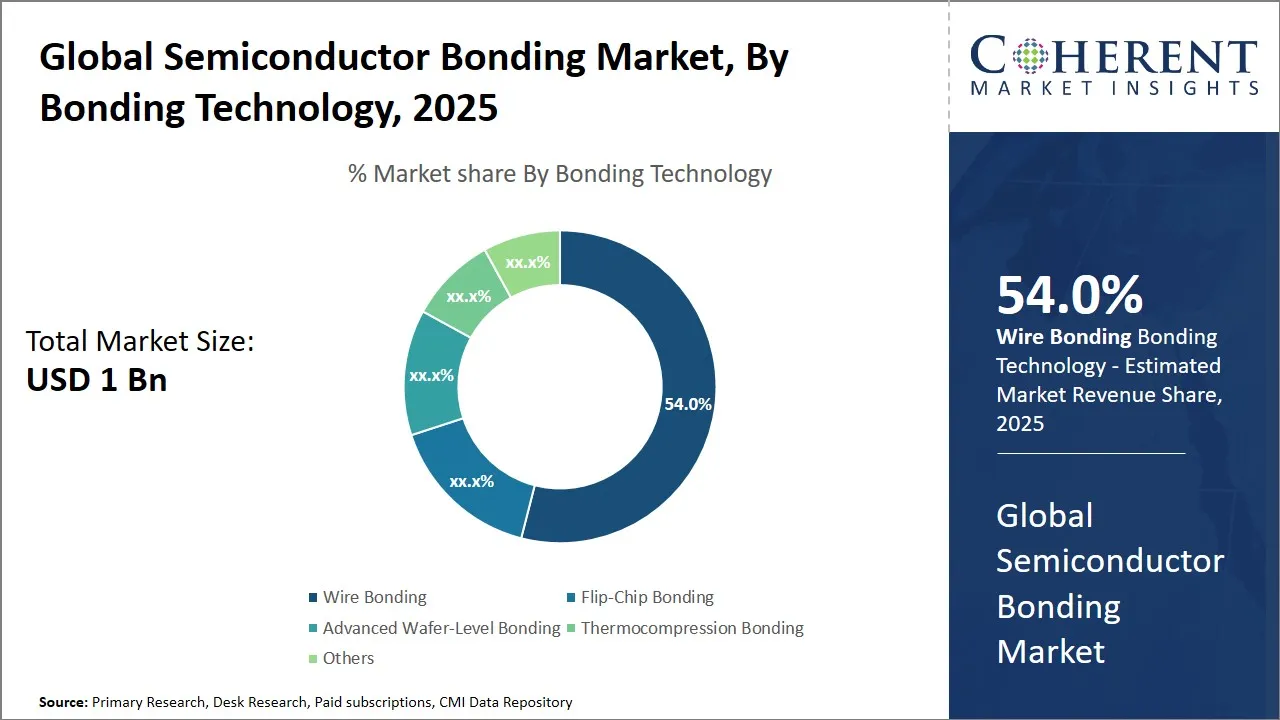
- The wire bonding segment accounted for 54% of the semiconductor bonding market share in 2025.
- The gold wire segment captured 34% of the market share in 2025.
- The outsourced assembly and test segment held 36% of the global semiconductor bonding market share in 2025.
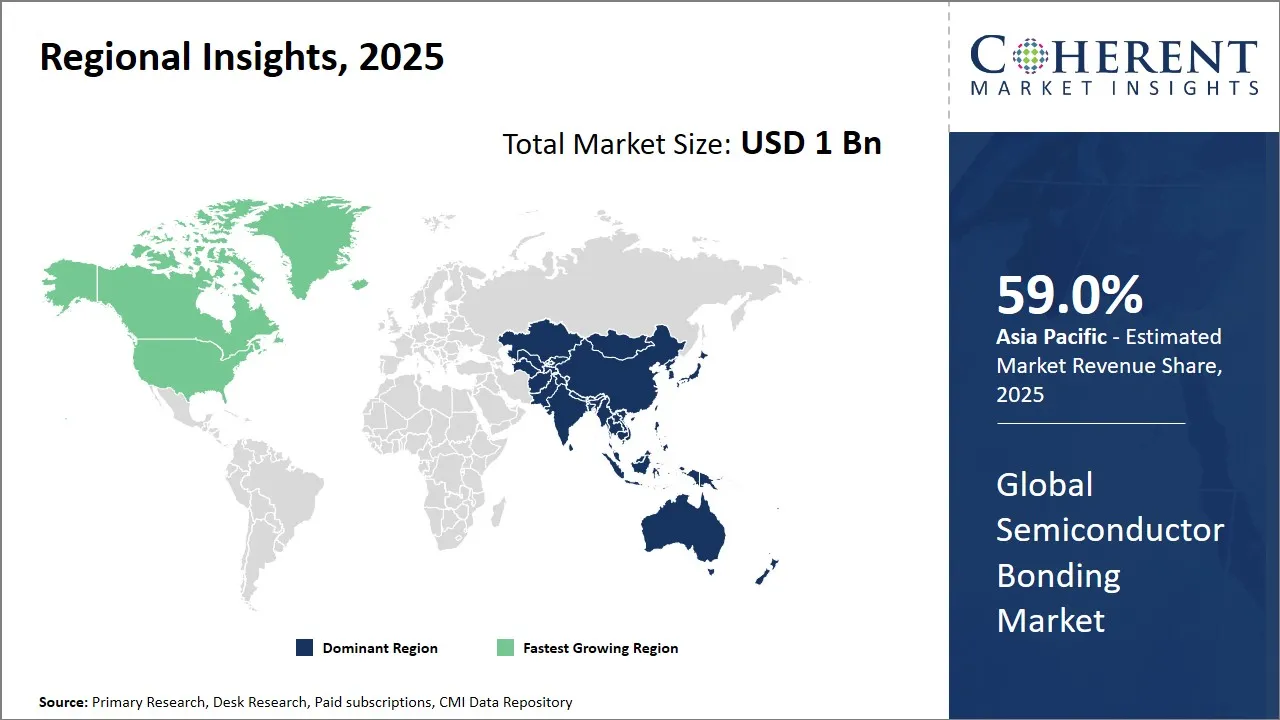
- Asia Pacific dominated the semiconductor bonding market in 2025 with 59%
- North America held 20% market share in 2025 and is expected to record the fastest growth over the forecast period.
Currents Events and Its Impact
Current Events | Description and its Impact |
Business Collaboration |
|
Segmental Insights
- Current Industry Events of 2026
- Market Size Estimation
- Regional Breakdown
- Competitive Landscape
- Customer Intelligence
- Segmental Analysis
- Pricing Analysis
- Key Market Drivers, Challenges & Future Trends
- Customized Insights Section
Why Does Wire Bonding Segment Dominate the Global Semiconductor Bonding Market in 2025?
The wire bonding segment accounted for 54.0% of the global semiconductor bonding market share in 2025. Owing to its well-rooted role as an adaptable, economical method for connections, expansion has occurred. Owing to wide compatibility with different base materials, preference persists in chip packaging processes. Flexibility across package styles, such as metal leads and polymer-based boards, strengthens its position. Performance stability over time comes from dependable behavior in diverse environments. Long-term function benefits from consistent conductivity and physical resilience of bonded wires.
Gold Wire Segment Dominates the Global Semiconductor Bonding Market
The gold wire segment captured 34.0% of the semiconductor bonding market share in 2025. Even with many options available, gold holds a key role because it conducts electricity exceptionally well while resisting corrosion and wear on its surface. Inside complex microchip housings, consistent signal transmission is achieved without interruption. Applications where failure is not acceptable like space systems, health monitors and long-range communication gear, lean on gold wires for enduring performance.
Why is Outsourced Assembly and Test the Most Widespread End User in the Semiconductor Bonding Market?
The outsourced assembly and test segment accounted for 36.0% of the market share in 2025. Progress arrives mainly by way of deeper intricacy in how chips are built and assessed. As devices shrink while gaining power, producers turn to outside specialists skilled in sophisticated linking structures and production processes. Through such targeted collaboration, creators gain room to explore ideas and experiment with substances, assigning detailed operations elsewhere. Complexity grows; expertise shifts accordingly. Efficiency improves when tasks like joining components move to those equipped for precision at scale. Expertise in tight integration becomes a reason to rely on dedicated partners rather than internal teams.
Yield Sensitivity & Defect Density Impact
Metric / Parameter | Cu-Cu Hybrid Bonding | Sn-Ag (SAC305) Solder Joints |
Typical Bond Yield Impact from Defects | Each +10 ppm particle increase can reduce post-bond yield by ~0.5 percentage points. | Voids as low as 1.9 % void fraction still affect mechanical reliability polarity. |
Defect Density (use-case threshold) | Target defectivity <0.1 cm² to avoid yield degradation at advanced nodes. | No universal industry standard; research indicates void fraction up to ~1.9 % measured. |
Yield in 3D Stack (layers) | Complex 3D stacks (e.g., >2 dies) can see total yield drop ~40 % with more layers if one fails. | Not directly quantified for solder, but reliability decreases with larger assembly complexity. |
Bonding Strength / Contact Quality | Cu–Cu hybrid bonds enable metal–metal direct contact with low resistance when pristine. | SAC305 solder has well-characterized mechanical performance but microstructure governs fracture. |
Regional Insights
Asia Pacific Semiconductor Bonding Market Analysis and Trends
Asia Pacific region led the market with a 59% share in 2025. Driven by strong local production systems, the region experiences steady progress owing to well-developed material flows alongside major spending on next-generation chip sealing methods. Found across nations including Japan, Taiwan, South Korea, and China are facilities among the biggest globally for producing chips and offering packaging services. Support emerges through state-backed research programs, financial backing for tech zones, along with trade frameworks that tilt toward growth.
Another factor is dense clustering of international sites where silicon components are built and put together, positioning the zone at the center of connector method evolution. Firms like JCET, ASE Group, and Amkor Technology push boundaries in attaching dies directly to wafers or managing full-wafer encapsulation, expanding both know-how and output volume.
North America Semiconductor Bonding Market Analysis and Trends
North America region exhibits the fastest growth in the market and contributed 20% share in 2025. This is attributed to modern research setups, progress gains strength alongside key players advancing packaging methods. Among nations, emphasis rises notably within the U.S. due to programs such as the CHIPS Act, designed to lessen reliance on distant suppliers while expanding local output. Located near each other, design centers in regions like Silicon Valley and Austin benefit from nearby access to sophisticated bonding solutions. Joint efforts linking major corporations with federal labs result in novel approaches adapted for future chips used in areas spanning wireless networks, intelligent systems, and vehicles. Firms such as Intel, Texas Instruments, and Micron influence direction, applying refined processes suited to shifting circuit designs.
Global Semiconductor Bonding Market Outlook for Key Countries
Why is U.S. Emerging as a Major Hub in the Semiconductor Bonding Market?
Driven by national priorities, China's semiconductor bonding sector aligns closely with efforts to strengthen internal production. State-backed funding pushes swift integration of modern bonding methods within growing chip fabrication networks. Major players like JCET and Tongfu Microelectronics invest deeply in next-generation assembly techniques, improving both output volume and consistency. Shifting policy landscapes and international commerce pressures further prompt faster growth of homegrown suppliers. Dependence on foreign inputs declines as domestic alternatives gain momentum under current economic conditions.
South Korea Semiconductor Bonding Market Analysis and Trends
Despite leading advances in semiconductor bonding, South Korea focuses on exacting techniques suited to components produced by top firms like Samsung Electronics and SK Hynix. Progress emerges through university-linked labs, where shared efforts improve glue materials and joining methods. Backed by policy goals that boost domestic supply chains while maintaining steady exports, its position in worldwide connection tech remains firm. Facilities outside major manufacturers receive significant backing from both firms, expanding capacity as sophisticated packaging needs rise.
Is U.S. the Next Growth Engine for the Semiconductor Bonding Market?
Growth in the U.S. semiconductor bonding market stems from fresh approaches to chip structure and assembly methods. Backed by public funding alongside private capital focused on boosting local production, efforts strengthen how components move from creation to customer. Firms like Intel, Micron Technology, and Texas Instruments lead advances in connections used within artificial intelligence systems, vehicles, and military equipment. Protected ideas and active early-stage financing help small teams explore new techniques for joining materials at microscopic levels.
Taiwan Semiconductor Bonding Market Analysis and Trends
Taiwan holds a central position in semiconductor bonding market owing to its dominance in packaging and testing. Through precise integration of cutting-edge methods, TSMC applies sophisticated bonding in wafer-level chip-scale designs along with three-dimensional stacking approaches. Industrial density across regions combines with strategic public investment in research, reinforcing sustained advancement. Supported by an established network of suppliers and strong international shipping channels, the island's sector remains deeply embedded in worldwide production flows.
Japan Semiconductor Bonding Market Analysis and Trends
Japan’s semiconductor bonding market is growing mainly owing to an emphasis on advanced material science alongside exacting production methods. Beyond Tokyo Electron, firms such as Shin-Etsu Chemical play a role in refining adhesives and related hardware, serving demand that extends well beyond national borders. Due to rigorous benchmarks for consistency, combined with sustained funding for toolmaking infrastructure, the nation maintains strong standing within global assembly processes. Another factor shaping progress comes from policy-level support intended to strengthen continuity across chip logistics networks.
Market Players, Key Development, and Competitive Intelligence
Key Developments
- On June 12, 2025, BE Semiconductor Industries N.V raised its long-term revenue targets and reaffirmed demand growth for its hybrid bonding tools, driven by AI and data center applications.
- On April 14, 2025, Applied Materials announced a strategic co-development investment with BESI for an integrated hybrid bonding system tailored to next generation packaging needs.
Top Strategies Followed by Global Semiconductor Bonding Market Players
Player Type | Strategic Focus | Example |
Established Market Leaders | Texas Instruments Product Launch | On September 16, 2025, Texas Instruments introduced the C2000 real-time microcontrollers (MCU). The F28E120SC and F28E120SB MCUs deliver 30% faster computing power compared to previous C2000 MCUs, helping transform the performance of home appliances, from washing machines and dishwashers to vacuum cleaners and power tools. |
Mid-Level Players | Infineon Product Launch | On February 6, 2025, Infineon launched the OPTIREG TLF35585 power management IC for demanding automotive applications. The OPTIREG Power Management IC portfolio enables highly efficient voltage regulation, offering pre- and post-regulator architectures with DC/DC and linear regulators as well as trackers. |
Small-Scale Players | Business Collaboration | On September 18, 2024, Analog Devices announced a strategic partnership to explore potential cooperative manufacturing opportunities. The collaboration aims to enhance strategic and business cooperation, explore opportunities for semiconductor manufacturing in India, and use ADI's products in Tata applications like electric vehicles and network infrastructure. |
Market Report Scope
Global Semiconductor Bonding Market Report Coverage
| Report Coverage | Details | ||
|---|---|---|---|
| Base Year: | 2025 | Market Size in 2025: | USD 1 Bn |
| Historical Data for: | 2020 To 2024 | Forecast Period: | 2026 To 2033 |
| Forecast Period 2026 to 2033 CAGR: | 4% | 2033 Value Projection: | USD 1.35 Bn |
| Geographies covered: |
| ||
| Segments covered: |
| ||
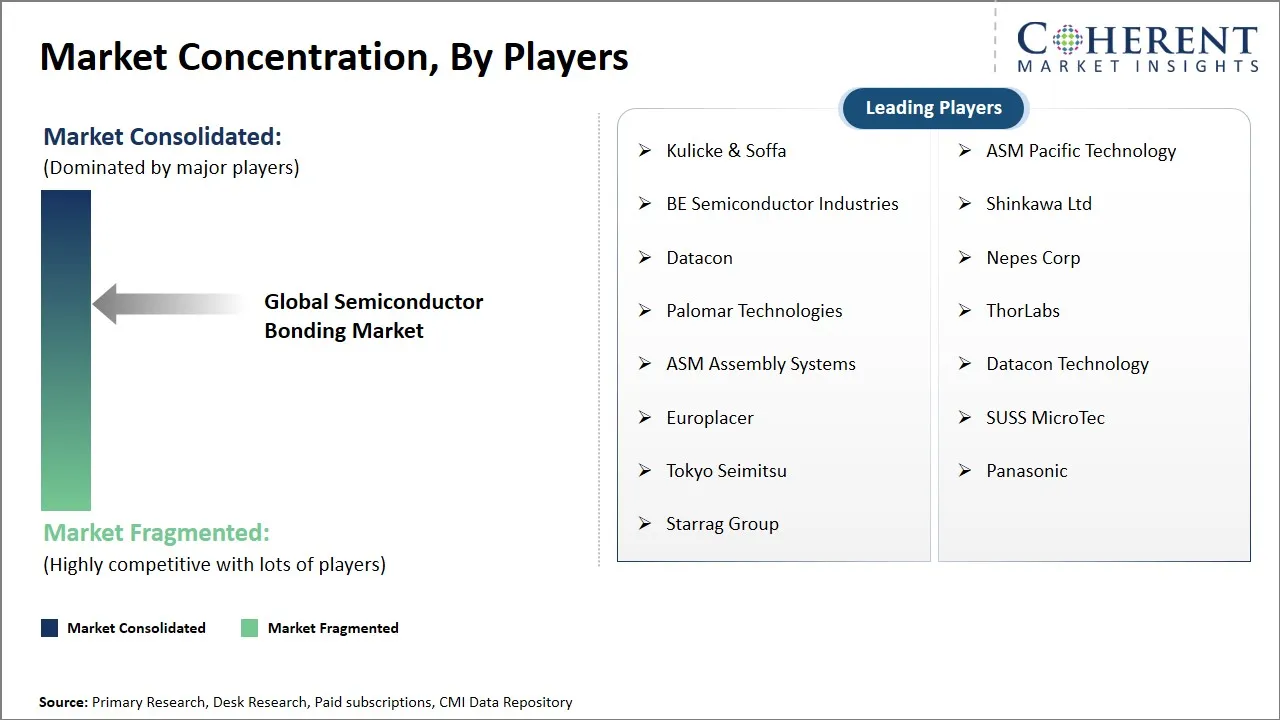
| Companies covered: | Kulicke & Soffa, ASM Pacific Technology, BE Semiconductor Industries, Shinkawa Ltd, Datacon, Nepes Corp, Palomar Technologies, ThorLabs, ASM Assembly Systems, Datacon Technology, Europlacer, SUSS MicroTec, Tokyo Seimitsu, Panasonic, and Starrag Group | ||
| Growth Drivers: |
| ||
| Restraints & Challenges: |
| ||
Global Semiconductor Bonding Market Dynamics
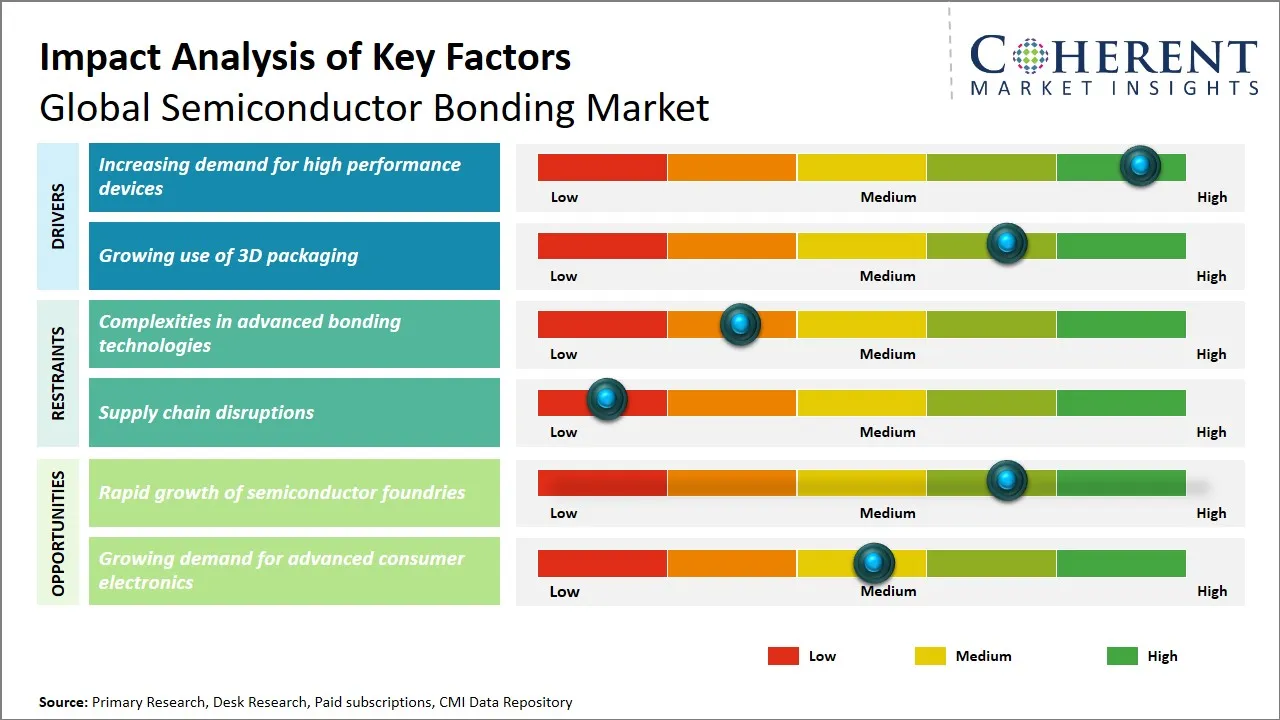
Global Semiconductor Bonding Market Driver - Increasing Demand for High Performance Devices
Driven by stronger needs for high performance computing devices, the worldwide semiconductor bonding market expands steadily. As users and sectors want better features, speed improvements, reliability gains, the push grows for compact, swift, energy-smart chips. This kind of bonding matters deeply as it holds together vital links inside microchips, making sure signals pass smoothly and structures stay intact. What results is performance that meets modern demands without compromise.
Global Semiconductor Bonding Market Opportunity - Rapid Growth of Semiconductor Foundries
Expansion in semiconductor foundry operations opens notable prospects within the worldwide bonding sector. Manufacturing hubs that produce integrated circuits for design-only firms face rising orders, fueled by broader adoption of innovations like 5G networks, machine learning systems, connected sensors, and vehicle-based electronics. With chips growing more intricate and smaller, connection techniques, including metal wire attachment, inverted chip mounting, and full-wafer encapsulation, play essential roles in maintaining functionality, durability, resistance to heat. Though often unseen, these methods support core operational standards across modern electronic components.
Analyst Opinion (Expert Opinion)
- Notably, steady growth marks the worldwide semiconductor bonding market, split into established mass production centered on wire methods, contrasted by rising momentum behind newer techniques like hybrid and wafer-level processes. Although innovation accelerates elsewhere, financial weight still leans toward traditional wire bonding due to lower expenses, proven dependability, and wide adaptability across applications including vehicles, household gadgets, energy systems, and machinery chips. Even as cutting-edge packaging evolves quickly, widespread output of older-generation and moderate-performance semiconductors keeps conventional wire approaches firmly central to manufacturing flows.
Speak to the analyst
Want personalized insights?
Take the findings above to one of our principal consultants, or have the report rebuilt around the segments, geographies and competitors you actually track.
Market Segmentation
- Bonding Technology Insights (Revenue, USD Bn, 2021 - 2033)
- Wire Bonding
- Flip-Chip Bonding
- Advanced Wafer-Level Bonding
- Thermocompression Bonding
- Others
- Bonding Material Insights (Revenue, USD Bn, 2021 - 2033)
- Gold Wire
- Copper Wire
- Solder Bumps
- Anisotropic Conductive Films
- Conductive Adhesives and Epoxies
- End User Insights (Revenue, USD Bn, 2021 - 2033)
- Outsourced Assembly and Test
- Integrated Device Manufacturers
- Foundries
- Automotive Tier 1 Suppliers
- MEMS and Sensor Manufacturer
- Regional Insights (Revenue, USD Bn, 2021 - 2033)
- North America
- U.S.
- Canada
- Latin America
- Brazil
- Argentina
- Mexico
- Rest of Latin America
- Europe
- Germany
- U.K.
- Spain
- France
- Italy
- Russia
- Rest of Europe
- Asia Pacific
- China
- India
- Japan
- Australia
- South Korea
- ASEAN
- Rest of Asia Pacific
- Middle East
- GCC Countries
- Israel
- Rest of Middle East
- Africa
- South Africa
- North Africa
- Central Africa
- North America
- Key Players Insights
- Kulicke & Soffa
- ASM Pacific Technology
- BE Semiconductor Industries
- Shinkawa Ltd
- Datacon
- Nepes Corp
- Palomar Technologies
- ThorLabs
- ASM Assembly Systems
- Datacon Technology
- Europlacer
- SUSS MicroTec
- Tokyo Seimitsu
- Panasonic
- Starrag Group
Sources
Primary Research Interviews
- Semiconductor equipment manufacturers executives
- Wire bonding technology specialists
- Electronic packaging engineers
- Advanced materials suppliers
Databases
- Bloomberg Terminal
- S&P Capital IQ
- Semiconductor Industry Association (SIA) Database
- IHS Markit Technology Database
Magazines
- Semiconductor Today
- Electronic Design Magazine
- Advanced Packaging Magazine
- Chip Scale Review
Journals
- IEEE Transactions on Components, Packaging and Manufacturing Technology
- Journal of Electronic Materials
- Microelectronics Reliability
Newspapers
- Financial Times
- The Wall Street Journal
- Nikkei Asia
- Reuters Technology Newz
Associations
- Semiconductor Industry Association (SIA)
- SEMI (Semiconductor Equipment and Materials International)
- Electronic Components Industry Association (ECIA)
- International Electronics Manufacturing Initiative (iNEMI)
Public Domain Sources
- U.S. Securities and Exchange Commission (SEC) filings
- Company annual reports and investor presentations
- Government technology roadmaps and initiatives
- Patent databases and technology publications
Proprietary Elements
- CMI Data Analytics Tool
- Proprietary CMI Existing Repository of information for last 8 years
Get access to 250+ pages report
Every segment, forecast, competitor profile and data table behind the analysis above — available for instant download.
- ESOMAR Member
- ISO 9001:2015 Certified
- D-U-N-S Registered
- GDPR & CCPA Compliant
Missing comfort of reading report in your local language? Find your preferred language:
Transform your Strategy with Exclusive Trending Reports
Frequently Asked Questions
The global semiconductor bonding market stood at USD 1 Bn in 2026 and is expected to reach USD 1.35 Bn by 2033.
The CAGR of global semiconductor bonding market is projected to be 4% from 2026 to 2033.
Increasing demand for high performance devices and growing use of 3D packaging are the major factors driving the growth of the global semiconductor bonding market.
Complexities in advanced bonding technologies and supply chain disruptions are the major factors hampering the growth of the global semiconductor bonding market.
In terms of bonding technology, wire bonding is estimated to dominate the market revenue share in 2025
Kulicke & Soffa, ASM Pacific Technology, BE Semiconductor Industries, Shinkawa Ltd, Datacon, Nepes Corp, Palomar Technologies, ThorLabs, ASM Assembly Systems, Datacon Technology, Europlacer, SUSS MicroTec, Tokyo Seimitsu, Panasonic, and Starrag Group are the major players.
Asia Pacific led the global semiconductor bonding market in 2025.